As we come to the end of the Everythink book project, I’ve been allowing my brain to drift into the next one. Which is currently looking like it will be the first of the antifragility series. To that end we’ve been playing around with ways to assess a person’s level of antifragility. In doing that, we’ve realised that its helpful if we can also measure the antifragility (or fragility) of the environment in which the individual exists. Their workplace, for example, or home and family. This second question has proven to be a tad more difficult to solve. I think we’re somewhere close. Close enough to think about how to present the data once we’ve calculated it.
In a blinding
flash of the ‘someone, somewhere already solved your problem’ obvious, it
seemed that making a fragility version of the Complexity Landscape Model (CLM)
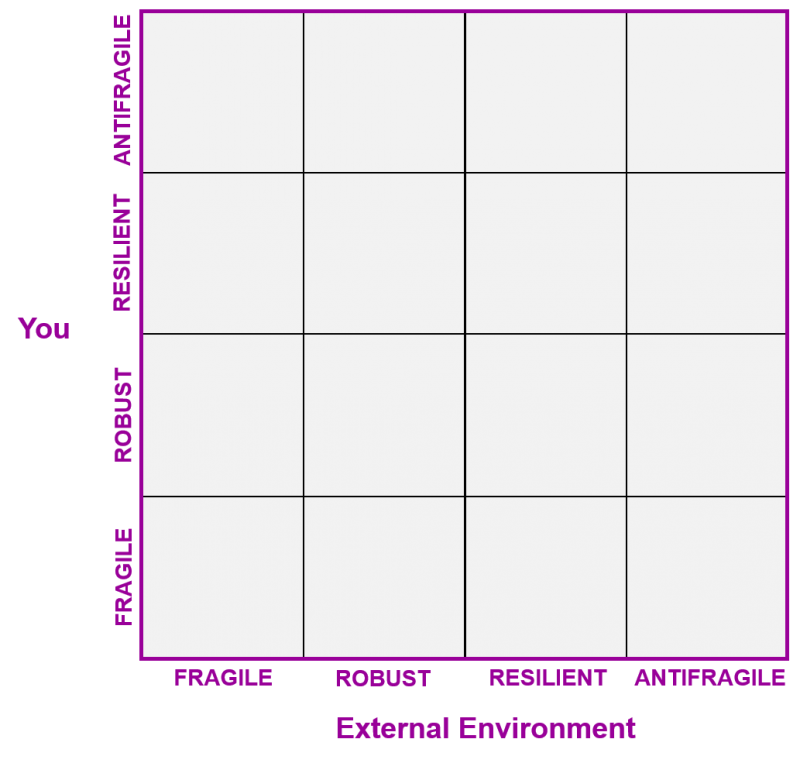
would at least offer a decent start point. Here’s what it currently looks like:
In keeping with the CLM story, we first needed to identify distinctly different levels of fragility. Distinctly different meaning a discontinuous (s-curve) jump between one level and the next. We ended up with three jumps and therefore four levels:
Fragile – the individual or environment is
unable to survive any out-of-the-ordinary perturbation (i.e. most enterprises
on the planet at this point in time)
Robust – the individual or environment has inbuilt safety margins that enable survival of a defined set of extreme perturbations. If these extremes are exceeded, failure will be ‘brittle’ – i.e. sudden, extreme and irrecoverable. Like glass.
Resilient – the individual or environment has inbuilt safety margins, but this time, if these margins are exceeded, failure mechanisms work slowly, such that any failure will be benign (‘fail-safe’), and such that there is a high likelihood of recovery. Like willow.
Antifragile – the individual or environment becomes stronger as a result of the stresses and other negative effects imposed upon them. Like the human body.
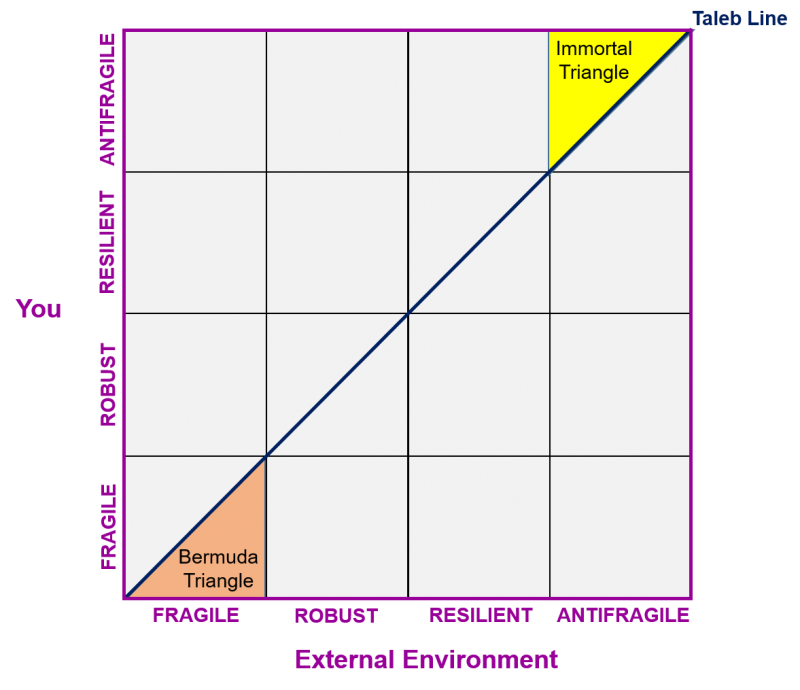
Next up, also aligned with the CLM, there are ‘good’ and ‘bad’ places to be when we map our individual and environment fragility levels. First up, it is a very good idea for the individual to have a higher level of antifragility than their surrounding environment. I.e. they should be above the Taleb Line. The overall best place to be, then, is in the ‘Immortal Triangle’ up on the top right hand corner of the Landscape:
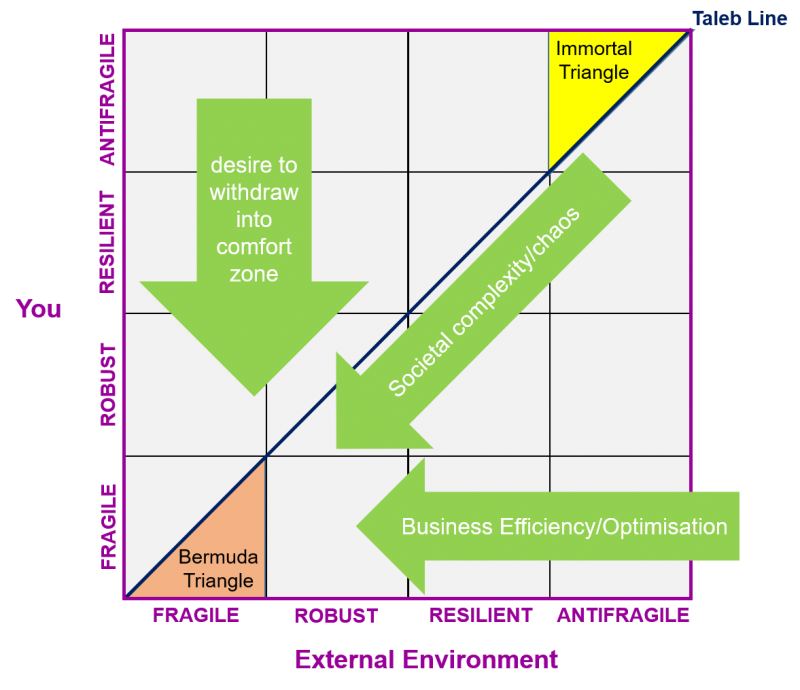
This is pretty much the opposite corner to the one in which most people currently find themselves. Down on the bottom left is the ‘Bermuda Triangle’. Most people are here right now because that’s where their environment is. And, worse, likely as not, that environment is less fragile than they are. Especially, for example, if you happen to be a person one any kind of zero-hours work contract. Here’s an extreme example of what most employers tend to want from their employees: a slight underpinning tension that let’s you know they’re in control, and you’re not. This unpleasant situation not helped by the natural desire for all of us to stay inside our comfort zones. What we end up with then are three big forces all working to (unwittingly) make us highly fragile:
It’s a long way from the Bermuda to the Immortal Triangle, but that’s the journey we all need to think about making in the coming months and years. Welcome to the Pleasure Dome.
“If the government wanted people to drive safely, they’d mandate a spike in the middle of each steering wheel.” Gordon Tullock
I’m a slow learner, but one of the things I think I’ve learned since lockdown is not to try and have a rational argument with anyone on Twitter. Especially about PPE masks. A domain where there are far too many people with strong opinions and far too few with any actual knowledge. That’s knowledge as in either the realities stopping airborne 80nm diameter virus particles from entering the mouth or nose, or the usually less than rational quirks of human behaviour.
We live and learn.
Only without the learning part, usually.
The most vociferous faction of the pro-mask lobby assumes that ‘there’s no downside’ to wearing a mask so therefore everyone should wear one. In the real world, meanwhile, there are, numerous, clear downsides should anyone care to spend more than five minutes thinking about it.
Masks, in economist, Gordon Tullock’s world, are the opposite of what has come to be known in engineering circles as a Tullock Spike. A Tullock Spike is something that looks dangerous, but instead works to increase safety. Next time you find yourself unlocked and out in a car, if you can imagine driving along with a Tullock Spike half an inch from your chest, you are going to drive much more safely than if you’re in a Stage 1, 2 or 3 autonomous vehicle, swigging Red Bull, and surrounded by a dozen airbags. Counter-intuitive, but demonstrably true. Except for the Red Bull bit.
Masks make people feel safer than they actually are. Unless, of course, they are NBC hazmat-suit grade protective equipment, in which case virus ingestion becomes the least of your problems (not drowning in your own sweat usually being the most pressing one). If you’re wearing an N95, you are not nearly as safe as you likely feel. And if you’re wearing a home-made mask, the misunderstanding becomes even worse.
So, this weekend’s challenge is to come up with a concept of a Tullock Spike for Covid-19: something (not that it has to be a ‘thing’) that makes people feel ‘unsafe’, but as a result, makes them actually safer.
I’ve got a target of 10,000 words to write for the next book over the weekend, but I’ve also promised myself I’ll think about the problem and publish what I come up with early next week. All thoughts and contributions welcome.
Its only a matter of time before any kind of measurement gets gamed. With several of our clients, if we’re not able to convince them to go with what we think is the ‘right’ (i.e. outcome-based) kind of measurement, we at least try and help them to work out what the half-life of the measurements they intend to put in place are. So that they know when they need to start thinking about re-designing that measure. Lots of companies, for example, put into place metrics relating to the number of patent applications different departments (or in some cases, individuals) were expected to submit per year. This kind of measure typically takes about one-cycle (i.e. around a year) before it gets corrupted: ‘It’s November, we failed our target last year and got reprimanded; it looks like we’re not going to hit it this year either, so…’ You know what’s coming next.
We had a theory that metric half-life (i.e. the amount of time it would take for half the stakeholders to work out how to corrupt the measurement) would reduce considerably during a crisis period. We just didn’t know how much. On the last day of April, we got our first datapoint. And the news wasn’t good. The half-life of the Covid-19 virus test metric, we now know is significantly less than a month.
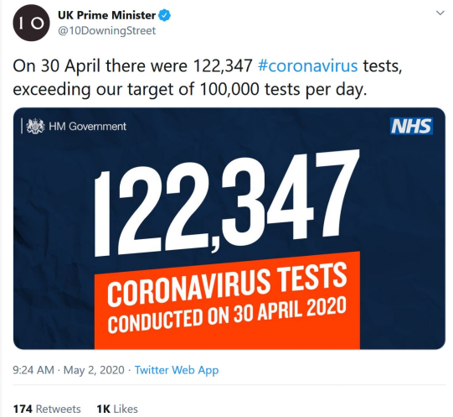
On the second of April, Health Secretary, Matt Hancock, announced, ‘I am now setting the goal of 100,000 tests per day by the end of this month. That is the goal and I’m determined that we will get there’
On the 30th came deliverance. 122,347 tests. Very impressive. Hancock looked almost smug when he showed up for that day’s media briefing session.
Execpt. There was a problem. Several problems. 27,497 turned out to be ‘home tests’. Tests that had been posted to people on the 30th. Another 12,872 were sent out to satellite sites. So they also weren’t actual tests either. So the 122,347 was actually just 81,978 by the 2 April definition. Then we learned that the number of actual individuals actually tested was 73,191. This because the tests aren’t massively reliable, and so large numbers of individuals had to be repeated. And then, worse still, now we also have figures for the early days of May, we also know that the 30 April figure was a one-off high.
I’m not blaming Matt Hancock for this corruption. He’s just the poor sap that set a target he didn’t understand. And he’s just the Minister putting pressure on everyone beneath him to make sure the target was met. A classic, ‘don’t let me be seen to have missed this target’ kind of pressure. Pressure that meant, as soon as said staff worked out they were going to fail, they were forced to start getting creative. Some kinds of creativity are good. But, generally speaking, not the kind where stupid things get done in order that some arbitrary target is reached.
So, May 5th, and here we are. The half-life of a UK Government metric looks like it is, if we take into account the time until someone worked out that posting home-test kits on the 30th might help, is around a fortnight. And yet still somehow the Government approval rating is above 50%. Which, if I had any faith that that particular metric hadn’t been corrupted several eons ago, I might start to worry about.
What we’ve managed to do with the clients that have had their ‘number of patent applications’ metric gamed is helped them to introduce a better ‘number of hgh quality patent applications’ measure. It’s hard to measure ‘high quality’, but the difficulty of doing it should be no impediment to working out how to do it. The same applies regarding virus testing. It shouldn’t be about how well the Government sends out unreliable home-testing kits to random individuals (and, by the way, I know from several friends that there is a massive element of randomness), it should be about the number of high-quality test results obtained. I think, maybe, everyone assumed that’s what Matt Hancock meant on April 2nd. That part of the measurement challenge isn’t rocket science. We all instinctively know what meaningful is. We just need to get those responsible for making the measurements re-direct their creativity away from gaming the system, and towards finding ways to measure what is needed rather than what is merely expedient.
I’m ploughing
my way through Volume 1 of Design Unbound at the moment. A bit of a complex-adaptive-systems
buzzword bingo game of a book if I’m being honest. With so many ‘insert miracle
here’ moments, by page 150, I found myself laughing out loud.
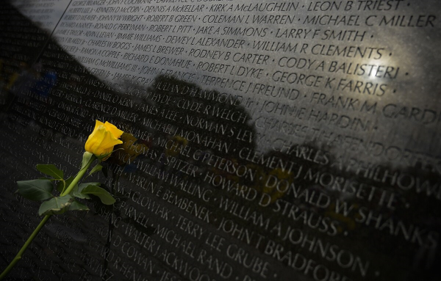
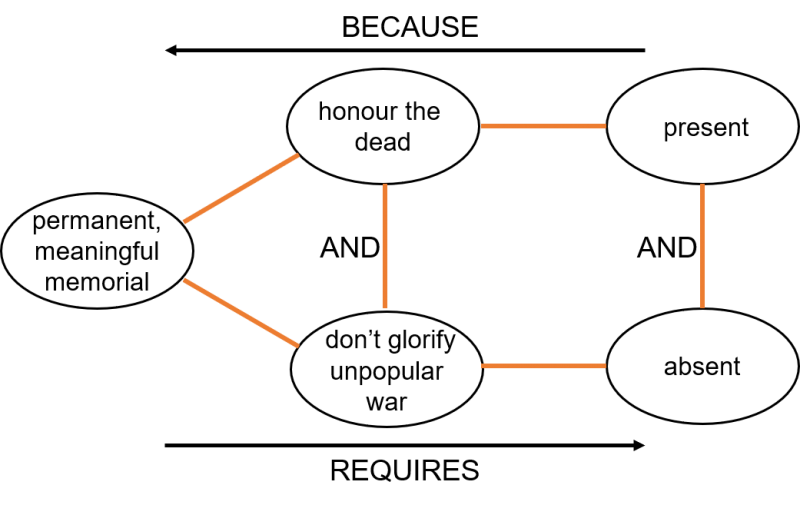
On the up side, though, the authors mention the word ‘contradiction’ quite a lot. They’re not brave enough to come out and say that contradictions should be ‘elminated’, and they don’t quite go so far as to say ‘challenged’ either. But they do talk about the need for designers to embrace ambiguity, which is quite nice in its own right, and at least a step in the right direction. Part of my problem with the book, I think, is the lack of examples of what’s been talked about. So it all comes across as very ethereal and, ultimately, little more than an advert to go and do an architecture degree. There were, however, a couple of quite elegant examples. My favourite concerns the beautiful Vietnam War Memorial in Washington DC. As it turns out, a classic architecture conundrum. On the one hand, the Vietnam War was probably not the US’s finest hour so in a lot of ways, people want to forget about it. On the other hand, close to 60,000 American military personnel lost their lives and visibly commemorating those tragic deaths was something that was considered vitally important to all those that fought or had loved ones lost in the conflict. A memorial was wanted and not wanted.
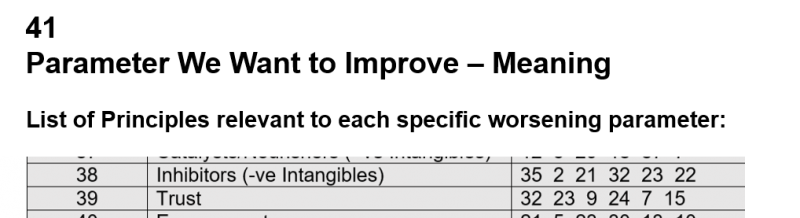
In TRIZ terms,
the contradiction looks like this:
And if we map
it onto the Business Matrix – where we have the biggest selection of ‘intangible’
parameters to choose from, the best fit says that what we’re trying to improve –
honouring the dead – is all about Meaning, and, the other side of the conflict –
not wanting to glorify the unpopular war – is best mapped as a Negative
Intangible, or, possibly, next best, Trust. Here’s what happens when we map those
pairings onto the Matrix:
And here’s what
the architects of the Memorial came up with…
…a stunning example of a (Principle 32) ‘increasing transparency’ solution. Looked at head on and the Memorial is a highly polished black marble, with the names of the lost engraved; looked at obliquely, and the Memorial ‘disappears’ by mirroring its environment. Monument and no monument.
Here’s one of
my favourite stories from Atul Gawande’s book, Better:
“Five years later, Albert Sabin published the results of an alternative polio vaccine he had used in an immunization campaign in Toluca, Mexico, a city of a hundred thousand people, where a polio outbreak was in progress. His was an oral vaccine, easier to administer than Salk’s injected one. It was also a live vaccine, containing weakened but intact poliovirus, and so it could produce not only immunity but also a mild contagious infection that would spread the immunity to others. In just four days, Sabin’s team managed to vaccinate more than 80 percent of the children under the age of eleven—26,000 children in all. It was a blitzkrieg assault. Within weeks, polio had disappeared from the city. This approach, Sabin argued, could be used to eliminate polio from entire countries, even the world. The only leader in the West who took him up on the idea was Fidel Castro. In 1962, Castro’s Committee for the Defense of the Revolution organized 82,366 local committees to carry out a succession of weeklong house-to-house national immunization campaigns using the Sabin vaccine. In 1963, only one case of polio occurred in Cuba.”
It describes a classic contradiction: what was Albert Sabin trying to improve? Answer: he was trying to vaccinate lots of children. What was stopping him: injected vaccines were slow to administer, and because every child had to be individually vaccinated, lots of vaccine was required and the time needed to inject everyone was considerable.
A classic vulnerability-versus-speed or vulnerability-versus-amount-of-substance
conflict. Which, if we look both up on the Contradiction Matrix give us the
following ranked list of Inventive Principles:
Of which, Sabin’s solution deployed three:
Principle 35, Parameter Change – switching from an injected to
an oral vaccine, and, perhaps more significant…
Principle 13, The Other Way Around – using a ‘live’ vaccine, and,
Principle 9, Prior-Counteraction – producing a mild contagious
reaction in the first children to be vaccinated, that would then spread to many
of the other children.
Sabin, of course, didn’t have access to the Contradiction Matrix when he devised his genius solution. His solution, however, offers us exactly the sort of case-study that our research continues to feed into the Matrix. So that everyone else in similar situations is able to access that genius.
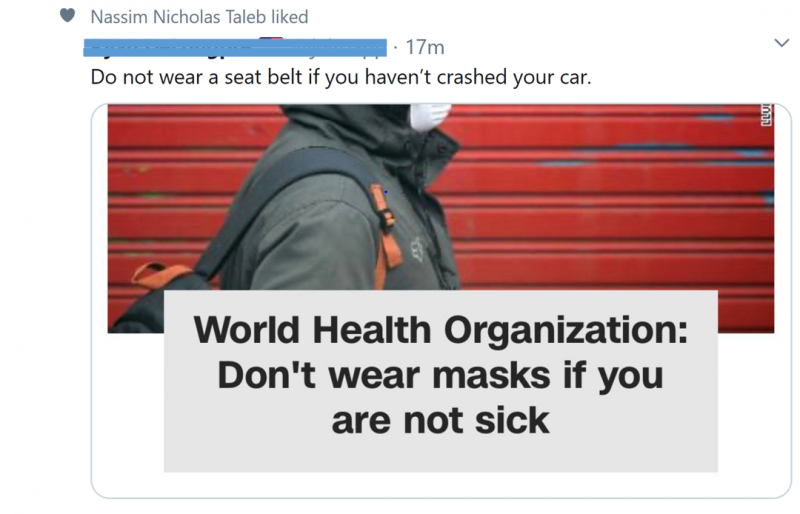
Do as I say not do as I do. Welcome to the Nassim Taleb fanclub. A group that has recently turned quite snarky when it comes to criticising institutions that don’t understand risk in the way that they do. The WHO in particular has come in for a lot of criticism from the Taleb wannabees in recent days for their ‘don’t wear masks’ advice.
The gist of this Taleban (too close to the edge?) argument has been that you don’t wait for evidence in order to decide to wear a seat belt. Wearing a seat belt, they will quite rightly argue – per the Precautionary Principle – can only help. There is an upside/downside asymmetry in favour of seat belts.
I posed the question whether any of the community also wore crash helmets and fireproof clothing when they got in their cars. The answer was a deafening silence. The sort of silence you get when someone realises their argument has a massive hole.
I didn’t even get to the part about data. The compiled data from the United States suggests that up to 3 % of vehicles involved in fatal crashes have a related fire event, and that over 5 % of fatalities occur in cars having caught fire, up to one third of the deaths being directly caused by fire. Surely, therefore, we should all drive in flameproof clothing. The Precautionary Principle says so. There’s only upside, right?
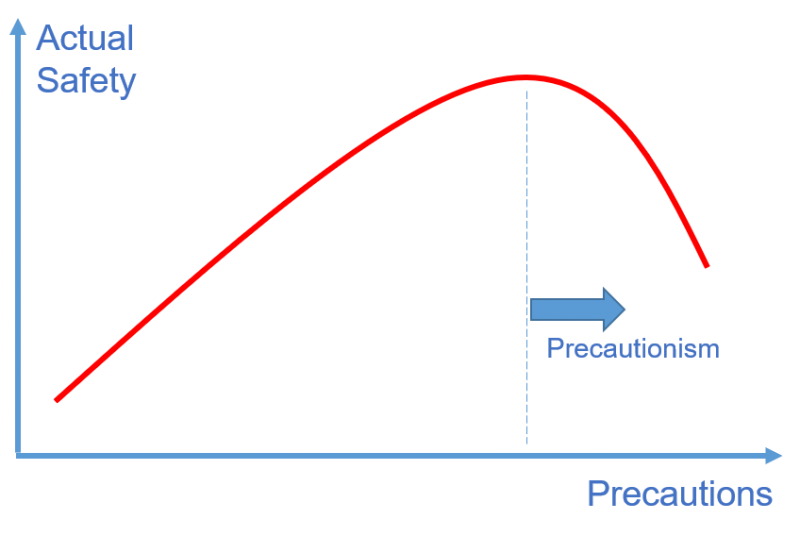
What the Taleban (I’ve decided I can get away with it…) don’t seem to understand, or want to understand is that we all draw the line somewhere. The line between precaution and precautionism. Nearly everyone wears a seatbelt, nearly no-one outside of motorsport wears flameproof overalls to go and pick the kids up from school.
The
precautionary principle is good. But only up to a certain level. Somewhere
along the spectrum of precautions we could take to mitigate risk the downsides
start to outweigh the upsides.
The current should-I-shouldn’t-I
debate over masks is happening, I think, because different people put the
decision on different sides of the dividing line.
From a TRIZ/SI perspective what’s happening here is the debate serves to tell us there is a contradiction. We want precautions and we don’t want precautions. And if we’re smart, that should mean there is an innovation opportunity.
Before that’s possible, however, it’s a really good idea to arm yourself with the requisite facts. Another point that seems lost on the Taleband (how about with a ‘d’?) I tried to give them some actual facts regarding masks filters and Covid-19, but I guess it sounded and looked too technical to them, so they tried to pretend they hadn’t seen it. No-one likes to be outside their comfort zone. That’s why the WHO isn’t apparently listening to the Talebanned (too far? Or wrong way around – is this the name for people Taleb has blocked?). The WHO know epidemiology and healthcare but they clearly don’t understand systemic risk. Or, probably, the Precautionary Principle. Or, very definitely, the idea of solving contradictions.
But its exactly the same knowledge-blindness, stay-in-comfort-zone issue being seen from the Taleband. They’re clearly uncomfortable with not only epidemiology, but also thermodynamics and filter design technology.
Discomfort, however, is not a valid excuse for continuing to spout half-science. They might think there is only upside in what they’re suggesting, but when we add in the other half of the story, the downside can and in most cases does very easily outweigh the up. Precaution becomes precautionism.
This means, ultimately, they’re failing their own skin-in-the-game test. True, the most ardent of the Taleband have changed their Twitter thumbnail photo to now show them wearing a mask. ‘Look,’ they seem to want to say, ‘see how I’m practicing what I preach’. Some of these people have over 30,000+ followers. They might think that by recommending mask-wearing there’s no downside, but because, after you add in the actual science, in reality there is net downside, they’re potentially causing harm to lots of people. People who, when things do go wrong, rest assured the Taleband will be holding up their hands and saying, ‘nothing to do with me, mate, blame the Precautionary Principle’.
Every innovator, meanwhile, by definition, has to have genuine skin-in-the-game. They know that relying on half-science is a guaranteed whole way of ensuring they end up amongst the 98% of innovation attempts that fail.
Speed is important right now. Building parachutes after jumping out of the plane is a pretty good metaphor for the times. Last I heard though, there’s still time to read the parachute design manual before you jump.
The manual telling us that precautions are good, but too many precautions are not. Too many precautions mean a contradiction needs to be solved. Solving those contradictions helps put you in the 2%.
Speed wins in a
crisis. We knew that. One of the consequences is our collective societal
knee-jerks more often than not mean we end up doing dumb things quickly.
Every time I do
our ‘save the Titanic’ exercise in workshops, within 5 minutes every group ever
has found all of the resources that would ever have been needed to keep all the
passengers and crew alive. And yet, on the night, 1500 people died. Death by,
in some cases quite literally, jumping before thinking.
Fear and
confusion does this to us. Ready, fire, aim. In crisis times, the job is to try
something, see what happens, learn from it, and try again. Crossing your
fingers that the thing you tried doesn’t turn out to be so dumb that you don’t
survive the experiment. Fire before aim. I get it.
But when Tom
Peters first popularised the aphorism, even though he switched ‘fire’ and ‘aim’,
he still left ‘ready’ at the start of the process. Like with the Titanic
exercise, ‘ready’ is all about that five minutes at the beginning where we take
a deep breath and think logically and rationally about the situation.
You can be
fairly certain this ‘ready’ stage hasn’t really happened when we start to hear
conflicting advice from experts. This is what we’re seeing at the moment regarding
masks.
The World
Health Organisation is telling people, ‘don’t wear masks if you’re not sick’. On
the other hand, those that understand systemic risk say wearing a mask ‘can’t
do any harm’ and so therefore we should do the opposite. Two separate
instinctive knee-jerks that together serve only to confuse the average person
in the street.
From a ‘ready’
perspective, when two smart groups of people are telling you different things
that you’re probably dealing with a right-versus-right contradiction. And that
contradiction needs to at least be managed before you make a personal decision
regarding whether you’re going to go looking for a precious mask or not.
The heart of
the contradiction is this. An argument between two different types of expert.
The WHO and the epidemiology community possess lots of domain knowledge about
pandemics. A lot of it is is based on statistical information.
The
risk/complexity community, on the other hand, doesn’t have any domain knowledge
relating to the spread of viruses, but they do know that the WHO’s statistical
foundations are in reality ‘naïve probabilism’ when taken at the systemic
level. In a complex environment, getting to where you want to get to (ending
the pandemic) means the main basis for action is working from where you are to
where you want to get to with heuristics that present a change vector that progressively
gets everyone pointed and moving in the right direction.
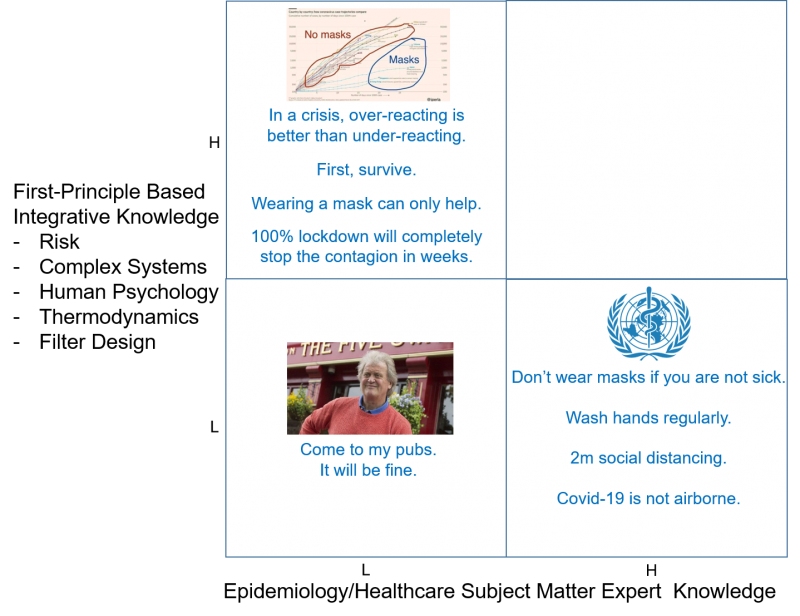
The two
perspectives – subject matter expert domain knowledge and integrative risk and
complex systems knowledge – can be presented as a 2×2 matrix like this:
What the matrix
ought to remind us is that where we need to try and get to is the top right
hand corner. Answering the mask question is not about picking a side in the either/or
debate, it is about solving the contradiction between the two differing
perspectives and thus getting the best of both worlds.
If we’re going
to do this properly, the integrative-knowledge axis of the plot needs to
include all of the ‘out-of-domain’ knowledge that is relevant and not included
in the domain knowledge axis. So, in addition to understanding risk and complex
systems, we ought to add to the list things like human psychology and, in the
case of the Covid-19 virus, some knowledge of virus and droplet aero/thermodynamics
and, if we’re thinking about masks, the design of filters. Now we’re presenting
ourselves with a pretty tall order. In order to meaningfully answer the ‘should
I wear a mask?’ question we need someone with the requisite level of knowledge
of epidemiology, risk, complex-systems, human psychology, thermodynamics and
filter design. I don’t think there are too many of those people around.
Or maybe there
is. Maybe this is where TRIZ/Systematic-Innovation comes into the story. The basis
of the TRIZ aphorism, ‘someone, somewhere already solved your problem’ is that
the whole method is built from knowledge accumulated by looking across all of
the world’s different domains. It offers a first-principles synthesis of
everything.
As someone that
has used TRIZ for the last 30 years and been developing it for the last 25,
while I can’t claim it has made me an expert in any of the needed domains, it
has enabled me to go and find the experts and ask them the right questions.
What this then
means is, to take a first example, looking at the WHO declaration that Covid-19
is not airborne, but is rather transmitted in droplets of saliva and mucus. Big
droplets don’t stay airborne for very long, and will not travel much more than
1m from their source (hence the 2m social distancing rule – 1m plus safety
factor).
As far as they
are concerned this is statistically true. But, when we bring a little
thermodynamic knowledge to bear on the problem, we have to also take into
account the fact that the liquid that forms the droplet will inevitably evaporate.
The rate at which this will happen depends a lot on ambient temperature, pressure
and air movement. A typical 50micron water droplet will evaporate on a typical UK
Spring day in around 120 seconds. If the droplet is on, say, the surface of a
mask that is being breathed through, the evaporation rate will be significantly
higher, and so the droplet will evaporate in around 60 seconds (this is an
experiment that’s fairly easy to reproduce yourself… sneeze onto a surface that
allows the resulting droplets to be visible (I used a piece of slate) and see
how long they take to disappear, first by just leaving the slate to dry, and
second by blowing on it).
The importance
of this is that after less than two minutes, the droplet that was carrying the
virus has evaporated, leaving the virus exposed. This being the case, there is
now a question about whether it is able to become airborne. Whether or not this
is going to happen, again depends on a number of factors, some of them relating
to the ambient conditions and some relating to the virus itself. Now, the
aerodynamicist needs to know the size and density of the virus particles. The
data is still coming in as far as Covid-19 is concerned, but reliable reports
(Reference 1 from South Korea) suggest a diameter of between 70-90nm. This is
small. So far I’ve not been able to find any figures on the specific volume or
density of Covid-19 – which in itself is a worry, because it means the epidemiologists
don’t think this knowledge is important. It is important.
If we don’t
know the specifics of Covid-19, we do know the details for other corona
viruses. Their density is around 1.37g/cm3. Asuming Covid-19 is in the same
ball-park, this tells us that, yes, Covid-19 will very definitely become and stay
airborne. Like for like, it is slightly worse, but similar to cigarette smoke.
What this now
means is that, the sneeze that lands on the ground will evaporate after a
couple of minutes and allow any wind to lift the virus particles up and blow
them into the atmosphere. Once up in the air, they are very likely to stay there
for some time. Now the issue becomes how long they will continue to be viable. Another
current unknown, although figures of between a few hours and a day are
circulating.
More
importantly, as far as our mask problem is concerned, is recognising that a
sneeze droplet from someone else’s sneeze landing on the mask I might be
wearing will evaporate after less than a minute, leaving the virus particle
itself on the surface of the mask.
So, now the
question becomes whether this virus can get through the mask and into my mouth.
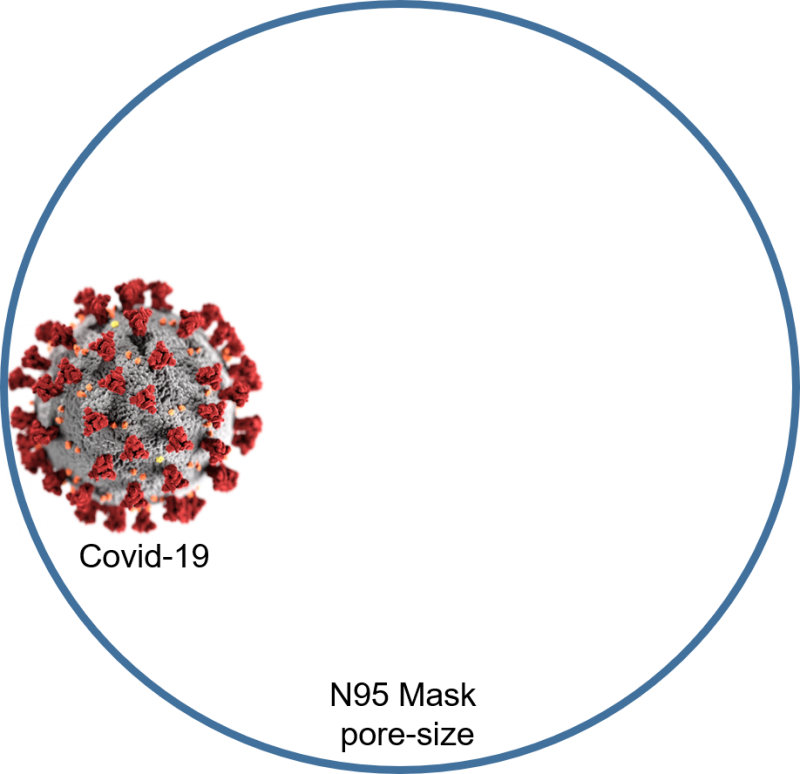
Now we need the filter designer’s knowledge. Will a 70-90nm diameter virus get
through the mask filter? Fairly obviously, the answer to this question depends
on the mesh size of the filter. There’s been a lot of mention of the N95 type
filter in recent days. The ‘N95’ designation means that when subjected to certification
testing, the respirator blocks at least 95 percent of very small (0.3 micron)
test particles. Which basically means, to a Covid-19 virus N95 looks like lots
of really big holes. The equivalent of throwing a tennis ball through a
basketball hoop. N95s will absolutely stop sneeze droplets from entering the
wearer, but after the moisture has evaporated, the remaining virus particles
will easily get through the mask. If not on my next breath, a later one.
This is not to
say that the N95s are useless, but what it does mean is that if you’re wearing
one in the vicinity of a sneeze, you’ve got about 60 seconds to change it for
another one (ideally sterilising the old one rather than throwing it away) if
you want to stop virus transmission.
We could go on
to talk about sealing around the sides of the mask – another significant design
flaw in most masks – and we could also look at load factors (i.e. how many
virus particles does a person need to ingest before they’re likely to become
symptomatic and get the disease (about 10 is the emerging knowledge, but we
still don’t know for sure)) but I think we should now say ‘so much of the hard
science’. Now let’s have a look at some fuzzy human psychology. The
risk/complexity world says we should all wear a mask because, ‘it can’t do any
harm’. While this might be factually true if humans were 100% reliable automatons,
the reality is that a number of very human quirks come into play.
The first is
that, when we’ve taken a precaution we think is going to work, we think we’re
safe. Every safety feature car manufacturers add to the vehicles we drive, we
all compensate for by driving worse. In other words, the safer we think we are,
subconsciously the more risks we allow ourselves to take. Example 1: we don’t
take social distancing so seriously. Example 2: we know that hand washing and
not touching your face is good WHO advice. But when you’re wearing your mask,
suddenly it becomes more okay to touch your face. Plus, the mask is often a bit
uncomfortable and irritating, so there’s a tendency to ‘have’ to touch the mask
more to adjust it. Thus, if you’re not washing your hands every ten minutes,
transferring more virus to the surface of the mask.
This is where I
think the risk/complexity people have been naïve. The blanket assumption ‘it
can’t harm’ does not take account of the real world. The same as when they’ve
been declaring that ‘100% lockdown will stop the virus completely in ~15 days’.
15ish. I can’t remember their precise number, but in reality I don’t need to
because I know that there’s no such thing as 100% lockdown. In the real world
people need to go out and get food. They need exercise. They get bored. We go
out.
Anyway, that’s
a story for another day. Today’s question is should I wear a mask?
What do we
know, now looking at the world from the top-right hand both/and perspective of
our domain knowledge and integrative knowledge matrix? i.e. taking into account
both what the WHO says and the risk/complexity people say and adding in some
actual facts that are needed to properly answer the question.
If you’ve got symptoms, you wear whatever mask you can to help reduce the spread to others.
If you’re working around Covid patients, you should have a mask considerably better than N95 (see the hazmat suits worn by Chinese doctors and nurses).
If you’re the average citizen out in public (why aren’t you locked down?) unless you have a fully sealed mask with a filter mesh size less than 70nm, it is virtually pointless and will probably lull you into a false sense of security, so don’t wear one. Especially if you having one means that a medical professional doesn’t get them because you’ve hoarded them all (…stop being selfish, while you’re at it).
If you can’t get the ‘it can’t harm’ meme out of your head and are going to wear one anyway, remember not to touch your face or the mask, wash your hands regularly and change the mask (or, better, sterilise and re-use) probably just as regularly.
At the end of
the day, everyone makes up their own mind on these issues. A lot of people –
bottom left of the matrix – actually, it seems, don’t want the truth. Or maybe
they’ve just become so jaded after several years of fake news that they’ve just
decided to blank everything out and listen to whoever shouted the loudest. The
sort of people that listen to prats like Tim Martin telling them its safe to go
and drink in his pubs.
Ultimately, to paraphrase Nassim Taleb, don’t listen to what people say, watch what they do. When I decide to go to the supermarket later this week I have risk-taking skin in the game. Will I wear a mask? Based on the top-right hand corner of the matrix, I will not be wearing a mask.
When I worked at Rolls-Royce, I guess because I was perceived by my bosses to be the person most open to ‘weird’ ideas, I was the nominated person to receive the letters occasionally sent to the Company from individuals claiming to have re-invented the jet engine. They averaged one or two a week. Meaning that, after a few years, I’d had the pleasure of reading several hundred suggestions. After the first few dozen, my initial excitement had begun to diminish. The ideas were already falling into what later became two distinct categories. The first came from the person that had not thought to check on whether someone in the industry had already thought of the idea. The second, depressingly more frequent category, came from people that didn’t understand the basics of how the world works. Things like physics, Bernoulli’s Equation, the Laws Of Thermodynamics, and gravity. Don’t get me wrong, my mind wasn’t and still isn’t closed to the possibilities of breaking some of these Laws (I’ve done it successfully myself on a couple of occasions), but there ought to at least be an attempt to understand them first. Needless to say, in all the time I received and responded to these approaches there was not a single occasion when anything tangibly useful appeared. Nothing even close. The ratio of bad-to-good was infinite. It was like Open Innovation before Open Innovation existed.
These days, we
still get some of these kinds of approach from people. Only now it’s a cornucopia
of things rather than just perpetual-motion-powered jet engines. Mainly,
though, I get to meet people in client companies that find themselves in the
same role I had at Rolls-Royce. Only now times have changed. Firstly, they tell
me, the flow rate has increased considerably. Secondly, the level of in-company
paranoia has increased exponentially. No-one wants to be the person that turned
down the Beatles.
It only takes one or two cases for this paranoia to become extreme. The knowledge that Hoover turned down Dyson, for example, when he approached them with his cyclone vacuum cleaner. As it happens, I met several times with the person at Hoover who did the rejecting. He insisted he would do the same thing again tomorrow. I could empathise with him. Even after the fact I’d approached the company in pretty much the same way Dyson had, only with a far better way of cleaning floors than a cyclone. But that’s another story.
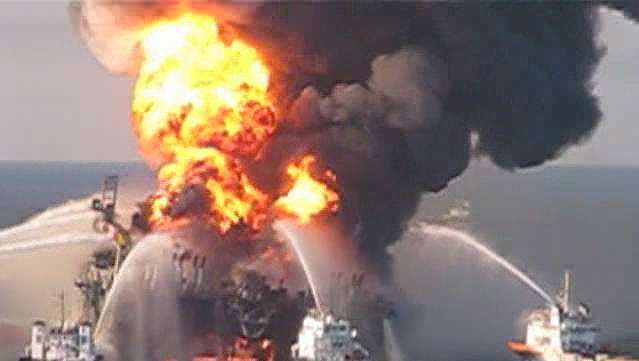
Spool forward a few years to 2010 and a client asked us to get involved in the emerging Deepwater Horizon disaster in the Gulf Of Mexico. The client wasn’t BP or a competitor of BP, but rather someone interested in Open Innovation. Which, thanks to Henry Chesbrough’s 2003 book had already become a thing. A shiny bright dysfunctional thing. Our brief was to watch what happened when BP decided to embark on their own Open Innovation experiment. The Deepwater Horizon oil-spill was an almost impossible to solve problem. Thinking it would help allay some of the already horrendous public relations damage caused by the incident itself, someone at the company figured, ‘let’s tell the world what the problem is, and lots of people will turn up with answers’. 300,000 responded within the first week. Humans love a crisis. Especially when the crisis belongs to someone else and we have no skin in the game. Humans love to help.
Pity the fool, though, that had to work their way through those 300,000 suggestions. 299,999 of which were very likely to have come from the knowledge-vacuum person who took time out of writing to Rolls-Royce to explain how to re-invent the jet engine.
Frankly, you need a small army of people to go through that many ideas. A small army that BP clearly didn’t possess. So, less than two weeks after the call first went out, the media started to hear from some of the call responders. ‘I told them what the answer was, but they haven’t listened,’ was their clear message. Something done, I’m sure, with the best of intentions had quickly turned into a PR disaster. If it hadn’t been for the BP CEO, Tony Hayward, committing the all-time worst PR blunder in history, its possible that BP could have killed the Open Innovation mess for good.
Thankfully for Henry Chesbrough, but not so good for everyone else, Open Innovation survived Deepwater Horizon, and Chesbrough got to spread his naïve, ill-conceived claptrap even more broadly.
Which brings us to the Covid-19 pandemic. This time a global crisis that has already, just weeks in, shown everyone the human spirit in all its manifest forms. The occasional profiteer – who, one of the best things to come out of the social media echo-chamber-creation machine, have been universely called out for their evil ways – but mainly the literally millions of people wanting to help. Simultaneously heart-warming and utterly chilling.
When half a million Brits answered a call to volunteer to help out the NHS, that’s the heart-warming part. Volunteering to deliver prescriptions, help prepare food and do portering jobs, we see humans quite literally at their community-minded finest.
But then, on the other side, oftentimes the ‘help’ ends up being the precise opposite. We’ve been asked to work on a couple of the emerging bottleneck problems – ventilators and masks. The world doesn’t have nearly enough of either. Both problems are serous, but the ventilator shortage is the most life-threatening. Not surprisingly, many public officials started to put out calls for more ventilators. A classic Open Innovation play.
Finding technical solutions to both problems has been easy. That’s what happens when you have a method. The real issue, we predicted, is going to be fighting through the noise. We’ve already seen some of the consequences of this in the UK. Big, sexy ventilator contracts offered to (Government supporting) Dyson on the one hand, and a small company that already makes ventilators being ignored on the other. The sort of state incompetence both Orwell and Kafka would have rejected as too far-fetched.
We’re back in Deepwater Horizon territory here. Only this time hundreds of thousands of human lives are at stake. Tens of thousands of helpful – jet-engine re-inventing – souls that are clogging up the system with naïve, time-wasting crap. Worse still – like Deepwater Horizon – many of these people are precisely the same highly opinionated ‘geniuses’ that will soon be going to the media to moan about how they aren’t being listened to. Thus compounding the problem even more. Not only are those in charge wasting time ploughing through hundreds of nonsensical ventilator rescue suggestions, but now also having to justify to the press why they haven’t responded to all the amateur Professor Branestawm wannabees.
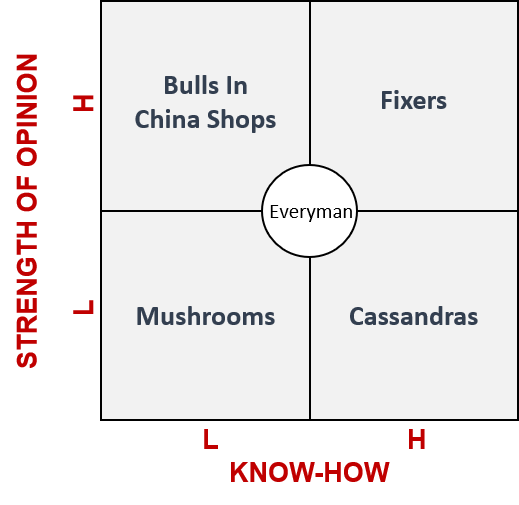
Strongly opinonated people are really important in an innovation context. But only when they have the know-how to back it up. The world doesn’t have enough of these know-how-and-opinion ‘fixer’s right now. Meaning we end up with a million and one bulls in the ventilator shop and a growing number of Cassandra’s, pulling their hair out with frustration at the lack of attention they’re getting. In normal times, the cream has time to rise to the surface. In crisis times, tragically, wrong answers thrive while the needed answers wither on the vine.
Not that its for me to make any kind of public plea, but if I could, it would to politely request that those beautiful people that want to help, but have no relevant know-how should stop clogging up the communication channels and stay out of the way. Go do the shopping for the locked down vulnerable members of the population. Grow some vegetables. Volunteer to help farmers pick crops. Save lives, stay home, shut up. Let those with the actual knowledge – the quiet ones, the Cassandras – do what society now needs them to do. This is their time.
I left home for the first time in over a week this morning. Food shopping. After seeing a week’s worth of stripped supermarket shelves on the News, I figured I’d shop at the local village store. My slight trepidation disappeared the moment it was my turn to step across the threshold. Everything I wanted was there. None of the shelves were bare. There were no ‘maximum two purchases’ notices anywhere. Just my normal village shop.
Why do people
panic-buy in supermarkets and not in local shops?
First principles.
Everyone stepping into a supermarket steps into a world of anonymity. Pile too many toilet rolls into your trolley and you might get one or two people shaking their heads at you in pity or disgust, but chances are you won’t ever see them again, and if you do they won’t recognise you anyway. Plus, you’ve probably already worked out that if anyone actually has the nerve to challenge you, you can easily lie and say you’re shopping for others as well as for yourself. Not to mention the fact that the moment one person starts piling too much into their trolley, it gives everyone else permission to do the same. And within minutes the supermarket has become a community of anonymous hoarders. No recriminations, no downside. At least, not until you go back a couple of days later to find the shelves are bare.
In the village shop, on the other hand, everyone knows everyone. Being the anonymous hoarder is not an option. Take more than you need and, guaranteed, next time you’re out for a walk, everyone else in the village will have been told. There goes that selfish-asshole. Not the kind of label that anyone wants. The kind of label you’ll be no closer to shedding five years later.
Reduced to first principles, humans are simple creatures. ABC-M. Autonomy, Belonging, Competence, Meaning. Going to the village shop offers up a simple reminder of how transitory the Belonging part of the story can be. We all want to belong to something. Six miles away at the local Asda, I get to belong to the anonymous-hoarder tribe, just doing what’s best for my immediate family; five miles closer to home, and I’m part of a community that makes sure not just my family but everyone else’s family is okay.
There aren’t
many universals in life, but the S-curve offers us one of them. S-Curves are
everywhere and apply to systems of every kind. When viewed from a business,
industry or societal perspective, the S-curve features a number of, again
universal stages:
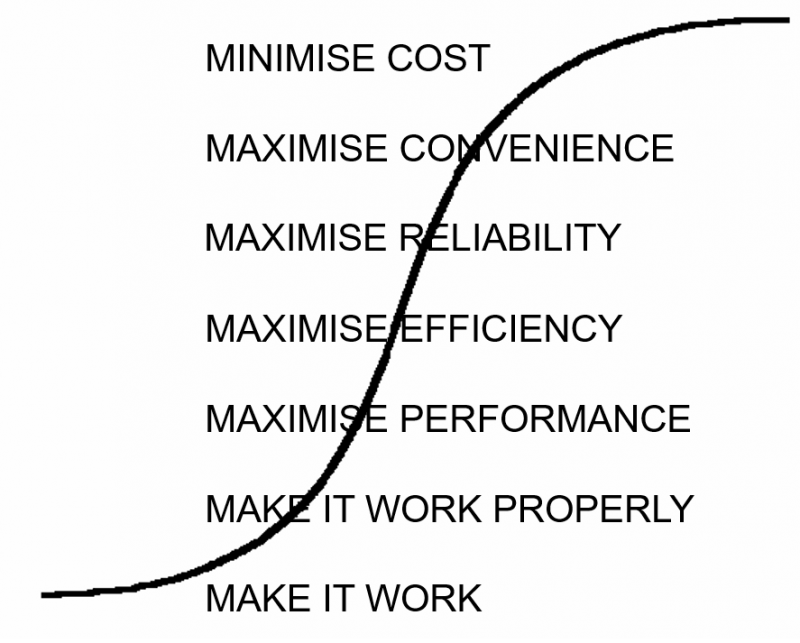
After having
the first flickers of an idea for a new way of doing things, the first job is
to somehow make it work. Then the job becomes making it work properly. Then maximise
performance. Then efficiency. Then reliability. Then convenience. Then, when
there’s nothing left to improve, the final job becomes one of minimising cost.
Thanks to the
Japan-triggered quality revolution of the 1970s, most industries have become extremely
good at accelerating this sequence of events. To the point, now, where almost
every domain on the planet finds itself at the top of its current s-curve.
Perhaps the most iconic examples of this can be seen in the automotive industry. Thanks to the Model T Ford, the automobile is quite literally, to steal the title of the book that sparked the Lean movement, ‘the machine that changed the world’. That this happened, is, overall, an amazing achievement. By the end of the 1990s, however, when we started working with several automotive OEMs on ‘5-day’ car projects, the industry was already at the tail-end of the ‘maximise convenience’ stage. The big idea underpinning these projects involved refining logistics operations to the point where a customer could go into a car dealership, choose their car, choose all of the different options – colour, trim, engine size, air-con, carpets, tinted-windows, sound-system, etc – and then have it delivered to them five days later. The OEMs quickly found themselves in a race. If they can do a 5-day car, we need to be able to offer 4. And then 3. Until, finally, someone asked the question, ‘does the customer actually care whether their car arrives in 2, 3, 4 or 5 days?’ and realised the answer was – for the most part – no. At three-days, the customer was effectively saying, they now had enough convenience. And so, having tightened up the logistics side of the car production story, the attention shifted full-on to cost reduction. To the extent that Tier 1 and Tier 2 suppliers of components are now expected to sign up to contracts that had future delivery options tied to guaranteed cost reduction targets. The fight for reduced operating costs has become vicious. It has also, in order to enable maximisation of these cost reduction demands, caused the industry to become very strongly interdependent. Having components lying around the factory as inventory is very ‘expensive’, and so every OEM insisted on ‘Just-In-Time’ deliveries from suppliers. Armies of Six Sigma black belts get trained. All of them told that variation is bad, and that their job is to remove it. So everything gets segmented into manageable chunks and the boundaries between chunks get frozen. Then came Lean-Six-Sigma black-belts. Now, ‘waste’ was added to the list of bad things. In fairness to the originators of Lean, their definition of what waste was and wasn’t was quite broad. One of them, for example, was the waste of a ‘lost customer’. Alas, the Lean Six Sigma blackbelts stuck on the production line had no control over what customers did and did not buy, and so this ‘waste’ got conveniently swept under the carpet, and the focus shifted to the wastes found on the production line. At first there were lots. Then came the ‘lean with consequences’ phase. This is where teams realised that when they removed what they thought was waste created an unexpected adverse consequence somewhere else. Probably in somebody else’s silo. So then there was no choice but to work across silos and derive even more coupled solutions. To the point where eventually no-one has any wriggle room any more. That’s when teams start going around in circles. And the innovators give up. I remember a project with a Tier 1 supplier of gear-shifts. They wanted to get some electrical power into the gear-shift in order to add some potentially valuable new functionality to drivers. Alas, getting a 12v cable into the gear-shift meant passing it through various other parts of vehicle real-estate that came under the control of other Tier 1 suppliers. Attempts to negotiate with the other Tier 1s responsible for these other bits of real-estate quickly showed that a win for the gear-shift meant only downside for the other bits. End result: no innovation. Multiply that to include every other massively optimized, massively over-coupled vehicle sub-system and component and what you end up with is complete paralysis and, today, a sector that is amongst the worst innovators on the planet. This is the Dodo-Lean stage. Not only does innovation become increasingly impossible, but, resilience decreases exponentially (https://www.darrellmann.com/dodo-lean/).
Only healthcare, education and financial services are worse. Mainly because they’re even more over-coupled. Perhaps the all-time iconic example of the over-coupling that emerges when cost reduction is taken past the ‘with consequences’ phase and into the Dodo phase is the 2008 GFC-triggering US sub-prime loan market. Bundling together lots of crappy, ill-advised, un-vetted loans into bundles to ‘reduce risk’ turns out to be a way to massively increase systemic risk. And offers up ample proof that over-coupling results in people looking after the pennies thinking the pounds will look after themselves, without realising that this aphorism doesn’t make sense in a complex interdependent world.
In theory, the
GFC was a way of creating the sort of crisis that is often needed in order to
stop the over-coupling effect. What’s supposed to happen when a system makes
the discontinuous jump from one s-curve to the next is that everything has the
opportunity to de-couple. Everyone realises that the current rules don’t apply
any more and that the crisis offers permission to go and explore new and better
ways of doing things.
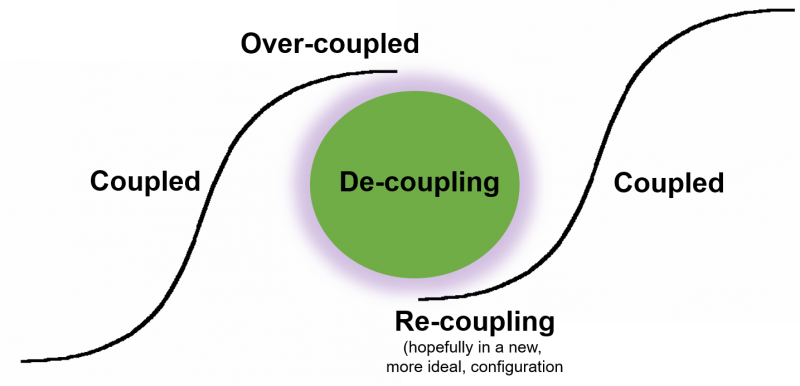
Except that’s not what happened after the GFC. Instead, regulators imposed even more rules and constraints. And thus added even more coupling effects into the industry. This was called ‘kicking the can down the road’ by most economists and commentators, but from an S-curve perspective, what it really ended up being, was an even bigger accident waiting to happen. The industry over-over-coupled and thus made itself even more vulnerable to external disruption. As we’re perhaps already beginning to see in the form of a perturbation called Covid-19.
Whether the financial world has learned the lessons of over-coupling I’m not sure. I suspect not. This time around, however, Covid-19 is a toppling domino that looks like it could easily topple several others. Covid-19, too, looks like it has pushed the world off its current S-curve. Which means that at least some of the other toppled industry dominoes will do what’s supposed to happen during a crisis. The rules get re-written. First up, de-coupling happens because when some organisations realise they can’t survive stuck in their current over-coupled world, they have to get inventive and go find other ways to earn their way in life. The flashlight company that switches – in 8 days no less – to becoming a hand-sanitizer producer. The automotive OEM that sees car sales plummet and realises their stark choice is to either close the doors or finally do what customers have been demanding for at least the last decade, and start offering ‘mobility’. Something that companies like Uber, Ola and Lyft have understood since their disruptive inception, of course. A shift that the current over-coupled automotive industry has been scared of even contemplating.
The de-coupling transition phase between one s-curve and the next is rarely pleasant. When the transition in triggered by crisis, it is never pleasant. Except, of course for the innovators – that small cadre of people that live their lives in the between-curves limbo world – since they now find themselves in their element. Lots of great problems to solve, lots of exciting opportunities to exploit. Lots of rules they have permission to break. The innovators know that whoever makes it through the de-coupling transition gets to be the one who determines how the world re-couples during the early phases of the new S-curve. Given that the typical societal S-curve duration is around 80 years (https://www.darrellmann.com/history-rhyming/), whoever de-couples and re-couples the best, gets to live a comfortable life for the next 50+ years… before they too succumb to the ‘inevitable’ temptations of cost reduction and another round of over-coupling. History doesn’t repeat, but, as the over-couple-de-couple-re-couple pattern shows, it very definitely rhymes.