
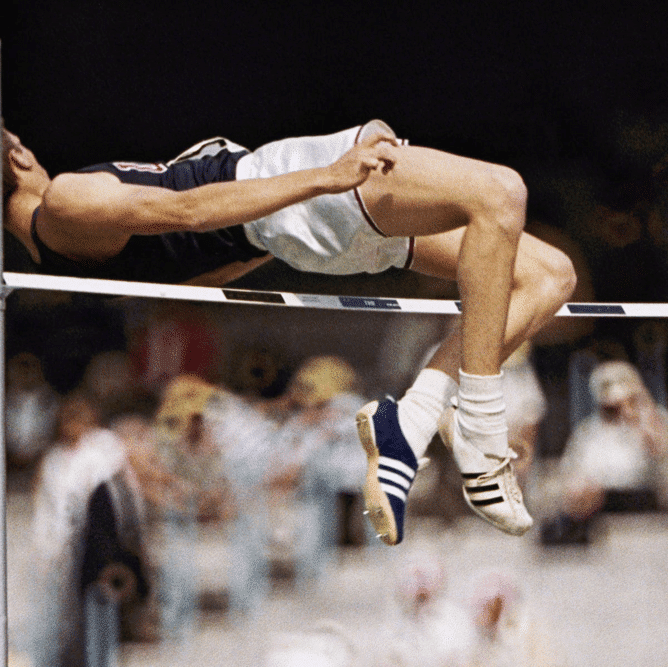
Dick Fosbury changed the high jump. I’ve mentioned him several times over the years, Usually when trying to describe how universal s-curves are. How all systems hit limits and how, when they do, the world needs people like Dick Fosbury to come along and solve a contradiction or two.
Before Fosbury, high jumpers generally went over the bar facing downwards or sideways. Fosbury did something different. He turned around. He approached the bar on a curve, planted his right foot, and went over backwards. The result became known as the Fosbury Flop. At first, his coach tried to stop him, later everyone mocked him. And then, under the 1968 Olympic spotlight he changed the high-jump forever.
His Principle 13, The Other Way Around, solution to the how-to-jump-higher problem is the thing I’ve usually focused on. But one of the lovely things about mavericks like Fosbury is the deeper you look, the more you realise he’s not just solving one contradiction, he’s challenging them everywhere. Here’s my new favourite:
Before Fosbury, a conventional high jump was, fundamentally, about generating vertical force. Run. Plant. Jump. The harder and more efficiently the athlete can convert horizontal momentum into vertical lift, the higher they can go.
But Fosbury’s new other-way-around technique added another requirement. He didn’t just need to go up. He needed to turn around. More specifically, his body had to acquire the rotation required to take him over the bar backwards.
So now the take-off contained a contradiction. He needed maximum vertical lift, and he also needed to generate rotation. In TRIZ Contradiction Matrix terms Fosbury needed lift force and to change his orientation angle relative to the bar. Here’s what that conflict looks like when mapped onto the Matrix:
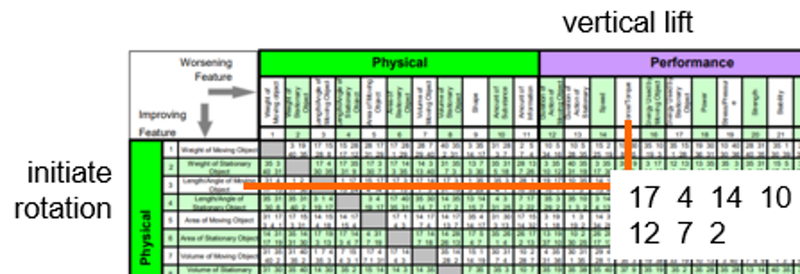
The first part of his solution involved (Principle 2) separating the two functions. For Fosbury that meant giving his left leg the task of initiating the rotational movement, and then having is right leg providing the vertical lift force. The left leg providing the penultimate step, and the right the final, launching step. Easy when you know how.
But then comes a much more subtle part of the story. If his left leg is tasked with the performing the rotation job, he needed a different kind of grip on the track to that required for his right leg. For rotation he needed a firm, non-slip interaction with the ground. And for lift his right he needed to support the rapidly moving body and generate the vertical impulse required to lift the jumper over the bar with as little ground resistance as possible.
How to achieve those two different requirements?
Answer: Asymmetry. Two different requirements, two different shoes (did you notice them in the photo at the top of the article?). For his left foot he wore a classic spiked running shoe, and on his right he wore a shoe with a smooth sole.
What I love most about this solution is it demonstrates escape from a classic piece of psychological inertia. Every shoe-shop on the planet sells pairs of identical shoes. Two feet. Two shoes. One design. Symmetry. Humans love symmetry. We default to symmetry. Companies sell symmetry. Consumers buy it.
But symmetry only makes sense if the required functions are symmetrical. Principle 4 is a reminder that every time we default to symmetry there’s a strong chance we’ve missed an opportunity.
An opportunity that, in The Wizard Of Foz’s case was likely the difference between Olympic gold-medal winning fame and a soon to be forgotten fool wearing odd shoes.
The Fosbury Flop changed high jumping by challenging an assumption about how the human body should go over a bar. The mismatched shoes challenge a smaller assumption. But perhaps a more transferable one. Whenever we see two things that have been designed identically, it may be worth asking whether they actually perform the same functions. If the answer is no, symmetry is no longer an advantage and its time to roll out Principle 4.