
Capitalism is an extraordinarily powerful optimisation system. Give it a target and enough freedom to pursue that target and, sooner or later, somebody will find a better way of getting there. That has been the source of much of its success. It is also becoming the source of some of its problems. Because the obvious question is, what, exactly, have we asked capitalism to optimise? The answer, for the most part, is also obvious. Profit.
There is nothing inherently wrong with that. Profit provides an essential signal. It tells us that somebody, somewhere, values what we are doing sufficiently to exchange resources for it. It rewards efficiency. It encourages experimentation. It enables investment in future ideas. And, importantly, it allows a vast number of individual decisions to be made without requiring a central planner to decide what everyone should do.
That freedom has generated extraordinary prosperity. But as we approach the top of an S-curve, the same optimisation mechanisms that helped generate progress can begin to reveal their unintended consequences. If a company can increase its profits by improving human flourishing, that is excellent. If another can increase its profits by diminishing human flourishing while transferring the costs elsewhere, that too is currently a perfectly viable business model. And therein lies the problem.
Perhaps capitalism is not malfunctioning. Perhaps it is doing exactly what we have asked it to do.
The Wrong Feedback Loop
Consider a product that generates substantial profits for its producer while simultaneously creating costs elsewhere. Those costs might appear as:
- poorer physical health;
- addiction;
- mental ill-health;
- environmental damage;
- biodiversity loss;
- reduced autonomy;
- wasted resources;
- social fragmentation;
- or burdens transferred to future generations.
The producer receives the profit. Society absorbs the cost. Economists have, of course, had a name for this problem for a very long time: externalities. But perhaps the challenge now is becoming broader. We are increasingly capable of recognising that some activities don’t simply create a measurable environmental cost or health cost. They influence the overall direction in which society is travelling. Some increase our capacity to flourish. Others diminish it. And some do both.
Which suggests that perhaps we need a new feedback mechanism. Not one based on prohibition. Not one in which a central authority decides which products people are allowed to buy. And not one in which every undesirable consequence generates another layer of regulation. Instead: Keep the freedom. Change the feedback.
A Flourishing Economy
Imagine a taxation system designed around a simple question: Does this activity tend to move society towards or away from human flourishing? The answer would not be binary. Nothing would simply be labelled Good or Bad. Instead, every activity would occupy a position on a spectrum. At one end might sit activities that generate significant and demonstrable harm:
- highly addictive products;
- business models designed to exploit addiction or vulnerability;
- environmentally destructive processes;
- systems that destroy biodiversity;
- products deliberately designed for premature obsolescence;
- activities that transfer substantial costs to society or future generations.
At the other end might sit activities that generate demonstrable benefits:
- regenerative agriculture;
- biodiversity-enhancing processes;
- preventive healthcare;
- durable and repairable products;
- clean energy;
- technologies that increase human capability;
- products that save time and increase autonomy;
- education;
- activities that build resilience;
- products and services that increase meaning, connection and participation.
Between the two would sit almost everything else. And the taxation system would respond accordingly. The further an activity moved in the direction of diminishing flourishing, the greater its contribution back to society should be. The further it moved in the direction of increasing flourishing, the greater the tax relief, rebate or other economic advantage it could receive.
Well, almost. The simple answer to any kind of complex problem like human flourishing is almost inevitably wrong. Far more effective, if we instead chose to embrace the complexity, we should not simply tax the position. We should tax the trajectory…
Tax the Trajectory
Imagine two companies. Both currently manufacture products that sit on the negative side of the flourishing spectrum. Company A is happy where it is. Its business model depends upon maintaining the status quo. Company B is investing heavily in reducing the harmful consequences of its products. It is redesigning them. Reformulating them. Finding less damaging materials. Reducing dependence. Repairing environmental consequences.
Under a conventional tax system, the two companies will likely be treated identically.
Under a flourishing-based system, their trajectories would be different. Company A is remaining stationary. Company B is moving.
The system, therefore, should recognise that. Indeed, perhaps an organisation’s tax position should depend upon both: Where are you now? and: Which direction are you travelling?
This changes the nature of the game. The objective is no longer to divide the economy into saints and sinners. The objective is to create an incentive for movement. A company currently causing harm is not condemned to permanent punishment. It has a route towards a more favourable future. Conversely, a company that currently generates positive outcomes should not receive permanent immunity. If the evidence changes, so should its position. This is important because flourishing itself is not static. Nor are our attempts to understand it.
Flourishing Vectors
Perhaps the most useful way to think about this is not as a single flourishing score, but as a flourishing vector. An activity may have effects in several directions simultaneously. For example, a product might:
- improve physical health;
- reduce autonomy through dependence;
- save time;
- create environmental damage;
- generate social connection;
- and impose future costs.
What is its score? The answer cannot simply be found by asking whether the product is “good” or “bad”. We need to understand its direction and magnitude across several dimensions. A preliminary flourishing vector might include:
- Health
- Autonomy
- Capability
- Meaning
- Relationships and social connection
- Resilience
- Environmental regeneration
- Intergenerational wellbeing
An organisation’s position would therefore not be determined by one simplistic judgement. It would be based on evidence concerning the net direction of travel.
This would also make the system capable of learning.
An activity initially believed to be beneficial may later reveal harmful unintended consequences. Another initially considered problematic may be redesigned into something overwhelmingly beneficial. The vector changes. The trajectory changes.
The taxation changes. No activity needs to be banned. No category needs to be permanently condemned. The system simply updates its feedback.
Carrots More Than Sticks
The most important characteristic of such a system, however, should be its bias towards encouragement rather than punishment. The objective is not to create an ever more sophisticated system for taxing undesirable behaviour. The objective is to make desirable innovation increasingly attractive. That means carrots more than sticks.
Taxation should certainly become progressively heavier as demonstrable harm increases. Otherwise the system fails to deal with activities whose profits depend upon transferring costs elsewhere.
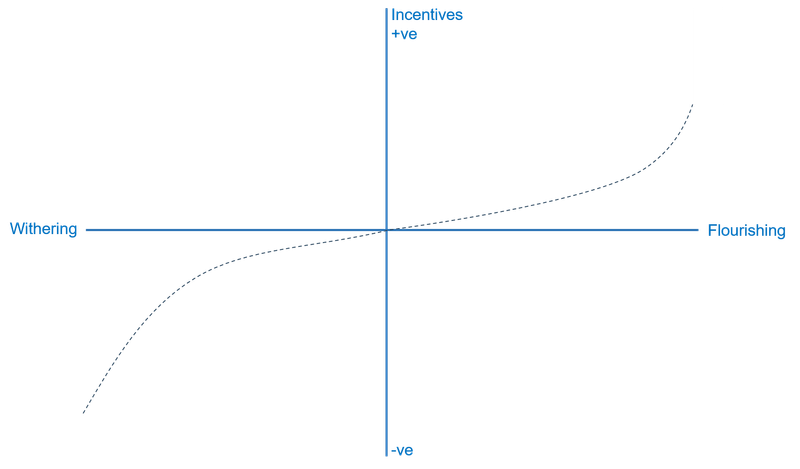
But the greater opportunity lies at the other end of the spectrum. What if an entrepreneur knew that solving a significant societal problem would not merely create a market opportunity, but would also place their business on an increasingly favourable tax trajectory?
What if investors could see ten years ahead and recognise that some activities were becoming progressively less economically attractive while others were receiving progressively stronger incentives?
What if companies were given ample warning that the system’s assessment was changing?
The result would not be an overnight shock. It would be a controllable change in direction. Capital would begin to flow. Innovation would begin to follow. The system would respond. Which, of course, is precisely what capitalism is rather good at doing.
Don’t Tax the Past. Signal the Future.
This suggests another important design principle. Any changes should be gradual and predictable. A company that has invested billions under one set of rules should not suddenly discover that the rules have changed overnight. That simply replaces market uncertainty with political uncertainty. A flourishing taxation system should therefore operate on long, clearly signalled trajectories.
Perhaps a Citizens’ Assembly determines that a particular activity is generating greater harm than previously understood. The response need not be, ‘your tax rate doubles next year’. Instead, the system might say, ‘based on the current evidence, your tax trajectory will progressively change over the next ten years unless the underlying flourishing vector changes’.
That gives everyone a choice. The company can:
- accept the future tax burden;
- innovate;
- redesign the product;
- reduce the harm;
- find a new business model;
- or invest somewhere else.
Investors receive the same signal. So do entrepreneurs. And the market remains free to decide how to respond. The system does not dictate the solution. It creates the conditions under which solutions become increasingly attractive.
Once again, the system decides…
But Who Decides What Flourishing Means?
And now we arrive at the most difficult question. Who gets to decide? Who determines whether one product increases human flourishing while another diminishes it? A government? Scientists? Economists? Philosophers? An algorithm?
None of these answers is particularly attractive on its own. Give the power exclusively to politicians and the system risks becoming an instrument of political ideology. Give it exclusively to scientists and we forget that flourishing involves values as well as measurement. Give it to economists and we risk reducing human wellbeing to what can be counted. Give it to algorithms and we merely conceal human value judgements behind mathematics.
So perhaps the answer is not to find the one group clever enough to decide. Perhaps the answer is to design another system…
A Four-Layer Feedback System
The model I find increasingly attractive looks something like this.
Layer 1: The Foundation
At the bottom sits a broad and deliberately difficult-to-change understanding of human flourishing. Not a detailed prescription for how people should live. A direction.
For example:
- health;
- autonomy;
- capability and opportunity;
- meaning and purpose;
- relationships and community;
- resilience;
- environmental sustainability;
- intergenerational wellbeing.
This is the equivalent of the system’s constitution. It should change slowly.
Layer 2: Measurement
The next layer belongs to evidence. Scientists, health researchers, ecologists, economists, psychologists and other relevant experts develop the best possible measures of the flourishing vectors. Their role is not to decide what society should value. Their role is to measure consequences. And, crucially, to update those measurements when new evidence emerges.
The system must be capable of admitting, ‘we thought this was beneficial. We were wrong’. Or, ‘we thought this was harmful. We now understand the situation differently’. That is not a failure. That is the feedback working.
Layer 3: The Citizens’ Assembly
The third layer is where society makes its value judgements. A rolling, continuously refreshed and representative Citizens’ Assembly considers the evidence. Its task is not to run companies. It does not ban products. It does not decide which technologies should exist. Instead, it determines how the evidence should translate into future economic signals. How much incentive? How much disincentive? How quickly should the change occur? What unintended consequences might result?
The rolling nature of the Assembly is important. No permanent elite. No single electoral cycle. No assumption that today’s judgement must become tomorrow’s orthodoxy. The membership changes. The evidence changes. The decisions change. The feedback continues.
Layer 4: The Market
And then comes the most important layer. The market decides what to do. Companies innovate. Investors reallocate capital. Entrepreneurs spot opportunities.
Consumers remain free to choose. Nobody needs to ban the product. Nobody needs to prescribe the solution. The economic landscape simply begins to reflect something that it currently reflects only imperfectly: the consequences of success.
The Real Contradiction
At the heart of all this sits a familiar contradiction. We want the extraordinary innovative power that economic freedom can generate. But we do not want unlimited freedom to damage the conditions upon which everyone else’s flourishing depends.
Traditionally, we try to resolve this contradiction through regulation. More harm leads to more rules. More rules lead to more loopholes. More loopholes lead to more rules.
Eventually, innovation and regulation begin an arms race.
Perhaps there is another way. Don’t remove the freedom. Change the feedback.
Make the system increasingly rewarding for those who move towards flourishing.
Make it progressively more expensive to profit from moving away from it. But always leave the route open. Always allow innovation. Always allow a company to change direction. And always recognise that our understanding of flourishing may itself need to change.
The Top of the S-Curve
Capitalism has been spectacularly successful. But perhaps some of its greatest successes are now revealing contradictions that were less visible during the steep growth phase. We have become extraordinarily good at producing. But not necessarily at distinguishing production from progress. We can make products more efficiently than ever. But efficiency at producing the wrong outcome is not progress.
We can optimise engagement. But engagement is not the same thing as meaning.
We can extend treatment. But treatment is not always the same thing as health.
We can increase consumption. But consumption is not necessarily flourishing.
Perhaps this is what happens when we reach the top of an S-curve. The old optimisation target has delivered most of what it can. The next leap requires a new target. Not the abandonment of capitalism. Not central planning. Not prohibition. A new feedback loop.
Who Decides?
The honest answer is that nobody should decide alone. That may be the most important design principle of all. The problem is too complex for government to solve. Too value-laden for science alone to solve. Too important to leave entirely to markets. And too dynamic to be captured in a permanent set of rules.
So perhaps the answer is another self-correcting system. A broad societal direction.
Expert measurement. Citizens’ judgement. Market freedom. And continuous feedback between all four.
We would still make mistakes. Of course we would. But the objective should not be to construct a perfect definition of human flourishing and impose it forever. That would be the opposite of flourishing.
The objective is to build a system capable of learning. A system capable of recognising unintended consequences. A system capable of changing direction.
A system that provides more carrots than sticks. And, perhaps most importantly, a system that does not ask us to choose between freedom and responsibility.
It asks us to design a better relationship between the two. The challenge is not to decide what everyone should do. The challenge is to create the conditions in which increasing human flourishing becomes the most attractive direction in which to go.
Don’t ban the behaviour. Don’t prescribe the solution. Tax the trajectory. And then let the system decide.
20 activities/products/services that tend to diminish flourishing
| # | Product / service / activity | Why it tends to diminish flourishing |
| 1 | Tobacco and highly addictive nicotine products | Dependence and major health harms |
| 2 | Products deliberately engineered for harmful addiction | Transfers autonomy from the individual to the provider |
| 3 | Gambling products with high addiction/exploitation potential | Financial, psychological and family harm |
| 4 | Highly processed foods designed around overconsumption | Can exploit reward systems while undermining long-term health |
| 5 | Excessive added-sugar products | Significant health burden when consumption is chronically high |
| 6 | Ultra-processed food systems with poor nutritional value | Cheap calories, but often at long-term health cost |
| 7 | Alcohol products associated with substantial social and health harms | Costs extend beyond the individual consumer |
| 8 | Fossil-fuel products where lower-impact alternatives are viable | Climate, pollution and long-term systemic costs |
| 9 | Monoculture agriculture dependent on ecological simplification | Soil depletion, biodiversity loss and systemic fragility |
| 10 | High-pesticide agricultural systems | Ecological and potential human-health externalities |
| 11 | Products designed for premature obsolescence | Waste, resource depletion and forced consumption |
| 12 | Disposable products where durable alternatives are practical | Externalised environmental costs |
| 13 | Extractive business models dependent on depletion of natural capital | Creates present wealth by reducing future capability |
| 14 | Services that monetise harmful misinformation | Reduces informed autonomy and social trust |
| 15 | Digital products optimised primarily for compulsive engagement | Can capture attention without increasing wellbeing |
| 16 | Predatory lending and exploitative financial products | Monetise vulnerability rather than create capability |
| 17 | “Symptom management only” products where prevention is deliberately neglected | Potentially sustains demand rather than addressing root causes |
| 18 | Products that deliberately create dependence or lock-in | Reduce consumer freedom of movement |
| 19 | Ecologically destructive extraction and land-use practices | Damage resilience and impose costs on others and future generations |
| 20 | Products whose profitability depends on shifting significant hidden costs onto society | The meta-category: privatised benefit, socialised cost |
20 activities/products/services that tend to increase flourishing
| # | Product / service / activity | Why it tends to increase flourishing |
| 1 | Regenerative agriculture | Rebuilds soil, resilience and ecological capacity |
| 2 | Biodiversity-enhancing land and water management | Increases ecosystem resilience |
| 3 | Preventive healthcare | Avoids problems rather than merely responding to them |
| 4 | Root-cause medical and health interventions | Increases long-term capability and reduces recurring harm |
| 5 | Mental-health prevention and effective treatment | Supports agency, relationships and quality of life |
| 6 | Nutritious, minimally harmful food systems | Supports long-term physical capability |
| 7 | Clean energy and low-impact energy systems | Meets needs while reducing systemic externalities |
| 8 | Durable, repairable and upgradeable products | Deliver value with less forced replacement |
| 9 | Circular-economy products and services | Retain material value and reduce waste |
| 10 | Products that restore rather than merely reduce environmental damage | Creates net-positive effects |
| 11 | Education that increases genuine capability | Expands future autonomy and opportunity |
| 12 | Tools that increase human agency rather than dependence | Help people do more for themselves |
| 13 | Products and services that strengthen meaningful relationships | Build social capital and belonging |
| 14 | Housing and infrastructure that improve long-term community resilience | Creates enabling conditions for flourishing |
| 15 | Products that save people time without merely transferring work elsewhere | Creates capacity for other meaningful activity |
| 16 | Arts, culture and experiences that increase meaning | Flourishing is more than health and consumption |
| 17 | Technologies that augment rather than replace human capability | Increase what people are able to achieve |
| 18 | Open knowledge and genuinely useful information systems | Increase collective capability |
| 19 | Products that improve accessibility and inclusion | Allow more people to participate fully |
| 20 | Businesses that demonstrably create more social/ecological value than they consume | The positive meta-category: private success aligned with public benefit |