
When I was in my twenties I decided I would become a bit of a Francophile. Mainly wine related. Mainly Chateauneuf du Pape related. Because it was fashionable, and I thought I’d give that a go too, I also got sucked into the Beaujolais Nouveau game. For those that don’t know, the Beaujolais region of France came up with the idea of speed-wine making. Harvest the wine at the end of the summer, and then bottle it and ship it out to gullible consumers by the third Thursday of November. The first year I joined the game it tasted like cat-piss. I figured it was a bad year. The next year, fighting every red-wine-is-supposed-to-be-served-at-room-temperature instinct i possessed, I chilled the bottle to a lower temperature. It also tasted like cat-piss. I began to become suspicious. The third year I bought a bottle of Beaujolais Villages. I think it had been bottled the same year of my first Nouveau experience. It was an object lesson in recognising that some things take time. Sure, it’s possible to pour a bunch of chemicals into a bottle of wine and speed the maturing process, but why? If you’ve been making wine for hundreds of years and accepting that you need to store the wine for a couple of years before selling it, the inventory in effect costs you almost nothing. Not totally nothing, of course, and I suppose that’s where the accounting department comes along and says they know how to save the vineyard a bit of money. That’ll be the people tasked with knowing the cost of everything and the value of nothing. Last time I looked, 13.4 million bottles of Beaujolais Nouveau are sold each year. That’s something like 20% of the total grape harvest of the whole Beaujolais region. If that’s what the customer wants, I suppose, you’d be a fool to not satisfy the demand. If the customer demands cat-piss, give them cat piss. I’m not sure that counts as contributing to human flourishing though?
I mention this, because earlier this week I became aware of a distant connection who had invented an equivalent way to accelerate the process of ‘maturing’ whisky. The lack of ‘e’ in the word whiskey tells you he’s based in America. The invention was about a decade ago. My recent update revealed that he’s now selling enormous quantities of his product. Forget fifteen-year, twelve or ten year matured whiskey, his process needs a few weeks. Not that you’ll see that fact written on the bottle. Rather, the bottle has had some top-notch brand design work done on it. It looks like a very expensive bottle of whisky, and hence fits the classic form of the money-making powerhouse that is the US ‘food’ industry – great marketing, ultra-consistency, ultra-addictive, and lowest-possible-cost ingredients and processes. AKA also the opposite of human flourishing.
I’ve not had an opportunity to taste the product. I don’t know, it might be amazing. But I’m not sure that’s the point. Rather like the scary statistic that 97% of listeners can’t tell whether a piece of music has been generated by AI or a human. The meaningless, it seems, beats the meaningful. When the Emperor’s New Clothes marketing fades, the price of 80proof brown liquid tends to zero. Johnnie Walker Green Label, meanwhile, wants to be expensive. In the short term, well marketed muzak beats artistic struggle. If the function is background noise, who cares? Ditto, if the function is inebriation and escape from a vapid existence, who cares? Either way, as a species, it feels like the slippery slide to idiocracy is rapidly turning into a cliff-edge. Gluttons for our meaningless doom.
These trends will bottom out eventually. I know that. I hope that. I hope we don’t all hit the rocks at the bottom of the cliff before the direction of travel reverses. We’ve been predicting an Age Of Meaning for some time now. An age where we collectively come to realise there are problems that shouldn’t be solved. That the distillers pouring twelve years of their love into a bottle of Laphroaig Islay single-malt Scotch will be fully appreciated again. That we collectively opt for flourishing. Sláinte.
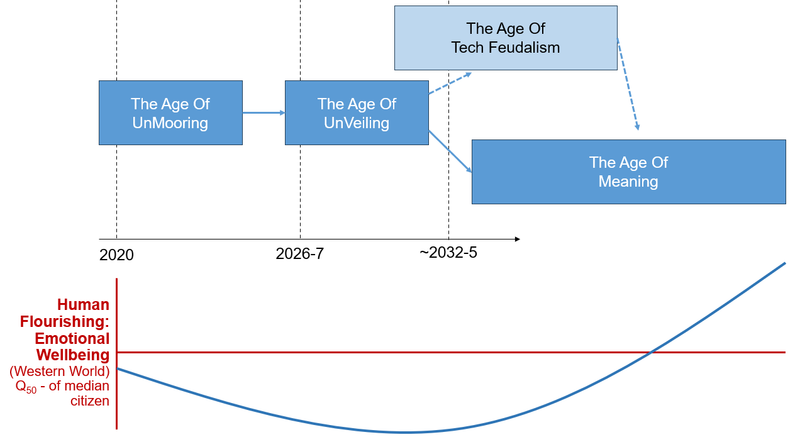
(Predicted shift in flourishing – adapted from the 1%ers, How New Things Get Done’ book.)