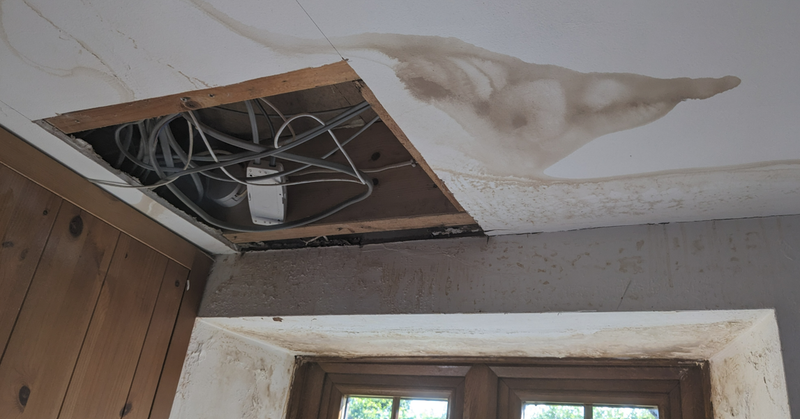
I live in an old Victorian house. Which has lots of benefits, but also a few annoying quirks. Most of which usually involve water in places you don’t ideally want water. The beginning of this year saw the arrival of a new leak above the kitchen window. We’d had what felt like a whole month of rain leading up to the start of the leak, so my troubleshooting psychological inertia took me outside and up a ladder to clear out the guttering. That didn’t work, so then I started looking for cracks and gaps in the walls and eaves. There were a couple of unlikely looking cracks. I tried a temporary silicon filler. That didn’t work either. At which point my better half, having now seen the stain on the kitchen ceiling grow to the size of an expensive redecoration job, the work surfaces covered in buckets, and, the last straw, water dripping into the light-switch, decided we needed professional help. Somewhat amazingly, Devon roofers usually being unwilling to climb onto roofs in Feburary in the rain, someone turned up the following morning. He couldn’t find anything wrong. So then we convinced another one to come. He couldn’t find anything wrong either. As he left, he suggested that perhaps the water was coming from inside the house. I told him that I’d looked and there were absolutely no pipes anywhere above the kitchen window. I looked again. It was impossible. But now there was no other viable alternative. So I tried turning the water off at the mains. Within minutes, much to my surprise, the sound of drops falling from the ceiling plopping into the line of buckets stopped. I looked harder for hidden pipework. Nothing. I then attempted to convince better half that maybe we could live with only turning the mains back on when we needed water. This didn’t go down well. I sort of agreed, the stopcock being several yards away from the house at the bottom of an arm-length hole in the ground inhabited by what always seems like half the spider population of the county. It was time to call in the professionals again. This time a plumber. He couldn’t find any pipework in the vicinity either. So he said the only thing we could do now was remove a part of the kitchen ceiling and see what we could see above it.
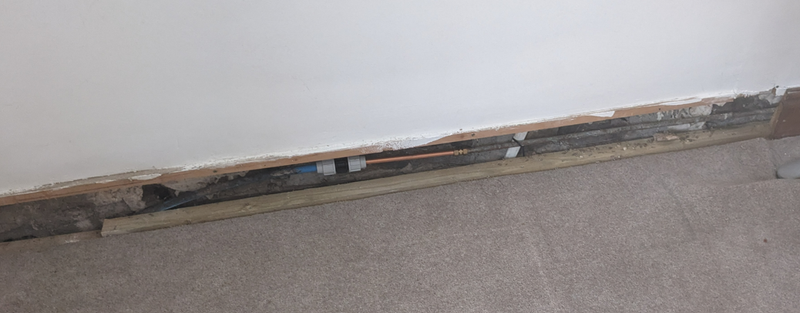
When he’d finished that task, the kitchen was covered in plaster dust and buckets and there was still no sign of the source of the leak. The only new clue was a damp ceiling joist. Meaning the leak must be upstairs in the better half’s office. The general rule in the house is that only she is allowed in her office. Now there’s a plumber in the room, re-arranging all the furniture, lifting carpet and then a couple of floorboards. Still nothing. Getting a little desperate now, he pulls away the skirting board. And finally, there it is, the dripping mains pipe.
At this point, I should perhaps also add to the story the fact that the people we bought the house from fifteen years ago turned out to be DIY-nuts. And more to the point not very good ones. If a job was worth doing, in Captain Bodge’s eyes, it was worth doing badly. Despite re-wiring most of the house after we moved in, there are still one or two ghostly lighting mysteries that have never been solved. And now, it turns out that the good Captain had at some point taken it upon himself to re-route the pipework from the mains into the house by feeding the pipe vertically up the inside of the wall, into the wall of the now precious office and through to the end wall of the office into the rest of the house. Don’t ask me where precisely, because I still don’t exactly know where it goes after it passes behind the office skirting board (probably because I’m still slightly scared at the sight of the Captain Bodge tie-wrap connecting the pipe to a passing electric cable conduit – see photo).
Meanwhile, now we’ve found the leak, the plumber looks at the 4” square cavity through which the leaky pipe is passing, gets down on his hands and knees, head to the gound, looks at the three (thanks, Captain Bodge) transition joints, scratches his head and let’s out a long sigh. No doubt at the unlikely prospect of being able to do what in effect looked like the plumbing version of keyhole surgery. ‘I’m getting too old for this’, he said as I watched him try and hacksaw off the offending joint and then, worse, install a new compression fitting into a space that had room for either the fitting or his hand, but not both. By way of what I hope is some kind of consolation, I tell him that I’ll re-install the skirting board and return the office to something like its original state. And I’ll fix the now very blown-looking light switch in the kitchen.
Six months later, we’ve finally managed to get a builder to come and repair the hole in the kitchen ceiling.
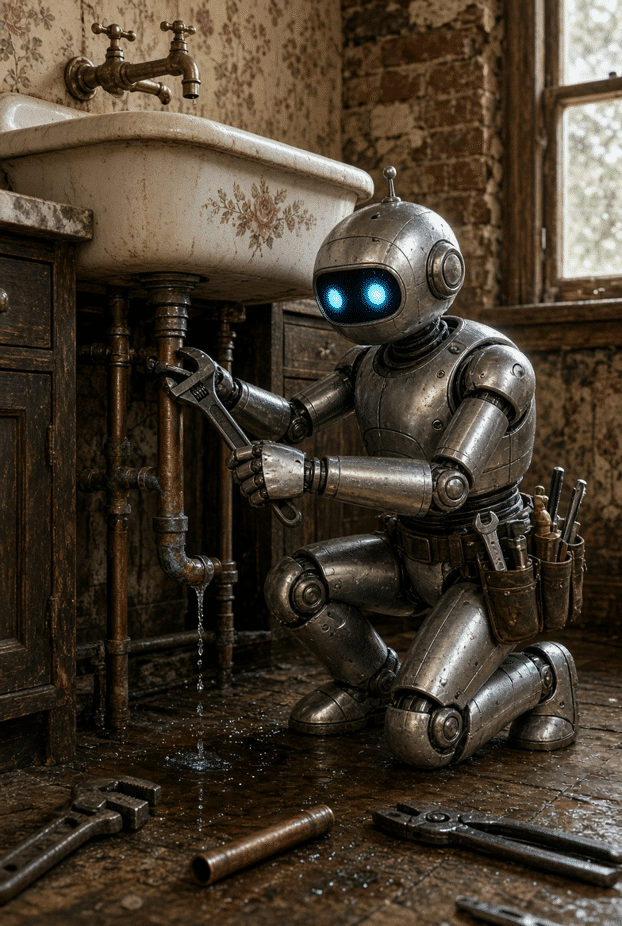
The point of this story is that during these six months it feels like life has decided to torture me with lots of images and stories of how, soon, we’ll have plumbing robots that will come and sort these kinds of leak problem out.
I understand that the AI and robot-hungry tech bros have a vested interest in painting a bright rosy picture of a utopian future where robots do all our manual work for us at the drop of a hat, but sometimes their level of naivety is so astonishingly high that I’m now convinced the primary existential threat to humanity is their apparent lack of understanding of the absolute basics of how new things get done. It’s one thing to win Nobel prizes for developing super-cunning protein folding algorithms that will create lots of exciting new proteins, quite another to put any of those proteins into our mouths. Similarly, it is one thing to train a robot to change a u-bend in a shiny new laboratory sink, and a very different thing to expect that robot to come and find and fix my leak. At this point in history, we know how to train robots to do very specific tasks. We give them lots of training data, and tightly bound the variability of the task. We can see the results of this design philosophy in the masses of industrial robotic solutions designed to operate 24 hours a day on highly repetitive jobs in very tightly controlled environments. Specialists know how to train specialists. Especially robot specialists.
Designing generalists, on the other hand, requires a completely different design philosophy. One that does not exist at the moment. Humans aren’t great at doing repetitive jobs. We’re two-9s reliable at best. AI and robots will beat us every time on boring repetitive tasks. What humans are great at is being creative generalists, capable of rapidly adapting to previously unknown situations and circumstances.
In the aerospace industry it has long been known that a two-9s pilot is not good enough to fly a plane demanding 12-9s and beyond levels of passenger safety. That’s why the automatic pilot, George, flies the plane for 95% or more of every flight. Another of the reasons planes are easily the safest form of transport is because planes have a very tightly constrained flight envelope. Don’t fly higher than this, don’t fly faster than that, don’t fly slower than that, don’t take-off if you weigh more than this. Stay within the envelope and George will get you where you need to go. On the other hand, get a simultaneous Canada-goose-strike in both your engines during take-off and George is completely out of his depth. Now you need Sully.
Same thing with my Victorian, Captain Bodge leak. The only time I’ll be inviting a robot in to fix that kind of problem will be the day the world knows how to design twelve-9s reliable generalist robots. The robot plumber that’s also capable of finding hidden pipes at a location its never seen before, making holes in the ceiling, removing skirting boards, doing keyhole pipe repair, cleaning up after itself, and re-assuring my better half that she’ll get her office back exactly the way it was before.
It will happen one day. But not in this AI Hype Cycle. Or the next. Or the one after that. In other words, when Satya Nadella suggested the world was ‘one innovation away’ from AGI, he probably meant ten. Maybe twelve.
Dick Fosbury changed the high jump. I’ve mentioned him several times over the years, Usually when trying to describe how universal s-curves are. How all systems hit limits and how, when they do, the world needs people like Dick Fosbury to come along and solve a contradiction or two.
Before Fosbury, high jumpers generally went over the bar facing downwards or sideways. Fosbury did something different. He turned around. He approached the bar on a curve, planted his right foot, and went over backwards. The result became known as the Fosbury Flop. At first, his coach tried to stop him, later everyone mocked him. And then, under the 1968 Olympic spotlight he changed the high-jump forever.
His Principle 13, The Other Way Around, solution to the how-to-jump-higher problem is the thing I’ve usually focused on. But one of the lovely things about mavericks like Fosbury is the deeper you look, the more you realise he’s not just solving one contradiction, he’s challenging them everywhere. Here’s my new favourite:
Before Fosbury, a conventional high jump was, fundamentally, about generating vertical force. Run. Plant. Jump. The harder and more efficiently the athlete can convert horizontal momentum into vertical lift, the higher they can go.
But Fosbury’s new other-way-around technique added another requirement. He didn’t just need to go up. He needed to turn around. More specifically, his body had to acquire the rotation required to take him over the bar backwards.
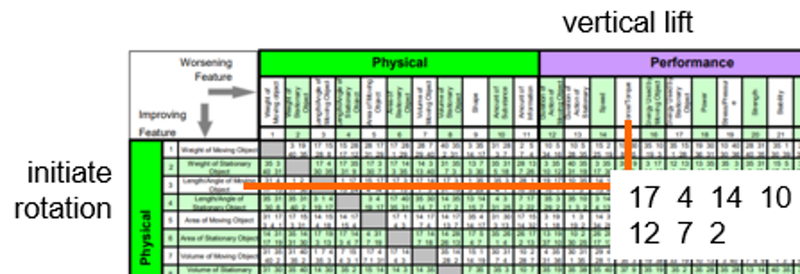
So now the take-off contained a contradiction. He needed maximum vertical lift, and he also needed to generate rotation. In TRIZ Contradiction Matrix terms Fosbury needed lift force and to change his orientation angle relative to the bar. Here’s what that conflict looks like when mapped onto the Matrix:
The first part of his solution involved (Principle 2) separating the two functions. For Fosbury that meant giving his left leg the task of initiating the rotational movement, and then having is right leg providing the vertical lift force. The left leg providing the penultimate step, and the right the final, launching step. Easy when you know how.
But then comes a much more subtle part of the story. If his left leg is tasked with the performing the rotation job, he needed a different kind of grip on the track to that required for his right leg. For rotation he needed a firm, non-slip interaction with the ground. And for lift his right he needed to support the rapidly moving body and generate the vertical impulse required to lift the jumper over the bar with as little ground resistance as possible.
How to achieve those two different requirements?
Answer: Asymmetry. Two different requirements, two different shoes (did you notice them in the photo at the top of the article?). For his left foot he wore a classic spiked running shoe, and on his right he wore a shoe with a smooth sole.
What I love most about this solution is it demonstrates escape from a classic piece of psychological inertia. Every shoe-shop on the planet sells pairs of identical shoes. Two feet. Two shoes. One design. Symmetry. Humans love symmetry. We default to symmetry. Companies sell symmetry. Consumers buy it.
But symmetry only makes sense if the required functions are symmetrical. Principle 4 is a reminder that every time we default to symmetry there’s a strong chance we’ve missed an opportunity.
An opportunity that, in The Wizard Of Foz’s case was likely the difference between Olympic gold-medal winning fame and a soon to be forgotten fool wearing odd shoes.
The Fosbury Flop changed high jumping by challenging an assumption about how the human body should go over a bar. The mismatched shoes challenge a smaller assumption. But perhaps a more transferable one. Whenever we see two things that have been designed identically, it may be worth asking whether they actually perform the same functions. If the answer is no, symmetry is no longer an advantage and its time to roll out Principle 4.
Capitalism is an extraordinarily powerful optimisation system. Give it a target and enough freedom to pursue that target and, sooner or later, somebody will find a better way of getting there. That has been the source of much of its success. It is also becoming the source of some of its problems. Because the obvious question is, what, exactly, have we asked capitalism to optimise? The answer, for the most part, is also obvious. Profit.
There is nothing inherently wrong with that. Profit provides an essential signal. It tells us that somebody, somewhere, values what we are doing sufficiently to exchange resources for it. It rewards efficiency. It encourages experimentation. It enables investment in future ideas. And, importantly, it allows a vast number of individual decisions to be made without requiring a central planner to decide what everyone should do.
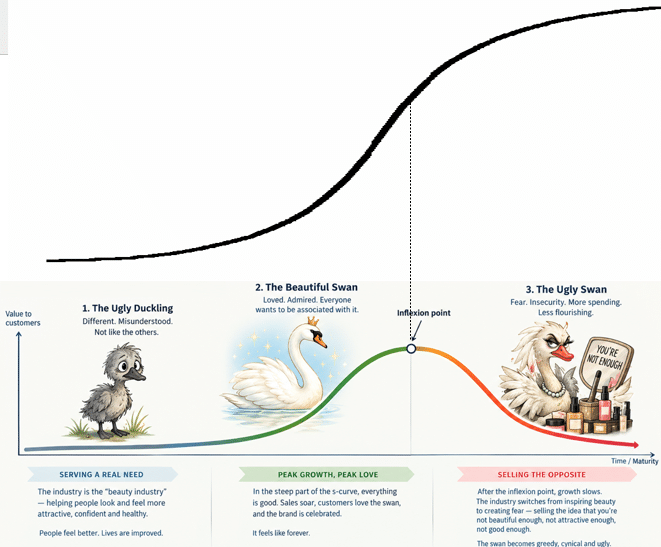
That freedom has generated extraordinary prosperity. But as we approach the top of an S-curve, the same optimisation mechanisms that helped generate progress can begin to reveal their unintended consequences. If a company can increase its profits by improving human flourishing, that is excellent. If another can increase its profits by diminishing human flourishing while transferring the costs elsewhere, that too is currently a perfectly viable business model. And therein lies the problem.
Perhaps capitalism is not malfunctioning. Perhaps it is doing exactly what we have asked it to do.
The Wrong Feedback Loop
Consider a product that generates substantial profits for its producer while simultaneously creating costs elsewhere. Those costs might appear as:
poorer physical health;
addiction;
mental ill-health;
environmental damage;
biodiversity loss;
reduced autonomy;
wasted resources;
social fragmentation;
or burdens transferred to future generations.
The producer receives the profit. Society absorbs the cost. Economists have, of course, had a name for this problem for a very long time: externalities. But perhaps the challenge now is becoming broader. We are increasingly capable of recognising that some activities don’t simply create a measurable environmental cost or health cost. They influence the overall direction in which society is travelling. Some increase our capacity to flourish. Others diminish it. And some do both.
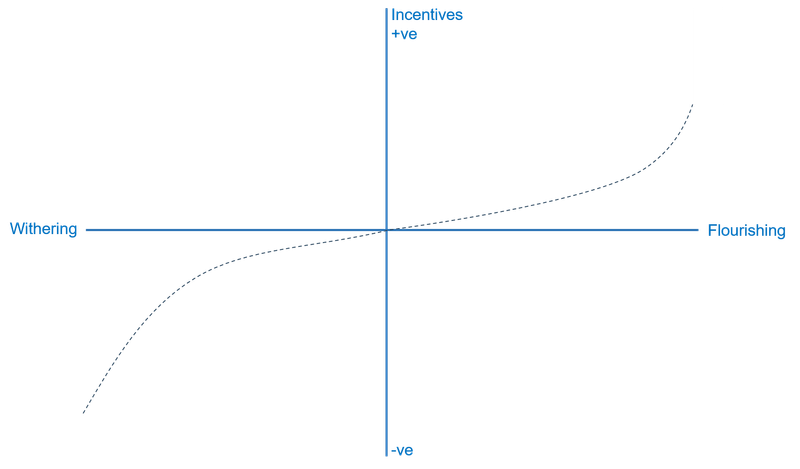
Which suggests that perhaps we need a new feedback mechanism. Not one based on prohibition. Not one in which a central authority decides which products people are allowed to buy. And not one in which every undesirable consequence generates another layer of regulation. Instead: Keep the freedom. Change the feedback.
A Flourishing Economy
Imagine a taxation system designed around a simple question: Does this activity tend to move society towards or away from human flourishing? The answer would not be binary. Nothing would simply be labelled Good or Bad. Instead, every activity would occupy a position on a spectrum. At one end might sit activities that generate significant and demonstrable harm:
highly addictive products;
business models designed to exploit addiction or vulnerability;
environmentally destructive processes;
systems that destroy biodiversity;
products deliberately designed for premature obsolescence;
activities that transfer substantial costs to society or future generations.
At the other end might sit activities that generate demonstrable benefits:
regenerative agriculture;
biodiversity-enhancing processes;
preventive healthcare;
durable and repairable products;
clean energy;
technologies that increase human capability;
products that save time and increase autonomy;
education;
activities that build resilience;
products and services that increase meaning, connection and participation.
Between the two would sit almost everything else. And the taxation system would respond accordingly. The further an activity moved in the direction of diminishing flourishing, the greater its contribution back to society should be. The further it moved in the direction of increasing flourishing, the greater the tax relief, rebate or other economic advantage it could receive.
Well, almost. The simple answer to any kind of complex problem like human flourishing is almost inevitably wrong. Far more effective, if we instead chose to embrace the complexity, we should not simply tax the position. We should tax the trajectory…
Tax the Trajectory
Imagine two companies. Both currently manufacture products that sit on the negative side of the flourishing spectrum. Company A is happy where it is. Its business model depends upon maintaining the status quo. Company B is investing heavily in reducing the harmful consequences of its products. It is redesigning them. Reformulating them. Finding less damaging materials. Reducing dependence. Repairing environmental consequences.
Under a conventional tax system, the two companies will likely be treated identically.
Under a flourishing-based system, their trajectories would be different. Company A is remaining stationary. Company B is moving.
The system, therefore, should recognise that. Indeed, perhaps an organisation’s tax position should depend upon both: Where are you now? and: Which direction are you travelling?
This changes the nature of the game. The objective is no longer to divide the economy into saints and sinners. The objective is to create an incentive for movement. A company currently causing harm is not condemned to permanent punishment. It has a route towards a more favourable future. Conversely, a company that currently generates positive outcomes should not receive permanent immunity. If the evidence changes, so should its position. This is important because flourishing itself is not static. Nor are our attempts to understand it.
Flourishing Vectors
Perhaps the most useful way to think about this is not as a single flourishing score, but as a flourishing vector. An activity may have effects in several directions simultaneously. For example, a product might:
improve physical health;
reduce autonomy through dependence;
save time;
create environmental damage;
generate social connection;
and impose future costs.
What is its score? The answer cannot simply be found by asking whether the product is “good” or “bad”. We need to understand its direction and magnitude across several dimensions. A preliminary flourishing vector might include:
Health
Autonomy
Capability
Meaning
Relationships and social connection
Resilience
Environmental regeneration
Intergenerational wellbeing
An organisation’s position would therefore not be determined by one simplistic judgement. It would be based on evidence concerning the net direction of travel.
This would also make the system capable of learning.
An activity initially believed to be beneficial may later reveal harmful unintended consequences. Another initially considered problematic may be redesigned into something overwhelmingly beneficial. The vector changes. The trajectory changes.
The taxation changes. No activity needs to be banned. No category needs to be permanently condemned. The system simply updates its feedback.
Carrots More Than Sticks
The most important characteristic of such a system, however, should be its bias towards encouragement rather than punishment. The objective is not to create an ever more sophisticated system for taxing undesirable behaviour. The objective is to make desirable innovation increasingly attractive. That means carrots more than sticks.
Taxation should certainly become progressively heavier as demonstrable harm increases. Otherwise the system fails to deal with activities whose profits depend upon transferring costs elsewhere.
But the greater opportunity lies at the other end of the spectrum. What if an entrepreneur knew that solving a significant societal problem would not merely create a market opportunity, but would also place their business on an increasingly favourable tax trajectory?
What if investors could see ten years ahead and recognise that some activities were becoming progressively less economically attractive while others were receiving progressively stronger incentives?
What if companies were given ample warning that the system’s assessment was changing?
The result would not be an overnight shock. It would be a controllable change in direction. Capital would begin to flow. Innovation would begin to follow. The system would respond. Which, of course, is precisely what capitalism is rather good at doing.
Don’t Tax the Past. Signal the Future.
This suggests another important design principle. Any changes should be gradual and predictable. A company that has invested billions under one set of rules should not suddenly discover that the rules have changed overnight. That simply replaces market uncertainty with political uncertainty. A flourishing taxation system should therefore operate on long, clearly signalled trajectories.
Perhaps a Citizens’ Assembly determines that a particular activity is generating greater harm than previously understood. The response need not be, ‘your tax rate doubles next year’. Instead, the system might say, ‘based on the current evidence, your tax trajectory will progressively change over the next ten years unless the underlying flourishing vector changes’.
That gives everyone a choice. The company can:
accept the future tax burden;
innovate;
redesign the product;
reduce the harm;
find a new business model;
or invest somewhere else.
Investors receive the same signal. So do entrepreneurs. And the market remains free to decide how to respond. The system does not dictate the solution. It creates the conditions under which solutions become increasingly attractive.
Once again, the system decides…
But Who Decides What Flourishing Means?
And now we arrive at the most difficult question. Who gets to decide? Who determines whether one product increases human flourishing while another diminishes it? A government? Scientists? Economists? Philosophers? An algorithm?
None of these answers is particularly attractive on its own. Give the power exclusively to politicians and the system risks becoming an instrument of political ideology. Give it exclusively to scientists and we forget that flourishing involves values as well as measurement. Give it to economists and we risk reducing human wellbeing to what can be counted. Give it to algorithms and we merely conceal human value judgements behind mathematics.
So perhaps the answer is not to find the one group clever enough to decide. Perhaps the answer is to design another system…
A Four-Layer Feedback System
The model I find increasingly attractive looks something like this.
Layer 1: The Foundation
At the bottom sits a broad and deliberately difficult-to-change understanding of human flourishing. Not a detailed prescription for how people should live. A direction.
For example:
health;
autonomy;
capability and opportunity;
meaning and purpose;
relationships and community;
resilience;
environmental sustainability;
intergenerational wellbeing.
This is the equivalent of the system’s constitution. It should change slowly.
Layer 2: Measurement
The next layer belongs to evidence. Scientists, health researchers, ecologists, economists, psychologists and other relevant experts develop the best possible measures of the flourishing vectors. Their role is not to decide what society should value. Their role is to measure consequences. And, crucially, to update those measurements when new evidence emerges.
The system must be capable of admitting, ‘we thought this was beneficial. We were wrong’. Or, ‘we thought this was harmful. We now understand the situation differently’. That is not a failure. That is the feedback working.
Layer 3: The Citizens’ Assembly
The third layer is where society makes its value judgements. A rolling, continuously refreshed and representative Citizens’ Assembly considers the evidence. Its task is not to run companies. It does not ban products. It does not decide which technologies should exist. Instead, it determines how the evidence should translate into future economic signals. How much incentive? How much disincentive? How quickly should the change occur? What unintended consequences might result?
The rolling nature of the Assembly is important. No permanent elite. No single electoral cycle. No assumption that today’s judgement must become tomorrow’s orthodoxy. The membership changes. The evidence changes. The decisions change. The feedback continues.
Layer 4: The Market
And then comes the most important layer. The market decides what to do. Companies innovate. Investors reallocate capital. Entrepreneurs spot opportunities.
Consumers remain free to choose. Nobody needs to ban the product. Nobody needs to prescribe the solution. The economic landscape simply begins to reflect something that it currently reflects only imperfectly: the consequences of success.
The Real Contradiction
At the heart of all this sits a familiar contradiction. We want the extraordinary innovative power that economic freedom can generate. But we do not want unlimited freedom to damage the conditions upon which everyone else’s flourishing depends.
Traditionally, we try to resolve this contradiction through regulation. More harm leads to more rules. More rules lead to more loopholes. More loopholes lead to more rules.
Eventually, innovation and regulation begin an arms race.
Perhaps there is another way. Don’t remove the freedom. Change the feedback.
Make the system increasingly rewarding for those who move towards flourishing.
Make it progressively more expensive to profit from moving away from it. But always leave the route open. Always allow innovation. Always allow a company to change direction. And always recognise that our understanding of flourishing may itself need to change.
The Top of the S-Curve
Capitalism has been spectacularly successful. But perhaps some of its greatest successes are now revealing contradictions that were less visible during the steep growth phase. We have become extraordinarily good at producing. But not necessarily at distinguishing production from progress. We can make products more efficiently than ever. But efficiency at producing the wrong outcome is not progress.
We can optimise engagement. But engagement is not the same thing as meaning.
We can extend treatment. But treatment is not always the same thing as health.
We can increase consumption. But consumption is not necessarily flourishing.
Perhaps this is what happens when we reach the top of an S-curve. The old optimisation target has delivered most of what it can. The next leap requires a new target. Not the abandonment of capitalism. Not central planning. Not prohibition. A new feedback loop.
Who Decides?
The honest answer is that nobody should decide alone. That may be the most important design principle of all. The problem is too complex for government to solve. Too value-laden for science alone to solve. Too important to leave entirely to markets. And too dynamic to be captured in a permanent set of rules.
So perhaps the answer is another self-correcting system. A broad societal direction.
Expert measurement. Citizens’ judgement. Market freedom. And continuous feedback between all four.
We would still make mistakes. Of course we would. But the objective should not be to construct a perfect definition of human flourishing and impose it forever. That would be the opposite of flourishing.
The objective is to build a system capable of learning. A system capable of recognising unintended consequences. A system capable of changing direction.
A system that provides more carrots than sticks. And, perhaps most importantly, a system that does not ask us to choose between freedom and responsibility.
It asks us to design a better relationship between the two. The challenge is not to decide what everyone should do. The challenge is to create the conditions in which increasing human flourishing becomes the most attractive direction in which to go.
Don’t ban the behaviour. Don’t prescribe the solution. Tax the trajectory. And then let the system decide.
20 activities/products/services that tend to diminish flourishing
#
Product / service / activity
Why it tends to diminish flourishing
1
Tobacco and highly addictive nicotine products
Dependence and major health harms
2
Products deliberately engineered for harmful addiction
Transfers autonomy from the individual to the provider
3
Gambling products with high addiction/exploitation potential
Financial, psychological and family harm
4
Highly processed foods designed around overconsumption
Can exploit reward systems while undermining long-term health
5
Excessive added-sugar products
Significant health burden when consumption is chronically high
6
Ultra-processed food systems with poor nutritional value
Cheap calories, but often at long-term health cost
7
Alcohol products associated with substantial social and health harms
Costs extend beyond the individual consumer
8
Fossil-fuel products where lower-impact alternatives are viable
Climate, pollution and long-term systemic costs
9
Monoculture agriculture dependent on ecological simplification
Soil depletion, biodiversity loss and systemic fragility
10
High-pesticide agricultural systems
Ecological and potential human-health externalities
11
Products designed for premature obsolescence
Waste, resource depletion and forced consumption
12
Disposable products where durable alternatives are practical
Externalised environmental costs
13
Extractive business models dependent on depletion of natural capital
Creates present wealth by reducing future capability
14
Services that monetise harmful misinformation
Reduces informed autonomy and social trust
15
Digital products optimised primarily for compulsive engagement
Can capture attention without increasing wellbeing
16
Predatory lending and exploitative financial products
Monetise vulnerability rather than create capability
17
“Symptom management only” products where prevention is deliberately neglected
Potentially sustains demand rather than addressing root causes
18
Products that deliberately create dependence or lock-in
Reduce consumer freedom of movement
19
Ecologically destructive extraction and land-use practices
Damage resilience and impose costs on others and future generations
20
Products whose profitability depends on shifting significant hidden costs onto society
The meta-category: privatised benefit, socialised cost
20 activities/products/services that tend to increase flourishing
#
Product / service / activity
Why it tends to increase flourishing
1
Regenerative agriculture
Rebuilds soil, resilience and ecological capacity
2
Biodiversity-enhancing land and water management
Increases ecosystem resilience
3
Preventive healthcare
Avoids problems rather than merely responding to them
4
Root-cause medical and health interventions
Increases long-term capability and reduces recurring harm
5
Mental-health prevention and effective treatment
Supports agency, relationships and quality of life
6
Nutritious, minimally harmful food systems
Supports long-term physical capability
7
Clean energy and low-impact energy systems
Meets needs while reducing systemic externalities
8
Durable, repairable and upgradeable products
Deliver value with less forced replacement
9
Circular-economy products and services
Retain material value and reduce waste
10
Products that restore rather than merely reduce environmental damage
Creates net-positive effects
11
Education that increases genuine capability
Expands future autonomy and opportunity
12
Tools that increase human agency rather than dependence
Help people do more for themselves
13
Products and services that strengthen meaningful relationships
Build social capital and belonging
14
Housing and infrastructure that improve long-term community resilience
Creates enabling conditions for flourishing
15
Products that save people time without merely transferring work elsewhere
Creates capacity for other meaningful activity
16
Arts, culture and experiences that increase meaning
Flourishing is more than health and consumption
17
Technologies that augment rather than replace human capability
Increase what people are able to achieve
18
Open knowledge and genuinely useful information systems
Increase collective capability
19
Products that improve accessibility and inclusion
Allow more people to participate fully
20
Businesses that demonstrably create more social/ecological value than they consume
The positive meta-category: private success aligned with public benefit
When I was in my twenties I decided I would become a bit of a Francophile. Mainly wine related. Mainly Chateauneuf du Pape related. Because it was fashionable, and I thought I’d give that a go too, I also got sucked into the Beaujolais Nouveau game. For those that don’t know, the Beaujolais region of France came up with the idea of speed-wine making. Harvest the wine at the end of the summer, and then bottle it and ship it out to gullible consumers by the third Thursday of November. The first year I joined the game it tasted like cat-piss. I figured it was a bad year. The next year, fighting every red-wine-is-supposed-to-be-served-at-room-temperature instinct i possessed, I chilled the bottle to a lower temperature. It also tasted like cat-piss. I began to become suspicious. The third year I bought a bottle of Beaujolais Villages. I think it had been bottled the same year of my first Nouveau experience. It was an object lesson in recognising that some things take time. Sure, it’s possible to pour a bunch of chemicals into a bottle of wine and speed the maturing process, but why? If you’ve been making wine for hundreds of years and accepting that you need to store the wine for a couple of years before selling it, the inventory in effect costs you almost nothing. Not totally nothing, of course, and I suppose that’s where the accounting department comes along and says they know how to save the vineyard a bit of money. That’ll be the people tasked with knowing the cost of everything and the value of nothing. Last time I looked, 13.4 million bottles of Beaujolais Nouveau are sold each year. That’s something like 20% of the total grape harvest of the whole Beaujolais region. If that’s what the customer wants, I suppose, you’d be a fool to not satisfy the demand. If the customer demands cat-piss, give them cat piss. I’m not sure that counts as contributing to human flourishing though?
I mention this, because earlier this week I became aware of a distant connection who had invented an equivalent way to accelerate the process of ‘maturing’ whisky. The lack of ‘e’ in the word whiskey tells you he’s based in America. The invention was about a decade ago. My recent update revealed that he’s now selling enormous quantities of his product. Forget fifteen-year, twelve or ten year matured whiskey, his process needs a few weeks. Not that you’ll see that fact written on the bottle. Rather, the bottle has had some top-notch brand design work done on it. It looks like a very expensive bottle of whisky, and hence fits the classic form of the money-making powerhouse that is the US ‘food’ industry – great marketing, ultra-consistency, ultra-addictive, and lowest-possible-cost ingredients and processes. AKA also the opposite of human flourishing.
I’ve not had an opportunity to taste the product. I don’t know, it might be amazing. But I’m not sure that’s the point. Rather like the scary statistic that 97% of listeners can’t tell whether a piece of music has been generated by AI or a human. The meaningless, it seems, beats the meaningful. When the Emperor’s New Clothes marketing fades, the price of 80proof brown liquid tends to zero. Johnnie Walker Green Label, meanwhile, wants to be expensive. In the short term, well marketed muzak beats artistic struggle. If the function is background noise, who cares? Ditto, if the function is inebriation and escape from a vapid existence, who cares? Either way, as a species, it feels like the slippery slide to idiocracy is rapidly turning into a cliff-edge. Gluttons for our meaningless doom.
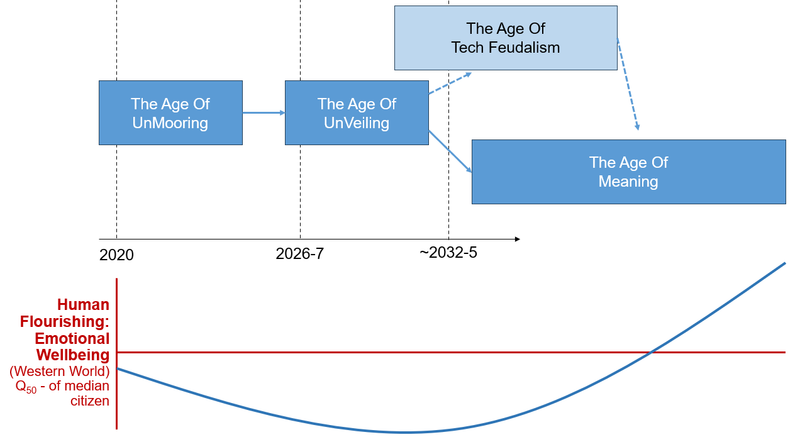
These trends will bottom out eventually. I know that. I hope that. I hope we don’t all hit the rocks at the bottom of the cliff before the direction of travel reverses. We’ve been predicting an Age Of Meaning for some time now. An age where we collectively come to realise there are problems that shouldn’t be solved. That the distillers pouring twelve years of their love into a bottle of Laphroaig Islay single-malt Scotch will be fully appreciated again. That we collectively opt for flourishing. Sláinte.
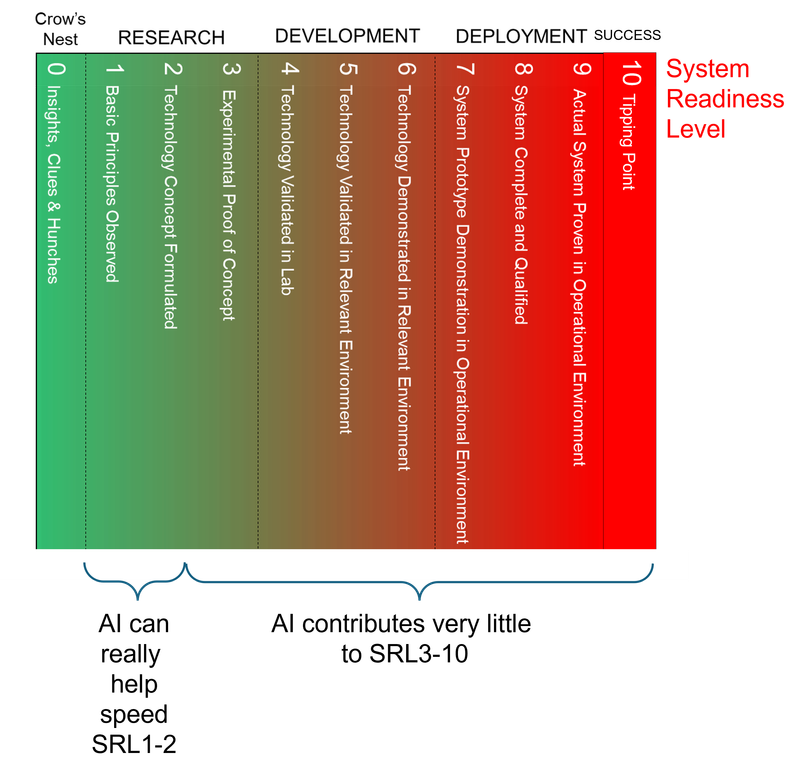
(Predicted shift in flourishing – adapted from the 1%ers, How New Things Get Done’ book.)
I have to admit this one surprised me. Many years ago, I happened across one of those websites offering advice for solving some of life’s trivial problems. The trivial problem in question being the indent marks left in carpets after heavy furniture has been stood on it for a prolonged period of time. The solution involved placing an ice cube into the indent and leaving it to melt. Hey presto, the website claimed, tomorrow the indent will have disappeared.
Finally, this week, after moving a piece of extremely heavy furniture and seeing the four rather depressing indents it had left behind, I knew something would have to be done if I was going to avoid having to move the extremely heavy furniture back again. After exhausting all traditional remedy routes – fingernails, wire-brush and catnip (cat claws having had a significant effect elsewhere on the carpet, albeit not in a good way) – it felt like time for an experiment.
One that I figured would best be done by trying one ice-cube in one of the indents. So that, if the experiment went horribly wrong, I’d be able to place a plant pot or something equivalent over one bit of worse-than-before carpet rather than four.
There was an immediate problem. The cat thought the ice-cube was a cunning new game. Meaning that, when I returned to look at what was happening to the carpet an hour after placing the ice-cube in the first indent, the ice cube had magically moved itself to a completely different, non-indented part of the carpet. The cat was duly instructed on the ways of science, and the need to not tamper with experiments. This mainly involved bribery of a prime chicken breast nature.
And so to the following morning. A carpet with three indents. Here’s a photo of the two of them. Or rather, one of the non-ice-cubed indents and – no longer there – the indent that had been subject to the ice-cube remedy. If the indent had still been there, it would have been on the left-hand side of the photo. It no longer existed.
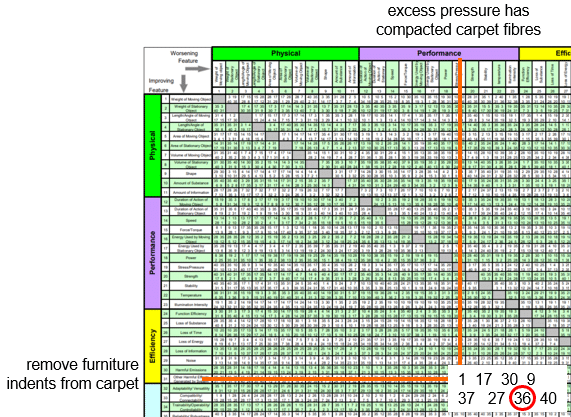
Time to sacrifice another three ice-cubes, and another kilogram of chicken breast. And also time to see what TRIZ might have to say about the problem and solution. A classic conflict: I want to get rid of the unsightly furniture-caused indents and I can’t do it because the weight of the furniture has placed too much pressure on the carpet fibres and ‘irretrievably’ compacted them. Here’s what the Contradiction Matrix had to say about how others had solved similar conflicts:
And there was the surprising bit. Inventive Principle 36, Phase Transition. Melting ice-cubes. Principle 36 is one of the least frequently used of the forty. But there it was. Telling me I should have listened all those many years ago when I first saw the dumb ice-cube trick. It wasn’t dumb, it was what the world’s smartest problem solvers did.
I can sense a whole new series of dumb-ancient-remedies-that-aren’t-dumb-at-all case studies on the horizon. Next up, rhubarb and my collection of burnt pans…
The lithium battery has provided an enormous leap forward for mankind. Smartphones, drones, long-distance electric cars, ebikes, all-day laptops, electric monowheels and skateboards – we owe them all to lithium.
They don’t go into thermal runaway and let go often, particularly if they’re well-built to tight standards and properly cared for, but there are so many now in our homes and businesses, garages, backpacks and vehicles – and so many cheap, non-standards-compliant cells out there – that spectacular TikTok’d and Tweeted lithium battery fires are now a fact of life,
“Fires” might not even be strong enough language; even a small one can explode with enough force to blow the windows out of a room. They can turn into molten-metal-spitting flamethrowers, setting fire to nearby buildings and vehicles. They can be very difficult to suppress once they get going.
Here’s the basic conflict mapped onto the Contradiction Matrix: we need to improve safety, but can’t because of the high energy storage density, lack of material stability and vulnerability to thermal runaway…
Handle high-density batteries with care; know your limits; enough said. But researchers from Clemson University and Hunan University now say they’ve made a breakthrough.
The team has created a new type of rechargeable lithium battery by replacing the typical, highly-combustible electrolyte fluid with [Principle 35] … well, more or less the stuff you’d normally find in a fire extinguisher. Instead of using the normal, flammable organic solvents for the battery electrolyte, the researchers used a modified version of 3M’s Novec 7300 [Principle 39] non-flammable heat transfer fluid.
“An electrolyte,” writes one of the researchers in a piece for The Conversation, “allows lithium ions that carry an electric charge to move across a separator between the positive and negative terminals of a lithium-ion battery. By [Principle 5] modifying affordable commercial coolants to function as battery electrolytes, we were able to produce a battery that puts out its own fire.”
The self-extinguishing electrolyte performed well in both lithium and potassium-ion batteries, refusing to catch fire even when nails were driven through them.
The fire extinguisher solution performed well as an electrolyte, too, working well between -75 to 80 °C, handling extreme hot and cold significantly better than conventional electrolytes, and in some cases retaining battery capacity over a considerably higher number of charge cycles.
And the best news? It seems it should be remarkably easy to roll out at commercial scale.
“Since our alternative electrolyte has similar physical properties to currently used electrolytes,” write the researchers, “it can be readily integrated with current battery production lines. If the industry embraces it, we expect that companies will be able to manufacture nonflammable batteries using their existing lithium-ion battery facilities.”
That word ‘if’ is now the key. The Clemson researchers have done the ‘1% inspiration’ part of the innovation process, now its time for the ‘99% perspiration’. With maybe this time around half of the perspiration being directed towards overcoming ‘damn, why didn’t we think of that’, Not Invented Here syndrome.
Facts are simple and facts are straight Facts are lazy and facts are late Facts all come with points of view Facts don’t do what I want them to Facts just twist the truth around Facts are living turned inside out Facts are getting the best of them Facts are nothing on the face of things
Talking Heads, Crosseyed & Painless
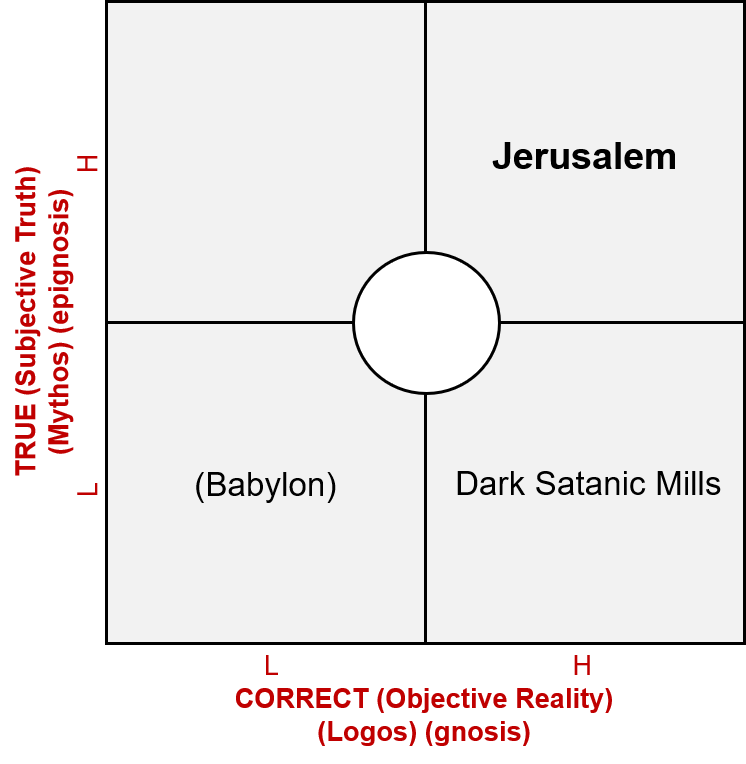
I realise a lot of people have an aversion to 2×2 matrices. Usually, I find, because they’ve nearly always seen them as categorisation tools, rather than what I think is their actual purpose. Or purposes. The first of which is that the best ones help us to identify contradictions. The second is that they’re much more useful when viewed as a kind of map. One in which we work out where we are, where we’d like to be and then start thinking about how we can get from one position to the other. The third – more subtle – purpose is when they force us to think about the dynamic nature of the world.
One of the 2×2’s that has had a big impact on how we conduct both our innovation and troubleshooting work is the True/Correct Landscape I first felt brave enough to talk about just over five years ago (https://www.darrellmann.com/yes-that-is-correct-but-is-it-true/). The realisation that provable, fact-based, ‘correct’ reality is not the same as ‘truth’ still takes a little while for people to get their heads around. Now comes the perhaps equally jarring realisation that both dimensions are also dynamic.
Here’s the original matrix:
Now let’s try a couple of thought experiments with it.
The first involves thinking about it as a map. In which case we need to become aware that this map is not the territory. The territory in this case, if we focus on the top right hand corner, ought to be defined by ‘all that is (factually) knowable’ in the x-axis direction, and ‘Ultimate Truth’ in the y-axis. These two axes define the yellow shaded territory in this image:
The True/Correct Landscape – ‘the map’ – then sits on top of this yellow territory. We might think of this grey area as mankind’s current understanding of knowledge and truth. The top right-hand corner of this area then in effect represents ‘all that is currently known’ in the x-axis direction, and ‘our current understanding of truth’ in the y-direction. Finally, we might imagine how, as our collective understanding of the world increases over time, the position of the grey area will both shift upwards and rightwards, and also increase in size. The grey area, in other words, is like a moving satellite, floating over the territory.
Now let’s try a second thought experiment. This time one where we zoom in and think about a more detailed and specific situation where a person might find the True/Correct Landscape useful. Think about an entrepreneur conceptualising a new enterprise, for example, or someone thinking about setting up a new charity organisation, or someone planning a new religion, political party, or maybe even a new educational institution.
During this person’s initial thinking, a smart move would be to think about where they would like to position themselves on the Landscape. Even smarter would be to aim for the top right-hand corner. In which case they would gather together the best of the globally available – known – factual knowledge, and they would define a mission and vision that was consistent with our best interpretation of ‘truth’. The institution should ‘do no harm’ for example, or encompass ideas around ‘always doing the right thing’, writing a code of ethics, determining to treat employees as fully-functioning adults wanting to do meaningful work, or, if we really wish to push the limits, to respect and assure sanctity of life.
We thus build the institution on as solid (and ‘futureproof’) a foundation as possible: we’re going to do the right things for the right reasons.
Then we start. It is now time to get our heads down and get on with the job of turning the idea into the reality. We find people to join us on the mission, and we form a huddle to work through all the gory details of who our customers are going to be, what they want from us, when and where they want it, and how much money they’re prepared to pay for the benefits we’re going to give them. As soon as possible, we’ll test the model, no doubt learn that many of our hypotheses were wrong, and that we therefore need to pivot to a Plan B. And then probably Plans C through W, until eventually, if we’re persistent enough, and and we earn enough money to keep going through all the scary going-backwards times, we become successful. Customers love us. Investors love us. We have ‘made it’. We grow market share. We become the dominant player. We have lots of spare revenue that allows us to re-invest and ‘stay ahead’ of competitors. Life is good.
Which usually then means that life is about to become less good. For two main reasons.
The first is that the institution begins to become much more insular. We develop psychological inertia. We focus on our solutions and our knowledge and forget that the rest of the world is also busy generating new knowledge, recognising that customer needs are changing and hence conceiving and developing new solutions. One day a disruptive threat arrives into our nice, comfortable market. We laugh at it, sure in the knowledge that it will never displace our great products and services. Our knowledge is expanding, but the rest of the world’s is expanding faster, and hence, in terms of the True/Correct Landscape, relatively speaking we’re heading backwards, away from the top right corner we started.
Even worse (usually), the success of our institution also leads to hubris, and a growing belief that our mission an vision in someway represent not just our ‘right way’, but everyone else’s too.
Even worse than that, the larger the institution becomes and the more customers we serve, the more we begin to encounter things that don’t fit our initially defined principles and values. Some customers become more valuable than others. Then we allow ourselves to think its okay to sacrifice one or two ‘outliers’ for the sake of the majority. Then, when it starts to become more challenging to meet the quarterly projections, comes a realisation that some customers are more valuable than others. Some lives are more sanctious than others. Then the slippery slope begins to get more steeply downwards pointing. Sanctity of life, except for those people over there. Sanctity of life, except our enemies. Sanctity of life, but its okay to kill enemies in order to preserve those on ‘our side’. And so on. The point being that ‘our truth’ becomes precisely that: a truth that shifts further and further away from what the rest of the world would recognise as the truth. Our hubris and increasing willingness to compromise our ideals drops us faster and faster down from the top right-hand corner of the Landscape, until one day we wake up and realise we’re no longer even in the top right hand quadrant. The world has moved on and therefore, in relative terms, we’ve gone backwards. We were once the lauded pioneers. Now we’ve become the protestor-surrounded evil empire.
Just a thought experiment. Or two.
Or maybe a reminder that the three biggest issues preventing an institution from being FutureProof are psychological inertia, hubris and (moral) compromise.
As a corollary to the Principle 9 solution from yesterday’s micro case study, here’s another, more recent example. This time from China. A place where, for various historical reasons, society’s elites attached a high level of prestige to the consumption of shark fin. Usually in the form of soup. Unlike sauerkraut, shark fin doesn’t taste of anything. It has virtually no nutritional value either. And, if the bowlful I was once ‘honoured’ with by hosts apparently keen to impress me is typical, it also has the approximate texture of old linoleum. As a dining experience, it ranks right up there with my experience at the ‘Total Cow Solution’ restaurant in Beijing, where I was encouraged to consume the ‘special’ nine-course dinner, each course of which featured a different part of a cow (the first course was testicle in blood jelly. I didn’t ask what was in the subsequent courses).
Anyway, cows aside, by 2010, the prestige-seeking masses of China were consuming seventy-three million sharks a year. Which, the authorities, calculated, was no longer sustainable.
Something needed to be done. The shark carnage needed to stop, but eating shark fin soup was still very aspirational and being seen to be consuming it made people feel like they were somehow part of the elite. Here’s what the conflict looks like mapped onto the Business version of the Contradiction Matrix:
Enter Prior Counteraction, again.
Firstly, a public information campaign was launched. It was headed by a suite of prestigious celebrities and elites including basketball star Yao Ming and – importantly – the President, who instructed that sharks-fin be removed from all official banquets
Between 2011 and 2018 shark consumption in China fell by 80%. Not quite as effective as sauerkraut’s impact on scurvy, but on the other hand, nearly sixty million sharks a year are likely grateful.
Scurvy, the disease known as the plague of the Sea, and the Spoyle of Mariners was responsible for somewhere around two million deaths between 1500 and 1800. In 1769, the English explorer, Captain James Cook set sail for the South Pacific with 7860lb of what he thought might be the cure. Sauerkraut. The only problem was that the pungent fermented cabbage looks awful, smells awful and pretty much tastes awful. And so he had a problem: how to convince the crew that they should chow-down and eat their daily ration.
Here’s a classic contradiction situation. Cook wanted to reduce the vulnerability of his crew to scurvy but was being presented by numerous negative effects. Here’s what the Contradiction Matrix has to say about how other problem solvers have successfully dealt with this kind of problem:
Captain Cook’s solution was straight out of the Principle 9, Prior-Counteraction playbook. At the beginning of the voyage, he instructed that the foul foodstuff would only be available to the ‘Cabbin Table’ and not to the crew.
The crew, seeing the bosses eating something that they weren’t permitted to have played on their (and all of our) prestige and status needs.
‘The moment they see their superiors set a value upon it, it becomes the finest stuff in the world’, Cook wrote in his journal.
Sure enough, the lower ranked players began requesting it. Not long after that, such was the demand, sauerkraut had to be rationed.
The number of men that died from scurvy on that expedition was an unprecedented zero.
Humans love contradictions. We hate them too. We instinctively recognise them and outwardly purport to not know what they are. We can subconsciously solve them, but consciously we usually can’t.
Illustration. Here are a selection of some of the most admired opening lines from classic books. What do they have in common?
Answer: They all contain a contradiction. A contradiction that instantly hooks us into wanting to keep reading. A hook that is picked up by our salience network.
The salience network is a crucial neural network connecting various different parts of the human brain. It is responsible for detecting and filtering important information from the environment. It helps prioritise sensory stimuli, emotional cues, and other relevant signals to guide behaviour and attention. The network plays a vital role in various cognitive functions, including decision-making, emotion regulation, and social behaviour.
The salience network also plays a significant role in conflict monitoring and resolution within the brain.
The anterior cingulate cortex (ACC), a key component of the salience network, is particularly involved in conflict detection. It identifies discrepancies between different pieces of information – such as when we read an apparently nonsensical opening-line of a novel – or between internal goals and external stimuli. When conflict is detected, the ACC signals other brain regions to engage in cognitive control processes, such as attentional allocation, inhibition of irrelevant information, and decision-making.
Moreover, the salience network interacts with other brain networks, such as the executive control network and the default mode network, to facilitate conflict resolution. By integrating information from various sources and coordinating activity across different brain regions, the salience network helps prioritise relevant information and guide adaptive behaviour in the face of conflicting demands.
The reason we love reading stories – especially ones with great opening-lines – is that they teach us how the protagonist can overcome impossible odds to solve an ‘Ordeal’ and thus resolve the contradiction that hooked us in the first line. Stories are built on contradictions. We love stories. Therefore, we love contradictions. In the world of fiction at least. In the world of reality, after the age of eight we get taught how to make trade-offs and compromises and start to develop our zero-sum bias. After a few years of this ‘education’ we forget the lesson that stories are intended to convey. We call this replacement compromise perspective ‘optimisation’ to make it sound like a good thing. It isn’t a good thing. It simply means we turned ourselves into Sisyphus. Rolling immense compromise boulders up mountains and then watching them roll back down every time they near the peak. All the while, a distant clock striking thirteen.