

I live in an old Victorian house. Which has lots of benefits, but also a few annoying quirks. Most of which usually involve water in places you don’t ideally want water. The beginning of this year saw the arrival of a new leak above the kitchen window. We’d had what felt like a whole month of rain leading up to the start of the leak, so my troubleshooting psychological inertia took me outside and up a ladder to clear out the guttering. That didn’t work, so then I started looking for cracks and gaps in the walls and eaves. There were a couple of unlikely looking cracks. I tried a temporary silicon filler. That didn’t work either. At which point my better half, having now seen the stain on the kitchen ceiling grow to the size of an expensive redecoration job, the work surfaces covered in buckets, and, the last straw, water dripping into the light-switch, decided we needed professional help. Somewhat amazingly, Devon roofers usually being unwilling to climb onto roofs in Feburary in the rain, someone turned up the following morning. He couldn’t find anything wrong. So then we convinced another one to come. He couldn’t find anything wrong either. As he left, he suggested that perhaps the water was coming from inside the house. I told him that I’d looked and there were absolutely no pipes anywhere above the kitchen window. I looked again. It was impossible. But now there was no other viable alternative. So I tried turning the water off at the mains. Within minutes, much to my surprise, the sound of drops falling from the ceiling plopping into the line of buckets stopped. I looked harder for hidden pipework. Nothing. I then attempted to convince better half that maybe we could live with only turning the mains back on when we needed water. This didn’t go down well. I sort of agreed, the stopcock being several yards away from the house at the bottom of an arm-length hole in the ground inhabited by what always seems like half the spider population of the county. It was time to call in the professionals again. This time a plumber. He couldn’t find any pipework in the vicinity either. So he said the only thing we could do now was remove a part of the kitchen ceiling and see what we could see above it.
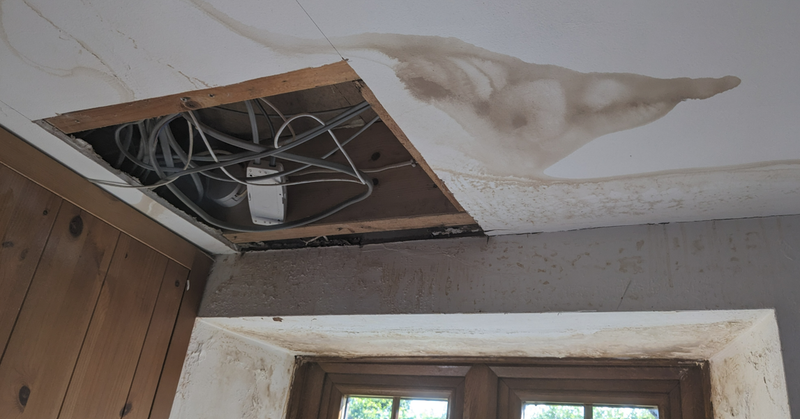
When he’d finished that task, the kitchen was covered in plaster dust and buckets and there was still no sign of the source of the leak. The only new clue was a damp ceiling joist. Meaning the leak must be upstairs in the better half’s office. The general rule in the house is that only she is allowed in her office. Now there’s a plumber in the room, re-arranging all the furniture, lifting carpet and then a couple of floorboards. Still nothing. Getting a little desperate now, he pulls away the skirting board. And finally, there it is, the dripping mains pipe.
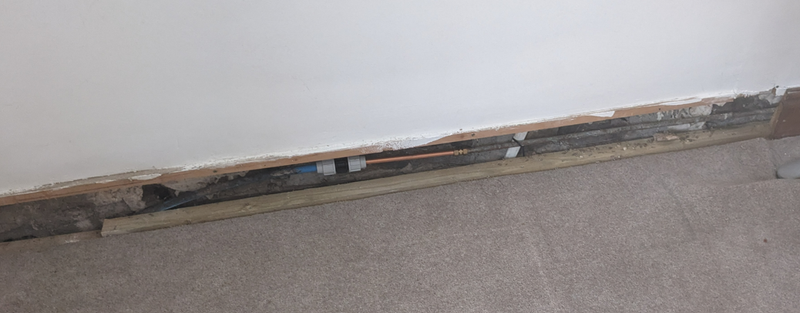
At this point, I should perhaps also add to the story the fact that the people we bought the house from fifteen years ago turned out to be DIY-nuts. And more to the point not very good ones. If a job was worth doing, in Captain Bodge’s eyes, it was worth doing badly. Despite re-wiring most of the house after we moved in, there are still one or two ghostly lighting mysteries that have never been solved. And now, it turns out that the good Captain had at some point taken it upon himself to re-route the pipework from the mains into the house by feeding the pipe vertically up the inside of the wall, into the wall of the now precious office and through to the end wall of the office into the rest of the house. Don’t ask me where precisely, because I still don’t exactly know where it goes after it passes behind the office skirting board (probably because I’m still slightly scared at the sight of the Captain Bodge tie-wrap connecting the pipe to a passing electric cable conduit – see photo).
Meanwhile, now we’ve found the leak, the plumber looks at the 4” square cavity through which the leaky pipe is passing, gets down on his hands and knees, head to the gound, looks at the three (thanks, Captain Bodge) transition joints, scratches his head and let’s out a long sigh. No doubt at the unlikely prospect of being able to do what in effect looked like the plumbing version of keyhole surgery. ‘I’m getting too old for this’, he said as I watched him try and hacksaw off the offending joint and then, worse, install a new compression fitting into a space that had room for either the fitting or his hand, but not both. By way of what I hope is some kind of consolation, I tell him that I’ll re-install the skirting board and return the office to something like its original state. And I’ll fix the now very blown-looking light switch in the kitchen.
Six months later, we’ve finally managed to get a builder to come and repair the hole in the kitchen ceiling.
The point of this story is that during these six months it feels like life has decided to torture me with lots of images and stories of how, soon, we’ll have plumbing robots that will come and sort these kinds of leak problem out.
I understand that the AI and robot-hungry tech bros have a vested interest in painting a bright rosy picture of a utopian future where robots do all our manual work for us at the drop of a hat, but sometimes their level of naivety is so astonishingly high that I’m now convinced the primary existential threat to humanity is their apparent lack of understanding of the absolute basics of how new things get done. It’s one thing to win Nobel prizes for developing super-cunning protein folding algorithms that will create lots of exciting new proteins, quite another to put any of those proteins into our mouths. Similarly, it is one thing to train a robot to change a u-bend in a shiny new laboratory sink, and a very different thing to expect that robot to come and find and fix my leak. At this point in history, we know how to train robots to do very specific tasks. We give them lots of training data, and tightly bound the variability of the task. We can see the results of this design philosophy in the masses of industrial robotic solutions designed to operate 24 hours a day on highly repetitive jobs in very tightly controlled environments. Specialists know how to train specialists. Especially robot specialists.

Designing generalists, on the other hand, requires a completely different design philosophy. One that does not exist at the moment. Humans aren’t great at doing repetitive jobs. We’re two-9s reliable at best. AI and robots will beat us every time on boring repetitive tasks. What humans are great at is being creative generalists, capable of rapidly adapting to previously unknown situations and circumstances.
In the aerospace industry it has long been known that a two-9s pilot is not good enough to fly a plane demanding 12-9s and beyond levels of passenger safety. That’s why the automatic pilot, George, flies the plane for 95% or more of every flight. Another of the reasons planes are easily the safest form of transport is because planes have a very tightly constrained flight envelope. Don’t fly higher than this, don’t fly faster than that, don’t fly slower than that, don’t take-off if you weigh more than this. Stay within the envelope and George will get you where you need to go. On the other hand, get a simultaneous Canada-goose-strike in both your engines during take-off and George is completely out of his depth. Now you need Sully.
Same thing with my Victorian, Captain Bodge leak. The only time I’ll be inviting a robot in to fix that kind of problem will be the day the world knows how to design twelve-9s reliable generalist robots. The robot plumber that’s also capable of finding hidden pipes at a location its never seen before, making holes in the ceiling, removing skirting boards, doing keyhole pipe repair, cleaning up after itself, and re-assuring my better half that she’ll get her office back exactly the way it was before.
It will happen one day. But not in this AI Hype Cycle. Or the next. Or the one after that. In other words, when Satya Nadella suggested the world was ‘one innovation away’ from AGI, he probably meant ten. Maybe twelve.