I’ve been reading John Higgs’s 2021 book, William Blake versus The World, and finding it enormously helpful. Blake has always been one of those figures I have admired more than understood. That is partly because he was writing more than two centuries ago, in a world sufficiently different from ours that it is easy to lose sight of what he was reacting against.
Higgs has helped me particularly with Jerusalem.
Like most English people, I have heard the poem – or, more accurately, Hubert Parry’s beautiful 1916 musical setting of Blake’s words – countless times. And like many people, I have always been slightly mystified by its status as something approaching an unofficial English national anthem.
Why Jerusalem?
John Higgs’s interpretation has helped me see it in a completely different way.
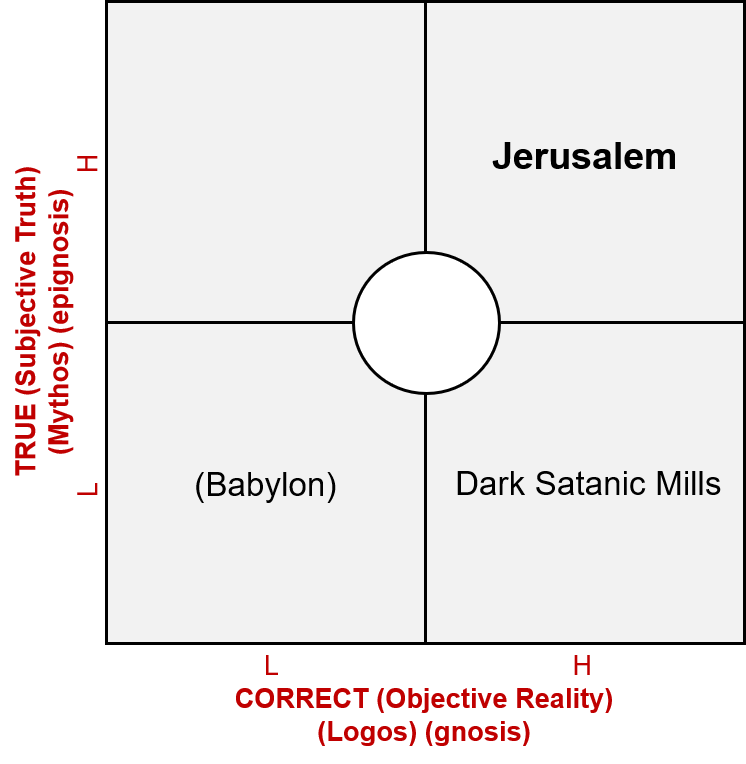
For many years, I have drawn a rather crude two-by-two matrix contrasting True and Correct. By “Correct”, I mean the objective world: facts, evidence, measurement, science and the material reality that emerged so powerfully from the Enlightenment. By “True”, I mean something rather different: the subjective world of meaning, mythos, imagination, spirit and those things that cannot necessarily be measured but nevertheless matter profoundly to human beings.
As with all goo 2×2 matrices, the ideal place to be is the top-right corner, in this case the place where True and Correct are both present.
And, reading Higgs, I suddenly realised that this is remarkably close to what Blake appears to have meant by Jerusalem.
Blake was living through the beginnings of the Industrial Revolution and the continuing consequences of the Enlightenment. Humanity was becoming increasingly successful at understanding and manipulating the material world. Science was telling us more and more about how things worked. Industry was transforming the physical landscape. Reason and measurement were becoming dominant ways of understanding reality.
All good things. Except, in Blake’s view, something important was being lost. The material was becoming separated from the immaterial. The measurable from the meaningful. The Correct from the True.
Blake’s Jerusalem, as I now understand it, was not simply a religious place. It was a metaphor for a world in which these things were reunited. In my crude matrix, it is the top-right corner. High Correct. High True. A place where we understand the objective world without losing our connection to meaning, imagination and spirit. A place where science and art do not compete. Where reason and imagination are not enemies. Where the material and the immaterial belong together.
That sounds rather more interesting than the version of Jerusalem I had previously carried around in my head.
And then there are Blake’s famous “dark Satanic Mills”. Whatever the precise historical referents Blake intended – and there is plenty of debate about that – Higgs’s contextualisation makes the broader idea easier to understand. The “mills” represent, at least metaphorically, a world in which the material has become dominant. A world of machinery, industry and reductionism. A world that is increasingly capable of manipulating reality but is in danger of losing sight of why.
In my matrix, that looks like the bottom-right corner: High Correct. Low True. We know how things work. But we no longer know what they mean. We have facts without wisdom. Information without purpose. Technology without imagination.
And Blake’s criticism was not confined to industrial machinery. He was equally suspicious of institutions of learning – especially Oxford and Cambridge – when they appeared to him to have reduced the world to what could be rationally analysed and categorised.
The irony, of course, is that we are still remarkably good at building that bottom-right corner. Perhaps better than ever.
Blake’s opposite to Jerusalem was Babylon. Again, I don’t want to turn this into a discussion about religion, because I think the metaphor works perfectly well without one. If Jerusalem represents the place where meaning and reality are reunited, Babylon represents its opposite: a world in which that connection has been lost altogether. In my matrix, I see it as the bottom-left corner: Low Correct. Low True. A place detached from objective reality, but without replacing it with genuine meaning. Not truth. Not correctness. Just confusion.
Jerusalem and Babylon, then, become opposite poles in a much broader human problem. How do we avoid losing either the objective reality of the world or the subjective truths that make life meaningful?
Which brings me back to my original question. Why has Jerusalem become something approaching an unofficial English national anthem? Because if Blake meant what I now think he meant, it is a rather odd choice. The England Blake imagined was not the England that existed. It was the England he hoped might one day be built. “Jerusalem” was not a celebration of the status quo. It was an instruction. A challenge. A destination. And, as far as I can see, we are not consciously trying to build it. We continue to separate science from art. Facts from meaning. Technology from wisdom. The measurable from the meaningful. We are extraordinarily good at the Correct. AI is even better. But both are much less good at the True.
And yet, when Parry’s music begins and thousands of people stand and sing about building Jerusalem “in England’s green and pleasant land”, something clearly happens. Perhaps most people singing it have no idea what Blake was actually proposing. Perhaps I didn’t either. But perhaps that doesn’t matter. Perhaps there is something subliminal in the appeal. Perhaps, underneath all the flags, nostalgia and ceremonial occasions, people are responding to something deeper.
Perhaps they are singing about a place they cannot quite describe. A place where the things we have separated might somehow be put back together. A place where we don’t have to choose between being Correct and being True.
Perhaps that is why Jerusalem still works. And perhaps the more interesting question isn’t why English people treat Jerusalem as a national anthem, but rather, when thousands of people sing it, are we – without quite knowing it – singing about the world we still want to build?