
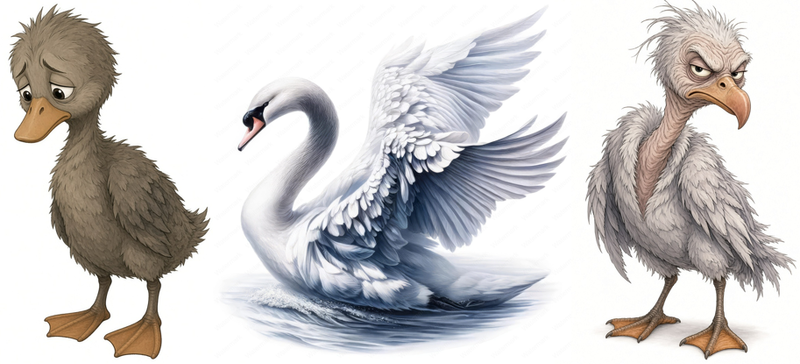
Every culture has its version of the ugly duckling story. Different from the others, awkward and seemingly unattractive, the duckling doesn’t fit in. It is mocked, rejected and misunderstood. Until, one day, it grows into a beautiful swan.
The moral is usually taken to be that appearances can deceive: what looks ugly today may turn out to be beautiful tomorrow. The outsider may become the admired insider. The misfit may become the influencer.
It is a surprisingly good metaphor for innovation. New ideas often begin life looking a bit like ugly ducklings. They are different. They don’t fit existing categories. They challenge assumptions. Most people don’t understand them, and many people don’t like them.
Then something changes. The idea begins to work. Customers discover its value. Adoption accelerates. The previously strange becomes desirable. What was once dismissed becomes fashionable. Eventually, everyone wants to be associated with the swan.
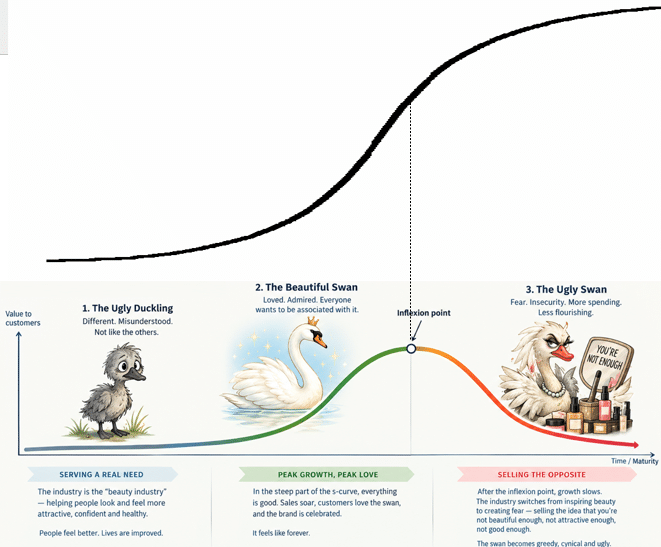
This is the familiar shape of the S-curve. At the beginning, progress is slow. The idea is finding its feet. Then comes the steep part of the curve: adoption accelerates, customers love the product, revenues grow and confidence builds. The organisation has found something that genuinely works.
For a while, it can feel as though the good times will last forever. But they don’t. Every S-curve eventually reaches an inflection point. This is the point at which the curve’s rate of growth is at its maximum. Beyond it, the curve continues upwards, but the gradient begins to decline. Growth is becoming harder, and we leave the ugly duckling story and enter a new one. One in which the swan starts to struggle.
In the first half of the S-curve, the organisation is generally doing what it set out to do. Take the beauty industry. At its best, the beauty industry is genuinely about beauty. It helps people look and feel more attractive. Cosmetics can be pleasurable, creative and confidence-enhancing. Hairdressing, skincare, fashion and many forms of personal care can help people express themselves and feel good about themselves.
The customer has a need. The industry helps satisfy it. That is a virtuous relationship.
But then the market matures. The obvious customers have been acquired. The obvious products have been developed. Competition intensifies. Sales targets that were once easy to hit become harder. Margins come under pressure. Growth slows. And the organisation faces a problem that every mature business eventually encounters: how do we persuade people to buy more when they don’t actually need more?
There are many possible answers. Some are good. Innovation can create genuinely new value. Better products can solve new problems. Entirely new customer needs can be discovered.
But there is another answer. One that turns out to be a lot easier to achieve. Change the customer’s perception of the problem. If it is difficult to persuade people that they need to become more beautiful, try persuading them that they are not beautiful enough.
And so the proposition subtly changes. Look how beautiful you could be becomes look at what is wrong with you. Confidence becomes insecurity. Aspiration becomes anxiety. The promise of beauty becomes the fear of ugliness.
Fear is a remarkably effective sales mechanism. Once its logic takes hold, it can become self-reinforcing. The more insecure people feel, the more products they buy. The more products they buy, the more the industry can normalise increasingly elaborate interventions. The standard of the “ideal” moves further away from ordinary human reality, creating yet more dissatisfaction.
The beauty industry has, in effect, started to sell the opposite of what it originally promised.
This is what makes the S-curve more than just a model of growth. It can also describe a change in the purpose of an industry. Before the inflection point, the enterprise creates value by helping customers move towards something they genuinely want. After the inflection point, growth can increasingly depend upon making customers feel that they are further away from it.
The industry doesn’t necessarily become evil overnight. There is no meeting at which somebody announces, “From now on, our purpose is to make our customers miserable.” It happens incrementally. A slightly more anxious advertisement. A slightly more unrealistic image. A slightly more aggressive sales target. A slightly more extreme product. A slightly greater emphasis on what is wrong rather than what is right. Each individual decision looks commercially rational. But taken together, they now, post-inflection point, produce something quite irrational: an industry whose continued growth depends upon the failure of its customers to feel fulfilled.
The beautiful swan has become an ugly one.
The the same pattern is found everywhere. Let’s call it a first principle.
The healthcare industry begins with a noble purpose: helping people stay healthy, recover from illness and live longer, better lives. But a mature healthcare economy increasingly find itself making more money from sickness than from health.
The fitness industry begins by helping people become stronger, fitter and more energetic. It ends up selling anxiety about body image, inadequacy and self-worth.
Fashion begins as self-expression and creativity, before becoming increasingly concerned with the fear of being unfashionable.
Social media begins by connecting people and strengthening communities, before discovering that comparison, outrage and inadequacy are extraordinarily effective ways of keeping people engaged.
In each case, passing the growth rate inflection point triggers the start of what can easily turn into a 180-degree reversal. The business starts by selling the positive condition that people want. Then, as growth becomes harder, it discovers that it can make money by selling the negative condition that stands between people and that positive condition.
Health becomes sickness.
Beauty becomes ugliness.
Confidence becomes insecurity.
Connection becomes loneliness.
Flourishing becomes dissatisfaction.
There is something almost Orwellian about this.
The industry retains its original name while gradually becoming its opposite.
The beauty industry becomes an ugliness industry.
The healthcare industry becomes a sickness industry.
An industry whose stated purpose is human flourishing can end up depending upon human dissatisfaction, and hence creating the precise opposite of flourishing.
And perhaps this is one of the great dangers hidden in the second half of an S-curve.
We tend to think of organisational decline as a financial problem. Growth slows. Costs rise. Competitors appear. Margins disappear. But there is another, deeper form of decline. The organisation can continue to succeed financially while becoming less aligned with the reason it exists. Indeed, its financial success can make the problem harder to see. The swan doesn’t look ugly to those inside the industry, it looks like a monthly pay cheque. In the same way that the problems of mature – top of the s-curve – capitalism, from a capitalist’s perspective, will be solved by more capitalism. That is what makes the ugly swan dangerous at a societal level.
The question is not simply where we are on the S-curve. It is, “what are we selling now?” Are we still helping people achieve something meaningful, something they genuinely value? Or have we discovered that it is easier to make money by convincing them that they are deficient, inadequate, unhealthy, unattractive, unsuccessful or incomplete?
The first half of the S-curve can produce beautiful swans. The second half almost always produces ugly ones. In which case, perhaps the real challenge of innovation is not simply learning how to transform ugly ducklings into swans, it is knowing when and how to retire – or reinvent – those swans before they turn ugly.