
Satya Nadella recently suggested that the world may be “one innovation” away from AGI. I understand what he means. In a field moving as rapidly as artificial intelligence, it is entirely possible that one apparently simple conceptual breakthrough could change the trajectory overnight. History is full of such moments: an invention that suddenly removes a previously immovable constraint and makes what seemed impossible become merely difficult.
But I wonder whether there is another way of looking at the journey to AGI. Perhaps the question is not which innovation will get us there, but how many innovations are still missing?
Over the weekend, we saw what may turn out to be one of them. A team in Shanghai has proposed what it calls Next Concept Prediction (NCP), a potentially significant departure from the way today’s Large Language Models work. The basic observation is deceptively simple. LLMs are fundamentally built around predicting the next token, or, loosely, the next word. Humans, by contrast, appear to operate much more naturally at the level of concepts: we don’t experience thought as an endless stream of individual words, but as structures, relationships and ideas. NCP attempts to exploit that difference. The results reported so far are still awaiting the kind of independent validation that will tell us how significant the breakthrough really is. But if the claims stand up, the potential is striking: a step-change in both efficiency and energy consumption, alongside an important shift in the way machines represent and predict information.
What interests me, however, is not simply whether NCP works. It is why the direction of travel seems so familiar. From a TRIZ perspective, the move from predicting individual tokens to operating at the level of concepts looks remarkably like a jump along one of the classic patterns of technological evolution: the Mono–Bi–Poly trend.
First one element. Then two. Then many. Or, more generally, increasing sophistication in the way components are combined and organised to perform a function.
If that interpretation is right, NCP may not be an isolated stroke of genius. It may be a relatively predictable step in a much larger evolutionary journey. One that will eventually progress along all of the Trends that have emerged from our Evolution Potential research.
If we can look at today’s generative AI systems through this Evolution Potential lens, we can quickly map where the technology sits today, what the Shanghai team have just delivered, and which jumps would be needed in order to achieve the mythical AGI.
The difficult bit being deciding what definition of AGI to use. In the end, I’ve opted for Jeff Hawkins’ vision of machines possessing a more general, human-like capacity for understanding and learning.
Here’s an Evolution Potential radar plot showing the current generative AI position (grey area), the jump just made by NCP (orange) and the number of jumps that would have to be made to satisfy Hawkins’ AGI test (blue).
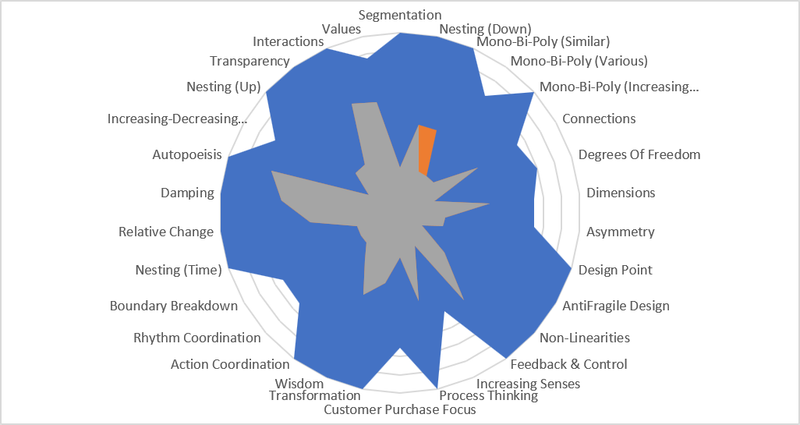
Before the weekend, the total was fifty-eight. Today it is fifty-seven.
All completely predictable. At least in terms of what is needed. The more difficult challenge, of course, concerns the question of timing. How quickly could the jumps be made is one question. How quickly should they be made is perhaps the more important one. Especially in light of the fact that we currently live in a race-to-AGI in which the winner looks like being the one that ignores safety the most. Perhaps, rather than waiting for seemingly ossified Government agencies to act, we should start writing some patent applications and use them to try and throttle the recklessness a little?