
History Rhyming

Termite mounds are often held up as examples of emergent structures. How a set of simple ‘instructions’ hard-wired inside the termite brain can produce enormously complex structures.

Every termite mound is different.

But not so different that a passerby wouldn’t recognise it as a termite mound.

A lot of people skirting in and around the world of complex systems make proclamations to the effect that no outcomes are predictable in a complex environment.

The similarity of termite mounds reminds us that this is not completely true. It might be true enough to tell us that the best way to operate in a complex environment is by making use of iterative processes – try something, see what happens, use the results to formulate our next iteration, repeat. This I agree with. Whoever iterates best, and learns fastest wins. What I don’t agree with, though, is the idea of complete unpredictability. There’s a lot we can’t know, but that’s not the same as knowing nothing.

One termite is simple. A colony of termites is complex.

One human is complicated. Two are complex. Seven billion are complex, bordering on, and occasionally tipping into, chaos.

Is there something that happens when the levels of complexity increase that make it impossible to predict what will emerge?

Well, clearly yes, but the only meaningful way by which to even begin to answer this question is to look at what is happening at a first principles level. The small number of ‘instructions’ in the termite brain are that species set of first principles. With humans the first principles ‘instruction set’ is a little bit bigger. But not much. We all want to be autonomous, we all want to be acknowledged and ‘belong to the tribe’, we all want to feel competent, we all want to do things that are meaningful. The way you were raised by your parents will impact the way you raise your own offspring. The ‘complete’ set of these first principles is looking like a page in a not much longer book of first principles we’ve been gradually decoding over the course of the last decade.

I can’t be sure we’ve unravelled the whole story. Which is a worry. But not so much of a worry that it prevents us from deploying another first principle: if you don’t know the absolute, make use of the relative. In other words, look for stuff that has changed.

So long as the termite mound-building first principles remain unchanged, all termite mounds will look like termite mounds.

So long as the human society first principles remain unchanged, all human societies will look like human societies.

One of the most controversial of our seeing-the-future models is the GenerationDNA four-generation cycle first revealed by the work of Strauss & Howe. We’ve spent the last twenty plus years trying and failing to disprove the model. Meanwhile, during those twenty years, the societal patterns predicted by the model have all come good. Things (like pandemics) happen at random, but peoples’ reaction to those events is not random. Until such times as our collective first principles change, we will keep seeing the same patterns emerging.

Occasionally the first principles have changed. The shift from hunter-gatherer to agrarian societies, for example. Or the shift from agrarian to industrial. Or – maybe – the shift from industrial to some kind of ‘knowledge’ economy. That part we don’t know yet. What we do know, however, is that the world has jumped off its current S-Curve in the last month, and over the course of the next 3 to 4 years will make its stumbling journey to the next one.
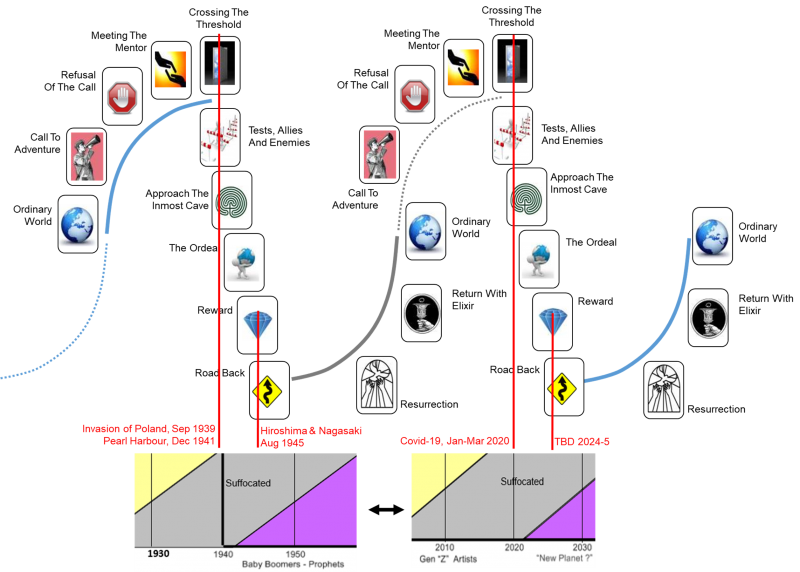
It is during these stumbling years that we have the possibility that the set of first principles shifts. In the worst case, they shift for the worse. If the alt-right populists have their way, for example.  More likely is that the pendulum swings so that a few contradictions get solved, some don’t and some new ones will appear. Consequently, some things in life will get better, some will get worse and others will stay the same. Ideally, if we embark on the journey with some kind of map, we solve the most significant contradictions so that more things get better than get worse. I’m putting my hand up for this strategy. There is a map. It’s sketchy in places, and probably a little wrong in others, but it is a map drawn from a knowledge of complex systems and first principles. Which, at this point in time, as far as I can see, are still the same ones that mankind carried 80 years ago. And 180.
Dodo-Lean

I’m fortunate to be invited to lecture on a number of Lean programmes. My usual job is to provoke Lean professionals so that they’re able to recognise when it is appropriate to deploy lean-thinking, and when it is not. The main times it is not appropriate is when systems find themselves at the top of the S-curve. Top of the S-curve means that a system has hit a fundamental limit and as such ‘optimization’-based improvement techniques won’t work any more.

For the most part, my words, I’m sure, fall on deaf ears. Especially when I suggest that, thanks to several decades of lean-thinking and continuous-improvement activity, nearly every enterprise on the planet finds itself sitting at the top of an S-curve.

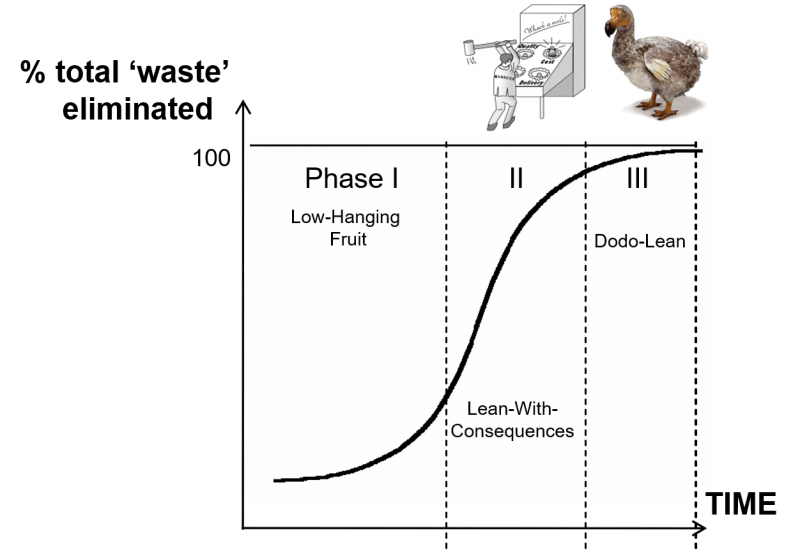
About ten years ago we started to identify three different phases of Lean. The first phase is what we called the ‘Low-Hanging Fruit’ Phase. This is the time when it is relatively easy to find examples of waste inside an organisation. And, when we take steps to eliminate that waste, there are no adverse consequences. The waste was genuine waste.

The second phase starts when attempts to eliminate waste begin to deliver unexpected adverse consequences. This is what might be thought of as the Whack-a-Mole or ‘Lean-With-Consequences’ Phase. This is the period when Lean improvement professionals increasingly find themselves spinning around in circles, gradually realising that every time they think they’ve solved one problem, another one pops up.

Then, finally, there is the third ‘Dodo’ Phase. This is the phase where so much ‘waste’ has been stripped from the system that it is unable to react when the outside world changes. As happened with the now-extinct Dodo.

In nature we see the evolutionary pressures of ‘survival of the fittest’ favour systems that waste less than those around them. But natural systems that optimize themselves too much tend to be the ones that become extinct. The Dodo offering us an iconic example. In its original environment, since most of the Dodo’s food was found on the ground in jungle-like environments, the ability to fly was not nearly so advantageous as having big thigh muscles that allowed the bird to run. Hence, over time, birds with smaller wings and larger thighs were more likely to thrive than those with big wings and small thighs. Putting evolutionary energy into flight-worthy wings was ‘wasteful’ from an evolutionary perspective, and so there came a point where the Dodo was no longer able to fly. Evolution favoured birds that ‘spent’ their available resources on thigh muscles. This is efficiency at work. Stop ‘wasting’ resources on wings. Fine until a predator appears that is able to run (and shoot!) much faster than the bird is able to do. At this point, the ability to fly would have been really useful. Sadly, it wasn’t possible for the Dodo to ‘re-evolve’ wings fast enough to avoid complete extinction.

A lot of the time, the clients that kindly call us in to help are at the second, ‘Lean-With-Consequences’ Phase. TRIZ is the perfect tool for helping in this kind of situation since the ‘adverse consequences’ arising from an attempted improvement action are, in TRIZ terms, merely the contradiction that needs to be addressed. And resolved.

Maybe our high level of exposure to Phase Two enterprises over the years has been something of a self-fulflling prophecy? Whatever the (probably unknowable) truth, my view of the world was that there were a lot more Lean-With-Consequences enterprises than there were Phase Three, Dodo-Lean enterprises. Now, sitting at the beginnings of the global crisis triggered by Covid-19, and watching share prices plummet, ruthless companies sacking staff and should-know-better large multi-nationals begging governments for handouts, I’m beginning to realise my instincts were all wrong. What we’re all watching right now is a world chock-full of Dodo Lean.

On some level, it often requires this kind of crisis to trigger enterprises into meaningful action. Indeed, we’re already seeing just how creative people can be when they find themselves confronted with rules that don’t apply anymore. In that regard, I’m kind of hopeful that many of the Dodos will be able to re-evolve wings and, to mix the avian metaphors, rise from the ashes (I’d certainly be happy to offer my services to see how we might help prove it). On the other hand, I’m also seeing what we’ve been saying for several years right now, an almost complete absence of crisis-solving creativity at the top of these Dodo-Lean companies. So- called leaders that, for the most part, find it easier to send out redundancy letters to half their staff rather than engage their brains and do what everyone with actual skin-in-the-game at the frontline knows to do: get stuck in, survive, thrive.

We know who you are. Another great thing about crises: its almost impossible to hide. There is no more hiding beneath the parapet. These people need to do the honourable thing and get out of the way. Hand over to people with grit, persistence and a belief that what doesn’t kill you will, in business at least, make you stronger. Step up, or step away.

The Crisis Switch

Fortunately, the Nudge Unit is no longer in charge of defining the UK’s response to the Covid-19 situation. Their reign lasted about 48 hours. 48 scary hours. Mainly because, nudging was only ever intended to be an adjunct to an actual strategy, rather than the foundation of that strategy. The idea of Nudge is simple: once you know where you’re going, design the three or four syllables that speak a thousand pictures and launch them into the public consciousness. Then cross your fingers that enough people respond positively to start moving society in the direction you want. Something like ‘Take Back Control’. Or ‘Drain The Swamp’.

The other reason to be happy they’ve been pushed to the background is because, much as they claim to be built around an understanding of human psychology, from where I sit that understanding is partial at best, and wrong-headed at worst.

Take the Nudge Unit belief – now thankfully dispensed with – that people will only comply with difficult instructions for a short period of time, so, therefore, it is important to only send out nudge-speak when the timing is absolutely right.

What this kind of thinking utterly misses are the various binary switches that exist inside people’s heads. The one I’ve talked about most has been the ‘Sick Switch’ (SI ezine, March 2014). When this switch is in the ‘well’ position, life is normal; once I flick the switch to ‘ill’ I’ve given myself permission to accept that things are not normal. It’s not normal to still be in bed at midday, but it’s okay when I’m sick. It’s not acceptable to goof-off going for a run when I’m well, but it’s definitely okay when I’m ill.

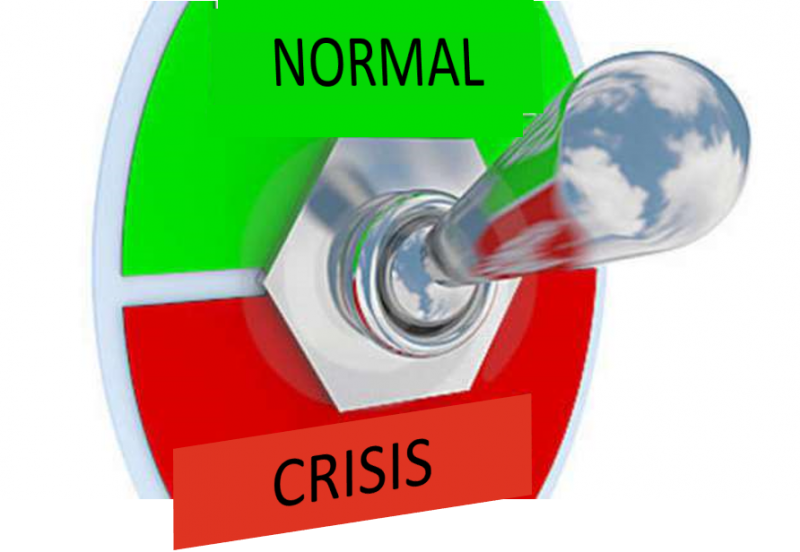
It’s pretty much the same thing with another switch, the one relating to ‘Crisis’. When this switch is positioned at ‘normal’ we might go out to the cinema or to a gig, or spend too much money on a guitar. But when it’s flipped to the ‘crisis’ setting, we know not to do those things. And – most important – as long as the switch stays flipped, we know we still can’t go and do those things. When there’s no crisis, people will get bored with washing their hands ten times a day; when the switch is flipped, while we might still get bored, we wash our hands anyway.

If that’s the case, I hear you say, why is it that a majority of patients fail to comply with their medication instructions? Well, many reasons actually (SI ezine, September 2018), but the overriding one is that something causes us to flip our Sick Switch back to ‘normal’. Our symptoms temporarily disappear, for example, or there’s a big family celebration tomorrow night that we don’t want to miss.

Exactly same idea again with our Crisis Switch. So long as its set to Crisis, we will continue complying with what we’re supposed to be doing in a crisis situation. The simple (first principles compliant) idea being, now we’ve all (well, ‘mostly’ – there are still idiots like Tim Martin and Godfrey Bloom in our midst) flicked the Covid-19 Crisis switch, we need to keep it switched until its safe to flick it back to normal again. Now, there’s a proper job for the Nudge Unit. Hopefully a Nudge Unit that chooses to read more than one psychology text-book in future.

The Rent-Seeker Innovation Challenge

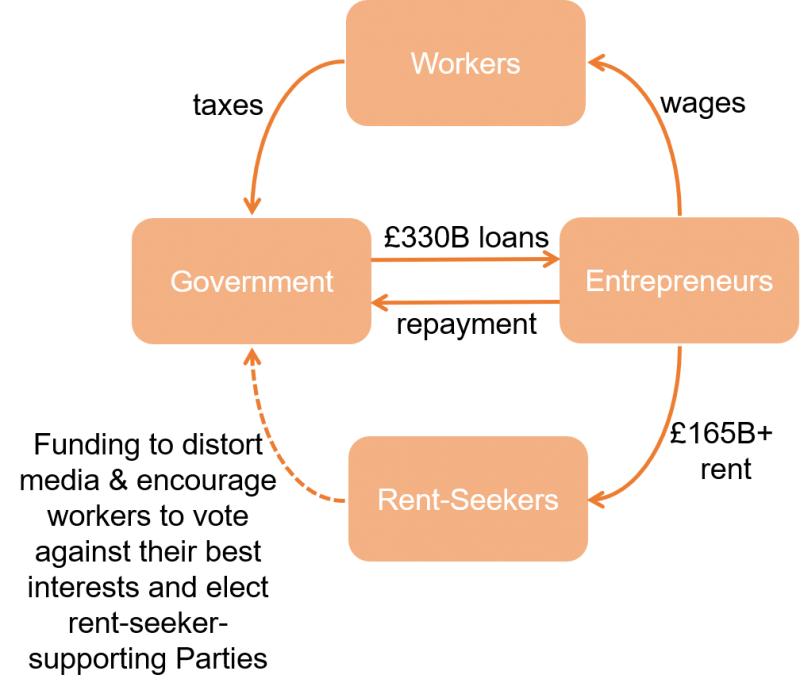
Listening to some of the stories from restaurant owners, shop owners and other small businesses talking about the Government’s offer of providing them with £330B in loans to get them through the Covid-19 crisis, is giving me a sense of impending tragedy. Also a deeper understanding of how the system (unwittingly?) conspires to ensure the rich get richer. Especially the rich that got that way through passive income they didn’t earn. Society’s rent-seekers.

The Government locks-down society and tells restaurants to close for the foreseeable future. They offer to loan money to a restaurant chain so they don’t go out of business. I don’t know the actual numbers but, as a conservative estimate, let’s say half of that loan, should the restaurant owner choose to go down that route, goes to compensating staff who would otherwise lose their jobs. The other half goes to the landlord. The person (or more likely ‘company’) that owns the building. Multiply this by the number of small businesses that find themselves in similar situations and what we end up with is the Government handing over £165B+ to landlords.

The Government is happy, because the restaurants will pay the loans back.

The landlords are super-happy because they keep getting their rents paid.

The restaurant staff are, if not quite ‘happy’, relieved that they still have some vital income.

But, the poor old restaurant-owning entrepreneur is put into a desperate situation because they’re tied up with a debt that is going to strip the profits out of their slender-margin business for the next N years.

What seems utterly wrong about this scenario to me is that the entrepreneur – the person doing all the job-creating work and taking all the risk – loses while the rent-seeker – the person who sits on their fat-arse counting money – wins.  

Not only is this unfair to the individuals involved, it progressively serves to make society more fragile. When people are disincentivised from being entrepreneurial the long-term lifeblood of the economy is removed.

Sure, Government officials will claim, a genuine entrepreneur will still find ways to survive, to be successful and to become rich. The capitalist system is set up in such a way that the struggle is necessary to weed out bad ideas. That struggle mechanism is a vital part of the way things work. Survival of the fittest and all that. I get it.

When people have nothing to lose, its easy for them to make a decision to start a new business. We’ve done it ourselves through the companies we’ve successfully spun- out over the years. The problem – for society – comes when companies and individuals have become successful. Now they have a lot to lose. And so innovation becomes a threat rather than an opportunity. So what do these people do? They buy property. They become landlords. Nice safe income. That even stays safe during a crisis. If the tenants can’t pay, the Government will pay instead. It’s a no-brainer.

Except now the world finds itself in a situation where 98% of the population are in effect paying rent to the other 2%. All of it perpetuated and guaranteed by the Governmment. Who in turn are funded by the 2%. You see the problem.

So, now we find ourselves in another crisis, the innovation challenge is to find ways of breaking this seemingly perpetual cycle of dysfunction. How to help those people that need help, and how to not feed billions of pounds to already-rich rent-seekers.

The imperative for solving the contradiction this time around is that, I fear when the Covid-19 crisis gets as deep as I think it will, if the rent-seekers are allowed to get even richer while everyone else suffers, there will be revolution and the rent-seekers will be guillotined. And the only guarantee if that happens is nobody will have won.

Any and all solution suggestions welcome.

The prize is a functioning society.

Everything More Important Than Everything Else

I like Tom Peters’ work. His 1997 effort, The Circle Of Innovation, still stands up today as some kind of innovation leadership mindset benchmark. Peters could have justified retiring a decade ago. And in some respects he did. Last year’s 450-page, ‘The Excellence Dividend’ in all probability represents a summing-up of all that Peters has written over the course of his career. A lot of it is written in capital letters. Which, I guess, is Tom telling us he has revealed a lot to shout about over the course of his guru-ship-by-wandering-around life. And so we learn that ‘listening’ is the most important leadership trait. And then so is self-knowledge. Reading is leadership requirement #1. And so is saying ‘thankyou’. And so is preparation. ‘Putting people first’ is a leader’s main job. Everything in Tom’s world of advice, it seems, is more important than everything else.

Which, ultimately, says to me that Tom has missed something critical from his catalogue of shout-y advice. If everything is important, nothing ends up being important. And that includes having an ability to prioritse one important thing over another. If everything is important, the only sensible way to navigate the jungle involves carrying a contradiction-finding torch and a contradiction solving machete.

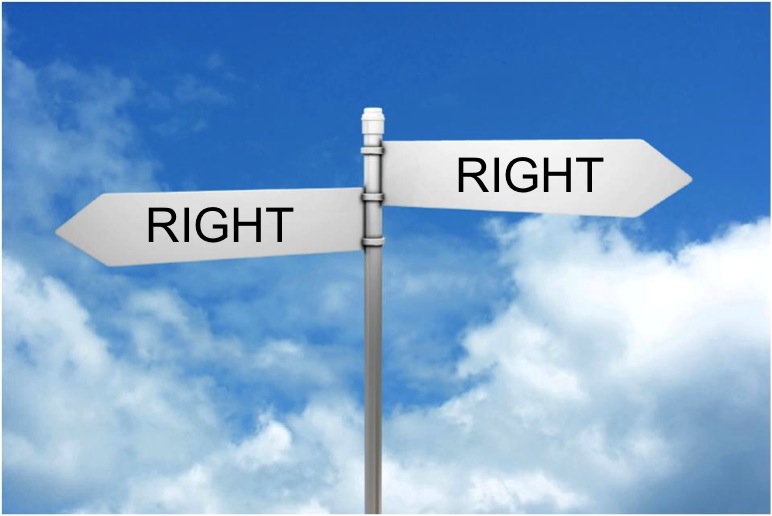
The only way to make meaningful progress in a right-versus-right world is to transcend the contradiction and create higher-level both/and solutions.

If a top-five management guru doesn’t get this, after fifty years looking for excellence, its no wonder we have a world full of leaders who, as we’re already starting to see in the early stages of the Covid-19 chaos, find themselves struggling to deal with society’s right-versus-right problems armed only with either/or tools. Here’s hoping that chaos brings with it some rapid both/and learning. Contradiction finding is (and has actually always been) leadership skill #1. It’s just hidden itself very well.

The Wrong Kind Of Experts?

Covid-19 offers a timely reminder that experts aren’t perhaps such a bad thing afterall. In a battle between Fake News and a real virus, I know who’s side I’m on. That said, its also fair to say that we’re already receiving some pretty horrific advice from the so-called experts.

Which might sound like we’ve just come full circle again. We want experts, we don’t want experts. The problem is what kind of expert is it that we need? Classic consultants answer: it depends.

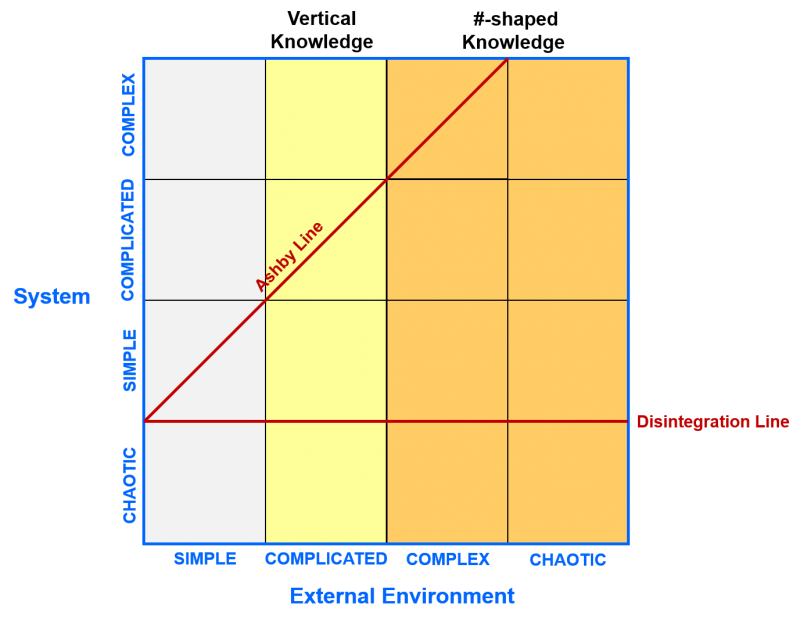
It depends on what sort of situation we find ourselves in. If it’s Complicated, then classic T-shaped vertically-educated domain experts are the people we should seek advice from.  If it’s Simple, anyone that has been given the relevant recipe will do. On the other hand, if the situation is Complex, we need #-shaped experts (SI ezine, Issue 183). People that are able to combine their deep domain knowledge with a requisite level of horizontal skills. In the case of pandemics, horizontal skills in complex adaptive systems and risk management.

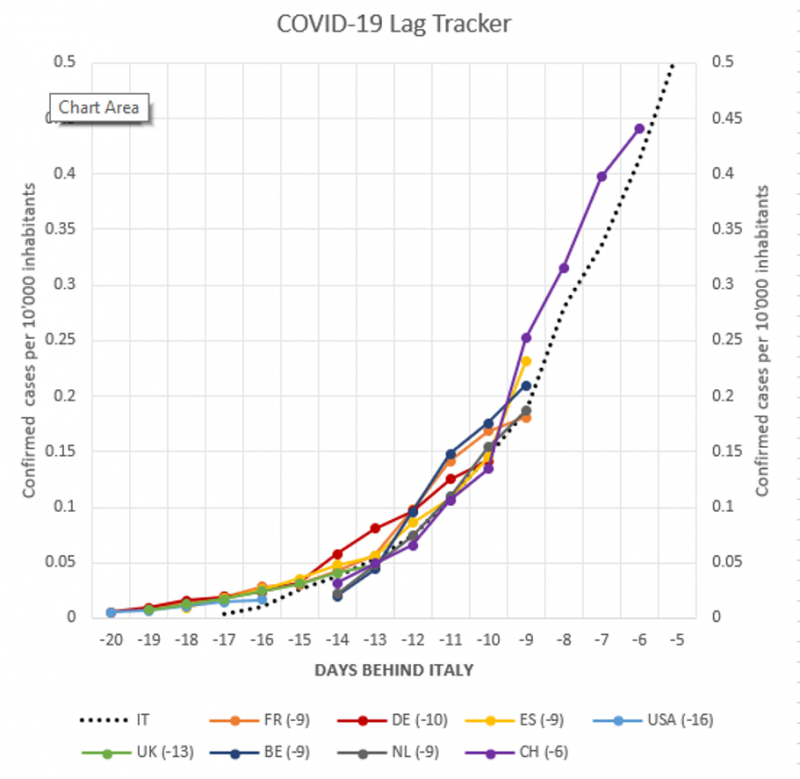
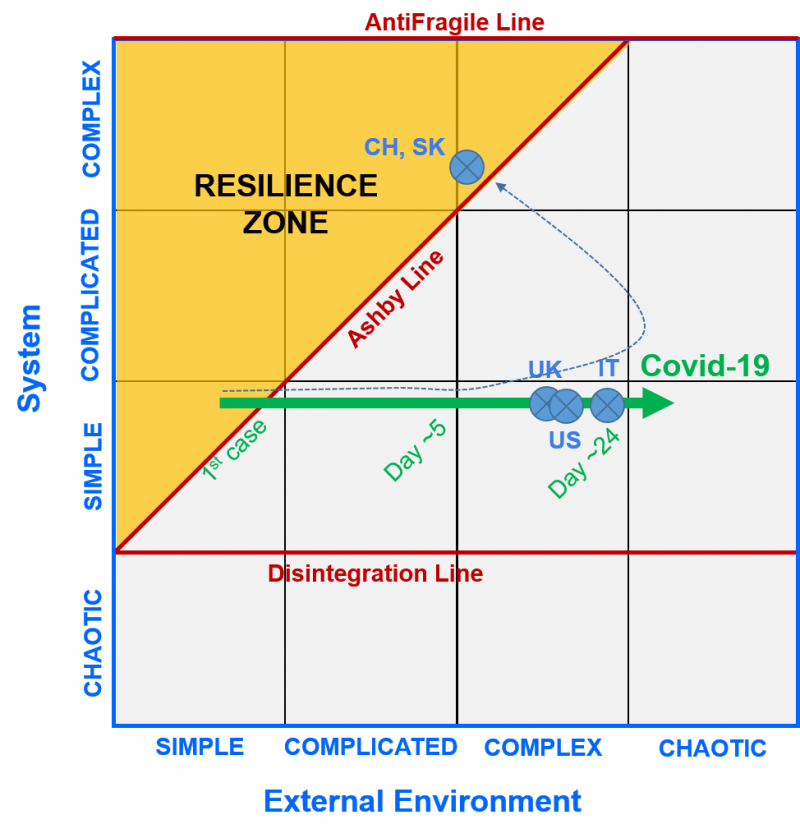
If you’re lucky enough to live in a part of the world that doesn’t have any cases of Covid-19, from a counter-measures perspective, you’re in Simple mode. This means that a range of simple social-distancing measures will likely keep your population safe. Most nations are now past this stage. So simple instructions (failing to take account of first principles of human behaviour) won’t work any more. The acceleration from Simple to Complex we now know from China’s experience happens very rapidly. The transition from Complex to Chaotic, as we’re starting to see in Italy, is almost as rapid. This is the consequence of applying linear thinking in exponential situations.

China acted ‘late’ but, through massive and highly impressive infrastructure initiatives managed to retrieve the unfolding disaster. South Korea acted earlier and more decisively and now seems to have put in place measures consistent with the prevailing complexity of the situation. Italy, meanwhile, it seems is still being guided by medics and politicians (and, by implication, economists).

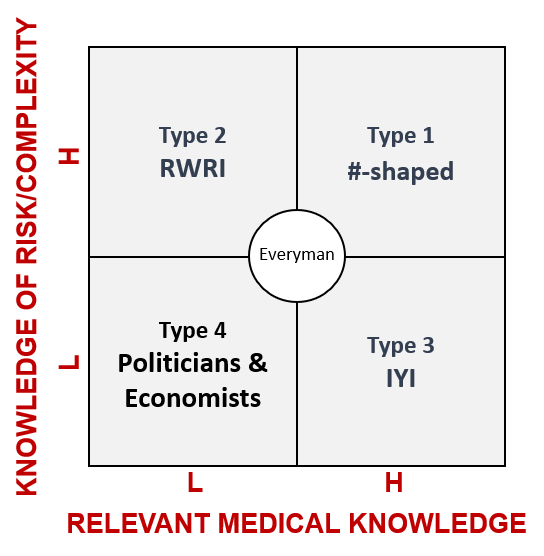
And here’s the problem. Complex situations need #-shaped people, and in the case of Covid-19 there don’t appear to be any. Not in the West at least. If you don’t have these people, your next best bet is Type 2 people like Nassim Taleb and people who’ve been through the Real-World Risk Insititute. The second worst situation is to put Type 3, Intellectual-Yet-Idiots in charge. The worst situation is to have these Type 3 people advising the Type 4 politicians and letting them make the decisions based on, what looks in the UK, like some kind of mind-today’s-pennies-pretend-the-future-is-linear economic trade-off calculation.

No, sorry, backtrack a second, because here in the UK, we’ve got Thaler-inspired ‘Nudge’ people also playing in the game. In theory, Nudge is very much about understanding complex systems. Specifically, in this case, the idea of injecting small psychological messages that you hope will create non-linear shifts across the population. Like telling people to wash their hands more often. In theory, this means we do have some Type 2 people in the game. Except they’re not really. Nudge is good. But only when you’re nudging in directions consistent with a clear understanding of fat-tail risk. And that part seems to be missing from the equation. So what we have in place in the UK right now is that actual worst-case: Half-educated Type 2s (which, I think, makes them Type 3s) listening to Type 3 medics advising Type 4 politicians listening to half-educated Types 2s. I’m sure everything will work out fine.

It is often said that true change only happens in the presence of chaos. So maybe there is some good news in this story. Maybe, in the aftermath of Covid-19, society starts acknowledging the Type 2 people more? And, better yet, starts using them to create more Type 1 people. Fingers-crossed… remember to wash for at least twenty-seconds.

EQ>>>IQ

Every time I look, the catalogue of different types of ‘intelligence’ seems to get longer. Whether it be musical-rhythmic, visual-spatial, verbal-linguistic, logical-mathematical, bodily-kinesthetic, interpersonal, intrapersonal, naturalistic,  existential or moral (to take just the expanded list of the original source of thinking in this domain, Howard Gardner), my working hypothesis is that when a human is born, we all carry more or less the same machinery and potential to develop our overall intelligence. Some will tend to bias that potential towards one form of intelligence over others, while others will have a natural proclivity for another. Vive la difference and all that.

Unfortunately, perhaps because, in theory at least, it has been the easiest to measure, the world still seems fixated on IQ as the primary means of quantifying intelligence. One of the consequences of this is that people with ‘a low’ IQ (e.g. Leeds United fans) somehow get stigmatised (e.g. as ‘Leeds United fans’). The net result is that, because of the sort of work I do, I frequently come into contact with ‘high IQ’ individuals. I’d have to say that some of these people might well have a lot of book-smarts, but they’re also, innovation-wise, the dumbest people I’ve ever met. Their focus on logical-mathematical intelligence has come about because they’ve been fooled into thinking this is the best way to get on in (corporate) life.

From an innovation perspective – innovation being the most difficult thing any person might choose to get involved in – IQ certainly has its place. But far more important is a critical mass of many of the other intelligences. Right at the top of the list being Emotional Intelligence, EQ. EQ eats IQ for breakfast, innovation-wise. EQ >>> IQ.

This is a pity because, in the same way the innovation world attracts a lot of IQ, it rarely manages to attract sufficient EQ. The innovation world to a large extent is an EQ desert. Which, I imagine, might have something to do with fact that 98% of innovation attempts end in failure? I’m not sure how I’d set about testing that the EQ-deficit was significant. But I’m not sure that the answer would be meaningful in any event.

It wouldn’t be meaningful because, what’s happening here is, yet again we find ourselves having a pointless either/or debate. Albeit a subtle one. There might be an overall EQ shortage amongst innovators, but that doesn’t mean we want more EQ and less IQ. Rather it means the multiple intelligence contradiction needs to be managed. Or, better yet, transcended. We want IQ and EQ.

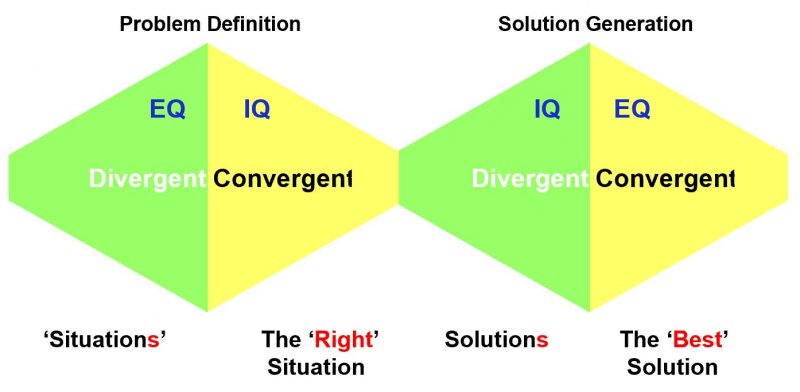
From the ‘management’ side of the story, one thing well worth bearing in mind when an innovation team is working on a complex problem and therefore making use of some kind of divergent-convergent iterative process that different stages of that process benefit from different EQ/IQ ratios.

Having a high level of EQ, for example, is really really important during the initial ‘fuzzy-front-end’ phases of a project when we’re seeking to explore what, if any, market opportunity there might be. Once we’ve explored and diverged as much as possible to identify options, it then becomes time for IQ to take over. Firstly, to help us work out which of the potential opportunities we’ve identified we’re best able to pursue, and then secondly to generate our first swathe of solution clues and ideas.

Finally, when we’ve again ‘diverged til it hurts’, its time for an EQ-dominated mindset to come to the fore again so that we can make sense of the ideas that have been generated, looking at combinations and builds that offer the best chance of resonating with the customer we have in mind.

All four of these stages are necessary, but it is the first and last that best enable us to learn the quickest how we’re going to deliver the ‘best’ solution to the customer. The innovative solution they couldn’t have described to us if we’d gone to ask them directly.

The Blob #445

This is how it works now. Efficiency. Efficiency and the middle-management blob (MMB). Scared, out-of-their-depth people intent on creating knowledge asymmetries that will keep them in power. Asymmetries that allow them to demonstrate improving operating efficiency to those sitting above them, while making the lives of those below steadily worse. Not to mention the poor old customer. Who ends up spending more to get products and services that get progressively worse.

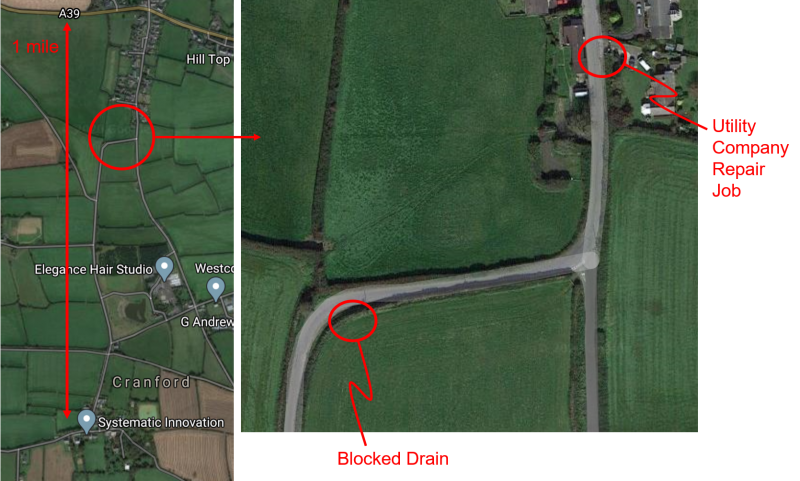
On my usual running route is a chicane in the road. Whenever it rains hard, guaranteed that one of the drains on the first bend gets blocked. Having endured several months worth of rain in the last couple of weeks, the drain blocked early on, and has stayed blocked so that half of the road is underwater. I run past it, to the next bend. About 100m. Around this bend is a team of workmen from the water utility company. They’ve blocked the road to repair what I soon learn is a broken pipe. It’s teabreak time, so I get to chat to three members of the team. Is there any chance you could pop around the corner when you’re done and unblock the drain?

The expression on their faces suggests I’m not the first person to ask this question. ‘We’re not allowed,’ one of them tells me.

‘It’ll only take a minute,’ I say, hopefully, ‘all it needs is one of your long rods’. I nod in the direction of the equipment on their truck. ‘I can do it if you like.’

‘Not allowed,’ the second team member says.

I can understand where he’s coming from. I’m not insured. I tell them that if I injure myself, it won’t be their fault. No dice. I get it, still. ‘How about if I speak to your boss?’

All three look horrified at this point. My immediate thought is now they’re angry with me because I want to complain about them. I try to re-assure them I’m not complaining. To try and demonstrate this, I suggest I speak to the boss to tell him what a good job they’re doing. And could they or I have permission to pop around the corner with a rod to unblock the drain.

The older one shakes his head again, ‘it’s not on the job sheet’.

‘Can’t we add it?’

A laugh this time. ‘If we don’t do what’s on the sheet we’re in trouble. If we do more than is on the sheet we’re in trouble. Boss says no. Computer says no.’

‘How about if we raise a new job-sheet with the drain unblocking on it? That way you get to complete two official jobs.’

A flicker of interest this time. But then another shake of the head, ‘we can’t add new jobs. The boss adds the jobs…’

‘That’s what I’m going to ask him to do…’

Another head shake, ‘he decides the priority. Unblocking drains not high. Lots of effort for not a lot of benefit.’

I want to say, ‘but you’re already here’, but I realise now that I’m fighting the boss’s job-sheet efficiency algorithm. I stand no chance. Time to smile at the three workmen and continue the run. Nothing to see here.

Except the MMB gone mad. Allow the team to add a new job-sheet. Do the job well within target because you’re already 100m away, happy boss. Road unblocked, happy citizens. Workmen allowed to use their initiative, happy workmen. Win-win-win. It’s not rocket science. But, tragically, it is anti-Blob. And if there’s only one rule in life right now, it is this: Blob wins; you lose.

Complex Motorways

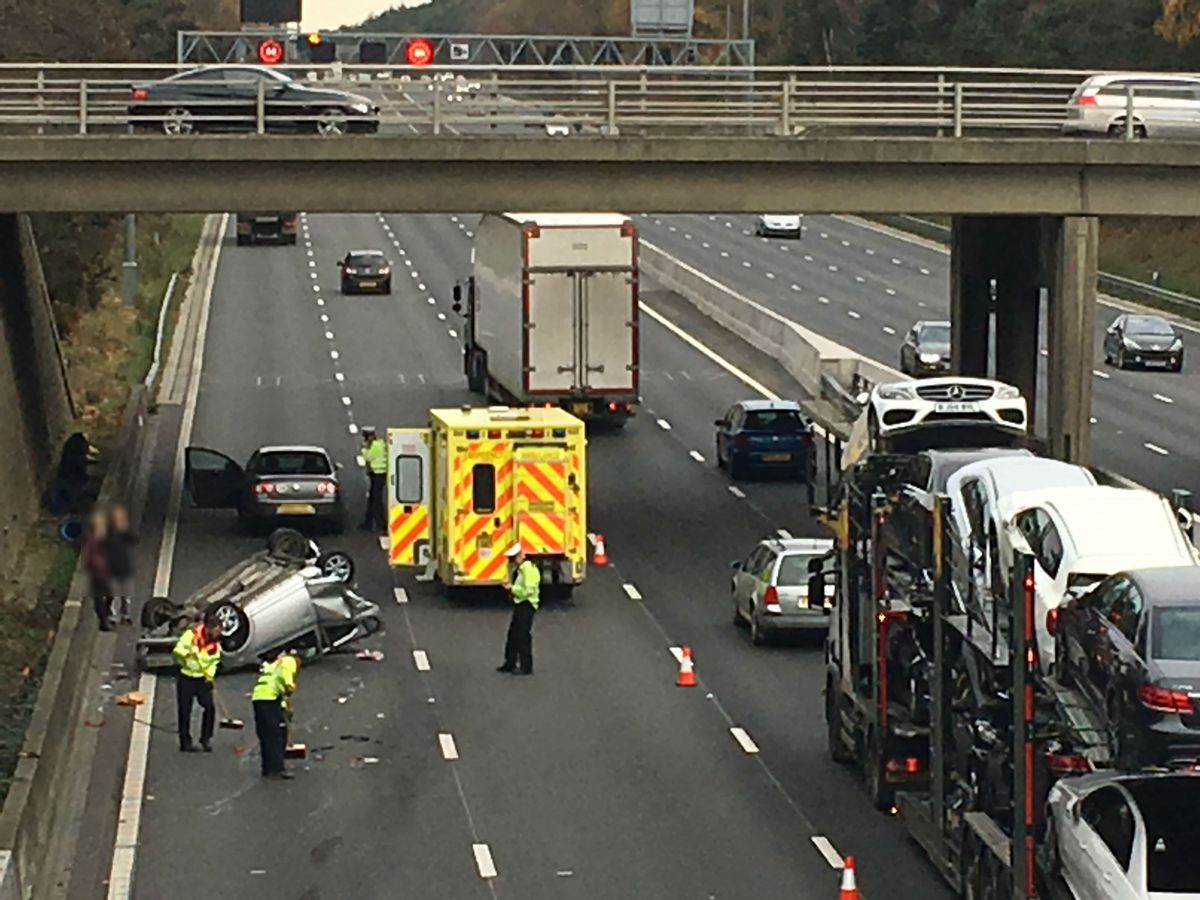
So now we know. Smart motorways aren’t. Smart motorways are the opposite. Smart motorways kill. Thirty-eight people so far.

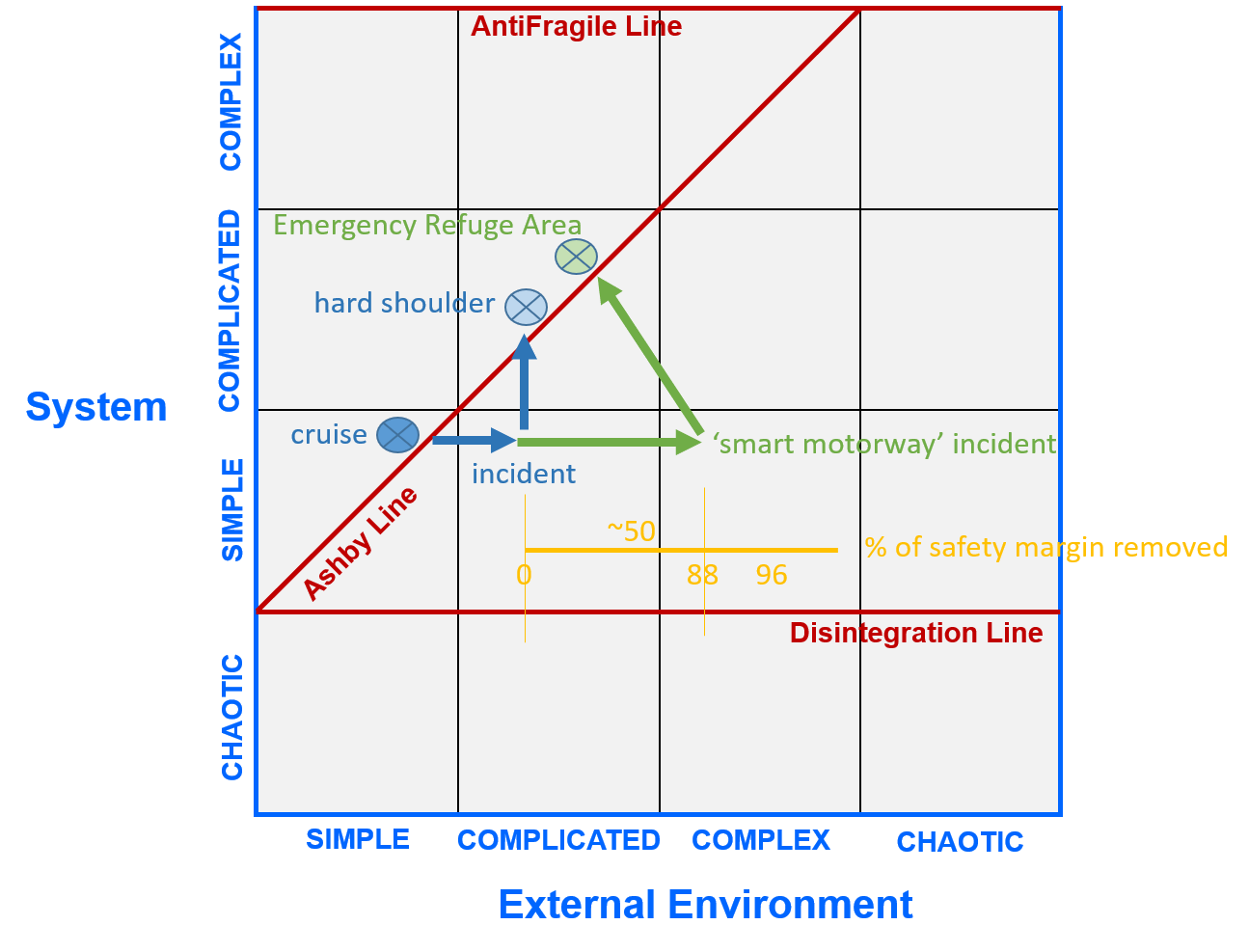
When the Government decided it was prudent to remove 96% of the safety margins on the UK’s motorways they were wrong.

Or rather, we now know, what they originally approved was the removal of 88% of the safety margin. And then subsequent bean-counters decided that they’d save even more money if they removed a further two-thirds of the planned Emergency Refuge Areas.

Now, I’m not privy to the calculations that got made in either the 88% or the 96% justifications, but given what I do know about risk, if I had to make a bet I’d say that neither solution was safe.

So, what do we know about humans and risk?

Humans make mistakes. The likelihood of failing to notice a major crossroads while driving is around 0.05%. The likelihood of leaving your indicator light on is about 0.3%. The likelihood of failing to notice another driver’s indicator is about 10%. The likelihood of making a mistake when stressed is 25%. The likelihood of failing to act correctly after 1 minute in an emergency situation is 90%. (https://www.lifetime-reliability.com/cms/tutorials/reliability-engineering/human_error_rate_table_insights/)

If a person is cruising along in the fast-lane of a motorway and a tyre blows out, that gives the driver an immediate complicated problem to solve. It is complicated rather than complex because there is a clear ‘right answer’ to the problem: navigate across to the hard-shoulder as quickly and as safely as you can.

Drivers of the vehicles behind the vehicle with the blown tyre also have a complicated problem to solve. They too have clear right answers to their problem: don’t hit the other car; decelerate; if it’s safe, switch to another lane.

We’re in 10% failure likelihood territory here. As I’ve mentioned before, most traffic accidents occur not because one person makes a mistake – we all make mistakes all the time – but because two or more people make a mistake simultaneously or within a few seconds of one another. Burst tyre problems don’t result in accidents 10% of the time. They might result in accidents 0.1×0.1 times. Or about 1%. And because everyone is slowing down, the likelihood of an accident causing injury is much lower still.

Remove 88% of the hard-shoulder, and I believe this kind of problem situation flips from complicated to complex. There is no such thing as the ‘right’ answer any more. Instead there are just heuristics: look for signs to let you know how far away the next Emergency Refuge Area is; put on your hazard warning lights; try and navigate across to the inside lanes; try to keep going until you reach the next ERA; if you can’t keep going, stop the vehicle; do not try and get out of the vehicle; phone emergency services to let them know what’s happened; cross your fingers and hope this stretch of smart motorway has radar detection switched on so the red-cross sign will tell drivers to leave the lane you’re stuck in; if the radar isn’t switched on, brace yourself for an (average) 17 minute wait for the emergency services to come and rescue you.

Moreover, it is clear that most drivers don’t know what all of the desirable heuristics are in this new world of smart motorways. So the driver with the blown tyre is highly likely to do something wrong. Now we’re in 90% error-rate territory. Which, if we take the ‘it-takes-two-to-tango’ factor into account and assume the following drivers are in 10% error mode, still means that its 0.9×0.1 = 9% likely there’s going to be an accident. The fact everyone has a heuristic saying ‘slow down’ is the only thing preventing a lot more than thirty-eight deaths so far. To calibrate ourselves a little bit more here, what we also all now know is that on one particular stretch of smart motorway, in the five years before the road was converted into a smart motorway there were just 72 near misses. In the five years after, there were 1,485.

When it comes to safe motorways, turning complicated problems into complex ones is what I think I’d have to say is the precise opposite of smart. Spending billions of pounds to make them less smart then feels rather like adding insult to injury.


Qualitative Economics

The biggest innovation opportunities exist between the echo chambers. But getting others to let you into theirs can be pretty tough. Several times I’ve tried to get papers into economics conferences and journals. I’ve only ever succeeded once. And even then, when I made it to the conference to present, it quickly became apparent that I wasn’t welcome. The main reason for my repeated rejection is that I don’t meet the mathematics quotient. There aren’t enough equations in my papers. Usually there aren’t any.

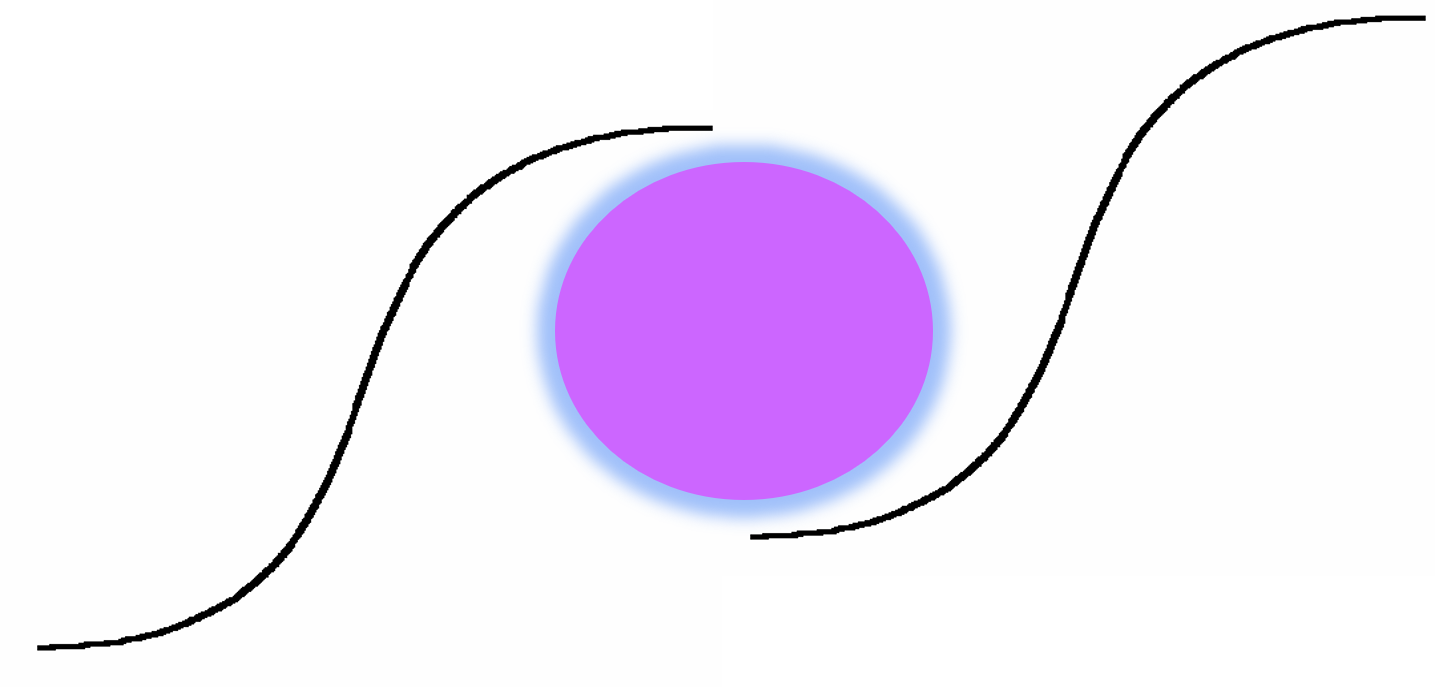
And that was kind of the point. There is no such thing as a mathematical formula to describe what is going on here:

This kind of statement seems to be another good way to inflame economists. Of course there is, I’ve had them say to me. And, speaking as someone who started his career as a mathematician, I can see where they’re coming from. It’s a pair of tangent curves laid on their side, right?

But, of course, that’s not the point. The point is the space between the two S-curves not the curves themselves. The space between the curves is where innovation happens. It’s where the current rules (‘formulae’) get challenged and replaced with new ones.

Economics is about top-down modelling of measurable patterns.

The real world emerges from innovators who’s job is to look at the world bottom-up, to look for gaps between the patterns and how to break the existing patterns.

Innovators know something that economists clearly still don’t. There is no such thing as ‘top-down’ anything in a complex world. If you’re not looking at things bottom-up, you’re getting it wrong. The only uncertainty is how quickly you’ll go wrong. Even the best economic ‘superforecaster’ can expect to have an predictable event horizon measurable in weeks. The more complex and inter-connected the world gets, the shorter this predictable period becomes. For most people, we’re lucky if our predictions of what’s for dinner tonight come good.

Economics is about correlation.

Innovation is about finding needles in haystacks. Needles being causal relationships. Which, again, you only get to find if you’re looking for what’s happening between the patterns.

Economics is about numbers.

Innovation is about putting the numbers to one side and looking for the unquantifiable.

In a world which is all turbulence, when economists try and run things using spreadsheets and ticker-tape they take us all closer and closer to the edge of yet another financial precipice.

In a world which is all turbulence, the innovators are the ones that survive. They do it by having a clear compass, and looking for the weak signals that help propel things in the right direction. They look for vectors. Manage the vectors, innovators know, and the right numbers will arrive of their own accord.

I think the economist echo chamber is only going to listen to this idea after they collapse the global system again. And even then, I’m not certain. They certainly didn’t learn anything after 2008. Or, worse, they learned to look harder at the numbers, to make more numbers. In so doing, they didn’t just ‘kick the can down the road’, they gave the can wheels.

Economics by numbers is taking us ever faster to the brink of chaos and oblivion. After which all we’ll be left with are cockroaches and innovators. Only half of which sounds good to me.