Everyone’s looking for the ‘easy button’. It was the dominant theme of my 2019. Everywhere I went, its what people said they wanted. ‘Just make it easy for me.’ ‘If it’s difficult no-one will do it.’ ‘We’re all too busy, we need things to make our job easier.’
I get it. Sometimes, what people were asking for was possible to deliver. But mostly it wasn’t. As far as possible, those places where it wasn’t, we extricated ourselves from the discussion before there was an opportunity to do any damage. It’s nice to be able to say ‘no’ to a prospective client some times. Especially, if what they’re asking for looks set to deliver a short-term win that subsequently puts everyone on a long, slow slide down a slippery slope to mindless oblivion.
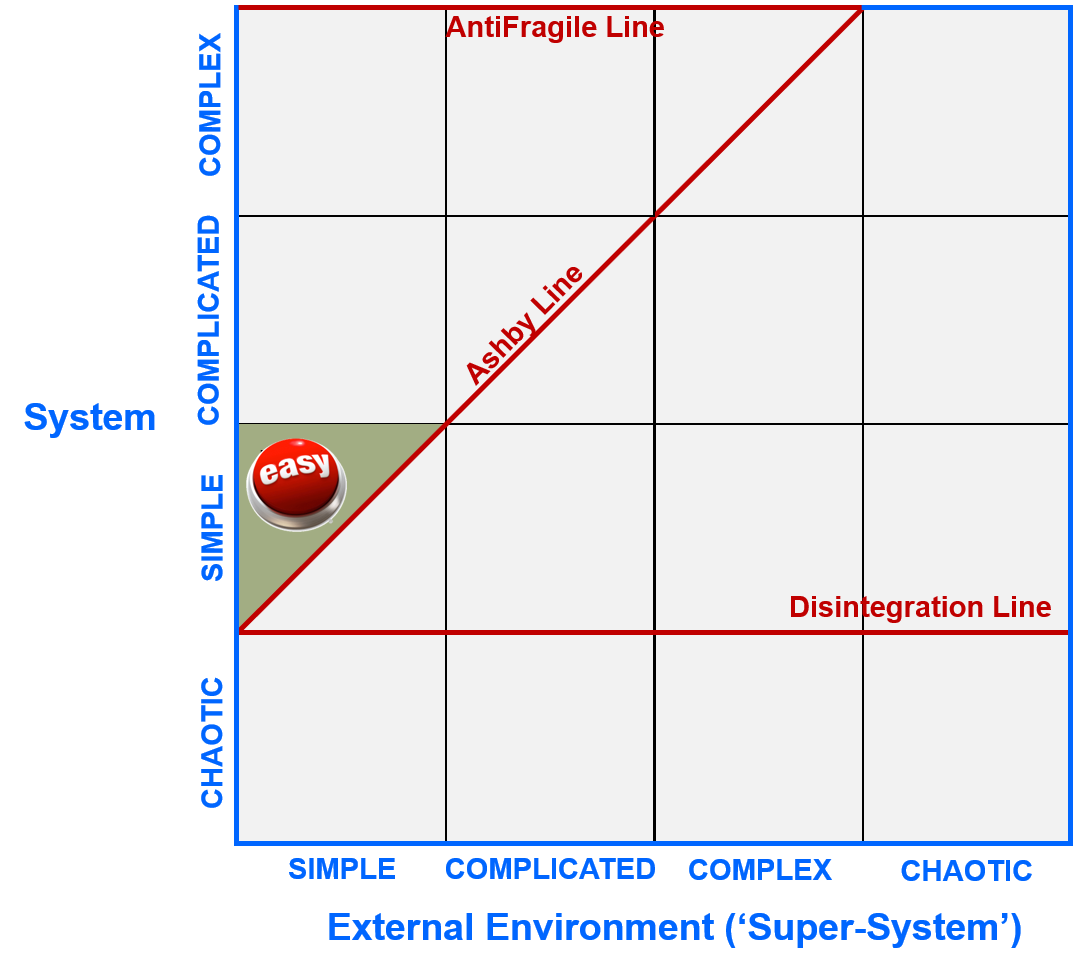
There’s only one type of situation where an ‘easy button’ has the possibility to be the right answer and that’s here:
Anywhere else on the Complexity Landscape and there is no such thing as easy anything. If there are two or more humans expecting to press the Easy Button, it won’t work. Humans are complex. Or rather, they are if we have a desire to treat them like humans. Easy Buttons are for robots. Or situations where humans need to mimic the behaviour of robots. Like pilots. George, the autopilot, is far safer than the best pilot. Or at least he is provided everything is happening normally. When everything is normal, the job of the co-pilot is basically to make sure the pilot doesn’t touch anything. In the same way, the job of the pilot is to make sure the co-pilot doesn’t touch anything.
The moment this kind of robotic normal doesn’t exist any more, we need to throw the easy button away. When things aren’t normal in the cockpit, we have a complex situation, no matter what the checklists might suggest otherwise. The sort of complex the world saw in the 1990s in what turned out to be a spate of Korean airliner crashes. Crashes in which the co-pilots were happier to die rather than tell their superior that he was making a mistake.
Easy buttons are great. Provided the system we’re designing is going to spend all of its time in the Easy Button zone. Easy Buttons mean maximum efficiency and no need for anyone to think. Some times this is the right strategy. Most times, we need to remember that when a situation shifts from simple-simple, it may be that the people involved may have spent so long not thinking, they’ve forgotten how to start again. Which kind of says – to me at least – that there probably aren’t that many Easy Button situations anywhere on the planet any more. Easy, in other words, is anything but.
I’m not enjoying ROI-Guru, Jack Phillips’ latest book, ‘The Value Of Innovation’, but I’m sticking with it. Business books are a bit like conferences for me these days. In that, for the most part, they exist to make me angry. And if I get angry enough, once the first wave of quiet seething is over, it can become a trigger for some kind of insight.
One of the reasons I’m having to stick with the book is because we’re getting lots of ‘can you help me measure this’ type innovation work at the moment. And, in classic, ‘someone somewhere already solved your problem’ fashion, Phillips is purportedly the go-to guy when it comes to ROI. He’s the one that already solved your problem. Except, apart from stating several times that everything is measurable, only very rarely does his book justify the statement with any evidence.
This problem is particularly acute when it comes to intangibles. Phillips admits they are important, but that’s as far as his story goes. In the end, he declares that the very definition of an intangible is something that is ‘unquantifiable’ and therefore something that won’t be included in any ROI calculation. Which sounds like the ultimate cop-out to me. Except, I guess that Phillips’ glib statement will have something to do with the fact that his primary audience is other finance-type people. Who, as far as my experience goes, not only don’t understand intangible, but actively don’t want to understand intangibles.
As I’m gritting my teeth reading the book, I’m also noticing that Phillips has no comprehension of complexity and complex systems. And, perhaps less surprising, he also has no conception that the level of Innovation Capability of an enterprise also has to have an impact on ROI calculations. I’ve said a little bit about that latter topic in the last two issues of the SI ezine. It’s the complex systems topic that I wanted to explore a bit here.
The straw that broke this camel’s back was a mini-case study concerning Wal-Mart, and Phillips’ praise for the not-so-bright spark who’d calculated the ‘cost’ of every minute a delivery truck was at the unloading bay waiting to be unloaded. I have a feeling this kind of mis-guided thinking is why so many employees are actively dis-engaged from their work and trust in corporations is at a historic low. Everybody is on the clock. The drivers get stressed. The truck unloaders get stressed. Job satisfaction takes a downward turn. Employees feel out of control. They feel ‘its not fair’ when things go wrong that have nothing to do with them.
So then what happens? When we get treated unfairly, we compensate. We sneak an extra break when the boss isn’t looking. Or we ‘borrow’ some office stationery. Or we add a more expensive meal to the expenses claim. Which, when the ilicit activity eventually gets found out, means the bean-counters get angry. And when bean-counters get angry, all they want to do is dream up ever more convoluted beans to count. Which means that, as well as costing out lost minutes at the loading bay, they bring in tools to monitor breaks, put cameras in the stationery cupboard, and put checks in place to reject expense claims with an over-allowance dinner receipt on it. Which, surprise, surprise, now closes the loop and makes employees feel even less trusted and even less in control. All the time this toilet-swirl of distrust is going on, the bean-counters are rubbing their hands with glee because their figures are getting better because things like trust and control are ‘intangible’ and therefore aren’t on the balance sheet. The bean-counters, in most cases, only even begin to realise there’s a problem when very tangible things like increased sick-rates and staff-turnover start to show up on their dashboards. By which time, sadly, the vicious cycle has turned into a tailspin and the game is just about over.
The simple truth is this. Working out the ‘cost’ of waiting delivery trucks is a simple response to what is in reality a complex problem. Moreover, it is one of the thousands of other wrong simple solutions to a complex problem.
If a system includes two or more humans, it is complex. And, given that almost every measurement in existence is done by one human on another, almost every ‘measurement problem’ is complex.
And if that is the case, any measurement situation demands new rules of behaviour. None of which will be found in Jack Phillips book. First of all, there are no absolutes any more. This means there is little point in quantifying things. Far better instead to be looking out for relative changes, for ‘vectors’ and ‘rules of thumb’. None of which are popular with today’s bean-counters, granted, but that’s a lesson they’re going to have to learn. Most likely the hard way.
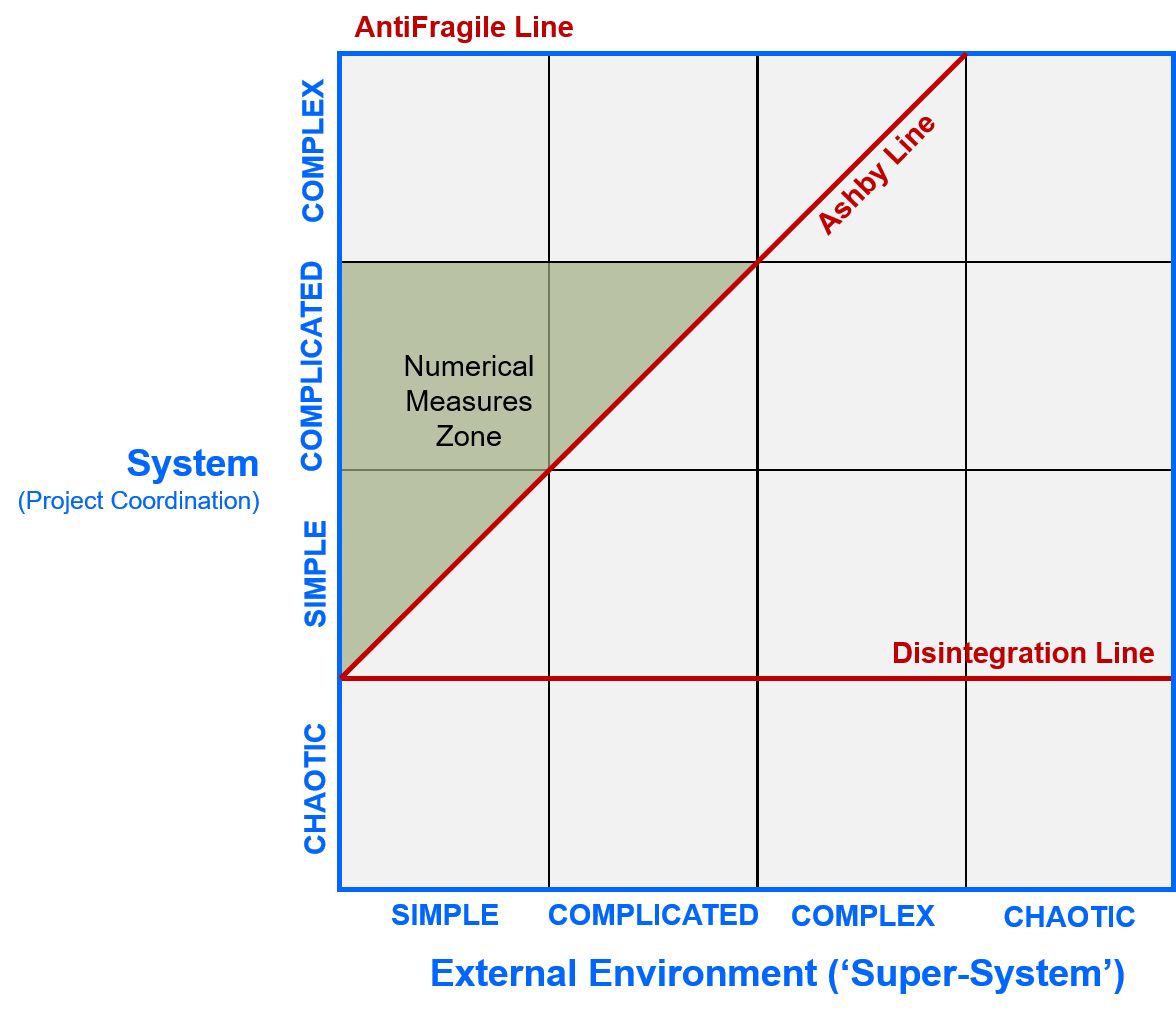
Thinking about the Complexity Landscape Model, my current thinking is this. The only sensible place to make quantitative measurements, and use the information to ‘run the business’ is here:
Numbers are for robots communicating with other robots. Robots that have been taught to operate in the ‘simple’ world: ‘do this; keep doing it forever, until I tell you to stop’. Perfect for automated processes where the aim is maximum efficiency. Robots aren’t quite to good at ‘complicated’ situations yet. They will be, because complicated problems are amenable to finding a clear and definitive ‘right’ answer. Right now, however, it is generally speaking going to be a human that is going to make such decision and such calculations. I used to design jet-engines. That’s a complicated problem, but it is also one in which it is possible to make a clear calculation that tells a designer that if they manage to redesign a component and reduce the weight of the engine by Xkg, the net worth to the Company will be $Y. Not quite so simple, obviously, but once you’re taught to take into account s-curve, ‘law-of-diminishing-return’ and other mechanistic effects, you’re pretty much good to go.
I think where I’m going with all this is to try and reach some kind of rule-of-thumb measurement heuristics. The first of which was going to be, ‘if you’re problem situation is not in the Numerical Measures Zone, quantification is pointless, and will probably lead you astray’.
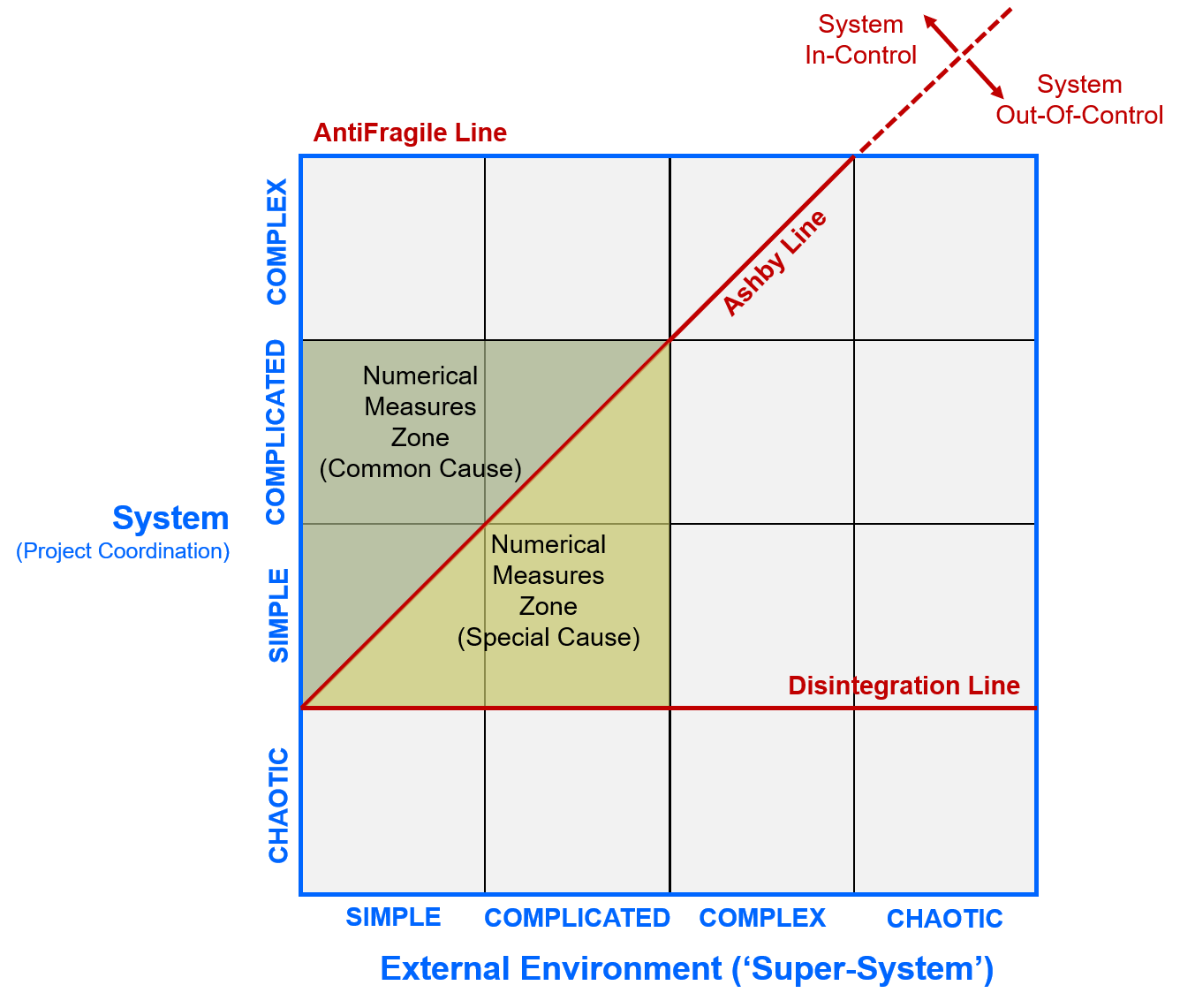
But then I thought about my old hero, W. Edwards Deming – a man who pretty much lived in the Numerical Measures Zone – and his careful division of the measurement world into ‘common’ and ‘special’ cause situations. I find the distinction has become blurry in a lot of post-Deming continuous improvement initiatives. Which is more than a shame, because, if a person mixes the two up, the only result is that they will make things worse. If a system is ‘in control’, the job of the continuous improvement team is to focus on ‘common cause’ measurements if the wish to improve the system. If the system is ‘out of control’, the job is to focus on ‘special cause’ measurements. Somewhat conveniently, this distinction between ‘in’ and ‘out’ of control maps beautifully onto the CLM like this:
So now I can really propose a new heuristic: ‘if you’re problem situation is not in either of these Numerical Measures Zones, quantification is pointless, and will definitely lead you astray’.
I think there might be more profound implications to come out of this. But first, I think I need to go test it with a few semi-friendly bean-counters…
First up, there’s risk. Likelihood multiplied by consequence. And sometimes, like for example when the future of huge swathes of humanity is at stake, the size of the consequence means that, no matter how small the likelihood, we ought not to ignore what’s going on.
Second up, when the problem at hand is a wicked one, the best – some might say, ‘only’ – way forward involves managing the unknowns. All the stuff we don’t know about a situation (including as best as possible all the things that are today ‘unknown-unknowns’), we work out what to do, and then go do it.
Its been my working assumption for coming up to three decades now that there’s a global climate change problem. Its been my working assumption for the last two that the climate scientists have been busy managing the unknowns, doing their level best to work out whether the problem is an actual crisis, and what we need to do about it. Its been my dawning realization for the last few years that this second assumption is poorly founded.
“97% of climate scientists agree.” That’s what we’re all being told. 97% of climate scientists agree that the Earth’s climate is reaching a tipping-point, beyond which the consequences will be catastrophic. And there begins my problem. All of the TRIZ research tells us that smart people run towards contradictions, and that solving contradictions is just about the only way to make meaningful progress. Full-stop. Climate scientists aren’t exempt from this rule. If I want to build a better, more meaningful, prediction about how our climate might change in the coming years I would be well advised to seek out those people – the 3% in this case – that are drawing different conclusions to the ones my model is generating. Look for the differences, understand them, build a better model.
Except that’s not what I see happening with the 97%. Like so many things in life these days, what I see instead is a great big climate-science echo chamber. One that automatically excludes the minority that don’t agree with the consensus view. Papers written by a member of the 3% don’t get listened to, don’t get published in recognized journals and, instead – and even worse – get adopted by the other echo chamber. The ‘climate-denier’ chamber. Which then puts the two echo chambers even further apart. Looked at from outside and all I see is the world’s biggest case of confirmation bias. One that, by its very nature, prevents anyone from making any kind of meaningful assessment of what’s going to happen in the next ten, fifteen, twenty, fifty years.
Ah, but, a voice from the climate-catastrophe echo chamber shouts, look at some of the idiotic comments coming out of the other echo chamber. The idiots that say, ‘look there’s only 412 parts per million of CO2 in the atmosphere, how can such a small proportion make any difference’ (to which my answer is usually, let’s put 412ppm of potassium cyanide in your double-shot latte and see how that grabs you). Not to mention the biggest idiot of all, Donald Trump, who’s pretty much made a game now out of saying something even more ridiculous than he said the last time. I’m still in awe of the one about the ‘tremendous fumes’, ‘Gases are spewing into the atmosphere. You know we have a world, right? So the world is tiny compared to the universe. So tremendous, tremendous amount of fumes and everything.’ This on the subject of wind-turbine manufacture.
Idiots. I get it. But how about the fact that there are the same % of idiots in the other echo chamber? The virtue-signalling vegans, for example, insisting that we all need to move away from a dairy-based diet because cows are massive contributors to CO2 and methane emissions. So massive tracts of land get turned over to almond production. The almond trees need bees to pollinate them, so millions of bees get brought in to do the job (I know, I know, ‘real vegans won’t drink almond milk either because it ‘exploits bees’). But there are too many mock-vegans and so an almond monoculture gets created, and all the bees get sick and start dying out.
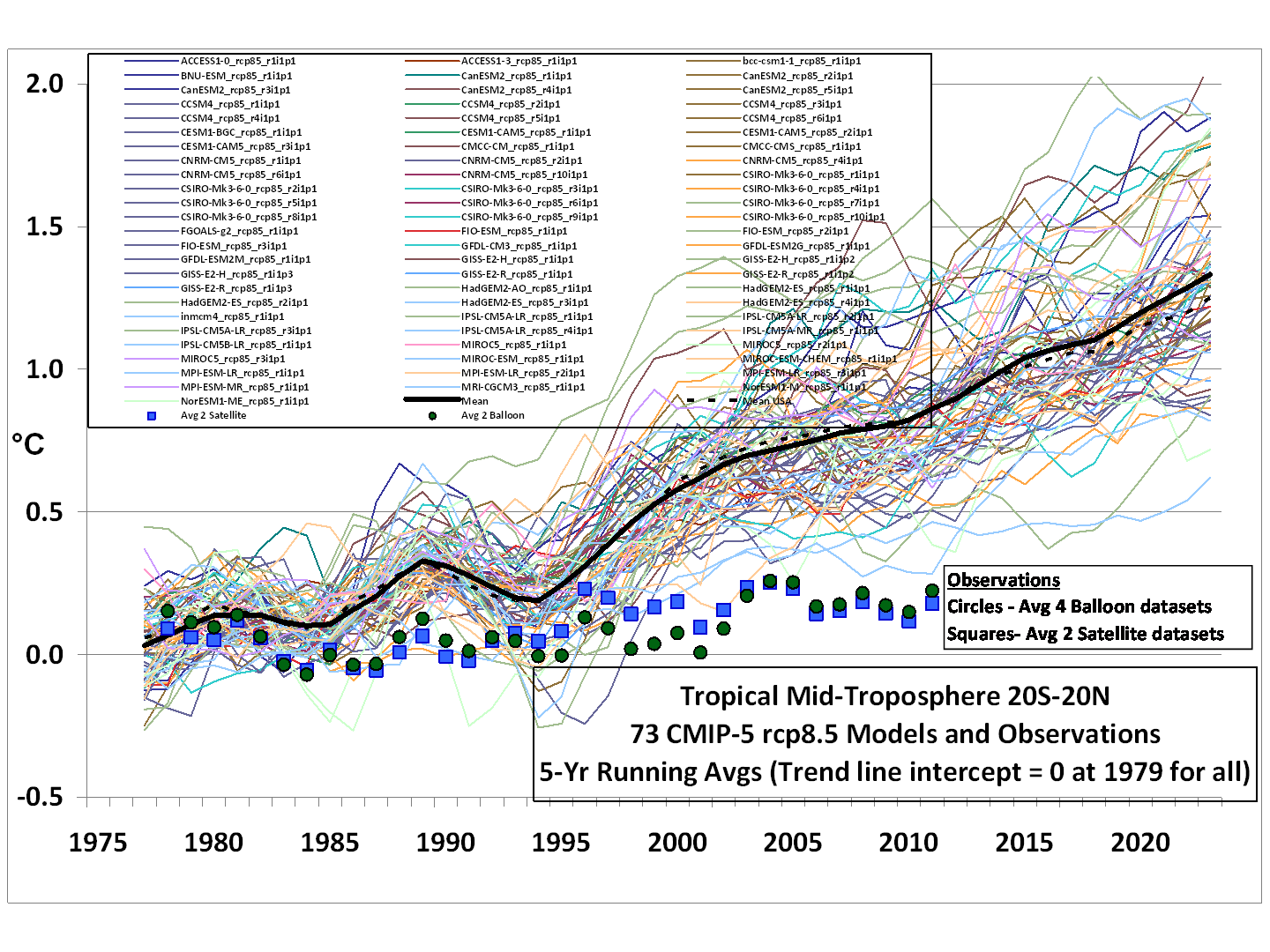
Or, how about the climate models that ignore any and all of the difficult issues that might complicate their calculations. Next time you meet a climate scientist, ask them how they incorporate solar activity in their models. Or the fertilization effect that increases as CO2 levels increase. Or how adaptation factors have been built into the models. These are questions I’ve been asking for a few years now, and I’ve not heard a single coherent answer. All I get instead is a curled lip and a dismissive comment along the lines that I sound like the enemy and that, if I know what’s good for me, I’ll shut up.
Yet again, the core problem concerns contradictions. In the same way that we had a blinding flash of the obvious twenty years ago with our TrenDNA work on consumer and market trends. That it’s not the trends themselves that help us to see the future, but rather the relationships between those trends. And particularly the relationships where one trend conflicts with another. The exact same thing applies when trying to predict climate. You can’t simply extrapolate along a CO2 prediction or a temperature prediction and hope to have any chance of achieving any kind of accuracy, because that’s not how complex systems work. You can’t just look at one attribute. There’s no such thing as a ‘root cause’ in a complex system. CO2 isn’t a root cause of global temperature rise. Neither is methane or NOx or SOx. Or industrialization. Or fossil fuels.
The only meaningful way to model a complex system is bottom-up, from first principles and taking into account ‘every’ aspect of the system. And if that means your computer’s not big enough to make such a calculation, that’s the unknown you’d better start managing… by, no surprise, solving the contradiction.
Time and time again, the human inability to look beyond single-parameter ‘root causes’ ends up creating way more harm than good. My recent favourite involves attempts to try and rid the world of malaria. A noble ambition. Mosquitoes are more than just a pest – they can be downright dangerous carriers of disease. One of the most innovative ideas to control populations of the bugs has been to release genetically modified male mosquitoes that produce unviable offspring. But unfortunately, a test of this in Brazil appears to have failed, with genes from the mutant mosquitoes now mixing with the native population.
The idea sounded solid. Male Aedes aegypti mosquitoes were genetically engineered to have a dominant lethal gene. When they mated with wild female mozzies, this gene would drastically cut down the number of offspring they produced, and the few that were born would be too weak to survive long. Ultimately, this program should have cut down the population of mosquitoes in an area – up to 85 percent, in some early tests.
Unfortunately, that hasn’t been the case. Researchers from Yale University have now examined mosquitoes around the city of Jacobina, Brazil, where the largest test of this technique has taken place over the last few years. Not only did numbers bounce back up in the months after the test, but some of the native bugs, they found, had retained genes from the engineered mosquitoes.
“The claim was that genes from the release strain would not get into the general population because offspring would die,’’ says Jeffrey Powell, senior author of a study describing the discovery. “That obviously was not what happened.”
Worse still, the genetic experiment now appear to have had the opposite effect and made mosquitoes even more resilient. The bugs in the area are now made up of three strains mixed together: the original Brazilian locals, plus strains from Cuba and Mexico – the two strains crossed to make the GM insects. This wider gene pool looks set to make the mozzies more robust as a whole.
All this was totally predictable. Or at least it was if you used something other than a one-dimensional prediction model. It’s not the trends, it’s the relationships between the trends that determine the emergent outcomes of a complex system.
So, where does this leave us? Is there a climate emergency? Do we have ‘twelve years to save the planet’?
No-one really knows. Which, on the one hand takes us back to rule one. Risk equals likelihood times consequence. We can’t afford to do nothing. But that then takes us to rule two. Manage the unknowns. Both sides of the climate ‘debate’ need to climb out of their echo chambers, start listening to the contradictions and use them to build better models. Until that happens, not only are we not solving the problem, we’re not getting any closer to understanding what the problem is.
I try not to impose too many rules on myself. Rules bad, heuristics good. One of my main heuristics is ‘when it comes to innovation, avoid crowd-sourcing’. There is almost no correlation between innovation success and use of a particular methodology. The only real – causally linked – relationship we’ve found is that innovation attempts purporting to use crowdsourcing are four times more likely to fail than attempts that don’t. Hence the heuristic. Why make one of the world’s most difficult jobs four times more difficult than it needs to be?
So much for heuristics. I’ve been hit twice by the crowd-sourcing world this week. Admittedly the first was while I was compiling our annual job of awarding prizes to the worst business books of the year and had to decide whether Henry Chesbrough’s latest tome, ‘Open Innovation Results’ was the third, second or first worst book of the year (you’ll have to check out the January ezine at the end of this month to find out what I decided). My exposure here was self-inflicted.
The second, where the infliction came from elsewhere, was a paper I’d been given to review for the International Journal Of Systematic Innovation. With Chesbrough’s ‘work’, given the amount of damage it has caused over the years, I felt it was okay to be brutal. When it comes to reviewing ‘academic literature’ I figured I needed to wear a different hat.
The whole academic world is subject to blind-review rules, so its not appropriate for me to say too much about the paper in question. Needless to say, I very much doubt that the author is likely to be a subscriber to this blog, or to anything that comes out of Systematic Innovation. I can say this with confidence because their paper exhibited zero interest or knowledge of either.
Anyway, that’s my problem not the author’s. The gist of their paper was a proposal to utilise social media to source inputs that will ‘in the future’ enable the construction of a ‘crowd-knowledge’ database. Already I hate it. Why are there so many academic papers these days about things people want to do rather than what they’ve done? Answer because the former involves a lot less blood, sweat and tears than the latter. No matter. Get past it, Darrell.
The basic premise of the paper seemed antithetical to the very foundations of ‘systematic innovation’. The author mentions TRIZ but really only to the extent that it allows them to declare it ‘too difficult’ and that therefore the crowd-knowledge database idea holds open the possibility of an easier alternative. I read on in the hope that the author would convince me this could be so, and that they might deserve a place in the International Journal of Systematic Innovation.
In practice, sadly, it quickly became clear that the model proposed by the authors in effect ignored all of the hard work done by the TRIZ community and replaced it with an idea that effectively starts a ‘systematic’ creativity tool from a new blank page. In this sense the paper describes a classic ‘can’t get there from here’ problem. The value of a functioning ‘crowd-knowledge’ database is high, but the likelihood of achieving such a thing using the suggested method is, to all intents and purposes, zero. The authors, unfortunately, exhibited a high degree of naivety and confirmation bias – their intent, it was now becoming clear, was to demonstrate that crowd-sourcing is an innately good (and ‘systematic’) route to innovation.
The first major problem with Open Innovation (strangely, barely mentioned in the paper, Chesbrough will no doubt be disappointed to learn) is that it does nothing to help with the crucial issue of garbage-in-garbage-out: if the wrong questions are posed, the wrong answer will be the inevitable result.
Existing crowd-sourcing advocates, regarding this issue, will no doubt declare the paper to be more useful than it actually is. The crowd will tell us what the right problem is, they will declare. The mistake here is to not look at the realities of the dysfunctions of the crowd-sourcing domain from an innovation perspective. Like so many things today, the crowd-sourcing world, is caught in its own echo chamber. As such it finds itself caught in a vicious cycle from which it is less and less likely to emerge. The paper merely serves to reinforce that vicious cycle. Crowd-sourcing advocates continue to believe that failures occur because not enough members of the crowd are participating yet. All we need to create this new database, the author declares, is to get everyone contributing more ideas. This is exactly the same fallacy as can be seen with Mark Zuckerberg at Facebook… the reasons for the company’s problems and its destruction of democracy, in their eyes, exists because ‘not enough’ people are connected yet. Seeking more knowledge from the crowd, however, merely adds exponentially more noise, and hence makes it progressively less and less likely that solutions to the current problems will be found. The haystack of apparent knowledge gets bigger, but the number of needles (i.e. useful insights and solutions), TRIZ tells us, remains largely constant.
This second critical problem (contradiction!) also hazards the creation of the desired database. From a TRIZ perspective, of course, all such problems are all solvable because TRIZ shows us that all contradictions have been solved by someone, somewhere before already. Because the authors clearly don’t appreciate this fact, however, they missed a potentially big opportunity to use TRIZ to identify solutions to the real crowd-sourcing problems.
Lack of knowledge of TRIZ thus becomes the primary cause of failure of the paper.
Now I have a new problem. The author of this crowd-sourcing paper is merely guilty of not knowing about TRIZ and so ended up writing something very naïve. The real problem needs to move up the line. To the editors of the Journal.
I can see that they too have a contradiction. On the one hand, the wish to broaden the scope and audience for the Journal, and on the other, the vast majority of ‘new’ authors have no grounding in all of the hard work done by past TRIZ researchers, and hence end up re-inventing the wheel, or, as in the case of the offending crowdsourcing paper, talking about a direction that makes no sense once you know what TRIZ has already done. The contradiction looks something like this:
And here’s the rub. The editors do know TRIZ. They know about contradictions. They know that the innovator’s job is to solve them. That’s the paper I want to referee. The paper describing how the contradiction got solved. That’s the paper, more importantly, I want to read. Because I might actually learn something. Crowd-sourcing might one day have a useful part to play in the (systematic) innovation story, but it will only happen if and when the TRIZ community decide to actually use TRIZ.
TRIZ people not using TRIZ. Hmm. Where have I heard that one before?
Let’s see what happens to my suggested solutions to the editors. If they come back suggesting we solicit more ideas from the crowd or, worse, from the crowdsourcing paper author, I’ll know I’ve lost. Again.
I know, I know, I said I wasn’t going to write about the UK political situation again. Let’s say I’m just using it as a convenient example of the importance of understanding the ABC’s of slogan design.
Despite the delusional politicians and media continuing their futile efforts to pin down the ‘root cause’ of the catastrophic performance of the Labour Party in the election, I’d like to add an additional contributing factor to the story.
Someone in the Conservative Party – in all probability taught by the Trump campaign team (or Steve Bannon) – understands ABC. No-one in or working for the Labour Party, sadly for them, appears to have the first clue.
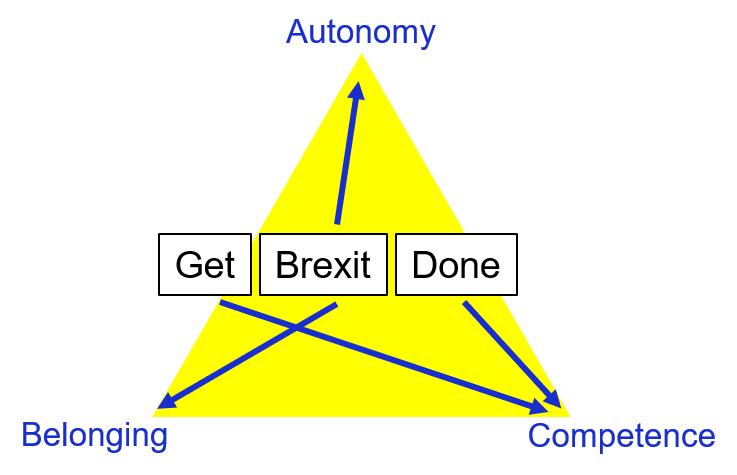
Autonomy, Belonging and Competence are the three core human emotional drivers. Good slogan designs need to tap into as many of them as possible. A great slogan taps into all three. The perfect slogan taps into all three using three words. Three single syllable words.
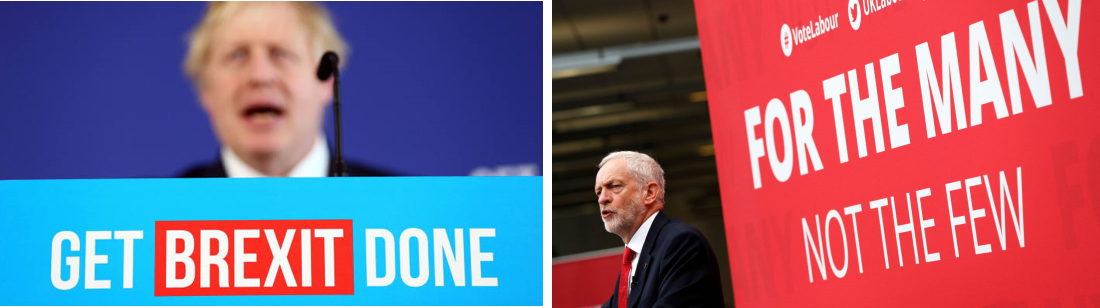
The Conservatives came close with their four-syllable, ‘Take Back Control’ in the Brexit referendum. And this election they matched it with ‘Get Brexit Done’:
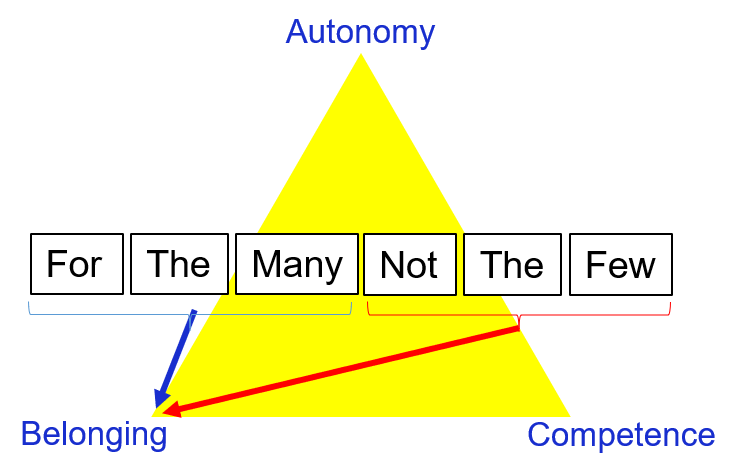
The Labour Party, on the other hand found themselves stuck with something akin to the antithesis of good slogan design, ‘For The Many Not The Few’, which maps onto the ABC story something like this:
No Autonomy connection, no Competence connection, and they somehow managed to get their Belonging words to cancel one another out. And they took seven syllables to do it.
Hopefully, someone tells them the ABC trick in the next five years. Or maybe make that ten, since its looking like it’s probably going to take the first five flushing out Corbynism. Maybe they could use their newfound slogan-writing skills to help with that job? Drain The Marx? Lock Marx Up? Just a thought.
Ludwig Wittgenstein and Karl Popper, by most accounts two of the smartest philosophers in modern history, only met once. The occasion was a meeting of The Cambridge Moral Science Club – a discussion group for the university’s philosophers and philosophy students – held on the chilly evening of Friday October 25 1946. Popper was the guest speaker, up from London to deliver an innocuous-sounding paper, Are There Philosophical Problems? Wittgenstein, chairman of the club, was one of the attendees. And if the Popper/Wittgenstein combination wasn’t enough for the lucky students, also present was Bertrand Russell, a man who for decades had been a household name as a philosopher and radical campaigner.
It quickly became apparent that there was a fundamental disagreement between the two main protagonists. One felt that there were only problems; the other that there were only puzzles. The discussion became heated. Wittenstein, finally exasperated, picked up a poker and started brandishing it wildly, shouting, ‘Popper you are wrong! You are wrong!’ The rising tension was only released when Russell, apparently, stepped in to intervene and persuade Wittgenstein to put the poker down. At which point, Wittgenstein stormed off in a huff, never to return.
The first moral of the story is that even extremely intelligent people can find themselves married to a view and no amount of facts or argument will dissuade them. Rather, they will wave a heavy iron weapon at anyone who challenges their outlook.
The second moral is that the world of philosophy had, by 1946, essentially devolved to become largely meaningless. Smart people arguing vehemently over the wrong question.
Sadly for Popper, Wittgenstein and Russell, another philosopher, Georg Wilhelm Friedrich Hegel had died just over a century earlier. Arguably, his death signalled the last breath of meaningful philosophy. Not that anyone in the philosophy community seems, even today, to have recognised or understood the fact.
I’m pretty certain that had Hegel been basking in the firelight in that dusty Cambridge meeting room he’d have metaphorically banged Popper and Wittgenstein’s heads together and shouted, ‘it’s not either/or you blithering idiots’.
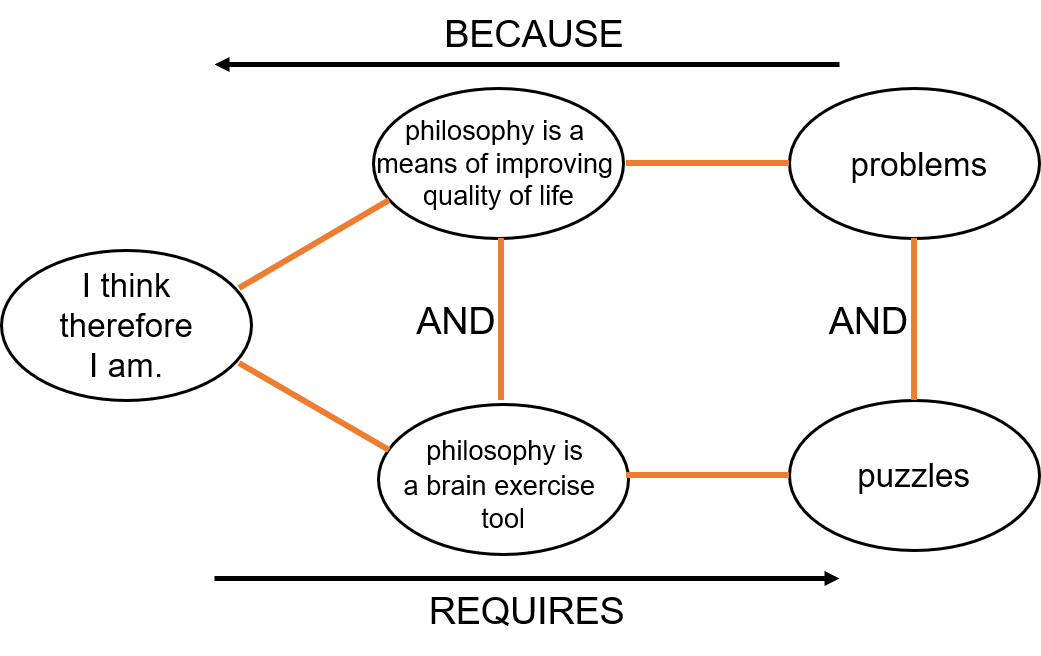
Had Hegel lived another hundred years and done a bit of Descartes-channelling, he might have gone a step further and drawn this picture…
And if they still didn’t get it, I think he would have been well within his rights to ask for the poker. If – thwack – the – thwack – question – thwack – contains – thwack – or – thwack – implies – thwack – the word – thwack – ‘or’ – thwack, thwack – it’s – thwack – the – thwack – wrong – thwack – question – thwack, thwack, thwack – dummy.
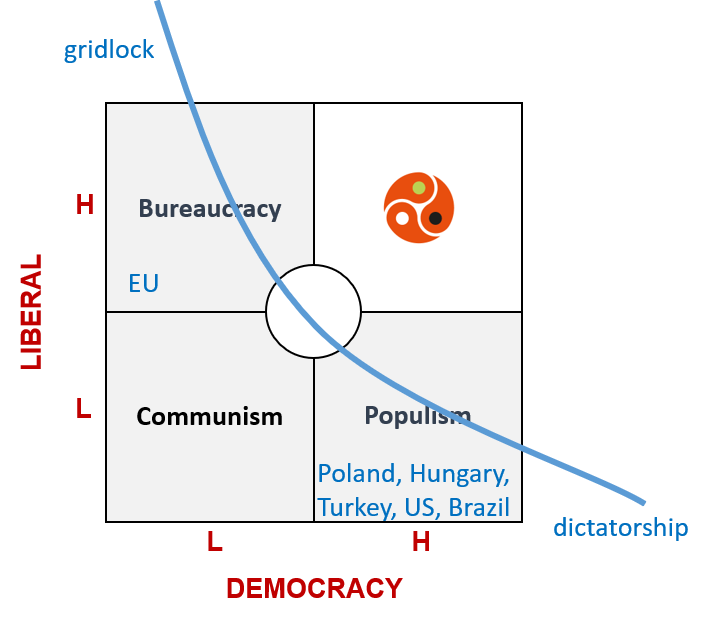
For every complex problem, there is a clear, simple, wrong answer. As the UK swiftly follows the US, Hungary, Poland, Brazil, Turkey, The Phillipinnes and others down the slippery slope of political populism, it is rapidly becoming clear that it is eminently possible to have a democracy in which the liberal rights of the individual tend to zero. Similarly, in many ways a large part of the Brexiteer argument against the EU, it is also very possible to have highly liberal institutions which are at the same time highly un-democratic. Achieving liberal democracy, in other words, is quite difficult. It is difficult because – counter-intuitively – ‘liberal’ and ‘democratic’ are in conflict with one another. This is the essential premise of Yascha Mounk’s already-classic 2018 tome, ‘The People Versus Democracy’. The premise builds on Mounk’s attempts to restore the original definitions of the two words:
Democracy: a set of binding electoral instruments that effectively translates popular views into public policy.
Liberal: effective protection of the rule of law and guarantees of individual rights such as freedom of speech, worship, press, and association to all citizens.
Under these two definitions, and a clear me/we conflict becomes apparent. In that, what ‘we’ collectively want as a society is rarely the same as what ‘I’ might want individually. Taken together, we can draw a liberal-democracy 2×2 matrix looking something like this:
This is the sort of picture I’ve normally found to be quite re-assuring. It means that if we wish to get the best of both worlds – liberal and democratic – we need to solve a contradiction, and, if we want to solve contradictions, there’s no better way than through using TRIZ and Systematic Innovation.
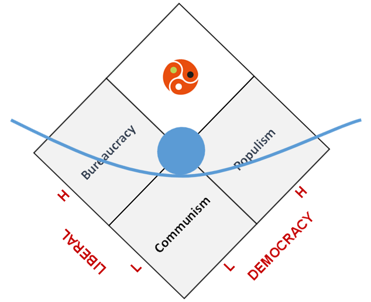
The other, perhaps more subtle, ‘re-assuring’ part of the picture is the blue either-or line, which, if we angle the matrix a few degrees begins to look something like this:
… a blue ball sitting at the bottom of a bowl means – re-assuringly – that the further we try and move the ball left or right, the more the walls of the bowl try and bring it back to the middle again. While we might not be totally happy with the ball sitting at the bottom of this bowl, it is an awful lot better than being at the extreme edges of the bowl. The shape of the bowl is such that the whole system is stable. The more things try to move to an extreme, the more surrounding forces seek to return matters to the middle.
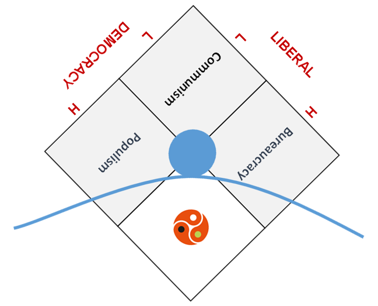
I now see, however, that my re-assurance by this stable-bowl model has not been well-founded. What Mounk’s book has taught me is that today the ball and bowl actually look more like this:
In this view of the world, the ball is very definitely not stable. As it nudges left or right of centre, it is more and more likely to keep going. The extremes, in other words, become not only much more likely, but actually inevitable.
My image of the bowl orientation has been wrong. Or, perhaps (no-one likes being wrong!), the self-stabilising bowl has somehow managed to become inverted. I’m still not sure which of the two is right, but I’m pretty certain that a lot of the societal feedback loops that helped the bowl stay upright and thus make the ball stable have recently, thanks to social media, Fake News and the deliberate (Russian) de-stabilisers of the world, disappeared or become perverted. Extreme-avoiding negative feedback loops have now become highly unstable positive ones. Just as in the pop-music charts, where the higher up the charts a song is, the more it is likely to be played on the radio, and so even more people go out and buy it, extreme politics increasingly begets even more extreme responses.
I’m too late I know, but I really hope that when UK citizens go to the polls this coming Thursday they take with them even the faintest inkling that a vote for a populist politician or party is a vote for massive instability in the coming months and years.
Anyone that knows me knows that inside my gruff glass-half-empty exterior is an equally gruff but nevertheless glass-half-full interior. Deep inside, I remain confident that there are always winners even during the biggest, fastest slide down the slippery slope and off the slippery cliff, but, boy, on the outside, I’m starting to wish I had a lot more fingers I could cross.
Three weeks in to an utterly tawdry squabble of election campaigns by all the current political parties and it has become crystal clear the UK political system is completely unhinged and not fit for purpose. I think the clincher was the Conservative candidate that decided to share some of the hate-mail she’d received. Apparently she deemed it no gruesome enough so took the liberty of adding a death threat. No-one expects politicians to be honest, but, really? So somehow, we find ourselves with a serial lying sociopath for a Prime Minister, and a time-warp crypto-communist hijacker as leader of the Opposition. Which in effect means, in our dysfunctional first-past-the-post election system, no party is worthy of anyone’s vote.
The crypto-communist party is currently standing on a platform of ‘real change’. In theory this sounds like the sort of thing we need as a country. Unfortunately, what ‘real change’ seems to mean in their case is a return to the early 1970s. The decade of powercuts, three-day week and uncollected refuse by the sides of the road. Good idea. Personally, I was kind of hoping for the sort of change that might help the UK get out of its ongoing tailspin decline.
I live in a constituency with a chasmic Serial-Liar Party majority. Meaning that I’m effectively dis-enfranchised. I have (postal) voted, but I might just have well flushed my voting paper into the septic tank at the end of my garden.
The party I would have liked to have voted for doesn’t exist. So I decided to sit down and think about what that party might look like, what their manifesto might contain.
Here’s what I got.
1) The way the current political system is set up, we inherently get the wrong politicians. A desire to ‘make a difference’ is a necessary but not sufficient condition to hold public office. Guiding the country requires a number of critical skills and wisdom, and as such, no prospective politician will be allowed to stand for office until such times as they have acquired the requisite skills. As time progresses, these same skill requirements will pass down the hierarchy from national to local level in such a way that progressively more decision making power in society can be devolved away from the centre and towards those closest to the immediate stakeholders. The requisite set of skills is described in the blog article preceding this one, ‘Minimum Viable Politician’.
2) The public has lost all trust in the political classes and as such, any person wishing to enter public life will be subject to synchronous veracity monitoring (SVM) technologies. Such technologies will indicate, for the benefit of any viewing/listening member of the UK public, whether a politician is lying and/or bullshitting on a topic they don’t understand. SVM will be activated whenever the politician is in public. The right to privacy for any citizen is sacrosanct, and as such, when a public figure is away from the public eye, they re-acquire this privacy right. The foundations of the SVM technology solution idea are described in ‘Making Sense Of Fake News #2 – Solution Generation’ in the February 2019 issue of the SI ezine. As can be seen from what’s happening in China, the technology already exists.
3) Several key sectors of UK society have suffered enormously from the disruptive oscillations caused by left-right shifts in political power. The biggest sufferer has been the Education sector. The main reason being that the time required to educate a child is considerably greater than the current five-year election cycle. As such, Education will be taken out of the political ping-pong arena, and Education policy will instead be determined by a permanent all-party coalition. The education of future citizens is simply too important to be subject to games of political table-tennis.
4) Measurement. One of the main reasons for societal dysfunction is the use of inappropriate measures and metrics. The Government has been consistently guilty of measuring what is easy rather than what is important. Education league tables, healthcare targets, GDP, etc have caused enormous unintentional harm to their respective sectors and the country as a whole. Measurement is an important precursor to improvement and to ensuring the country is moving in the direction that citizens desire, but only if said measurements are fit for purpose. It is often said that the most important numbers are ‘unknown and unknowable’, but we also now know that there is a science that underpins an ability to measure what is important. All current metrics used by the Government will be reviewed and, where necessary, be replaced with measures that are meaningful. Starting with Education and Healthcare. Our PanSensic tools might have a role to play here.
5) Meta-Data. The Magnificent Seven ‘Big Data’ companies have demonstrated the value of data, both in monetary and influence terms. Facebook, Twitter and Instagram in particular may be said, by optimising their algorithms to grab and trap maximum user attention, to have played an already significant role in destroying democracy. Billions of users have given these companies enormous amounts of information for ‘free’, and the companies have in turn monetised that information for their own benefits. Given the harm already committed as a result, the Magnificent Seven will be taxed and made to pay for the damage they have caused. Data provided by UK citizens will be ‘nationalised’ and each citizen will own the rights to any and all of their past, present and future data. The Government will have access to anonymised elements of this data for the sole purpose of measuring what is important to help steer the country in the directions desired by citizens.
6) Climate Emergency. The UK contributes only 2% to overall global emissions and as such there is only a limited amount of direct impact we as a country can expect to have on reducing climate change. That said, the UK’s core strengths continue to be creativity and innovation, and as such we have an enormous opportunity as a country to pioneer the creation of environmental technologies that will not only accelerate the de-carbonisation of the UK, but also open up the potential to create world-changing export markets. We will, therefore, seek to make a positive impact on the global emissions story that goes way beyond the 2% we can directly control. It is not known how real and deep the climate ‘emergency’ is. The large majority of the scientific community says there is a problem, but it is not clear how much their thinking is subject to poor assumptions and confirmation bias. As a matter of priority, therefore, we need to build far more comprehensive simulation models that remove the linear-extrapolation fallacy found in all current models and build in more coherent effect-interaction models in order to build more meaningful predictions of how our climate will change in the coming decades. That being said, we also need to be cognisant that risk is a combination of likelihood and consequence. Better models will allow us to be more precise on the likelihood side of the risk story, but whatever the likelihood story turns out to be, the potential consequences of getting the calculations wrong are utterly catastrophic. And because that is so, until such times as the simulation models tell us otherwise, we act assuming the climate emergency is a real and imminent threat. We do this in recognition of the fact that current generations have an obligation to the generations yet to come. All of our duties involve leaving the planet in a better state than it was when we arrived.
7) AI and other digital technologies look set to have enormous impact on large swathes of society, with, in particular, the threat of enormous disruption to the labour market. We should use these technologies to assist in the elimination of meaningless work in society. The work that people do brings – or should bring – important meaning to life, and as such, as a country we should be actively working to not just eliminate the meaningless, but to promote and open up opportunities for new meaningful work in the coming AI revolution.
8) The Small State. Government bureaucracy needs to be kept to a minimum, and in many ways the shift to a more digital, AI-driven world enables this to happen. ‘Nanny-State’ thinking is inconsistent with the desire to create an AntiFragile society. That said, the world is at a point now where the ability of advertisers and MNCs to manipulate individuals to act against their best interests means that the fight between freedom-of-choice of the individual versus sellers is no longer a fair fight. In the same way that politicians and those individuals that choose to live a public life will be required to use SVM technologies, any and all advertisements will be subject to the same technologies. The public has the right to eat as much fast-food as they wish, but at the same time they have the right to know that they are being manipulated. The ‘Snowflake & The (Magnificent) Seven Dwarves’ blog post describes this fight between MNCs and the individual in more detail.
9) Unearned versus earned income. The gap between haves and have-nots in the UK has reached unprecedented and now de-stabilising levels. The capitalist system, unfortunately, creates self-reinforcing cycles in which the rich get richer and the poor get poorer. The tax structure in the country reinforces these cycles by penalising earned income (principally work and entrepreneurship) and rewarding unearned income (principally land and property ownership). This happens in large part because historically it has been easier to tax the former. This is fundamentally unfair, and as such the country will progressively shift the tax system in the other direction. Rent-seekers and rent-seeking behaviours are not good for the country. Workers and entrepreneurs, on the other hand, people with ‘skin in the game’, are our future lifeblood as a nation, and as such income taxes will be progressively lowered and land and property taxes correspondingly increased to reward those invested in creating our future success. Our desire as a society should be to reward those that are actively working to improve our standing in the world and not those that inherited a property portfolio.
10) AntiFragile. The endemic shift towards ‘continuous improvement’ in both public, private and NGO sectors has realised great increases in efficiency, but, we now know, at the expense of massively impaired effectiveness. We have unwittingly evolved nearly all of our institutions to be very fragile, and therefore – as we saw in the GFC of 2008 – very vulnerable to disruption when stressed. There is now an urgent need to build greater resilience into our institutions. This does not mean compromising on efficiency, but it does mean recognising that not all ‘waste’ is waste. If an enterprise is unable to innovate and respond to external changes because it has trimmed staff and resource levels, they have trimmed too far. A key objective of Government policy and action should be to assist our institutions to attain resilience and, ultimately, antifragility. The more the UK is stressed, the stronger it should become.
11) AntiFragile II: Health. The UK can be rightly proud of the NHS. It has, however, largely evolved to become the National Illness Service. This in turn has created a downward spiral of increased capability to fix more medical problems, increased demand on the system, and increased cost to provide the services. All the time with there being little or no incentive to improve efficiency since every time there is a budget problem, eventually citizens will lobby and the Government will provide a bail out. The inefficiency problem is in part due to the use of inappropriate success measures (see Item 4), which has in turn lead to the creation of an enormous cadre of ‘managers’ who, in addition to adding no clinical benefit, have expanded exponentially to service the ever more resource-hungry dysfunctional measures. The NHS needs to transform into a genuine Health Service again, which means a much bigger focus on prevention rather than cure, moves to keep patients out of hospitals they don’t want to be in, and moves to introduce ‘self-organising’ healthcare practices requiring less ‘management’ and re-establishing the ability of medical staff to feel pride in the amazing services they provide to patients. During any kind of transformation, the system has to service current demands in addition to taking on additional one-off costs to enable the transition to the new system to take place. Additional transition funds will be provided to enable the required transitions to take place. Throughout and beyond, the NHS will continue to provide healthcare services free at the point of use for all UK citizens.
12) Education. The long-term success of the Nation is critically dependent on the presence of a population possessing the requisite skills and knowledge to thrive in a turbulent, often chaotic world. As such our Education system is the bedrock upon which all else stems. The current education system is 150 years out of date, and the problems of the sector have been exacerbated by poorly designed success metrics (Item 4 again). In addition to the rapid re-design of said metrics, we will embark on a major transformation of the way we educate our country’s children. Rote learning and the teaching of ‘answers’ makes no sense in a world where most answers can be Googled. Emphasis needs to shift much towards the teaching of critical-thinking skills and how to ask the ‘right’ questions. Answers are easy; finding the right problems to work on is what we now require.
13) Veracity. Item 2) is designed to begin solving the UK ‘internal’ trust problem. In a globalised economy, we cannot ignore the bigger problem of ‘external’ veracity. It is a well established fact that certain foreign states are actively seeking to de-stabilise other states through deliberate mis-information campaigns, driven largely through social media. It is a universal human trait that ensures ‘bad’ news travels seven times faster than ‘good’. An emotion-provoking lie travels seven times faster than the boring-truth. Such traits are difficult to change, but this should not stop us from working to actively counter deliberate mis-information campaigns coming from antagonistic states, and as such this will be a high priority for the Government. In a complex, rapidly changing world, citizens need to be able to be confident they have access to knowledge that is true and correct. As such we will work towards the creation of society-wide veracity-establishing and cyber-security capabilities that will be available for use by any citizen in relation to information entering the UK from outside our borders.
14) Dead wood. Too many Institutions -public and NGO sector in particular – have outstayed their usefulness and have become self-preservation societies that add no value to our nation. Such entities will be incentivised to shut themselves down once their original missions have been achieved. Every institution has a shelf-life, and society needs means by which redundant entities in the public domain cannot be allowed to outstay their usefulness. This is in many ways related to the idea of removing meaningless work: no-one wants to work for an entity that serves no useful purpose.
15) Written Constitution. UK citizens will, for the first time, be provided with a written Constitution. This Constitution will be designed to make clear the rights and responsibilities of each of us. First key amongst these responsibilities will be acknowledgment that the success of any resilient society comes from the diversity that it contains. We can see this clearly by looking at the last 5000 years of the country’s history, and that today we are one of the most diverse, multi-cultural societies on the planet. Second key amongst these responsibilities will be a requirement that every citizen is legally obliged to vote in elections. Every citizen, at the same time, is, of course, perfectly entitled to spoil their ballot paper. There will be fines for non-voters.
16) Elections. The first-past-the-post system is wholly unsuited to the complexities of the global economy the UK must operate within and will thus be re-designed to operate in a manner that enables every citizen’s vote to count and count fairly. Advocates of the first-past-the-post system have previously claimed that other voting systems don’t give a clear majority for government. When there have been such majorities, however, the actions of the in-power Government have generally been in direction that have not served the long-term needs of the country well. In this sense, if the results of an election require coalitions to form, this should not be seen as a bad thing. Some form of proportional representation system will be designed, and, at a local level, the opportunity for secure on-line voting will be created in a similar manner to that found in Switzerland.
Transitions
Key to the implementability of any kind of manifesto is a clear recognition that it is not possible to ‘start again’. Utopian ideas for re-inventing that seem to appear periodically all suffer from the problem of ‘can’t get there from here’. Step-change transitions require careful management, and must fundamentally start from where we currently are. The ongoing challenges of the moment cannot be ignored while bigger-picture transitions are being undertaken.
The start point for this manifesto is the creation of a new generation of appropriately skilled politicians and the necessary education of a first cohort of candidates will take two years. With this in mind, the term of a first Government will be two years, at the end of which will be an Election with parties able to field the newly eligible political candidates.
During this two-year term the Government will:
a) Conduct a nationwide survey of all UK citizens to invite contributions to inform the design and content of the new Constitution. A big part of this survey will be to understand how we collectively see our rights and responsibilities, what we believe our UK ‘values’ are and should be, how we collectively see our place in the world, and what we think our future goals and objectives should be relative to the rest of the world.
b) Put our new Constitution into law by the end of the first year of the Government
c) Urgently re-design the dysfunctional critical measures that we currently use to mis-guide our public institutions. Top of the list will be education and healthcare targets, since they are the things creating the largest levels of societal dysfunction. Measures are easy to change. The shift in the behaviours that emerge from them will, of course, take time
d) Mature and prove the SVM technologies such that they are fully functional, commissioned and in place after the next election.
e) Create strong incentives to encourage the creation and development of novel environmental and renewable energy technologies.
f) Introduce new legislation that will force the Magnificent Seven MNCs to return UK citizen’s data, and pay taxes to compensate for the damage they have thus far caused.
g) Introduce legislation to shift the current tax regimes away from earned income towards unearned income.
h) Introduce legislation to take the education and healthcare sectors out of party-political hands and into the hands of a permanent cross-party coalition.
i) Introduce legislation to replace the dysfunctional first-past-the-post election system to the new every-vote-counts system such that the election to be held at the end of the two-year period of this Government will by run using the new system.
j) Introduce a series of (quarterly) sense-of-progress delivering low-hanging fruit changes to resolve a number of current unfairnesses. These will include: removal of VAT on sanitary products, scrapping of vanity projects like HS2, and re-investment of the released funding into the creation of improved local public transport services, free TV licenses for all pensioners, initiating the sell-off of the tens of thousands of empty Government-owned properties on redundant military bases, fining house-builders failing to comply with agreed proportions of social housing within the sites they are developing and using the fines to build more affordable homes, provide tax incentives to re-use brown-field sites to convert ex-industrial buildings into affordable homes.
k) Within the first three months of Government, hold a ‘people’s vote’ referendum to determine whether we wish to withdraw or remain within the EU.
In retrospect, instead of my (pointless tactical) postal vote, I should have crossed the whole candidate menu out, added a new row, ‘None Of The Above’ at the bottom, and put my cross in that box.
Maybe next time… probably around 12 months from now?
The current UK General Election campaign seems to be hammering the final nails into the coffin of British politics. The choices put forward to the electorate effectively coming down to the smug, self-serving liar, the incompetent Marxist, or the rabbit-caught-in-headlights fudger. Whatever the outcome, the future doesn’t look bright. The underpinning problem (Brexit) won’t have been solved, and we’ll be no nearer to solving it. Insert image of a political can being kicked down the road here.
Thinking ahead a few years, to the time when we really hit crisis and decide it is time to re-invent the political system, one thing I’ll be pushing for is a minimum set of skills that anyone standing for election must be able to demonstrate. I’m thinking it needs to be a Masters degree. One that anyone in the country can undertake, paid for by the State. One that is the polar opposite of the sort of ‘political science’ degree on offer to students today, the curricula for which, I note with horror, appear to have a lot to do with why we’re in the mess we’re in right now.
This need for a Masters degree-worth of the right kind of knowledge is not about elitism or meritocracy or any kind of prejudice against ‘non-academic’ people (I firmly believe that everyone is born with the same basic brain physiology that they get to deploy in the direction of one or more of a myriad different kinds of ‘intelligence’ – whether it be IQ, EQ or any of the other thirty-plus different Qs). Rather, it is about ensuring the country is run by people with the requisite set of skills required to do the job. In the same way that I wouldn’t expect a random person off the street to come and re-wite my house, I’d want a qualified electrician. Specifically what I want is to solve the issue first discussed by W. Edwards Deming in his quote, “Best efforts and hard work will not suffice, nor new machinery, computers, automation, gadgets. One could well add that we are being ruined by best efforts put forth with the best intentions but without guidance of a theory of management for optimization of a system.”
A lot of politicians, in other words, enter politics with an admirable level of intent to make a positive difference to the world, the country and their constituents, but have zero knowledge regarding how to achieve those differences. Ditto the civil servants hired to support the politicians. As a consequence, things end up going backwards rather than forwards. Poverty-reduction initiatives that increase poverty, healthcare initiatives that make people less healthy, new education targets that make kids dumber, etc.
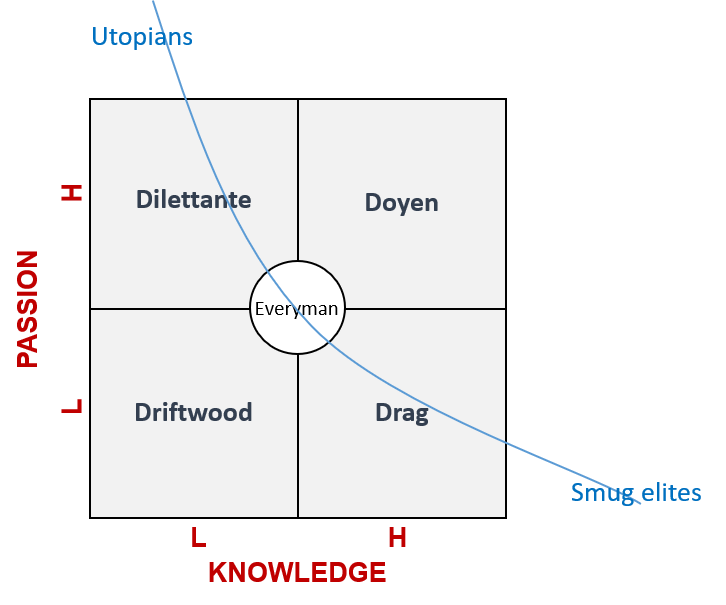
Best efforts and hard work often comes across as ‘passion’. Passion without knowledge, unfortunately, as we are all now beginning to see very clearly, is a shortcut to de-stabilisation of not just the political system but the country as a whole. Trust goes down, people don’t bother to vote, extremists rise to the fore, and hey presto, pretty soon no-one can talk to anyone from a different political perspective any more. Which removes even more trust and serves to perpetuate the downward spiral.
It’s perhaps a little harsh to pick out individual examples, but if I had to pick a couple, I’d opt for dilettantes from opposite ends of the left-right political spectrum, Jess Phillips and Mark Francois. Neither could be accused of not being passionate about their beliefs. But both, I believe, are so fundamentally lacking in the necessary knowledge of political, human and societal systems that they become devastation time bombs. There’s a fundamental contradiction that needs to be addressed here. One that looks like this:
Creating a critical mass cohort of political Doyens will undoubtedly be a tough nut to crack. One that will take time. Part of that time, I believe should be spent ensuring that a person is only allowed to stand for election (or take on a supervisory role in the Civil Service) if they possess the requisite skills. Here’s the curriculum as I currently see it. Twelve Modules and a dissertation:
Module 1: Complexity
Complex Adaptive Systems, Cynefin, Complexity Landscape Model, Systems Thinking, Emergence, Law Of System Completeness.
Module 3: S-Curves & The Dynamics Of Discontinuous Change
S-Curves, Tipping Points, All Systems Hit Limits, Types Of Step Change, Pulse-Rates, OODA, Hero’s Journey
Module 7: Direction & Directionality
Ideal Final Result, Convergent Evolution, AntiFragile, Start-With-Why, Critical-Mass-At-The-Critical-Point
Module 8: Where Have All The Leaders Gone?
Bravery, Wilful Blindness/Plausible-Deniability, Risk-Management, Managing-The-Unknowns
Module 9: How To Measure Anything
(Measuring what is important rather than what is merely convenient), PanSensic, Big-Data-Analytics, The-Meta-Data-Never-Lies-But-You-Need-To-Listen-Differently,
Module 10: The Science Of Reading Between The Lines
Zaltman Metaphor Themes, Culture-Codes, Cultural-DNA
Module 11: Ecology & Environment
Building Meaningful Scenario Models, FMEA, X-Cycles (Carbon, Water, etc), Eco-system Design, The Wide Lens
Module 12: Putting It All Together
Policy Design, Communication-In-A-(Too)-Transparent-World, Re-Thinking History (when we understand complex systems, history and the ‘lessons of history’ need to be completely re-thought), Seven-Habits-Of-Highly-Effective-Politicians
Dissertation: A real-world, get-your-hands-dirty, project, solving a genuine community-based problem using zero (financial) resources.
I’m thinking the whole thing – like our new on-line Systematic Innovation Masters Degree – can be done through distance-learning, the whole thing broken down into bite-size chunks that people can work through during lunch-breaks and after the kids have gone to bed.
I’m also wondering whether journalists also need to complete the programme before they’re allowed to publish. Seeing as they seem to be a big part of the political problem too.
Last week I read Arthur Schopenhauer’s book, ‘The Art Of Always Being Right’. Don’t ask.
I’m still not sure whether it was serious or meant to be funny. That was probably the point.
A good part of the thinking seemed to centre around the idea that it was important to win an argument irrespective of whether you were right or not. In that sense, it feels like it must be compulsory reading for the current crop of self-serving, truth-shy politicians. I’m guessing it plays a big part in the curriculum at places like Eton too.
The book contains ‘the’ thirty-eight ways to guarantee winning your next argument. In a lot of ways the strategies are similar to the ideas found in The Art of War. Not as evocative or well-described, but similar nevertheless. Which in turn means there must be a fair amount of overlap with the TRIZ Inventive Principles. In that an argument – irrespective of whether one or both parties is ‘right’ – is a contradiction, and if it is a contradiction, the only way to ‘solve’ it, according to TRIZ at least, is through one or a combination of the 40 Principles. I thus had my fingers crossed that Schopenhauer might have something to add to the contradiction solving story.
So I went through all of ‘the’ thirty-eight strategies to see if there was the flicker of insight. Some of Schopenhauer’s strategy titles weren’t exactly obvious, so the exercise meant literally reading the whole book. Even when I found myself tutting with frustration. Here are his thirty-eight strategies, so you can see what you think:
Extension
Homonyms
Generalise The Specific
Conceal Your Game
False Premises
Postulate What Has To Be Proven
Yield Admissions Through Questions
Make Your Opponent Angry
Question In Detouring Order
Take Advantage Of The No-Sayer
Generalise Admission Of Specific Cases
Choose Metaphors Favourable To Your Proposition
Agree To Reject Counter-Argument
Claim Victory Despite Defeat
Use Seemingly Absurd Propositions
Use Your Opponent’s Views
Defence Through Subtle Distinction
Interrupt, Break-up, Divert
Generalise The Matter, Then Argue Against It
Draw Conclusions Yourself
Counter With An Argument As Bad As His
Beg The Question (use circular reasoning)
Make Him Exaggerate
State A False Syllogism
Find The Instance To The Contrary
Turn The Tables
Anger Indicates A Weak Point
Persuade The Audience Not The Opponent
Diversion
Appeal To Authority Rather Than Reason
This Is Beyond Me
Put His Thesis Into An Odious Category
It Applies In Theory, But Not In Practice
Don’t Let Him Off The Hook
Will Is More Effective Than Insight
The Vicar Of Wakefield
A Faulty Proof Refutes His Whole Proposition
The Ultimate Strategy (personal insult)
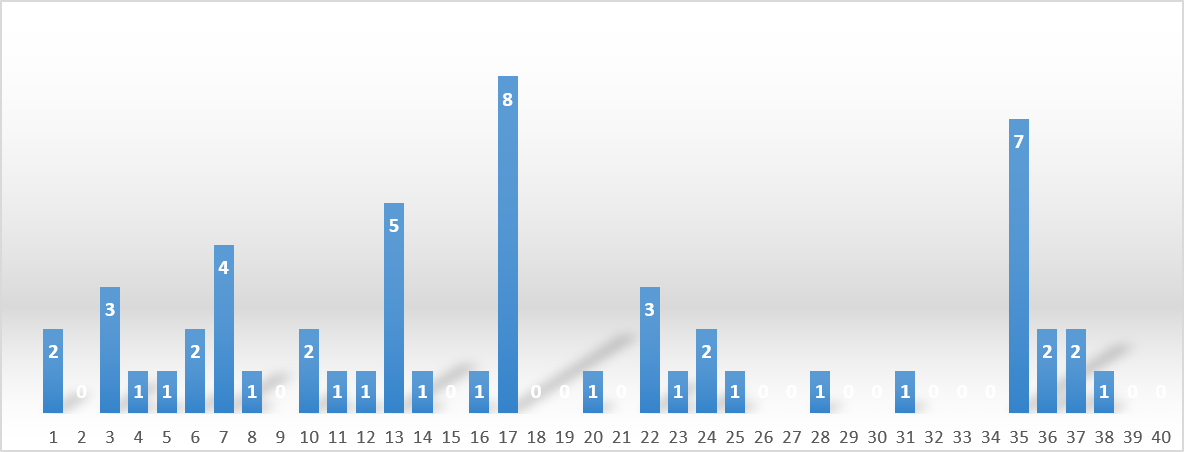
When mapping the full descriptions to the TRIZ Inventive Principle, it rapidly became clear that some of the strategies actually contained several different strategies, or sub-strategies, or combinations of strategies, but lest I come across as trying to build any kind of suspense, all of the variants fitted very clearly into the long-established Principle taxonomy. The eventual score looked like this:
Twenty-five of the TRIZ Principles had a Schopenhauer corollary, leaving fifteen Principles that Schopenhauer never thought of. Assuming the listing is in the chronological order in which Schopenhauer thought of them (I can see no evidence of any other kind of structure), when you learn that Strategy Thirty-Eight – the ‘Ultimate Strategy’ no less – is essentially to shout personal insults at your opponent, I’d have to say that he was getting somewhat desperate towards the end of his analysis. Which I have ultimately taken to be good news. Next time you find yourself on Question Time or in the Question Time audience, if you know some TRIZ you have a fifteen strategy advantage over the Public School educated charlatans on the panel.
Plus, contradiction-wise, you ought to have a far better chance of being right as well as winning.