For the most part I can’t watch Question Time anymore. To the pointless either/or debates we now have the added dis-incentive of knowing that the audience selection strategy is no longer fit for purpose, and that half the people asking the questions are some kind of an axe-to-grind plant. Last night, noticing that cyclist (cyclist??) Chris Boardman was on the panel, I thought I’d check out what was happening.
There was a question about the NHS. There’s an election coming, so this wasn’t such a great surprise. Neither, then, was the inevitable left-versus-right claptrap argument. This time around it seemed to devolve into a race to see who could make the most ridiculous claim about how much more money they were planning to throw into the Service after they were elected. ‘The Tories have given us 10 years of austerity, have stripped the morale out of all the staff and their new policy is just about putting back what they took away’. ‘Labour’s plans are un-affordable utopian nonsense’. You say tomayto, I say tomarto. Same old blather.
Then it was Chris Boardman’s turn to talk. He decided to take the discussion down a different direction. There are 20 million inactive people in the UK, he said, and if we change the way they move, everyone wins. People get fitter, we reduce pollution, we spend less money, everybody wins.
This was what I call a third-way solution to the problem. Not a total solution to the problem, but rather one that jumps out of the either/or psychological inertia debate and points us in a direction in which we end up with a better overall solution: an NHS that costs us less money, one that has less patients to treat, and one that delivers better outcomes because when people do become ill, they get better, faster. A step in the right direction. A step that tells us, hey, look, we can do this, let’s now go and look for other win-win solutions.
Unfortunately, that’s not quite the way the audience heard the answer. Most seemed to hear it from their ingrained either/or-think perspective, ‘why isn’t he answering the question?’ The others went down the cynical vested-interests track. One snarky, Tweeting either/or prat of a politician wrote, ‘man who sells bikes thinks everyone should use bikes. Quelle surprise.’ This is how far we’ve now sunk.
Generally speaking, given the choice between defending the Snowflake Brigade or the ‘Man-Up’ Army, I tend to veer in the latter direction. Mainly, I think thanks to my exposure to the first of the Generation Z apprentices we’re being asked to train by some of our clients. I’ve never met a cohort of people so ill-equipped to handle the everyday stresses of getting out of bed and arriving at work on time. No longer is it possible to set exercises like, ‘find a problem you’d like to work on and use the tools…’ because no-one seems to understand the concept of ‘problem’. Which I take to mean that, should anything out of the ordinary have happened to this cottonwool-wrapped generation, helicopter-mom or bulldozer-dad will have stepped in and fixed things at the first flickerings of anxiety. I suspect this doesn’t bode well for the future.
I’m not sure it is connected, but, for the first time in my life, recently I’ve found myself starting sentences with the words, ‘in my day…’. Which I suspect also doesn’t bode well for the future.
In my day… work was pretty much sink-or-swim. I was given big scary jobs and told to get on with it. I think I’m a better person as a result. Apart from the tendency I now have to be something less than patient when it comes to encounters with people that have had a smooth pathway mapped out for them wherever they go.
I know, too, that this occasional impatience is also unfair. The world is a more turbulent, faster changing, more complex world to the one I was expected to learn to swim in back in the late 1970s. Its very easy for all of us to feel overwhelmed. Ten minutes watching the News these days will usually do the job. I get it.
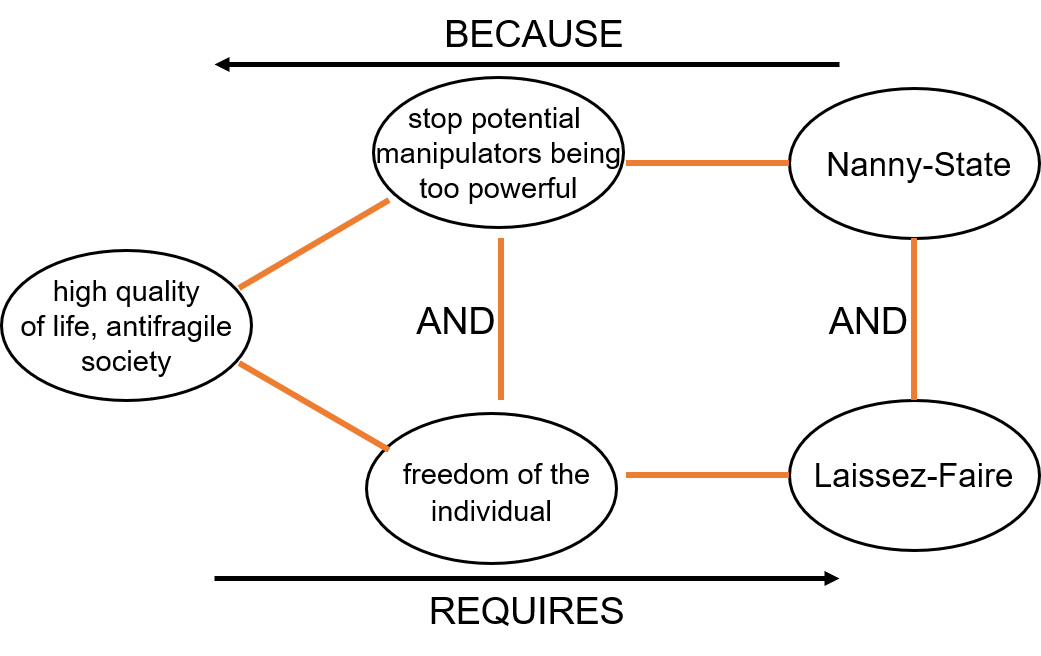
What I also get is that any kind of too-hard-too-soft Snowflake-versus-Superhero debate is also the wrong question. It’s a contradiction, dummy. Should society be laissez-faire or ‘Nanny-state’? It should be neither. And both:
That said, I’m also increasingly conscious of the fact that these kinds of over-protect/under-protect contradiction occur in a world that is now fundamentally different to the one that existed five or ten year ago. It used to be a fair fight. Now it isn’t. It used to be snowflake-versus-snowflake. Now its snowflake-versus-The-Magnificent-Seven.
There are several ways of interpreting who this Magnificent Seven is. Per one of my presentations earlier this year, one of the interpretations is that they are Google, Amazon, Facebook, Microsoft, Tencent, Baidu and AliBaba. The industrial mastadons that increasingly own all of the world’s data. The giants that know more about us than we do. And, for the most part, are more than happy to sell what they know about us to anyone anywhere with a desire to sell their stuff to us. Against this kind of foe, Johnny Snowflake stands essentially zero chance of success. Johnny Snowflake is going to buy whatever the Magnificent Seven tells her to buy.
Take food. The ‘Man-Up’ brigade, acting on behalf of the supermarkets, fast-food restaurants and big-data analysts from the Magnificent Seven, tell us that we’re free to choose not to super-size our order. But at the same time, they know we’re increasingly powerless to resist. The marketing psychologists know precisely – for every one of us – which buttons to press to ensure that more often than not we find ourselves acting against our own best interests and instead acting in theirs. In this context, there is no ‘free-will’ anymore. We’re puppets. We can’t see the strings, but they’re there, tugging and yanking our catalogue of quirks, biases and weak spots. Even though we’re continually being told we’re not, we’re actually all snowflakes now.
Another way of defining the Magnificent Seven we snowflakes have to battle against is in the context of the technologies behind the Magnificent Seven enterprises: sensor technologies that increasingly measure everything there is to measure about us; surveillance systems that mean we’re always on camera; the micro-niching technologies that allow advertisers to laser-guide their campaigns onto the most vulnerable; digital-design technologies that allow them to perform thousands of invisible experiments to optimize how to manipulate individual users; meta-data analysis algorithms that assemble our big-picture, no-hiding profiles; the commercial technologies that automatically connect these profiles to the next provider looking to extract their share of revenue from us; and finally – the coup de grace – the self-learning algorithm technologies that continually allow the other six technologies to get progressively better and better at doing their job.
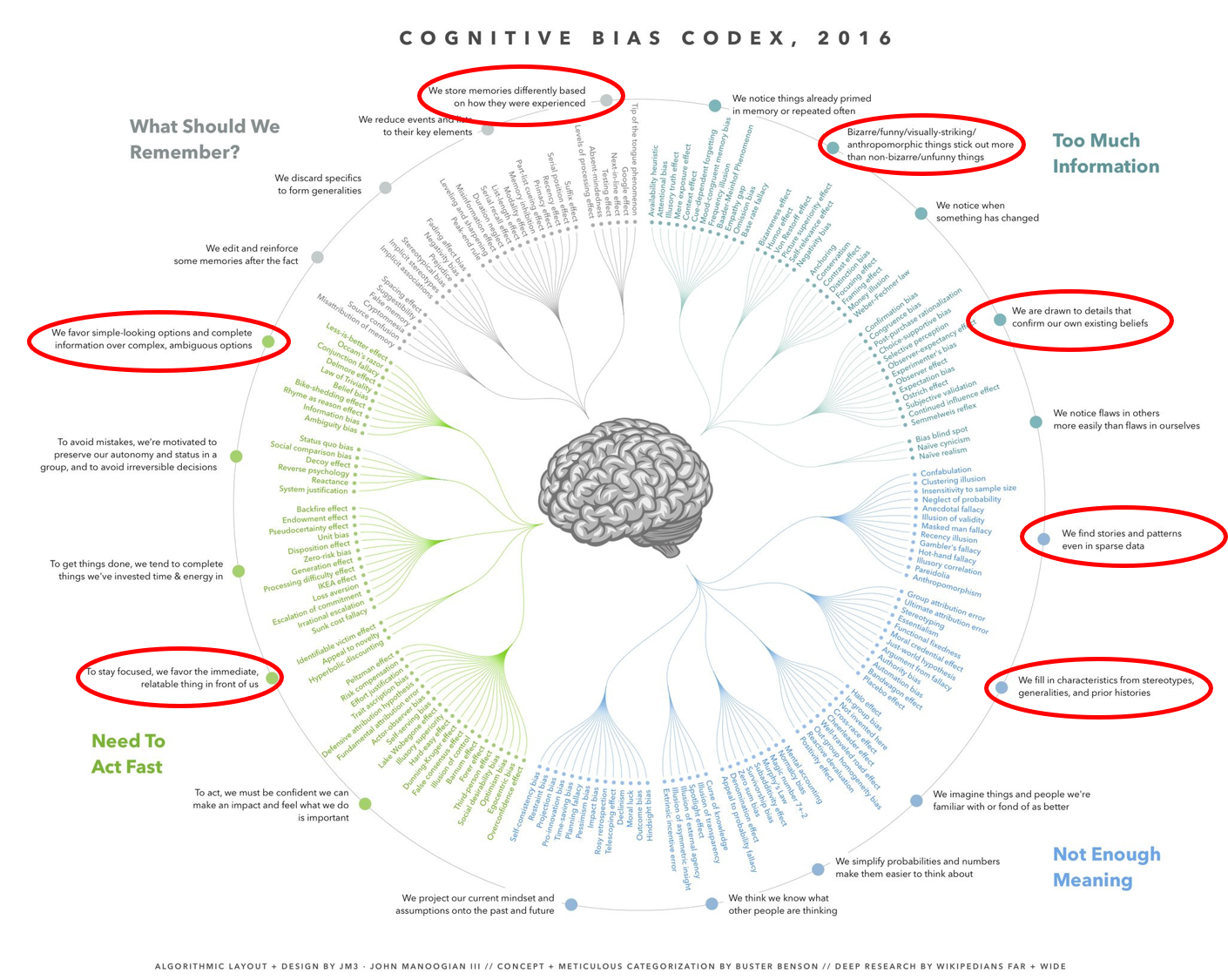
And then there’s a third way of thinking about who the Magnificent Seven are. Take matters down to first principles, and it looks like there are seven critical cognitive biases every individual on the planet that the Magnificent Seven organisations are able to use the most easily to work out who we are and to make us vulnerable to exploitation:
Like I said, this is no longer a fair fight. The snowflake increasingly has no chance. The contradiction needs to be solved. We need citizens that are able to stand on their own two feet and live a meaningful life. And the only way this can begin to happen is they know when and how third parties are trying to manipulate them. And then know what they can do to call foul and fight back. In the short term, society might have to manage the contradiction through legislation. The Magnificent Seven will no doubt argue that all they’re doing is serving their customers and trying to serve them better than competitors. That’s what capitalism is all about: the person that serve the customer best wins. But capitalism, crucially, doesn’t understand the word ‘enough’. And that’s where legislations comes in. As a temporary scaffold that sticks around just long enough for the snowflakes to work out how to get the systems we rely on to serve our needs act in our long-term interests rather than serving our short-term limbic-driven whims.
Settle in, this one looks like its going to be a tough, long-haul battle.
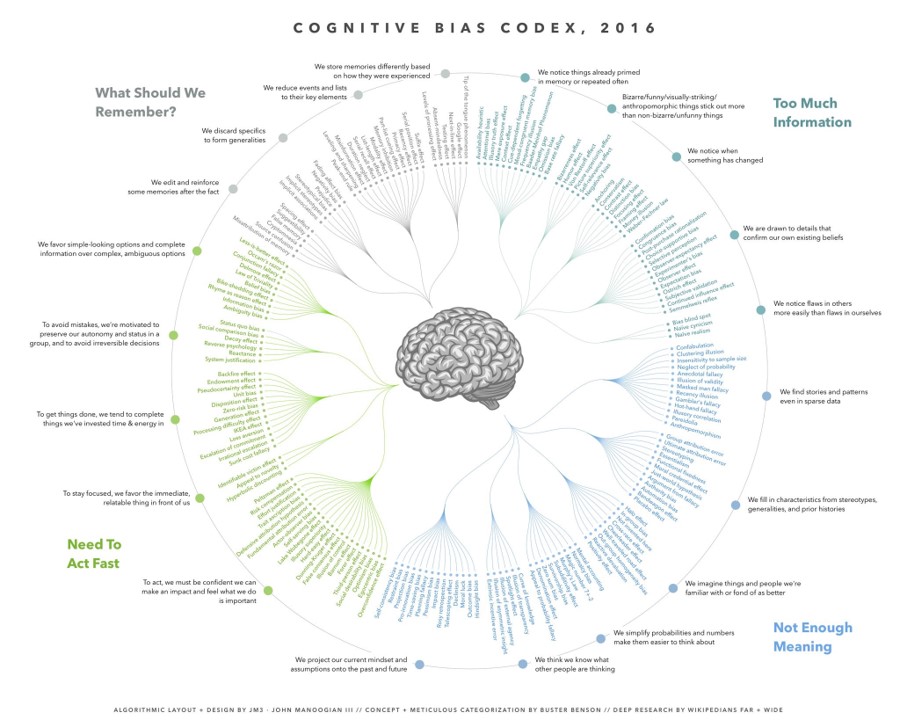
Spend more than a couple of minutes on the human cognitive bias Wikipedia page and it become very clear why so many of us struggle to make sense of the world. We’ve basically evolved a 175-ingredient primordial soup of different ways our brain inadvertently screws us up. Now some lovely person has taken the time to translate the original alphabetic listing into something with rather more structure. Buster Benson is the lovely person in question, and I heartily recommend you take a look at how he went about unravelling and making sense of the catalogue: https://medium.com/better-humans/cognitive-bias-cheat-sheet-55a472476b18.
Enter another lovely person, John Manoogian III, who took the time to transform Buster’s hard work into this amazing graphic:
There is always the potential – of course – with these kinds of activity that anyone could run off and build millions of different taxonomies. So the question inevitable arises as to what might make this Cognitive Bias Codex better than any other structure we might choose to assemble?
An early test we apply in the SI research team when it comes to this kind of question is to see how well a model relates back to first principles. Like it or not, we’ve evolved to possess all of these biases for good reasons. They, collectively, serve a purpose. Albeit one that is perhaps better suited to the cave-dwelling time in our history rather than the Fake-News, cut-and-thrust of the 21st Century. But if they serve a purpose, they must also form a system. And if they form a system, they must, collectively, obey the TRIZ Law Of System Completeness.
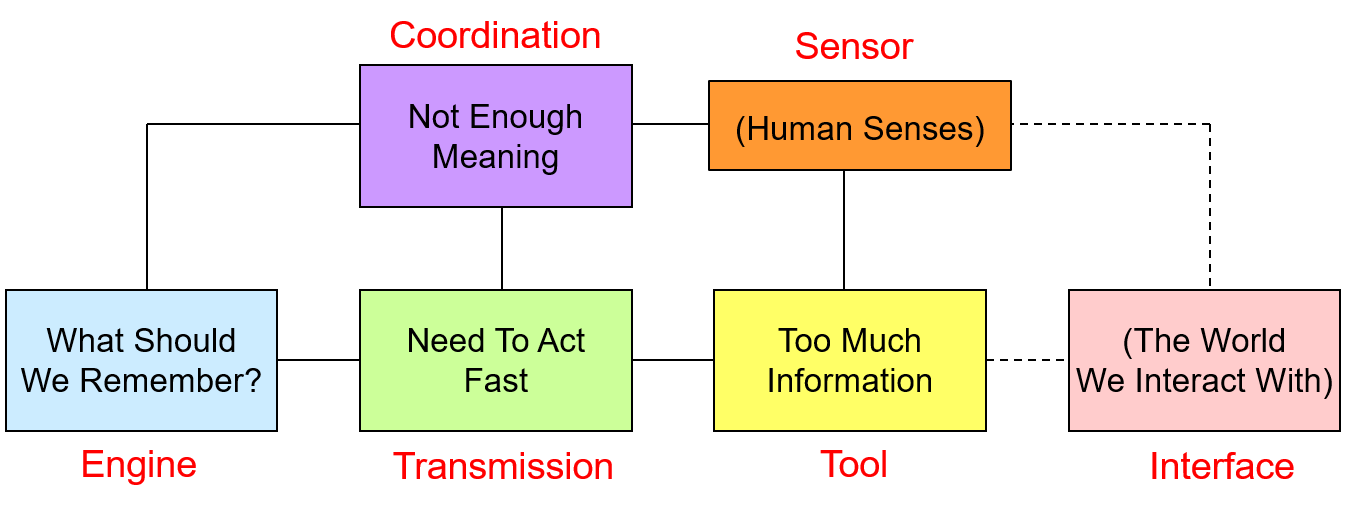
Which, at first blush suggests a problem. The LoSC says there must be six elements and Buster Benson’s structure only contains four:
1) Too Much Information: information overload sucks, so we aggressively filter. Noise becomes signal.
2) Not Enough Meaning: lack of meaning is confusing, so we fill in the gaps. Signal becomes a story.
3) Need To Act Fast: lest we lose our chance, so we jump to conclusions. Stories become decisions.
4) What Should We Remember: This isn’t getting easier, so we try to remember the important bits. Decisions inform our mental models of the world.
In order, these four elements can be seen to clearly represent the TOOL, COORDINATION, TRANSMISSION and ENGINE of our system. Meaning that we’re missing the INTERFACE and SENSOR parts. But these, of course, are, firstly, the outside world we sense from, and the senses (visual, auditory, kinaesthetic, olfactory, gustatory, etc) we use to do that. Which means we have something that is coherent and consistent with the Law. Like this:
Which in turn means we can start applying some other aspects of TRIZ to see if we can help explain why the human cognitive system is increasingly ill-equipped to cope with modern society. And – perhaps more importantly – what we might start to do about it…
It’s very difficult, I find, to disagree with everything that a person says or does. Lying Boris Johnson comes close, but even with him, I still find it difficult to argue with his point about wanting to bring a ‘can-do’ attitude back in to the British mentality.
Maybe it’s living through three years of political nonsense that has helped create the ‘can’t-do’ mindset that seems to have crept in to most segments of society. A case in point was the reaction to the Conservative Government’s recent announcement to recruit 20,000 new police officers. Now, granted, the announcement created a certain inevitable backlash from many sectors of society, since all it was essentially doing was bringing back 20,000 police officers of the 21,000 that had been lost from the police service thanks to the last decade’s worth of Conservative Government austerity. It seemed okay to me that everyone should have a 30 second moan about that fact, make a mental note to not forgive the Conservatives at the next general election, and move on.
But then the media started interviewing senior officers in the various police forces around the UK and a bigger problem became apparent. All we heard from them was how difficult the whole recruitment exercise would be, and how it wouldn’t be possible to recruit, train and get 20,000 people on board in the timescales the Government were demanding. The can’t-do coup de grace came from one Chief Constable who’s main argument against the whole initiative centred around the apparently impossible difficulty of finding enough lockers for the new recruits. Lockers. How he kept a straight face I will never know. I certainly couldn’t keep mine.
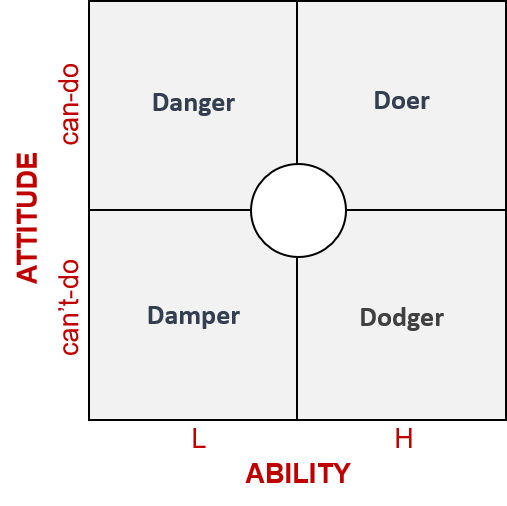
How do we find ourselves in situations like this, where even simple stuff becomes too difficult? Its not – as far as I can tell – about a lack of ability. If it was about lack of talent, then having a can’t-do attitude might actually be a good thing. Something like this:
People with low ability and a can’t do attitude present society with much needed damping. Far better that they stay home, playing on their x-box and blobbing-out on their Just-Eat app than getting out and messing things up for the wider community… which is what the ’Danger’ people end up doing. The combination of low ability and a can-do attitude is in many ways – thanks, David Cameron, thanks Boris Liar Johnson – why we’re in this mess in the first place. Seen in that light, its difficult to put too much blame on the Chief Constable who decides it is far better for his or her career to demonstrate strong ability to Dodge difficult, no-win projects handed to them by dangerous low-ability, can-do politicians.
But, then again, what we end up with is a society with a sorry dearth of Doers.
In that regard, I point back to The Basic Laws of Human Stupidity of yesterday’s blog rant. Or maybe another person that I disagree with almost everything they say. Hello, right-wing, misogynist, muck-raker, Steve Bannon. What does he have to contribute to the story? Perhaps a recognition that the people in positions of power in the world are now so dominated by Dampers and Dodgers that the only way forward is to judiciously place a few Dangerous puppets in positions of extreme power to ensure enough dominoes get pushed over to create the global chaos that will in turn kill off all the societal dead-wood and then allow the Doers to finally do their thing and set society back on track. Although hopefully along a third-way track rather than the right-wing, misogynistic muck-raking track Bannon seems to prefer.
It might have been coincidence. Or it might not. Yesterday I received my copy of the Nassim Nicholas Taleb foreworded version of Carlo Cipolla’s mini-classic, ‘The Basic Laws Of Human Stupidity’. And yesterday, the UK Parliament decided that the country would have a general election on December 12.
The will-they-won’t-they election decision has been debated for several weeks now. The Conservatives have been nervous because Boris Johnson promised – on his die-in-a-ditch life – that the UK would leave the EU on 31 October and now we know he has failed, there is likely to be a backlash. Picture Nigel Farage rubbing his grubby-hands with glee at the upcoming advertising campaign. On the other side of the house, the Labour party have been trying to put off the election for as long as possible because they’re about 14 points behind in the polls thanks in no small part to the fact that, in Jeremy Corbyn, they have a leader that appears almost totally un-electable by anyone other than a devout Marxist. The Liberals, being the liberal wimps they are, seem relieved that the election decision gave them a get-out-of-jail-free card in terms of failing to stop Brexit from happening. Thanks to the first-past-the-post election system, they will win a few more seats and, better yet, when the dust settles, get to shrug their shoulders and say they did the best a small party could do in the circumstances. The Scottish Nationalist Party, meanwhile, are rubbing their hands with glee at the prospect they will wipe out the Conservative Party in Scotland, and lay the foundations of another independence referendum that, this time around, thanks to Brexit, they will likely win. The SNP will thus, in their minds, do a good thing for Scotland, but in reality will end up making themselves and the rest of the UK worse off. Which, finally, leaves the DUP, who have swiftly sunk back to their pre-2017 level of irrelevance outside the Unionist community of Northern Ireland. The election decision means they no longer have any of the very non-linear power they’ve held since the Conservatives were forced to buy them off after the 2017 election. One day they decide for the nation; the next, no-one gives a damn what they think any more. It’s a tough game, politics.
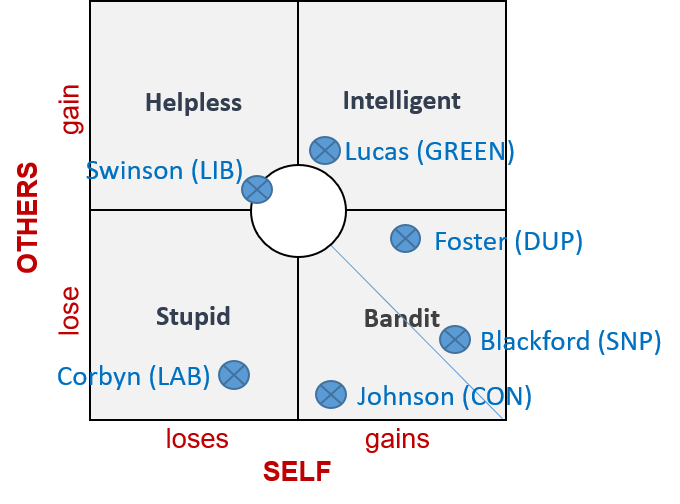
Plot this sorry mess onto Cipolla’s Map Of Stupidity and the UK political scene currently looks like this:
The Conservatives get to be the win-lose Stupid Bandits; the SNP and DUP get to be intelligent Bandits; Labour look like they’ve just sleep-walked into the Boris Johnson Bandits trap and, thanks to Jeremy Corbyn’s lack of leadership prowess, get to play the plain Stupid role in proceedings. Jo Swinson’s Liberal Party continue in their Helpless role – ‘winning’ a few seats while losing the prize they could’ve had. Which leaves Caroline Lucas and the Green Party as the only vaguely ‘intelligent’ players in the game. They too will likely win more votes and, who knows, even one or two extra parliamentary seats, and might even help build some more Save-the-Planet momentum. But, of course, will largely have no impact on the Brexit state of play at all.
All in all, the omens are not good for a meaningful outcome on December 13. Labour and Conservatives are already playing to their Stupid and Bandit types and are trying to make the election about more than just Brexit. But with Brexit in its current unfinished business state, the election can be about nothing else. And here, then, is the real problem. Anyone that voted Remain in the EU referendum is basically dis-enfranchised right now. The Conservatives want (hard) Brexit. The Brexit Party will push them to go even harder. Labour, in theory, are standing on the idea of a confirmatory referendum, but everyone knows that Corbyn doesn’t believe in the idea, and as a consequence he’s trusted almost as little as Johnson. The Liberals have chickened out. The Greens offer little more than a protest vote. Leaving only the SNP offering a meaningful home for Remain voters. Nice if you live in Scotland, not so good for everyone else. Unless they start fielding candidates in the rest of the UK.
As the last three years have shown, almost any kind of worst-case scenario imaginable proves to be inadequate within short order in Brexit Britain. The half-life of British political Truth is now measurable in hours and minutes. Meaning that predictions of what will happen are little better than a coin toss. Especially, too, in light of the fact that there’s the Facebook-broke-democracy element still to take into account. This election, in other words, takes place in an environment in which every party now understands that Facebook and other social media channels offer a non-legislatable, largely illegal Wild-West in which quite literally anything goes. Lying politicians has always been an oxymoron. Today, thanks to Facebook, they get to customize those lies to target the weak, the vulnerable, and the racist. Except, if I read Cipolla’s Stupidity Map right, I believe a prediction saying things will continue to get worse is very likely to be right. Which, to my mind, means December 13 (a Friday – surprise!) will bring the UK another hung parliament on December 13. This will then be followed by yet another extension begging letter to the EU by the middle of January. This will then prolong the agnoy for several more months until, finally, in utter despair, enough careerist politicians will stick their head above the political parapet and tentatively suggest what has always been the only sensible way through this mess, another referendum. This will then result in a revocation of Article 50, and the UK can safely return to its (comparatively) blissful 2015 state. Only several hundred billion pounds poorer thanks to the five years of combined political Banditry and Stupidity.
I guess deep-down I’m still a fan of anthropologist cum marketer Clotaire Rapaille’s work on Culture Codes. The big idea is that popular products can become associated in the minds of consumers with powerful metaphors that, if the product design or advertising shifts to become inconsistent with those metaphors will create a mental mismatch, that in turn will create a decline in sales of that product.
Rapaille opens the book with one of the less credible of his client engagements. Iconic off-road vehicle producer, Jeep, found themselves struggling with sales at a certain point in time, and went to Rapaille and his team to see if they could unravel why. Rapaille interviewed lots of Jeep customers in order to try and establish whether there were any deep cultural metaphors. It turned out there were. In parts of Europe, for example, the Jeep was associated with ‘rescue’. This metaphor appeared towards the end of the Second World War when, if you were a person living in, say, rural Italy, the first time you ever saw a jeep very likely was when an enemy-vanquishing American drove in to town.
In the US, where, because there was no enemy-vanquishing to be done, the culture code word for the Jeep turned out to be ‘horse’. The Jeep, in other words, was being associated with the same off-road goals as would traditionally have been achieved by four-legged friend riding cowboys. And, hey presto, Rapaille was able to announce to the Jeep marketing folks, the reason for your drop in sales is because you’ve just switched from round headlights to square ones. Horses don’t have square eyes and so now the vehicle doesn’t fit the code.
And so, Jeep apparently ordered a switch back to round headlights and sales of the Jeep magically turned in the right direction again.
If nothing else, I have to say I still stand in awe of Clotaire Rapaille’s powers of persuasion if even half of this story is true. ‘Culture Codes’ – if they exist at all (and I tend to think some of them do), can sound about as un-scientific as it is possible to be.
I’ve been increasingly reminded of the whole Jeep-as-Horse story lately thanks to the increasing appearance on my radar of the Jeep Renegade. And in particular the oddly star-shaped tail-lights. Which, turn out to be not nearly as odd as you might think in the context of Rapaille’s culture code…
…either that, or someone in the Jeep design team has finally had their revenge on the Marketing team suckers. Which, if it’s true, might just bring Culture Codes to a whole new level of reality. I have my fingers-crossed. If you’ll excuse the potential pun.
Like 85% of all drivers, I am above average. My finely tuned driving skills (i.e. driving at 36mph in a 30mph zone) meant I had to spend an afternoon at what is notionally known in the UK as Naughty Drivers Club. You get caught speeding and are given a choice: accept three penalty points on your driving licence, or attend a Naughty Drivers Club workshop so you can learn why speeding is a bad thing.
Deep down, I kind of already knew that driving too fast is a bad thing. Even if it is 2am and everyone else is asleep. That said, my expectations for a knowledge-packed telling-off by the Police were not high. I was wrong.
My first learning, when I entered a classroom with twenty-three other Naughty Drivers, was that 16 of us had been caught at precisely the same speed-trap. This suggested to me that rather than being a road-safety device, the speed-trap was in actual fact a money-grabbing scheme by the local council.
My second learning came closer to the end of the session when we were shown a one-minute drivers-eye video of a car being driven through a semi-urban scene and asked to record how many potential dangers we could see.
The clip started.
There was a young mother walking along the side of the road with a toddler.
They were approaching a junction.
Along the side of the road there were rows of bins, put out ready for collection.
There was another junction.
There was a car parked on a double-yellow line on the other side of the road. The road was wide enough for two vehicles, but not three. Two cars were approaching behind the parked car. The driver looked like he was waiting to get out of the car.
A sign said, ‘School ahead, 20mph speed limit when lights are flashing’. The lights were flashing.
Another junction. This time with a car waiting to join the traffic.
A cat sat on a garden wall.
The school. Various parents milling around outside.
More flashing lights.
A lollipop-woman poised to step in to the road.
A man with a dog on a long lead walking towards her.
You get the picture.
When the video finished, the Naughty Drivers Club instructor asked us to total up the number of danger points we had identified.
I let a bit guilty because I lost my concentration towards the end and only found 34.
The woman sat next to me stuck her hand up, ‘twelve,’ she announced.
Everyone else joined in. Lots of sixes. Lots of sevens. A few tens. Another twelve.
Then someone shouted out ‘eighteen’.
Everyone looked at him. The instructor smiled, ‘what do you do for a living, sir?’
‘Coach driver’, the man answered. One of the sixteen of us that had kindly decided to give the local council some free money.
I stayed quiet. For a few seconds I thought I must be going mad.
Then the instructor replayed the video. Only this time he gave us the benefit of his commentary while a colleague kept count. By the end of the video the official count total was thirty-two.
I wasn’t going mad.
Everyone else was. That or they were all walking through life in a trance.
And that’s my point. If professional drivers are missing almost half of the hazards around them, and if the average driver is missing three-quarters, then it shouldn’t be a great surprise that we’re all held up behind an ever-increasing spiral of road accidents. Modern life is turning us into mindless idiots.
Now I’ve got thirty five things to worry about. Thirty six if you count the fact the instructor continued to deny the cat sat on the wall was a hazard.
Aerospace engineers tend to be glass-half-empty kind of people. The same pretty much applies to ex-aerospace engineers like me. Pessimism kind of goes with the job. It’s the way you get to build the world’s safest industry: don’t believe anything anyone tells you; look for evidence; don’t stop until you’ve got enough of it, and seen enough of it with your own eyes to ensure the aeroplane you’re designing won’t fall out of the sky.
Living with this kind of perspective can be a heavy burden. One, it puts you somewhere close to the bottom most people’s list of other people you’d love to have at your next party. Two, in these post-truth times, the ratio of truth-to-crap can very easily become overwhelming. Particularly if you spend any time on social media. Which I increasingly try not to.
Up until recently, however, I did have a certain fondness for a good documentary. Now, alas, even that pleasure has gone. It went sometime during a programme on vaccinations that I caught up on last week. The programme centred around the tragic story of the return of previously eradicated diseases like measles. Measles is back because fewer and fewer parents are getting their kids vaccinated. In theory, it was a slam-dunk kind of story: a few decades ago, a couple of clinicians with poor knowledge of how to design an experiment and a large egomniac-clinician-sized chip on their shoulder published ‘research’ showing that vaccines are dangerous. They’re listened to for a while. Then they are discredited. End of story.
Except, in their desire for ‘balance’ the documentary makers – who also, evidently had no understanding of experiment design either – brought together a collection of interviewees, who for the most part also didn’t understand experiment design, and collectively then stitched together a narrative that failed to make the nonsense clear. I’m guessing, largely because there is no simple way to tell the story. And, above all else, it seems, the public wants and expects to here simple stories.
While I don’t doubt the nonsense of the discredited clinicians, the disappearance of my faith in documentary makers during the programme arrived with the thought that the documentary makers had absolutely no desire whatsoever to uncover and reveal the truth. Rather they were intent on making hour-long clickbait.
And, what they’ve learned from social media is that the best way to do that is to create content that evokes strong emotions. Preferably negative ones. People are, to my reckoning, around seven times more likely to respond to anger-inducing nonsense than they are fluffy-kitten, isn’t-it-loverly kind of nonsense.
Beating a 7:1 tide of crap is hard work. In the words of the aphorism, A lie can travel halfway around the world before the truth can get its boots on. Except, thanks to social media and the amazing self-learning algorithms present on Facebook, Twitter and the like, the lie has now done seven laps of the equator before the truth has even thought about boots.
All that said, as well as being a natural pessimist, I’m also a great optimist when it comes to believing that any problem is solvable. That’s what TRIZ did for me.
The post-truth problem is eminently solvable.
In theory.
In practice, when I combine my glass-half-full and glass-half-empty perspectives, its very easy to turn a solvable problem into an unsolvable one by introducing one too many constraints.
In theory, the post-truth problem can be solved, in the short term at least, by:
1) Acknowledging that human evolution has not yet reached sufficient maturity to deal with social media, we switch the whole shebang off.
2) Locking Mark Zuckerberg up in solitary confinement with a collection of Dunbar Number research and not letting him out until he understands there is no such thing as ‘connecting everyone’. Meanwhile all of his ill-gotten gains are re-distributed to each of the countries who’s elections, referenda and government surveys have been corrupted by his democracy-breaking algorithms. To pay for the re-running of those elections, referenda and surveys in a legal fashion.
3) Getting the mainstream media to re-recognise the idea that ‘balance’ is not about giving an equal voice to the different sides of an argument when one side is plainly and provably lying (“If someone says it’s raining, and another person says it’s dry, it’s not your job to quote them both. Your job is to look out the fucking window and find out which is true.”). To help journalists determine truth, we use software to assist in the identification of liars, deluded people and troublemakers.
4) We revoke the media ability to do voxpop interviews. Interviewing idiots in Stoke, while admittedly sometimes funny, is in reality nothing more than clickbait. Dangerous clickbait.
Of course, in practice, none of this will happen. Except in China. Which is a whole other story. One that currently rests on the general mis-understanding that politics is a two-dimensional left-right spectrum rather than a contradiction needing to be solved.
Meanwhile, on a personal level, while I’m often tempted to adopt the increasingly widespread strategy of blocking idiots from Stoke (other cities are available), I also know that this strategy also doesn’t work. Two-dimensional thinking again. Thinking that serves merely to increase the separation between the myriad us-bubbles and them-bubbles. What I need to do instead is to at least manage the contradiction. Which, as of now means remembering the importance of a two-second pause between reading clickbait and responding to it in order to realise there’s no point responding to it. Then all I need to do is keep in mind that 98% of what I’m exposed to these days is clickbait.
Which means lots more pauses than I’m used to. Who knows, if I’m somehow able to pool together some of those pauses I might re-gain a more sedate, relaxed, time-to-think lifestyle. And an end to blood-pressure medication.
It might be argued that the whole of the Brexit debacle started and ended with the subject of immigration. There are too many people in the country, we heard, too many still arriving, we heard, and we therefore need to ‘take back control of our borders’. So went the cries from Brexiteers.
Politics aside, what concerns me here is what does the data say? If anyone is going to make a decision on the subject, it is a fairly safe to say that having meaningful data would be a fairly important first step. We established PanSensic as way to help enterprises to measure what matters rather than what was merely convenient. As much as anything it has now become a way of innovating in the measurement domain: working out what we really need to know, and then working out how to measure it.
This is pretty much the opposite of the philosophy adopted by others in the measurement business. Some of them seem to have veered so far towards the ‘what’s easiest’ end of the spectrum it’s a wonder they can still see any kind of useful purpose in what they end up delivering. One such organisation here in the UK is the Office Of National Statistics. These are the people tasked by the Government with providing the information upon which policies like Immigration are determined. Being in effect a government agency (they were made ‘independent’ a decade ago), they have their own special version of ‘what’s easiest’ and that is, ‘whatever way we’ve always used’. Change, in other words, does not make up a significant part of the DNA of the people that work there. I know this from having had the occasional opportunity to work with their Senior Leadership Team.
‘Whatever way we’ve always used’ usually turns out to either employing an army of people to conduct telephone surveys (this is how a lot of VAT collection calculations are made, for example) or people with clipboards meeting members of the public face to face. This is the strategy used, it was revealed last week, to gather the country’s immigration data. One of the main characteristics of either of these methods is they are very expensive. Another is that, because people are generally speaking sick to death of being cold called or accosted by people with clipboards in the street, they tend to, ahem, not tell the truth, the whole truth and nothing but the truth. (See an earlier blog on our ‘5G’ model.) So, what we end up with is a method that is simultaneously the most expensive and the most shit. Excellent.
Not only are the UK’s immigration figures based on measurements taken by clip-board carrying ONS personnel, it also now transpires that they make the measurements at precisely two airports and zero other entry points on our borders. The two airports are Heathrow and Gatwick. And then somehow – by mathematical chi-squared unicorn-dust – they are able to extrapolate from these two clipboards-worth of data to produce national figures. To six significant figures. More excellent.
If you were setting out to make the least accurate, least meaningful way of calculating immigration, I suspect you would be hard pushed to do it. Unless you were taking Class-A hallucinogenic drugs. Which to my mind I’m not totally sure can be precluded from the discussion in this instance.
Having had this survey method ‘revealed’ last week, the UK Government has been forced to respond by downgrading the quality of the results produced to ‘experimental’. Class-A drugs might also have been involved here too in so far as the committee that opted for that word don’t appear to have had much more of a clue what they were doing than the clipboard bearers.
Experimental implies that, at the very least, you sat down and thought about the problem and then designed something. Key words: ‘thought’ and ‘designed’. For a start, thinking about the 28 airports and 11 ports that receive international passengers, and the destinations that people are able to travel from, and then thinking about the questions you might ask people to elicit a true and meaningful answer rather than the one they think you would like to hear.
But then, I think, pretty soon you’d conclude that, hmm, this all sounds like a lot of hard work. So then you start to wonder whether there might be other ways to work out how many people are living in or leaving the country. Something far easier. Things you’re already measuring, maybe. On Social Media, for example, or mobile phone signals. All the time knowing that you don’t need to calculate absolute numbers (the census will do that for you), merely relative ones. When I sat down and spent half an hour thinking about it, I concluded I could – with only the public domain data available to a shlub like me – design, build and commission a more accurate system than the current ONS effort in about three weeks. Step One: sack all Oxbridge-educated ONS statisticians (about 90% of the total my BS-detector suspects); Step Two: teach the rest Complex Systems 101 and Human First Principles 101; Step Three: sack them too. Step Four: Phone Google.
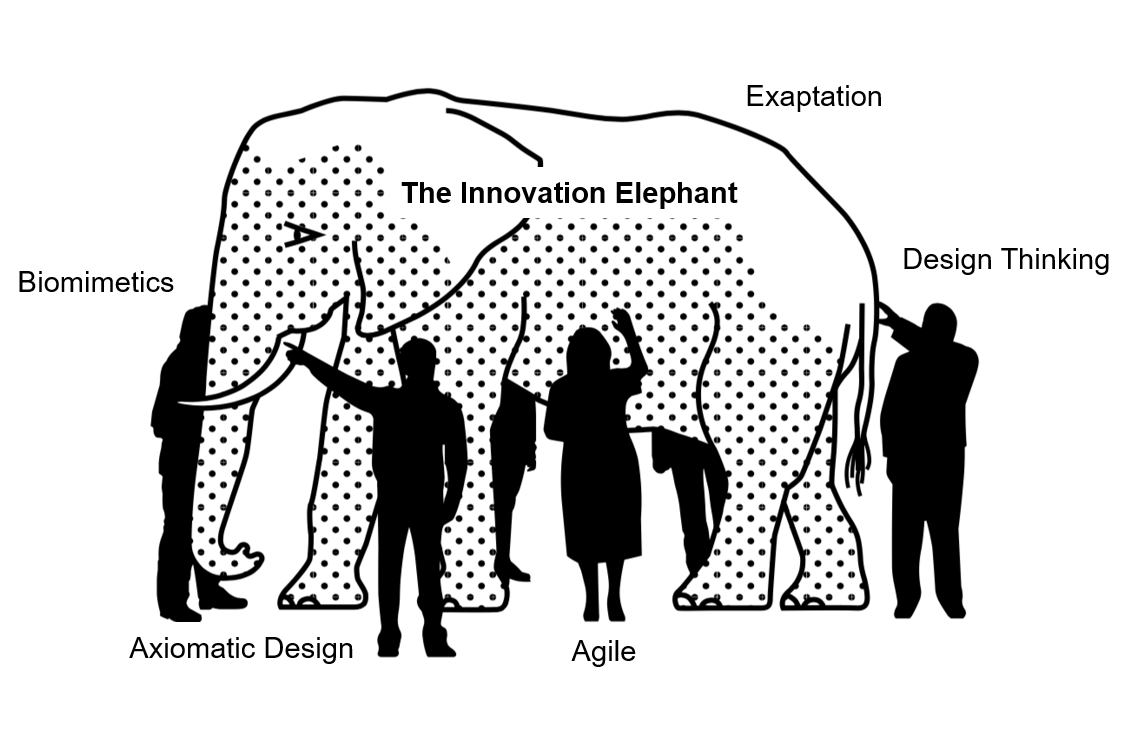
I’m not sure whether the blind-people feeling different parts of an elephant metaphor has reached Peak Cliché yet, but it still seems appropriate when I think about some of the smart people buzzing around the periphery of the innovation world.
In their desperation to not-use TRIZ or Systematic Innovation, these smart people periodically grasp at concepts they think will explain how innovation works. We saw it vividly with biomimetics. And then uber-fad, Design-Thinking. And now I find myself hearing the word ‘exaptation’ being used as the next innovation Holy Grail. Alas, like biomimetics, it turns out to be yet another tiny part of a much bigger picture. Albeit one that is easier to understand than TRIZ… which, of course, is a big part of its attraction. To gain a meaningful appreciation of TRIZ requires time and hard work. Far easier to gather half a dozen examples of engineers designing solutions inspired by biology. Or, from the exaptation perspective, to collect half a dozen examples (most of them biological anyway as it happens) of solutions that initially performed one function that were exapted to perform another. I’ve heard the bloody bird-feather exaptation story so many times now, I come out in a rash every time I hear the latest exaptation advocate prattling on about it.
People like easy, of course. On the other hand, systematically ploughing through ten million innovation case studies is definitely hard work. Had this research showed that biomimetics or exapatation were dominant innovation mechanisms, we might well have closed the research down a decade ago. The natural world ‘innovates’ at a glacial pace. And ‘exaptation’ doesn’t happen much faster. To calibrate us on how infrequent these mechanisms are, we might note that when Genrich Altshuller started the TRIZ research and spent a decade reverse-engineering important patents to generate the 40 Inventive Principles, exaptation was not one of them. It was our work in the early noughties in fact that we tentatively started talking about ‘Change Function’ as a recognisable strategy with any kind of statistical significance. If something takes over fifty years to spot, the researchers are either suffering from massive Confirmation Bias, or the something is pretty darn rare.
So, let’s try and set the record straight in terms of which is which. Just how big a part of the innovation story is exaptation? To help with the task, let’s bring in to play the work of
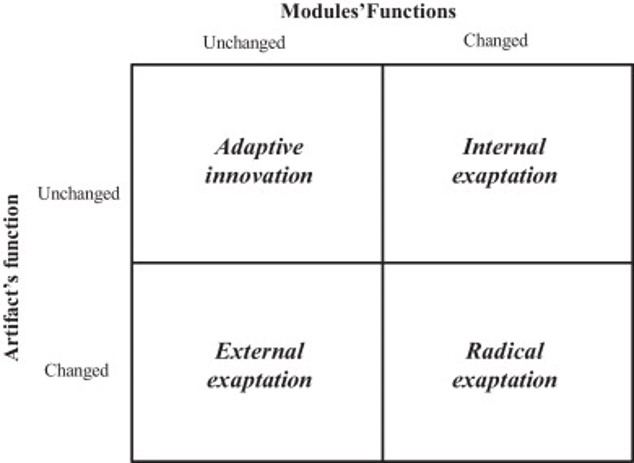
Pierpaolo Andriani and Giuseppe Carignani ( in particular, their paper, ‘Modular exaptation: A missing link in the synthesis of artificial form’), two of the current exaptation preachers. They built their thinking around a 2×2 Matrix that looked at whether an artefact did or didn’t undergo a change of function, and then whether the ‘module’ into which that artefact was contained went through its own did or didn’t change of function:
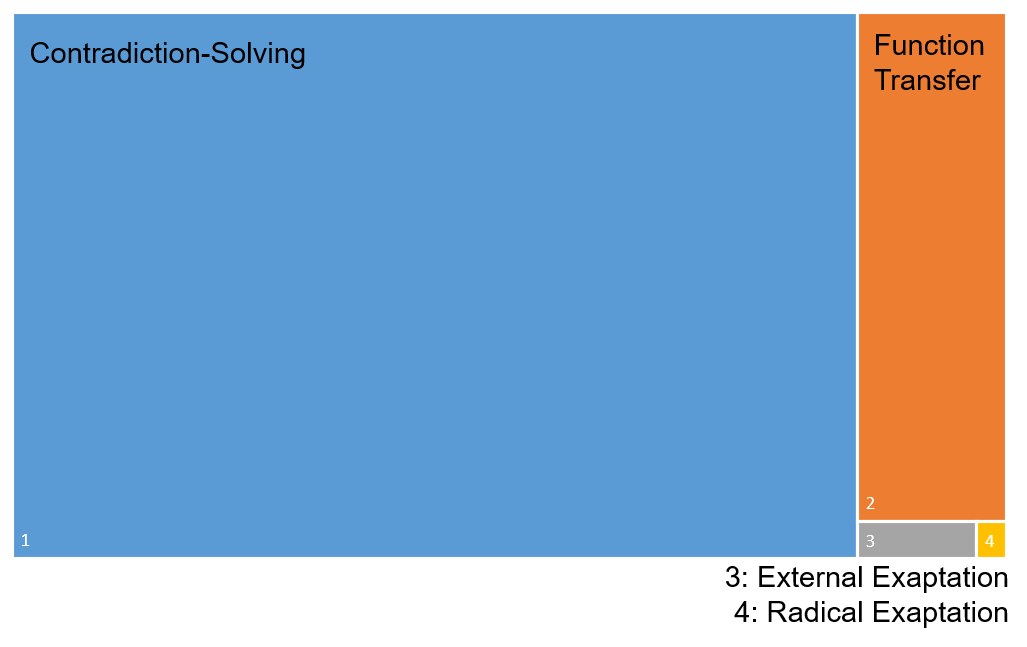
If neither artefact nor module function are changed, Andriani and Carignani use the rather disingenuous term ‘adaptive innovation’. In TRIZ terms, this type of innovation is what we call ‘contradiction solving’. Next up, what they describe as ‘internal exaptation’, is in actual fact what TRIZ calls ‘Function Transfer’. These are situations where an artefact that delivers a useful function (‘cyclone separates solid’) is installed in a domestic vacuum cleaner rather than an industrial sawmill. In so many words, this is the Dyson innovation strategy. Any connection to ‘exaptation’ here is tenuous to say the least.
More like the dictionary definition of exaptation is Andriani and Carignani’s term ‘external exaptation’. These are situation where the function of the ‘artefact’ does get changed. 3M’s Post-It Notes, Viagra, and Coal Tar offer up classic examples of this kind of Change Function innovation: Viagra was an ineffective cure for angina that turned out to be much more effective as a means of creating, ahem, male tumescence; Post-Its were the perfect solution for ‘rubbish glue’, etc.
Finally, comes ‘radical exaptation’. This is the situation where both the artefact and the ‘module’ change function. This is a much more difficult one to spot. Which means that nearly everyone ends up talking about microwave ovens, and not a lot else. Radical exaptations might indeed be important innovations when they happen, but, alas, they don’t happen very often at all.
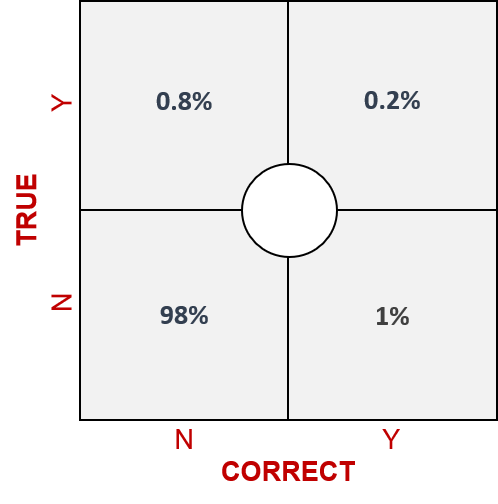
To calibrate us on just how infrequently this type of innovation happens, bearing in mind our usual definition of innovation as ‘successful step-change’ (i.e. the 2% of innovation attempts that were successful versus the 98% that failed), here’s how the four different types of innovation add up:
Which means, based on our ten million case studies, ‘exaptation’ accounts for slightly less than 1% of the story. Which, I think, is a way to say to the exaptation-advocates, ‘please shut up’. At least until you’re prepared to do the hard-yards to appreciate what innovation actually is: solving contradictions.