Anyone foolish enough
to contemplate writing a book on leadership (e.g. me at the moment), might like
to know what they’re up against, competition-wise.
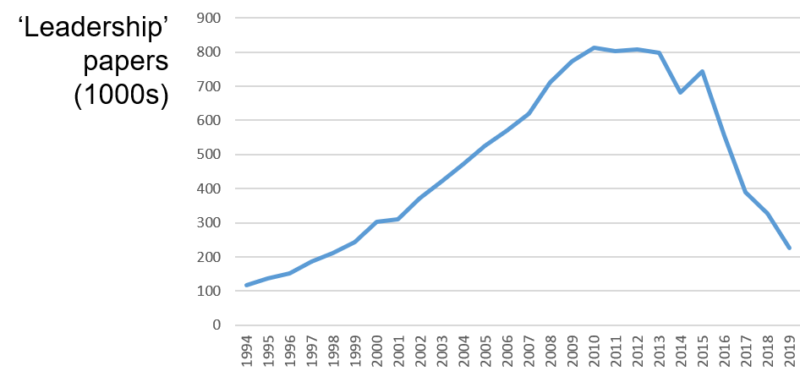
According to Google Scholar, last year there were 226,000 books, papers or articles published on the subject of leadership. A number I found difficult enough to compute inside my very small brain, that I was forced to look and see whether 2019 had just been a particularly bad year. Turns out that it wasn’t. Here’s what the scholarly output on leadership looks like for the last 25 years:
If you thought 2019 was bad, it turns out it was but a fraction of the ‘content’ published in 2010. A year in which an astonishing 812,000 pieces of leadership advice were flushed out of the minds of the leadership glitterati and into the corporate waste-bins of the world.
The curve made me think that leadership and people writing about leadership were somehow inversely proportional: the last time the world had any real leaders was probably in the 1960s. A time when people actually lead rather than taking the much safer route of writing about how to lead. By 2010 – in the wake of the GFC I imagine – the world had apparently no leaders at all, but rather lots of people carving a niche for themselves as leadership authorities. Not that I’m ever going to do the research, but I have a fairly strong instinct that the focus of many of the 812,000 leadership publications was ‘where have all the leaders gone?’ The answer to which, we can now see, was ‘writing papers about where all the leaders have gone’. And lo, the serpent began to eat its tail.
If this inverse correlation is in any way correct, the falling pattern since 2010 is probably a good sign. When people stop writing about leadership, maybe we might get some actual leadership back again? It would certainly fit with what happens in the sort of Crisis period most people on the planet now find ourselves in.
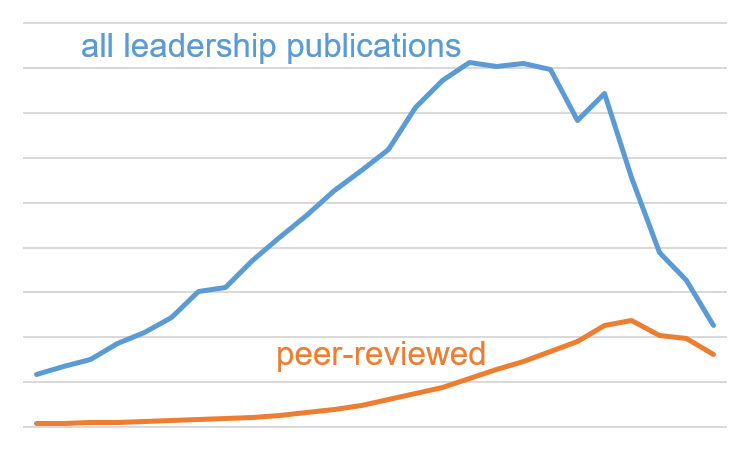
Meanwhile, before getting my hopes up too high, I thought I’d zoom in a little and restrict the analysis to leadership content that had been peer reviewed. In 1960, it turns out there were 2995 peer-reviewed research papers published about leadership. In 2017 the annual figure had jumped to 114,422. If my maths is correct, a 38x increase. In 2017, just to let you know they weren’t all writing about where all the leaders went, there were 31,339 papers published about leadership styles. This figure was up from 499 in 1960. A 62x increase in blind professors leading the blinder corporate flunkies.
When I plotted the trajectory of
peer-reviewed papers against the total scholarly output, the two graphs look
like this:
This data helped clarify another hypothesis. The peer-reviewed academia peak didn’t happen until 2016. Perhaps the most surprising conclusion that could be drawn here is that leadership ‘experts’ in academia are only six years behind the real world. If you’d asked me to guess, I would have gone for a higher number. Thirty years maybe? Forty? A hundred and fifty?
So, anyway, the upshot is, if both academia and the real world are on a downward trajectory, publication-wise, maybe those of us writing a book on leadership get to cling on to the hope that we end up writing the last book on leadership. That’s what’s keeping me going anyway. That plus the fact that by 2025 we might have some real leaders in our midst again. Ideally ones that received their Call to Action after reading the last book 😉
In an average
year, I probably get asked to review a couple dozen academic papers. I usually
accept, figuring that if the paper is any good, I might learn something, and if
it isn’t, I get to write comments that will hopefully enable the authors to
learn something. In the last couple of years, I’ve noticed a distinct shift from
the former to the latter category. Which basically means that either I’m
getting grumpier as I get older, or the quality of the papers being written is
on a sharp decline. Probably a bit of both.
July turned out
to be a pretty bad month. Three reviews to do and each paper exponentially
worse than the one before it. Which meant that, ten minutes after opening the
third paper, I was all for picking up a baseball bat and heading off to the Journal
of Civil Engineering and Management to conduct a more physical version of
author learning.
This first ‘paper’ reported an exercise to translate the original Altshuller Contradiction Matrix into a business matrix. Anyone that knows me can probably already guess where this might go. Anyway, the authors tried to justify this rather stupid decision by listing a page full of references. None of which were relevant. Including the reference to one of my papers. Which, if memory serves me correctly, was trying to make the point that it was barely acceptable to try and use the original Matrix for architecture problems. Never mind project management ones. This in turn made me realise that the authors very likely hadn’t read my paper at all. Rather they’d more likely done a five minute SCOPUS search for ‘TRIZ and architecture’, then copy-pasted the results into the back of their paper, and randomly allocated some reference numbers into their equally random sequence of words. It’s better than working for a living I guess.
The second paper related to an attempted de-bunking of so-called Generation Theory. Definitely a paper that should have been up my street, since, if anyone has heard me talking about Generation Theory during workshops will know we’ve spent the last twenty years trying to achieve precisely such a de-bunking. Therein lies the only similarity in approach though. We’ve tried to use some actual science in our attempts to dis-prove the model. Whereas the author of this paper hadn’t understood the ‘theory’, hadn’t attempted to, and was instead intent on executing what the popular press likes to call a hatchet job. So we end up with an argument that goes something like: generation theory sounds too good to be true. Therefore, it can’t be true. Therefore, let’s simplify it down to something a lay-person (or ‘reviewer’) can understand. Then make a few naïve and/or disingenuous assumptions. Then formulate a meaningless research question. Then misinterpret the results. Then swing the hatchet. Publish. Rinse. Repeat.
The third paper was so bad I really don’t know where to begin. Except maybe to say that the researchers in question had very likely picked up the half-science manual by mistake when they were looking for some authoring advice. Here are a few words from the abstract at the beginning of the paper. In theory, these are supposed to be the most readable part of the paper:
Since reliability and validity are rooted in positivist perspective then they should be redefined for their use in a naturalistic approach. Like reliability and validity as used in quantitative research are providing springboard to examine what these two terms mean in the qualitative research paradigm, triangulation as used in quantitative research to test the reliability and validity can also illuminate some ways to test or maximize the validity and reliability of a qualitative study.
This word salad indeed turned out to be the most readable part of the paper. It was definitely the bit that made the most sense. To say the work was ghastly is an insult to ghastly things.
It felt like time to offer up some advice. Initially, I figured this would best be directed at the researchers, but then the more I thought about it, the more I realised my anger was perhaps better directed at the supervisors that were directing their researchers to do dumb things. Or, perhaps more likely, didn’t know the difference between dumb things or smart things in the first place (one of the hazards of becoming a career academic?). But then again, no. The current round of ‘supervisors’ are probably a lost cause by now. Any researcher worth the name should be able to work out their supervisor was deluded, dumb or distorted within a couple of weeks of starting their research. That’s what literature reviews are supposed to be about. You know, like finding out that someone’s already created a Contradiction Matrix for Business problems fourteen years earlier before spending six months doing ball-aching, nugatory work.
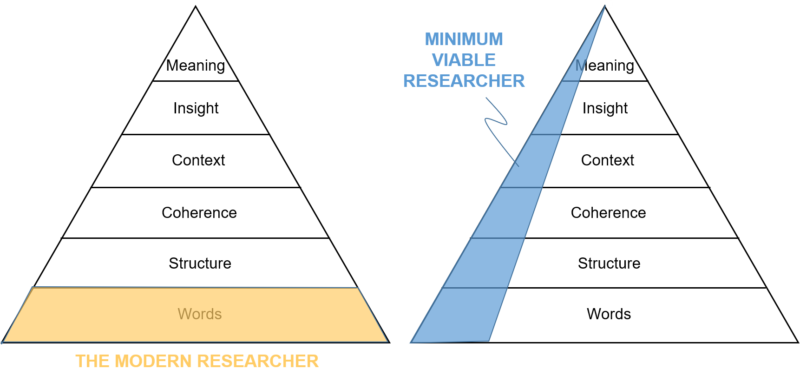
So, anyway, here’s my non-exclusive set of suggestions for a minimum
viable researcher:
A minimum two-days learning some of the basics of TRIZ at the beginning. The main aim being to understand that when we say, ‘someone, somewhere already solved your problem’ researchers not only begin to realise it is actually true, but also know how to go and find the somebody. The secondary aim being to get them to realise that research means advancing the chosen subject. Which to all intents and purposes means that if we haven’t revealed or solved at least one contradiction before we’ve finished, we haven’t been doing research but re-search.
A minimum three days learning the basics of Complex Adaptive Systems. Enough that they can grasp some of the basic tenets as they apply to their research topic. Like, for example, to choose a contentious area, appreciating there’s no such thing as ‘clinical evidence’ when we’re dealing with a complex problem. Quite simply because its never possible to step in the same river twice. Then appreciating that it’s perfectly possible to design experiments that are less than complex and still valid, provided you understand the first-principles from which the overall complex system has emerged, and are extremely cunning with your experiment design. This then leads to…
A minimum of two days uncovering and understanding those first-principles. Add another day to ‘really’ understand them.
A minimum of three days on human psychology. The main purpose of which will be to equip the researcher with the necessary gumption to go back to their supervisor to tell them that the research they’ve been asked to do is pointless. And, so we don’t come across as unduly negative, that we’ve found the critical contradictions needing to be addressed and now have a plan to start tackling them.
A minimum of three days on the science of measurement. Specifically, to learn that it is vital for researchers to measure what is important rather than merely expedient.
A minimum three days learning about the structure of story. That way, when it comes to finally writing up the brilliant contradiction-solving piece of research we’ve just done, we don’t bore the reader shitless when they have to read about it.
TRIZ. Complex Systems. First Principles. Psychology.
Measurement. Story.
Seventeen days.
All in all, quite a big investment of time. But then again nothing compared to the two years that seems the new normal as far as doing pointless re-search is concerned. Even if – and I say this because I’ve seen it apply to a majority of ‘researchers’ – your primary motivation is to emerge from the train-wreck with a bright shiny qualification, your soul will thank you for spending those two years doing something meaningful.
The destination
of choice for anyone wishing to engage in meaningless, going-around-in-circles
debate about the important issues of the day.
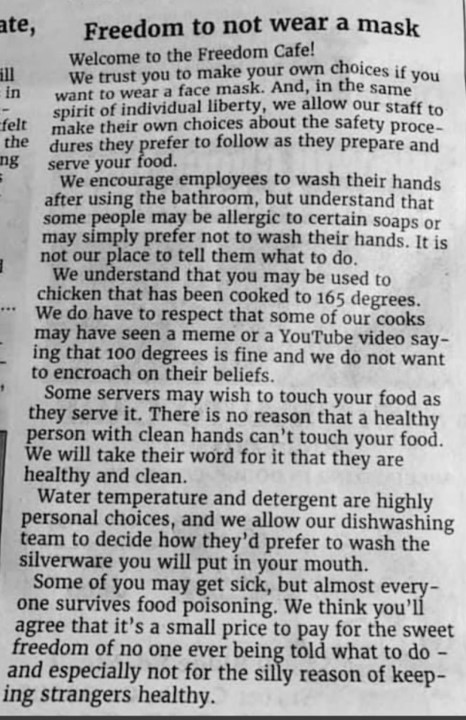
Like masks, for example. A topic guaranteed to bring out a whole rainbow’s worth of factless opinion and unlogic. The café is a place where customers can debate whether the mask issue is an epidemiology problem, or a fat-tailed risk problem, or a sociology problem, a psychology problem or a fluid-dynamics problem, an electrostatics problem, or, heaven forbid, a two-phase flow with a double evaporation somersault and a half twist problem. All the time forgetting that the real problem is a combination of all of the above, and where none of the individual pieces can be ignored.
The café has become a safe place where the person with the simplest message and the most trustworthy face wins. So that, now we’ve elected a Government of bare-face liars, when we try to work out who the most trustworthy face is, the preferred choice turns out to be, wait for it… Gary Lineker. With David Icke in second place, BoJo the Clown and his troupe of devolved jabbermonkeys in third, anybody with a recognisable professional qualification from the adjacent Half-Science University – someone with a ‘Dr’ at the beginning of their name for example – comes fourth, and anyone with a genuine desire to establish the truth gets to sit with a dunce’s cap on in the far corner facing the wall. But, hey ho, either way, visitors will be guaranteed to leave the café with a doggy-bag and a cunning sound-bite answer they can use should anybody question their subsequent mask choices back in the outside world.
The Half-Science Café is a place, too, where its possible to watch literary magicians weave their wit-filled hypnotic spell in such a dazzling way that we end up thinking cooking chickens and washing dishes are somehow equivalent to mask wearing. That the ability to put a chicken into a 190degC preheated oven for 20 minutes per pound, plus 20 minutes has some kind of analogous relationship to the problem of keeping 80nanometre diameter particles out of harms way when they’re sneezed out of a symptomless infected person. After, crucially, a couple of minutes of droplet evaporation time.
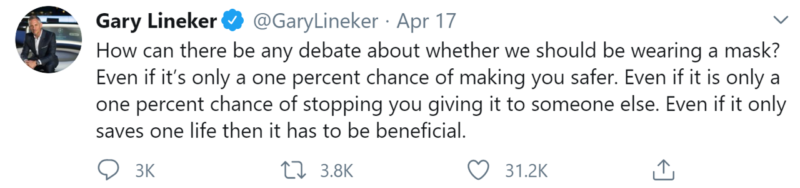
The staff here at the café love their work. They know the customer is always right. If the customer concludes that a lovable football commentator (7.6 million Twitter followers can’t be wrong) is the way to go, that’s clearly the way to go. Even if it only saves one life, why wouldn’t we all wear a mask, right? Never mind the fact that the advice turns precaution into precautionism (https://www.darrellmann.com/precautionism/). Which in turn means we’re a whisker away from extending the unlogic to mean we’ll all be wearing full NBC hazmat suits come the Autumn… because, guaranteed, that will save at least one life.
Here at the Half Science Café, we are also able to offer counselling to anyone that accidentally snaps out of their hypnotic trance and starts to experience one of those awful, stomach-churning moments when we realise – tragically – how all of this blather is utterly trivial compared to the real issue. The issue that reveals how we now live in a world in which there’s so little common sense and so little leadership, that no one even thinks to go and find the actual truth anymore. That not a single Government, not a single Chief Scientific Officer, not a single WHO executive has had the gumption to stand up and say, you know what, let’s get all the different domain experts – the epidemiologists, the risk analysts, the fluid dynamicists, the sociologists, the psychologists, those annoying two-phase flow geeks – together into a room and lock the door on them until they’ve either worked out what the proper questions to ask are, they’ve answered them, or worked out what information is still missing in order to come back and answer the question properly next week. Because, until that happens, were all forced to live in a Russian-bot guided world filled, courtesy of Cummings and his Nudge Squad, with empty safetyism-provoking slogans like this week’s stroke of anti-genius, ‘Hands. Face. Space’.
In the Netherlands, a combination of geographical size, flat landscapes and frequent flights conspired to makes aircraft noise a vexing problem.
In the early 2000s, Amsterdam locals, frustrated with sound pollution, demanded the city do something to address the problem. Faced with lots of flat land around the airport, it was understood that traditional barrier solutions would not work for the most disturbing low frequency/long wavelength parts of the noise spectrum. Airport staff, once they began to look for alternative solutions, realised that plowed fields in the area seemed to help dampen the noise. Especially ones with a particular spacing of ridges.
Reverse-engineering
this phenomenon, landscape architects worked with artist Paul De Court and drew
on the work of acoustician Ernst Chladni to create over 100 grassy pyramids
specifically designed to address this site-specific problem.
From a TRIZ
perspective, the problem being solved represents a classic contradiction: we
want to reduce noise, and what stops us are the long wavelengths of the most
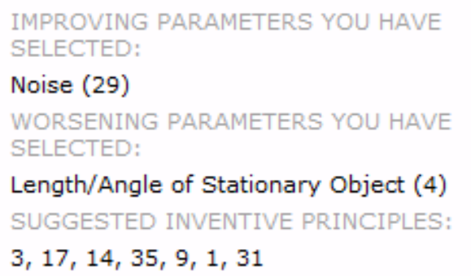
troublesome low frequencies. Here’s what this problem looks like when mapped onto
the Contradiction Matrix:
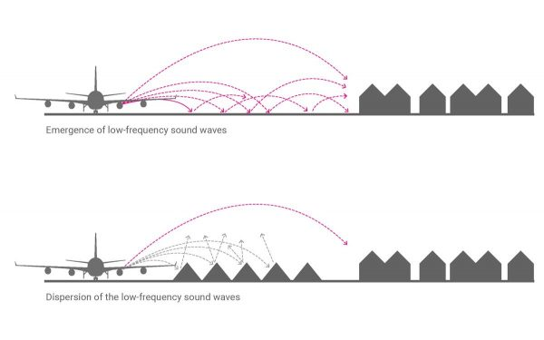
And there is Principle 17, Another Dimension as the second most frequently used solution strategy for this conflict pair. Here’s how this solution works from an acoustic perspective at the Land Art Park:
Interesting, too, if we look at the overall pattern of ridges used by the architects, is how they’ve incorporated several Principle 3, Local Quality strategies so not all of the ridges are the same height, shape or orientation:
That solution alone would have merited looking at this story. The architects on the project, however, also went a step further by thinking about the next contradiction: we need ridges to solve the noise problem, but we don’t want to lose the potential to use the ridged area for other things. One of the Inventive Principles the Matrix recommends always considering for this kind of unwanted side-effect problem is 22, Blessing in Disguise.
A strategy the architects used with some aplomb. Firstly, by instead of simply disrupting sound waves, incorporating paths for cyclists and pedestrians, and then creating ‘…vistas and lines of sight, smaller and bigger allowing ‘rooms’ to emerge, which can be used for sports and cultural events. To the north and south the grassy ridge structure extends until it dissolves into longitudinal pyramids, distributed along the edges. Unique art objects are placed on the pyramids, inspired by parabolic sound mirrors, exploring the meaning of sound in this soundscape.’
Then, in a final Blessing in Disguise masterclass, the architects also engineered spaces that specifically amplify rather than reduce the aircraft noise, turning a former regional frustration into a highly localised aural experience.
One Inventive Principle good; three, better. Same as it ever was.
Mercedes surprised no one by regularly topping the timing screens in Formula 1 testing at the start of this year. They did, however, manage to spring a surprise when one of the enabling innovations was revealed: DAS or, to give it its full name, dual-axis steering.
On-board
footage showed both Lewis Hamilton and Valtteri Bottas pulling the wheel
towards them on the straights, before pushing it away when reaching the
corners. They could not hide it any longer, and technical boss James Allison
was seemingly happy to confirm its existence – if very little about what it was
actually doing.
The innovation,
it later transpired, was all about dynamically altering the toe-angle of the
front wheels of the car.
Why would
Mercedes want to do this? To briefly explain, toe is the angle that the wheels
sit in relation to dead ahead when the steering is straight. If the front of
the wheels are pointing out, this is known as toe out, the opposite and they
are toed in.
The toe angle
has a significant effect on a car’s handling and changes how the tyre interacts
with the road surface. Generally, a degree of toe out will aid both stability
and grip on initial turn-in to a corner, however, too much toe out means the
tyre scrubs – effectively it is dragged rather than rolled across the track
surface.
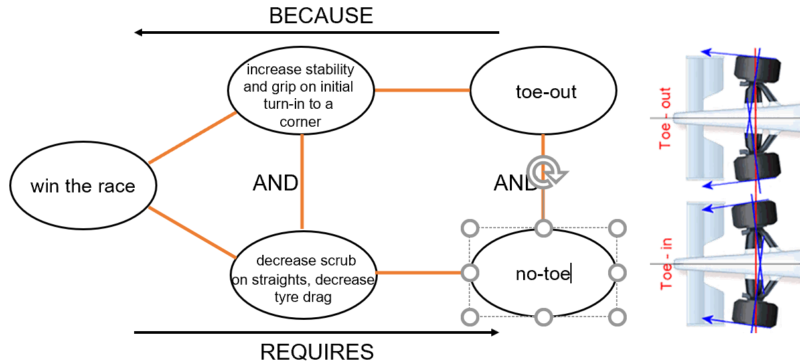
TRIZ-wise, here’s a classic physical contradiction: the car wants toe-out and it doesn’t want it. Something like this:
Once we know there’s a contradiction to be solved, all we need to do is think about the three different separation strategies and we’re half way to a solution. Actually, in this case, all we need to do is think about the first of these strategies, separate in space. Where do we want toe-out? Where do we not want it? As soon as we realise the two questions have a different answer – corners versus straights – we can start tapping in to the solution strategies of others. The most common of which is Principle 1, Segmentation.
Simple when you know how. As ever, the real trick is giving yourself permission to believe that contradictions don’t have to be solved by the usual trade-off strategies.
Another unexpected benefit of lockdown. I used to have to spend hundreds of pounds to travel to conferences to get angry about the parlous state of academia and what might laughingly be called the knowledge industry. Now I get to log in to a free webinar while sitting at home, looking at nature outside my office window. I find the anger dissipates faster when you get to watch a blue-tit feeding its four just-fledged offspring from the bird-feeder.
Sadly though, not fast enough to prevent me feeling the need to write another rant-y blog article.
This week’s primary anger maker was a Cisco-sponsored event for the launch of a new book on leadership. The author in question – I won’t name him (it is a he) as it feels like adding oxygen to an already alight dumpster-fire of a TED-speaking career. Not bad for someone that still looks and sounds like he lives at home with his parents.
The dumpster-fire in question is the effect this author and his three previous ‘best-sellers’ seems to be having on the world of business. Which, frankly, doesn’t need any more oxygen either these days, never mind more fuel. This, rather than the subject-matter-dunce penned book, becomes the point of the rant.
The premise of the anger-inducing new book was to think about leadership in the future. Fifteen years into the future to be precise. So far so good. It’s an interesting question. Provided, of course, that you follow it up with a sensible method for obtaining answers. Of which going to interview large numbers of CEOs is definitely not one.
CEOs get to be CEOs by having been operationally excellent yesterday. I’ve yet to meet a CEO anywhere that understands what innovation is. Or what the pulse rate of their industry is. Or where on a Complexity Landscape would they place their organisation. Or what antifragile means. Which basically means that asking this cohort about what the world will look like in fifteen years is about as valid as me asking the cat. Lennie has no idea, and neither do CEOs. On balance, I think if I had to pick one, I’d go with Lennie. At least he knows he doesn’t know.
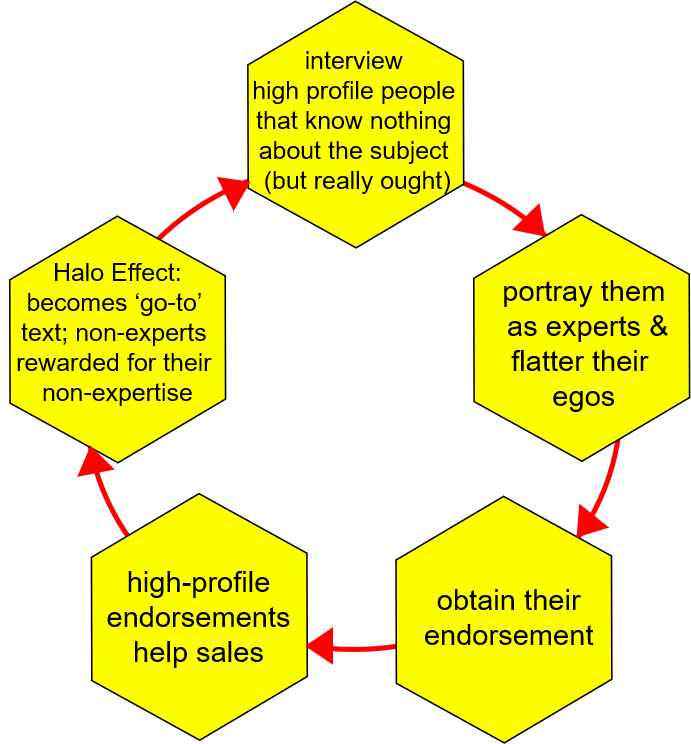
So what, you say. Just ignore the stupid book that results from the interviews. What do I care? Much as I’d love to be able to do that, it turns out that it has already triggered a host of five-star reviews on Amazon. Thus putting into play a ‘virtuous cycle’ that I imagine the naïve author (or, more likely, his publisher) was rather less naïve about. Writing (lord save me) 300+ pages of grandchild teaching grandmothers to suck eggs cliché-ridden glibness turns out to be a most excellent way to flatter the egos of future-blind CEOs. It sets up a rather splendid bit of symbiotic sycophancy: By writing an endorsement of the book, the CEOs get to show their shareholders that they’re featured thought-leaders in a book about not just leadership, but leadership in the future. The author gets to show off all the names of high-profile CEOs that endorsed his work. The publisher then gets to sell a shit-load more books. And, before you know it, the book as become a classic. The ‘go to’ tome on leadership in 2035. No doubt to be picked up and used as a reference guide by just as naïve academics and, worse, people like Dominic Cummings and his growing army of not-so-superforecasters (not so good that is unless they’ve bet on the economic destruction of the UK economy (which I kind of think they have)). This is why we’re in the mess we’re in. And I don’t just mean the UK economy. The whole shebang is in tailspin.
I’m not sure whether we’re too late to stop it, but I do know that if we’re going to stop it before we find ourselves back in the Stone Age, then we have to stop the sort of ‘virtuous cycle’ created by this truly awful piece of leadership half-science. This is what it looks like:
It probably
needs a catchier name before it has a chance of being turned into another 300+
page management text, but for the moment, I’m going with the Sycophancy Cycle. That
or, Stop The Ride, We All Need To Get Off. I’m drawing up the interviewee list
as we speak.
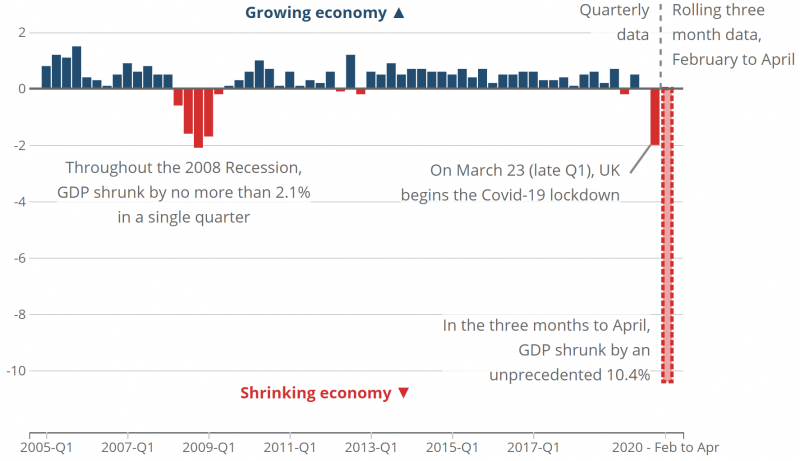
Difficult times call for radical measures. The UK economy is is Covid-19 sparked freefall. Something needs to be done. Easy stuff.
In no
particular order, here are ten highly effective, proven strategies for
increasing GDP:
Spark a crime wave
Sink fully-laden oil-tankers off the coast (other environmental disasters will also work)
Create the conditions for household disharmony in order to increase divorce rates
Encourage eating of fast-food every day (especially if it can be delivered)
Encourage rioting
Stop building or maintaining flood defenses
‘Break your neighbour’s arm’ (thanks, Umair Haque)
Encourage bad driving in order to increase traffic accidents
Construct more out-of-town shops and other things that increase inconvenience
Encourage more social media rage and hardening of echo chambers
GDP, of course, is merely a measure of total national expenditure (or income). It doesn’t discriminate between expenditure we might enjoy (eating better) and that which we’d prefer to avoid (having to buy big new padlocks).
Better yet, to be serious for a second, why not use this unique opportunity in global history to acknowledge that GDP is an utterly irrelevant measure of economic success. Well, irrelevant to everyone apart from the greedy bastard 1%.
There have been several attempts to produce more sensible measures of a nation’s success. They all seem to get bogged down in the vested interests of the already rich. The 1% don’t want ‘Genuine Progress Indicators’ or ‘National Happiness’ indexes. They want more money in their bank account in the easiest, lowest effort manner possible.
Now is the time to find win-win solutions. I don’t mind the 1% making more money, I just don’t think they should be allowed to do it by making life worse for everyone else any more. All we need to do is introduce a system where all the things like this Top Ten get counted as the negatives they are.
Have you ever
found yourself brushing your teeth, looking at the tap you’ve left running while
you brush? You know it’s wasting water, but you do it anyway.
Too long ago now I had the pleasure of working with one of the FMCG giants to try and understand why people sometimes did this. I sometimes wish the research had been published, because I thought it would help explain a lot more about society than how to sell more toothpaste.
I was reminded of the research again this week while looking at photographs of the 41 tonnes of litter collected off Bournemouth beach following the warmest day of the year so far.
Why would people suddenly not be taking their litter home? Looking at photos showing the high density of the non-social-distancing crowds from the day in question, my first thought was that it was because the situation was like Glastonbury festival, where, for the most part the crowds are too dense to even contemplate a walk to a bin. But, no. The crowds were dense (in more ways than one), but not dense enough to prevent movement.
More evidence
that the answer had nothing to do with a very tangible ‘can’t move’ explanation
came in the form of an even more depressing photo of the signs that the keepers
at St James Park in London have felt the need to put up, also this week:
Never, the keepers
have been declaring, have so many people left so much litter in the park
before.
Again, the park
had been busy, but not that busy.
Enter the running-tap explanation. The people that knowingly leave the tap running while they brush their teeth turned out to be people experiencing an absence of autonomy in their lives. Leaving the tap running, even though they knew it was wrong, was a way of demonstrating control. Breaking the rules – and getting away with it – is a way of telling ourselves that, for this minute at least, we are in charge.
Well, almost.
The big difference between leaving the tap running and walking off the beach or
out of the park without taking our litter with us is that no-one is likely to
be watching us when we’re brushing our teeth, but, very likely, everyone is
watching us when we walk off the beach leaving behind the remains of our
picnic. Surely, in the watched scenario, we go against the next of our primary
emotional drivers: the need to Belong.
We’re talking
now, of course, about our ABC model – Autonomy, Belonging, Competence.
Under normal circumstances, litterers don’t belong to the tribe of civilised society. But the pandemic, and 13+ weeks of lockdown, has consciously and subconsciously told us these are not normal circumstances. Lockdown has removed our Autonomy, and then when we see several of the key Government figures that took it from us living by rules that are visibly different, we all now realise we Belong to the tribe of Screw-One-Rule-For-You-One-For-Me and, once that happens, anything goes. Collective littering is a quite literal demonstration of a public taking back control.
Forgive me if you’ve heard me tell this one before. I’ve been put in the highly privileged position of designing a curriculum for a new technology degree. My specific brief is to drag the subject into the 21st Century. If that sounds like something of an oxymoron – technology/21st Century – bear with me a second or two.
Back in the late 90s, after several years of pleading, I was allowed to teach a TRIZ Module as an option to some of the final year Engineering students at the University of Bath. I’d originally asked if I could teach First Years and had been told it was ‘too dangerous’. I didn’t explore what that meant. At the time I took it to mean that the Head of Department had no idea what TRIZ was and therefore – understandably I could imagine – wasn’t prepared to take the risk. The degree programme had just hit the UK Top Five, and no-one wanted to jeopardise the growing reputation. Again, I could understand that. So, anyway, we get to the end of the optional Final Year Module and, as was the Department’s policy, the students were asked to provide feedback on the quality of the teaching and content. The consensus was basically one of outrage. Outrage of the, ‘why weren’t we taught this in the First Year’ variety. Needless to say, I wasn’t invited to run the Module again the following year. Either with the Final or the First Year’s.
This memory
came starkly back to the front of my mind as I started thinking about what a 21st
Century technology degree might look like. ‘Dangerous stuff’ seemed to be one
of the conclusions.
Beyond that, I decided to go back and look at the rest of the Bath curriculum from the same years I was teaching there. Then I compared it with a current day version, and then the one I was taught during my degree back in the Stone Age (1981-4). To be honest, there wasn’t a lot of difference between the three. First up, there was a lot less mind-numbing derivation of formulae in the later curricula. Second up, there was an awful lot more use of software analysis tools in the 1999, and, particularly, the 2020 curricula. If a student wanted to do a stress or flow analysis back in the early 1980s, they had to write the software to do it; today, it’s all been done for you, so the student just has to build a model and then press the magic button. Beyond that, however, all the other differences were second order optimisations. Which ultimately means that, if my post-degree working experience was anything to go by, 90+% of the content would never be of any use whatsoever ten minutes after the graudation ceremony. And, moreover, the 10% that does still get used either gets used as first-principle ‘rules of thumb’. Or gets Googled. The former being a good thing – as it turns out, 1984 seems to be one of the last years that any engineer got taught anything from first principles anymore. The latter serving as a reminder that today its possible to answer almost any question by looking it up.
And, boy, is there a lot to look up these days. The technology ‘database’ has become an awful lot bigger in the past forty years. A lot more books, a lot more papers, and an awful lot more specialisation. What I’m a lot less sure about, however, is how much of this exponential increase in content is signal and how much is noise. Actually, that’s not true. When we force ourselves to go back to first principles and ask how much of the most recent content has altered or expanded our first-principle knowledge base, the answer is very stark: it hasn’t really changed at all. The signal is still pretty much the same signal. If it has grown, it has grown linearly. The noise is the thing that’s grown exponentially.
I think this is significant. Great that things can be looked-up on demand. Not so great if the technologist doesn’t have a first principle of understanding of what they’ve looked up to know whether the answers they produce make sense. It’s really useful to be able to run a finite element analysis to work out what and where maximum stresses in a structure are, but not so great if you don’t understand that stress = force/area will get you 90% of the way there. And therefore, allow you to establish whether the software is giving you something like the right answer.
That seemed to
offer another clue as to what a new curriculum might do. If finding answers is
easy, then surely, finding the right question to ask becomes much more important.
Here again I think the technology education system has let students down badly.
My main evidence for this is the fact that, particularly in the last three or
four years since Generation Z has started entering the workplace, I find I can
no longer set exercises to students that start with the phrase, ‘think of a
problem…’ The first time I did it, it took me ten minutes to realise that
everyone in the room was looking at me with an expression close to blind panic
because they had no idea what a problem was.
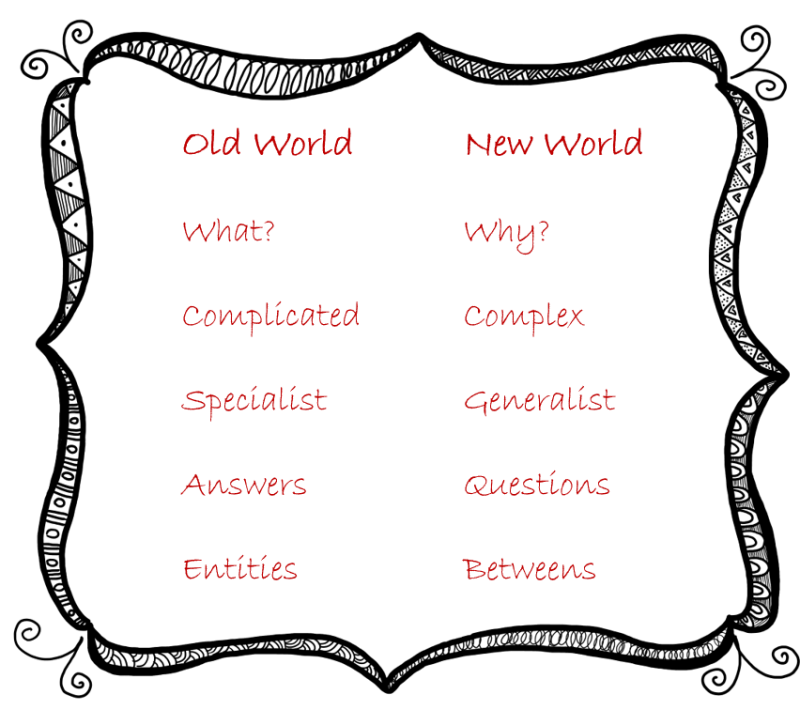
At the same time this is happening, the world is becoming more complex. Every problem is increasingly likely to be connected to every other problem. That then highlights another issue with the way technology is taught today. The complexities of inter-disciplinary, interdependent problems makes for a really bad fit in an academic world that is still taught in tight specialisations. And which, more critically, tend to inherently avoid the ‘human’ issues that can no longer be excluded from whatever challenges are being worked upon. Without wishing to delve too deeply into technology cliché-land, I think its fair to say that most technologists (‘geeks’ to use the modern parlance) become technologists as a means of avoiding as many of the complex human-relationship issues as they can. Pure technology problems (if such a thing exists any longer) have the possibility to be merely complicated. Which means there is the potential for a ‘right’ answer. Real technology problems, however, are complex. Which means there is no longer such a thing as the ‘right’ answer any more. As far as I can tell technology educators are either not aware of this shift, or, more likely, have no desire to become aware of it. As a consequence, they do their students an enormous dis-service.
Finally, let’s add one more big challenge into the technology education mix. Back to the idea of the expansion of knowledge for a second. Even if it is the case that the rate of creation of ‘new’ first-principle knowledge is slow and essentially linear, the fact that it is increasing at all inevitably means that the number of combination possibilities increases exponentially. Which means we find ourselves back in complex territory again. And another technology education shortfall: almost no curriculum I’ve seen has even started to think about – never mind solve – the issue of how to combine partial solutions from different domains.
Except, of
course, TRIZ. Which, sadly, brings us back full circle. As I experienced at the
University of Bath, the vast majority of the technology education community either
has no knowledge of TRIZ, or has no desire to acquire said knowledge. If they
did, it would offer a solution to many of the innate problems of today’s
technology education dysfunction. Which I believe can be summarised as follows:
Virtually nothing gets taught from first principles anymore, so students don’t understand the world at a first principle level. This means they often know what to do (what the computer tells them) but have no idea why. TRIZ, by asking the questions that it did – accidentally – gave the world a comprehensive database of first principles.
Students are taught how to answer questions rather than ask them. Finding answers is a much easier job today than it was 40 years ago. Today’s technologists need to be taught how to ask better questions. TRIZ helps to do this through the discovery that technology evolution has a very clear direction, and that progress occurs through a series of definable discontinuities.
Nearly all modern problems involve people somewhere, and hence all are complex. Meaning that teaching students how to solve only complicated problems is no longer sensible.
The world of technology is now massively hampered by extreme specialisation. The 20th Century was the time for specialists. The 21st Century technologist needs to be a boundaryless generalist.
The best solutions to any complex problem almost inherently emerge from a combination of partial solutions. Few if any students are taught how to explore and make sense of the potentially billions of combinations to converge on solutions that are both coherent and meaningful. Understanding how to make the right combinations means understanding how to deal with the ‘betweens’.
The new
curriculum is built to address these five core problem areas. It, in summary,
is about focusing on signal. By avoiding the task of teaching noise (a problem
endemic in the computing world, where lecturers continually fight a losing
battle against every changing languages and protocols), and instead focusing on
first principles, we become able to solve a crucial contradiction: We get to
teach a more comprehensive, useful and future-proof curriculum in a shorter
amount of time. That’s ‘useful’ in terms of benefit to the students, benefit to
their future employers, and benefit to society at large.
Module 6:
Energy – energy flow/transfer/losses/S-Fields
Module 7: Control
– sensors/feedback-loops/control-system-design
Module 8:
Users, Abusers & AntiFragile System Design – understanding humans and how
we interact with technology
Module 9: Real-World Projects – students will work with sponsoring companies on at least five real-world challenges to deliver actual, tangible-benefit-delivering solutions.
Module 10:
Dissertation – adding a new needle (‘signal’) to the global technology haystack
At the moment,
we’re looking to teach it either as a stand-alone two-year degree programme, or
a one-year option to help ‘re-orient’ students that have graduated from
existing technology degrees to help enable them to cope in the New World we’re
all now having to get used to.
Hopefully more news in the coming months. Job one: the tussle to win over a critical mass of technology educators.
It feels like my list of rules-of-thumb is growing. If someone asks me a question that piques my interest, it’s highly likely – assuming we (the SI research team) are able to reach a sensible looking answer – to generate a paper or an article or a blog post. If someone asks me a question that doesn’t pique my interest it gets filed. Filed until about ten people have asked the same question. At that point I feel I should probably do something. The question probably still doesn’t interest me, but the fact that multiple people have thought to ask it very likely does. I think this rule of thumb has kind of always been there, I just never explicitly thought about it. Maybe that’s a lockdown effect? Too much reflection time. Or maybe just lots of locked-down, bored people asking random questions?
Anyway, this week’s ten-time question concerned aesthetics. And specifically, is ‘make it beautiful’ a 41st TRIZ Inventive Principle?
Before I get
too much further, probably best provide the one word answer up front. No.
That’s not the
interesting bit.
In relating Principles to ‘beauty’ it is necessary, I think, to divide the story into two segments. One in which beauty is the solution, and one in which beauty is the problem.
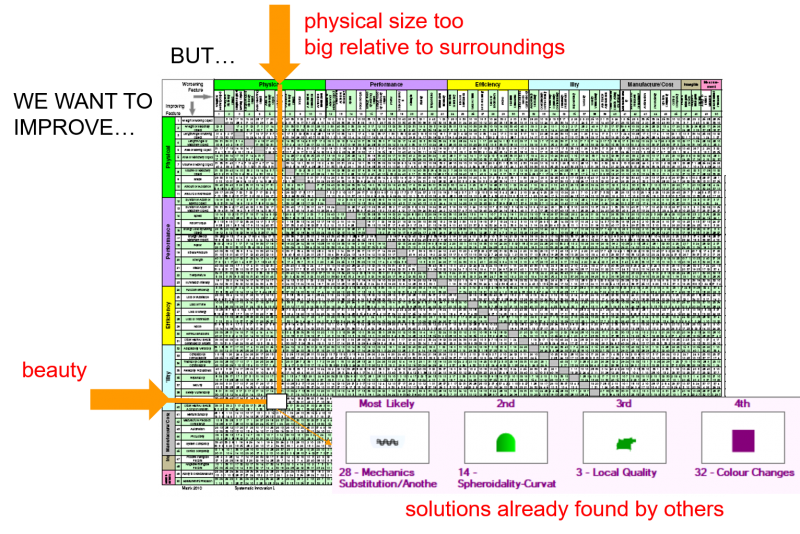
Let’s start with the latter. One way of thinking about ‘beauty’ is that it is one of the desirable outcomes of some form of (human) activity. If we are seeking to achieve beauty, the question becomes, ’how do we do it?’ Taken from this perspective, the Inventive Principles offer up the full spectrum of possible ways to achieve what we are looking for. They are provocations and directions that will eventually (if we are persistent enough) give rise to beauty. In this sense, any of the 40 could do the job. From personal experience, and looking at the technical version of the Contradiction Matrix – where ‘Aesthetics’ is one of the Improving Parameters – we know that some of the 40 Principles are more likely to help deliver ‘beauty’ than others. Simple example: Principle 4, Asymmetry is frequently obervable in a photography context as the ‘rule of thirds’ – i.e. an image ‘looks better’ if it is not in the centre of the picture but rather is shifted so it is centred around one of the ‘third’ lines.
Or, by way of a classic architecture contradiction, the architect always seeks to make the buildings they design ‘beautiful’, but they also know that beauty can only be achieved in the context of the surrounding structures. Here’s what this problem might look like when mapped onto the Matrix:
At this point, the Matrix offers a ranked list of the most likely beauty-delivering solution strategies. So far so good.
The other way of thinking about beauty in the Principles context, then, is that it is the solution to a higher level contradiction. So, for example, I might have a contradiction formulated as something like, ‘I want to improve customer revenue, but my solution needs to be very cheap to produce’, look that up on the Matrix and be informed that ‘making it more beautiful’ would be a good solution direction to go and explore. It worked for IKEA I suppose.
In this scenario, IKEA aside, there is a case that ‘make it beautiful’ is a valid solution provocation. Taken in this context, the question becomes whether it justifies a separate Inventive Principle provocation of its own. In my view, the existing Principles already do the job as well as they need to. At least in a generic sense. Principle 38 kind of implies it. So do 16 and 17. But then Principle 35 becomes the real ‘get out of jail free’ card in terms of why ‘make it beautiful’ cannot be a 41st Inventive Principle – ‘Parameter Changes’ is a very (very!) general Principle and so covers a myriad directions.
Over the years, I’ve tried to get the TRIZ community to rethink the Principles. With, of course, zero success. Unless triggering angry emails from TRIZniks counts. Anyway, if I could, Principle 35 is the first one I’d look to change. When the chronologically generated Soviet list of Principles had grown to 34, I’m pretty certain that Altshuller and team looked at all the miscellaneous unclassified solutions that they’d accumulated, looked at each other, and asked themselves, ‘what do we do with these?’ And then, because no-one could come up with a good answer, they collectively shrugged their shoulders and said, ‘screw it, let’s just bundle them all together and call it ‘Parameter Change’. And so Principle 35 became this awkward hotch-potch orphan. The embarrassing relative we always seem to get stuck with on family occasions.
The best we’ve been able to do to solve this Principle 35 rag-bag problem is to do technical, software, business, architecture. Literature, etc versions of Principle 35 (with it’s A, B, C, etc sub-variants) so that it becomes more useful as a solution generation provocation than merely .’change something’. In this context, I have also suggested to almost everyone that I meet during workshops that they should make their own list of the 40 Principles, adding their own examples. Things that are meaningful to them personally. Which, if it makes sense in your specific context, might well include examples connected to ‘making it beautiful’ as a solution direction.
Meanwhile, for me personally, I know that if someone suggested ‘make it beautiful’ as a solution direction, I’d have two reactions. Number one, I’d think that any solution creator in any domain that is worthy of the label ‘creator’ already knows that aesthetics and beauty are a part of their job. Asking this person to ‘make it beautiful’ is about as useful as suggesting they make it ergonomic. Or long-lasting. Or any other trite statement of the obvious. Yes, I know, there are a lot of ‘creators’ out there who are not worthy of the label. ‘Helping’ them by giving them facile reminders of their job, sadly, does nothing to increase the likelihood of achieving a beautiful solution. The solution will still look rubbish because the creator was rubbish.
Second, and more important, comes the next level problem down the hierarchy. As soon as I remember that aesthetics are important and that I need to achieve something that is beautiful, there is very likely to be a dawning realisation, as i dig deeper into the details of the design, that my desire to create beauty is hindered by my parallel desire to improve another design feature. And at that point – realising that achieving beauty is the problem – all I need to do is reach for the Contradiction Matrix in order to tap in to the solutions of tens of thousands of better creators than me, and stand on their shoulders.