Pithy as it might be, I’ve never been a massive fan of Peter Drucker’s famous aphorism, ‘culture eats strategy for breakfast’. The intended meaning – that corporate culture outweighs strategy – sounds about right. But then, when I hear people using it, it usually gets stretched to encapsulate the rather faulty meaning that changing the strategy of an organisation is easy, whereas changing culture is almost impossible. Faulty because I’ve been witness to several situations where company cultures have quite literally been flipped overnight. All that was required was to fire the senior leadership team. Boom. Goodbye dysfunctional culture, Hello sparkly, fresh-start, new one.
The other way to instantly change culture is to give people a cause. As in, cause eats culture for breakfast. I’ve seen groups of people who really don’t get on with each well at a personal level, and I’ve seen some fairly alien and unproductive cultural traits that all became utterly irrelevant the moment everyone was aligned around a bigger issue. Like Covid-19. Or putting a man on the moon. Or shutting down a manufacture facility with dignity. Or ‘Beat Sony’, Samsung’s de facto mission statement through the years it took to achieve. The subsequent shift to ‘Beat GE’ didn’t quite work out so well, but that’s another story for another day. The point is that there’s not much to beat a meaningful cause. Simon Sinek might claim that it also needs to be an infinite cause, but, as the success of ‘Beat Sony’ suggests, it just needs to give employees the clear sense of a common enemy. Actually, thinking about it, ‘Beat Sony’ was really a proxy for ‘Beat Japan’, a rather bigger cause. Finite or infinite, though, the point is, successful organisations identify a high enough level, yet still tangible ‘enemy’-based cause to unite a critical mass of their people. I’m not sure whether that counts as a ‘first principle’, but if it’s not, it’s somewhere close.
One of the most successful and meaningful metaphors I’ve found when working on innovation projects in ICMM Level 1 or Level 2 organisations recasts the innovator as pirate. Pirates rebelled against authority; innovators need to rebel against the authority of Operational Excellence. Pirates hide away in Pirate’s Cove; innovators need their own equivalent. Pirates talk funny, have a wooden leg and a parrot sitting on their shoulder. Etc.
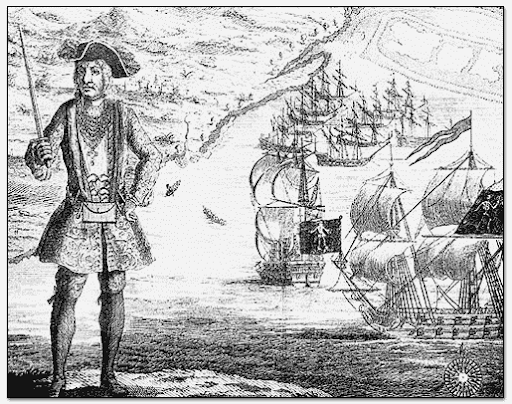
Pirate clichés aside, what’s less well known about the seafaring pirates of the 18th Century is the extraordinary level of trust and teamwork they engendered amongst their ranks. In no small part this came about because many pirates arrived at their career after being illegally dragged into the Royal Navy and then thrown out again without any support after the wars they were expected to fight had ended. In other words, they had something to rebel against, and that something was The Establishment. I guess this is stretching the metaphor a little bit since very few employees recruited onto Operational Excellence were literally press-ganged, but the point ends in pretty much the same place: Operational Excellence is all about efficiency, which in turn means that employees are often seen as resources to be exploited. Anyway, let’s not go too far down that rabbit-hole, the main point is to understand how 18th Century piracy achieved and maintained the levels of trust and teamwork required to defeat much more plentifully resourced opponents. The answer was the Pirate Code. Effectively a set of heuristics that every pirate was expected to sign up to. Like any good manifesto, the Pirate Code evolved over the years, with successive pirate Captains building on the principles of their predecessors. The Code probably reached something like its pinnacle in the Bartholomew Roberts version. If there is a competition between all pirates in plundering ships, Bartholomew Roberts, or ‘Black Bart’ as he is more popularly remembered, would win it by far. Perhaps he was the most successful pirate that the world ever knew. Rumour has it that he successfully plundered close to 400 ships.
In addition to his Code, the other big reason for the success of the Black Bart crew was his boldness. This fearless leader terrorised every ship he encountered throughout the Caribbean Sea. Including many superior warships, ones that most pirates would avoid at any cost. The conventional pirate logic was very much consistent with the strategy that later came to make Napoleon such a successful General: Critical mass at the critical point. Or, only fight battles you know you can win. Black Bart knew that there was a chutzpah-related multiplication factor that could be applied to the equation: Critical mass of highly integrated, self-organising, fully-focused pirates at the critical point. That’s probably another story for another day. The main point of this story is to look at Black Bart’s Pirate Code and make a first attempt at re-framing it into the context of the 21st Century innovation pirate inside a larger organisation that likely as not sees them as a virus, cockroach or efficiency-sapping parasite. Other derogatory labels are available.
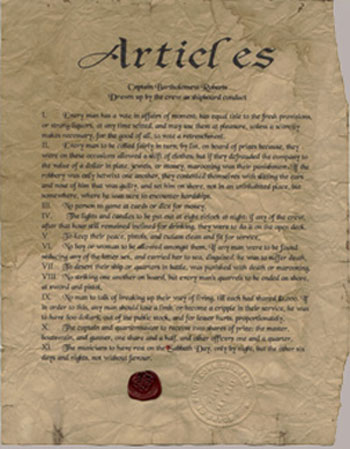
Here it is, with my first hack at making a 300-year upgrade:
I. Every man has a vote in affairs of moment; has equal title to the fresh provisions, or strong liquors, at any time seized, and may use them at pleasure, unless a scarcity makes necessary, for the good of all, to vote a retrenchment. (Every innovator gets a fair say in what happens; every innovator shares equally in the spoils; every innovator has equal skin and equal soul in the game – ‘no prey no pay’.)
II. Every man to be called fairly in turn, by list, on
board of prizes because, they were on these occasions allowed a shift of
clothes: but if they defrauded the company to the value of a dollar in plate,
jewels, or money, marooning was their punishment. If the robbery was only
betwixt one another, they contented themselves with slitting the ears and nose
of him that was guilty, and set him on shore, not in an uninhabited place, but
somewhere, where he was sure to encounter hardships. (Any innovator betraying the trust of other team members, irrespective
of how trivial their betrayal, is out of the team.)
III. No person to game at cards or dice for money. (Innovators don’t gamble. Any and all experiments must be ‘safe-to-fail’.)
IV. The lights and candles to be put out at eight o’clock at night: if any of the crew, after that hour still remained inclined for drinking, they were to do it on the open deck. (Tempting as it might be to put in all-nighters, there needs to be clear end-point to the working day. The problem with all-nighters and working excessively long hours is that if an opportunity or threat arrives suddenly, every member of the team needs to be at their peak, and ready to deal with it. Outside the agreed working hours, it is definitely okay to re-charge the batteries on ‘open deck’ with other members of the team… the team that plays together, stays together.)
V. To keep their peace, pistols, and cutlass clean and fit
for service. (Keep all your resources clean and fit for service at all
times… you never know when things might kick off.)
VI. No boy or woman to be allowed amongst them. If any man
were to be found seducing any of the latter sex, and carried her to sea,
disguised, he was to suffer death. (No Operational Excellence thinking or
thinkers allowed within the team.)
VII. To desert their ship or quarters in battle, was punished with death or marooning. (Innovators have the back of other innovators at all times; when the pressure is really on, innovators do whatever is required to support other members of the team.)
VIII. No striking one another on board, but every man’s quarrels to be ended on shore, at sword and pistol. (Shit happens. Innovators check their egos when they join the project, and sort out personal quarrels only after it ends.)
IX. No man to talk of breaking up their way of living, till each had shared £1,000. If in order to this, any man should lose a limb, or become a cripple in their service, he was to have 800 dollars, out of the public stock, and for lesser hurts, proportionately. (Innovating is hard and comes with a strong likelihood of harsh psychological penalties; innovators will be compensated for such harms… Bearing in mind that ‘what doesn’t kill you makes you stronger’.)
X. The captain and quartermaster to receive two shares of prize: the master, boatswain, and gunner, one share and a half, and other officers one and a quarter. (The team decides how to divide up the rewards. There is no such thing as the ridiculous orders of magnitude difference in reward between the Captain and the crew as is usually found in hierarchical Operational Excellence management.)
XI. The musicians to have rest on the Sabbath Day, only by
night, but the other six days and nights, not without special favour. (The
innovator emotional support network needs, deserves and will have time off.)
XII (Add optional article(s) here) (e.g. Operational Excellence
is not the enemy. What the innovation team does today benefits them tomorrow,
and their tomorrow, in turn, pays for ours.)
That’s it. Pirate First Principles.
It’s almost like Black Bart understood complex systems.
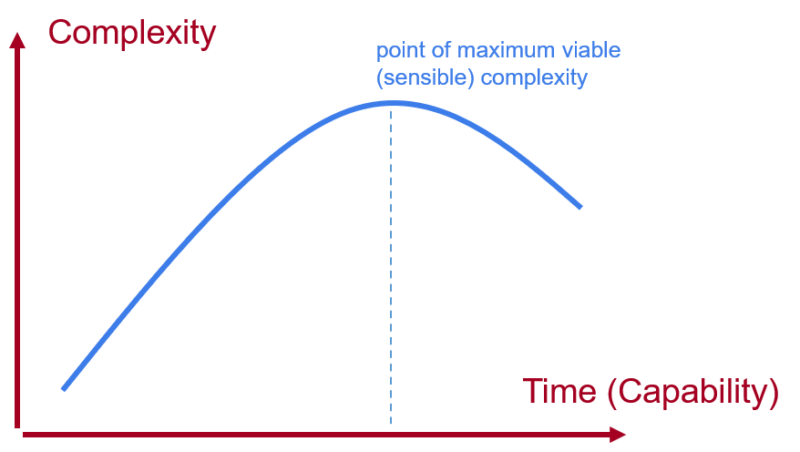
One of the main TRIZ Trends of Evolution, ‘Mono-Bi-Poly’, describes the law of diminishing returns that kicks in when engineers turn off their creativity and instead look to make systems ‘better’ by adding more of what they’ve already done. Eventually, if the absence of creativity is allowed to continue for long enough, the world begins to bite back. It bites back by bringing in a bunch of negatives. These negatives progressively outweighing the benefits of adding more. To the point where a point of maximum viable (or sensible) complexity is reached. This is hopefully the time that the engineers wake up and realise that they now have a different job to do, that they need to increase the capabilities of the systems they’re tasked with creating and decrease the complexity.
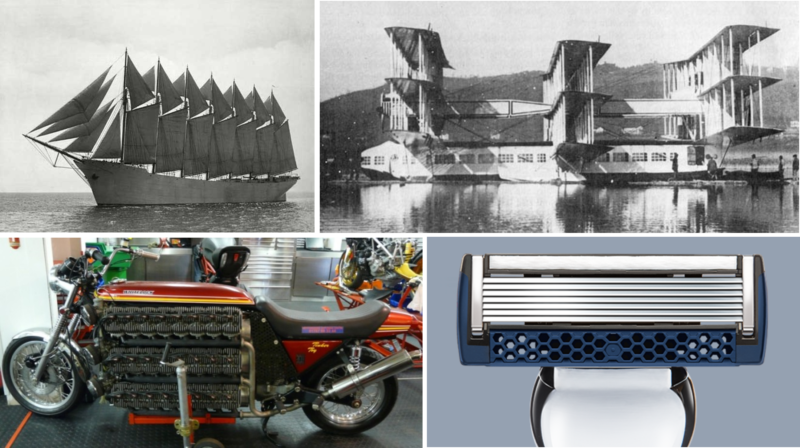
With razors, sadly for customers, that point of maximum complexity occurred probably somewhere around the three-blade mark, and had entered the world of the surreal by the time 5-blade designs hit the market. The less said about the 7-blade versions probably the better. Imagine having to come in to work tomorrow morning to start a new razor project only to find that ‘the answer’ your boss has decided involves adding yet another superfluous and problem-creating blade.
Still, could be worse. You could’ve been working for the boss that thought adding a sixth mast to the Thomas W Lawson schooner was a good idea. Or the bosses at Caprioni that believed the new Ca.60 project would benefit from adding a ninth wing. Or the bosses at the Whitelock Tinker Toy bike company, who thought that what the world needed was a bike with a 48 cylinder engine. Make that 49, because it also turned out the bike needed a separate engine to start the main engine. I daredn’t ask what was used to start the starter engine.
Somehow, it feels like some of the pages have fallen out of the Book of Common Sense. The page with this picture in it especially:
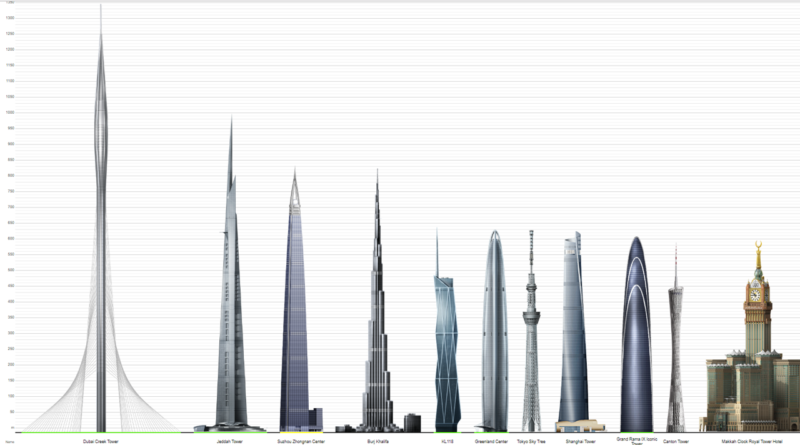
Not quite the same as the Mono-Bi-Poly Trend, but very definitely a close relative is the boss-loved concept of ‘bigger’. This Trend is perhaps most visible in the world of architecture. Probably in no small part because architects tend to have much bigger egos than engineers. Seemingly every architect on the planet aspires to work on a ‘world’s tallest building’ project at some point in their career. Especially those living in countries where the amount of disposable money has exceeded brain power.
Intelligence aside for a moment, one of the great things about these ‘my building’s bigger than yours’ pissing contests is they allow the engineers to switch on their creativity. Literally anything is possible if you think about it hard enough. So, if the architect wants a 1300m high tower, and the client is dumb enough to stump up the cash, why not?
Never mind the fact that, physics being the awkward thing it can sometimes be, the end result looks utterly ridiculous, and the support structures take up the same amount of land as a dozen more sensibly proportioned buildings. These kinds of project require some fairly delusional economic thinking. Like kidding yourself the final building will be a tourist attraction, and that the revenue earned allowing tourists to travel to the top will somehow offset the price of a window-cleaner.
Architects are worst, but aerospace engineers have often showed themselves to be not so far behind. And again, what engineer wouldn’t want to work on a ‘world’s biggest’ plane project? Especially since they have quite literally no skin in the game. The boss wants a plane that can carry 850 passengers? No problem, we can do that.
The bosses also, it turns out, have no skin in this game. And so when the politicians come calling for a piece of ‘statement’ technology, they’re also happy to play the game. Far easier than turning around and telling the truth. Like, revealing that the economics of big-ness only make sense up to a certain point. Carrying 850 passengers at a time is good for lowering seat-mile price, but only if you ignore all the awkward peripheral parameters. Not least of which being, working out exactly how many routes can sustain that level of traffic.
It’s a fine line between ‘statement’ technology, half-science economics and stupidity. The case for the Airbus A380 was always a marginal one. But because there was literally no-one with any real skin in the game when it came to deciding whether to go ahead with the project, it went ahead anyway.
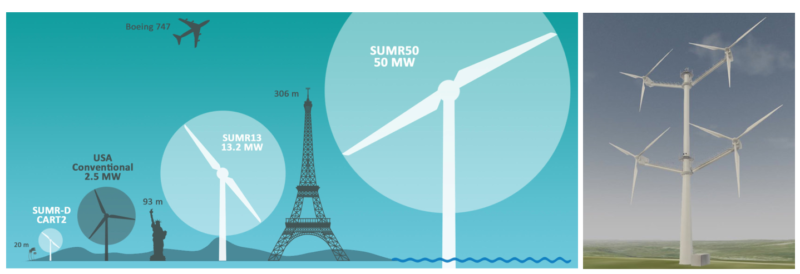
The desire of economies of scale naturally push all systems towards these kinds of giantism boundary. And, tragically, if there’s no-one willing to cry foul, it’s also highly likely that things will be allowed to sail blithely through the boundary and into the land of dinosaurs. Now that the industry has become ‘big business’, we can also see this boundary looming in the world of wind-turbines. Or rather, with the Sandia announcement of a 400m diameter, 50MW turbine, the industry has allowed itself to crash through the boundary with a flourish that is quite likely unprecedented. Unless, of course, we also include the Vestas project to ignore the rules of the Mono-Bi-Poly Trend and assemble multiple turbines on the same tower.
Here we see the precise same one-eye-closed economic logic at play. Bigger is more efficient, so bigger must be better. Well, it is until it isn’t. People – investors and politicians mainly – look at highly disguised data that shows all of the economy-of-scale upsides while conveniently not being shown (and, one suspects, they wouldn’t want to see it anyway since many of the inevitable downsides won’t become apparent until they’ve sold on their stake to an even more naïve downstream sucker) all the awkward and uncomfortable real world effects that also need to be taken into account. There are a thousand-and-one ‘yes, buts’ when it comes to proposing the world needs a 400m diameter off-shore wind-turbine – that the structural loads increase as the cube of the diameter, that the storm-forces on the structure increase with the square of the diameter, that the ‘out-of-sight-out-of-mind’ offshore location makes a terrific terrorist target that now necessitates constant surveillance – all of which ingenious engineers will be able to solve. But being able to, and deciding we should are two different things. Vastly different. Especially when there are so many other far more useful uses of that ingenuity. Which probably brings us back full circle to that Book of Common Sense again. And knowing when we’ve crossed the fine-lines between ego and truth, giant and giantism.
There’s a joke that goes something like… Ask me what the secret of comedy is.
‘What’s the
secre…’
‘Timing’.
It’s hard to
get the timing of many things right. At the more difficult end of the spectrum
is innovation timing.
That said, one of the emerging phenomena arising from Covid-19 and the Disaster Cycle is that for a lot of work related innovation possibilities the timing question becomes, ‘now’. Especially for those that during the last seven months have had time to acclimatise to working from home.
Prior to the pandemic, most bosses were minded to ask their employees to work in the office. The rationale being that employees are being paid for their time, and its only when we can physically see people in the office that we can be sure they’re earning their salary. Never mind the fact that said employees might spend 4 hours of the day with their brain in neutral. Or worse. Then along comes lockdown and suddenly bosses have no choice but to trust that the people working for them will put in the hours. By all accounts, this trust seems to have been justified. Treat people like children and they will behave like children. Treat people like adults and they will behave like adults. Weird.
No innovation happening here so far though. And still a fairly strong likelihood that the four hours of brainless coasting a day is still happening. Only now its easier to hide the fact thanks to lack of camera resolution during Zoom meetings. Where a thousand yard stare and intense listening look indistinguishably alike.
Back in 2010, Cali Ressler and Jody Thompson published their book, ‘Why Work Sucks And How To Fix It: The Results-Only Revolution’. It offered up a revolutionary way of working based around the idea that if bosses gave workers control over how they achieved the outcomes they were being paid for, the company would get significant cost savings and workers would get their lives back. Actually it was a bit more radical than that. As can perhaps be seen from the book’s 13 ‘guideposts’:
1)
People at all levels stop doing any activity that is a waste of their time, the
customer’s time, or the company’s money.
2) Employees have the freedom to work any way they want.
3) Every day feels like Saturday.
4) Work isn’t a place you go, it’s something you do.
5) People have an unlimited amount of paid time off as long as the work gets
done.
6) Leaving the workplace at 2pm is not considered leaving early; arriving at
the workplace at 2pm is not considered coming in late.
7) Nobody talks about how many hours they work.
8) Every meeting is optional.
9) It’s okay to catch a movie on a Tuesday afternoon; it’s okay to grocery shop
on a Wednesday morning; it’s okay to take a nap on a Thursday afternoon.
10) There are no work schedules.
11) Nobody feels overworked, guilty, or stressed out.
12) There aren’t any last-minute fire drills.
13) There’s no judgment about how you spend your time.
The book was mainly built around an experiment conducted at US retailer Best Buy, to implement a Results Only Working Environment (ROWE) across nearly all of the staff at their HQ in Minneapolis.
The whole thing
was built on trust, and treating workers like adults.
It lasted until
2013. When, it sounds like the CEO decided that people couldn’t be trusted
after all, and that, human nature being what it is, we all of us have a tendency
to try and goof off after a while. Treat people like adults for a couple of
years, in other words, and they’ll behave like adults. Especially if they’ve
just been let off the leash and given the reward of incredible time flexibility.
But then, adults being what we are, what was once exciting becomes the everyday
norm, which in turn becomes the new tedium.
What the Best
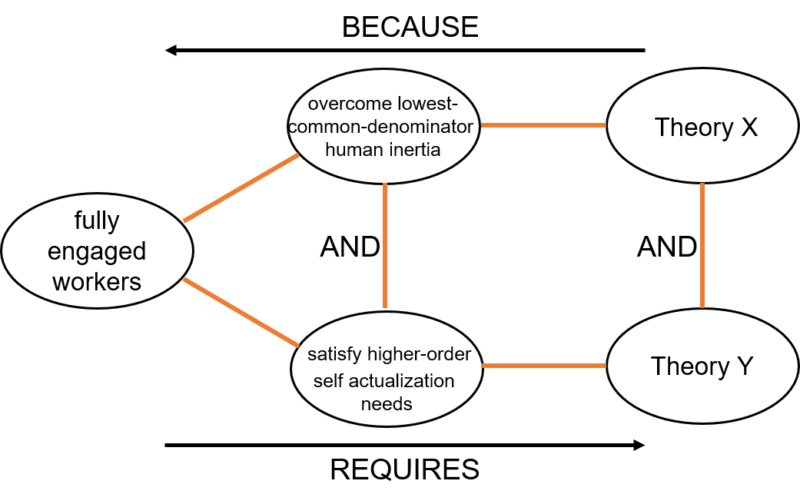
Buy CEO apparently got caught up in was the old Theory X/Theory Y
contradiction:
Which is to say
that he saw adults naturally migrating from Y
to X just through the Second Law Of Thermodynamics. Entropy increases.
Humans need extrinsic motivation because intrinsic motivation tends to zero
over time.
In the TRIZ world, of course, we know that there’s no such thing as the right answer to any either/or question. It’s not ‘X or Y’, it should be X-and-Y. Or, better yet, Z. A solution that transcends the initial either/or question. Several esteemed work psychologists – including Abraham Maslow no less – posited possible ‘Z’ solutions fairly swiftly after Douglas McGregor first published his Theory X/Theory Y hypothesis in the 1950s. To be honest, though, neither Maslow nor any of the other Theory Z searchers seemed to understand the idea of contradiction solving.
But that can’t be allowed to be the case any more. Now we also understand that, complex as humans might appear, when distilled down to first principle level we’re all driven by just four things: Autonomy, Belonging, Competence and Meaning (ABC-M).
The beauty of the ROWE model was that it gave workers their Autonomy back. Emotional entropy, however, means that any feeling of autonomy we gain eventually fades. And when it does, we veer away from Theory Y and back towards needing the carrots and sticks of Theory X to keep us on the boss’s track.
The missing part of the ROWE story seems to us to be that it does little or nothing to tackle the Meaning part of the ABC-M story. We all of us want to spend our precious time doing things that are meaningful. The propensity to goof-off, in other words, only kicks in when we’re tasked with delivering boss-demanded outcomes that are essentially meaningless ‘busy-work’.
So where does
this take us?
Well, first up, now that lots of people are forced to work from home, and bosses have realised that we can be trusted, it is perhaps the right time to re-introduce the ROWE concept again? It didn’t work in 2010 because the required foundation of adult-to-adult trust wasn’t there. Now it is.
Maybe, though, what we can now also see is that what’s needed is an evolved version of ROWE. One in which, rather than merely creating a results-only work environment, we design something that is a meaningful-results-only-work-environment. MROWE. The acronym’s not as good, but the idea is a step-change in the right direction.
Weak signals. One. A friend was talking to an estate agent in rural Wales about the number of ‘sold’ signs, and was told that everything has been bought up by English city-dwellers over the summer. Two. Things are exactly the same here in North Devon. A friend recently put their house on the market and sold it within three days.
There are always winners in a crisis. On the evidence of these weak signals, what is becoming clear is that some of the biggest winners so far are those with money. Rent-seekers who have been given billions of pounds by the government – quite likely the biggest transfer of money to the already-rich ever in history – and are now looking to invest in more properties they can rent out. It beats working for a living I guess.
What it also means is money that by rights ought to be heading in the direction of crisis-solving innovation projects is instead heading in the direction of ‘safe’ property investments. Investments that – tragically – only serve to make the overall crisis worse.
This is not an unexpected phenomenon. Neither is the fact that it will end badly for all concerned. Rich included.
We’ve been
saying since the start of (the first) pandemic lockdown that we shouldn’t
expect the real surge of innovation until the ‘Disillusionment Phase’ of the
Disaster Cycle kicks in. Today, we’re still very clearly in the preceding ‘Honeymoon
Phase’ of the cycle. Although, granted, unless you’re a lauded frontline worker
or cash-rich rent-seeker, it probably doesn’t feel too honeymoon-like any more
for the majority. Expediency is rarely a sustainable trait.
Which then perhaps
begs the question – especially if you live in Innovaton World like we do – when
does the expected innovation tsunami start?
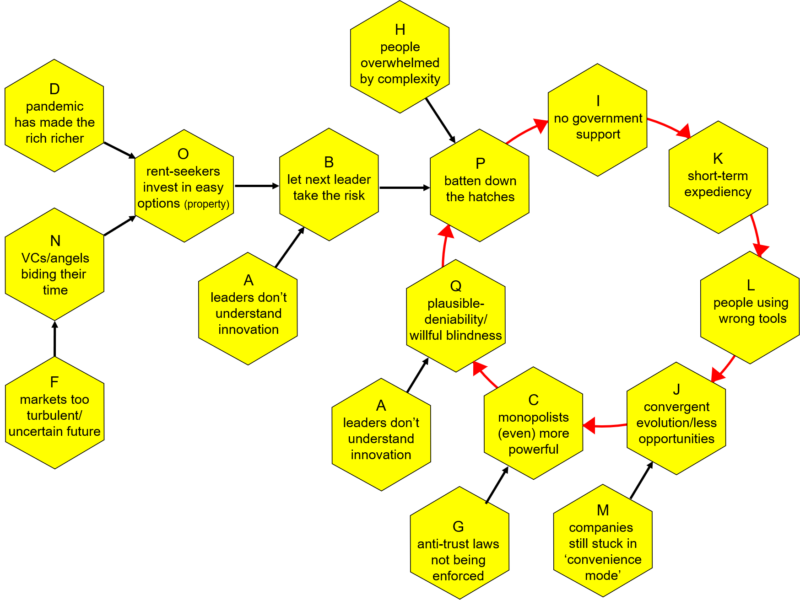
It felt like
time for a Perception Map. One that started with the question, ‘innovation isn’t
happening yet because…?’
Here’s the
resulting Map:
The vicious cycle creating the logjam looks like a particularly vicious one. One that doesn’t look like ending any time in the next six months if I’m being honest. Especially not in the UK, where I think we need the next two economic dominoes to fall over before people properly wake up. In theory, the ‘easiest’ place to break the cycle comes from Government support. Here in the UK I guess we’re starting to see the first tiny steps in the right direction. The first round of disaster-mitigation Government funding was a pure expediency play to furlough people and allow them to pay their rent to the already rich. The second round, announced by the Chancellor yesterday, looks like a move to force employers to contribute more. Which in turn likely means that there will be a brutal cull of jobs in the last quarter of the year. In theory, the move is supposed to remove meaningless, bullshit jobs, but in practice, I fear it will end up eliminating a lot of essential-but-low-paid jobs and in so doing cause a lot of lose-lose suffering. I hope I’m wrong. Right or wrong, though, it’s – again ‘in theory’ – a step towards supporting the flow of money into innovation… if only because when people have nothing to lose, it’s much easier to decide to innovate your way out of the mess you’re in. All in all, though, it feels like a fairly long-winded way of getting the money to where its needed. The rent-seekers, as we’re seeing here in rural Devon, can only be trusted to indulge in more low-risk rent-seeking.
There’s little value in speculating on ‘if only’ hypotheticals, but, its difficult to avoid wondering whether, if the Chancellor had given the first £400B to sparking innovation rather than giving it to rich people, the economy might now be on the way up again rather than in a steep descent, teetering on the edge of an all-out tailspin. Which, I guess, is a way of saying, ‘buckle-up, we’re in for a rough ride’.
When is an innovation not an innovation? One of our perennial problems when trying to establish whether an innovation attempt has transitioned to become an innovation is working out how to account for integrated clusters of innovation attempts. The most visible forms of attempt-clustering being those found in new cars.
Because OEMs tend to inject new models onto the market in three, four or five year cycles, what usually happens is that some or all of their Tier 1 and beyond suppliers turn up before design-freeze day with a catalogue of new ideas and concepts. Some of these will be adopted into the new car design and some won’t.
So far so good. Here’s the problem though. Let’s assume that the new car becomes a hit, and that the OEM ends up repaying the cost of developing the vehicle and, miracle of miracles, gets to turn an actual customer-money-in-the-bank profit. Does that then mean that all of the innovative features present on the vehicle get to call themselves innovations?
The extent of the problem recently became apparent when a friend succumbed to some heavy OEM advertising propaganda and went out and bought a new car. Being his only engineer friend, I was forced to sit in the car so that he could inflict his version of the showroom demonstration on me. There were so many ‘innovations’, the demonstration lasted several hours. Or maybe that’s just what it felt like. Grinning can give you cramp after a while.
After a while, when
I’d start become conscious of impending smile-muscle spasms, I thought I’d try
and apply a bit of TRIZ Principle 22 to calm my misery. Turn new-owner-pride
lemons into research lemonade.
So, after each
new feature demonstration, I started asking whether he thought it was something
he could see himself using after the initial novelty had worn out.
That worked for a while. Then, when we got onto things like ‘automatic handbrakes’ or ‘heated indicator switch’ (I’m joking – everything was becoming surreal by this stage), the answer to my question turned into variants of the sentence, ‘err, yes, because, I can’t turn it off/get rid of it’.
To cut a too-long
story short, the upshot of the analysis was that 98% of the new features were precisely
that. Features. As in features with no discernable benefit.
Now, I have to say that this 98% number is rather convenient. Because that’s precisely the percentage of all innovation attempts that end in failure.
Only now, we’ve got to take into account that, because the overall car under consideration has sold well, all of the new features contained in it get to call themselves innovations. Even though 98% of them clearly aren’t. Which means our 98% number is actually recursive.
Stepping back a little before we get ourselves stuck in a nest of recursions, the situation is rather worse than it might already sound. That’s because when my poor friend purchased the car, he had little or mostly no option to not have the feature. Which basically means that he’s paid for a pile of digital and hardware crap that has zero utility. Which, when brought into my Yorkshire-Economics, no-way-am-I-paying-for-that mind, means I’ll probably never be able to buy a car made after, by current reckoning, 2008.
From a more pragmatic innovation-accounting perspective, it means that we need to be very careful about labelling ‘all’ the novel features in any kind of integrated cluster as innovations just because the overall cluster turns into an innovation. Rather, we need to take into account a 98% nested-dysfunction effect and recognise that the large majority of those features are junk.
Which then just leaves the final challenge of somehow isolating them so the OEMs can gain a better understanding of which of the 2% of the new features they’re inclined to keep adding to the cluster are the ones worth spending time and money on. Sounds like a job for PanSensic. Or diverting some of the OEM research funding towards asking their customers better questions. Hopefully in time for the day I have to finally replace my (2007) car.
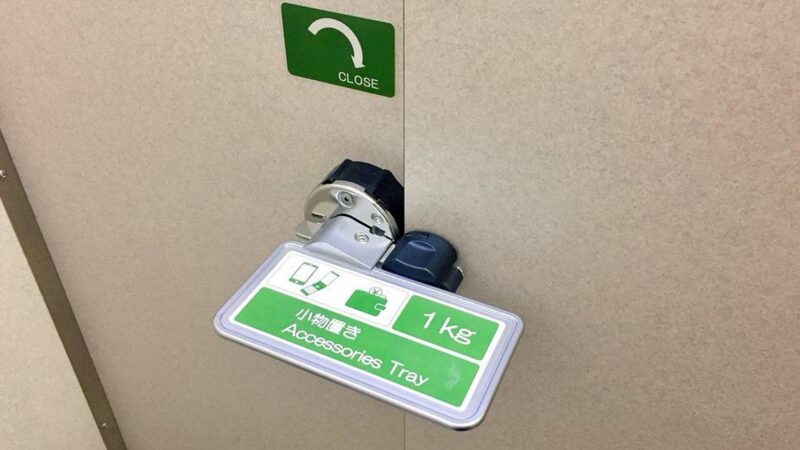
It is one of the more annoying first-world-problems of 21st-century living: a hurried stop at a public convenience, a quick exit and in the rush leaving a mobile phone behind. After realising some of their rest-room staff were having to spend 30 or more hours a month re-uniting left-behind phones with their owners, Japanese authorities set out to devise a simple, self-organising way to prevent people from losing things.
It is called an ‘accessory tray’ and consists of a shelf attached to the lever which holds the toilet door shut, giving a convenient place to put a mobile phone, wallet or a small bag. Because the shelf must be flipped up to open the door, it is impossible to leave things behind.
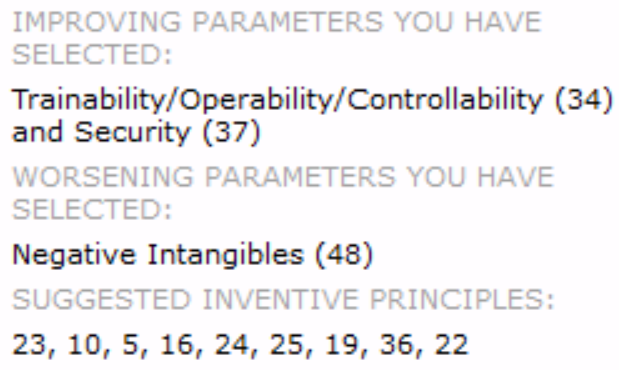
The innovation makes for a simple illustration of contradiction solving in action: we don’t want people to leave their possessions behind, but we know that they’re often distracted when in a rush. Not the easiest conflict to map onto the Contradiction Matrix, but if we had to make the best connection it would likely look something like this:
As far as the ‘accessory-tray’
solution is concerned, we can see evidence of several Inventive Principles in
action:
Principle 23,
Feedback – possessions are placed on the door unlock mechanism so are
inherently visible at the critical ‘leave-behind’ moment.
Principle 10, Preliminary Action – users are encouraged to pre-place their possessions at the right position to ensure they can’t be forgotten.
Principle 5, Merging – the accessory tray is integrated into the door-lock mechanism.
Principle 24,
Intermediary – the accessory tray!
Principle 25, Self-Service – the whole system is self-organising and self-correcting.
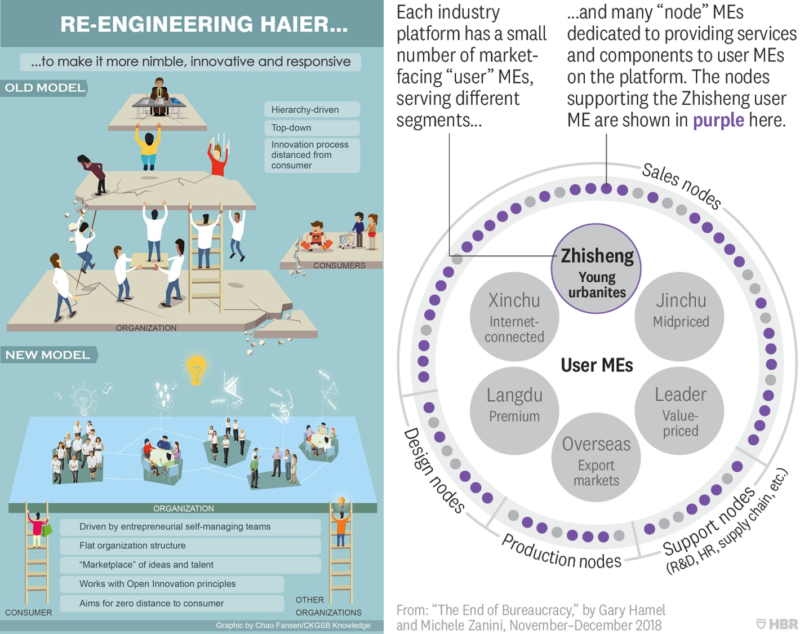
I’ve just finished reading Gary Hamel’s new book, Humanocracy, the best chapter of which offers up an in-depth analysis of white-goods manufacturer, Haier’s, business model. The book is about the need to eliminate bureaucracy from organisatons, and Haier is used as an exemplar of what’s possible. Even if, like Haier, you have 84,000 employees to look after.
The overall bureaucracy story makes for a classic business contradiction: the bigger an organisation becomes, the more layers of management it requires in order to make sure everyone is doing what they’re supposed to be doing in order to, in turn, maximise the efficiency of the business. Or at least that’s been the traditional thinking since the advent of large organisations, and particularly the arrival of Frederick Winslow Taylor’s ‘Scientific Management’.
There are various ways of looking at the contradiction. At the physical contradiction level, we want bureaucracy and we don’t want bureaucracy: we want it because it enables stability and, assuming we do it right, operational efficiency; we don’t want it because, as the organisation gets bigger, controlling it becomes progressively more complex, it stifles employee autonomy and therefore innovation, and it impairs agility because the multiple layers of hierarchy each add friction that impedes communication.
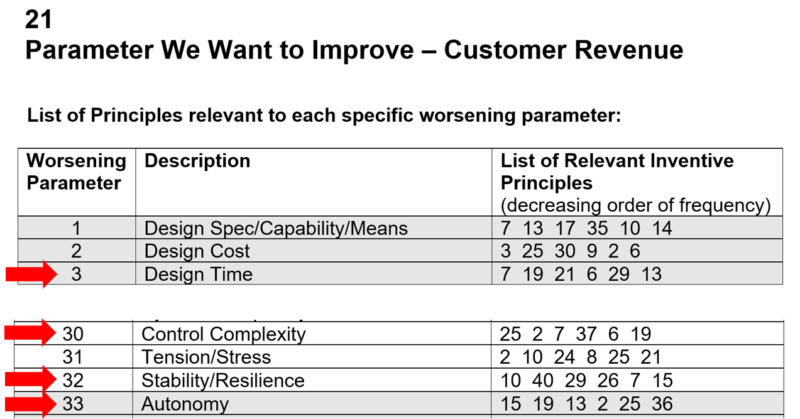
We could also shift the problem to a higher level by focusing on the primary job of the organisation, which in Haier’s case is to generate sustainable revenue/profit from customers. What then prevents this is control complexity, the simultaneous need for stability and rapid creation of new offerings, and the lack of employee decision-making autonomy. When we have a multi-faceted set of contradictions like this, often the best way to map it is to revert to the tabular form of the Contradiction Matrix. Something like this:
By forcing
ourselves to look at several conflict pairs like this, we obtain a long list of
Inventive Principle suggestions. The majority of which, in this case, we can
see have been implemented at Haier:
Principle 2, Taking Out – in the drive to eliminate the gap between customer and employee, over the course of the last 10 years the company has eliminated 10,000 middle management positions; then the business has been separated into more than four-thousand ‘micro-enterprises’ (MEs).
Principle 13, The Other Way Around – top-down command-and-control management structures have been replaced with bottom-up autonomy; every employee becomes an entrepreneur rather than an employee.
Principle 25, Self-Service – each of the MEs operates largely autonomously; when potential new customer opportunities are identified, they are free to build new offerings to meet those needs.
Principle 6, Universality – each of the MEs, in keeping with the universal size of human empathy group, has between 10-15 people within it.
Principles 15, Dynamics/29, Fluid – as the overall business grows its web-centric ecosystem, more MEs are formed; as business needs shift, MEs are able to decide how best to morph to suit emerging needs.
Principle 7, Nested Doll – each of the MEs is situated within a higher level ‘platform’ (see figure below).
Principle 40,
Composite – each ME incorporates all of the requisite skills required to
deliver their intended outcomes; thanks to the entrepreneurial spirit, individuals
recognise the need to be multi-skilled rather than specialised in just one area.
On every meaningful metric, Haier is now out-performing its competitors. This won’t be too much of a surprise to TRIZ aficionados: when a business is designed along ‘self-x’-based Ideal Final Result lines (Haier calls it ‘rendanheyi’), traditional to-down, command-and-control enterprises stand no chance.
Anything I say here about the enormity of Haier’s achievement will inevitably sound glib. Anyone interested in digging deeper, should check out Humanocracy. Anyone interested in digging deeper still, should go and talk to people in any of the company’s MEs.
For me, meanwhile, I’m just happy that the world now has a second addition to the Innovation Capability Maturity Level Five club. I suspect, this being the case, the Haier journey is still just beginning.
I’ve written several times now about the idea of every aphorism having its equal and opposite analogue. What I haven’t worked out yet is whether they all therefore ultimately cancel out – a zero-sum feast of smart sayings – or whether they lead to some kind of higher truth. A truth emerging from Hegel’s dialectic method of progress that postulates a higher level proposition synthesised out of a reconciliation of a conflict between thesis and antithesis. I guess I was hoping that someone would pick up the challenge and that, one day, I’d receive the definitive dissertation in the mail. Sadly, still nothing has arrived.
Which I guess
means that if there is an answer out there, I’m going to have to be the person
that does the hard yards required to find it. Damn.
So, in true,
how do you eat an elephant fashion, here’s what I hope will become a series of
bite-sized attempts to try and synthesise something meaningful from pairs of opposing
aphorisms.
Here are two of
my simultaneous favourites:
“When the pressure is on, you don’t rise to the occasion – you fall to your highest level of preparation.” Chris Voss
“To achieve great things, two things are needed; a plan, and not quite enough time.” Leonard Bernstein
The underlying
physical contradiction between Voss and Bernstein centres around pressure: Voss’
thesis is that pressure is basically bad, while Bernstein’s is that, by not
quite giving ourselves time to do a job, the resulting pressure is good. Can
both be right? Can we construct a picture that allows both aphorisms to hold
true?
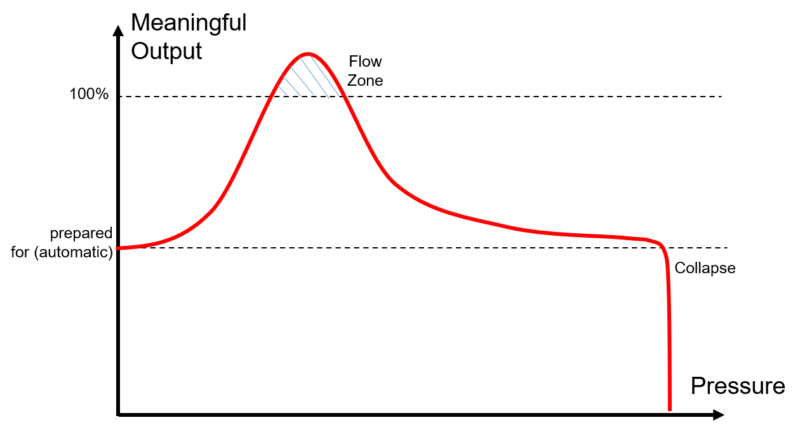
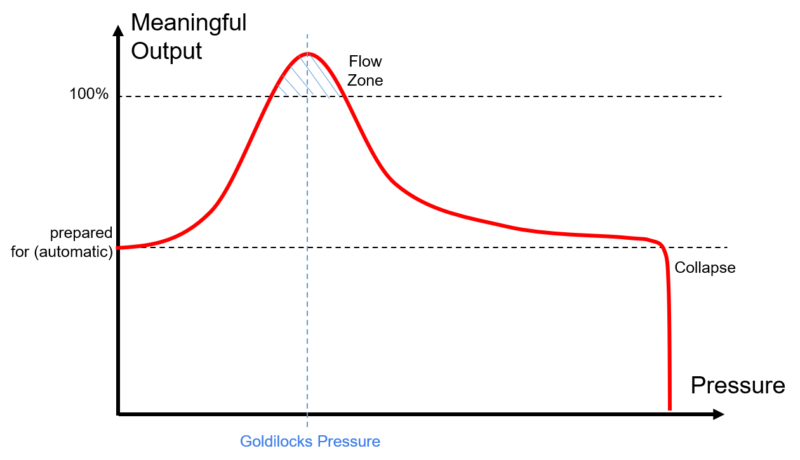
I think so. I
think it looks something like this:
The upshot of which, I believe, is that both esteemed thinkers are indeed correct. Provided we understand the varying impact on outcomes attributable to varying levels of pressure. To Voss’ point, if we put too much pressure on people, they stop thinking, and hence revert to ‘automatic pilot’ (plus, if we keep increasing stress sufficiently, we eventually cause a cliff-edge collapse). To Bernstein’s point, if we put people under ‘Goldilocks’ conditions (i.e. just the right amount of pressure), we can attain a one-plus-one-is-greater-than-two level of output. Getting the level of pressure right allows people to enter a ‘flow’ state in which their creative juices come to the fore and difficult problems get solved.
I’ve deliberately used the idea of achieving ‘more than 100%’ outcomes in the figure, knowing that I regularly encounter individuals who become very uncomfortable at the thought. I have some sympathy with their view. Usually, when I hear naïve Millennials (yes, it is still possible to be extremely naïve when you’re in your late thirties) claiming they’re going to put ‘110%’ into their next relationship, or that they’re committed ‘120%’ to the project goals. Most times when people say these things they’re merely regurgitating a modern-day trope and don’t know what they’re talking about. But occasionally they do. In the jet engine business, for example, engines are designed to have a series of different power ratings. One of which is ‘100%’. This is the maximum level of power the engine is designed to be able to deliver continuously over the entire scheduled life of the engine. The jet engine industry being very safety conscious, its also standard practice to recognise that in some situations an engine might fail unexpectedly – e.g. by ingesting a wayward goose. If an aircraft loses an engine, the other engine(s) are then able to be operated at power levels greater than 100% to compensate for the power lost from the non-functioning engine. These higher power levels – in extreme cases 160% – can’t be sustained indefinitely, but they can be used for long enough that the aircraft can either safely return to the ground or, more usually these days, fly for several hours to reach the intended destination. At which point the over-exerted engine will be inspected and its remaining life re-calculated.
Exactly the
same ‘extreme situation’ capability is available to humans. We are usually
calibrated to be able to work a 40 or 50 hour week (120 if you’re a Systematic
Innovation person). Whatever our normal week looks like, that’s our ‘100%’. We
also know, I think, that occasionally we’re able to go beyond the 100% level.
The ‘all-nighter’ to submit the final report for example, or the ‘hackathon’ to
solve a knotty problem. The key point being – like in the jet engine – that we
do it for a short period of time and not (as some employers seem to think) for
ever.
I believe many individuals instinctively understand this ‘more than 100%’ capability. We take advantage of it when, like Bernstein, we deliberately don’t quite leave ourselves enough time to finish what we’ve been tasked with. Back to the figure again, if we get the pressure level ‘right’, we get to take advantage of a flow-based synergy effect.
And maybe that’s the higher-level synthesising third-aphorism takeaway from Voss and Bernstein’s apparently contradictory quotes: if we manage to hit the Goldilocks pressure level, we win, if we miss it, we get what our automatic pilot is prepared for. Or collapse.