Now we live in a world of constant coronavirus testing, the question of how to make a step-change improvement in testing rates arises.
Back in November, a group of Israeli scientists announced their method for revolutionising testing protocols in a hospital lab, with a change they say can instantly quadruple the capacity of almost any coronavirus screening facility in the world.
Systems
immunologist, Professor Tomer Hertz announced that the lab at Soroka Medical
Center in Beersheba would be shifting immediately to the new strategy.
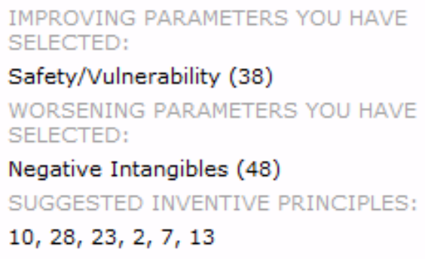
From a TRIZ
perspective the test-rate problem represents a simple to describe contradiction.
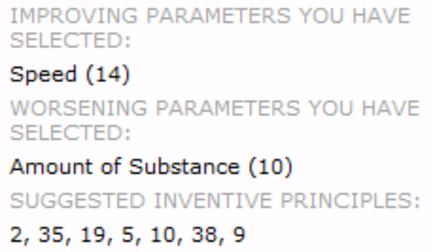
Namely that we want to improve speed, and the number of tests required to be analysed
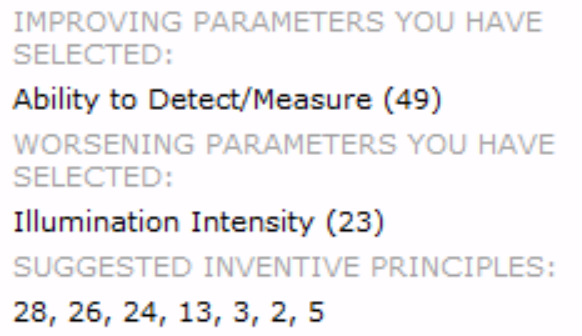
prevents us. Here’s what the Contradiction Matrix has to say about the problem:
And the Soroka Medical Center solution? The change isn’t powered by a medical or technological innovation, but rather by some cleverly applied mathematics. Labs will use only their regular computers and widely available machines to implement the solution. Which, in classic ‘blinding flash of the retrospective obvious’ involves testing in batches. The normal impediment to such ‘pooling’ solutions is that they are logistically clunky and require a two-stage process. The minority of labs that currently “pool” samples combine the RNA from several people and test it as if it were a single sample. Then, if a positive result is detected in the batch, each individual sample is retested to see who generated the positive result.
The new method
eliminates this two-stage approach, telling lab workers exactly who is positive
from the initial “pooled” test.
It is the brainchild of Open University computational biologist Noam Shental. Or rather, in a sense, his mother. In March she reminded him during a family lunch that a decade ago he had developed a pooled method to test sorghum, a flowering plant from the grass family, for a genetic disorder, and urged him to repurpose the research for coronavirus in humans.
Shental started thinking through the maths on the drive home, and quickly got Hertz and another Ben-Gurion professor, Angel Porgador, on board to do exactly as his mother had said.
The basis of their method is that a range of “pools” is prepared in a lab at once, and RNA from each sample is added to several of them, often around nine. “What happens then is that we ‘read’ the pools,” said Hertz. “This means that we look at the pattern of which pools showed positive results, using a modified version of the sorghum calculation, which tells us exactly who is positive.”
“Unlike in
regular pooled testing, there’s no need for us to reexamine samples from pools
that tested positive in order to pinpoint exactly who is positive. We already
know.”
From a contradiction-solving perspective, the solution offers up an elegant illustration of Inventive Principles 5 (Merging) and 10 (Preliminary Action).
From a more general perspective, the Covid-sorghum connection offers an iconic example of the more general TRIZ philosophy of ‘someone, somewhere already solved your problem’, albeit the ‘someone’ in this case was the same person. Just ten years earlier.
Thirdly, and perhaps most important of all, the case offers up a timely example of the emerging Covid-sparked Crisis Period innovation paradigm. First, Covid-19 triggered the arrival of a host of expedient testing solutions, and now we see the frustrations associated with those initial solutions provoking the true innovation.
Amid all the SI talk of wobbling societal dominoes, it feels like another one might just have wobbled too far this week. All thanks to millions of amateur traders working together to take on some of Wall Street’s most sophisticated investors — and, for the moment at least, winning. Propelled by a mix of greed and boredom, gleefully determined to teach Wall Street a lesson, and turbocharged by an endless flow of get-rich-quick hype and ideas delivered via social media, these investors have piled into trades around several companies, pushing their stock prices to stratospheric levels.
Some of the
names are from an earlier business era. BlackBerry’s shares are up nearly 280
percent this year. Stock in AMC, the movie theater chain, has surged nearly 840
percent. But the trade that captures the David-versus-Goliath nature of the
moment involves GameStop, the troubled video game retailer that was once a
fixture in suburban malls.
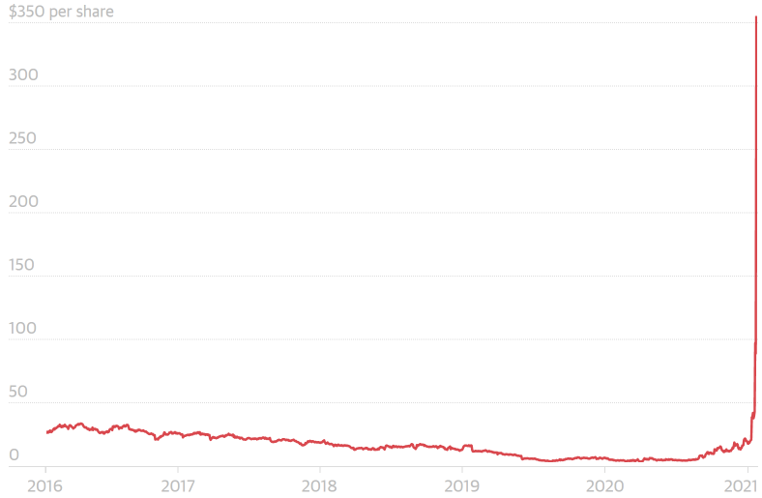
On Wall Street, individual investors are often derided as ‘dumb money’, destined to lose against the highly compensated analysts and traders who buy and sell stocks for a living. But in recent days, individual investors — many of them followers of a popular, juvenile, foul-mouthed Reddit page called Wall Street Bets — have upended that narrative by banding together to put the squeeze on at least two hedge funds that had bet GameStop’s shares would fall. At the time of writing, GameStop’s share price is already up 1700% and, thanks to the fact that the game has created a ‘virtuous cycle’, looks set to continue rising high enough to send the two hedge-funds to the wall.
I’ve never been a great fan of the stock market, but very definitely at the evil end of the morality spectrum, it seemed to me, were those organisations that sought to earn their way in life by betting on the poor fortunes of others. Worse yet, organisations whose actions wittingly served to accelerate the poor fortune of others.
And so it feels
more than fair that when a domino falls it falls squarely on those responsible
for the shorting-evil.
Looked at from a contradiction solving perspective, a desire to destroy these short-focused funds has traditionally been prevented by the fact that Wall Street looks after its own. From a Business Matrix perspective, this situation can be generalised as a Support Risk versus Support Capability conflict. The four most frequent ways to resolve such conflicts are currently:
Principle 13, The Other Way Around
Principle 10, Preliminary Action
Principle 4, Asymmetry
Principle 35, Parameter Change
All of which
point quite astutely to the still unfolding GameStop situation. A handful of
Financial Elites outdone by (Principle 4) millions of ‘dumb’ (Principle 13)
investors, who got together online (Principle 35) and worked out a (Principle
10) work-together plan.
Extrapolating just a little, the 99% seem to have unlocked a peaceful and potent way to disrupt the invulnerable ‘1%’. Social Media might already be responsible for destroying democracy. Now, if the momentum is allowed to continue building it might just be on its way to doing the same for capitalism. Or, at the very least, establishing a ‘virtuous cycle’ that will see the end of the shorters.
How will it all end? Probably badly. The bigger the balloon, the louder the pop. And, thanks to being bailed out in the GFC, and being artificially pumped up by Quantitative Easing fake money ever since, the Wall Street balloon has become the biggest in mankind’s history.
Just when you thought it wasn’t possible for the UK Government’s Covid-19 strategy to get any worse, you wake up to find they’re considering giving £500 to anyone that tests positive. And it’s not even April Fool’s Day.
Then you think, well, maybe this time there is a cunning plan. Just because something is counter-intuitive, doesn’t necessarily mean it is dumb.
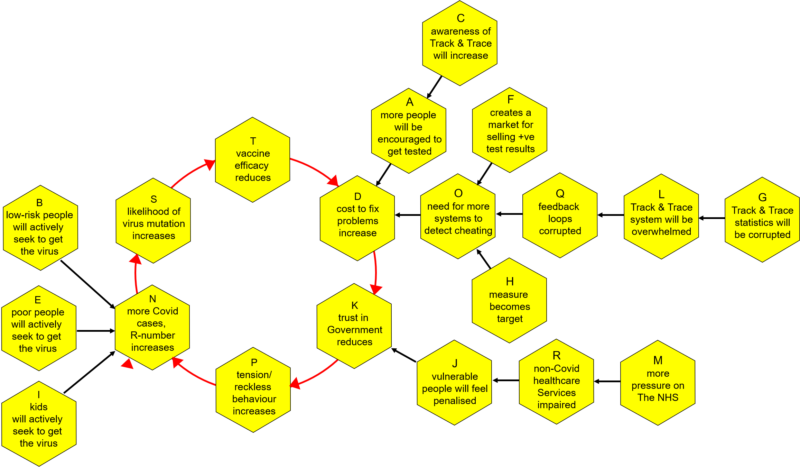
Then you think, okay, let’s draw a Perception Map to see what it has to say on the matter.
Here’s what it looks like:
Then you look at it. And see, yup, the idea is really dumb. Some counter-intuitive ideas turn out to be brilliant. Just not this one.
Still, out of stupidity comes opportunity. Anyone thinking of setting up an app to facilitate trading of positive-tests, I’m ready and willing to invest.
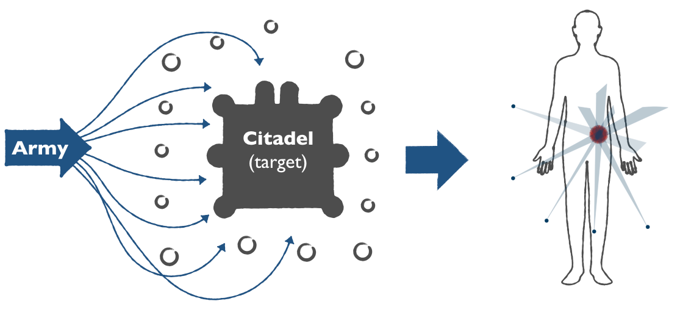
For those poor unfortunate people that have never heard fo TRIZ, one of the few problem solving lessons come via the German psychologist Karl Duncker, who posed his now famous ‘radiation problem’. In the problem, a doctor has a patient with a malignant tumour. The patient cannot be operated upon, but the doctor can use a particular type of ray to destroy the tumour. However, the ray will also destroy healthy tissue. At a lower intensity the rays would not damage the healthy tissue but would also not destroy the tumour.
When asked what they would do to destroy the tumour, only about 10% of people manage to generate a meaningful solution to this problem.
This percentage
rises to about 30% after subjects are exposed to a second, analogous problem. Here’s
the usual one:
“A small
country was ruled from a strong fortress by a dictator. The fortress was
situated in the middle of the country, surrounded by farms and villages. Many
roads led to the fortress through the countryside. A rebel General vowed to
capture the fortress. The General knew that an attack by his entire army would
capture the fortress. He gathered his army at the head of one of the roads,
ready to launch a full-scale direct attack. However, the general then learned
that the dictator had planted a ring of mines on each of the roads. The mines
were set so that any large group of enemy troops would set them off. It
therefore seemed impossible to capture the fortress. However, the general
devised a simple plan. He divided his army into small groups and dispatched
each group to the head of a different road. When all was ready he gave the
signal and each group marched down a different road. Each group continued down
its road to the fortress so that the entire army arrived together at the
fortress at the same time. In this way, the General captured the fortress and
overthrew the dictator.”
The 30% of people that successfully recognised this dictator problem was analogous to the tumour problem, were then able to translate the General’s strategy and apply it to solve the tumour doctor’s problem:
From a TRIZ perspective, the General’s strategy was basically to use Inventive Principle 1, Segmentation.
That’s the easy bit of the problem-solving story.
In Duncker’s context, he had to do the hard work of finding the tumour/fortress analogy (and even here, some might argue it is quite contrived). Perhaps the real power of TRIZ is it makes it much easier to find analogies so that the problem solver themselves can work through a problem without clues from a friendly analogy-supplying psychologist.
The tumour problem is a classic physical contradiction: a high dose of the rays is required to destroy the tumour and a low dose is required to avoid damage to the surrounding tissue. And, likewise, for the fortress problem, a high number of troops are needed to destroy the dictator and a low number are required to weave past the mines.
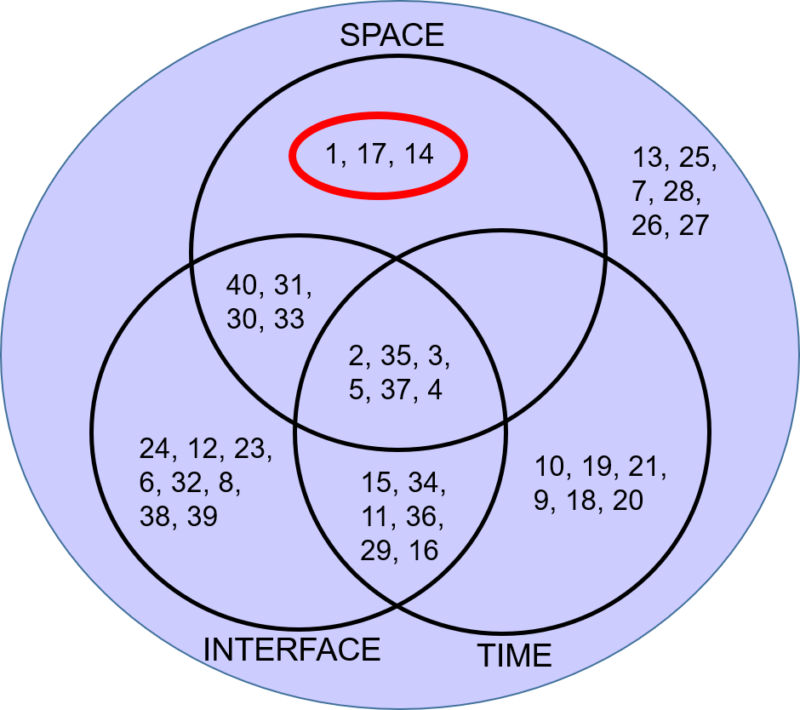
Both problems require high and low. Moreover, when we start thinking about how the contradiction might be separated, it quickly becomes clear that Separation in Space is the most viable solution strategy in both cases. Which then means we can jump to a prioritised list of the Inventive Principles that others have previously used to solve the problem:
The advantage we get here, apart for the structured analogy approach, is that, in addition to receiving the Segmentation solution strategy, we also get Principle 17, Another Dimension. Which takes us even closer to the actual solutions. Destroying the tumour by segmenting the ray is part of the solution, but we only get to something that might work when we also realise that the segmented rays need to arrive from different directions.
Talking of contrived, I first encountered Duncker’s radiation problem while reading David Epstein’s otherwise rather excellent book, Range (more about that in the February Issues of the SI ezine). The main thesis of Range is that generalists make better wicked problem solvers. Largely because they’ve seen a broader range of problems and thus have access to a broader range of potential analogies. I suspect he was also picking up on the post-Duncker finding that the 30% of people solving the radiation problem increased to something over 90% when they were given multiple analogies, and therefore wanted to provide an analogy of his own. Which ends up going something like this:
“A small-town Fire-Chief arrives at the scene of a woodshed fire. The woodshed was about 50 yards from a very conveniently placed lake, and true to the cliché, a chain of bucket-passing locals had been formed to transfer water from the lake to the fire. Alas, as each bucket load of water was thrown on the fire, it wasn’t really having any impact.”
So, what did
the Fire-Chief do?
Now I don’t know whether Epstein was being very clever here, or whether he merely demonstrated the difficulty of finding analogous situations when you don’t know TRIZ. In his mind, the Fire Chief problem is similar to the tumour and dictator problems. And, true enough it is also a high-and-low contradiction. In that we need a high amount of water to put out the fire, and each bucket-load only contains a small amount. But it is also 180 degrees opposite to the tumour and dictator problems. In that, solution-wise, the bucket-chain has in effect already used Segmentation, but it is not helping.
Rather what’s
required – and what the Dire Chief knew to recommend – was to break up the chain,
give every person a bucket, send them to the lake to fill it, then all come
back and throw their bucket-load onto the fire simultaneously.
i.e. while the
fire problem is indeed a high-and-low problem, it’s solvable not just by a
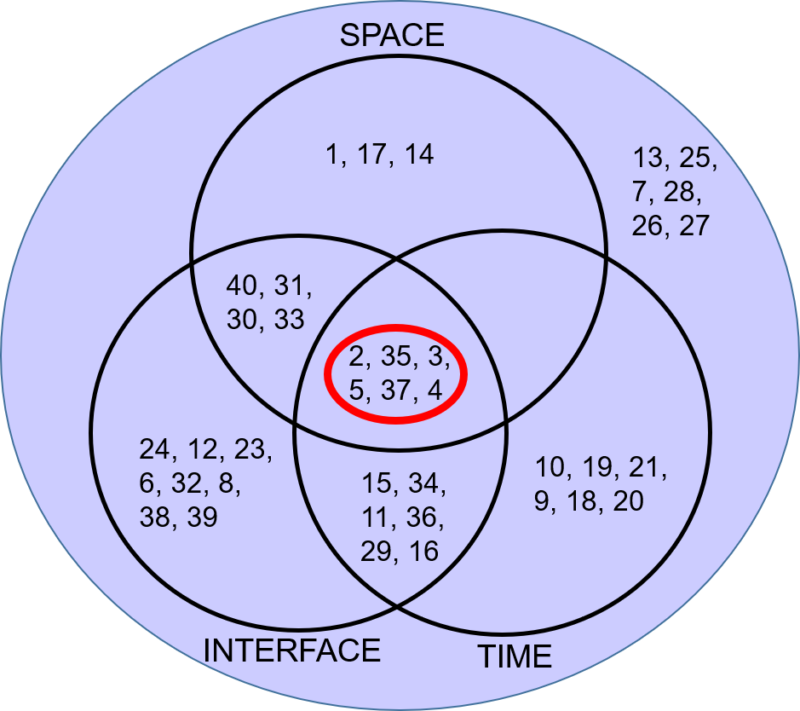
Separation in Space strategy, but also by Separation in Time and by Interface.
In which case, we learn that Principle 5, Merging is more likely to help:
It’s too late for Karl Duncker, who passed away in 1940, but if anyone knows how to contact David Epstein, I’ll be happy to send him a copy of Business Matrix 3.0. Help him to work out how to build analogies at will. And turn him into a proper specialist generalist.
What is it
about the public sector? Specifically their propensity to try and influence
human behaviour using public service announcements. Which almost by definition
end up doing the opposite of what they were set up to do. Social distancing
campaigns that make people less likely to social distance. Litter reduction
campaigns that increase the amount of rubbish on our streets. ‘Just Say No’
type anti-drug campaigns that attract more people to drugs.
The common
feature of all these kinds of initiative is their failure to understand the
workings of the human mind. People do not change they’ve been told to by a
well-intentioned authority figure. Rather, many people – especially youngsters –
will stubbornly do the opposite.
So, what to do
if we want to reduce drink-driving? Well, rule one, based on past experience,
would be to not try and do it using a public service announcement.
Enter Jay Winsten of the Harvard Alcohol Project, a person that recognises people do things for two reasons, a good one and a real one. Traditional public service announcements give people good reasons not to do something, but nothing at all to influence their real-reason thinking. Real-reason thinking is all about appealing to our ABC-M-driven core. In terms of changing a person’s behaviour, this means understanding change happens when a desired new behaviour is perceived by people as ‘normal’. All of us instinctively want to belong to the tribe. And the easiest way to do that is to fit in with what we perceive the tribe already does.
Here’s the
basic contradiction: we want to improve drink-driving safety, but traditional
campaigns ignore all of the intangible, emotional aspects of a situation and
hence end up tapping into the negative rather than positive ones. When we map
that pair onto the Contradiction Matrix, it looks something like this:
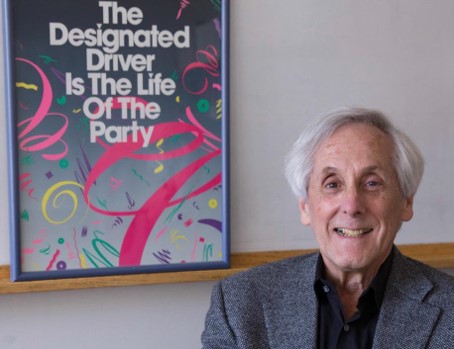
Back to Jay Winsten. Instead of presenting his designated driver programme as a government social marketing campaign, Winsten persuaded several major Hollywood studios and TV companies to embed casual references to the ‘designated driver’ in their scripts. One of the first shows to take up the challenge was the (set in a bar!) sitcom, Cheers. When the scriptwriters began building designated drivers into the show, they were able to present it to viewers as already ‘normal’ behaviour. If Norm does it, so can we.
Carla draws lots to see whose turn it is to be the designated driver.
Thanks to Carla
and Norm, the concept quickly spread from fiction to real life. It was an
enormous success, one that has significantly reduced the loss of young life in
car accidents.
The principles
of Winsten’s solution seem eminently transferable. And consistent with TRIZ:
Principle 28,
Emotional Fields – tap into human emotions
Principle 2,
Take Out – remove the public service announcement
Principle 13,
The Other Way Around – do the opposite of a public service announcement.
Principle 7,
Nested Doll – insert the desired concept into an established set of popular fictional
characters
Principle 10, Plant the idea in people’s heads as already established normal
My good friend, Professor Toru Nakagawa asked to make a Japanese translation of the virtual presentation I prepared for this year’s US TRIZCON. I happily agreed. Then we found out that my colloquially-dominated English commentary was a major hindrance to effective translation. Partly, I suspect, because there was never a script, and that I merely recorded my commentary on the sequence of slides. Worse still, I did it in one take.
So, anyway, if you want the Japanese translation, you’ll still have to wait a while. In the meantime, having now made a transcription of the commentary, I thought I’d publish it here. The slides, in the meantime, can be downloaded from the link found in the News section on the SI home page. The full paper, if you’re feeling particularly masochistic, is the lead article in the October issue of the SI ezine.
The transcription:
Slide 1
Hello, TRIZCON. Long time no speak. Great to be a part of
this years conference and to share with you some of the things we’ve been doing
with our clients this year. Helping them to make sense of the world we now all
live in, and to see what’s likely to happen in the coming years.
Slide 2
I’ve got four parts to the presentation. First of all, I
thought I’d look at society as a whole, and where we think society might be
heading in the next ten years. We’ll then zoom-in to focus on the world of
business and how it may be changing. Then zoom-in one step further and look at
the world of innovation, and what’s likely to happen there. And then, finally,
use those three levels to try and understand a little bit better how the
TRIZ-world might change in the coming years.
Slide 3
As soon as we say we’re going to try and predict the future,
then we’re in fundamentally complex territory. Which means that there are an
awful lot of things that we can’t know about what’s going to happen. But at the
same time as that, we know that’s not the same as saying there is nothing
we can know about the future. And, particularly if we look at things from a
bottom-up perspective, if we look at things from a first principles
perspective, we can do a pretty good job, I think, of seeing how the world
emerges from where it is to where it is going to end up in the next ten years.
Slide 4
A big part of the problem of predicting the future is the ‘Black
Swan’ side of the story. This relates to the Nassim Taleb concept of the highly
unpredictable, high consequence event in life. What we know to help us on such
a journey is that even though events happen at random, society’s reaction to
those events is conditioned by fundamentals associated with the behaviour of
human beings. And so, if we can build that stuff into our prediction models and
our evaluation of what’s happening then we stand a pretty good chance of
identifying some of the key things that are likely to be ahead of us.
Ironically, perhaps with the Covid world that we now live in, Covid was not a
Black Swan, but rather a highly predictable event. And really the only
surprising part of the story, perhaps, is the fact that so few Governments
decided to prepare for the pandemic. And then, because of that lack of
preparation, as soon as you see that has happened, it sets in place a sequence
of events that are now unfolding.
Slide 5
Let’s start with the Societal level perspective. I’m using
Nikola Tesla here as a marker to distinguish between the different sections of
the presentation.
Slide 6
At the Societal level, what’s happening at the moment is
completely consistent with some of the things we talk about in the TrenDNA
book, and in turn, where we got that from was the work of Strauss & Howe
looking at generation cycles. I think they’re a little bit mis-understood in
that they’re perceived as being top-down analysts of the world, whereas in
actual fact, the premise of their work was very much a first-principles idea.
One which says the way you were raised by your parents will impact the way you
raise your own children should you choose to have them. This model tells us
that the years 2000-2025 is a Crisis period if the previous pattern is allowed
to repeat. And, so far it has done. We’ll dig a little bit deeper into that in
a second. I’m conscious with this presentation that I’ve got a lot of material
to try and cover and so the way I’m trying to handle that is by providing, as
you’ll see on the bottom of a lot of the slides, a reference for further
reading. We’ve published a lot of material this year, and if anyone’s
interested in any particular part they can go and look at whichever bits they
feel they’d like more information on.
Slide 7
We also know that there are an awful lot of things we can’t
predict as described earlier. We do know that in the Crisis period there are
lots of wobbling dominoes. And while it’s difficult to predict which domino
will fall over first, once one domino falls over it gives us a good indication
of what the next domino and the domino after that will be to fall over.
Slide 8
So, whether it’s trade, employment, politics, we’re now in
a situation where the pandemic has already severely impacted other dominoes and
we’re starting to see some of those also falling over.
Slide 9/10
Right at this moment we’re coming to the climax of the
Strauss & Howe predicted Crisis period, and, if the pattern plays out, it
tells us the next four-to-five years, things will get worse than where they are
today. And then hopefully, somewhere around 2024/2025, things will settle down
into a ‘New World’. In effect what the model says is that the world is currently
in transition from one s-curve to the next.
Slide 11
Another model that’s useful in these kinds of situation is
the Hero’s Journey. Here, as soon as we understand there is an s-curve shift
taking place, the work of Joseph Campbell tells us that there are some clear
milestones that occur during those transitions. One of the key ones being that,
once we’ve jumped off an s-curve, there will be an ‘Ordeal’, or, from a TRIZ
perspective, a contradiction that needs to be solved. Trying to look at
previous cycles of the pattern and where we are right now, the analogy I would
draw is that the pandemic is the equivalent, in the US at least, of Pearl
Harbour in the last cycle. Pearl Harbour was a clear signal to the United
States that their current way of living wasn’t going to prevail any longer, and
triggered the start of a transition to a New World. So, right now with Covid,
if the pattern repeats, then we have four or five years to unravel the Ordeal,
make sense of it, solve the problem and – hopefully – solve it well.
Slide 12
We also know that we’re in a situation here of ‘punctuated
equilibrium’. So, for large periods in history, things are relatively calm.
Then one domino will fall over, and it will trigger the fall of a number of
other dominoes and we’ll see lots of change, and then things will settle down
again. So, again, right now we’re in one of those punctuated equilibrium
situations. And one of the things we know from previous cycles is that these
periods of instability are really important from an innovation perspective.
Slide 13/14
Here’s another model of the world offering a classic case
of someone, somewhere having done some hard work for us. This is the Disaster
Cycle. A piece of knowledge concerning the occurrence of bad events, that what
follows from them forms a very consistent pattern. So, we have the impact of
the event, there’s a subsequent ‘honeymoon’ period when everyone pulls together
to try and fix things, followed by disillusionment, where we realise that the
temporary fixes that have got us out of the initial emergency aren’t innovation
at all, but rather merely expedient, and that the real innovation job starts
during the Disillusionment phase. We’re heading in to that phase right now and
a lot of the expedient solutions are becoming innovation opportunities.
Slide 15
This is another piece of research looking at the world from
a societal perspective, and again, looking at disaster and situations where
society jumps off its s-curve. This is the work of Dmitry Orlov. His scenarios
for the world where it is now are all quite bleak to be honest. The best of
which is that we do what Iceland did at the end of the GFC and thus allow
ourselves to stay, or return to where we are. He didn’t have one of the good
scenarios that we think is a possibility. We just published the ‘Everythink’
book, and that talks about a breakthrough situation where we jump to a ‘higher’
level s-curve than the one we’re on right now. We think it’s a fairly low
probability, but its not possible to say at this point in time which of those
scenarios, whether it’s the optimistic one that we’ve got, or the five
pessimistic ones that Orlov has got, is the one that will happen. I think what
we do have though is the opportunity to identify some of the signals that will
tell us which of those scenarios is the most likely to play out.
Slide 16
In order to make any kind of meaningful prediction about
the future, we need to take all the uncertainties and try and bracket them. So,
what we’ve done with several clients this year is build a number of scenarios
which together cover the range of possible changes in the world. In this
picture here we’re essentially looking at four scenarios along two different
axes. One looks at society – which either stays in the doldrums that its in
right now or it undergoes a significant step-change. And on the other axis we
look at the world of business and again have one scenario that says the current
systems remain locked-in where they are right now, or, at the other end of that
spectrum, there’s some kind of a major breakthrough. That could either be a
technological breakthrough (for example the energy sector, probably the most
likely), or its some kind of legislative breakthrough and shift. The most
likely scenario there, I think, is the power of the Big Data companies and the
likelihood that Governments will try and break them up. So, we look at those
four scenarios and then, if we identify something that occurs in all four
scenarios, then we can say with a degree of confidence that its likely to
happen whatever the reality turns out to be. We’ve done that analysis. I don’t
have time to go through it here, but…
Slide 17
Pointing out what we have seen from those scenarios is that
in Crisis periods, whatever the scenario turns out to be, looking at those four
extremes, there are always winners, winners that are consistently winners, and
then there are winners that are likely to be winners in this particular cycle.
The headlines on the slide are essentially the findings that we’ve published,
and we think are going to inform the innovation side of our story.
Slide 18
It’s sometimes nice to look also at some of the losers.
Without wanting to get too depressing about things, there’s a few references I
think give us some signals. One of the most likely ones is, looking at the
book, ‘Bullshit Jobs’ by David Graeber, who sadly passed away recently. During
Crisis periods a lot of those meaningless jobs that currently exist in the
world will disappear. That could mean 30% of the jobs in the world according to
Graeber’s research. I think also highly likely is the fact that when we’re in a
period of chaos and high instability, optimisation is not the right strategy
anymore, and so things like Lean, SixSigma will fade into the background. Providers
of those kind of services are going to have a tough time.
Slide 19
Let’s now zoom in and look at the world of business…
Slide 20
…and introduce this model. Again, it’s all written up
elsewhere so I’m not going to spend too much time describing it here. One of
the things that we’ve been saying quite strongly to our clients is that you
need to understand the capability of your organisation in terms of complexity,
and you need to set that in the context of the surrounding environment that
you’ve got. So, you’ve basically got four scenarios you need to be thinking
about. One is that the world you’re operating in is ‘simple’. Another is that
it is ‘complicated’. Then it’s complex. Then it’s chaotic. If you don’t know
which of those scenarios you’re in then it’s highly likely you will find
yourself doing the wrong things at the wrong time. So, know where you are, know
where the context is…
Slide 21
…One thing we know from before the pandemic hit is that the
prevailing business model for most organisations was efficiency-driven. And so
what that meant was a desire to simplify things inside organisations…
Slide 22
…ever since Taylor came along and studied work,
‘standardisation’ has been the dominant model. The converse of that is Nassim
Taleb again, and his 2012 book, looking at AntiFragile. Which is kind of the
opposite view that says you should be aiming for a situation in which the more
your organisation is stressed, the stronger you become…
Slide 23
…that’s the line at the top of the 4-by-4 picture. The
natural world tries to take us away from this line. So standardisation and
Taylor’s work tries to simplify everything; the 2nd Law of
Thermodynamics and the reality of life push us towards the boundary with chaos.
Boththese forces combine to make it difficult for organisations to get to where
they’d like to be… which is where they are ‘efficient’…
Slide 24
…there are certainly things we can do in order to achieve
that. Some of them quite drastic – for example, if we look back at the
beginning of the automotive industry and Henry Ford, ‘any colour you like as
long as it is black’ was a great way of simplifying their market. If you wanted
to buy a Ford, it was going to be one that had a black paint-job.
Slide 25
Where you’d like to be, where Taleb encourages us to be is
up in the ‘Golden Triangle’ at the top of the picture. That’s the place that
says we acknowledge the world is complex, and we have processes in place inside
our organisation which are consistent with that complexity. Above the diagonal
line – the Ashby Line – says that the capability of our system is greater than
the level of complexity of the world around us. Hence it makes a great target
for organisations to be. The distance between the previous green triangle, the
Efficiency Zone and the Golden Triangle, unfortunately, makes life quite
difficult for most organisations. It’s a big shift that needs to take place…
Slide 26
…the book we published at the beginning of lockdown is all
about start-up companies, but it’s also about the journey of getting out of the
‘ordinary’, efficiency-dominated world and into a complex environment. Almost
fundamentally that means going through a period of chaos. I think many people
will recognise that the world only really changes when we are in such a
situation of chaos. Because, if nothing else, chaos teaches us that the
existing rules don’t apply any more.
Slide 27/28
I think, just looking at business, and how it’s changed by
this s-curve shift that society is taking, there’s another book that has come
out recently, which we think is relevant. That is Gary Hamel’s latest book,
‘Humanocracy’. It talk about a shift in paradigm that’s taking place in the
workplace. He’s another person who understands ‘first principles’. Humanocracy
in effect talks about the shift that is taking place away from the
efficiency-dominated world in which people employed by organisations are
effectively given tiny, segmented, easily-trainable jobs… into one in which
efficiency shifts to effectiveness, and where we need people to bring their
brain to work and to think creatively. Now, whether that creates any innovation
opportunities remains to be seen, but that paradigm shift is certainly
something we can see on the horizon…
Slide 29
…I’m not sure every organisation is going to be able to
make it. I’m not sure many actually want to make it. If we look at what’s
happening in the media at the moment, there’s lot’s of talk about a K-shaped
economy. All of our scenarios predict the same thing. Which basically means
that we’ve got three types of organisation: Type 1 is the organisations that
are currently part the way up their s-curve and get to keep going; Type 2 is
the type of organisation that, unfortunately, doesn’t make it through the
societal shift; and Type 3 is the organisation that makes a shift to the new
paradigm described in Gary Hamel’s book: the ‘effectiveness’ world rather than
the efficiency world.
Slide 30
I think there are clear signals, and certainly looking at
Hamel’s book we can see examples of these ‘new world’ organisations – where
they’ve engineered completely different organisation structures: structures
that are consistent with empowering people, eliminating the ‘bad’ jobs,
creating ‘self-organisation’. In many ways, very consistent with TRIZ. Haier,
WL Gore are the two prime examples of what the new world could look like. The
‘command and control’, Type 1. Organisations, those are the Facebooks, the
Amazons of the world, the ones that have become highly dominant in the past
decade or so because they’ve tapped into the virtuous cycle that comes from
owning peoples’ data and using that data to better understand what it is that
customers will want in the future. And then, the Type 2 downside sees the
‘command and control’ dinosaurs, the top-down driven organisations… I think
automotive is going to be one of the biggest sufferers in this domain.
Aerospace not far behind it. Unless these companies are able to make a marked
transition to a new way of doing things then they’re going to be in serious
trouble.
Slide 31
From an innovation perspective then, what have we heard so
far? From a societal perspective we have difficult times, but good times for
innovation. Business on the other hand, has got to undergo a significant shift
away from an efficiency model towards an innovation model. And one of the
challenges of that is, do the skills exist inside organisations…
Slide 32
…to enable it? Certainly if we look at the Big Five
consulting companies there’s a strong case to be made to say that they’re the
cause of the problem that the world’s in right now, because what they’ve been
doing is teaching client companies about operational efficiency for the last 40
years, and have taken companies too far down that efficiency road. To the point
where many of them are unable to come back and rethink how they do things. We
think they’re in trouble. We think there are signs, if you look at the
companies the Big Five consulting companies are buying at the moment – eg
buying ‘Design Thinking’ boutiques and innovation boutiques – its clear they
fundamentally don’t understand what innovation is about yet. They could be a
solution in the future, but in the short term are very definitely not going to
be…
Slide 33
…part of the reason for that is there is still an awful lot
of confusion about what we mean when we use the word ‘innovation’. We published
this article a couple of months ago looking at the different definitions that
are out there. The one that we use is the one that defines innovation as
‘successfully implemented ideas’. In other words, it is making money for the
organisation. But it turns out that our view represents a minority perspective
on what innovation means. The majority of innovation authors think it’s about
an ‘implemented idea’, irrespective of whether it has been successful or not,
and about a third of authors still think that ‘innovation’ means ‘generating
ideas’. It’s only the green definition on this slide that actually makes any
kind of sense in terms of the TRIZ story, and the future for the innovation
world – that you’ve got to deliver success to your clients, otherwise you’re
basically not innovating, but rather merely preserving the status quo.
Slide 34
Something we’ve known for a long time is that TRIZ
over-shoots the market to a high degree. It was 2012 when we published the
Innovation Capability Maturity Model, where we’d identified five different
Levels of Capability to innovate inside organisations. TRIZ really becomes a
valuable tool for Level 4 and Level 5 organisations, but, as shown in this
picture here, there aren’t many of those organisations. The majority of
organisations have never really had to think about innovation, and so have
really been thrown in at the deep end when the Covid domino fell over. This is
a problem for the TRIZ World… a lot of the tools are useful, but actually quite
dangerous if the Capability to innovate inside the organisation is low.
Slide 35
What do we also know? We know that other methods struggle
similarly to deliver success inside organisations. So, 98% of all innovation
attempts fail. And if we look at innovation attempts that purportedly use
Design Thinking, Or QFD, or Open Innovation, they really do nothing to impact
the overall success or failure rate. The problem is something deeper than
methodology. We could easily add TRIZ into that story too. It’s a necessary
part of the innovation story, but it’s not a sufficient part when we’re dealing
with complexity.
Slide 36
So, what we’ve tried to do over the years, we did it with
the Capability Maturity Model back at the beginning of the last decade, is try
to look at the 2% of organisations that were successful, and reverse engineer
what they did. This year’s book, the Hero’s (Start-Up) Journey is really been
about the start-up organisations and the 2% of those that are successful, and
reverse engineering what is it about their capabilities that allow them to
succeed where their competitors did not.
Slide 37
So that takes us to TRIZ. And how TRIZ becomes a big part
of that success story…
Slide 38
…’necessary but not sufficient’ is the way we’ve been
describing it for a number of years. Some of you may be familiar with the ‘Hype
Cycle’ from Gartner. We’ve been tracking TRIZ’s along this Cycle for a number
of years. It makes for a great case study. One we’ve written up a couple of
times now, looking at some of the key events that took place in the 1990s – the
arrival of the first consulting companies, the software, and the deployment
inside companies like Samsung. The pinnacle of TRIZ so far was probably the
Samsung medal awarded to the TRIZ team. Everything after that has seen TRIZ on
a downward trajectory, completely consistent with what the Hype Cycle tells us.
I’d have to say, where we are right now is right at the bottom of the ‘Trough
of Disillusionment’… which is a dangerous place to be. Ideally, we get through
it, and up the ‘Slope of Enlightenment’ – so people begin to understand what
TRIZ actually does, But, when you’re in the steep downward trajectory,
sometimes it’s the case that we can’t climb out of the descent fast enough and we
end up crashing everything completely.
Slide 39
So, what do we conclude from our analysis? The answer takes
us back to our Complexity Landscape
again. One of the reasons why TRIZ has struggled s because if we look at original,
Classical TRIZ…
Slide 40
…it really sits in the ‘Complicated’ domain. It’s not
designed for complex problems, but rather, complicated technical problem where
the system is in control. The clue is in the name – ‘theory of inventive
problem solving – it tells us something about the problem, but the crux
of the method really resides with the problem solving part of the story…
Slide 41
…it’s only later on when we have what might be called, TRIZ
2.0, where we start to bring in some of the Western influences. So, Function
Analysis gets added to the story, for example, and it’s then that we can look
at complicated problems where the definition is very unclear. What we’ve been
trying to do is, because of the work we do with marketing functions and looking
at ‘business’ is create a TRIZ 3.0, or, more appropriately, ‘Systematic
Innovation’ these days, is to get into that complex world such that we can deal
with complex situations. And where we’re trying to get to at the moment, the
upcoming TRIZ 4.0, or ‘Systematic Innovation 4.0’ more properly, is enabling
organisations to work no matter where we are on the Landscape. So, if the
environment is in Chaos, for example, we know there are things that can and
should be done in order to get the organisation out of that chaos. The idea
here is, again, diagnosing where an organisation is and then bringing along the
appropriate sets of tools and methods for that particular situation. So, if
it’s a complicated situation then Classical TRIZ is a perfectly adequate, and a
perfectly sensible thing to bring to the story. If you’re in a complex
environment then, unfortunately, Classical TRIZ is really not going to help
you. It will point people in fundamentally wrong directions. What’s required is
to acknowledge and embrace the complexity that’s there. When we’re dealing with
chaos, what that essentially means is that we have to be able to do things an
awful lot faster…
Slide 42
…and so when we start attaching methodologies to these
different scenarios then, in the Chaos world, we’re looking at the work of John
Boyd and his OODA model – the idea of rapid learning cycles, which may well
have a TRIZ element to them, but it is the cycling and the rapid learning that
is the key to survival and thriving in those environments. The model basically
gives us an indication that, once we’ve understood where an organisation is and
where their market is, we get a much better chance of bringing along the right
combination of tools and methods to deal with the situation.
Slide 43
As far as TRIZ itself is concerned, then, I’ve used this
slide way too many times in recent years. The UK has some of the worst
politicians on the planet at the moment. Historically, we’ve had some of the
best, and I think, the best was probably Winston Churchill, who, famously
talked about democracy as being the worst form of government… apart from all
the others. I think TRIZ finds itself in a similar situation, in that it is the
worst innovation method… apart from all the other ones. This is a problem. It’s
certainly a problem for the TRIZ community. But it’s a problem for
organisations that are trying to innovate also, because there’s a lot of stuff
out there – with 1500 books a year published on innovation – and none of it
really seems to help…
Slide 44
…so, the prognosis for TRIZ… what are the ‘yes, buts’ first
of all? A constant frustration, certainly inside our organisation, is the
bickering and argument that still takes place in the TRIZ world. Fighting over
crumbs instead of growing the pie. I look at some of the Big Five consulting
companies that have got zero innovation capability, and the TRIZ world really
should be destroying those organisations. And yet, here we are, literally
scraping a living, especially those that are trying to do it with purely TRIZ.
There are too many TRIZ providers… many of whom are not users of TRIZ. Again,
it’s an enormous frustration of mine that TRIZ tells us the customer wants the
function, and still we hear TRIZ consultants saying you have to use TRIZ. It’s
completely inconsistent with the reality of the world and, because a lot of the
TRIZ providers aren’t innovators – they’ve never innovated, they’ve never seen
a project all the way through to its end, its really difficult for them to
understand the complexity of the world, especially the 99% perspiration that
follows the 1% inspiration at the beginning. We’ve talked a little bit already
about complexity and using compatible strategies for a complex world, but
Classical TRIZ is still stuck in the ‘complicated’ world. That’s clearly a problem.
Where we do try and take TRIZ out of the technical world and into the business
world, we immediately fall into the trap of, looking at the history of TRIZ and
its Soviet origins, raising eyebrows with organisations who cannot connect the
idea of ‘business’ and the Soviet Union at all. That is a really enormous
problem. Both for the organisations that are trying to innovate and don’t know
where to go to look to find solutions, but also for the TRIZ community,
because, its very clear that the people with all the money inside organisations
are the people that sit in the boardroom. If we take all of that stuff and
think about how we solve all these contradictions, what do we get left with?
Slide 45
Fundamentally, I think we can say very safely that, when we
take things down to a first principle level, innovation is largely about
contradiction solving. The vast majority of all innovations – in other words
the 2% that have been successful – they’ve identified and they’ve solved a
contradiction. TRIZ is the absolute home of contradiction-solving. Theory of
Constraints is perhaps the only other methodology that gets anywhere close to
it. Recognising the importance of contradictions, philosophically speaking
we’re looking at Hegel and his insights about the importance of contradiction
solving. So, the good news as far as the TRIZ community is concerned, is that,
whatever happens, when the world understands that innovation is contradiction
solving, TRIZ has an enormous advantage over just about everything else. I think,
unfortunately, the down side, and I guess the bad news, which isn’t going to
make me popular with a lot of people is, whichever way we look at it, the TRIZ
name makes no sense in the world we’re heading into. You’ve got to deal with
complex problems, you’ve got to deal with business situations, and its just not
possible to overcome the stigma that comes with the Soviet roots of the
methodology. So, I can’t see that, by 2030 the TRIZ name will be anything other
than a footnote in history. I think a lot of Altshuller’s research, on the
other hand, and the contradiction-solving part of the story in particular will
be right there in the centre of whatever the innovation world ends up being. I
think, if we come back to the societal level part of this presentation’s story
for a second, we’ve got four or five year’s worth of Crisis and Chaos ahead of
us. I don’t think that’s a great time to be launching on to the world a new
TRIZ or whatever the successor to the TRIZ name ends up being. It’s a time to
stay underground. People want to innovate, they don’t want to learn innovation
methods. They need the output, they need the success stories, and so, certainly
we’re not going to put any effort at all into promoting new methodologies in
the next four/five years. What we are going to be doing is getting ourselves
ready for the period when things settle down, when society has found it’s new
s-curve and is stabilised in that New World, because that’s the end of the
punctuated equilibrium and we’re back to equilibrium, and it becomes a much
more sensible time to start thinking about creating innovation capability in a
wider number of organisations and a wider range of the population inside those
organisations. If we look at the Haier business model, however, its difficult
to see them outsourcing a lot of innovation activity, simply because, when you
have a self-organising system, and you’ve got lots and lots of tiny
organisations within the overall organisation, all of them empowered to do
whatever they need to do in order to innovate, its difficult to see them going
out to innovate with large consulting companies. And so the TRIZ opportunity
there is going to be a highly segmented one, and one that is still largely
unclear. It’s a case of being underground at the moment to get some success
stories, getting ready for whatever the New World turns into. In my most
optimistic days, I have the probably naïve expectation and hope that the TRIZ
community will get together in this four/five year period such that we can make
a positive difference to the rest of the planet. On my more realistic days, I
think what’s going to happen is that an outsider – again applying TRIZ to
itself – is going to come along and cherry-pick the important parts of TRIZ,
combine them with other things, and they’ll be the ones that end up being the
big success and will reap the rewards of surviving the chaos period and
prevailing then in the New World.
Slide 46
So, a mix of good and bad news. Thanks again for the
opportunity to let me speak. I’m conscious that I’ve thrown lots of information
at people. If anyone wants to know more information, I’m always happy to start
a conversation. Either through email or, these days, through Twitter. Enjoy the
rest of the conference, and thanks very much.
One of the more
fatuous exhortations I hear being used, usually by weary academics talking to incalcitrant
students (or weary bosses to incalcitrant employees) is, ‘don’t give up’. I’m
sure in the majority of situations the advice was well-intentioned. But it was
also lazy. And, if we’re working on a wicked problem, potentially quite
dangerous. And not just for the incalcitrant student or employee.
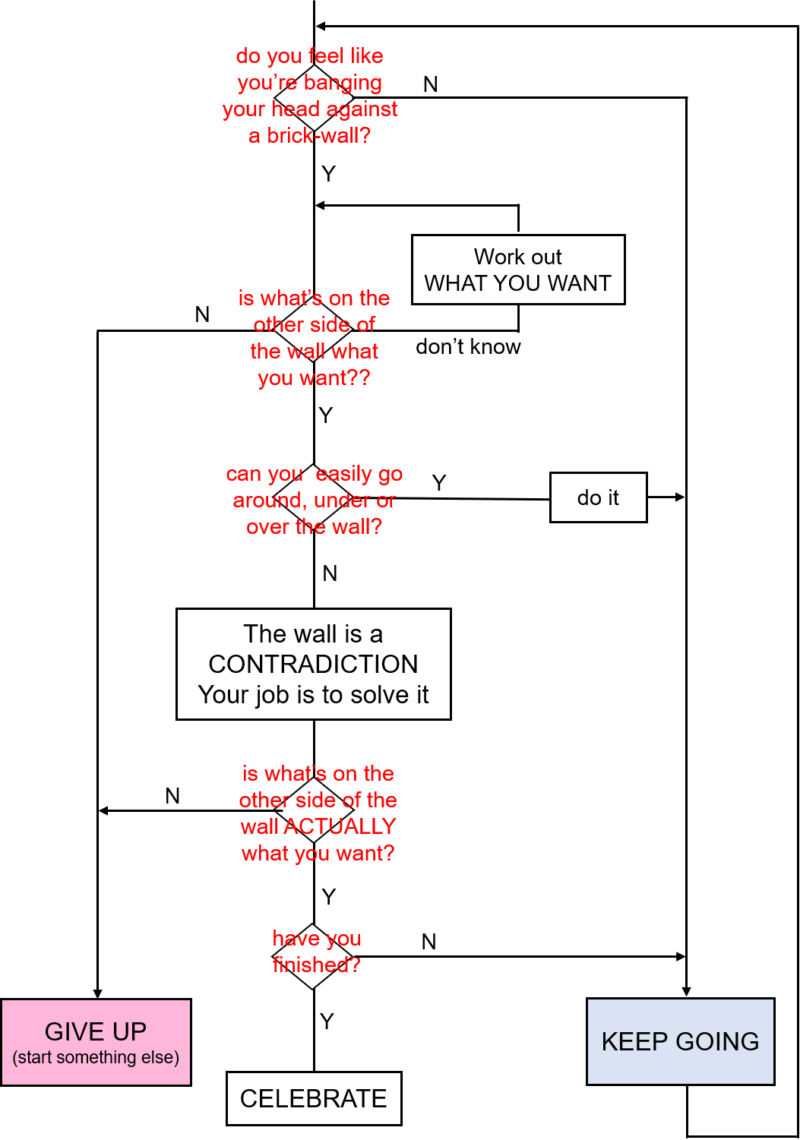
There are
definitely times, wicked-problem-wise, when giving up is precisely the right
thing to do. “If at first you don’t succeed, try,
try again. Then quit. No use being a damn fool about it.” So said one of my
all-time favourite comedians, W.C. Fields. I think what he was getting at was
the sort of situation where we find ourselves beating our heads against brick
walls. Which, when we find ourselves blinded by the metaphorical blood dripping
off our metaphorical forehead, is probably as good a time as any to give up. Except
things are never quite that simple. And not just because W.C. Fields never
actually said those words.
Here’s
a hopefully better version of a give-up/don’t-give-up decision process:
Very British
Problems #2384. Drivers hogging the middle lane on the motorway. Why do they do
it?
I read a theory this morning that it was all about the British class system. The inside-lane is for lorries, and inferior vehicles that can’t travel very fast, otherwise known (according to the espoused theory) as the Working Class. Then by extension, the middle-lane is for Middle Class people, and the fast-lane is for the Upper Class, In that they have better, faster cars.
The theory seemed a little odd. The question, though, was quite intriguing (and, frankly, way more interesting than the student essays I’m supposed to be marking today). Intriguing enough to go on a short, ‘someone, somewhere already solved your problem’ exercise. On which, sure enough, there have been a number of surveys of lane-hoggers. Perhaps not surprisingly the ‘middle-lane-equals-middle-class’ argument was not one of the cited reasons. It wouldn’t be, would it. Because no-one is going to give such an answer to a person with a clipboard and tape-recorder. A classic case of people doing things for good reasons and real reasons. Surveys capture the good reasons, but we have to do something different in order to capture the real reasons. Like understanding human bevahiour at a first-principle level. Using something like our Autonomy-Belonging-Competence-Meaning (ABC-M) model, maybe.
Then there’s another piece of the jigsaw missing: it’s not just the good and real reasons that govern behaviours, but the relationship between all those reasons. If we don’t understand the ‘betweens’ there’s no chance of understanding – actually – why drivers persistently hog the middle lane of the UK’s motorways. It was time for a Perception Map…
First up, then,
I needed to formulate a question. I decided on, ‘Ideally, drivers don’t hog the
middle lane of the motorway, but…’
And then I trawled through the literature to make a list of all the good ‘buts’. There were quite a few. Then I spent a few minutes thinking about and speculating on the (ABC-M) real ones. Here’s the overall list I ended up with:
A Inside-lane
is for ‘Working Class’/grubby/slow/inferior people
B Middle-lane
is for Middle Class people
C Driving in the
middle-lane is a sign of control
D Drivers don’t
understand why lane hogging is bad
E There’s a
perception of increased safety margin when driving in the middle-lane
F Reduced
effort staying in lane (laziness)
G Rules are not
enforced (or enforceable)
H Being in the middle-lane
saves having to think ahead for lane-changing to overtake
I ‘Better
visibility in the middle-lane’
J ‘I drive at
the speed limit so no-one should be overtaking me’
K ‘More options
if there’s a problem on hard-shoulder or central reservation’
L ‘Everyone
else does it’ (surveys show ~23% of drivers follow Code instruction)
M ‘Not aware of
Highway Code requirement’
N ‘It’s faster
in the middle-lane’
O ‘It doesn’t
harm anyone else, people should mind their own business’
P ‘More likely
there will be oil/debris on inside lane’
Q ‘It’s called
the ‘cruising lane’’
And here’s what happens after using the ‘leads to’ question responses to map the betweens:
The upshot of which is a big vicious cycle preventing the problem from being solved. None of which has to do with Middle Class, Working Class or any other kind of Class. The only intangible ‘real reason’ element in the vicious cycle is the perception that driving in the middle-lane is a sign of control. Something along the lines that we enjoy breaking rules that we perceive as trivial… especially if, looking at the rest of the vicious cycle, we know were likely to get away with it.
Breaking the vicious cycle still looks like a tough one. But that’s what solving complex problems is inevitably about. An absence of silver-bullet solutions on the one hand, and the need for multiple partial yet complementary strategies on the other. Like using smart motorway cameras to spot and fine drivers, making those fines visible to all (overhead signs saying things like ’25 drivers fined for lane-hogging this week’), and public education programmes that show how lane-hogging has a real and tangible adverse effect on other road users.
Or, if I revert to mapping the overall contradiction on the Contradiction Matrix and see that Principle 13, The Other Way Around, is the most frequently used solution, I might suggest solving the problem by doing what other more enlightened nations do, and switch to a traffic system that allows drivers to go (and stay) in whatever lane they want. Self-organisation beats command-and-control. But then again, as we’ve been amply demonstrating to the rest of the world for the last four years, the reality of ‘taking back control’ seems to mean sticking with petty top-down, command-and-control rules. And then moaning about it.
You’ve just purchased your cinema ticket and you’re on your way into the theatre. You remember to check your seat coordinates before entering the already darkened auditorium. The moment you find yourself in the dark though, the information leaves your head. Worse, you’ve turned your phone off so the flashlight check option is gone. You have no idea where you’re supposed to sit.
What to do?
Answer: you
visit the cinema with these tickets…
…a simple but, I think, elegant example of contradiction solving in action: I want to be able to read my ticket, but there’s not enough light. A problem that maps onto the Contradiction Matrix something like this:
Use a field,
use an intermediary, turn something around the other way, remove something –
all sound like pretty good clues. Use the light from whatever’s on the screen
and remove something from the ticket.
Admittedly, I think I’d ideally like to have seen Principle 31, Porous Materials (or, more colloquially, ‘Holes’), which would have given a pretty direct jump to the holey-numbers solution. But that’s one for Matrix 2022 I think… the place where we finally – fingers-crossed – solve the contradiction that will allow us to provide readers with not just the most frequently used Principles to solve a particular conflict pair, but also the ones that give the biggest, most wow-like resolution clues.
I was kind of hoping people would’ve cottoned onto this monetised anger game by now, but seemingly not. Yesterday I noticed Fairytale of New York trending on Twitter. The BBC in their wisdom had apparently banned it because it contains a couple of no longer acceptable words. Then it turned out they hadn’t. Or not quite. Only an edited version could be played on some stations. But, alas, by the time this clarification arrived, it was too late. Every nut job in the UK was on the case. About half defending the song, about half saying it was about time. The latter group were mostly glad because, quote, the lyrics might offend someone. Not them personally, obviously, but, you know, someone.
Spool forward a couple more hours and the offended-third-party warrior anger levels had reached a solid nine on the Laurence Fox Uber-Twat Psychosis Scale and #defundtheBBC was trending. These are the moments my faith in humanity’s ability to dig itself out of the myriad global problems hit tailspin levels.
Will we never
learn?
Banning or editing controversial stuff always ends up having the precise opposite effect to the one intended. Just ask Tipper Gore. Founder of the PMRC movement in the 1980s. Prototype Stepford-wife soccer-mom, Tipper, found herself shocked after hearing some of the lyrics her kids were listening to. Something has to be done about this, she said, and so, being, ahem, politically well connected, to cut a long story short, she managed to force record companies to put stickers on records with potentially offensive content. Genius. What better way to make kids want to listen to something than stopping them. Banned stuff is cool when you’re fourteen. Stuff labelled ‘explicit content’ was like nectar to innocent youth. Artists that would never thought of swearing on record realised that having a PMRC sticker on their album was a great way to increase sales. In more ways than one, you could argue that Tipper Gore’s noble but ill-conceived intentions were the making of artists like Madonna, Prince and way too many way too crappy hair-metal bands. Talk about Law of Unintended Consequences.
And so here we are again. The more the PC brigade seeks to ban potentially offensive material, the more they try and re-write history, the more they force it underground, the more they make it irresistibly cool.
Hmm. Wait a minute. Maybe that was the plan? The actual BBC plan. Now the GenXer’s are in charge of the Beeb, what better way to get back at the Establishment than to overturn one of the biggest crimes in pop-chart history? Let’s make the monetised hate work the other way around for a change. Let’s get the best and only Christmas song worth a damn to the Number One position it cruelly never achieved.
Yes. Ha. I get it now. Hash tag. I have ten copies on order.