
(Complex) Games People Play

I think I was probably thirteen when I first read Eric Berne’s book, ‘Games People Play’. Which, when I think back is a borderline weird thing for a thirteen year-old to be reading. I’m not how much I got out of it at the time, except, safe to say, enough for me to have periodically re-visited it ever since. Especially, this century, when I encounter the monster that is Transactional Analysis and need to remind myself of the dangerous propensity of cults to corrupt the original message.

The main point I took from Games People Play was that there are basically two ways if getting someone to do what you need them to do. The first way is for you to act as a  ‘Parent’ and to treat the person you’re talking to as a ‘Child’. The second involves both of you behaving as ‘Adults’.

In a traditional hierarchical work situation, the modus operandi is typically Parent-Child, with ‘the boss’ acting as the instruction-giving, carrot-and-stick bearing Parent and the long-suffering underling serving as the recalcitrant, unruly Child. If nothing else, this approach is deemed to be efficient. So long, of course, we discount the cost of the passive-aggressive resistance of the masses. Which, because its not easy measuring that kind of thing, the bloated, wilfully-blind bean-counters at the top of the hierarchy have conveniently been able to ignore.

In Complexity Landscape terms, this Parent-Child relationship is typically what we would expect to find in the ‘Efficiency Triangle’. A place where the innate complexities of the world and human relationships are stripped down to a list of ‘do that’ and ‘don’t do that’ instructions. Which, if the work you’re asking people to do is largely meaningless anyway (insert image of script-following call-centre workers here), probably makes sense. Especially, again, if all the Parents are measuring is number of rings before a call is answered and how many calls are handled per hour.

Having observed a host of different call centres ‘in operation’ over the years, I’m pretty certain that without the Parent-Child communication method, all the Children would play truant most days.

Humans, on the other hand – e.g. call-centre workers ten minutes after the end of their shift – tend away from the Simple and towards the Complex. Or, put another way, turn into anxiety-ridden yet high-functioning, autonomy-seeking adults.

Acknowledging the fact that humans are Complex means that the only sensible progress-making option is to adopt the other communication strategy. Treat people like adults and they will respond as adults. It’s not rocket science Part 387. Adult-Adult is the form of communication required if we want to operate our enterprises and teams in the Golden Triangle portion of the Complexity Landscape.
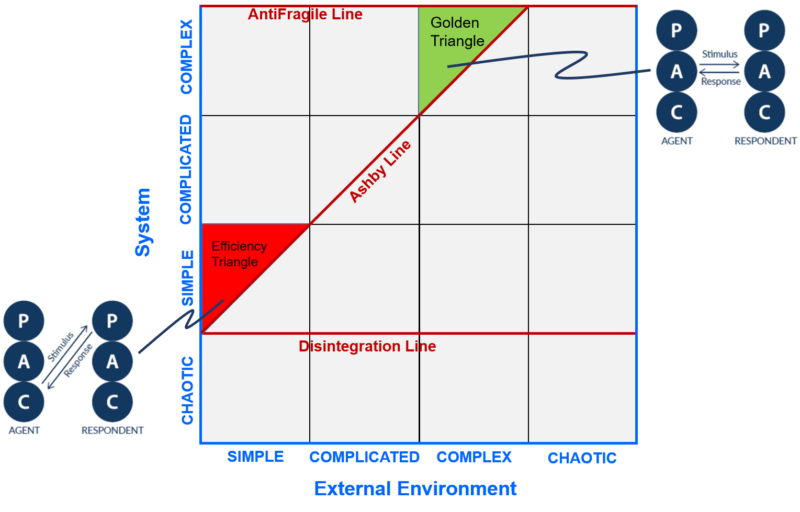
The Golden Triangle is a place built on transparency and trust. It’s a place where everyone understands there are crappy jobs that need to be done (‘clear your mess at the end of the day’), and that the best way to get them done is make sure everyone knows why tidy is good, shares the crappy load equitably, calls out freeloaders, and, perhaps most important of all, avoids the temptation to descend back into a Parent-Child world of stick-wielding tidy-police and increasingly resentful passive-aggression.
Agony Aunt TRIZ?

By my estimate, over 80% of the Systematic Innovation work we did last year related to what I think of as ‘business innovation’. Which in reality usually meant ‘people innovation’. Developing breakthrough technical solutions is now by far and away the easiest part of almost any innovation project. The real difficulties only begin to appear when people are asked to change from what they’re currently doing to what’s needed. People love change. They hate being changed.

Which sounds like a contradiction. And, surprise, surprise, the vast majority of ‘people innovation’ challenges also involve contradictions. Hence the reason for the big leap in ‘intangible’ related parameters in the third edition of the Business Contradiction Matrix.

The biggest challenge populating the tool has been finding a critical mass of real-world case studies to reverse engineer. The business literature has been a primary source of information, but when it comes to conflict situations at the personal level, the well is mostly dry. In true, ‘someone, somewhere already solved your problem’ fashion, we’ve long speculated on the rich outpourings of the world’s agony aunts and uncles. In a world where almost every newspaper or magazine includes a daily personal advice story, theoretically it shouldn’t take long to be able to accumulate tens of thousands of stories. In practice of course, the moment we find ourselves talking about humans, we’re also talking about complexity. Which in turn means that any agony aunt/uncle takes a tightrope walk as far as being able to offer meaningful advice to a correspondent that has probably only supplied a couple of paragraphs of background information. Couple that with the even bigger problem that once the aunt or uncle has dispensed their sage advice to said correspondent, the loop rarely if ever gets closed. Meaning that the efficacy of their advice remains largely unknown and unknowable.

This latter problem has ultimately been the one that caused us to shy away from the whole agony domain. Well, that plus the fact that most of us are engineers and therefore assumed to be somewhere along the autistic spectrum. Usually, in my own case, at the non-empathic end.

Anyway, a year and a half of lockdown ends up having an impact, one of which being what feels like an explosion in the number of people seeking advice, another being that I’ve now read enough of said ‘advice’ to recognise the whole agony aunt & uncle game is largely, like large parts of the psychiatry/psychotherapy world, a quasi-scientific sham. We might not be able to close the loop on the efficacy of agony-relieving advice, but we can at least take a heap of randomness out of the advice being dispensed to the lost, lonely and confused.

So, by way of a brief taster of what’s to come, here’s a small example from one of the less sensationalist of the agony aunt’s working in the UK today, Annalisa Barbieri from the Guardian, and the latest of her weekly ‘Family Ask’ columns (Saturday, June 19 – https://www.theguardian.com/lifeandstyle/2021/jun/18/disinvite-unsupportive-family-from-my-wedding).

The gist of this week’s contradiction is as follows:

“My partner and I are getting married this summer. It is a small wedding, and I have invited my mum and siblings. However, most of my family members are not supportive of my relationship… My partner and I are worried about how they might behave at the wedding, but I am concerned that disinviting them would be seen as aggressive… I feel torn: I don’t want to deepen the rift that exists, but at the same time I don’t want their behaviour to ruin our wedding.”

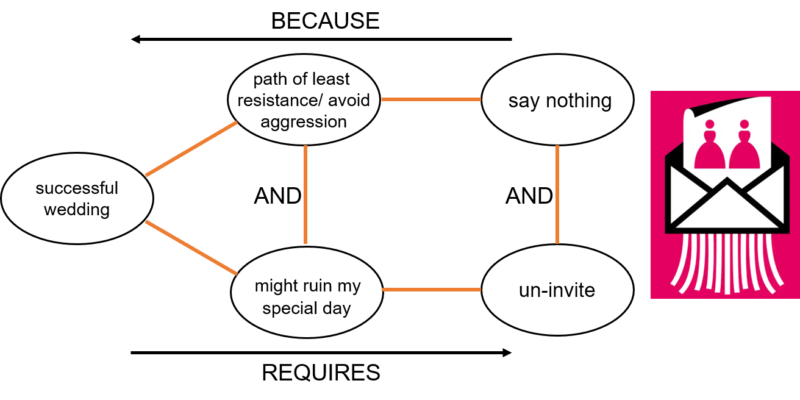
All in all, a fairly clear contradiction: should the worried bride-to-be un-invite her relations from the wedding, or allow them to potentially show-up and disrupt proceedings. Here’s what the problem looks like when mapped onto a Bubble Map:

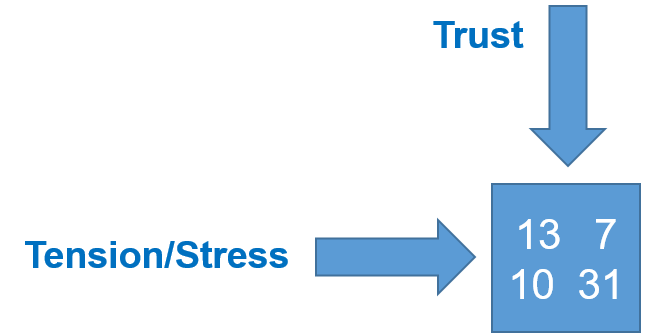
As far as the Matrix is concerned at this point, the big idea is that the bride to be is not the only person in the world seeking to avoid aggression and crossing their fingers and trusting that the invited relatives won’t disrupt the day. The conflict, in Matrix terms, is a classic tension/stress versus trust conflict pair. For which the Matrix tells us the most frequently used contradiction-solving strategies are:

Which, when I look at Ms Barbieri’s advice (or rather psychotherapist, Henry Adeane, who she asked to tackle the problem) seems to fit rather well.

The main crux of that advice makes for an elegant illustration of Inventive Principle 10, Preliminary Action – or ‘do something in advance’:

“… inviting your mum and the difficult sibling to a meal, “somewhere neutral. Be kind and gentle but firm, and say something such as, ‘I don’t think you want to be at the wedding, and I don’t want you to be there if you’re not comfortable with my relationship and marriage.’”

Then, the follow-up, this time an on-the-money illustration of Principle 31, ‘Pause’:

“…looking at the way you respond to what they say: if you feel peaceful and as if you’ve cleared the air, then possibly this is a goer. But if you feel tense and wrongfooted, then it’s best if you disinvite them. And, remember, it’s fine to take a day or two after the meeting to think about the way you feel and decide what to do.”

One bride-shaped swallow doesn’t make a summer of course, but we’ve now analysed enough of these types of case (one of the non-engineer member of the SI Network has been using TRIZ in marriage-guidance counselling for several years now) to see a relevance that begins to turn the quasi-science story around the other way. If the Matrix is pointing in the same directions as the psychotherapists, and is based on cases where we have been able to close the loop (so we know the directions have delivered success in business settings), does that mean it becomes the ‘evidence-based’ data that the psychotherapists always want but have never thus far had? It’s probably a long road ahead, but there’s no better time to embark on long roads than times of crisis. Like the pandemic-driven mental-health tsunami heading our way.

S-Curves & Risk

Risk. It’s not rocket science, but it might just as well be, given how badly it is managed in most organisations. We’re talking about another key difference between Red World and Green World here. The difference between Operational Excellence thinking and the Innovator’s Mindset. The difference between systems at the mature end of their S-curve and those still at the beginning. The difference between working assumptions that glasses are half full or half empty.

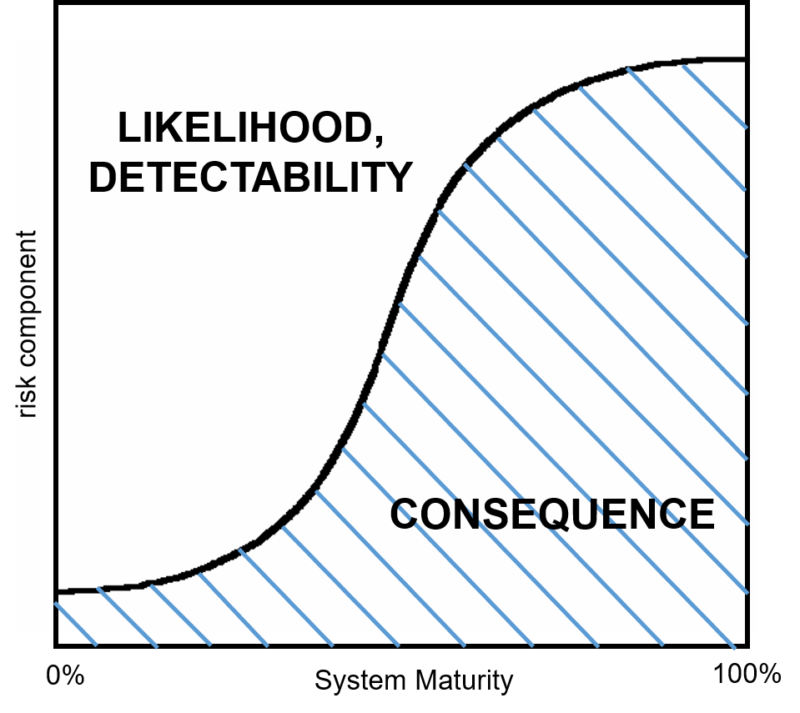
There are various ways to calculate risk, but likely the most effective one incorporates measures of the likelihood of an event happening, the consequences if it does, and the difficulty of detecting the arrival of the event. The level of these three factors changes quite significantly as a system travels along its s-curve. The general pattern looks something like this:

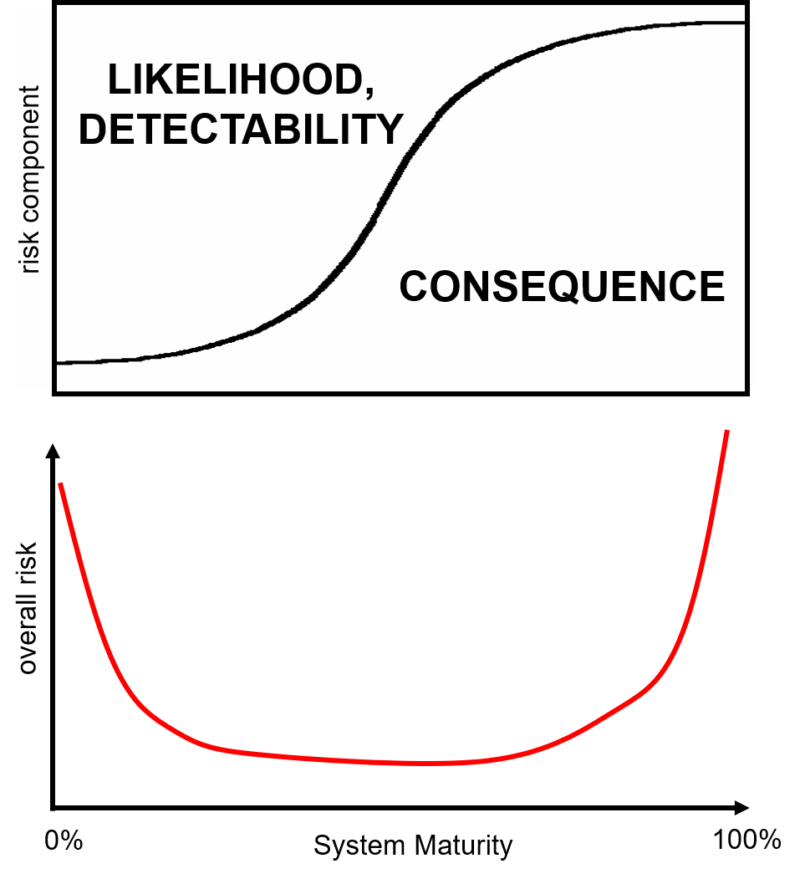
At the immature end of the s-curve the likelihood and detectability of risk events tend to be at their highest, while the consequences are at their lowest. Then, as a system matures, the situations get reversed, such that, by the time the system has plateaued at the top of the curve and all of the associated operational excellence related checks and balances are in place, the likelihood of adverse events has reached a minimum and there are procedures in place to track and trace all the myriad ‘known knowns’. The converse problem is that the few remaining ‘unknowns’ (think ‘black swans’) become progressively more difficult to detect, and at the same time, because the system has been optimised to the end of a dead-end road, the consequences when something does go wrong are potentially catastrophic.

We could see this vividly in mature, top-of-s-curve, operationally excellent enterprises deploying just-in-time supply chains at the start of the Covid-19 pandemic. We can also see it in society at large, where we also have a global ‘system’ at the top of its s-curve.

The problem at both ends of this size spectrum is ultimately the same: that the overall risk, when we integrate likelihood, consequence and detectability together gives a classic bath-tub curve profile. Something like this:

Which is probably another reason why this is the time for innovation. Or, better yet, systematic innovation.  

The Glass Parapet?

Stock sentence of 2021: ‘intellectually, people get-it, but when it comes to reality, they don’t’. Case in point – contradictions and contradiction solving. I spend several days with a group, at the end of which almost everyone is sick to death of me hammering them over the head with the c-word. They get it. Then I see them a month later, and people are still asking either/or questions, beating their heads against walls, still be going around in circles, moving their trade-offs from one place to another, and wondering why nothing is getting better.

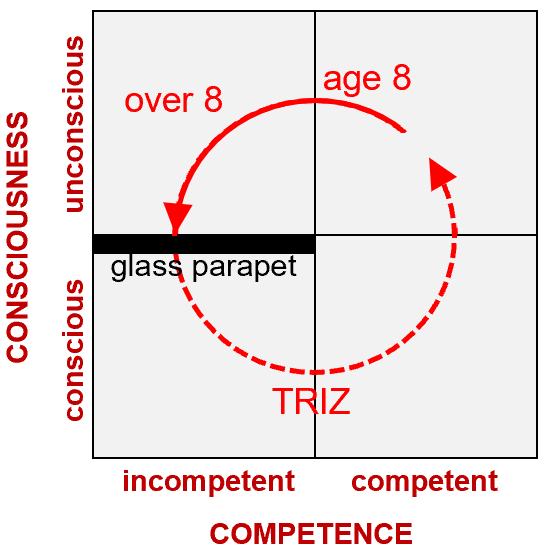
These are the times I kind of wish everyone in the sessions was still eight-years old. Eight is the age when we’re generally considered to be ‘at our most creative’. Latterly, I’ve come to realise what that really means is that when we’re eight, we still think that everything is possible. Contradiction-wise, in other words, eight year-olds are unconsciously competent. They don’t understand what a contradiction is, so they haven’t yet intellectualised the (erroneous) thought that they can’t be solved.

Alas, everything that happens to us after the age of eight teaches us that ‘impossible’ is everywhere. And that it dominates everything. This is how the real world works we get taught. You can’t have your cake and eat it. We all have to make compromises. Progress is trade-offs. After eight, we shift from contradiction-blind to contradiction-bound. And, irony of ironies, we shift from being unconsciously competent to being unconsciously incompetent. Needless to say, this is rarely a good place to be. Especially when we find ourselves surrounded by a world full of populist politicians who not only exhibit the trait, but also extol it’s virtues.

Probably best to not dwell on that thought too long.

It’s probably too late for politicians. More productive to think about ways of getting a critical mass of actual humans out of the unconscious-incompetence quadrant and into the scary-place called conscious incompetence. A place that has traditionally been fairly easy to hide from. Contradiction-wise, for the last forty years, it has been relatively easy to hide behind the parapet. Far easier to keep our heads down and do the ‘continuous improvement’ optimisation work Japanese manufacturers taught us all was important back in the 70s. Except, we now know that it’s not possible to continuously improve for ever. Sooner or later, a pandemic comes along and shows us the error of our ways. Continuously improving your way along a dead-end road isn’t nearly so much fun when your nose ends up pressed against a mile-high, million-tonne parapet with a ‘no further’ signing hanging off the crenellations, and there are thousands of people still pushing you forward.

They say change only happens when there’s chaos. A fact Steve Bannon and his nut-job cronies were all banking on. A fact that, I suspect, the puppet-master pulling Bojo The Clown’s strings are still kind of banking on. Chaos happens, more and more people are beginning to see, because we’re all very, very visibly incompetent.

We’re able to intellectualise ‘win-win’ solutions, but we don’t know what they feel like in reality. Or how to make them happen. Everything we’ve been taught is wrong. Literally wrong.

The million-tonne parapet is transparent. That’s what everyone that bravely makes the leap into conscious incompetence is able to look back and see. A mile high wall of pressed noses hiding behind a wall they can’t see is transparent.

No-one likes being wrong. Innovator’s, however, have learned that being wrong is an essential part of the process. And that it’s okay to be conscious of your incompetence. The pain that comes with that knowledge is the pain that drives you forward to try and become less incompetent. It’s the pain, too, that eventually brings the realisation that true progress starts with finding contradictions and continues by then persisting until they’re solved. This is the main learning of TRIZ. Or the Theory Of Constraints. Or Edward De Bono’s parallel thinking. Learnings that, until now, most people have filed away in the ‘intellectual-curiosities’ part of their brain.

Now, though, is the time to stop hiding behind the parapet. Those that have admitted their contradiction-incompetence can see you. They’re waving to you. Beckoning. ‘This way,’ they’re miming, ‘don’t worry, it’s not so bad. All you have to do is remember back to when you were eight. Impossible was nothing back then. And it can be again. All we need to do is tap into the knowledge of those that passed through contradiction-incompetence before us. Those brave souls that now realise, whatever the contradiction, someone, somewhere already solved it. Someone that became consciously contradiction competent. And maybe then went one step further and used that competence often enough to re-train their instincts sufficiently to make it unconscious again. Like when we were eight. Only now with the added ability to distinguish the genuine breakthroughs from the currently impossible.

Non-Flying Colours

Once in a while I find myself building a model to help explain an idea or principle to a client. The emphasis in these situations is usually to build something quickly. Which in turn usually means not worrying too much about consistency with other spur-of-the-moment models. Most of the time this works out okay. Sometimes a model takes on a life of its own and finds its way into the language with several different clients. For some reason its often the colour aspect of the models that helps with its spread. And that’s where things can easily start to turn out not okay.

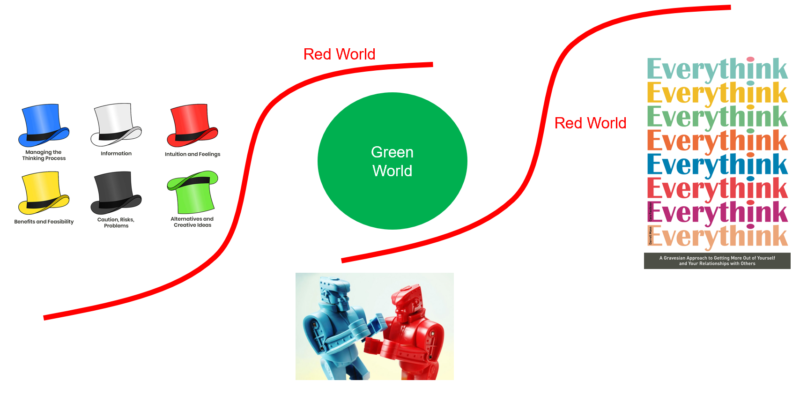
The most recent series of colour clashes have come through the Red-World/Green-World discussion I started in the wake of the Innovation Capability Maturity Model book. An attempt to get people to recognise that Operational Excellence (‘Red World’) and Innovation (‘Green World’) are polar opposites. After I’d decided I needed a model to compare and contrast the two Worlds, I spent about 5 minutes thinking about the best colours to characterise them. The logic behind the use of green was, a) green is the colour of the ‘creativity’ Hat in Edward DeBono’s Six Thinking Hats model, and, b) green is the colour of the Systematic Innovation logo. Having chosen green, and recognising that I needed a second colour to describe green’s polar opposite, I went to the colour wheel and, hey presto, red was that colour. Decision made.

Spool the clock forward a couple of years and the colours of the different Value Systems in the Everythink book also started to connect with a number of clients. Which meant the arrival of questions like, ‘is the green of Green World the same as the Communitarian green found in Everythink?’ To which the answer, sadly, is no it isn’t.

Then someone else hears me talking about the Intel-initiated, only-the-paranoid-survive idea of companies comprising a Red Team and a Blue Team. The Blue Team being the majority of people in the existing business, and the Red Team being a small group of lateral thinkers whose job was to try and find ways to put the Blue Team out of business. Now the colour problem becomes much worse. Now I find myself describing how Blue Team lives in Red World and Red Team lives in Green World. And, worse again, that Red Team people in Green World will work best if they they’re thinking with the Yellow value system. It was only small consolation to then be able to say that they should be wearing Green Hats most of the time.

Act in haste, repent at leisure.

Innovator’s live in Green World, wear Green (and sometimes Black – like baddies) Hats, have Yellow value-systems and one of their roles is to act as a Red Team.

Operational Excellence workers live in a Red World, wear mainly White Hats (like goodies), ideally have Blue value-systems and are Blue Team.

Not that it helps an awful lot, but if I had my time again I’d re-label Red-World and Green World as, respectively, Blue World and Yellow World. That way at least there’d be a consistency between ICMM and Everythink. And that would then just leave the tiny inconvenience of having companies like Intel and people like Edward DeBono in the world. Messing things up as usual. With their Purple ways.

Innovation Alphabet

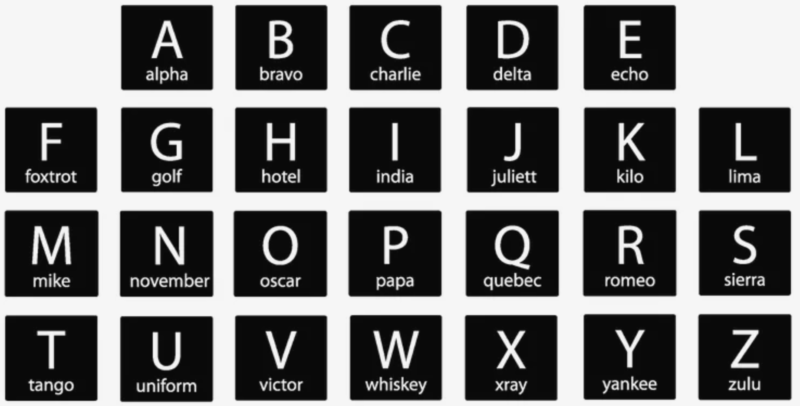
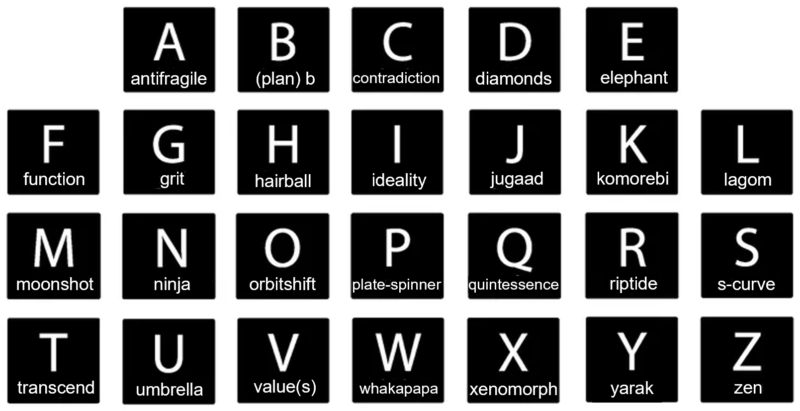
In this month’s SI ezine (http://systematic-innovation.com/assets/iss-229-apr-21.pdf) I introduce the seven habits of highly effective innovation project manager acronym, NEPTUNE. Navigator, Empath, Plate-spinner, Transcender, Umbrella, Ninja, Umbrella. It sounded like a weird distorted version of the NATO phonetic alphabet. Which then made me wonder whether it might be possible to make a whole alphabet of similar innovation-relevant words. Here’s the long list of candidate words I managed to compile:

A AntiFragile/Autonomy/Altshuller

B Belonging/PlanB

C Contradiction/Competence/Chutzpah/Cockroach/Cybernaut

D Diamonds (Diverge-Converge)/Duende/Disrupt/Diversity

E Empath/Elephant/Emergence

F Function

G Grit

H Hairball/Hero’sJourney

I Ideality/IFR

J Jugaad/Jazz

K Komorebi

L Leapfrog/Lagom

M Moonshot/Meaning

N Navigator/Ninja

O Outcome/Orbit-Shift

P Plate-Spinner/PlanB/Pirate

Q Quintessence

R Riptide

S System/SkinInTheGame/S-Curve

T Transcender/Tipping-Point/TRIZ/Turtles/10x

U Uniter/Umbrella

V Value(s)

W Whakapapa

X Xenomorph/X-Factor

Y Yarak

Z Zen

Hopefully, most of the words are self-explanatory. The NEPTUNE ones get explained in the aforementioned Seven Habits article. Here are the ones that perhaps need a little more explanation:

Hairball: from Orbiting The Giant Hairball, an off-beat innovation classic text. Subtitle: ‘a corporate fool’s guide to surviving with grace.’

Jazz: if operational excellence looks like an orchestra playing a score, innovation is a jazz combo improvising.

Jugaad: a colloquial Indian word, referring to a non-conventional, frugal innovation, often termed a “hack”. It could also refer to an innovative fix or a simple work-around, a solution that bends the rules, or a resource that can be used in such a way. Indicative of the perennial innovator drive to obtain the maximum amount of learning from the minimum amount of resource.

Komorebi: a word I first learned in Peter Fisk’s recent book, Business Recoded. Picture a hot sunny day, lying in the shade, and seeing the few streaks of light hitting the grass through the branches of a leafy tree. That’s the perfect place to be during the Japanese summer: komorebi. Like Ideal Final Result only more poetic.

Lagom: one of Sweden’s three great contributions to the English language (the other two being smorgasbord and ombudsman :)), lagom translates to “not too little, not too much” or “just right”—and in Sweden it represents the art of living a balanced, slower, fuss-free life. The first time I heard the word defined, I was told a story of warriors sitting around the dinner table passing around a bowl of stew and lagom was the uncanny ability of each person to know how to take just the right amount to ensure that all the other warriors would get their fair share. Which still feels like a good metaphor for what needs to happen inside any innovation team.  

Quintessence: the most rich and best example of something. The perfect embodiment. Another IFR end-goal pointer.

Riptide: defined in the dictionary as either a dangerous area of strongly moving water in the sea, where two or more currents meet, or a strong negative feeling or force that is difficult to control, riptide felt like a useful metap

Whakapapa: a Maori word defined as the “genealogical descent of all living things from the gods to the present time. “Since all living things including rocks and mountains are believed to possess whakapapa, it is further defined as “a basis for the organisation of knowledge in the respect of the creation and development of all things”. Whakapapa also implies a deep connection to land and the roots of one’s ancestry, and the idea of leaving a great legacy: ‘plant trees you’ll never see by being a good ancestor.’ Another word from Peter Fisk’s book, Business Recoded.

Xenomorph – not necessarily a real word, but used post movie franchise, Alien, to describe the Alien, ‘a highly aggressive endoparasitoid extraterrestrial species’. The Xenomorphs are vicious predatory creatures with no higher goals than the propagation of their species and the destruction of any life that could pose a threat to them. Not quite a perfect metaphor. Except for the bit about protecting their own and the ability to morph into different forms at different life stages. This is the word I think I’d be most likely to vote into any NATO suggestion scheme to change the classic phonetic alphabet.

Yarak’ – a Persian falconry term meaning ‘super-alert’, hungry-but-not-weak, and ready to hunt. Without this kind of mindset and these characteristics, in a critical mass of its people, a business will not succeed. Discussed at some length in the Hero’s Start-Up Journey book.

Zen – the parallel need for calm, mindfulness and a beginner’s mind.

And so, finally, here’s the proposed short-list…

Great Art, Bad Plumbing

A friend told me a story the other day. I don’t know whether it is correct or not. If it turns out to be apocryphal, I suspect it won’t affect the truth the story contains.

The story involves a Liberal Arts professor at a prestigious university. The professor tells his students that every student in the class will receive the same mark for their assignments. The mark being calculated by taking the average of each of the individual assignment scores.

In the first assignment everyone received an A. In the second, the average mark went down to a B. In the third assignment, everyone received a C-. The fourth assignment, everyone failed.

At first blush the story offers up what looks like an iconic example of how socialism quickly devolves to the lowest common denominator. When it comes to rewards, humans tend to care most about what they get relative to others, rather than absolutes. So, I’m okay with less provided that my neighbour is getting even less than me. Or, taking into account the fact that we all tend to be pain-avoiding before pleasure-seeking, I tend to be not okay if my neighbour is visibly doing better than me. Combine this relative-envy factor with the fact humans also tend to be lazy, and it doesn’t take long before everything combines into an exponential race to the bottom.

The only alternative, the political right and capitalists tell us, is competition. Competition, they say, creates a race to the top.

Or at least that’s what the theory predicts. Except, humans are still lazy, and so the road to the top quickly becomes hierarchy-shaped. Which means society makes a different kind of exponential shift, this time with 1% at the top of the pile and the other 99% scraping a living on zero-hours contracts and feeling they would have been better off in the socialist system. A system where, if nothing else, they wouldn’t have to stand outside the gates, looking at the rich coiffing champagne in their Mcmansions.

All this, of course, is just another example of weak, two-dimensional left-versus-right thinking. Those on the right might rub their hands with glee hearing the Liberal Arts professor story. And they might be right, but not for the reasons they think.

The archetypal socialist race-to-the-bottom doesn’t happen just because humans are lazy and envious. It also happens because the majority of tasks that modern life expects from us are essentially meaningless Mcjobs. And somewhere near the all-time top of the list of meaningless McJobs is the liberal arts assignment. Had the assignments been relevant to anything other than the professor’s blinkered ego, students might have ignored the fact that their best efforts would not score them a good grade and worked hard. Combine socialist measures and meaningless work, however, and students quickly work out there really is no point in trying at all.

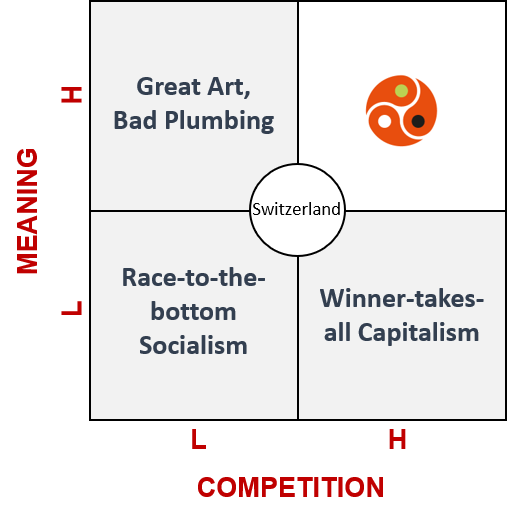
The missing third-way dimension in the left-right spectrum is meaning. Or almost. Add meaning to socialism and, while we might slow the race to the bottom, we don’t get utopia either. Instead, we get great art and bad plumbing.

Which leaves the competition-and-meaning combination. While that inevitably won’t be perfect either, it would at least help cure the corrosive, post-truth, every-man-for-himself version of capitalism we now see in too many parts of the world. And it would, too, likely serve as the step-change to society’s next, right direction, s-curve.

Sense-Pause-Respond

Time was, when something or someone pissed you off, you’d come home and vent about it to an amenable member of your family. Or the cat. Half the time they’d help you to realise you were being over-sensitive, you didn’t know what you were talking about, and that you needed to grow-up and move on. The other half, the moment you heard yourself spouting the ill-formed, angry, frustrated words left your lips, you realised you didn’t need them to tell you. You worked it out for yourself. Either way, problem over.

Now, however, five seconds after the pissed-off event, everyone is on social media spouting those self-same ill-formed, angry, frustrated words. Only now to a couple of hundred anger-by-proxy seeking followers. Rinse and repeat a few hundred times, and there’s democracy dead and gone.

‘Russian bots’ might help reduce the number of iterations from 450 to 440 but they’re really just noise in the exponential dysfunction caused by the Social Media industry’s share-of-mind addiction. Bad news travels seven times faster than good (Microsoft Word – dec03 newsletter.doc (systematic-innovation.com), it is seven times more likely to be re-tweeted, and is at least seven times more likely to be Tweeted in the first place.

The root of the problem is trying to do in public what would normally happen in private. In private, being face to face with a logical, kind-of-rational family member (or cat) helps you count to ten, allows the anger-chemicals drowning out your common sense to drain away, and enables you to start to think kind-of-rationally again: maybe I was being a dick? Maybe I could’ve handled it better?

This is the way society used to function. The pause between stimulus and response. The pause that gave democracy a chance.

24 Rules For (Two) Life (Systems)

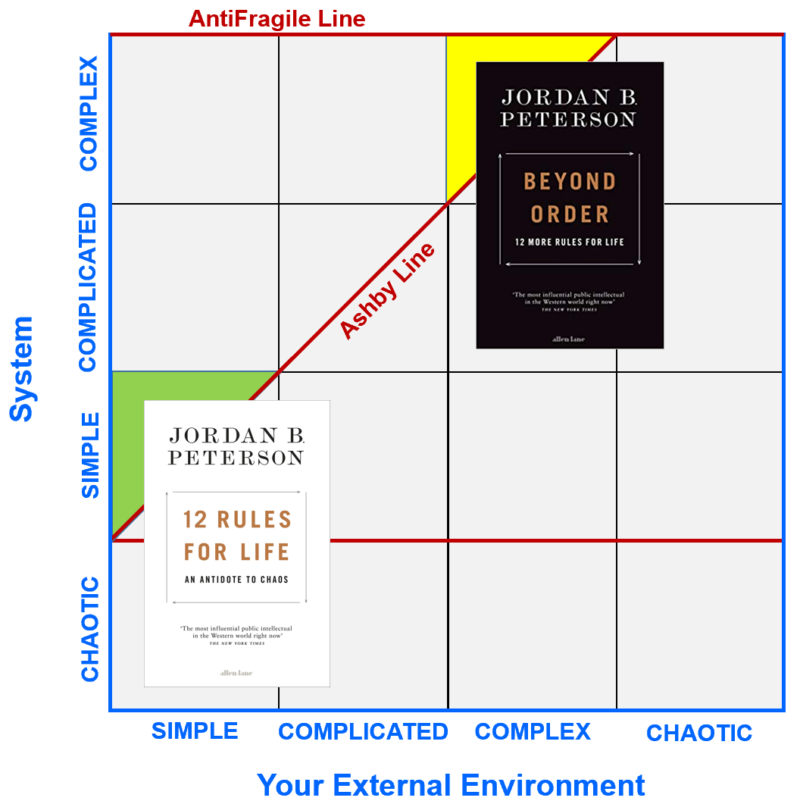
So, the new Jordan Peterson book is out. Beyond Order, ’12 More Rules For Life’ a complement to his original 12 Rules For Life. The main difference this time around being that the focus is on Rules for becoming a human capable of surviving in complex and chaotic environments. As opposed to the first 12 Rules, which were all about becoming a human capable of living resiliently in a Simple world – i.e. it was largely for Feudal Millennials that had never been taught some of the difficult lessons of life. Like tidying up their room.

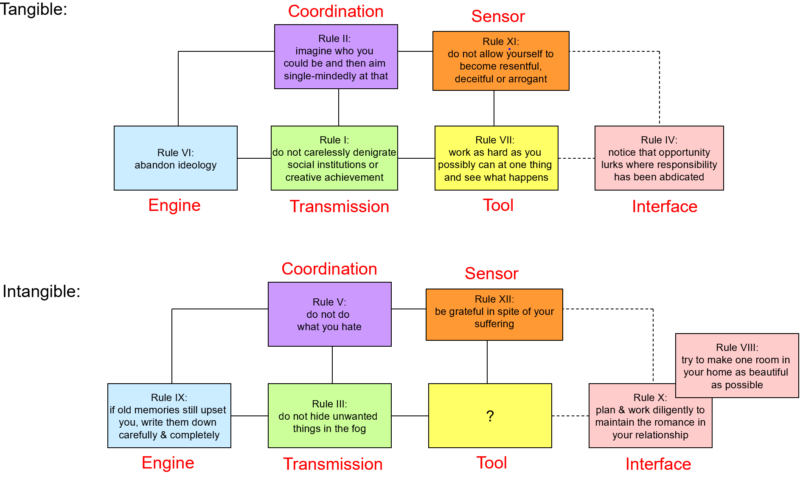
Anyway, the pair of books fit into two of the most important triangles in our Complexity Landscape Model (CLM). The first 12 Rules in effect being all about (steady-state) Operational Excellence, and the second 12 being about (liminal) Innovation World:

As I got further through the new book, I began to realise that there was a further innovation connection to be made. Specifically the Law Of System Completeness. Which tells us that any viable system must contain a minimum of six different elements. And since ‘being a human’ involves a system, that system must contain these six elements. Or rather two times six – one viable Tangible system and one viable Intangible system. Which, if my maths is anywhere up to scratch suggests twelve system elements in all. The question then was, was this something Peterson was aware of?

Time to start fitting his 12 Beyond Order Rules into the Law of System Completeness. The end result of which looks something like this:

(As Peterson-fans will attest, some of his Rule titles are a little obtuse and their connection to the various elements of the complete system only become clear through a proper reading of the relevant chapter. If you’ve already read the book, and have a passing acquaintance with the Law Of System Completeness, I imagine you will be able to make the same connections that I have. If you haven’t read Beyond Order, you’re going to have to take my word for it. And if you’re not familiar with the TRIZ Law Of System Completeness, you may want to hum the bits you don’t understand.)

According to Peterson, the 12 new Rules found in Beyond Order were distilled down from an original list of 42 (life, the universe and everything?) There’s no real explanation for how this process was conducted, but my impression is that he ended up with the twelve that had most frequently helped patients in his clinical psychology practice. There was, in other words, no attempt on his part to create any kind of coherent system of Rules. The fact that he ends up with eleven of the twelve that the Law Of System Completeness would have told him to go look for, therefore, is rather impressive.

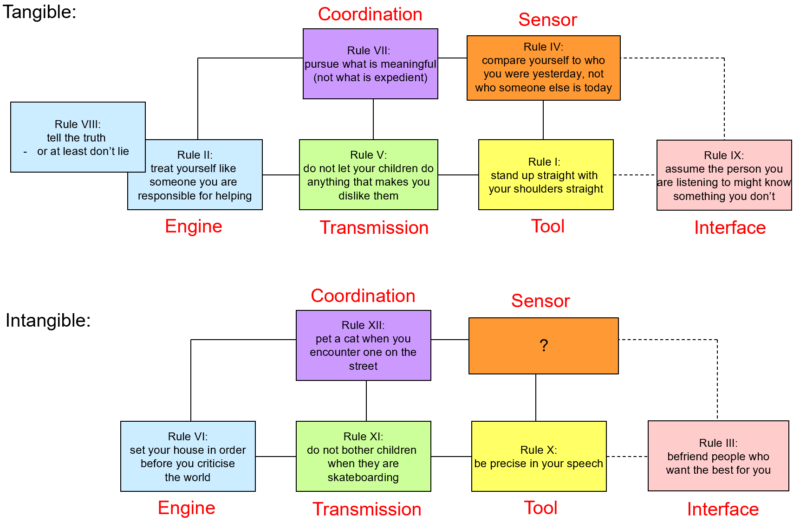
Impressive enough to go back and re-visit the initial 12 Rules to see how well he’d done to map the complete system of Simple-Simple humanity. Here’s the result of doing that analysis (where, again, it was necessary to go back and re-read the whole thing in order to translate the obtuse rule names into their intended meaning – ‘petting cats’ for example doesn’t have an awful lot to do with petting cats, but quite a lot to do with human fragility):

Another impressive eleven-out-of-twelve score.

Close enough on both counts for me to start thinking about what the two ‘missing’ Rules might be. While I think I can do obtuse titles, I quickly found myself out of my depth in terms to coming up with something either pithy or meaningful. Which then usually means adopting the classic TRIZ stance of ‘someone, somewhere already solved your problem’. Were there other books, in other words, that might be able to slot into Peterson’s holes?

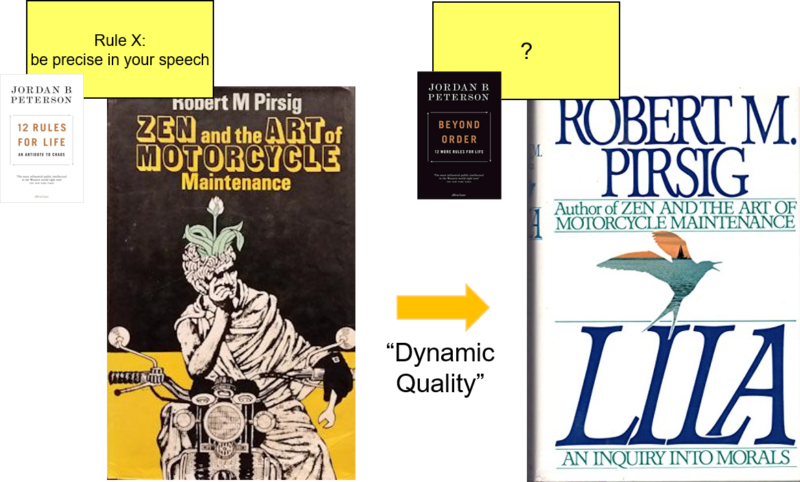
The Law of System Completeness offers some clues of course. As far as Beyond Order is concerned, Peterson doesn’t have a Rule to cover the Intangible ‘Tool’ part of the system. In the first book he did, and as I was re-reading that Rule, ‘be precise in your speech’, the best connection I could make to other works was my second all-time favourite book, Zen & The Art of Motorcycle Maintenance. The thrust of that book was (a metaphysics of) Quality. Pirsig extends this discussion in his follow-on, and my all time favourite book, Lila: An Inquiry Into Morals. The extension primarily centring around ‘dynamic quality’… what I firmly believe forms the missing piece in the Beyond Order jigsaw:

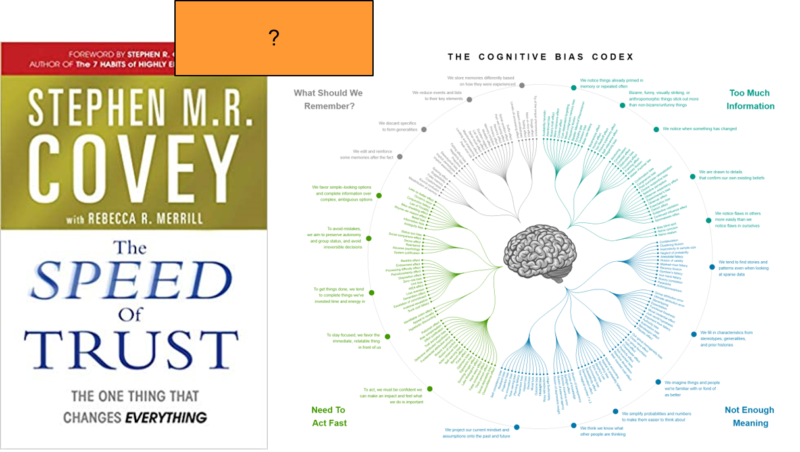
The Law of System Completeness also offers up clues as to the missing piece in Peterson’s first 12 Rules – the Intangible ‘Sensor’ is what needs to be found. Which means we’re in the realms of measurements and feedback loops as they pertain to the emotional aspects of our steady-state human ‘system’. In this case I wasn’t able to find a single solution to fill in the gap. The ‘character’ aspects of Steven M.R. Covey’s book ‘The Speed Of Trust’ seemed to capture some of the Sensor story, but missed much of what I see as the most frequent (mis)understanding problems that occur in human communication, biases. These days, mention of that word usually sends me immediately digging out the Bias Codex (https://www.darrellmann.com/cognitive-biases-as-a-system/). And there it was, Peterson’s 12 Rules For Life missing piece was two pieces…

…unless, that is, you know different?

The Laws Of Meaning I-III

More and more people seem to be coming to the conclusion that The Sovereign Individual book has played a significant behind-the-scenes role in the way the Brexit story has played out (https://alastaircampbell.org/2020/12/the-brexit-revolutionaries-have-barely-begun-britain-needs-to-wake-up-fast/). At the very least, the book does much to explain some of the more counter-intuitive moves of those implementing the strategy. In that sense it has much in common with other late-period Capitalist thinking. The most recent of which to cross my radar came from the (notorious?) Babson College, its commercial offshoot, Babson Global, and its Babson Global Competitiveness and Enterprise Development Project. Which, Babson Global CEO, Shahid Ansari has said, ‘gives us another powerful tool to use entrepreneurial thought and action to address the economic and social problems facing the world and allow individuals and societies to thrive and prosper during these challenging economic times’.

Going a step further, “There is simply no greater challenge faced by mankind than helping to lift people out of poverty and frame a world of abundance, and not of scarcity,” said Shanker Singham, Managing Director of the CED Project. “By leveraging the forces of the competitive market system, as opposed to relying on aid, the Babson Global Competitiveness and Enterprise Development Project seeks to identify new ways of delivering economic growth to countries around the world.”

The Babson worldview represents classic Gravesian, ER, Orange thinking. Which looks at a DQ, Blue world of fairness and use of state-aid to ‘help’ those at the bottom of society and concludes that such things fundamentally don’t work. And that they don’t work for two reasons. Firstly, at an individual level, they create a state of ‘learned helplessness’ that serves only to perpetuate the need for more state-aid. Secondly, at a state level, comes comes a recognition that aid comes with an inherent level of inertia, which in turn provokes corruption.  At first, the competition that capitalism sparks will very likely achieve what Babson Global is trying to achieve. The key phrase being, ‘at first’. The problem being that sooner or later the fundamental law of the s-curve kicks in. In the first half of a capitalism s-curve, we see what might be thought of as the sort of ‘good capitalism’ the Babson Enterprise Project is trying to spark. In the second half, however, when the law of diminishing returns kicks in, good capitalism turns inherently bad. It’s one thing to introduce the developing world into this new world of capitalism, but, sadly, most parts of the developed world are already well into the bad second-half of the curve. A second half that means, fundamental human nature being what it is, capitalists start their own version of cheating and corrupting the system. This cheating, unlike the DQ version, usually comes in the form of ‘externalisation’. Businesses that produce toxic side-effects try and hide them. The gig economy – probably the definitive manifestation of bad-capitalism – tricks individuals into believing they’ve been offered ‘freedom’, when in fact they’ve been turned into little more than indentured slaves. Anything that can’t be measured or generates problems that only become apparent in the long term (oestrogen-based pesticides for example) becomes grist to the short-termist bad-capitalist mill. Failing to be able to sensibly measure things like ‘quality of life’, adverse effect on mental health, etc mean they become candidates for more externalisation.

So much for global fundamentals. The answer to such top-of-s-curve challenges, however, is not to regress to the previous s-curve. Solving ER’s bad-capitalism, in other words, doesn’t happen by reverting to DQ’s bad fairness. That’s basically what was attempted in the aftermath of the GFC. The capitalists demonstrated that de-regulation gave them the perfect opportunity to ‘externalise’ a whole bunch of things they shouldn’t have been allowed to externalise. But trying to fix the problem by creating a mountain of new (Sarbanes-Oxley, DQ) regulation merely created a worst-of-both-worlds solution. Far better would have been solving the ER and bad-capitalism contradictions and ‘breaking through’ to the next s-curve.

Perhaps the Babson work, much as it betrays their abject lack of understanding of s-curves as they might apply to societal progress, does make some kind of attempt to distill the world down to first principles. At least in a Newtonian sense.

Here is Shanker Singham’s capitalist version of Newton’s Laws:

  1. Wealth can be created or destroyed.
  2. Wealth is easier to destroy than create
  3. Competition is the greatest force for liberating wealth-creating forces

If we now bring the idea of societal s-curves into this story, we might speculate that the next s-curve after DQ’s Order and ER’s Competition, has to be FS’s ‘communitarian’ paradigm. There’s no rule at this point that says the structure of any first principles of an FS-lead society have to follow the same structure as Singham’s reframing of Newton. But we do know that the FS world-view is still one that does not fully understand the innate complexities of the world. i.e. the FS world is also a Newtonian world. That knowledge, then, might cause us to at least start with a hypothesis that Singham’s structure makes for a valid set of FS-based first principles. Here’s what I think they translate to:

  1. Meaning can be created or destroyed.
  2. Meaning is easier to destroy than create.
  3. xxx is the greatest force for liberating meaning-creating forces.

The first idea being that in the FS Communitarian world, ‘meaning’ supplants Capitalist ER’s ‘wealth’.

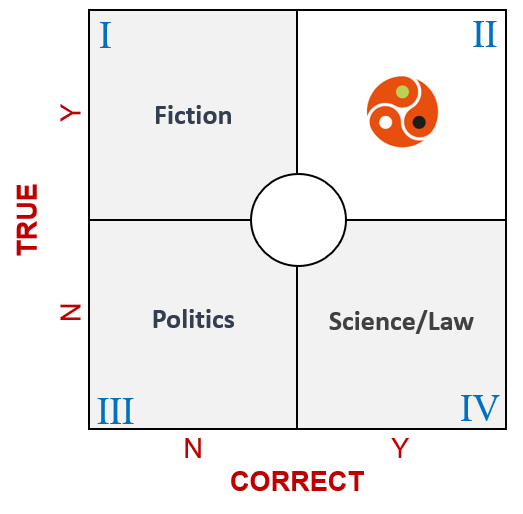
Which then just leaves the question of xxx. Competition is to wealth as xxx is to meaning. Answer? Xxx is truth. Or, more accurately, the ‘true and correct’ second Quadrant of this 2×2…

…One we’ve been using quite  bit these past few months. Maybe now we’re beginning to understand why?