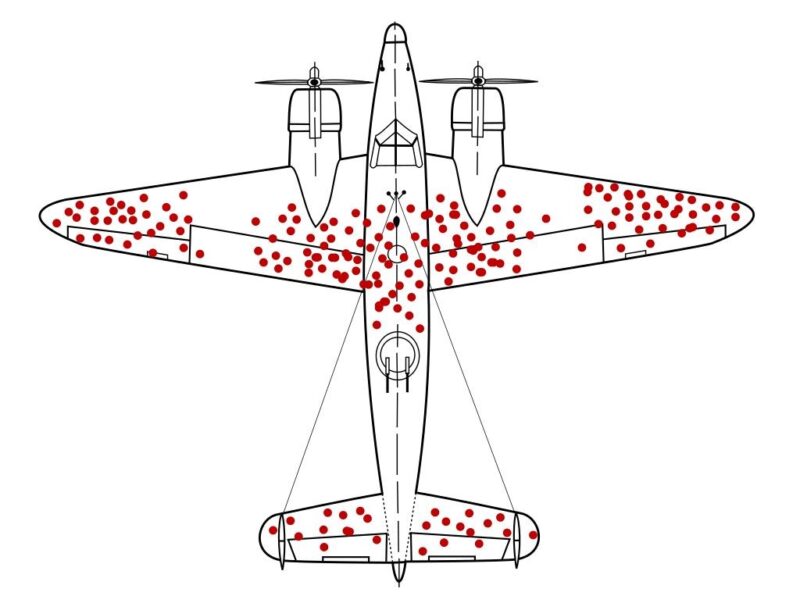
World War II. An important time for making sure your planes don’t get shot down by enemy fighters. Oftentimes, planes would return from battle covered with bullet holes. The damage wasn’t uniformly distributed across the aircraft. The data gave insight into where armour plating should be added. Adding armour, of course, comes with a significant trade-off: adding more armour made the planes less vulnerable to bullet damage, but it also makes the plane heavier, and heavier planes are less maneuverable and use more fuel. Armouring the planes too much is a problem; armouring the planes too little is a problem. So the traditional response was to find an optimum middle ground. And the bullet-holed aircraft data perhaps presented a way to manage the contradiction.
Enter mathematician, Abraham Wald. He was asked to look at the data. The Air Force was expecting to receive recommendations to strengthen the most commonly damaged parts of the planes to reduce the number that was shot down. Counter-intuitively, Wald had some rather different – contradiction-solving – advice: perhaps, he speculated, the reason certain areas of the planes weren’t covered in bullet holes was that planes that were shot in those areas did not return. This insight led to the armour being re-enforced on the parts of the plane where there were no bullet holes. A classic illustration of Inventive Principle 13, The Other Way Around.
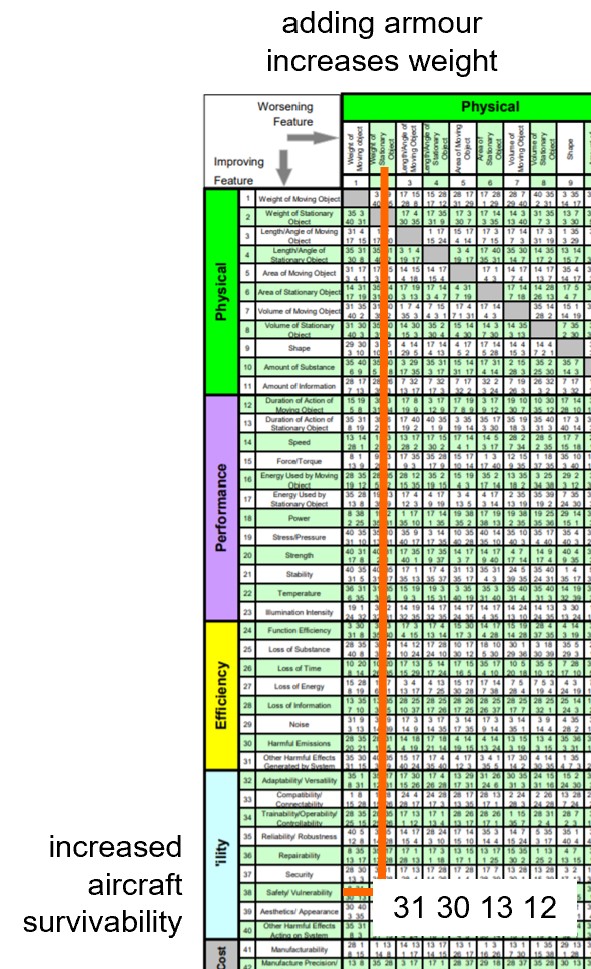
Wald didn’t have access to the Contradiction Matrix back in 1943, when his insight came to light. If he had, it would have told him something like this:
At first sight, Principle 13 is definitely a strange looking answer to a Safety-versus-Weight problem. And making best use of the strategy indeed demands a high degree of lateral thinking. What are we supposed to do the opposite of? How can we sensibly do the opposite of what the data is apparently telling us? Or, how might the missing pieces of data turn out to be more meaningful than the data we have?
“I’ve got a brilliant new strategy which is to make so many gaffes, that nobody knows which one to concentrate on… they cease to be newsworthy… completely out-general the media in that way, and they despair. And so… they leave you alone. You shell them. You pepper the media… you pepper their positions with so many gaffes that they’re confused. It’s like chaff. It’s like a helicopter throwing out chaff. And then you steal on quietly and drop your depth charges wherever you want to drop them.”
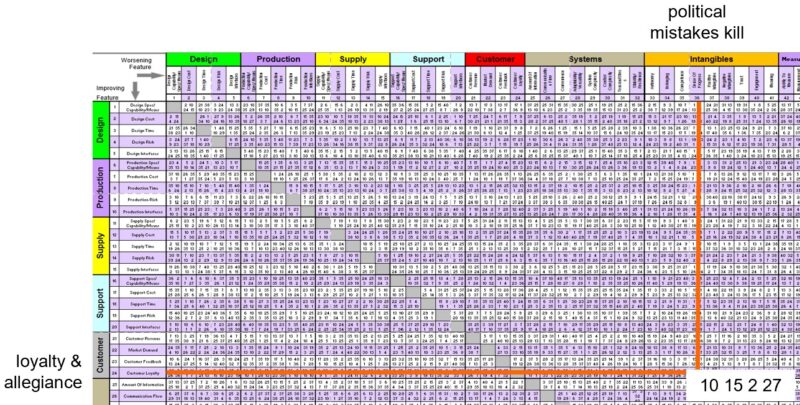
So said truth-vacuum Boris Johnson in a 2006 interview. For the first time I found myself quite impressed by the Clown. Not that I believe the chaff/error analogy was his idea. But, from a contradiction-solving perspective, it makes for a rather elegant illustration of how the Business Matrix works. Here’s how we might best map Mr Pants-on-Fire’s contradiction:
Hey presto, out comes Inventive Principle 27, ‘Cheap Disposable’. Definitely the best match to the uber-liar’s still evident ‘gaffe-chaff’ strategy.
Meanwhile, just for interest, here’s the more usual use of chaff in its defensive context:
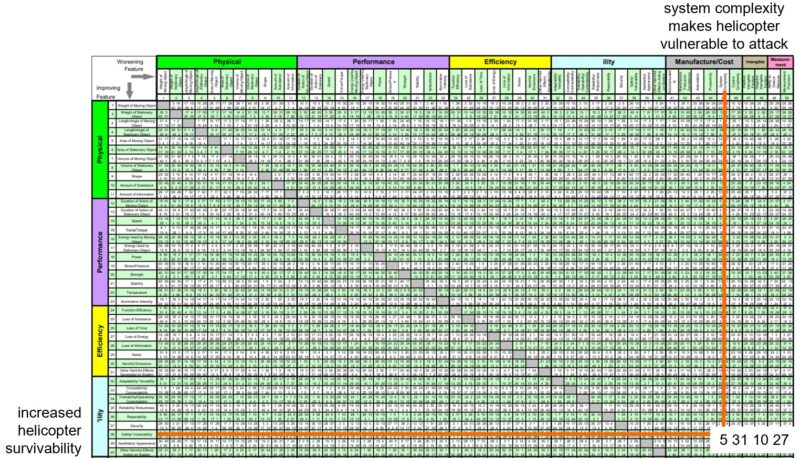
And here’s how we might best get to that solution. This time using the technical version of the Contradiction Matrix:
Not quite the same problem, but the fact that we end up with the same Principle 27 solution strategy is hopefully telling. All we need to do now is hope that Principle 2 – one of the other recommended solution strategies for the business version of the problem – will soon be on its way. Fingers crossed y’all.
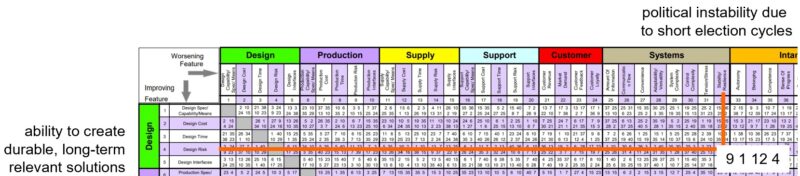
‘Democracy is the worst form of government’, Winston Churchill famously said, ‘except for all the others that have been tried’. Which is to say that, despite the fact it is currently stuck at the limits of its current capabilities, it has done a pretty good job of increasing the quality of life for a large majority of citizens. The current swathe of wobbling institutions, though, perhaps indicates that we’re not too far away from some kind of a step-change. What such a discontinuity might look like is still massively uncertain. Much less uncertain is the fact that many of the underlying contradictions are very plainly visible. One of the biggest of them is the growing mismatch between the growing imperative to build long term sustainable solutions and short election cycles. The latter forcing political parties to promote short-term, expedient vote-winning measures to help improve their chances of being re-elected. How to solve this contradiction?
Here’s what the Business version of the Contradiction Matrix has to say about the problem:
Principle 9, Prior-Counteraction doesn’t appear very often in the Matrix, and appears as the most frequently used Principle in only a handful of places. So, to see it heading the list in the Design Risk versus Stability box means we have to have collected several thousand examples of it being used to tackle the conflict. Here’s one of them: the Welsh Government’s creation of the world’s first ‘Future Commissioner’:
With a remit set out in law to be “the guardian of the interests of future generations in Wales”, Sophie Howe’s role is to provide advice to the Government and other public bodies in Wales on delivering social, economic, environmental and cultural well-being for current and future generations and assessing and reporting on how they are delivering.
Sophie took up the post in 2016 and has led high profile interventions around transport planning, education reform and climate change challenging the Government and others to demonstrate how they are taking account of future generations. Described by the Big Issue Magazine as one of the UK’s leading Changemakers, her interventions have secured fundamental changes to land use planning policy, major transport schemes and Government policy on housing – ensuring that decisions taken today are fit for the future.
Fingers-crossed they’re using TrenDNA to help decode what the future might look like. Or at least remembering that there’s a difference between long term planning and long term responsibility. That the former is largely futile, but not using it as an excuse to give up on the latter.
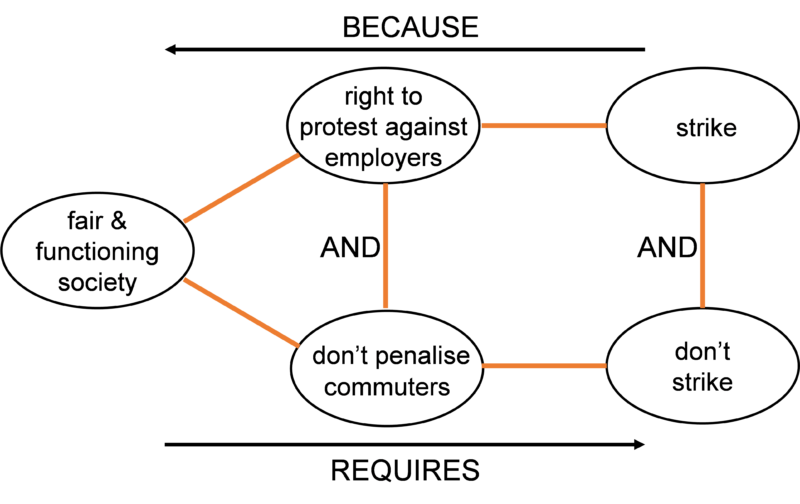
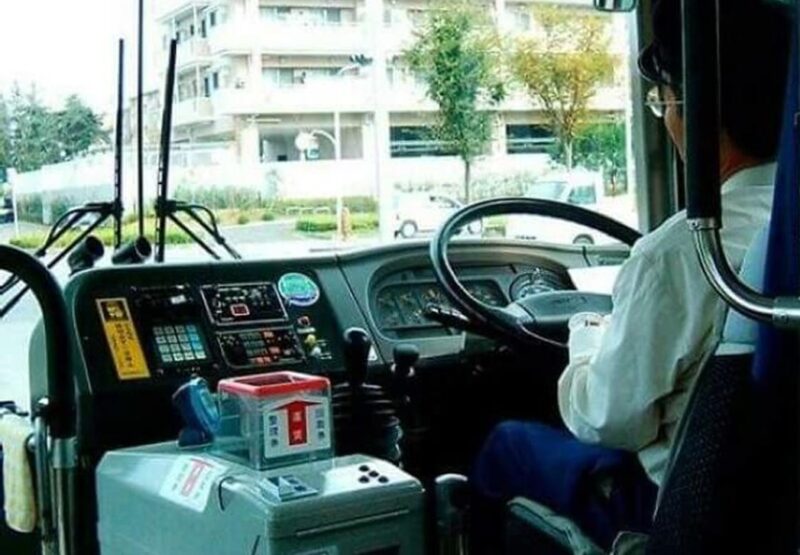
The local bus drivers are threatening to go on strike again. In a rural community like ours, when the buses aren’t running, half of the population is literally cut off from many of the basics of life. I’m sure the drivers are very apologetic when they eventually decide to come back to work. In the same way, I’m pretty certain many of the commuters are sympathetic to the drivers’ plight. That’s the way strikes work in the UK. Workers protest, customers sympathise, customers suffer. Surely, there’s a better way? A way that recognises a contradiction – we want strikes and we don’t want strikes:
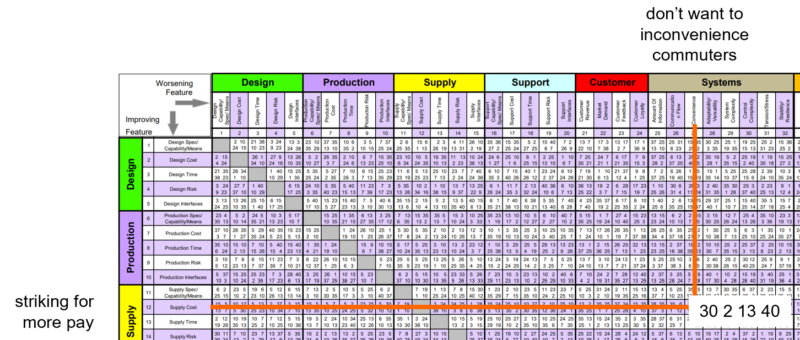
The problem can be mapped onto the Business Contradiction Matrix as a Supply Cost versus (in)Convenience conflict. Here’s what the Matrix has to say about how others have successful transcended such problems:
A lovely example of a joint Principle 2, Taking Out and Principle 13, The Other Way Around, solution to the problem can be found in Japan. Drivers continue to drive their usual routes but refuse to take payment from the commuters. Commuters get to work on time, and the bus company has a greater incentive to settle the dispute because as well as the lost revenue, they’re also having to pay for fuel. One suspects that both bus company and drivers continue to earn the respect and sympathy of the commuters.
Gigs are back. Actual, live, face-to-face, beer-and-sweat gigs. Last week I went to see one of my favourite artists. One of the brave, dipping-her-toes-in-the-world-again, pioneers. The theatre was half-empty, so I guess not everyone is ready yet. Probably thanks to a large scale loss of trust in anything said by politicians, media, medics or experts of any kind anymore. But that’s another subject. This one is about how the gig was full of old songs. A lot from the 2019 album, which I happen to like a lot, but only one new song. ‘I was supposed to be launching a new album now,’ she announced from the stage, ‘but then what happened happened, and time seemed to slip on by’.
My instinct at this point said, it was a pandemic, damnit, there was nothing else for a musician to do but make the next record. Then I thought about all the new music released in the last eighteen months. And how almost none of it was any good. There were a couple of great records, I think, made despite the pandemic, but so far as I can tell, none made because of it.
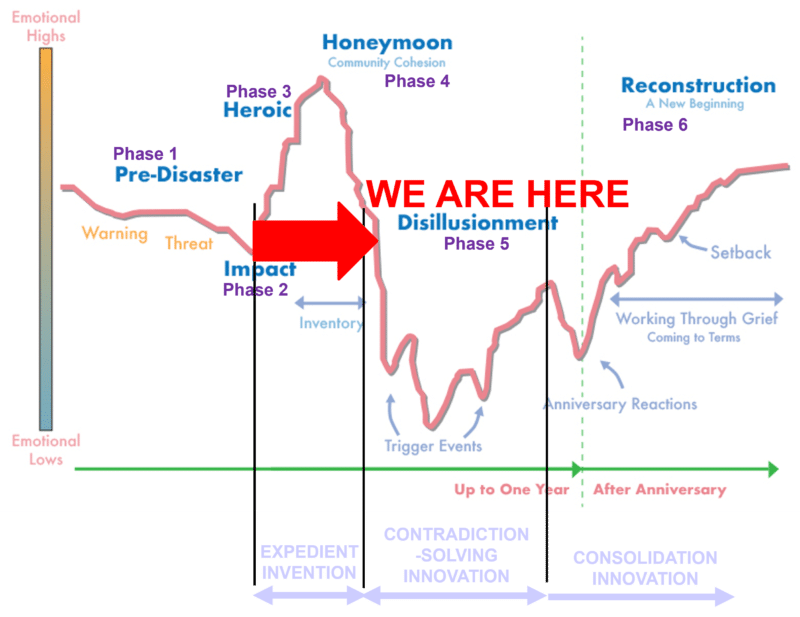
We’ve spent a large part of this same eighteen-month period talking about the Disaster Cycle, tracking society’s progress through the various different stages. Mainly the Heroic and Honeymoon phases, where the emphasis is on finding expedient solutions to the firt tranche of crisis-generated challenges. I had thought that this expedience applied to public and private sector enterprises. But reflecting on the poor quality music being produced at the moment made me realise that musicians caught in the pandemic are going through a period of expedience themselves. Great art, in other words, shouldn’t be expected to happen when society’s metaphorical roof is leaking. Rather it happens during the later ‘disillusionment’ phase. The place we now find ourselves:
The place where it’s been possible to reflect on the disaster, and then hopefully synthesise meaningful conclusions. Great art reveals universal truths. If the artist gets lucky, as well as seeing these truths, they get to describe a way forward through them. A way forward to better truths.
Which in turn
means I’m supposed to be thankful that my favourite artists have largely stayed
quiet since Covid-19 arrived. And that I’m supposed to be patient. Better
truths need a critical mass of disillusionment and reflection time. No
pressure.
One of life’s small annoyances. First up, a watched pan of water or milk never boils. So you go and do something else. Then, by the time you return, half the contents have boiled over and left you with a charred mess to clean up.
The simple
solution to this problem would be to just wait. Don’t try and do other things.
But that’s inefficient. In which case, it’s time to consider whether TRIZ might
be able to help solve the boiling over contradiction.
The problem is
basically a conflict between the desire to not have the pan boil-over
(stability) being prevented by the fact that there’s a continuing energy supply
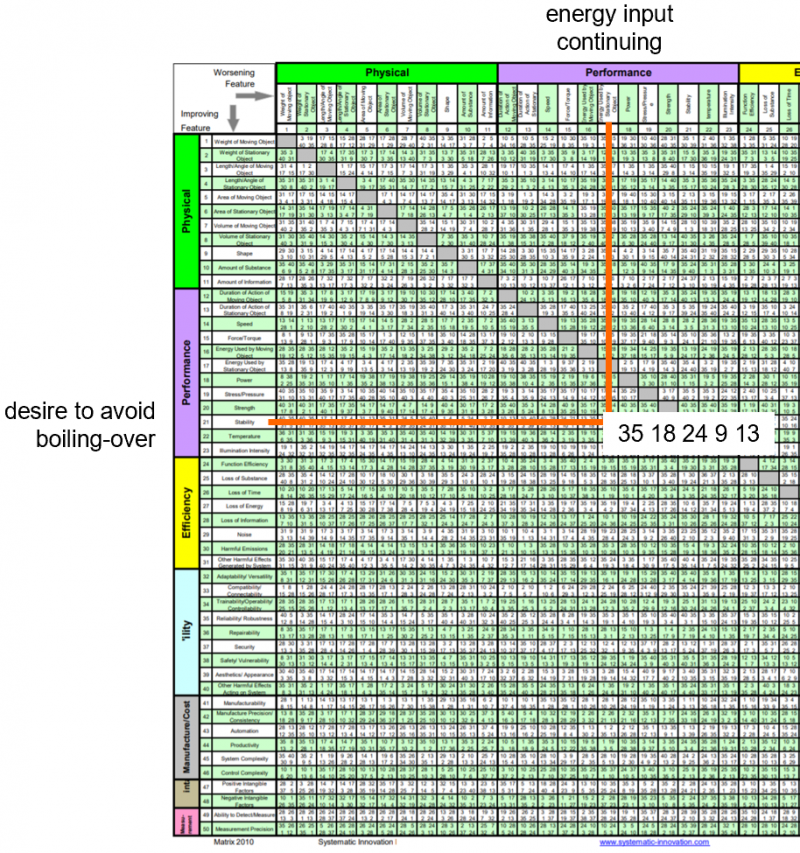
into the pan. Here’s what the problem looks like when mapped onto the Matrix:
Third on the
list of Inventive Principle suggestions is number 24, Intermediary. Which in
this specific case equates to perhaps one of the simplest use of existing
resource solutions ever… place the wooden spoon you were probably using anyway
on top of the pan. Something like this…
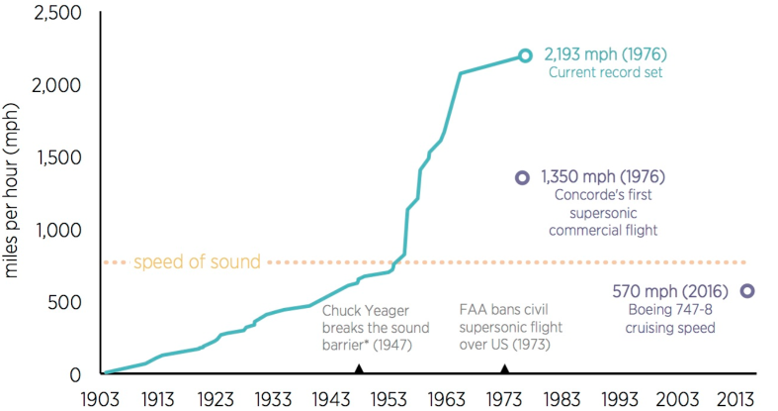
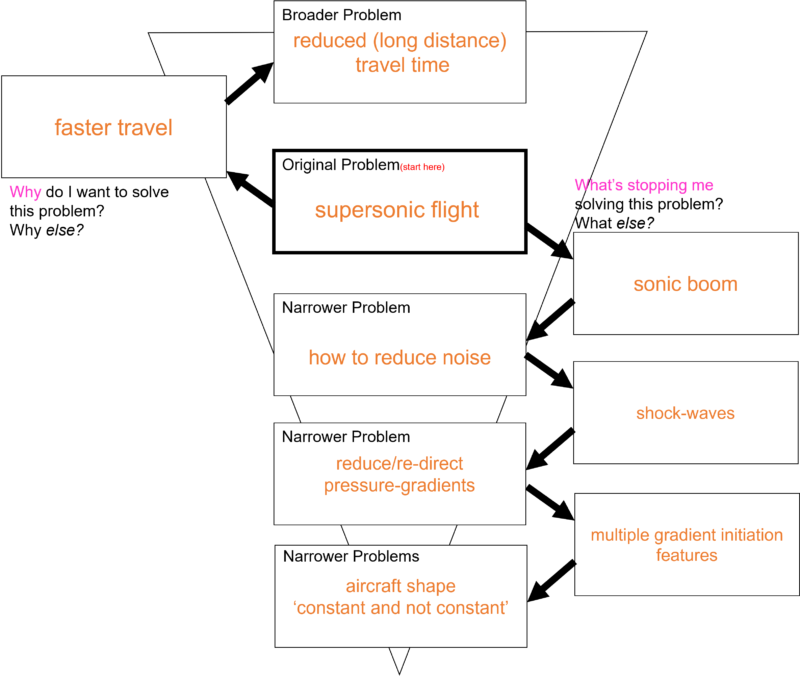
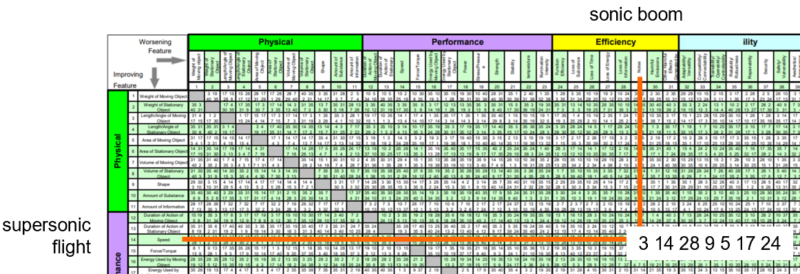
It seems strange to say it, but the speed record for atmospheric flight hasn’t changed since 1976. The speed-versus-date graph shows a pretty good approximation of an s-curve. Which should tell aircraft designers that there’s a contradiction to be solved. Actually several. Aircraft designers, even though they tend not to possess a lot of TRIZ awareness, almost invariably have the luxury of having plenty of time to think about problems. In theory, this means that they will get there in the end. If they had known TRIZ, meanwhile, they might have conducted a root-contradiction analysis. Something like this:
At the root contradiction level, as has been known by designers for some time, any big variation in shape on the body of the plane, like the cockpit jutting up at the front or the tail sticking up at the back of the plane, will produce a shockwave. To minimise the shockwaves that travel down to the ground, you need to change the shape of the plane and make it far more streamlined, smoothing out the variations in shape and spreading them out across a much longer body.
At its surface level, though, the speed contradiction is all about sonic boom. And the fact that, when an aircraft flies supersonically over urban areas, it is likely to cause a fair few broken windows and phone-calls from citizens thinking the world is ending. Here’s how this speed versus noise problem is mapped onto the Contradiction Matrix:
From this list, Principle 17, Another Dimension forms the most immediately visible feature of NASA’s current X59 project. The plane is 99 feet, 7 inches long, roughly a third of which is an extended, flattened-tip nose leading as seamlessly as possible back to the swept-back wings and a single engine at the rear.
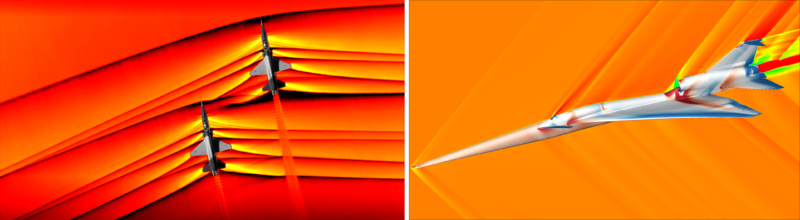
Look a little closer and we can see another example of Principle 17 in action: The engine intake and exhaust, both of which are traditionally housed on the underside of the plane, have now been shifted to the upperside. Through this geometry shift, the wing blocks and prevents the exhaust from interacting with the shock waves on the bottom of the aircraft.
Zoom in further
still and we see all the necessary (Principle 3, Local Quality) geometric
features positioned in such a manner that the shock waves each one instigates are
kept parallel and separated from each other, so they don’t combine into a loud
sonic boom:
traditional versus X59 shockwave patterns
The X59 is scheduled to fly for the first time next year with these Principle 3 and 17 features incorporated. The theoretical modelling seems to suggest that the sonic boom power levels will be reduced by a factor of somewhere between 8 and 10, making the traditional ‘boom’ into a less intrusive ‘thump’. Time will tell whether society says this will be good enough. If it isn’t, my Contradiction-Matrix influenced bet is that the designers will need to get beyond geometry and start thinking about Principles 28 and 9. You heard it here first. No pun intended.
Following on
from yesterday’s Grey Swan Top 5 blog, I thought I’d spend a few minutes
thinking about the ‘betweens’ aspect of the story. That’s ‘betweens’ as in ‘it’s
not so much the things that are important as the relationships between those
things’.
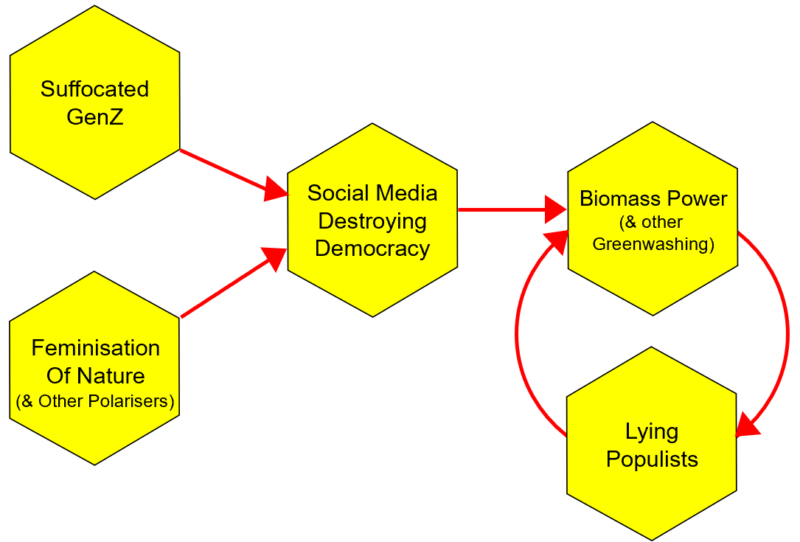
Here’s the
resulting Perception Map (which, I have to say, became quite a bit easier to
create after I’d generalised two of the more specific of yesterday’s definitions):
I’m never sure whether a Perception Map with five components is going to reveal much that we didn’t know already. In this case I surprised myself a bit. Especially regarding the greenwashing-populists vicious cycle. Not so much the idea that Social Media’s unwitting destruction of democracy is the primary driver of the cycle.
COP26 should be
fun later this year… don’t believe (any/every)thing you read.
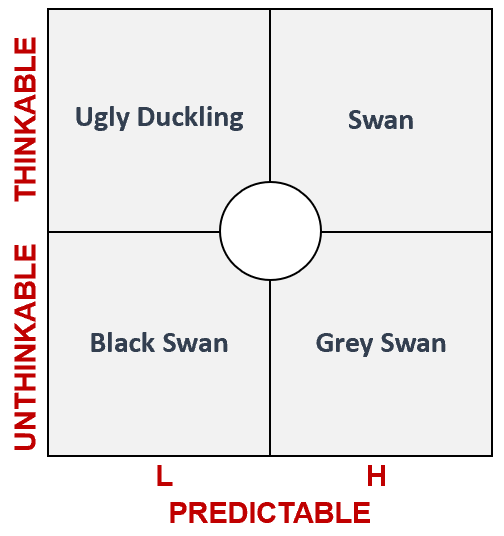
It seems like everyone knows what a Black Swan is by now. The jury is still out on Grey Swans. Black Swans are unpredictable, unthinkable high impact events. The most useful Grey Swan definition, I think, also involves unthinkable high impact events, but unlike Black Swans, Grey Swan events are highly predictable. We can now see that Covid-19 falls into this Grey Swan category. Everyone in a position of power knew that it was only a matter of time before the world would experience a pandemic, and almost all decided to bury their heads, ostrich-like, in the sand and hope it wouldn’t happen on their watch.
These kinds of unthinkable event are supposed to serve as a reminder that not-thinking about something because it sounds bad is not such a smart life strategy. From where I sit, I don’t think many people have taken the Covid-triggered hint. So, let’s try pushing the idea a little further: thinking about predictable-but-unthinkable events doesn’t just save lives, it makes society as a whole more resilient. And, if you’re that way inclined, it also highlights future innovation hot-spots.
Here, according to our research, are the current predictable-but-unthinkable Grey Swan Top Five. In something like ascending order of hot-spot-creation potential:
#5 Suffocated Generation Z – one being predicted as long ago as the mid-1990s in the Strauss & Howe Generations model. Over-protect kids and they’ll grow up to be fragile adults with few life skills. And therefore limited ability to thrive in a chaotic world. Locking kids down for a significant proportion of their childhood turns out to be the best over-protection mechanism ever invented. And the global chaos half of the story isn’t going away anytime soon. The oldest GenZ’s are now looking to enter the workplace. Ideally in a job that can be done over Zoom while sitting in a domestic cocoon. Following an interview they attended alongside their parents. When it comes to this ‘Artist’ generation’s inevitable turn to take over the reigns of power, things won’t go well. The standard of movies on the other hand will rise considerably. So it’s not all bad, I guess.
#4 Biomass
Power Stations –
becoming an iconic example not just of greenwashing, but how to sound like a
sustainable solution when in reality you’re making the problem you purport to
fix several times worse than it would have been if you did nothing. The second Law
of Thermodynamics tells us there’s no such thing as a free ride. It doesn’t
always tell us just how much collateral damage doing dumb things can do.
#3 Social Media Kills Democracy – Turns out that the innocent, sort-of well-intentioned act of personalising a person’s newsfeeds and recommendations doesn’t end up producing a world in which everyone is joyfully connected to everyone else. Instead what we end up with is a billion-and-one echo-chambers and a population that, as every day goes by, becomes less and less able to get along with people who’s opinions are slightly different to their own. How Mark Zuckerberg sleeps at night, I have no idea.
#2 Lying Populist Politicians – one of the lessons of Covid was supposed to be that anytime there’s a fight between a real virus and fake news, reality wins. The other thing that’s supposed to happen is that by making the world more transparent, anyone in public office is supposed to realise they can’t hide their shady-dealings anymore. Unfortunately, in the UK at least, the appalling performance of the Government – the polar opposite of a King Midas administration – has only served to reinforce the idea that those in power can say literally anything and get away with it. Couple that with opposition parties that still naively think revealing nitpicking truths is a vote winner, and its only a matter of time before a truth-less slippery slope turns into a cliff edge. Walk this way, confirmation-bias lemmings.
#1 The Fertility Timebomb – the greyest of the Grey Swans. The story that literally no-one wants to contemplate. Spray the planet with oestrogenic pesticides for a few decades and, surprise, surprise, it starts to play havoc with the reproductive systems of every lifeform. You start looking in to this one – starting with ‘The Feminisation of Nature’, a first warning shot published in 1997 – then look around at the myriad already visible manifestations and get so scared, you can see why Wilful Blindness is sometimes the only sensible way of maintaining our ability to function.
Finally, if your
own wilful blindness gene hasn’t kicked in yet, #0 on the Top Five Grey
Swan list is what happens when any of the five combines with any of the others.
That’s when the contradictions really start to become visible. Inside every
Grey Swan is an opportunity. Between every pair of Grey Swans is where the
opportunities become exponential.
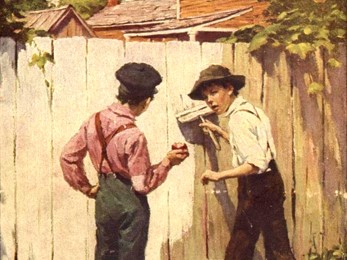
“Ben Rogers: Say, Tom, let me whitewash a little. Tom Sawyer: No, no, I reckon it wouldn’t hardly do, Ben. You see, Aunt Polly’s awful particular about this fence – right here on the street, you know – but if it was the back fence I wouldn’t mind.”
1876 saw publication
of Mark Twain’s classic, The Adventures Of Tom Sawyer. It was a book ahead of
its time. Managing to pull off the rare feat of being both a rattling good read
while also being filled with meaning and symbolism. It was a story about the
titular mischievous young boy, who wittingly tricked his way to get everything
he wanted.
One of the most
prominent scenes in the book is the “fence scene”, where Tom Sawyer was tasked
by his Aunt Polly to whitewash their fence as a punishment for a prior
mischief. Tom Sawyer, being young, wished he could play instead, naturally. Ben
Rogers, one of his friends saw him doing this job and did his best to ridicule
the boy for his penance.
Most people
would bow their heads and take it in the chin. But Tom Sawyer not only turned
the situation around, he spun it like a top on his palm. At the end of that
day, a dozen boys painted the fence for him while he played to his heart’s
desire. Not only that, but he also convinced the willing volunteers to pay him for
the privilege.
The fence scene
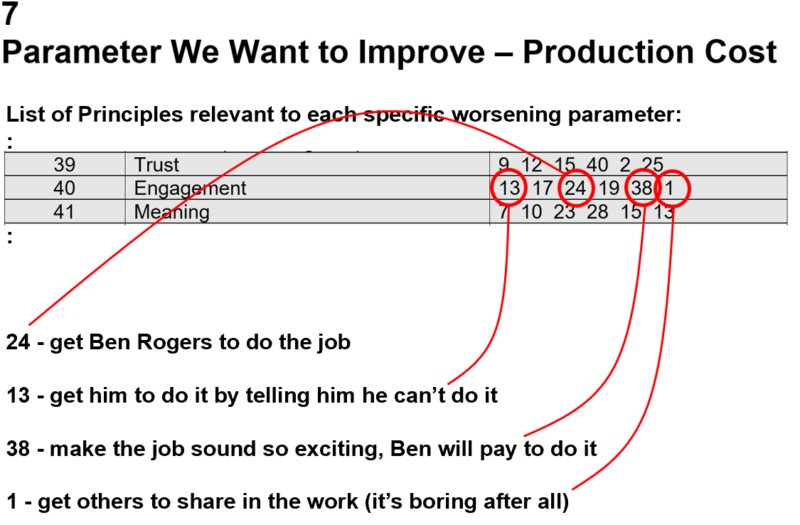
makes for a lovely ‘people’ contradiction example: Tom is forced to paint the
fence, but painting fences is a dull, tedious job. Here’s what the conflict
looks like when mapped onto the Business Matrix:
The overall life lesson being that there are no dull, tedious jobs. Or, as Mark Twain put it, “work consists of whatever a body is obliged to do. Play consists of whatever a body is not obliged to do.” Every job is an opportunity to tap into an intrinsic motivation. Every job is an opportunity for a (Principle 13) breakthrough solution.