
Bad Design #7519: Milk


Has something gone wrong recently in the milk bottling industry? Someone taken their SixSigma training too far? I don’t know what’s happened, but suddenly I find myself in need of sharp implements to open my milk when the convenient pull-tab on the seal is somehow no longer very convenient.

It’s a classic ‘if the only tool you have is a hammer, every problem looks like a nail’ issue I think. That plus the bigger issue of the way process engineers (and actually all of us) have been taught. When the process engineer is trying to get the seals to stick on the top of the bottle, there aren’t many process variables they can play around with. The main one in fact is how much glue to place between the rim of the bottle top and the seal. As soon as this becomes the case the only available hammer then becomes the Goldilocks and the Three Bears strategy: Not too much glue, not too little. And the desire to find ‘just the right amount’.

This is classic optimization territory. But it is also bad news from the customers point of view because it leads the designers to do dumb things. Not putting enough glue on the bottle is worse news than putting too much on. If the milk leaks, everyone complains, but if the seal needs a knife or fingernail to get it off, the customer is probably frustrated but not sufficiently to actually write an email (or blog article!) to complain about it. Consequently, ‘just the right amount’ of glue tend to err on the side of too much.

Then, of course, the process engineer knows there is variation in the glue dispensing system. So that gets cunningly compensated for too. More glue. Not so good from a cost perspective, but definitely better than those troublesome customer complaints about leaking bottles. Just more annoying seal-removal frustration.

What’s so idiotic about this whole scenario is that the designer thinks they’ve done a good job. They used maths. They did their Design of Experiments. They drew a distribution curve. They worked out their safety margin. They ‘proved’ they’d done the best they could possibly do. They were taught – SickStigma Black Belt-style – how to optimize a situation that wasn’t actually an optimization problem.

When you find yourself playing Goldilocks, it ought to be a pretty good indicator that you’re working on the wrong problem. Goldilocks was an optimizer. Smart people recognise there’s no such thing as ‘just right’ and instead look to solve the contradiction. Which in this case is ‘we want more glue AND we want less glue’. Something like this:
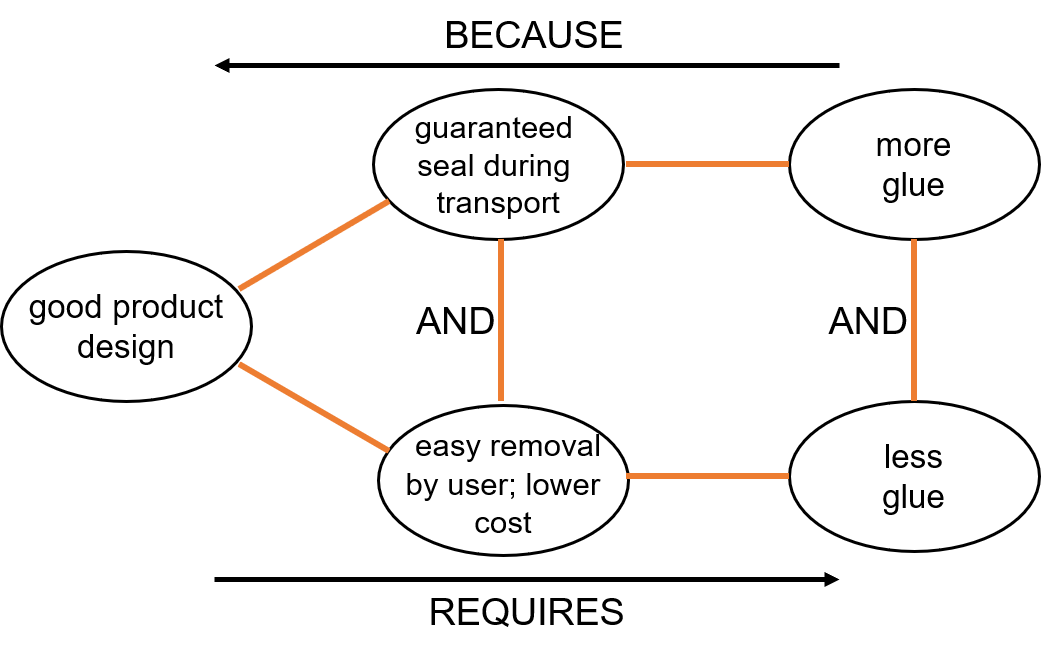
Now at least we’re working on the right problem. The ‘best of both worlds’, solve-the-contradiction problem. Now we have some chance of making progress. And not have to have thousands of customers spend time fishing out fragments of broken seal and excess glue from their milk.

Breaking Rule #1 – What If The Lawyers Didn’t Get Rich?

Here’s another reason the global patent system doesn’t make any sense. One of the main criteria against which an inventor’s application will be assessed is the ‘obviousness’ of the solution being proposed. If it’s deemed to be obvious, it can’t be granted.

The ‘obviousness’ test is one of those lovely grey areas that helps reinforce the only real rule in the patent system: the lawyers get rich and the inventors don’t.

The real stupidity in play, however, is that ‘obviousness’ is one of the best tests of whether a solution is a good one or not. If it’s a good solution it should – in retrospect – look obvious. The ‘why didn’t I think of that before’, palm-clasped-on-to-forehead’ moment.

There are multiple tricks patent lawyers can deploy to resolve this problem (we wrote about several in Issue 116 of the SI ezine), but the simplest is effectively the murder-mystery novel technique. A good murder mystery writer successfully obscures the identity of the murderer until a big exciting final reveal. We the readers hadn’t guessed who it was going to be, but when he or she is revealed, we should rapidly realise it had been obvious all along. The butler did it.

Fortunately for the patent lawyers most inventions are rubbish and so they don’t have to be too smart in terms of playing this novelist trick. If its actually a good solution, however, then its likely you’ll see evidence of the trick being played. If it’s a lazy lawyer, you’ll see it used most frequently with words like ‘surprisingly’ or ‘unexpectedly’. As in, ‘we mixed the two combustible chemicals together and when we tried to burn them, unexpectedly, they now completely refused to combust.’

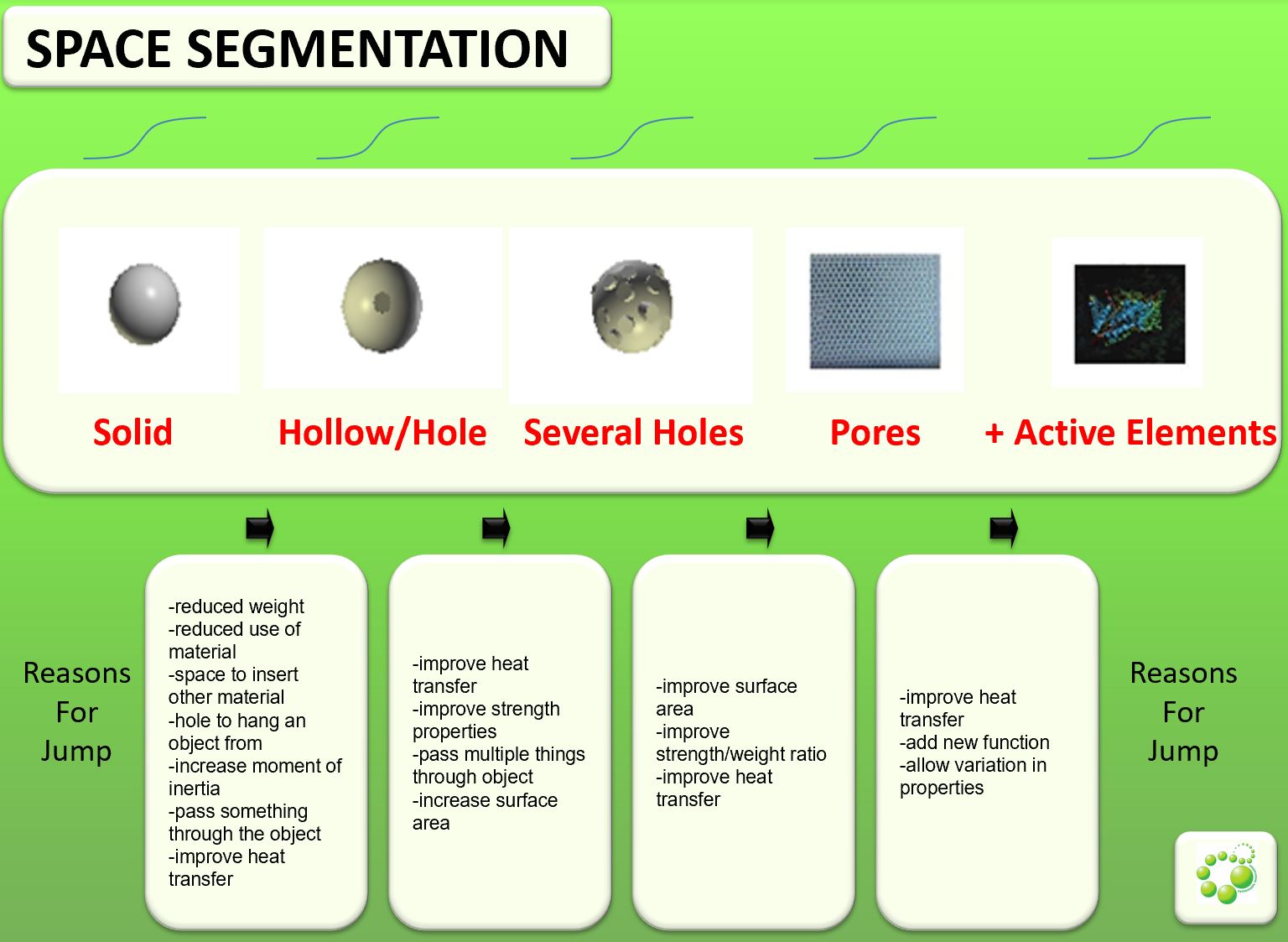
So here’s the real problem. It’s one that comes from TRIZ. And specifically the Trends of Evolution part of the toolkit. Here’s the part that gives inventors and (if they chose to listen) Patent Examiners a clear road map defining successful solution directions. We’ve found 38 of them so far. Here’s one of the more simple ones:

This is known within the TRIZ World as ‘Space Segmentation’. It’s the Trend that basically says all physical objects, for as long as they still exist, will have an advantage if they add progressively more and more holes, that in turn get smaller and smaller, and eventually, get some kind of ‘active’ element added to them. It’s a classic ‘doing more with less’ trend. There are multiple different reasons for adding the holes – making things lighter, for example, or increasing surface area, or improving material transfer. Lots of reasons. But the point from a patent ‘obviousness’ perspective is that any inventor that becomess the first to realise that adding a hole to, say, a semiconductor ball grid array is a good thing can’t be allowed to have that holey-solution patented, because even though it’s the first time in a semiconductor, the TRIZ Space Segmentation Trend tells me that adding holes is totally obvious because that’s precisely how tens of thousands of prior-art inventions have been successful.

Now, for some reason, the patent lawyers don’t seem to want to know about these 38 Trends. I’ll leave you to work out why that might be. From my perspective, I’ve stopped worrying why they will or won’t listen, because what we’re doing is publishing all of the ‘obvious’ evolution jump ideas that the TRIZ Trends tell us will happen at some point in the future.

Even better, I have a piece of software that will do it automatically for me: Take the Space Segmentation Trend. All I need to do is read through all the Claims in all the patents of the world looking for nouns that describe physical objects – scalpel, pill, shoe, compressor blade, toothbrush, you name it – and write a new set of Claims that add ‘at least one hole’ to each of them.

Repeat for the other 37 Trends, for all the patents, and we’ve just defined the future evolution path of every component, process and system on the planet. Now each one is undisputably ‘obvious’ so even the blindest rent-seeking leach of a Patent Lawyer has no choice but to acknowledge the fact. And in the process of making that happen, I firmly believe we will end the patent stranglehold the large enterprises of the world have on the rest of us.

Mastery Age?

I’m still thinking this one through. A way of measuring a person’s thinking maturity. A brain analogue to what ‘RealAge’ does for a person’s medical age. RealAge is a way of letting people know how healthily they live. Having a RealAge lower than your calendar age is a way of saying you’re living healthily. And vice versa. I’m imagining a similar thing for your brain. Or rather how effectively we do or don’t make use of it.

I think I’ve got several of the necessary components of a ‘Mastery Age’ measure in place. One definite is the Malcolm Gladwell ’10,000 hours to achieve mastery’ meme. Not so much the 10,000 hour number per se because, as I’ve written elsewhere, it seems possible to me to achieve ‘mastery’ of something in a lot less than 10,000 hours if a person works smartly enough. And similarly – as with my guitar-playing efforts – it is very possible to devote 10,000 hours to a subject and quite clearly not achieve mastery. The difference is about how many discontinuous learning experiences you’re able to put yourself through. When I’m playing guitar, I find it too easy to stay in my comfort zone, noodling my way through the same things time and time again. On the other hand, when it came to getting up to speed with some of my innovation-adjacent domains of expertise, I deliberately put myself in contradictory situations to stimulate faster learning.

If the 10,000 hour number means anything, it is perhaps a datum. Like the number of calendar years a person has lived. If we assume a 40 hour-week devoted to mastering a subject, ‘mastery’ of that subject should – assuming a 10,000 hour average – be achieved in around five years. Then, assuming we say the first 20 years of life are about mastering the mechanics of being a sort-of-functioning adult, that leaves, on average, fifty years of adult life in which we could – on average – envisage mastering ten subjects.

In this way, the average person who lives an average actively life to the age of 70 and has used this time to master ten things, they might be said to have achieved a Mastery Age of 70.

A person mastering fewer things could then be said to have a lower Mastery Age. And, conversely, the person that sets out on a journey of pro-active contradiction-chasing mastery could conceivably achieve a Mastery Age considerably beyond their 70 calendar years.

So far so good. But not quite. Because I also think another piece in the jigsaw needs to be some of the #-shaped people model I’ve talked about in this blog and elsewhere (https://triz-journal.com/shaped-people/). The underlying idea of #-shaped is the need to combine both ‘vertical’ domain specialist mastery and ‘horizontal’ domain-bridging generalist knowledge mastery. Somehow the Mastery Age measure needs to account for this parallel need and how well a balance has been achieved. A person that masters 10 domain subjects ought to have a lower Mastery Age than a person that masters five vertical and five horizontal subjects. Now the calculation gets complicated. To the point, I think, where it needs to be done as some kind of automated survey. That’s what we’re working on right now in PanSensic Land.

Meanwhile, I’m figuring, guitar-non-prowess notwithstanding, Mastery-wise, I’m batting below average. My calendar age is 56. My ‘RealAge’, last time I did the assessment, was 48. Which I’m pretty happy with. My Mastery Age, though, seems to be hovering around the 35 mark. Which doesn’t sound so good at all.

Must try harder.

Or re-calibrate the model.


On Anxiety, Legislation & Venus

Not so long ago, just as I was about to set off on a cross-country drive, a friend emailed me to warn me to drive carefully. Unfortunately, the email arrived just as I was shutting down the computer so I never got to ask what the problem was.

Anyway, I somehow made it safely to my destination and got to ask what the issue was in person. Turns out the problem was in the heavens. Venus and Jupiter were both in the same house. Something like that. Two of the planets that shouldn’t have been where they were.

The scariest part was that she believed it. That the convergence of the two planets was going to cause gridlock on the roads of Britain. And I assume everywhere else.

I checked the papers the following morning, but it seemed like the forewarning had paid off. That was her thinking anyway. To my mind she was in a Popperian ‘no lose’ situation  If there had been carnage on the roads, her prediction was right; if there wasn’t it was because the forewarnings paid off. Heads astrology won, tails I lost.

In my mind, bringing matters back to Earth for a second, the ‘drive safely’ warning was a bit like safety legislation. Which for the most part these days has exactly the opposite of its intended effect. Telling people to hold onto the handrails when they go down a flight of stairs, it turns out, is a great way to ensure that more people fall down flights of stairs. Telling people to pull over to the side of the road if they feel sleepy is a great way to ensure more drivers end up snoozing their way into a car-wreck.

Investigators and legislators, sadly, find themselves in rock-and-hard place positions when these kinds of thing go wrong in society. They’re under pressure to do something whenever they investigate an accident or an incident. Usually, the easiest thing they can do is to add more legislation or instruct that warning signs are put in place. Or more labelling on packaging. And so on until we’re all of us completely surrounded by cotton wool exhortations to be more careful.

The first problem with this strategy is the investigation team, as far as I can tell, have little or no understanding of the difference between special and common cause problems. Nor the idea that if we mix the two up any response we design will have the opposite impact to what we intended. Treat a special cause problem as common cause and you make the system worse. Treat a common cause problem as special and you fail to change a dysfunctional system. Either way, irrespective of whether the legislators understand common and special causes or not, the population at large almost definitely don’t. Which means that the legislators have to be seen to be doing something irrespective of whether the situation is special or common.

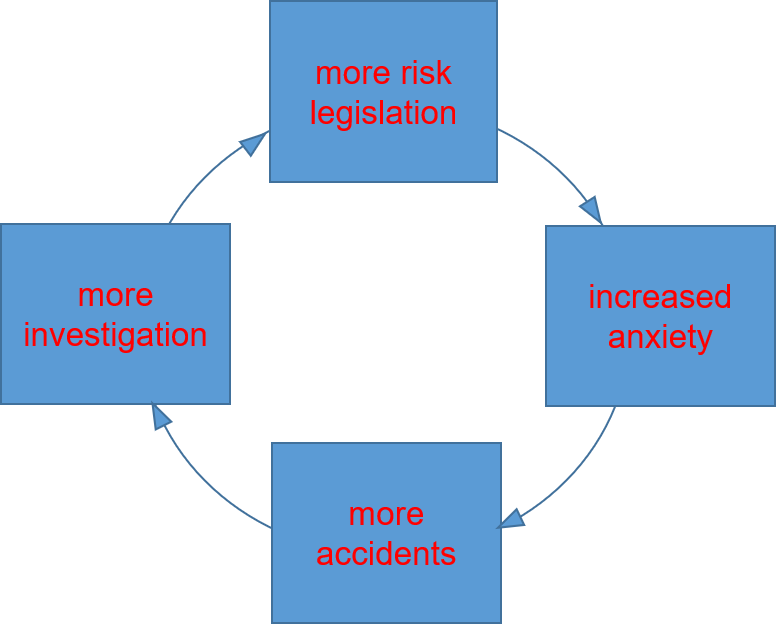
That ends up being a recipe for a great downward spiral for society because the even bigger problem is that what happens when we’re bombarded with safety information all the time is that we become collectively more anxious. And if there’s one thing to guarantee more accidents and unwanted incidents it’s a population full of anxious people. The downward spiral looks something like this:

Astrology, meanwhile, is yet more anxiety-causing bunkum. The reason deluded friends continue to believe our future is written in the heavens is predominantly about confirmation bias. The actual reason Pisceans (or whichever Sign it is – I can’t be bothered to look up the statistics) are more ‘accident-prone’, for example, is because they’re more anxious than other star signs. And the reason they’re more anxious is because they continually get told by other astrology-delusionals that they’re more accident-prone.

Maybe I’m being a bit harsh here. Maybe the position of Venus in the sky really does have a genuine impact on our lives like the Moon actually does. I’m open to the possibility. Or at least I am if I can be shown an experiment where all of the other related effects – confirmation bias, etc – are properly controlled for.

If I had to assemble a theory based on what we know so far prior to such experiments, if I wanted to be generous to astrology I might hypothesise that the position of Venus has a 0.000001% effect on me crashing my car this afternoon. The likelihood of me crashing my car because a friend tells me to be careful, meanwhile, based on actual scientific evidence relating to the effect of anxiety on errors, will increase by around 5000 times that amount. The anxiety caused by being told to drive carefully, in other words, is about 5000 times more potent as a cause of accidents than the orbital position of Venus.

Which, all in all means, maybe the legislators might start decreasing the rate of harm they’re currently causing if they spent more time reading horoscopes and less time designing counter-productive signs. Or something like that.

The Innovator’s Mission

We stand sideways.
We work in corridors and abandoned spaces.
We get up early and go to sleep late.
We’ve been mocked.
We’ve been turned away by people that won’t have us.
We are relentless.
We dream it, we make it, we break it, we fix it.
We create.
We destroy.
We wreck ourselves day in and day out and yet we stomp that one breakthrough or find that one line that keeps us coming back.
We progress.

These words, with one or two small modifications, come direct from the mission statement of an innovator. A disruptive innovator. Jake Burton, one of the pioneers of the snowboarding world.

I know a lot of skiers and I know quite a few snowboarders. For the most part, they don’t get along so well. For me, the antagonism between the two communities says a lot about the difference between Innovation World (the underdog snowboarders), and Operation Excellence World (the elitist, have-all-the-right-equipment-follow-the-rules skiers).

The world needs both types. And both need to get along.

Snowboarding is now an industry. It is also entering Operational Excellence world. The antagonism with the skiers dissipates…

…And leaves a growing vacuum for the dis-affected, the under-resourced and the unpopular. The next mutiny of sideways-standing rule-breakers.

40 Inventive Principles Not 40 Innovation Principles

There seem to be a lot of people in and around the TRIZ community with the mistaken impression that the 40 Inventive Principles are some kind of a magic shortcut to innovation.

Anyone that checks out the ‘Not So Funny’ section in our monthly e-zine will have noticed a theme over the years. The 40 Inventive Principles map just as well to really bad solutions as they do to the 2% of good ones that will end up being called ‘innovation’.

To be clear: there is absolutely no correlation between evidence of an Inventive Principle having been (explicitly or implicitly) used to generate a solution and the future commercial or value-delivering success of that solution. The driver in the above photograph could be said to have exploited Inventive Principle 17 to solve his contradiction, but its unlikely that anyone else would necessarily see it as a ‘good’ solution.

The 40 Principles are merely a collection of ‘provocations’ that enable problem solvers to break out of their current ways of thinking to hopefully derive ‘better’ solutions. The fact that the list is a comprehensive one – i.e. we haven’t been able to add anything meaningful to the list since the 1970s – is one of its main attributes over other solution-triggering taxonomies. If we haven’t generated solutions we like from any of the 40, it’s either because we haven’t thought hard enough, or that there aren’t any.

Some people, when they realise that the Principles will just as likely deliver bad solutions as good ones tend to then make the incorrect follow-on conclusion that ‘TRIZ is no good’.

This is a big mistake. Sadly, it is also a common one.
On some level, I find it difficult to motivate myself to argue against such people these days. The more people that don’t use TRIZ, the bigger the playing-field of breakthrough opportunities for those of us that do. On the other hand, I don’t think rectifying the erroneous thinking demands too much effort.

Here goes:

1) The 40 Inventive Principles offer a comprehensive suite of solution directions that point just as much to ‘bad’ solutions as ‘good’ ones.

2) The Ideal Final Result tool within TRIZ offers a clear compass heading describing what ‘good’ looks like for any given situation.

3) The Contradiction Matrix provides a ranked list of Inventive Principles that specifically do point in the direction of the ‘good’ solution directions for any given conflict situation.

4) There is strong causal evidence to show solutions derived from the use of two of the Matrix-recommended Principles are more likely to be successful than those using one. Similarly, solutions derived from three will do better than those derived from two. And so on, at least up to five.

5) For those that don’t wish to take advantage of the Matrix, it is perfectly sensible to use ‘all’ the 40 Principles to help provoke new ideas and directions, provided that solvers bring to bear a clear idea of the IFR compass-heading when evaluating and combining those ideas and directions into the eventual solution

It’s Called Skunk Works For A Reason (Actually, Two)

For some reason I’ve had a flurry of conversations lately with organisations thinking about setting up some kind of sexy innovation ‘centre’ or ‘lab’ or ‘hot-house’. The conversation quickly devolves into ‘it depends’ territory. Sometimes it’s a good idea; sometimes it’s not. The answer depends on the Level of Innovation Capability Maturity of the enterprise. At Level 1, it’s usually a really bad idea; Level 2 and it potentially becomes a good idea; Level 3 and it’s probably a bad idea again.

The usual model for these kinds of innovation early learning centre is the Lockheed Skunk Works.

When it was set up, in the late 1930s, Lockheed was a Level 2 Capability innovator. Actually, they probably still are. The aerospace industry has some particular innovation challenges to overcome that make it very difficult to evolve past Level 2, not least of which is the need to be able to re-assure customers that you’re the safest industry on the planet (no-one likes it when aeroplanes fall out of the sky), and that you’re simultaneously able to do exciting new things.

Skunk Works solves the contradiction by physically separating production and development activities. Different rules, different protocols, different procedures, different reward systems. Different pretty much everything. Operations World and Innovation World are literally two separate worlds.

What’s often lost on Level 2 ICMM enterprises contemplating their own Skunk Works is the significance of the name chosen by Lockheed.

First up, ‘Skunk’. Which is deliberately a very non-aspirational kind of creature. When someone calls you a skunk, they’re probably not being complimentary. Very few people want to be tarred with such a non-attractive label. Which turns out to be a terrific way of separating the innovators and the operational excellence people in an organisation. Innovators know that they’re looked down on by the rest of the enterprise, and they don’t care. They’re people with a different perspective on why they come to work each day. Ego means nothing; doing exciting stuff means everything.

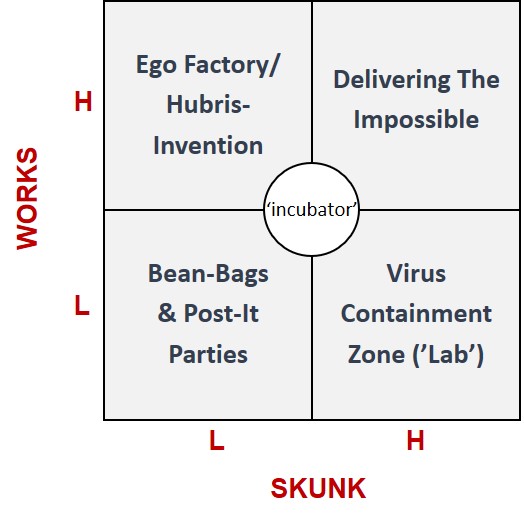
Second comes ‘Works’. This is slightly more subtle than ‘Skunk’, but it is nevertheless a critical part of Lockheed’s success. Skunk Works is a place where work is done. It’s not a ‘lab’ or an ‘incubator’ or a ‘centre’ or any other pretty name for a physical space full of bean-bags and motivational creativity posters. A Works produce real aircraft that are going to fly in the real sky. It is an innovation factory.

The two words form an important contradiction that prospective innovators need to embrace and work through:


I was fortunate enough to spend the first fifteen years of my career in the aerospace industry, and even more fortunate to visit Skunk Works at a time close to its peak days. At the time it was quite literally a place where people with real grit consistently delivered the impossible, impossibly quickly and at impossibly low cost. Not a bean-bag  or delicate managerial ego in sight.


The Zuckerberg Fallacy

The previous Facebook Mission Statement, “Making the world more open and connected” had one fundamental flaw: it didn’t push for any specific positive outcome from more connection. Technically, it could encompass digital voyeurism via the News Feed, trading in-person friendship for online acquaintanceship or the filter bubbles and echospheres that have further polarized the United States.

So last year, as Facebook approached 2 billion monthly users, its CEO Mark Zuckerberg revealed a new mission statement, to “Give people the power to build community and bring the world closer together.”

Zuckerberg announced the change at the Facebook Communities Summit for top Group Admins where it announced new Group management tools. “For the last decade or so we’ve been focusing on making the world more open and connected. But I used to think that if we just give people a voice and help some people connect that that would make the world a whole lot better by itself,” Zuckerberg admits. “Look around and our society is still so divided. We have a responsibility to do more, not just to connect the world but to bring the world closer together.”

Rather than have the new mission be just a philosophy, Zuckerberg says Facebook is turning it into a goal. “We want to help 1 billion people join meaningful communities. If we can do this it will not only reverse the whole decline in community membership we’ve seen around the world… but it will also strengthen our social fabric and bring the world closer together.”

It all sounds so great. Until you actually think about it. Until you bring some actual knowledge to bear. But then, isn’t that the problem of so much of the Silicon Valley story these days. A fatal Ignorance-Arrogance delusion. Naïve good intentions ending up in horrendously harmful and damaging consequences for everyone else. (Although not necessarily for the Facebook share price. Hmm.)

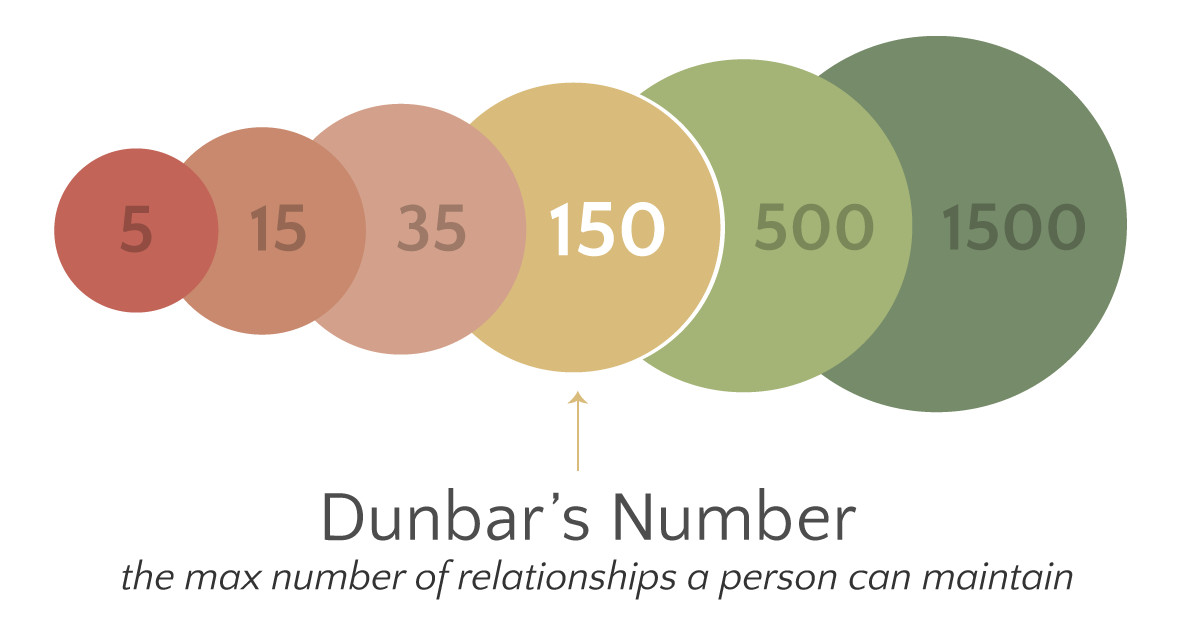
Let’s look at a quick example. I happen to be a fan of anthropologist, Robin Dunbar, most famous these days for the Dunbar Number: the maximum number of people we are able to maintain relationships with. Which turns out to be around 150. Plus or minus, depending on the way your brain works.

Now, for me, if Dunbar is anything close to right, the Dunbar Number alone tells us there is no such thing as a world-size community (see also my blog, ‘The Plural Of Community?’). And that as soon as we create a 150-strong community of ‘us’, we, by definition, create another much bigger community of ‘thems’.

As if to prove my point, I knew I wouldn’t have to look very hard in order to find a community of people who didn’t believe in the Dunbar Number. ‘The Fallacy Of Dunbar’s Number’ popped up at the top of my search (https://www.fullcontact.com/blog/maintaining-relationships/). A better example of exception-proving-the-rule I’d be hard pushed to find. Brad McCarty is the author of that blog. He has a ‘solution’ to the Dunbar number that involves building a personal taxonomy of contacts for all the different topics he’s interested in. Funnily enough, each of these topic-communities seems to end up containing around 150 contacts, but hey, once some people have made their mind up that something is wrong, they’re not going to change no matter how much evidence they’re given. Now, if I imagine that every person on the planet follows Mr McCarty’s advice, and, let’s say each of us is capable of juggling a dozen or so of these topic communities in our fragile, overloaded little heads, then what we’ve also contributed to are a dozen topic communities with the opposite view to our own.

If we reduce everything down to first principles, the human brain has thus far evolved to categorise three types of people: me, us and them. For every ‘us’ we create or participate in, one of the things that unites ‘us’ is our rejection of the nearest ‘them’. Zuckerberg’s naïve desire to create ‘meaningful communities’, laudible as it might be, is utterly – utterly – inconsistent with ‘bringing the world closer together’. Point one, there is no plural of community. Point two, every meaningful community that gets built sparks the creation of its opposite. It’s very possible to create ‘communities’, but when you do that, you don’t bring the world together, you create lots and lots of polarised views that make it progressively less likely that people are able to talk to each other any more.

Unless you know how to recognise and solve the contradictions you’re creating. Which delusional, ivory-tower-based social media oligarchs like Mark Zuckerberg, sadly, appears to be heading further and further away from. Good intentions often create terrible outcomes. Good intentions that fail to understand the first principles of human behaviour, simply create terrible outcomes faster.

The FAMGA Five & The Rule Of Three

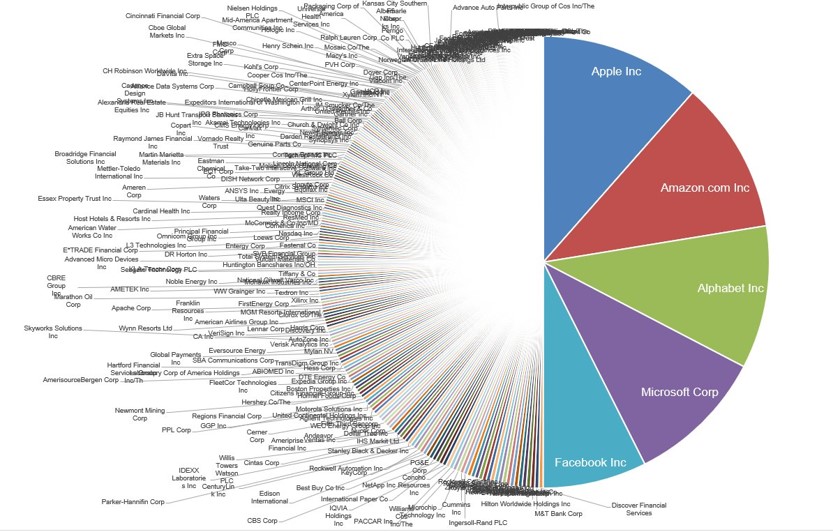
I must admit when I saw this pie-chart breakdown of US companies I found it a bit shocking. How did the ‘FAMGA’ Big Five get so much bigger than anyone else so quickly? I’ve been saying to clients and anyone that will listen that ‘the integrators will win’ for quite some time now, and I think that’s part of the Big Five story. The ones that own the data have the best opportunity to reach the top of the pile, and certainly these five organisations appear to have the majority of it.

So, I then figured, how does all this tie up with Jagdish Sheth’s classic management text, ‘The Rule Of Three’, a book that says every industry will eventually converge to three players. Maybe the five ‘integrators’ are merely part of the divergence that comes for any new industry before the convergence takes place?

Actually, I think it’s a bit more complicated than that. Complex even.

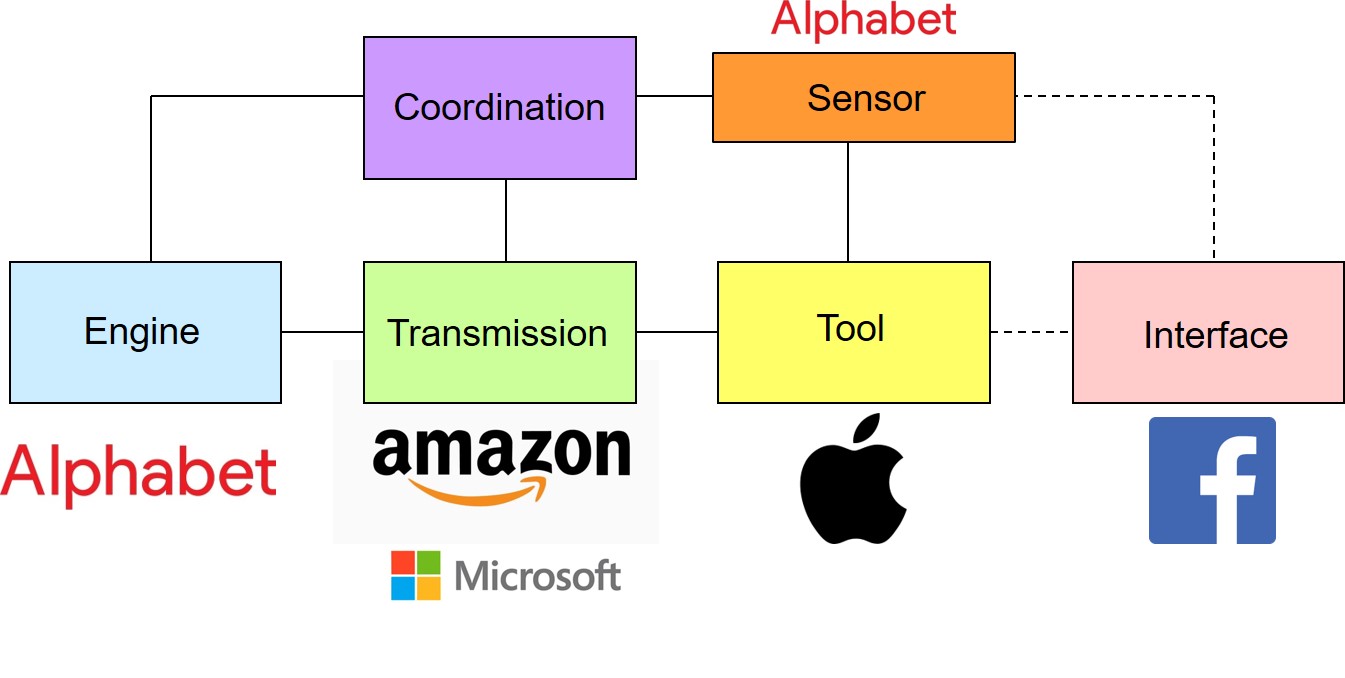
Another of my unproven, largely unexplored, hypotheses is that the industrial world will ultimately converge according to the TRIZ Law Of System Completeness. There will be three Engines, three Transmissions, three Tools, three Interfaces, and three Sensors. And, with the whole ‘integrator wins’ idea in mind, eventually, three higher level Coordinators.

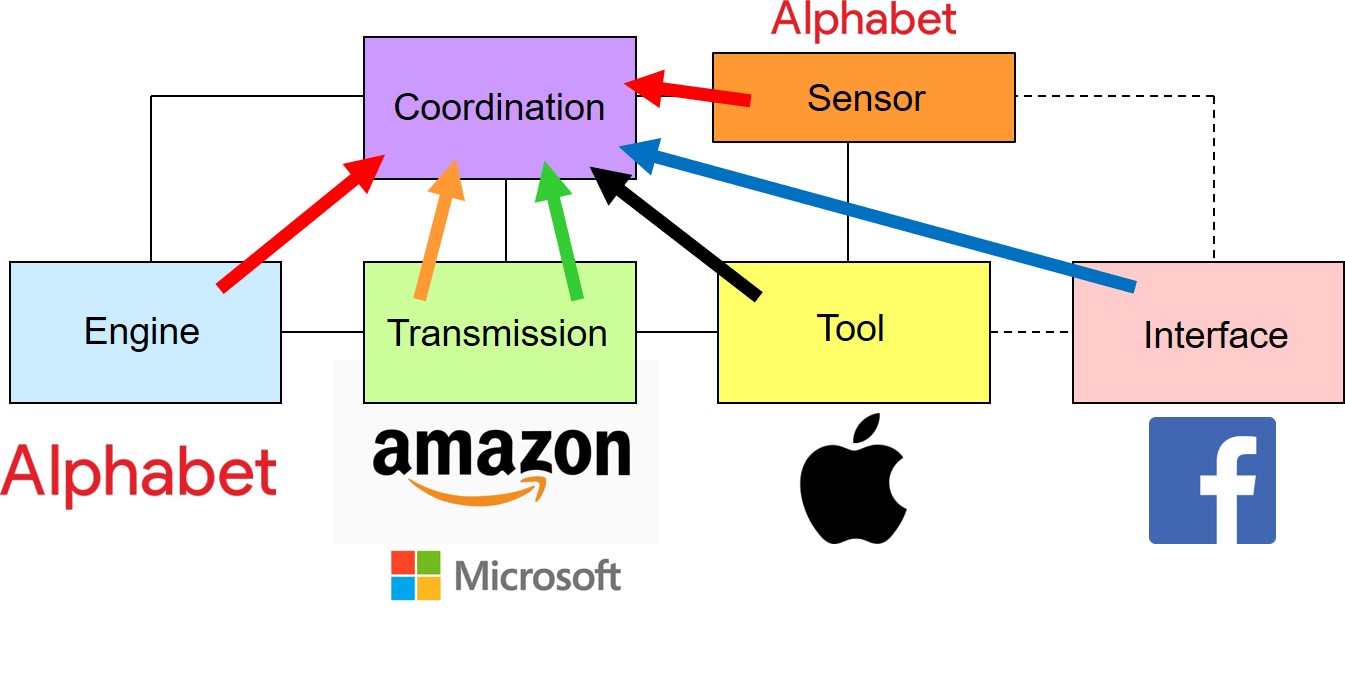
It seems clear to me that each of the Big Five are trying to capture that ‘Coordination’ position. But, positioning them on the various elements of the Completeness Law, I was struck by how they so neatly split across the other five elements:

Each is already the biggest (by some considerable margin) of their respective Law element players. They, of course, have competitors within these elements. Thus Apple – who’s still largely in the device business (hence, ‘Tool’) – experiences increasingly fierce competition from Samsung, LG and, catching up fast, Huawei within their ‘Tool’ world. Apple, I’m sure knows this, and hence their desire to climb to the top Coordinator position.

When the markets value you at $1T and you have almost as much sat in the bank waiting to spend, you’re probably well placed to achieve any goal you set your mind to. That said, whether they will be able to out-compete the other four Big Five players to take one of the three available coordinator places I’m not sure. When we look at this kind of upward migration move at lower levels in the global systems hierarchy, the eventual three winners tend to come from Engine, Transmission and Sensor elements. Which, if this part of the theory holds true, probably means I should be putting most of my eggs in the Alphabet basket. Plus they seem to be the player with the highest Innovation Capability Maturity of the Five. So they might just have to do a bit more actual innovating before they lock the whole global industrial system down and kill wide-scale innovation for the next fifty years. Have a great day.

55 Business Model Patterns and TRIZ

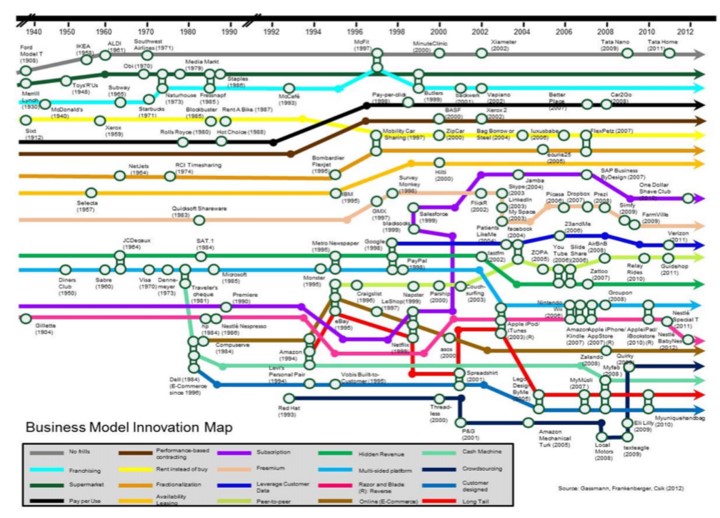
I’ve always been a sucker for inventive strategy taxonomies. One that’s been on my radar for a while has been the ’55 Business Model Patterns’ output from the University of St Gallen (https://www.thegeniusworks.com/wp-content/uploads/2017/06/St-Gallen-Business-Model-Innovation-Paper.pdf). Essentially, each pattern the St Gallen authors identified represents a step-change jump strategy made during successful business innovation attempts. As can be seen from the above image, the authors have done a really nice job of mapping such innovations.

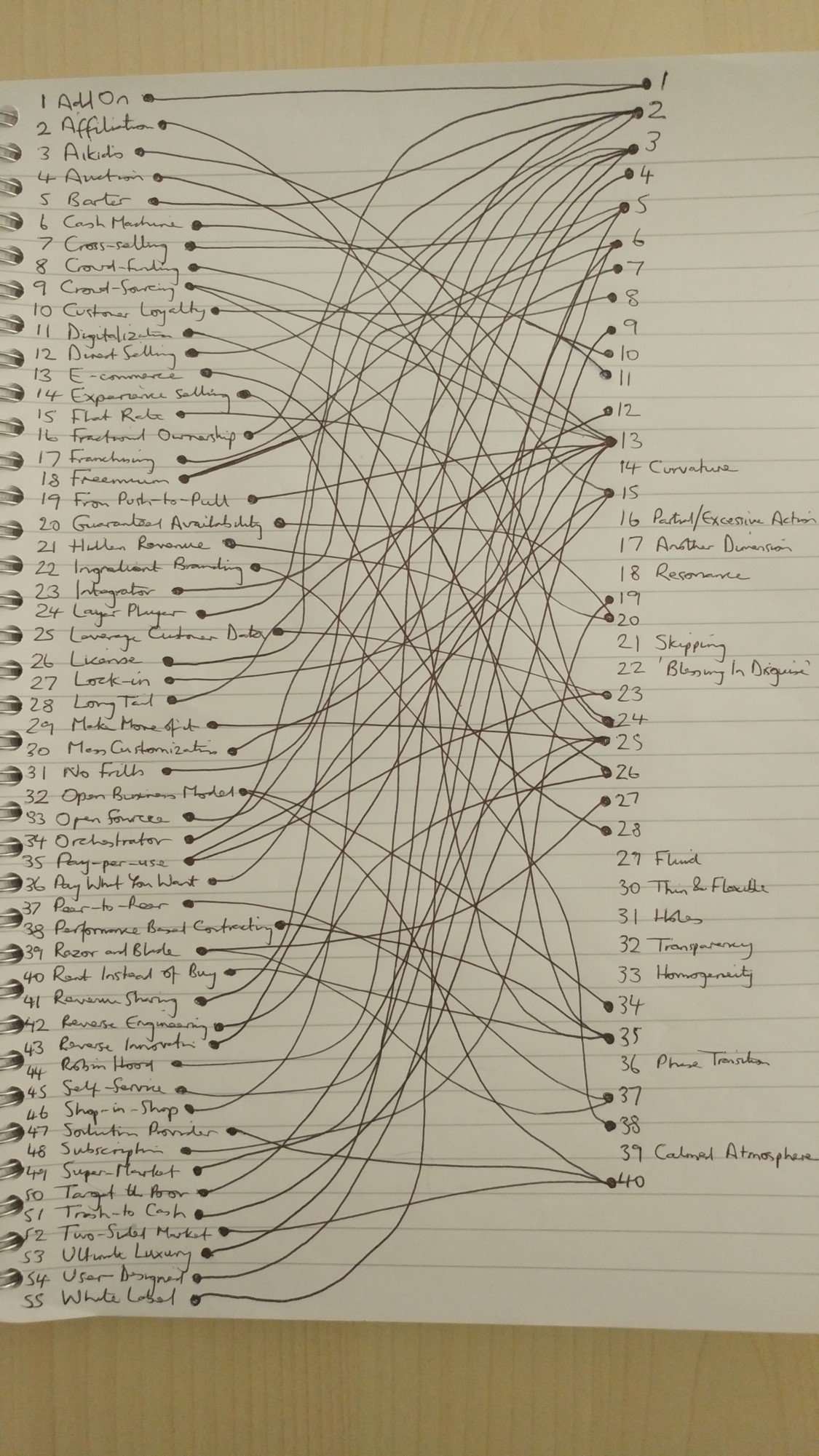
Finally – thanks to a fortuitous parallel job – I’ve had the opportunity to compare the 55 St Gallen patterns with the TRIZ Inventive Principles. Of which, of course, there are only 40… meaning that there must be some kind of taxonomy mismatch contradiction. Especially in light of the fact that the patterns and the Principles are intended to do the same basic job. Here’s the result of my analysis:

…from which it is possible to conclude that what the St Gallen researchers have found is a somewhat partial subset of the total number of step-change jump strategies that are (so far) universally known to exist. Thirteen of the forty Inventive Principles have no corresponding entry in the list of St Gallen Business Model Patterns.

One possible hypothesis we can draw from this discrepancy is that none of the thirteen is relevant in a business model step-change context. This one can be rather swiftly dismissed since it is eminently possible to use any of the thirteen unused Principles to provoke business step change ideas that seem, following a short experiment on my part, to be self-evidently valid.

Another possible hypothesis is that the St Gallen work provides us with some kind of prioritisation model based on the number of times each strategy has been used to deliver a successful business innovation. This is perhaps more credible, albeit, the St Gallen research appears to have considered hundreds of case study examples rather than the millions that can be found in TRIZ. Following through this frequency correlation hypothesis, nevertheless, reveals that the most commonly used Patterns are strongly correlated to the most frequently used Inventive Principles (35, 2,13, 25), so there may well be some useful insight here.

From a TRIZ perspective, finally, we might question whether the St Gallen work adds anything to the story. They certainly haven’t found anything provocation-wise that the TRIZ researchers hadn’t picked up on several decades previously. But one thing I think they have done well is created some short, punchy titles for the patterns that are somewhat more evocative than those found in the TRIZ Inventive Principle taxonomy. The parallel job I’m trying to finish off is a re-issue of the TRIZ playing cards we did a long time ago. Just before we go to print with those cards, I’m wondering whether there’s any merit in exploring the ‘evocative name’ direction. If only because my deck of cards requires a taxonomy structure of 52 rather than 40 or 55.