While our work on the Innovation Capability Maturity Model (ICMM) has not so far taken off in the way I thought it would (biggest problem: people don’t like bad news), we continue to have lots of discussions with senior leadership teams on the subject of building innovation capability. A common question is, ‘what are the top five things we should do to build our capability?’ To which the answer is, ‘it depends’. What it depends on is your ICMM Level. That’s why we built the Model. So we can give meaningful answers to the question.
Far less frequent is the question, ‘what are the five worst things we should do?’ Probably, I believe, because most manager have a (correct) instinct that the answers I’m going to give them are closely aligned with what they have been doing. Or are about to do.
As to be expected, the Top Five Worse things also depend on ICMM Level. Here’s what I think the five different Top Five’s look like, based on the sorts of things I usually and frequently see enterprises doing or not doing. While, I might add, simultaneously striving to be seen to be doing something in order to satisfy the CEO’s request that something be done, and ensuring there is some kind of plausible deniability when it all (inevitably) goes wrong.
So, in the vain hope that by publishing this we might take away some of that plausible deniability, here are my ICMM Level-based Top Five Worst Innovation-Capability building Ideas, ranked in increasing levels of harm:
ICMM Level 1
5) Hold a Dragon’s-Den/Shark-Tank type internal innovation competition
4) Instigate big, sexy high impact innovation targets
3) Set up a centralised ‘idea management’ system
2) Bring in a ‘creativity consultant’ (‘lack of ideas’ is never the problem to be solved)
1) Establish an ‘Innovation Manager’/’Innovation Centre’
ICMM Level 2
=5) Seek to ‘add’ innovation tools to existing operational-excellence toolkits (Lean/SixSigma, etc)
=5) Embark on widespread teaching of innovation tools across the organisation
4) Set innovation-related KPIs based on commercial return
3) Embark on technical innovation projects that also demand a corresponding business innovation. Or vice-versa.
2) Embark on cross-silo innovation projects without cross-silo KPIs
1) Operate innovation projects under operational excellence rules and protocols (KPIs, hourly rates, quality standards, career progression, etc)
ICMM Level 3
5) Not knowing prevailing industry step-chenge pulse rate
4) Not having an disruptor-observatory actively looking for out-of-industry threats
3) Instigating projects that fail the ‘critical mass @ critical point’ test
2) Assuming the same person can have the requisite skills to lead the project from start to finish
1) Not having a CIO/person with a main Board position
ICMM Level 4
5) Are not recruiting/training/placing according to requisite OpEx/Innovation ratio
4) Have not established ‘systems coaching’ for innovation project leads
3) Have not deployed widespread TRIZ/contradiction-solving training
2) Still have matrix-management organisation structure
1) Have not integrated Complex-Adaptive-Systems/OODA thinking into Senior Leadership Team
ICMM Level 5 (NB: there are very few Level 5 enterprises on the planet, and those that do exist are so far ahead of everyone else it seems almost churlish to find fault in what they’re doing. However, for the sake of completeness…)
5) Failure to introduce mechanisms for influencing industry pulse rates
4) Not managing R&D activities according to ‘contradictions-solved/remaining’
3) Failure to maintain step-change scenario opportunity map for target markets
2) Succumbing to hubris
1) Failing to build ‘meaning’ into project design opportunities
Jordan Peterson turns out to be yet another 2D, cardboard cut-out ‘thought-leader’. It took me a while to work out what his two dimensions were, but I unravelled the not-so-mysterious mystery sitting on a plane this week. I know early on that ‘meaning’ was one of the dimensions. That one was easy because I believe my ‘meaning’ radar has been very sensitively tuned since I started reading Edward Matchett’s work. Plus, there’s a whole rule in Peterson’s 12 Rules For Life (7: Pursue What Is Meaningful (Not What Is Expedient)) devoted to the topic. It took me a while, though, to work out his second dimension. Or maybe I was hoping to discover it wasn’t what my initial impressions feared it might be. At first, I thought it was just an annoying feature of 12 Rules For Life. Peterson’s argument building formula. Which seems to go something like this:
1) Assert a hypothesis
2) Illustrate it with a compelling case study or two
3) Make a usually decent stab of describing the surrounding science – usually human psychology- or physiology- based.
4) Quote the Bible
5) QED the point is proven
The contrast between steps three and four being the annoying bit. I have no problem with Peterson – or anyone for that matter – believing in fictional deities, but when they lay their beliefs side by side on equal terms with the accumulated mass of scientific data as if they’re comparing like-with-like it betrays all the tenets of scientific research. And specifically the awkward evidence and proof related bits. Faith can be a wonderful thing, but it can never be proof.
Anyway, that’s none of my business. What is my business is now realising that Peterson is nothing more nor less than a fire-breathing religious preacher, and that religion is his second dimension.
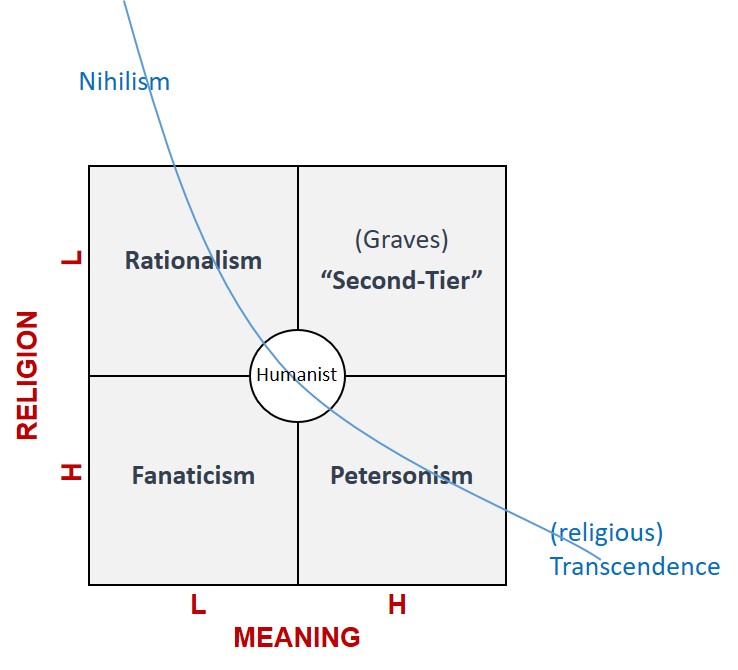
As soon as I had that insight, I was able to draw this 2×2 matrix:
Peterson’s two-dimensional thinking fallacy is all about believing the blue dotted line is a spectrum that people must sit somewhere along. At one end of the spectrum is a person that has zero religious life and zero meaning. The nihilist. At the other is someone who devotes their life to religion and religious study and therefore leads a highly meaningful life. The heart of the fallacy is the word ‘therefore’, since Peterson sees meaning and religion as unbreakably tied. In his terms it is only possible to live a meaningful life if you are religious. By which he specifically means ‘believe in God and study the Bible’. Followers of Peterson are encouraged to live their lives in the bottom right-hand quadrant of the Matrix. There seem to be so many of thee people these days that we can probably safely label the box, ‘Petersonism’.
The whole point of drawing the 2×2 matrices, however, is to make the point that the world always allows for a third dimension, and that – if we’re smart and creative – we’re able to leave the cardboard cut-out 2D world, solve the contradiction and enter the best-of-both-worlds third dimension described by the top-right-hand box. Meaning and religion are, in other words, correlated but not causally. It is perfectly possible – if we think hard and seek to design a better way – to leave a highly meaningful life in the complete absence of religion, God or the Bible. Something a group of far more effective psychology scholars, building on the work of Clare Graves, called ‘second tier’ thinking.
All Peterson is doing in his angry-foghorn rants is encouraging people to move from one end of the spectrum he wrongly (or duplicitously) assumes is fundamental. He’s one of a number of phenomena happening in the world right now that are doing nothing more nor less than inducing a societal pendulum to start shifting back in the direction it came from. About six hundred years ago.
Humans are better than that. The most powerful human trait – the thing that makes us stand out relative to any other living form on the planet – is our ability to design our future. Which is not the same thing at all as seeing the problems of today and in effect saying, look how much better it was yesterday, we all need to go back there. Anyone that understands complex adaptive systems (something Peterson claims to do) knows that you can never step in the same river twice. There is no such thing as ‘going back’ in a complex system. There is only thinking hard, trying things out and – here’s where I absolutely agree with Peterson – have an intention to make our lives of inevitable suffering just that little bit better. One day at a time we have the ability to design a better future for ourselves and – more importantly – for those around us. But to do so we have to put away foolish things. And top of that foolish-things list is the fallacious ‘either/or’ thinking Peterson seems unable or unwilling to escape.
“You could take Michael McIntyre home to meet your granny. You couldn’t take Frankie Boyle home to meet your granny… McIntyre articulated things you hadn’t realised you thought. Boyle articulated things you thought but didn’t feel you ought to articulate.”
If you follow me on Twitter, you might have noticed a flurry of 2×2 matrices recently. They’re becoming a bit of an addiction. Mainly, I think, because they’re as good a way as we’ve yet found to talk about contradictions, and their importance in the innovation story.
I’ve also been reading a lot about comedy in recent weeks. It was a merely a matter of time before the two threads crossed. The link came from reading Stewart Lee’s very excellent book, ‘If You Prefer A Milder Comedian, Please Ask For One’. If you ever want to get a real insight into the mind of someone at the very top of their stand-up game, as far as I can see, this is the place to start. It’s where the quote at the head of this short article came from. Any time I read about this kind of either/or spectrum these days, I’ve learned to recognise that a contradiction, and therefore a 2×2 matrix, isn’t too far away.
First up though, a health warning is perhaps in order. One of the best ways to take the joy out of comedy is to try and deconstruct it. To a large extent the same problem exists in the world of innovation. It’s something the SI research team is acutely conscious of. Many ‘innovators’ and the vast majority of ‘creatives’ I’ve noticed, actively don’t want to ‘destroy the mystery’ of their craft. The more sensible ones – the ones that get the idea that once we unravel one mystery there’s always going to be the ‘next one’ – have a different problem. And that’s the problem of never being able to step in the same river twice. Every complex case is different from every other one, so how can you ever be sure that when we’re reverse engineering previous case studies we’re not finding patterns that don’t actually exist. One of the answers is that you need to be looking at the world through a ‘first principles’ lens. And part of that means, in at least part, looking for contradictions.
That said, it is – as Stewart Lee manages to prove both in his book and on stage – not necessary to destroy the humour by deconstructing the humour. If you get it really – first principles – right, you can get the best of both worlds: analysis of funny stuff that is funnier than the original funny stuff.
I’m not sure I’m good enough to achieve that kind of feat, but I think that, by decoding Lee’s comedy spectrum I can help see why he’s so much better than other stand-ups (apart, maybe, from his wife Bridget Christie who blew me away when I saw her at a gig last month), and as a result, help innovators to see the sort of – first principles again – things they might usefully translate across from the comedy to the innovation world.
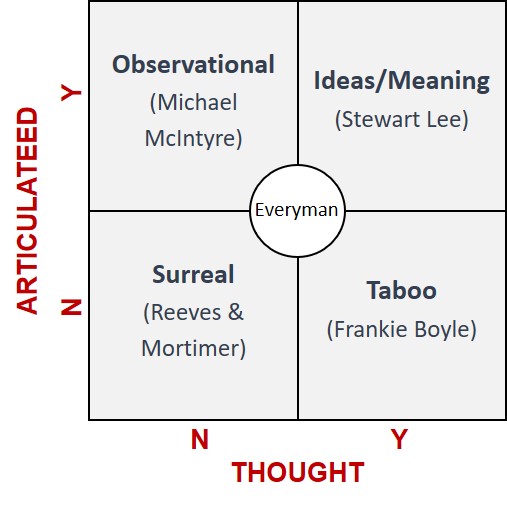
So, to the 2×2 matrix. On one end of Lee’s spectrum is the observational comedy of people like Michael McIntyre. Observational comedians ‘articulate things you hadn’t realised you thought’ (“there’s no love in homes any more because everyone’s fighting for the one phone charger in the kitchen”). The other end is Frankie Boyle-type taboo comedy (try https://www.youtube.com/watch?v=TDBjoSSzI1Y for Boyle’s ‘Top Ten’) – articulating things we were all thinking but daredn’t say. The two ends give us the top-left and bottom-right corners of a matrix with ‘articulated’ and ‘thought’ as the vertical and horizontal dimensions:
Placing the spectrum onto a 2×2 forces a recognition that there are two other boxes to think about. The bottom-left box in this case is the situation where comedians talk about things that people at large have neither thought about before, nor tried to articulate. For me this is the surreal comedy of people plike Reeves & Mortimer (“eranu/uvavu”). The bottom-left corner is rarely a good place to be in 2×2 matrix convention. Reeves and Mortimer have sustained a fairly long career, but very few other surreal comedians have.
Top-right is the place to be if you can. Getting into this box is difficult because it means solving the thought-articulated contradiction. This is the ‘third way’ solution that delivers the best of both worlds. For me, Stewart Lee and Bridget Christie are the two best (only?) exponents of comedians that achieve this feat of magic. They talk about things that we all think about and all talk about, but do it in such a manner that we are exposed to ideas that reveal a higher level meaning.
The top-right box of this comedy matrix is, I believe, the only, part of the 2×2 where new meaning is created. The other three boxes all deliver output that is at best meaningless, or at worst a destroyer of meaning.
A few months ago I wrote an article for the SI ezine all about meaningful and meaningless innovation. 98% of all innovation attempts fail. That’s pretty bad. But what we thought was worse was that 70% of the 2% of ‘successful’ attempts had done so by negatively impacted meaning.
The 2% number tells us that no innovation is easy. The 70% tells us that, if you want to make it as easy as possible, do meaningless stuff. Which predominantly means observing (Michael McIntyre-like) what people didn’t know about themselves and give them a faster, simpler, more convenient, solution that, the moment they think about it they realise its just what they always wanted. Or, if that doesn’t work, do something tasteless or something surreal like a pet-rock.
Personally, though, I think I’m happier working with teams that want to be in the top-right box. Looking at the world we can all already see and already articulate, challenge the contradictions and create a more meaningful, 1+1>2 solutions. You need to watch out for the hecklers though, they can be mean.
I guess, like a lot of country roads, the one that connects our house to the highway is troubled by drive-by litterers. Or at least it has been since a certain fast-food ‘restaurant’ opened six miles down the road.
In our village, we’re lucky that a medal-deserving, 80-year-old hero walks up and down the road once a month filling a carrier bag with discarded fast-food packaging, losing lottery tickets, empty cigarette packets and confectionery wrappers so that the rest of us don’t have to look at other peoples’ detritus everytime they leave the house. In the spirit of ‘doing my bit’, I thought I should take a turn this week. This is what I collected in the first 100yards:
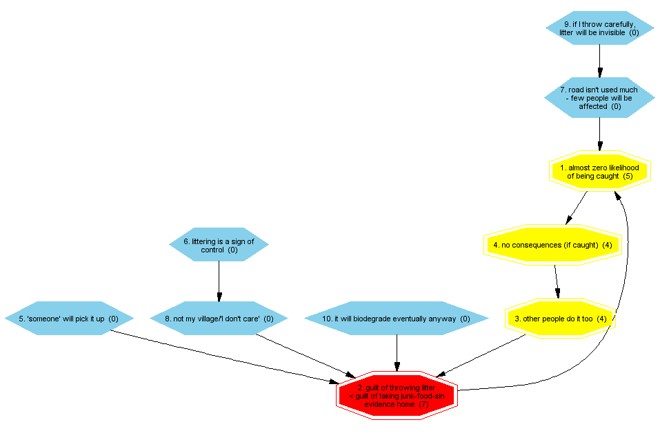
One of the nice consequences of doing something mindless like picking up a mile’s worth of litter (5 carrier bags when I’d finished) is that it offers plenty of time to think about why people throw things out of their cars. I did it for long enough that I ended up with a whole Perception Map’s worth of thoughts. Here’s what happened when I plotted them out:
95% of the litter is the remains of what looks to me like ‘guilt’ purchases. People – mainly men, I’m guessing – that took a sneaky diversion to fast-food-sin-land on their way home and decided that the small feeling of guilt they felt when the threw the packaging out of the car window was lower than the guilt they would be made to experience if, instead, they did the ‘right’ thing and discarded of the litter when they got home. You can probably imagine the scene: he sneaks the Happy Meal debris into the bin, only to find that, even though he thought he’d buried it, the wife still finds it. And then confronts him with it. ‘I spend all day making you dinner, only to have you leave half of it… because, we now see, you’d already filled yourself up with crap before you got home’. Not that I’ve ever been in this situation myself.
According to the map, meanwhile, it is precidely this lesser-of-two-evils issue that sits at the core of my country road litter problem. So now I know what I want – no more litter – and what’s stopping me. I’m not the only person in the world with this contradiction. The Contradiction Matrix tells me that the most frequently used strategies others before me have used to resolve similar conflicts are:
Principle 9 – Prior Counter-Action
Principle 23 – Feedback
Principle 24 – Intermediary
I thought about these for a while. Then I made a phone call to a local farmer. One of his fields borders the road. He laughed. And now we have a plan…
Maybe its because I’ve been reading too much Jordan Peterson recently. Or maybe it was re-reading AntiFragile? Whether I need to blame Peterson or Taleb, my Generation-Snowflake radar has been particularly sensitive these last few weeks.
The levels of fragility in many of the students I’ve been meeting is reaching frightening proportions. Not helped, I might add by certain members of the media seemingly bamboozled by a belief that offence taken by a particularly fragile little (Millennial) flower somehow trumps another person’s freedom of speech. Or inconvenient truth.
Anyway, I heard the expression ‘Peak Snowflake’ during my trip to the US earlier this month. The context being, ‘could this political correctness horseshit possibly get any worse?’ Is the level of Millennial fragility going to get even higher than it is right now, or do we still have a way to go?
Answer: by my reckoning, we still have one or two years of nausea ahead.
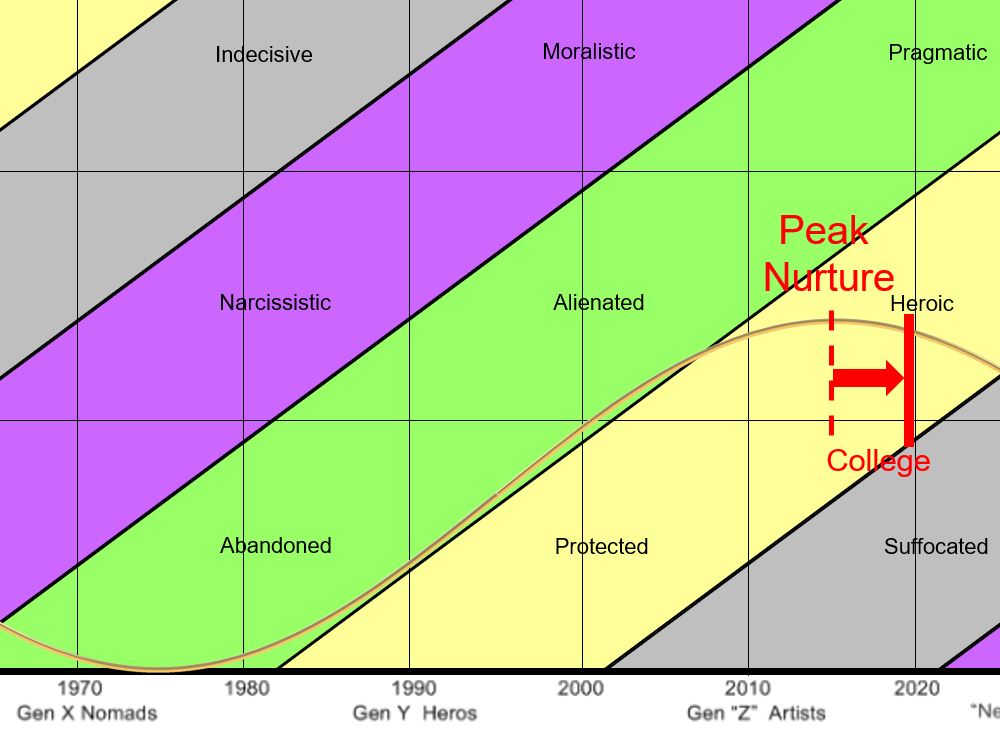
Peak Nurture was around 2015. Parents, in other words, are starting to get the message that the suffocation of their precious offspring is not a wholly good idea.
But then that isn’t the end of the story. If the kids go to college, they’re going to be exposed to a whole extra level of molly-coddling and the half-baked, delusional ideologies of the liberal-arts intelligentsia. Add a year after graduation for all the nonsense to percolate, and that gives us a Peak Snowflake date coinciding with, most likely, the Class of 2020.
Careful with that axe, Eugene, we still have a way to go.
I’ve turned my library upsidedown three times now and I still can’t find the book where I read about the Native American belief that we all have 87 problems in life. I can’t find any reference to the idea on the Web either. If I didn’t know better, I might be inclined to believe its something I dreamed. In some ways, that’s quite a nice idea. Rather than have ‘failing memory’ as one of my 87 problems.
The full ’87 problems’ idea, meanwhile, is that whenever we solve one of our 87 problems, a new one is sure to appear to restore the requisite number of problems.
Over the years, when I’ve had occasion to mention the idea to others, I notice two reactions. The first (most common) one is a look of horror, followed by a furrowed brow and then a discussion about how the idea contradicts their life strategy of trying to find ‘happiness’. Here’s the kind of person who seeks to avoid problems by progressively cocooning themselves from the real world. Or, if I accept the Native American logic, its the person that, if we really do always have 87 problems to contend with, seeks to substitute big ones with progressively smaller and smaller ones, until, perhaps, finally, the eventual 87 are each no bigger than the hassle of trying to get the last drop out of the toothpaste tube?
At the other end of the reaction spectrum, then, are the shoulder-shrugging nihilists whose immediate reaction to the 87 problems idea is ‘blimey, what if I solve a problem and receive a worse one in its place? Rather than take the risk, why bother trying to solve any more problems?’
I have to admit, I occasionally have some sympathy with both extremes of the spectrum. Then again, being one of those annoying ‘third-way’ people, I feel that my best strategy is to make sure I’m always working my way through the ‘right’ 87 problems.
Which perhaps make the issue of establishing what ‘right’ means becomes one of my 87.
While that doesn’t feel like such a bad idea, it also feels a bit abstract.
But then again, I know it ought to have something to do with ‘meaning’. And probably also ‘mastery’ of whatever it is I decide I should knuckle-down and do.
This is the moment when I find myself connecting to the now largely discredited idea of Malcolm Gladwell that it takes 10,000 hours to master anything. I have person experience of the fallacy of the idea. There being several things that I know I’ve devoted more than 10,000 hours to and still feel like an absolute novice.
Connecting the Native Indian and Gladwell dots, however, something begins to dawn on me. The reason my 10,000 hours of guitar playing hasn’t resulted in sold-out concerts at Madison Square Garden is because I rarely if ever solve any problems when I’m trying to play. If something gets difficult – there are a couple of tricky licks in Johnny B Goode for example – its too easy to give up and move on to playing something else.
On the other hand, there are other areas of life where I think I’ve achieved something like mastery in a lot less than 10,000 hours. These are the parts of (work, sadly!) life where my strategy has been – as TRIZ tells me – to actively run towards the difficult stuff. These are the areas where, even though I haven’t done my requisite hours, I have solved a requisite number of difficult problems. And by ‘difficult’, sticking with TRIZ, I obviously mean contradictions. And by ‘requisite’, sticking with my elusive Native American aphorism, I probably mean 87.
Mastery, in other words, is what happens when we’ve solved 87 contradictions in a chosen domain.
Which sounds like a pretty good piece of research to do. What were the 87 contradictions Lennon and McCartney worked their way through prior to Please Please Me? And was one of them that damn lick from Johnny B Goode?
If I believe in the Lindy Effect, the most antifragile industry ought to be the oldest industry. There’s probably a lot of truth in that idea. Except there’s a problem: the oldest industry, as far as I can tell, is an industry that still consists for the most part as large numbers of individual, ahem, ‘artisans’.
Artisans are one of the few instances of life’s skin-in-the-game heroes if I read Nassim Taleb’s work correctly. The other heroes are entrepreneurs.
There’s a problem here, I think. For society to function, there are things that need to be done that go quite some distance beyond the capability of individual artisans and entrepreneurs. For the thirty-plus people attending the AntiFragile get-together in London on Tuesday, for example, their timely arrival was only made possible thanks to the coordination of several thousand employees of Transport For London.
Looked at in that sense, I think there’s a need to re-calibrate the ‘antifragile industry’ question. To some extent, TFL – and other large enterprises – do what they do with thousands of employees who have little skin-in-the-game above and beyond the possibility they might lose their employment if they don’t do the work that’s asked of them. But then, to quote W. Edwards Deming, ‘no-one comes to work to deliberately do a bad job’. Despite the dumb things I sometimes see bosses asking them to do. Maybe a half-decent salary and a desire to serve the customer, when scaled up to include each individual in the organisation is sufficient to deliver requisite collective skin-in-the-game at the enterprise level? Maybe the individuals that put up with the crap dished down to them from above and still do a great job for their customers are the real heroes in life? Maybe it is this sense of collective responsibility to do the right thing that keeps society on an even keel?
Either way, I think there’s something significant missing from Taleb’s perspective on the heroes and villains of modern life. To divide the world into individual skin-in-the-game heroes and the villainous rest represents a failure to accept the possibility that we don’t live in an either/or world. It is possible – as nearly every large enterprise on the planet demonstrates – to have the best of both worlds. Not every organisation, of course. I completely agree with Taleb’s perspectives on organisations like Monsanto or, my own ‘favourite’, SAP, in both cases collectives of individuals – none of whom come to work to do a bad job – that can very easily be seen to deliver considerable collective harm.
One hopes that organisations like this will prove to be very fragile. 90% of the enterprises on the original Fortune 500 list no longer exist. They turned out to be very fragile indeed.
So what about the large enterprises that do prevail in the long term? Which of them is the most antifragile?
In my opinion, the answer to this question is the aerospace industry. Even though it has only existed for the last hundred years. By definition, everything that happened after the Wright Brothers flew at Kitty Hawk in 1903, getting people into the air safely has demanded large numbers of people working together. And because the industry very quickly learned that when people die in aeroplane crashes that is very bad news, ‘safety’ became the absolute. It therefore embarked on a very rigorous journey of building better and better safety protocols. At the same time, I might add, as also constantly innovating. The 100 year jump from the Wright Brother’s efforts and an Airbus A380 is quite mind-blowing if you think about it.
The aerospace industry is the most antifragile because it has to solve the safety AND innovation contradictions every day of its existence. And that is only achieved by making sure everyone in the industry learns from anything and everything that ever goes wrong. Every incident is investigated and the findings are shared across the industry to make sure the incident has as little chance of being repeated as possible.
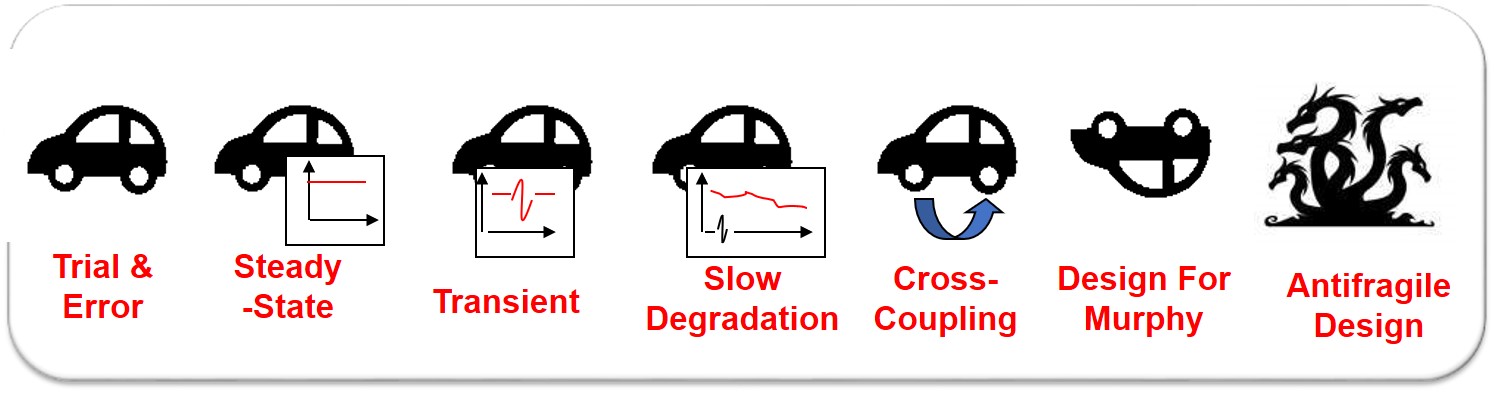
As it happens, I started my career in the aerospace industry. I worked there for fifteen years. When I left to begin working in other domains, it took me a while to realise that not everyone saw the world in the way that had become the norm in aerospace. The cognitive dissonance was one of the things that prompted us to reverse engineer the evolution journey of the industry and to formulate the ‘Resilient Design’ evolution trend pattern:
Tracing back through the evolution of the design methods deployed in the industry, it was possible to identify a number of step-changes in capability. Design method s-curves if you like. That’s what each stage on the trend picture is intended to represent.
The latest stage on the trend – ‘antifragile design’ – is where I think the industry is pretty much at these days. In the 1990s we used to talk a lot about – and design for – ‘Murphy’. In a Design-for-Murphy world you’re forced to accept that customers will occasionally do stupid things, but that when they do such things, the aircraft should still be resilient enough to make sure that everyone gets down onto the ground again in one piece. Nowadays, thanks to scenarios like GermanWings Flight 9525, when a co-pilot decided to commit suicide with 144 passengers and five other crew members on board, the industry has evolved capabilities to ensure it’s a one-off. The outcome for the 150 unfortunate souls on Flight 9525 wasn’t good, but for the rest of us, their story means we can take to the skies safe in the knowledge that the aerospace industry was made stronger as a result.
When I look at – and work with – other industries, one of the first things I look to calibrate myself on is how far along the Resilient Design trend pattern are they – actually, we should be looking to rename the trend ‘AntiFragile Design’ – in order to better understand how we set about innovating with them.
Transport For London, much as they succeed in getting millions of commuters to their destination kind of on time most days of the year, is still essentially at the second stage of the trend. As anyone who’s ever tried to get across London following the (transient) arrival of half an inch of snow will attest, there are days when the system is very fragile indeed.
Someone at the AntFragile meeting earlier this week asked me whether it was possible to use this trend-pattern way of thinking to decide where to invest money. I’ve forgotten the answer I gave at the time, other than remembering it was horribly glib. If I could turn back to the moment of the question again, I think I’d probably answer that I don’t invest in any kinds of stocks or shares because I can’t think of any bank or broker that’s ever reached the third stage of the Resilient Design trend. Also, I don’t know whether its possible to invest in an ‘industry’… i.e. I’d quite happily invest in the antifragile aerospace industry, but am somewhat less clear about investing in any individual aerospace company, given the potential possibility that at any given moment they might have a very fragile management team in charge. I think, if I could ever motivate myself to spend time thinking about stocks and shares, I would very definitely do it by looking at the Resilient Design (AntiFragile Design) level of the enterprises I’m thinking of investing in. Which, thinking about it, is the reason why I don’t invest in anything other than our own business. And the things we occasionally spin-out. We know the trend pattern, but we’re still very much in the minority. The vast majority of enterprises on the planet don’t know the pattern and therefore, in my eyes are all very fragile. Even if they might happen to have a lot of money stashed away in the bank at the moment.
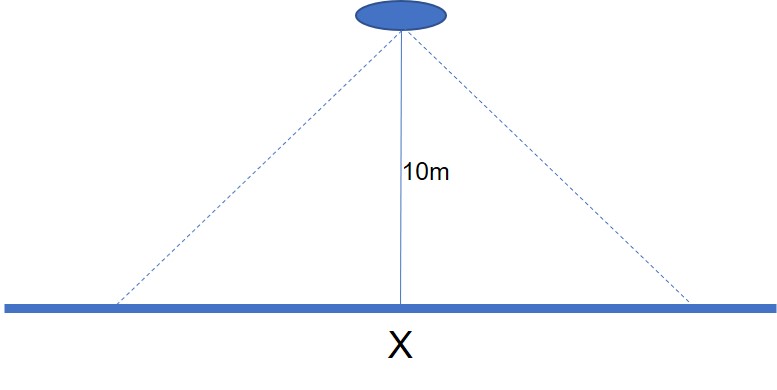
Imagine an archer facing a wall 10 metres away and about to fire lots of arrows at it. The archer is not so accurate and will shoot randomly within a plus or minus 45-degree angle as shown in the figure:
The question is, if X is the point on the wall directly perpendicular to where the archer is standing, when lots and lots of arrows have been fired, what’s the average position along the wall that they will end up?
The answer is, of course, that X marks the average.
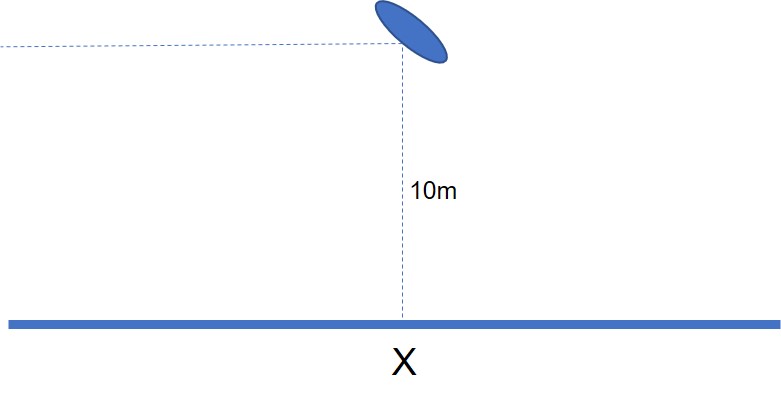
Now let’s rotate the archer by 45-degrees and, retaining the same plus or minus 45-degrees random accuracy range, what will be the average position on the wall after firing lots and lots of arrows this time?
This calculation is a little bit more difficult unless you can remember some of your school-level trigonometry class work on right angled-triangles and tangents being opposite over adjacent.
Most people’s instincts let them down when trying to answer this question.
What are your instincts telling you right now?
If you had to answer the question, what would you say?
I went to a Twitter-sparked AntiFragile meeting yesterday and Mark Baker (aka the rather famous @guruanaerobic) showed everyone a lovely sequence of YouTube videos of a father talking his son’s through the problem. If you’ve ever got 20 minutes to spare, you should watch them (https://mikesmathpage.wordpress.com/2018/04/08/sharing-an-advanced-expected-value-problem-from-nassim-taleb-with-kids/).
It offers an inspiring journey involving a computer programme that allowed the kids to fire millions of random arrows at the wall and see what the average distance from X turns out to be. The main learning being that their (and I think most people’s) instincts are quite badly mis-calibrated.
The answer, in case you’re interested, is infinity.
Most people can’t imagine this could be the case. That’s because most situations we encounter in life are like the first, symmetrical version of the problem. In this version, the arrows all hit the wall and thanks to the symmetry are equally likely to end up one side or other of the X point. Which then means that, the more random arrows we fire the more likely everything balances out to make X the average. This problem is convergent.
In the second case, however, not only is there an asymmetry, but there is also the possibility that a fired arrow might end up being fired exactly parallel to the wall, in which case it will never hit the wall. This second problem contains a non-linearity. Remote as the extreme possibility might be (it is, after all, right at the limits of the range of randomness of the archer), it is nevertheless a finite possibility. The more arrows the archer randomly fires, the more likely this remote possibility comes true.
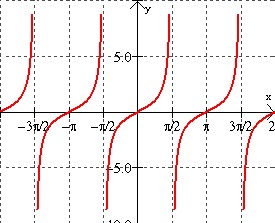
Anyone that can remember those trigonometry lessons will have a vague recollection that the tangent graph contains exponential characteristics. And whenever we see such a phenomenon – they’re everywhere in the real-world (for example in s-curves) – we know that our human instinct for linearity is no longer a good idea.
The father-son videos offer up an inspiring illustration of kids re-thinking their instincts. The magic in the videos comes from the way dad gets his sons to hypothesise their answers and then runs increasingly more simulations to test them. It’s great learning.
One of the points I tried to make during my 20 minute ‘this is what antifragile means to me’ post-lunch diatribe was that the aerospace industry is the safest industry on the planet because it has learned to be more antifragile than other industries. Accepting the non-linearity of the world, like what dawned on the kids in the video, was an early stage in this journey.
Later on, you begin to realise that running millions of trials to test your non-linear hypotheses is a very expensive business. I once destroyed a jet engine on test. The rate of spend during the failure was around £2M per second in today’s money. Spending like that makes you quickly recognise you have a contradiction – you want to continue to be the safest industry on the planet but you also need to innovate and try new things without spending all your money exploding thousands of expensive engines. The way you solve this contradiction is you work out what the worst case is, then add a big safety margin, and then design for that. You quickly learn that you don’t learn anything from doing millions and millions of ‘average’ things. Averages are pretty much meaningless in complex, non-linear worlds.
An aerospace engineer tasked with working out the second archer problem has retrained their instincts to not need millions of trials to know the answer is infinity. You only need to run one trial: the extreme one. The worst case in the second archer problem is that the arrow flies parallel to the wall and thus never hits the wall. The extreme X answer is therefore infinity. Calculating the ‘average’ is then going to be done by summing all of the distances from x from each random arrow, then dividing by the number of arrows fired.. When the extreme case happens the number of arrows fired will have been finite, the average is going to be infinity-divided-by-a-finite-number. Which equals infinity.
Retraining our linearity-assuming brains to acknowledge non-linearity is hard. Even though the kids in the video learned something important, they’d need to see a bunch more examples of non-linearity to really get the point. The point is the journey. Retraining our (first principle-holding) brains to shift away from averages to extremes, however, is somewhat easier. It’s also a good step in the antifragile direction. One smart (extreme antifragile) trial always beats a billion dumb (random/average) ones.
This just in from the research team: most innovation is meaningless. Or, worse, serves to diminish meaning. That’s ‘meaning’ as in the raison d’etre of human lives. Humans being meaning-makers.
Or at least that’s what I thought we were. Now it seems we spend the majority of our innovation time making lives more convenient. Or more superficial.
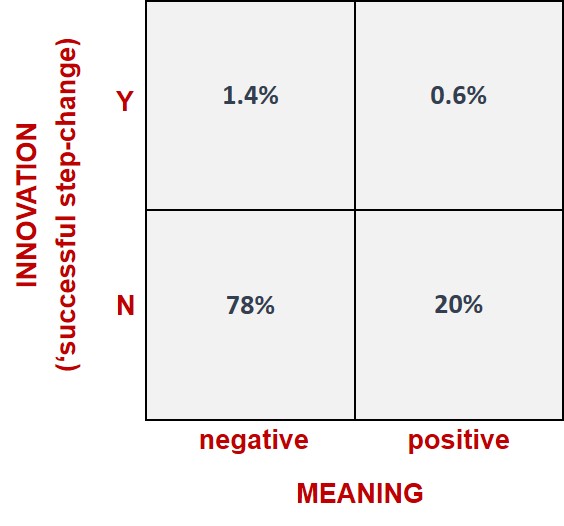
This is what the high-level summary of the six-month analysis looks like:
The 2×2 matrix plots meaning and innovation. ‘Innovation’ is defined in our usual ‘successful step-change’ terms. The top row of the Matrix shows there has been no change in the overall 98% failure rate of innovation attempts. That overall number has barely shifted in all of our analyses over the course of the last eight years.
Now we can break the number down further into successful innovation attempts that were meaningful versus those that were not. The ratio of meaningful-to-not is revealed to be 0.6/1.4, which means 30% of successful innovation attempts deliver increased meaning, and 70% are either meaning-neutral or diminish meaning. The biggest offenders in this 70% are innovations aimed at increasing the convenience of consumers. The food and beverage sector looking particularly bad. From food delivery apps to eat-on-the-go-breakfast-drinks, from microwave puddings to easy-peel oranges, here’s an industry that seems to have largely forgotten that the preparation and consumption of food is supposed to be a meaningful act.
The ratio of meaningful to meaningless gets even worse when we then look at the bottom row of the matrix, with a shade over 20% of failed innovation attempts seeking to increase meaning, and the remaining 80% don’t. Looking at the ‘meaning’ columns of the matrix reveals that, overall, 79.4% of innovation attempts are meaningless and 20.6% are meaningful.
That feels like an awful lot of wasted effort to me.
The ‘meaning’ data comes from the PanSensic ABC-M tool, which we used to analyse consumer feedback on several thousand novel products and services launched in the last two years.
More details will be presented in the May issue of the Sytematic Innovation e-zine. Meanwhile, I thought it would be good to plant the ‘meaningless’ seed in peoples’ minds ahead of time. Smile.
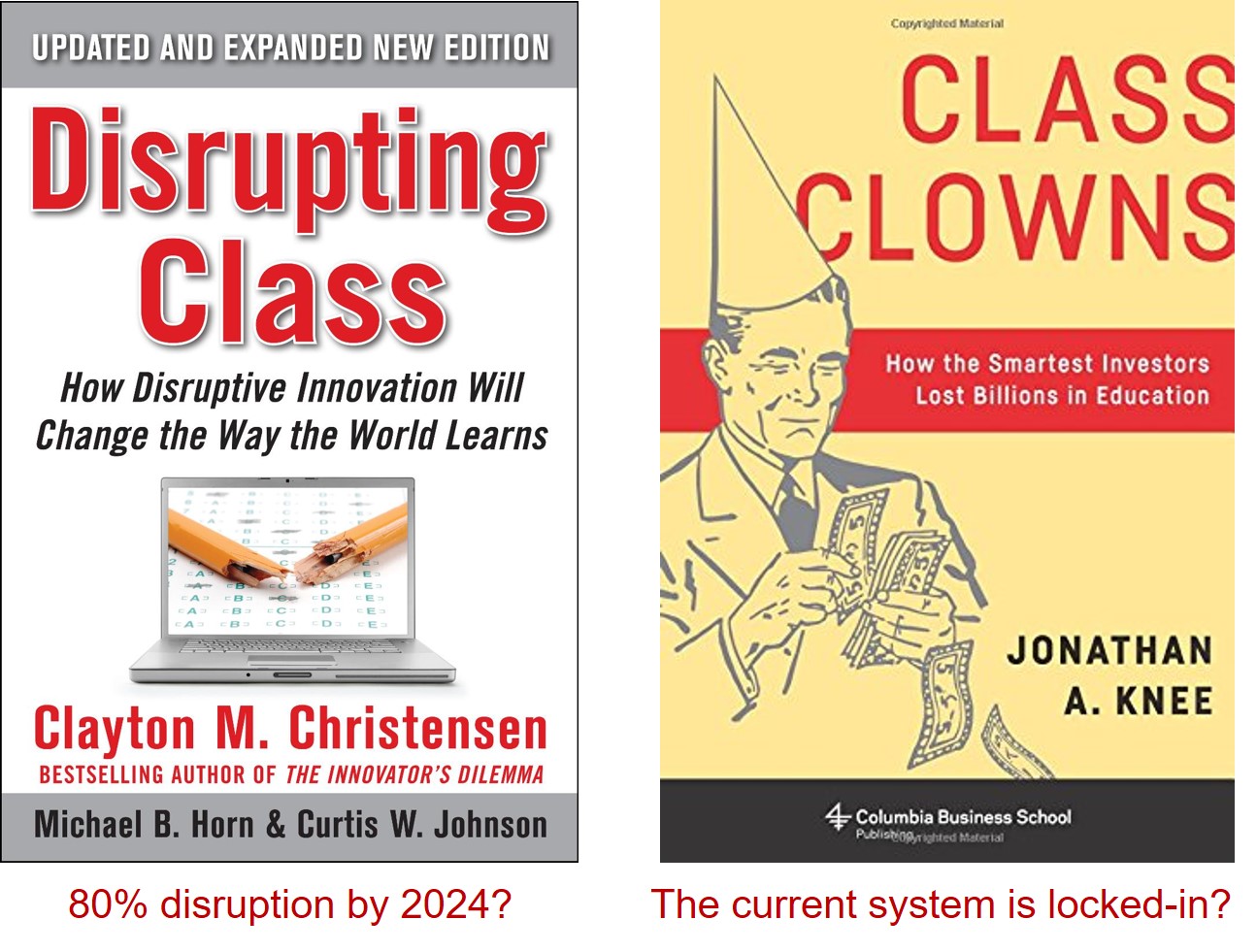
The best part about working with Millennials is their passion to do big things and make a difference. I was working with a number of young teachers this week. Their passion was to innovate in the education sector. The Clay Christensen view of education, if you believe his book Disrupting Class, is that the whole shebang is going to be disrupted in the next 6 years. On the other hand, if you read Class Clowns, it tells a very different story. A story of how many big would-be disruptors have lost billions of dollars in the last decade trying to disrupt education and failing miserably. My take-away from Class Clowns is that the whole system is locked-in.
Tell passionate change-agent Millennial educators the Christensen story and they rub their hands with glee. Tell them the Class Clown locked-in scenario story and they get quite depressed. How do you make a difference if the system proves to be impossible to change?
Well, one answer, is that you keep chipping away at as many of the problems as you can until you find a way through the maze. The other answer – the (Nomad) pragmatist’s answer – is that if you’re an innovator a certain amount of banging-your-head-a-brick-wall is a prerequisite, but you should only do it for so long before allowing yourself to wonder whether there might be some other, easier, walls to knock down somewhere else.
Then came my flash-of-the-blinding-obvious moment. This desire to not bang your head against brick walls leads to a significant winner-takes-all bifurcation: innovators sooner or later all migrate to organisations (or industries) that are good at innovation. The converse of which is that organisations (or industries – like education) that aren’t good at innovation become even less likely to be able to innovate in the future, because all the innovators have migrated elsewhere.
Innovation Capability Level 4 enterprises are progressively more likely to evolve to Level 5; Level 1 enterprises are progressively more likely to stay stalled at Level 1. The good get better; the bad get worse…
…until, the bad get so bad they either collapse, and/or, more likely – thanks Clay – eventually get disrupted by the good. And so, per the trend, the winner takes it all.
Which, if I apply this to my Millennial teacher friends, means the best way for them to make the difference they’re so desperate to make, is to leave the current education system and go work for one of the enterprises that do innovation well. Then, if they still want to make a difference in the education sector, the only other thing they need to do is choose an innovator that will sooner or later become one of Christensen’s predicting Class disruptors. It might take a bit longer to get there, but it’s a strategy that will get there. The shortest path between two points is rarely a straight line in innovation world. Winner takes all…
…until, of coure, the natural law of the meta S-curve kicks in. Innovators like innovating. Enterprises need innovation, but they also need operational excellence and the proper execution of the mundane day-to-day business. When the balance between operational excellence and innovation tips in the wrong direction, that’s when the trouble starts again, and a different winner takes all.