Engineers Versus The World Of Sales & Marketing

When I worked at Rolls-Royce, there was a joke that went something along the lines, ‘how do you remember whether it was Henry Royce or Charles Rolls who was the engineering genius? Answer: Rolls was the sales and marketing person, that’s why his name comes first’.

It was telling at the time, and I still see it most places I go. The Sales and Marketing people are the ones most likely to earn the big bucks and climb the corporate ladder the fastest. Is this because they’re inherently ‘better’? Or is it because they’ve understood how the business world works far better than the Engineers and Scientists?

If I were to exaggerate what this means, I’d say the Engineers and Scientists are allergic to corporate bullshit and much more interested in the next exciting problem to work on, whereas the Sales and Marketing people know they’re supposed to let everyone know how much they contributed to the last success before taking on their next challenge. To be slightly cynical about what I see, the Sales and Marketing people use their skills to sell and market themselves as well as – if not better than – the products and services the sell and market to customers.

Case in point. I’ve been working with a group of engineers and scientists at a big multi-national for the last few months. Never have I seen a harder-working group of individuals. Nor have I seen one so frustrated at their inability to find any time to do anything other than the urgent day-to-day ‘operational excellence’ work. I’m supposed to help them to innovate. So far I’m not winning. Operational Excellence beats innovation every hour of every day of every week in their world.

One of the engineers, bless him, told me he’d just used some of our innovation tools to help solve a customer problem. Great, I said, how much was that worth to the Company? Silence. I let the silence build. Whoever spoke next was going to have to reveal something important. The silence continued. I wasn’t going to lose this one. Finally, the engineer reluctantly squirmed and offered me an embarrassed-sounding explanation to the effect that improvements in customer satisfaction were intangible and couldn’t be quantified.

Now I had a dilemma. I’d been teaching the group about complex adaptive systems and so we all knew that there was almost no way of establishing the value of any change unless a very carefully conducted back to back experiment had been configured and conducted. And even then, in true ‘you can never step in the same river twice’ fashion, you still can’t be sure whether your intervention had a quantifiable benefit. This message seemed to have gone in. He was right: there had been no back-to-back experiment in his situation and so customer satisfaction improvements couldn’t be translated into a project value.

But then the other side of the dilemma was the knowledge that the Sales & Marketing people know that the real world might be complex, but the business world is all about sales and marketing. Their view of the world is that it is eminently possible to make a correlation between a percentage point increase in customer satisfaction and how much monetary value that has to the business. Sometimes they even write the method up (‘someone somewhere already solved your problem’, right?). Sometimes you find papers that publish formulas like this:
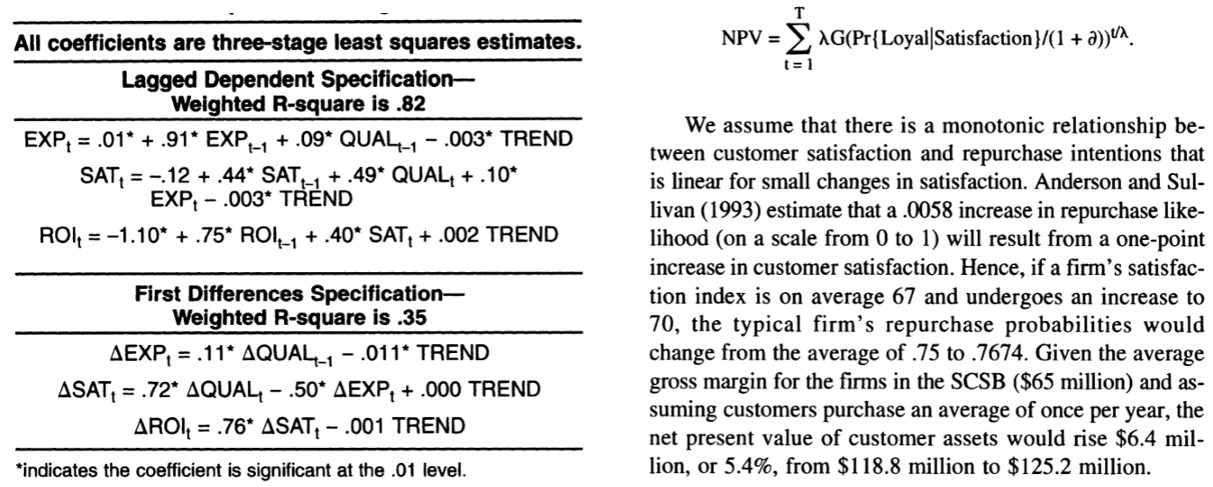
This is a classic example of what I refer to as ‘crackpot rigour’. From a complex systems perspective it is complete and utter nonsense. From a Sales & Marketing perspective, however, it is ‘evidence’. At first glance, to some, very convincing evidence. Someone did some maths. Moreover, though, it is ‘plausible deniability’. Which means that when anyone challenges you on the fictitious numbers you might create using the formula for the increase in customer satisfaction you just achieved (fictional though that probably is too, no matter what ‘scientific method’ you used to demonstrate the improvement), you simply point them to the reference. Then, assuming they even both to look, they’ll see something that looks like the maths no-one normal human understands. If they don’t understand it, they figure, neither will their boss. And then things get even better: if they use the reference when their boss challenges them on the numbers, the boss can’t admit that they don’t understand the maths. Rather, they are more likely to be impressed that the people below them are smart enough to understand this kind of gobbledy-gook. And, hey presto, everyone is bought into the numbers.

Suddenly, the ‘intangible’ increase in customer satisfaction the engineer thought couldn’t be quantified, has a very clear number attached to it: every percentage increase in customer satisfaction in our business unit is worth $350,570 in incremental future sales, and hence this project has just delivered $848,652 in tangible value to the Company. Boom.

If I’m sounding cynical here, I propose it’s exactly the same kind of cynicism that allowed people like Jack Welch to stand up and tell the world that GE ‘saved $9B using Six Sigma’. Or Sergey Brin to say in 2012 that all his Google employees would be driving autonomous vehicles within a year, and that by 2018, we’d all be able to pop down to our local car-delaership and buy one. It’s all a lie. But – and here’s the important point – if we do it right it’s a useful lie. If you don’t think you could live with your conscience making up fictitious numbers, remember what’s behind the message when people like Welch and Brin espouse this kind of quantified-fiction nonsense. They know its nonsense, but its nonsense that tells people in the organisation where they should be heading. What gets measured gets done. Connecting customer satisfaction to revenue is pure fiction, but its good fiction. In that it tells everyone in the organisation that improving customer satisfaction is a fundamentally good thing to do.
Requisite Skin?

At the risk of beginning to sound like a broken record, here’s another rant about Nassim Nicholas Taleb’s apparent either/or worldview. In that world, people have either got ‘skin in the game’ or they don’t have skin in the game: they’re either good or bad. In this way journalists, academics, bankers, lawyers and politicians all fall on the bad side of the line and artisans, entrepreneurs and suicide bombers all fall on the other.

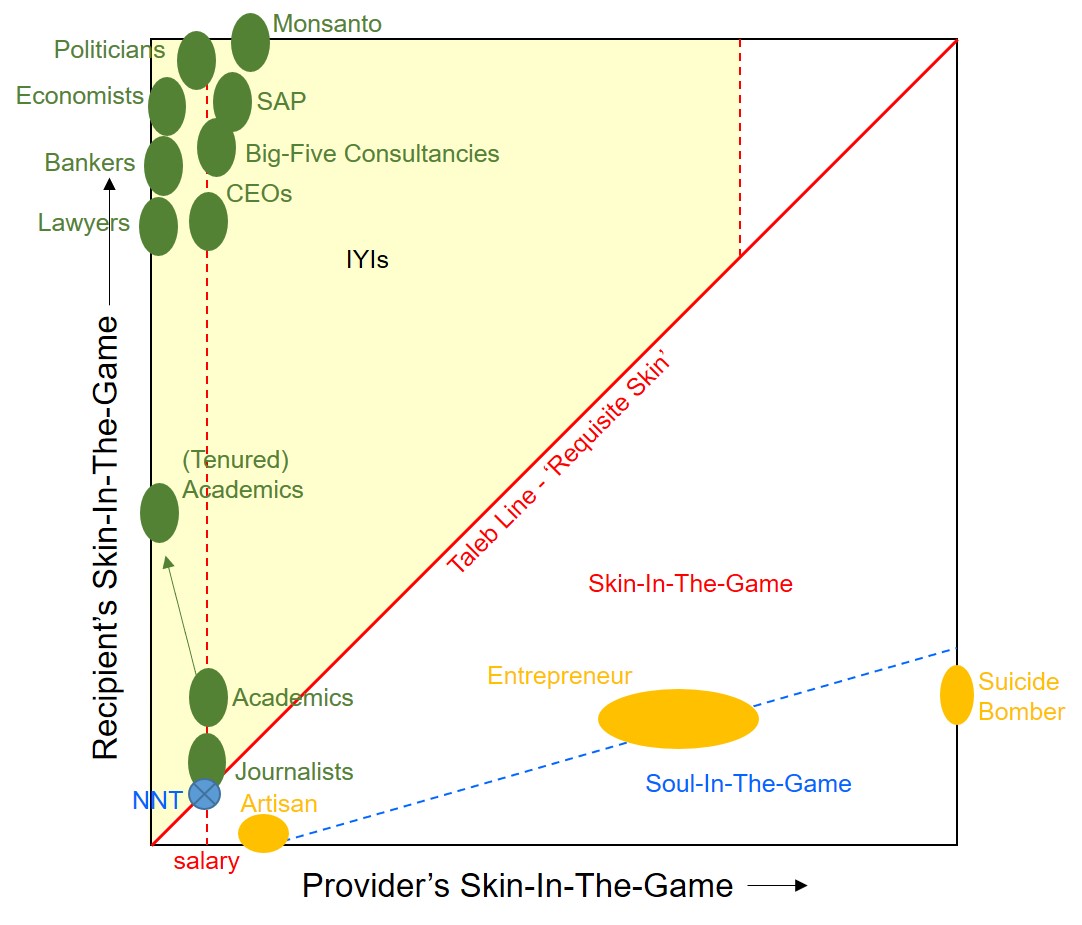
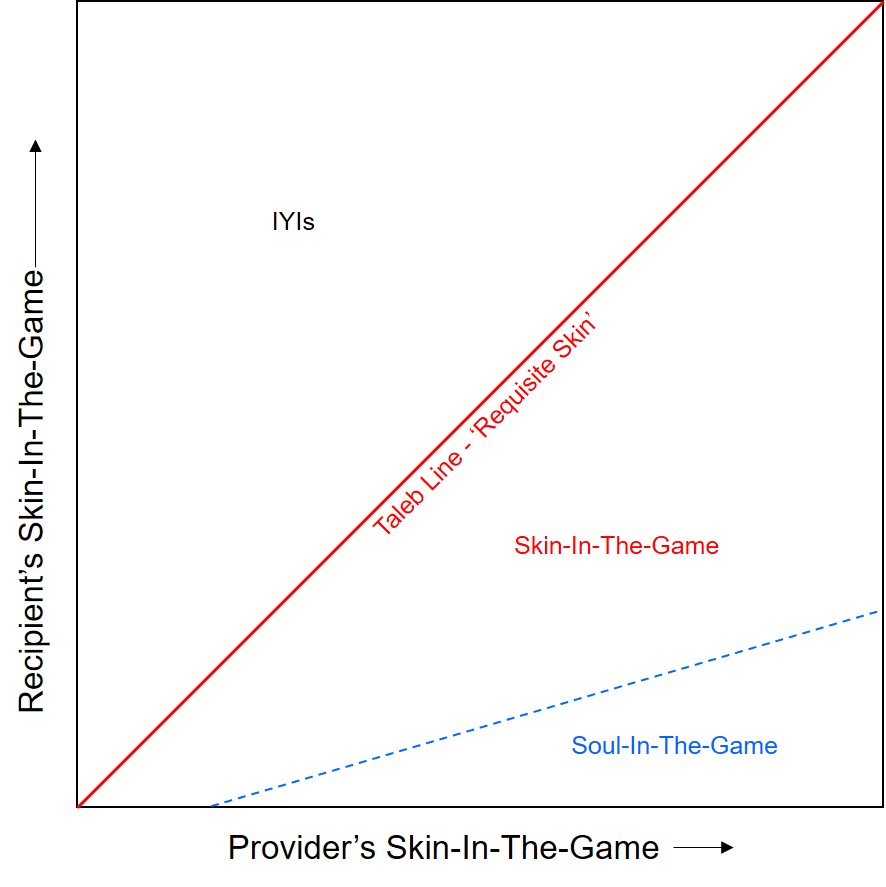
To overcome the futility of either/or debates, I thought it might be a good idea to create some kind of a skin-in-the-game landscape. Drawing such I landscape, I figured, might be a way to capture the relative amounts of skin that different professions might have, and the relative amount of skin the people listening to them might have. Here’s the basic idea:

One of the things that I see causing the most push-back to Taleb is the view that all of us have, to some extent, skin in whatever games we choose to play. In that if we do something bad, at work for example, there is the possibility that we lose our job and therefore our source of income. That said, some professions are more likely to sack wayward employees than others. Journalists live on a fairly precarious employment knife-edge these days, whereas few if any bankers or lawyers find themselves out of work as a result of their mistakes. Any sensible skin, landscape, therefore needs to relativise skin in some way. The landscape image attempts to do this via the diagonal ‘Taleb Line’ or ‘Requisite Skin’ line. The idea behind this line is that if I’m advising a client, the amount of skin I possess in my game should be proportional to the amount of skin the client expose themselves to by following my advice. If my bad advice risks N% of the turnover of the client’s enterprise, if I have requisite skin in the game, I should risk N% of my annual income as a sign to the client that I believe in what I’m telling them to do. Above this line means the client’s risk is proportionately greater than mine; below the line and my risk is proportionately greater than theirs.

The figure also allows for Taleb’s acknowledgement of a third kind of person, down in the bottom right hand corner of the landscape, the (relatively rare) individuals with ‘soul in the game’.

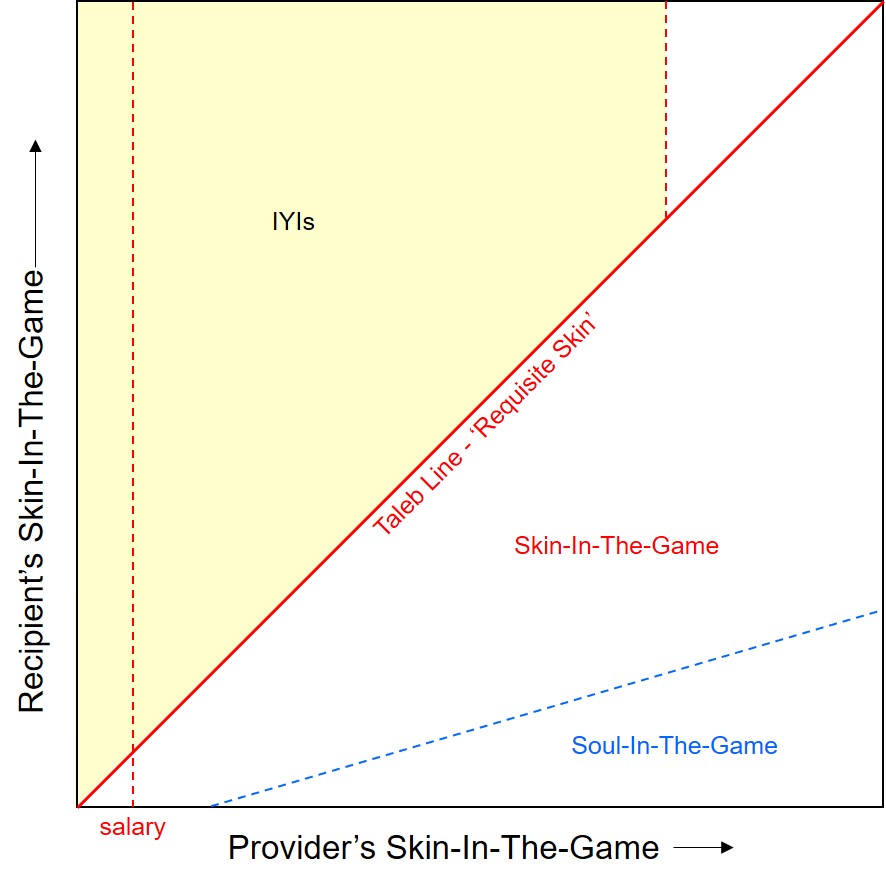
The next thing we can do to continue the relativisation journey is to add in a couple of vertical lines. The first one indicates the skin associated with a person’s salary. The second one, set at a much higher level of skin in the provider’s game is a (perhaps hypothetical) level of skin beyond which no individual or provider organisation could hope to match the skin commitments of the recipient. The thinking here is that there are certain capital-intensive construction or infrastructure projects that can only be afforded by recipients capable of mitigating their risks by means other than those coming from the provider. Of the two lines, the salary line is probably the more important one in terms of hopefully helping to answer the complaints of Taleb detractors.

Now we have defined the landscape, we can start adding a few data points to it. In this next image, in green, I’ve tried to pick out one or two of Taleb’s Intellectual Yet Idiot (IYIs) victims, plus one or two of my own. And in orange some of Taleb’s ‘do have skin in the game’ heroes. Or maybe, in the case of suicide bombers, not so much ‘heroes’ as ‘people with a very high level of soul in their game’ (which is why the problems they’re associated with are so difficult for society to resolve). Finally, for good measure, I thought I’d add Nassim Nicholas Taleb himself (blue dot) onto the picture:

Looking at this populated landscape, I think, reveals a somewhat different picture of who the criminals and heroes in modern society are. Criminals in this sense being the people on the top left corner, furthest away from the Requisite Skin line, the people that have the least skin in the game and the recipients of their spoutings have the most to lose.

Most interesting to me is that this picture places Taleb pretty close to one of his favourite targets, journalists. It’s often said that the people we bear the most anomisity towards are those closest to ourselves, and this picture seems to bear that out. Taleb is not far off a journalist himself. He might earn more than most, but once we relativise everything to salary units, he’s pretty much exactly the same. He’s a self proclaimed ‘flaneur’. The same as the better journalists. Taleb’s only real advantage over them being he understands better how the world works at the first-principle level, and he’s had skin in multiple games.

(Complex) Turtles All The Way

First up, everything is complex. The only thing in doubt is how far up or down the hierarchy of turtles do we have to travel before we realise we don’t really understand what’s going on any more.

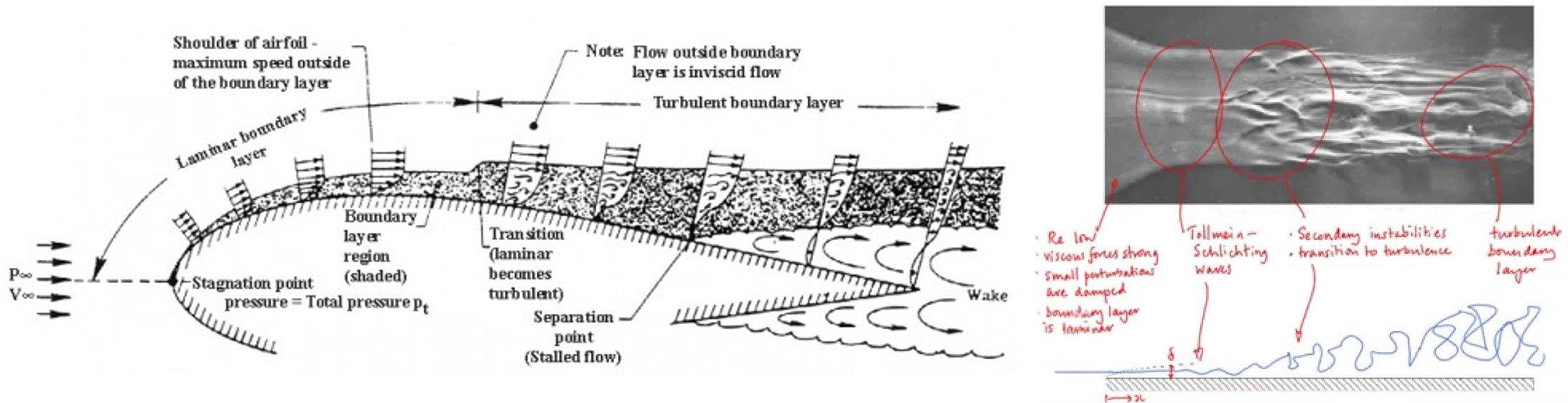
I used to design jet engines. Jet engines are complex. Not that we liked to admit it because it tends to make passengers and crew nervous. I used to design compressors. They’re complex too, and we didn’t like to admit that to ourselves either. Much of the complexity occurs when we get down to the molecular level and start to think about the behaviour of the air molecules flowing over the compressor blades, especially in the boundary layer region. Especially when the layer is turbulent. With a big enough computer program you can sort of model what the air molecules are doing, but you’re not entirely sure. So what you do is do the best you can, then build in a safety margin. When every designer of every component in the engine does the same and we bolt all the components together (a jet engine is often described as a ‘quarter of a million components flying in close formation’), we then add another safety margin for good measure. Then you can say to a pilot, provided you keep your aircraft within this operating envelope, we guarantee everything will be all right. Flying the aircraft will still be complicated, but it will be guaranteed safe.

A similar thing happens at the other end of the turtle scale thinking about the people tasked with maintaining the engines. The moment we add humans to the picture, we know we’re in complex territory again. Humans are not error-free. Stuff happens outside work that affects what happens in work. The crew just had an argument about overtime with the boss. Everyone’s in a bad mood. But that doesn’t affect the safety of the aircraft because everything’s been designed so that the complexity is confined within a set of very clear protocols. If anything goes wrong the system won’t let you proceed. If any two things go wrong, ditto. And so on.

(By the way things aren’t this sophisticated in other industries. If the driver of a car does something stupid, the safety systems will usually save the day. Most car accidents occur when two or more people aren’t driving with due care and attention – driver A is sending a sneaky text and accidentally drifts out of their lane at the same time Driver B is shouting at the kids in the back of the car and isn’t really looking when they pull back into the same lane after overtaking another car.)

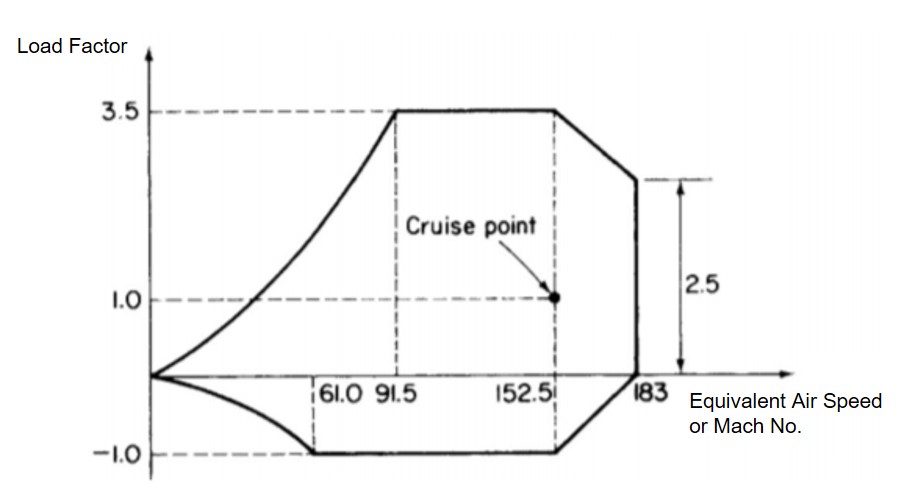
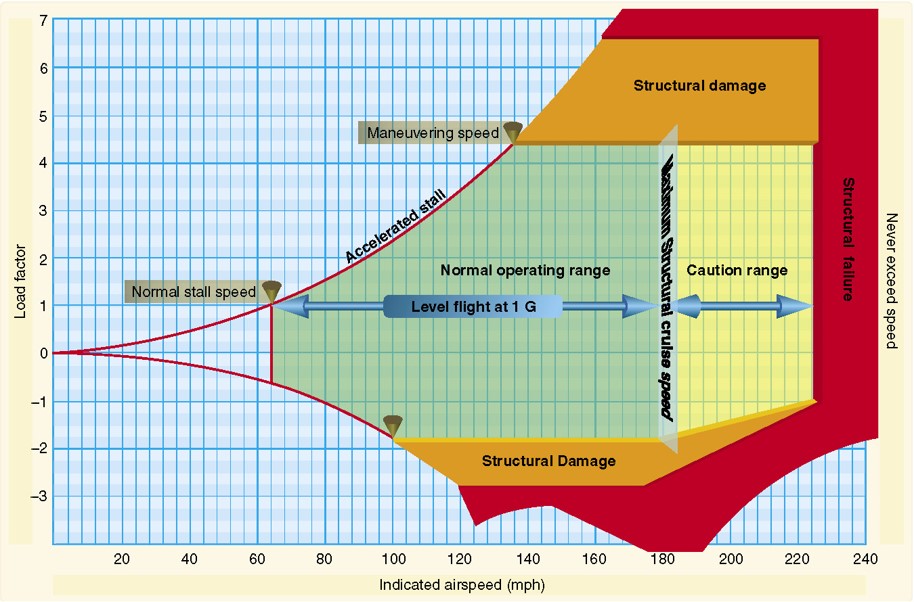
Meanwhile, back in the far safer air, so long as pilots stay within the allowed operating envelope and everything will be okay. Complicated, but okay. Go outside the limits, and now you’re back in the hands of complexity. Sometimes circumstances put you in such situations. If you’re a fighter pilot in a dogfight for example. Now you can easily find yourself outside the controlled ‘complicated’ envelope and into a world of ‘not quite sure’. Keep veering into this territory and fairly swiftly ‘complex’ turns ‘chaotic’. Reach the chaotic stage and you’re really in trouble. While in complex, at least you know know the likely dangers because part of the job of designing and testing the aircraft has been to go and fly in those parts of the envelope to see what happens.

The next important feature are the labels on the axes. They’ve been ‘non-dimensionalised’. Which means that the numbers are relativised to the real world around the aircraft. If the environment changes, the aircraft’s position in the envelope changes. Pilots have to live in the real world, and that’s only possible when we know where we are relative to our surroundings.

There’s another, final, feature of the flight envelope story that is important, and that’s the ‘design point’ or ‘cruise point’. This is the point in the flight envelope to which everything has been optimised. It’s the point where the aircraft will spend most of its time. It’s the point where the plane pretty much flies itself. At the cruise point, not only has the complexity been absorbed, so has the complication. The plane is in ‘obvious’ mode.

Every enterprise seeks to find these ‘obvious’ operating conditions. The primary thrust of things like Six Sigma is to minimise deviation from an optimum ‘design point’. Deviation in the Six Sigma sense is bad. Deviation brings complication. And, worse still, if we deviate too far, we can find ourselves out-of-control in a complex environment. The main difference between aircraft design and most enterprises on the planet is that in an aircraft you have to know where the obvious, complicated, complex and chaotic boundaries are, and not only that, you also have to know where you are relative to the environment that you’re operating in. When I try and quiz enterprise leaders on these issues the inevitable response is they have no idea what I’m talking about. They have no idea what their envelope is. And even less idea of how to non-dimensionalise the envelope to take account of the external environment. If pilots don’t understand these things, they don’t survive for very long. The same applies to business. If managers have no idea where they are, the likelihood of appropriately managing the business is small, and, as the environment gets increasingly turbulent, becomes ever smaller. Especially since, irrespective of our desire to make everything obvious, the reality is turtles-all-the-way complex.


Taleb’s (Depressing) Either/Or Worldview

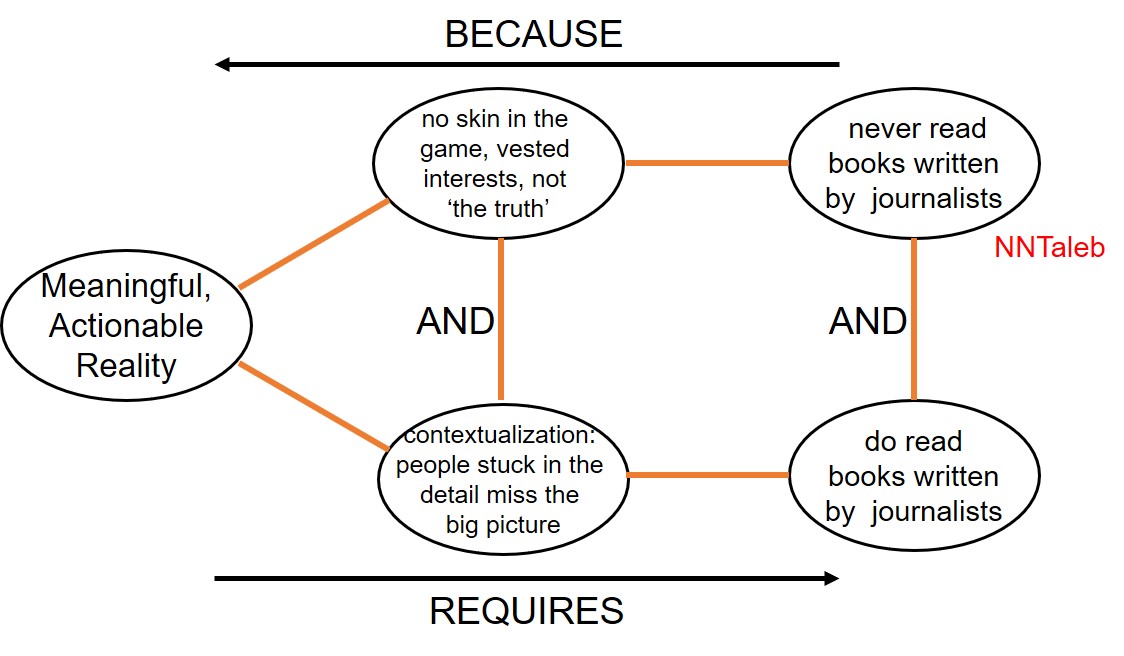
“Never read a book written by a journalist”  Nassim NicholasTaleb

Here’s my new piece of confirmation bias. Nassim Nicholas Taleb’s either/or worldview. Which seems to be rapidly spreading to all of his legions of followers. In this world, you’re either a no-skin-in-the-game charlatan, or one of the rare cluster of types – entrepreneurs, artisans, etc – that might be described as skin-in-the-game-Taleb-friends.

The world is only either/or if we lack a modicum of creativity.

When we give ourselves permission to think creatively, we rapidly realise it is always possible to achieve both/and solutions.

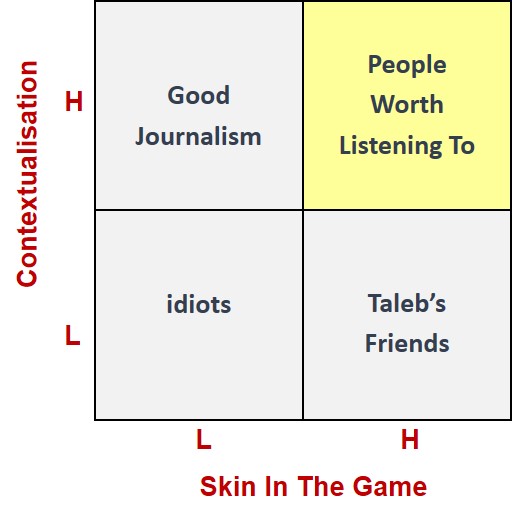
Per my last post, there aren’t two types of people in the world, there are four:

There are people who are just idiots (95% of the population), there are the ‘journalists’ subjected to Taleb’s ire, there are his Friends, and – top right – there are people who both have skin-in-the-game and can contextualise a wider world that those with the skin-in-the-game usually can’t see.

Admittedly, this last group is the smallest of the four. But it does exist. And the only reason it’s the smallest, I’m convinced is because influential flâneurs like Nassim Nicholas Taleb don’t seem to be able to (or want to) recognise that if we’re creative, we can have our cake and eat it too.

We’d all be a lot better off, I think, if instead of making futile either/or attacks, we’d start looking for, encouraging and recognising the people in the top right hand corner of the matrix, the ones that solve the contradictions.


On Black Swans & Contradictions

I love Nassim Nicholas Taleb’s work. I think I’d love it even more if he understood (or knew about) TRIZ. Or at least the concept of contradictions and our ability – should we give ourselves permission– to ‘solve’ and eliminate them.

I’ve been busy absorbing his latest epic, Skin In The Game, after I picked up my copy at his lektchur in London last month. As expected, it’s full of great insight and even fuller of (highly deserved) jibes at the Intellectual-Yet-Idiot (IYI) sector of society. By which he means economists, most academics, journalists, CEOs and all those other parts of society who make pronouncements about ‘the way things should be’ without having any skin in the game. Because they don’t have skin in the game, Taleb argues, they really don’t care whether their pronouncements are valid or not. In many situations, they win irrespective of whether they’re right or wrong with those pronouncements. Meanwhile, the rest of us who act on the pronouncements only to discover they were inappropriate, suffer asymmetrically. A classic example being former US Treasury Secretary, Rob Rubin. Rubin became a highly rewarded director and ‘senior adviser’ at Citigroup as it over-reached itself in the 2000s. When the bank became insolvent, Rubin didn’t write any check, but rather invoked (Black Swan) uncertainty as an excuse. Taleb comments, ‘nobody on this planet represents more vividly the scam of the banking industry. He made $120 million from Citibank. And now we, the taxpayers, are paying for it.”

As Taleb describes it in the book, there are two kinds of people, IYIs like Rob Rubin and people with ‘skin in the game’. Or, put another way, people who sound and look convincing yet talk nonsense, and people who talk sense but don’t sound or look the part. Skin In The Game describes the example of two surgeons to illustrate the point. One surgeon looks very smart, has all the right certificates on the office-wall and talks with great confidence to the patient. The other surgeon looks unkempt, has no certificates on the wall, probably doesn’t have an office and mumbles when they speak to you. Which one should you choose to operate on you? Taleb’s answer is that the in detelligent decision would be to choose the second surgeon. His compelling rationale being that the unkempt, mumbling surgeon has had to work harder to maintain their position than the smartly dressed surgeon. The unkempt surgeon has more likely spent their time devoted to being the best surgeon they can be, while the other surgeon has spent their time devoted to looking like the best surgeon.

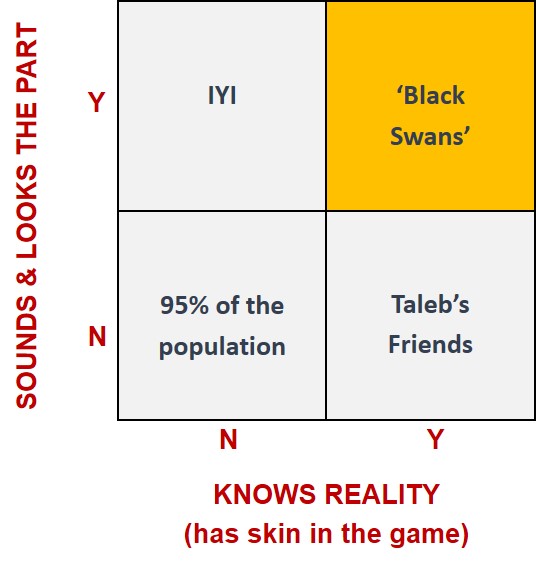
We can express the two-kinds-people-story on a simple 2×2 matrix. Something like this:

The horizontal dimension of the matrix considers whether a person understands reality or not. The vertical dimension considers whether the person looks and sounds like they know what they’re talking about. Taleb’s IYI class of people form the top left quadrant of the picture, and people with ‘skin in the game’ – people, in other words, who survive by knowing how the real world works – are contained in the bottom right quadrant.

Drawn as a 2×2 matrix, however, we see there to be not two but four kinds of people. The bottom left quadrant are people that don’t know what they’re talking about and don’t look the part either. I think this is about 95% of people on the planet. The more I look at what people write and say on social media the more I’m convinced this number is probably on the low side. And is probably getting lower.

But then there’s the top right-hand quadrant of the matrix. These are people that Taleb’s worldview doesn’t seem to acknowledge. These are people that know reality (and, by association, have skin in the game) and look and sound convincing. In TRIZ terms, these would be the people who successfully resolved the contradiction. In TRIZ terms life is specifically concerned with not accepting either/or dilemmas, and instead looking towards people who successfully switched to a both/and frame of mind.

I’m pretty certain Taleb doesn’t acknowledge such a both/and possibility. When I saw him lektchuring in London I’d have to say it was one of the worst presentations I’ve ever witnessed. It looked to me like he hadn’t spent more than ten minutes preparing what he was going to say, he mumbled, his most frequent word seemed to be an uncomfortable clicking ‘err’ noise, and he spent half the time fiddling with the copy of his newly published book, trying to find pages to read from, not finding them, and then moving on to another point, leaving everyone hanging halfway through his previous point. It was toe-curlingly bad. Part of me believes that Taleb has convinced himself that it’s not only okay for him to lektchur ‘badly’ (e.g. he now actively uses the self-depracating term ‘lektchur’), but that, like the mumbling-surgeon, its actively necessary for him to be bad in order to avoid falling in to the IYI category.

But this is surely a dumb assumption on his part. It is perfectly possible to solve the contradiction. He could have spent some time preparing his lecture. He could have bookmarked pages in the book that he wanted to refer to. He could have constructed some coherent anecdotes. But yet he chose not to do any of these things.

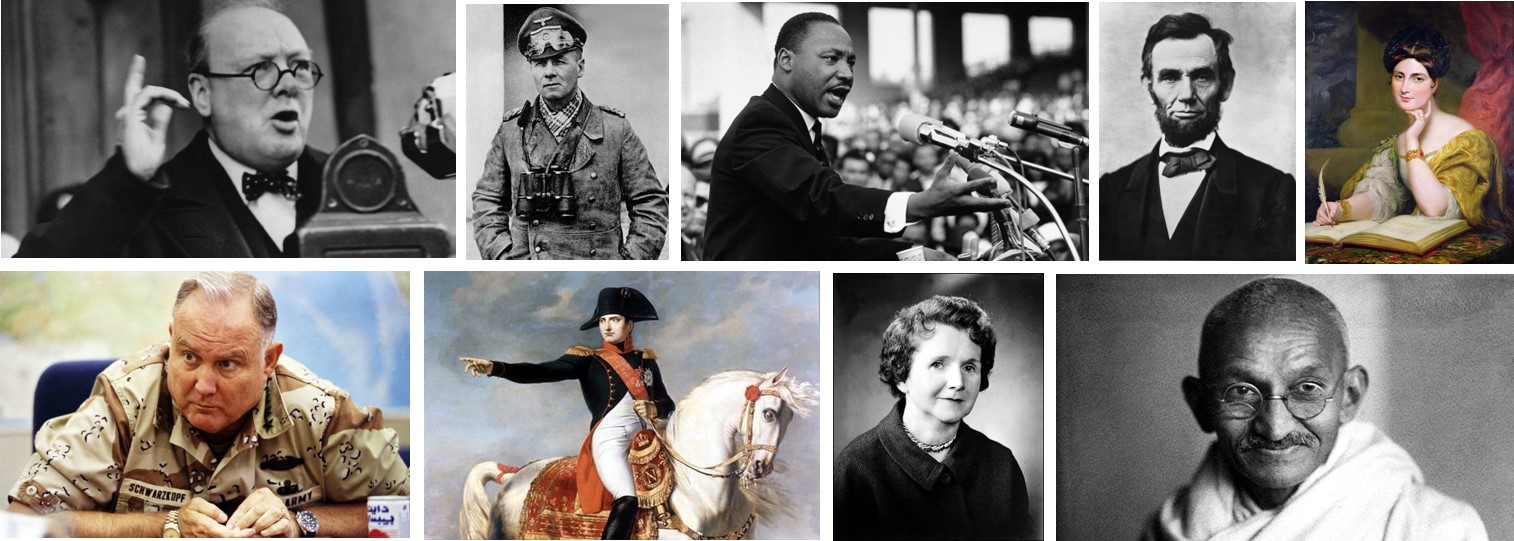
There are people who have solved the contradiction. Not many of them admittedly (inevitably since 95% of people are in the bottom-left quadrant of the picture), but we only have to think of people like Churchill, Rommel, Schwarzkopf, Napoleon (early part of career at least), King, Norton, Carson, Ghandi and Lincoln: people who knew that it was possible to solve the contradiction, solved it, and went on to deliver the best of both worlds.

Having skin in the game is really important. I totally get that. But that doesn’t mean I have to turn up to lectures ill-prepared. Taleb, I think, needs to understand contradiction solving far better than current evidence suggests he does. If he did, not only would Skin In The Game have been a better book, but he’d also begin to understand that ‘Black Swan’ events are merely revealed or resolved contradictions. And once he understands that, he’ll also come to realise that there are no such things as Black Swans. Only contradictions that society hasn’t solved yet. Or – more likely – didn’t have the foresight to go look for.

Darrell 1, Brambles 0

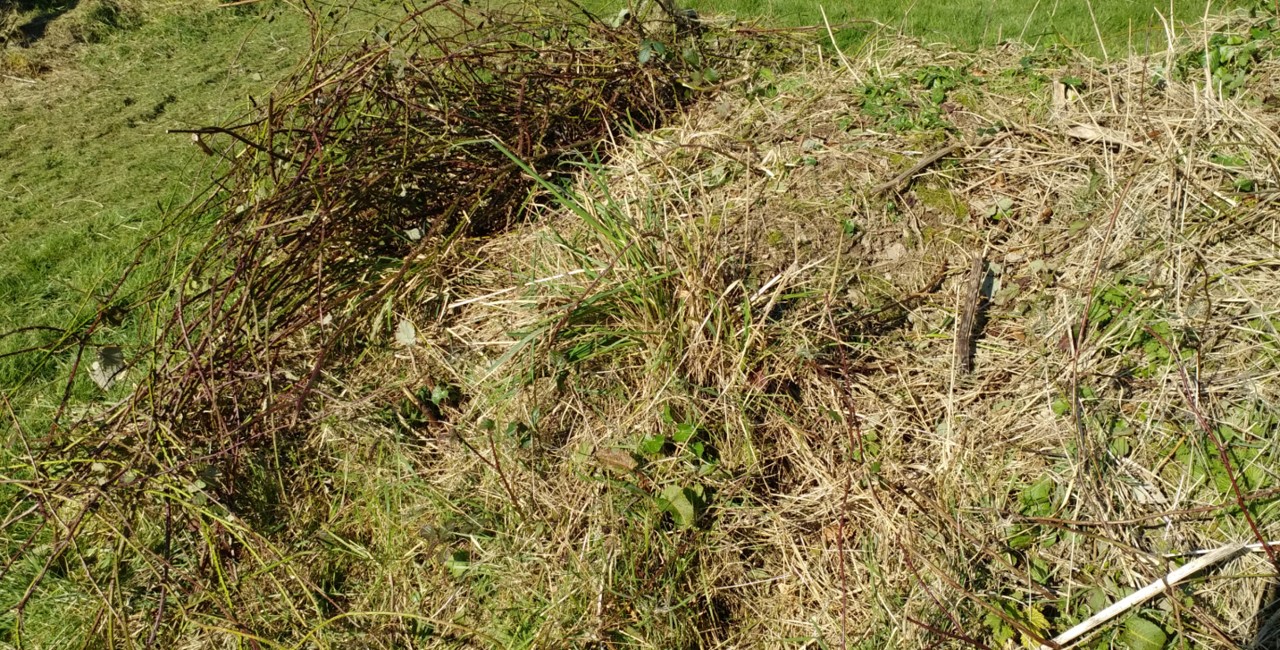
Last year, brambles had the measure of me. For every bramble I lopped from its roots and pulled up, another three grew in its place. And three times faster than the previous one. It was like bramble-Hydra. Now its February 2018 and, looking out into the garden, it felt like a new season of bramble-based torture was already in full swing. Pretty much nothing is growing except brambles. The 3x20m mound that I distinctly remember clearing in October, was already choked with new growth bramble.

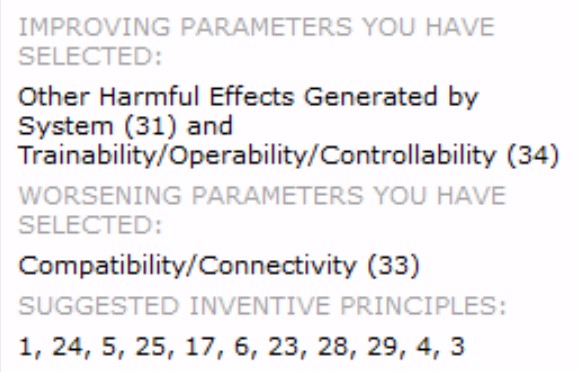
Something was going to have to change. Time for desperate measures. TRIZ-based desperate measures. Time to solve the bramble contradiction. I want to make it easier to remove them, but every time I try and pull out a branch, all of the barbs do their best to impede the removal. Here’s how the I mapped the problem on to the Contradiction Matrix:

Principles 1 and 24, it seemed, were already part of my bramble-removal armoury: one branch at a time, using clippers and wearing gloves. Principles 5, Merging; 25, Self-Service and 17 Another Dimension, on the other hand, appeared to offer up more intriguing strategy alternatives.

Self-service particularly so. If the brambles refuse to be parted from one another, why not use their self-sticking nature as a resource? Merging seemed to be a complementary idea: don’t try and take one at a time, take them all together. ‘Another Dimension’ took a bit more experimentation, but ultimately made the final solution into a small piece of magic. Instead of pulling-up, I tried pushing everything to the side: push the brambles sideways to expose the next bit of root, clip those roots, then move the pile further sideways. Repeat.

And hey presto, ten minutes later, 60 square metres of bramble were all self-bundled at the end of my mound.

You know, there might yet turn out to be something in this TRIZ lark.

The Hero’s (Perpetual Sub-Loop) Journey

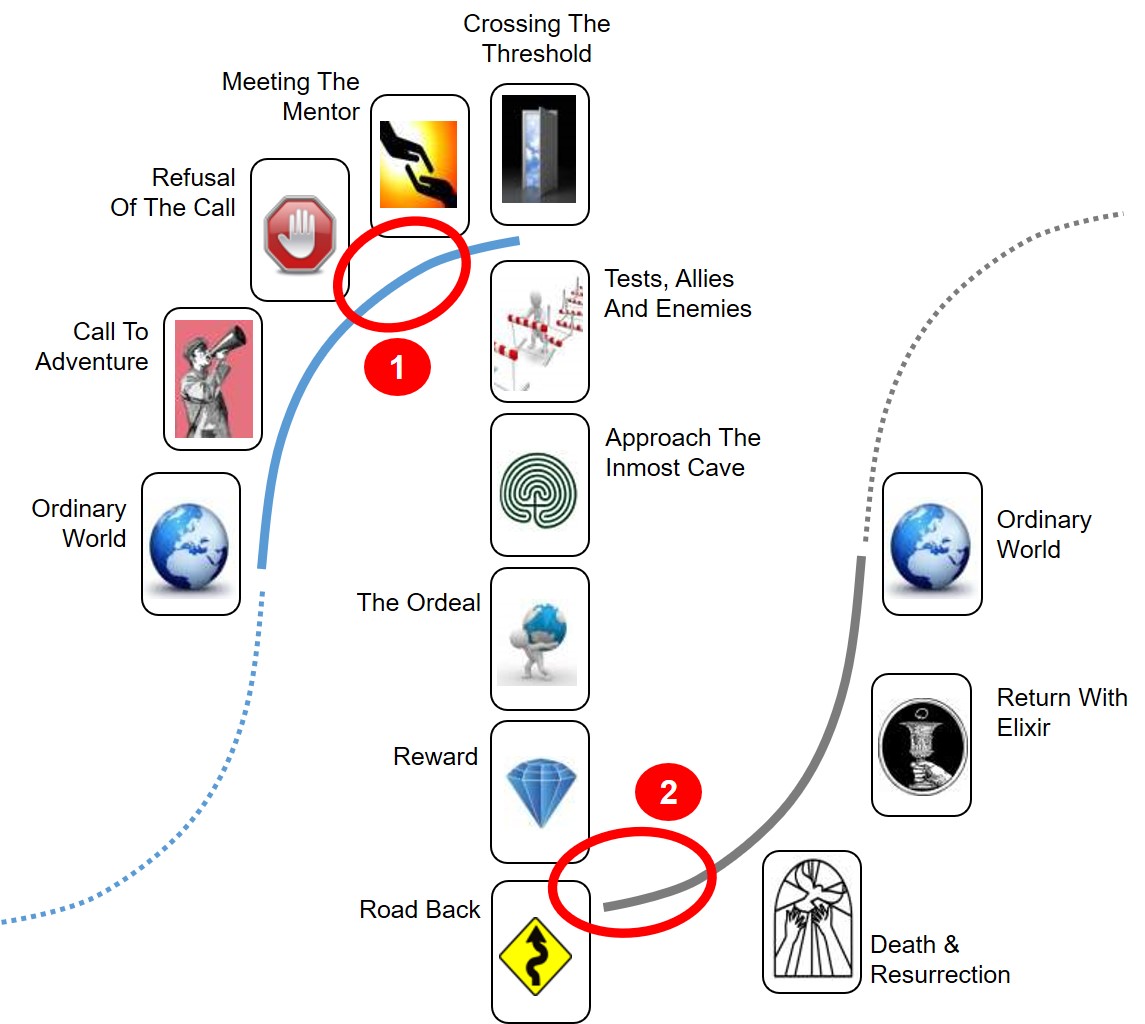
I’ve long been a fan of Joseph Campbell’s Hero’s Journey model as a means of explaining the dynamics of discontinuous change. We typically use the model in an innovation context, but we’ve also had some of the best opportunities to quiz people about it when we’ve been using it to help explain and explore some of the difficulties of organisational change. ‘Where do we think we are on the story?’ is the typical starter question. The answers are many and varied, but in the last couple of years a couple of recurrent themes have begun to appear.  Two quite literally recurrent themes. Teams getting stuck in seemingly never-ending loops.

The first one is what I’ve come to think of as the ‘Big Five Consulting Company Dream Cycle’. The dream being their dream of perpetual fees without having to do any meaningful work. As opposed to the client’s dream of meaningful change without expensive bullshit artists watching them do it. This loop – labelled ‘1’ on the Hero’s Journey centres around the ‘Refusal Of The Call’ and ‘Meeting The Mentor’ stages before the Hero crosses the threshold (i.e. jumps off their current S-Curve) into the Campbell’s ‘Special World’. Crossing The Threshold is always a daunting cliff-jump into the unknown. The job of the Mentor is to tell the Hero that it will be all right because they, the Mentor, has already been there, and that the Special World is the only sensible way forward. The job of the Big Five Mentor, on the other hand, is to stop the Hero from crossing the threshold. Partly because the Big Five Mentor has probably never crossed the threshold (unless you count inviting themselves, vampire-like into your ordinary world) before and would quickly reveal they don’t know what they’re doing. And partly because they’ve learned that they can help make the Hero feel better – at least in the short term – by explaining in comforting and convincing ways why it’s not necessary to jump off any cliffs any time soon. What the Hero will see instead are a whole series of seemingly very do-able tiny steps. Do this little thing over here. Stop doing that little thing over there. Get rid of this position. Take three people out of this department. Put them into this new department over here. In so many words, its called tampering. The Big Five Mentor knows how to do it for years if you let them. All the time helping the Hero to Refuse the ever-louder Call. Usually – in the ideal Big Five Mentor world – for as long as it takes for a change in the client’s Senior Leadership Team. Someone brought in to do some crisis management because the Big-Five Band-Aid clearly isn’t working any more. Now everyone in the business is going to cross the threshold. No doubt waving bye-bye to the hanky-waving Mentor, still stood firmly on solid Big Five Consulting Company ground.

The second seemingly perpetual loop occurs later in the Journey. I call this one the Perpetual Design Thinking Procrastination Cycle. It’s the place a lot of Design Thinking teams get themselves stuck. They think they know what the right design (‘The Reward’) is from their Special World (i.e. lab/studio) perspective, but when they try and take the Road Back into the Ordinary World of the customer, they are continually able to find something else to tinker with. Maybe, too there’s an element of knowledge that there’s going to be a Death & Resurrection, and, if they’re not careful, the thing that will die will be the Design Thinking team. Either way, the new thing that’s being designed seemingly never gets to have its opportunity to get past a Tipping Point to become the new ‘Elixir’.

If the first loop is all about not wanting to enter the Special World, this second loop is all about not wanting to leave it. Designers ‘know’ they need to test their solutions in the (Ordinary World) of their intended customers, but they also know the Ordinary World can be quite boring. And, worse still, demanding of some tough commercial decisions. So any opportunity to return to the comparatively safe waters of their Special World is adopted with gleeful arms.

They say awareness is half way to a solution. Having watched the Big Five consulting companies operate for over three decades now, I’m pretty certain they’re confident its not. As for the Design Thinkers and their rather newer perpetual loop, I suspect a lot of them – the growing army of Design Thinking Authors – are desperately learning as fast as they can from the Big Five consulting companies how to ensure their own trains remain full of gravy.

Good job I’m not cynical about these things.

Learning From Failure #22: Songs Of Innocence

On 9 September 2014, the band U2 gave away their new album ‘Songs Of Innocence’ free to 500 million iTunes subscribers. No doubt sponsored by Apple, the gesture rapidly backfired on the band and, within a month, singer Bono was forced to organise a press conference to apologise for the incident. Listening to him speak, it was still pretty evident that he didn’t know what the band had done wrong. It was an apology of sorts, but then again any apology containing the word ‘if’ isn’t really.

In Bono and clearly Apple’s mind, the gesture was a no-brainer success story. What customer wouldn’t want a free album? From one of the most popular bands on the planet no less.

But the gesture disobeyed two and likely three of the First Principle foundations of human behaviour. People make decisions for good reasons and real reasons. The ‘real’ reasons are the ones that come from our emotional brain. That part of our thinking focuses around four Principles: we want Autonomy, we want Belonging, we want to feel like we’re Competent and we want to do things that have Meaning. ABC-M.

The innovation rule is that all four – ABC-M – all need to be moved in an improving direction.

If U2 had been aware of this rule, they would quickly have seen that:

a)    By installing the album onto customer’s iPhones without permission, they demonstrated that they, the band, were in Control and the customer was not.

b)    U2 is a very polarising band. Lots of people love them. Even more feel the opposite. If you love U2 and they give you their new album, your sense of allegiance and Belonging to the U2-tribe is likely to go up. If, on the other hand, you really don’t like U2 and they force their new album on your phone, it comes across like they’ve tried to force you to Belong to a tribe you’ve already decided you want no part of. Forcing tribal solutions on non-tribe members will only ever have one effect: it will unite the non-tribe members against you even more.

c)    Then, if getting the A and B wrong, as if to twist the knife they’d stuck in everyone’s stomach, when the majority of the 500 million tried to delete the album from their accounts they quickly noticed it wasn’t easy. Now hundreds of millions of customers also felt incompetent.

Three years later, the band are still taking stick for their Song of Naivety. Or was it Songs of Meglamania?

ABC-M all need to get better. It’s not rocket science.


How To Predict When Your Football Team Is Going To Lose


Il faut souffrir. Supporting any football club involves an emotional rollercoaster ride. With some clubs the highs are higher. With others the lows are lower. Sometimes, as in the case of my team tangibly so. Sometimes the lows are just dumb frustrations. Like the fact that, this season, my team is beating all the top clubs and losing to all the bottom ones. To the point where, because we were scheduled to play a relegation-zone team today, I was 100% confident that we would lose.

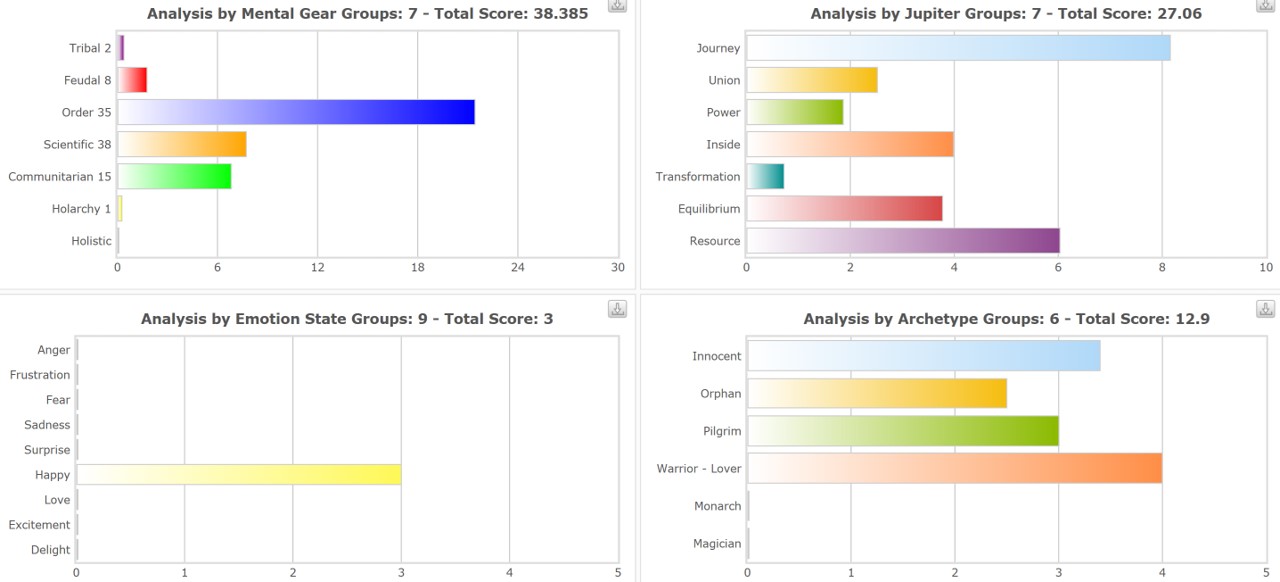
Part of that confidence, these days comes from running our PanSensic software. Every week, our manager gives a press conference, and I’ve started to put the narrative into the software. This is what it told me this week:


The important thing to look out for is the high ‘Innocence’ score in the Archetypes dial. This score is only high during the press conferences prior to playing opponents at the bottom of the league. When we’re about to play the top clubs ‘Innocence’ is almost zero and the ‘Pilgrim’ and ‘Warrior’ scores go off the end of the scale.

Against the big clubs, the manager seems to know its going to be a tough day. When we’re about to play one of the bottom clubs the message usually involves phrases like ‘no complacency’ and – this week’s humdinger, ‘we are not naïve enough to think it will be that simple’.

I don’t think anyone from the Club is ever likely to read my insignificant nonsense, but I kind of wish they would. Maybe then the manager would realise that the human brain doesn’t process words like ‘no’ and ‘not’. When we tell someone not to think of pink elephants, so says the cliché, its almost impossible to avoid thinking about pink elephants. We’re not wired to process negatives. So, ‘no complacency’ is heard (by the team as well as everyone else) as ‘complacency’. Likewise, ‘not naïve’ is heard as ‘naïve’.

Then there’s the killer word ‘that’. It’s the word that reveals the manager also isn’t processing the negative. He’s trying to tell everyone not to be complacent and to not think the game will be simple, but he’s already convinced himself that its okay to be complacent and that the game will be simple. Put simply, we lost today because of what he said on Thursday.

A Dilbert Trilemma

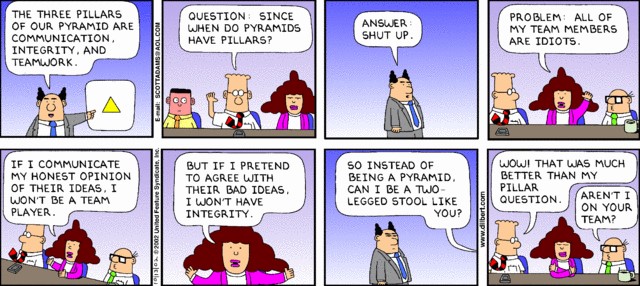
During the eighties and nineties it was rare to visit a client where there weren’t Dilbert cartoons all over the walls. The joke was funny then. Today I see less of them on the walls. I don’t know whether that’s because management have banned them, or because Baby-Boomer and Generation X workers don’t like being reminded that they’re still living in the same Kafka-esque nightmare today that they were thirty years ago. Either way, you sometimes still have to love a Dilbert cartoon.

This one is a particular favourite. I’m in the contradiction business, so I guess I have to love it. Even better, this strip describes a great trilemma. A lot like the ‘cost, quality, schedule’ problem and the ‘which two would you like?’ question, Alice’s response to the Communication, Integrity and Teamwork triad defined by management is a classic ‘two out of three’ solution.

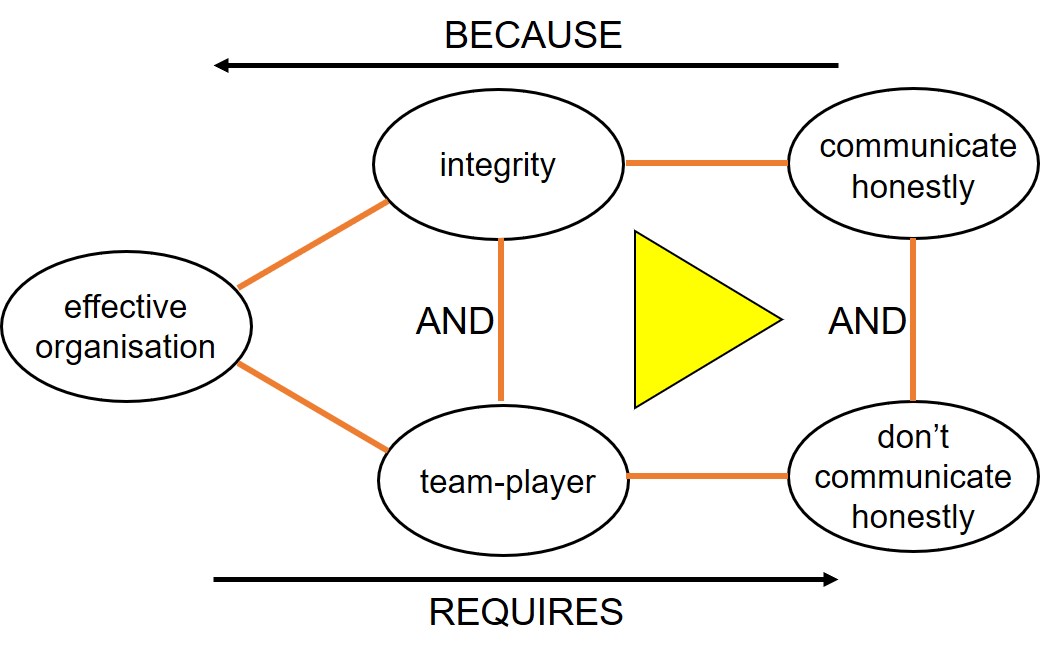
If Alice had used TRIZ, she might have re-framed the problem to look something like this:

The Contradiction ‘Bubble Map’ is in effect a way of drawing trilemmas. The physical contradiction – ‘I should be honest and I should not be honest’ – being the part of the trilemma Alice was unable to solve.

If we map the problem onto the Contradiction Matrix we ought to be able to tap into the solutions used by others to solve the whole problem. When we do this, the ‘three-out-of-three’ solution to the Communication, Integrity and Teamwork trilemma is likely to make use of these Inventive Principles:

   7 – Nested Doll

 13 – The Other Way Around

   2 – Taking Out

 17 – Another Dimension

All of which, suggests that Dilbert and Wally in this case – rarely – are the ones that hold the key to the ultimate solution. Damn, Scott Adams is good.