According to our research last year’s US election was pretty much won on the basis of nine syllables. Whatever your politics and whatever you think about the morality of spending money to influence how people vote, I think its fair to say that a certain level of genius had been at play.
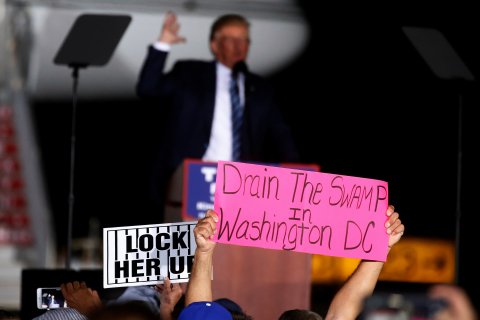
The nine syllables came in the form of three three-syllable phrases that Donald Trump managed to use in nearly all of his campaign speeches. In many they were turned into crowd-chants.
Drain The Swamp. Build The Wall. Lock Her Up.
They say a picture speaks a thousand words. Here were nine words that each spoke a thousand pictures. Ah, sweet Resonance.
Whoever was responsible for the genius, clearly doesn’t seem to be in place any more.
The person that came up with Rocket Man got the three syllables part right but, right from the get-go it sounded more like a pretty cool compliment than the belittling jibe it was intended to be. Recognising the mistake, some bureaucrat quickly tried to modify the phrase to ‘Little Rocket Man’. This didn’t help. Ten more minutes of thinking and they might just have come up with ‘Rocket Boy’. That would have done the intended job far more effectively. Albeit at the possible risk of nuclear Armageddon.
Things didn’t go much better this week, when Drain The Swamp got down-rated to ‘Spread the Swamp’. When the bureaucrats realised those words didn’t work, they switched to ‘Move The Swamp’. That was vaguely less clumsy, but still utterly missed the killer instinct of the original. And the ultimate election winning aphorism was now turned into an embarrassing climb-down.
Amazing how smart people can work out the DNA of election success and then ten minutes later completely screw things up.
Single syllable words. Three word phrases. Emotive verb. Thousand-pictures object. Simple.
One of Facebook’s earliest executives has said the social network is “destroying how society works” and that he feels “tremendous guilt” about his work. Chamath Palihapitiya, who joined Facebook in 2007, accused it of “programming” its users and said he no longer uses the website or allows his children to access it. “It literally is at a point now where I think we have created tools that are ripping apart the social fabric of how society works,” he told an audience at Stanford University. “We are in a really bad state of affairs right now in my opinion, it is eroding the core foundations of how people behave by and between each other.”
Daily Telegraph, front page, 12 December 2017
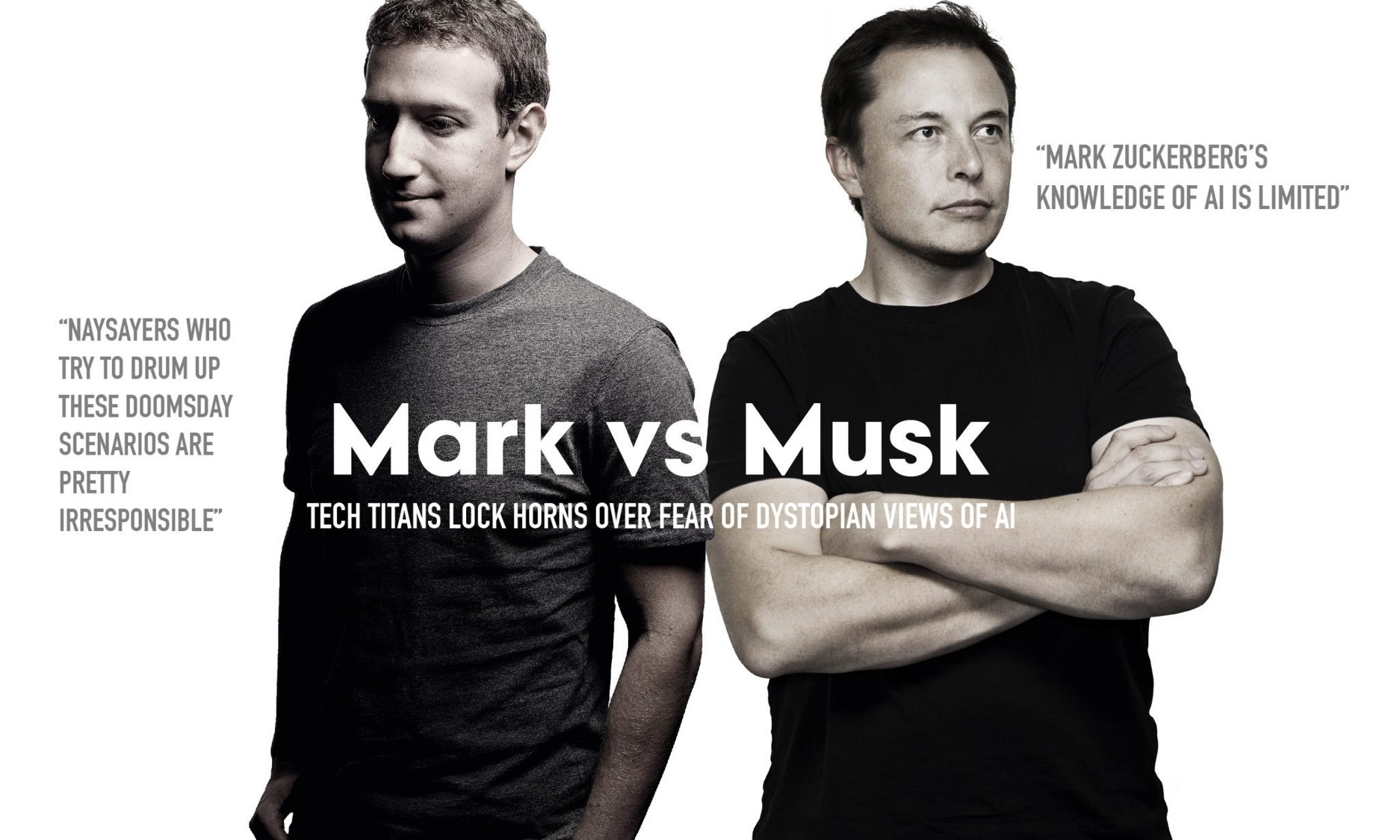
Society makes progress when contradictions get identified and solved. The bigger the contradiction, the greater the progress potential. In this context, when two goliaths of the modern business world find themselves embroiled in a very public argument we perhaps get to see a really big contradiction.
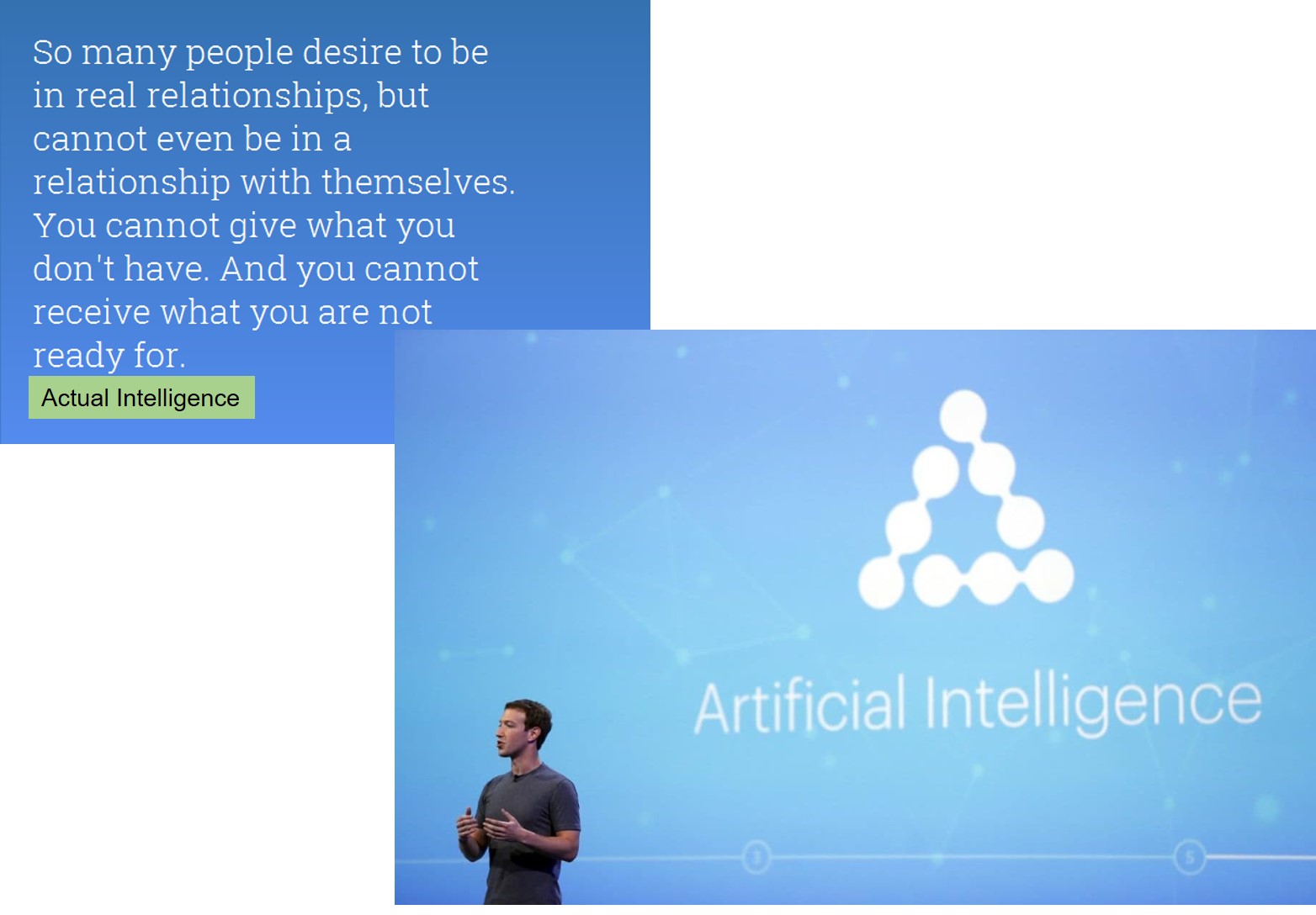
Zuckerberg says that Artificial Intelligence is good; Musk says it is bad. Who’s right and who’s wrong? Or are they both right? Or both wrong?
What we do know for certain is their argument centres around a contradiction: we want AI and we don’t want AI. AI will eventually help society to solve an awful lot of its current problems; AI today is probably doing more harm than good. And therein lies a clue. Two clues. Eventually and today.
Once we understand what we’re doing, then we open up the possibility for AI to be our best friend rather than our worst enemy. We solve the contradiction, in other words, in time (eventually…) and on condition (…once we know what we’re doing).
What Elon Musk seems to understand that Mark Zuckerberg clearly doesn’t is that the vast majority of today’s AI solutions – and especially those being deployed by Facebook – have not been coded with an understanding of complex systems. Once we accept that a system is complex, the only sensible hope of affecting it in a positive manner is to understand behaviours within the system at a First Principles level. Elon Musk represents the epitome of First Principles thinking. Mark Zuckerberg is, as far as I can tell, the precise opposite. He naively believes that by connecting everyone you create one big happy family. The reality is that when people are motivated by Autonomy, Belonging, Competence and Meaning (the First Principles of human behaviour), any attempt to connect everyone ends up connecting no-one. For every tribe we connect to become a member of, a dozen other tribes that oppose what we think appear.
Zuckerberg, in other words, might be right about AI in the long term, but right now, Musk knows that Zuckerberg is the very person preventing AI from going beyond its current manifest dysfunctions.
There aren’t too many advantages to being an aerodynamicist, but one of them is not having to sweep up fallen leaves in the Autumn. Even when we had a garden the size of a postage stamp, it was a pain. Now we have two-acres and look after a dozen or so hundred-and-fifty-year-old trees, the task has, in previous years, been, how shall I put it, onerous.
Last Autumn, I figured it was time to apply a little TRIZ to the problem: how could I get the leaves to collect themselves?
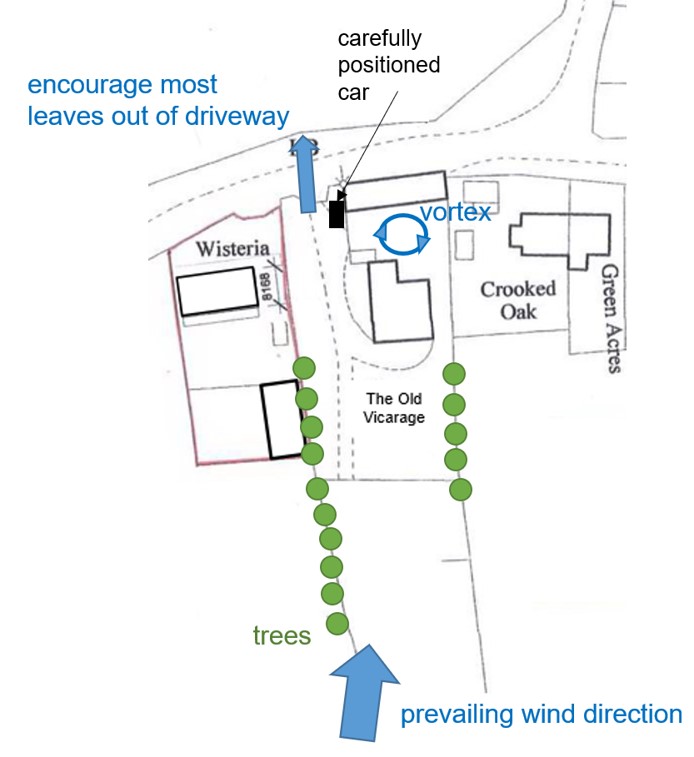
It didn’t seem too likely, but on the other hand a quick search for free resources highlighted a couple of big ones. Firstly, the prevailing wind direction served to blow all the leaves off the trees and towards the house. Secondly, the shape of the house lends itself to creating an aerodynamic vortex that I could use to coax the leaves into a ‘trap’:
I’d noticed some kind of naturally propensity for leaves to find themselves entering the vortex in previous Autumns, the problem was it didn’t happen as fast as I’d like and when it did happen, the leaves tended to accumulate in front of the door. Which in turn meant that when the door was opened, the leaves tended to migrate into the house.
So what to do? How to increase the vortex flow rate? And how to subtly re-direct the leaves so they entered the vortex but stayed away from the door?
Another search for resources…
Realisation number one: changing the places the cars are parked changes the vortex entry. Park the cars differently and the vortex trap works better.
Realisation number two: outdoor plants. Judicious placing of plant pots lowest pressure point of the vortex and the leaves accumulate around the pots rather than the door.
Add a couple of days of experimental adjustment of car and pot placement and hey presto, we have self-collecting leaves.
Now all I need to do is wait a couple of days for the new mountain to appear, rake them into the wheelbarrow and take them down to the compost bin, then wait another couple of days.
A multiple hour chore now becomes a 20-minute game. Autumn? My new favourite season.
It feels like a long time ago when I wrote the Systematic (Software) Innovation book. One of the main, albeit inadvertent, themes of the book was to highlight a dichotomy that, now we all live in the first stirrings of a Big Data tsunami, seems to be getting worse rather than better: software engineers and architects, the book described, are simultaneously the people most likely to determine how society evolves in the coming decades, and also the people least well qualified to take on such responsibilities.
Last week I came across an online article bearing the ominous title, ‘Machine Learning Is Racist Because The Internet is Racist’. If I ever needed a way to exemplify the dichotomy, I think this might just make it into my Top Five.
The article represents the sort of complete abdication of responsibility now becoming quite typical of the ICT industry. An industry that still – two months after it hit the media – hasn’t done anything to tackle the problem that recommendation algorithms now teach people how to make bombs. ‘People who bought this product also bought…’ and hey presto, everyone knows how to make their very own explosive device. This the same industry that – they tell the media – can’t be blamed for providing a conduit for terrorist communications.
At the crux of the issue here is Artificial Intelligence. Plenty of the former, not so much of the latter it seems. There’s perhaps a telling irony in the fact that the software geeks effectively try to tell us all that their AI algorithms can’t be blamed for mimicking the content of what they find on the internet. The irony being that if they are able to declare a significant enough amount of internet content is ‘racist’, how come they weren’t able to create a racist-comment-detecting algorithm and thus exclude such trash from the data they use to train their algorithms?
Sure, the Internet might be ‘racist’ right now. But in no way does that give AI professionals a ‘get out of jail free’ card excuse for creating racist AI. It’s not rocket science.
Or maybe it is. Not in the offending blame-dodging article under examination here, but I’ve heard from other ICT ‘thought leaders’ that any racism (or any other kind of ‘ism) detection algorithm cannot be their responsibility, because who are they to decide what is and what is not racist? Only the politicians can tell us what the rules are, they claim. My confidence that our politicians can help solve the problem is frankly quite low. Not so much because the problem requires any rocket-science per se, but rather that it requires someone to come at the problem with a contradiction-solving mindset.
I suspect every person on the planet is guilty of at least half a dozen ‘ism-crimes’ during any given day. I can be confident of this because spending a couple of hours watching any trending ‘controversial’ topic on Twitter quickly reveals the rapid appearance of a quite staggeringly broad spectrum of responses. Every single respondent sits somewhere along an -ism spectrum. From one day to the next, their position might shift, as might those of every other person wanting to join the conversation. The fact this spectrum exists and that it might be dynamic, however, does not mean the job of the AI algorithms (or their programmers) is to define ‘the’ point along the spectrum at which ‘on average’ the boundary between racist and not-racist sits. Making decisions based on any kind of average is a pretty dumb thing to do in any kind of complex environment.
The only meaningful design response in this kind of dynamic spectrum situation is to solve the contradiction between the two ends of the spectrum: make people at each extreme ‘happy’ and everyone in the middle is also happy. If every person on the planet draws the racist/not-racist boundary somewhere different, the AI needs to take into account that personal boundary when delivering content to that individual.
Solve one contradiction, of course, and the next one inherently appears in its wake. Every person on the planet is entitled to hold their own opinion about where the racist/non-racist (or sexist/non-sexist, etc) boundary exists for them personally, but by the same token they are absolutely not entitled to hold their own truths. Truth-wise, then, the new problem becomes whether it is ever possible to objectively determine what racism is and is not? This too would appear to require a dynamic way of thinking. I’ve heard several comedians making jokes around the phrases ‘different times’. What was apparently ‘acceptable’ in the 1970s, clearly appears not to be today. Whether that makes it appropriate to judge historical ‘misdemeanors’ according to today’s norms is yet another contradiction to be solved.
But again, it is ‘merely’ a contradiction. Systematic (Software) Innovation was intended to help software engineers – the future rulers of society, right? – to identify and resolve such conflicts. If any of them was in any way smart, they’d be writing AI algorithms that automatically identified society’s conflicts and conundrums. If they were smarter still, they’d be writing self-evolving code that also helped solved these conflicts and then automatically identified the next contradictions. More fool them if they haven’t started the journey yet. The slower they are to the game, the further ahead PanSensic gets. AI gets intelligent by asking intelligent questions, and intelligent questions start by measuring what’s important rather than what’s easy to measure. It’s very easy to measure racism. Or sexism. Or any other kind of ism. (We know because we do it every day.) Real intelligence is knowing why we’re measuring it. And what contradictions we’re intending to solve when we do find it. Perhaps our next PanSensic lens should be one for detecting software engineers abdicating their moral and ethical responsibility to think before they code. I don’t think that’s rocket science either.
Everyone is somewhere on an Autistic Spectrum. Some people will stay fixed where they are, others will move. This is neither a good nor a bad thing, merely a pair of statements of fact. Vive la difference and all that.
Where a person sits on that Spectrum only starts to become relevant when we think about specific contexts. If I’m looking at a person taking on the task of devising global strategy on social media and the role of artificial intelligence within that strategy, for example, I think I’d prefer to have someone closer to the non-Autistic end of the spectrum than someone at the other end. Key word in that sentence being ‘social’. If I’m going into the social business I think having some social empathy skills would be useful.
The fact that Mark Zuckerberg in all likelihood doesn’t nor can’t sit on this end of the spectrum means that the moment he opens his mouth, I’m already doubting the validity of what he’s about to say. Especially now he’s been successful and is surrounded by people agreeing with every word he says irrespective of its validity. This inferno of agreement-without-understanding ought to ring a number of alarm bells, irrespective of how right the words that emerge from his mouth might eventually turn out to be.
Before that, however, because what I see in Zuckerberg is a severe lack of understanding of the majority of (first principle lead) things in life, I can be pretty certain, when he tells me that Facebook is in the business of ‘building community and bringing the world closer together’, that the sentiment is both naïve and has no way whatsoever of translating into reality. Mission without theory is far worse than theory without mission. Just ask any ego-driven despot throughout the annals of history.
I try and avoid Twitter these days. And I especially try and avoid the trending hit parade on the left-hand side of my screen. The other morning, when I saw that comedian, James Corden was trending with 30 plus thousand Tweets, my first thought was that he must be dead. Rather, it turns out, he happened to make a couple of perhaps ill-timed jokes about Harvey Weinstein. The world – even, it seems, a massive proportion who clearly hadn’t heard the jokes – within a matter of minutes had divided itself into two. One camp who thought that Corden was worse than Hitler and should be deported, and the other that thought Corden is quite a nice guy and leave him alone… oh, and, by the way, didn’t we used to have a thing called free-speech in this country?
I don’t know if Zuckerberg was watching, but I imagine him glowing with pride at the two brand new ‘communities’ his Social Media world has just – in a veritable instant – created. We now have a tribe of Corden-ites and a 180degree opposite tribe of Corden-lynchers demanding he be – word of the year – ‘deplatformed’.
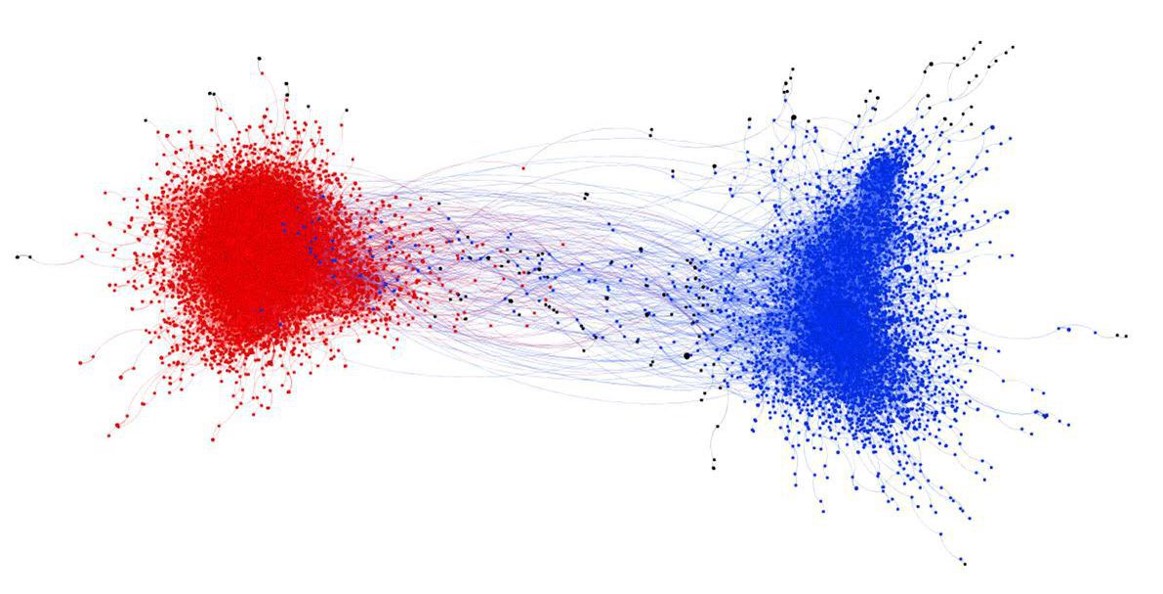
Social Media in its current clueless evolutionary stage is indeed good at creating communities. The problem is there is no such thing as the plural of community. Today’s Social Media is inadvertently creating a million and one ‘us’s. But at the same time, it is also creating double that number of ‘them’s. Everyone shouting louder and louder and listening less and less. We’re only allowed to listen to the people in our tribe because that’s who the algorithms tell us to listen to, and, if we step out of line, we risk being ex-communicated from our tribe and thrown to the deplatform-lions.
Extrapolate that forward and pretty soon we’ll all need to be wearing a thousand lapel badges defining which tribes we belong to. And then being shot when we accidentally step into a store wearing the wrong colour socks.
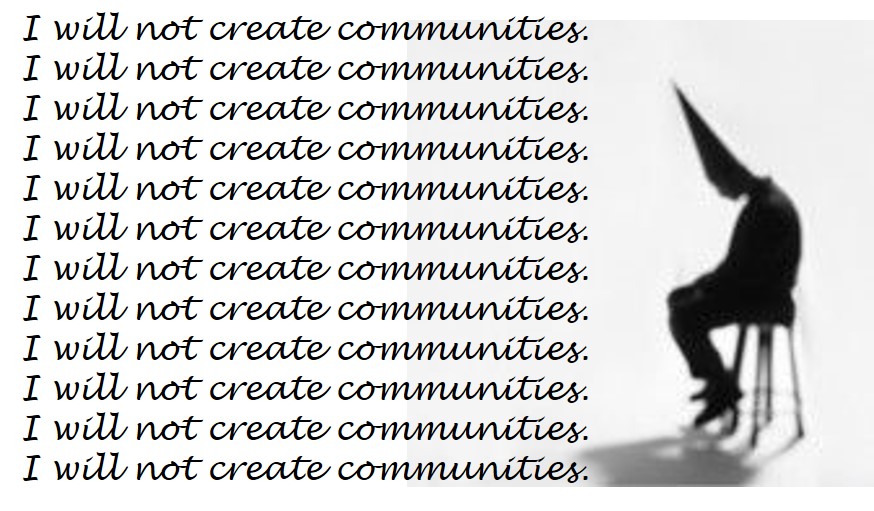
Every trend direction comes to an end eventually, of course. Let’s hope there’s still enough of us alive to see that day. The day we see Mark Zuckerberg sent to a distant corner of the remedial psychology classroom and told to wear a dunce cap for the next decade. And the day, also, where the contradiction-solvers get the community-building due they deserve.
It’s political conference season here in the UK. Which is usually a good reason for me to be out of the country. This year I got it wrong, so, sadly, much as I have tried to stay away from the media commentary, some of it has still leaked to my book-writing, patent-drafting cocoon.
This week it has been the turn of the Conservative Party, and today the turn of Theresa May to give her big speech.
Full disclosure. I’m not a fan of the party or the person. Then again, if you’ve read any of my previous posts, you’ll know that I’m not a fan of any of the other political parties either. The one I want to vote for doesn’t exist yet.
Not being a fan of Theresa May might in theory have meant that I’d be rubbing my hands with glee at the ‘biggest disaster ever’ diagnosis delivered by each and every single media commentator.
On the other hand, when I look at the three reasons for the ‘disaster’ conclusion, I see the prank of a fourth-rate comedian, some dodgy scenery and a tickly cough. Two of which had nothing to do with the Prime Minister, and none of which, as far as I can tell had any relevance whatsoever to the content of the speech.
This seemed a tad, how shall I put it, ‘harsh’ to me. But worse than that, when I watched the two most reliable television media organisations devote 95% of their reporting to the three reasons and 5% to the content, it felt like I was witnessing something far more sinister. It felt distinctly like I was witnessing the death of meaning.
My take-away thought is that the words that come out of politicians’ mouths have now become so utterly meaningless, it really doesn’t matter what they say any more. Much more important is the orange-ness of their skin, the madness of their hair, or how well they suck a throat sweet. Somehow the media appear to have interpreted that the audience isn’t listening, doesn’t understand, and moreover doesn’t want to understand what is being said, and they have as a consequence placed journalism into a tailspin-like race to see who can lower the lowest common denominator fastest.
Is today the death of meaning? Or, in the world of politics at least, did it already die some time ago? If I had to guess, I’d say it received a mortal wound during the Brexit referendum, and breathed its last breathe about halfway through the US presidential election last year. All I really saw from the British media today was a final sprinkling of the ashes.
I made Joshua Greene’s book ‘Moral Tribes’ book of the month in our ezine this month (http://systematic-innovation.com/current-e-zine.html), but I’m still more than a bit freaked out by the book’s assertion that ‘happiness’ is the ultimate measure of individual and societal well-being. Greene is by no means alone in the assertion: enormous chunks of the self-help literature seem to point towards the same definition of the meaning of life. Other thinkers have different opinions, the most coherent of which seems to be the Kierkegaard/Frankl concept of ‘will to meaning’. Beyond that, there seems to be a lot of confusion – meaning is a necessary (but insufficient) condition for happiness; happiness is an outcome following attainment of meaning; happiness and meaning are opposite ends of a spectrum; happiness is meaning. The philosophers of the world have a lot to answer for. Of all the domains of human endeavour right now, they seem to be the ones that are the most lost.
Being lost is, in theory at least, an important – some might say ‘necessary’ – precursor to breakthrough. But only if you’re asking the right questions. And that’s where it seems to why the world of academic philosophy is so adrift. No-one seems to know what the right questions are. Or, maybe, it’s that there are too many questions and no-one can make sense of them?
From a Hegelian or TRIZ perspective, the ‘right’ questions almost always involve the definition of contradictions.
Taken from this perspective as soon as we hear questions like ‘is it happiness or meaning that defines a successful life?’ we know the answer is both. There is no such thing as either/or when it comes to defining good questions.
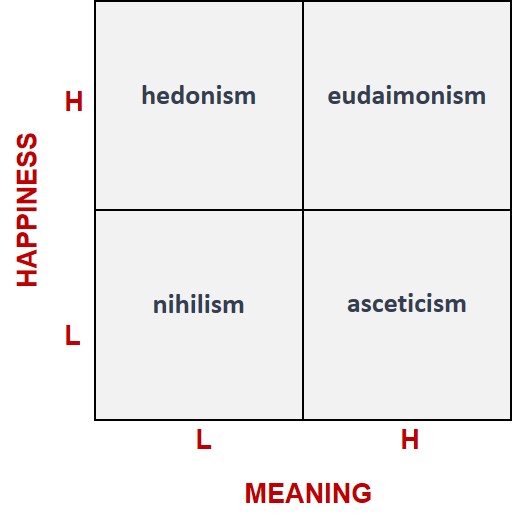
Meaning and happiness are two essential components of a ‘good life’. They are also largely independent of one another. Which in turn means that it’s very possible to achieve one without affecting the other. Which then means I can draw happiness and meaning as two orthogonal axes of a matrix. Something like this:
As with any good 2×2 matrix, the top right-hand quadrant define the ideal state in which we achieve the best of both of the parameters defining the two axes. It’s also the corner where the conflicts and contradictions between the two parameters are successfully resolved.
It’s also, too, useful with 2×2 matrices to be able to find words to characterise each of the quadrants. I’m not sure I’ve got the labels totally right in all four case, but I’m pretty certain the ‘eudaimonism’ word in the top right-hand is the right word. The fact that I’d never heard of it before tells me two things. The first of which is that not many people have thought about the need for a word to define a ‘happy and meaningful’ situation. As it happens the word comes from Aristotle and the Ancient Greeks. Which is perhaps ironical given their Socrates-driven insistence on the kind of either-or thinking that got us all into this mess in the first place. But this then leads on to the second thought: has anyone ever thought about explicitly formulating (and, better yet, resolving) the contradiction between happiness and meaning?
As far as I can see, the answer to that second question is ‘barely’. Which to my mind seems to offer up a big reason for the mass of philosophical confusion. Enter TRIZ.
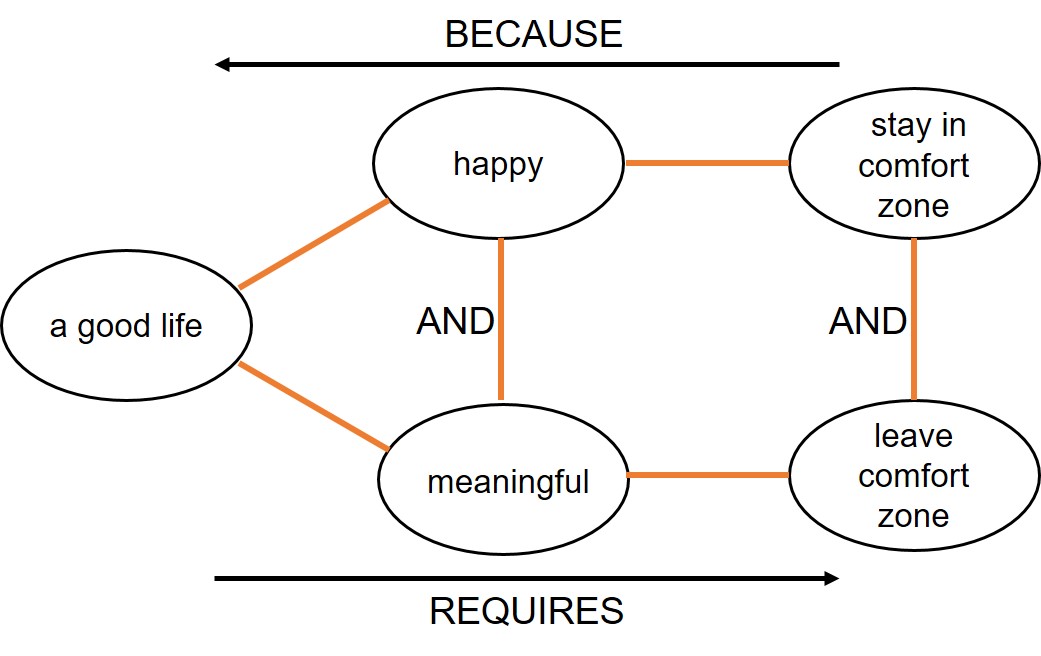
Happiness and Meaningful are largely independent and fundamentally in conflict with one another. Key word ‘fundamentally’. The reason they’re in conflict is because of contradictions between the now and the future, taking and giving, or staying in our comfort-zones and escaping from those comfort-zones. Something like this:
They say a problem well defined is a problem half-solved. Solutions may still take a while, but I feel a lot more confident than I was ploughing through the philosophers’ confused ramblings, that this picture offers up a much better problem to work on.
Darrell waits in the queue, then when it’s his turn, walks up to the counter, smiling
Darrell (handing over passport): Hi, I’m checked-in already, just need to print out my boarding pass.
Counter: Thanks. Flying to Orlando?
Darrell: Mmm, yes. Thanks.
Counter: Any bags to check-in?
Darrell (turning head to the left and right to indicate the bags hanging off the respective shoulder): No, thanks. I just have my laptop and my overnight bag.
Counter (not smiling any more): You’ll need to check one of them in.
Darrell (looking puzzled): Really? Is there a problem?
Counter: Let me weigh them. Put the bag on the scale for me.
Darrell (places overnight bag on the scale): Okay?
Counter: And the laptop bag.
Darrell (places the laptop bag on top of the overnight): Okay?
Counter: Sorry. You’re only allowed 10kg.
Darrell (looks over at the scale reading, adopts puzzled expression): It says 10.2kg.
Counter (switching on laser eye-beam stare): You’re only allowed 10kg.
Allow me to stop the scene at that point. In my head I am about to explode. In practice, I know that venting frustration in these situations is rarely a good idea. Respond immediately and my limbic brain is doing all the talking; pause for a second and my more rational pre-frontal cortex has a chance to survey the situation.
Fortunately, I managed to get past the limbic moment. Spooling the clock forward a couple of hours to the point I was boarding the plane and realised there were over 200 empty seats, I think that if I’d known this while I was at the counter, it would have been much more difficult to stop my emotions from doing the talking. With 200 empty seats, every passenger on board could be carrying an anvil and the plane still wouldn’t be over-weight.
Getting past the ‘limbic moment’ is necessary in order to create a win-win solution. I’m pretty certain I didn’t want to check my bag in and thus ensure a 20 minute wait at baggage claim in Orlando in order to retrieve it, and I’m also pretty certain it was better for all the Virgin baggage handlers if I handled my own bag. A limbic reaction would have almost guaranteed a lose-lose outcome.
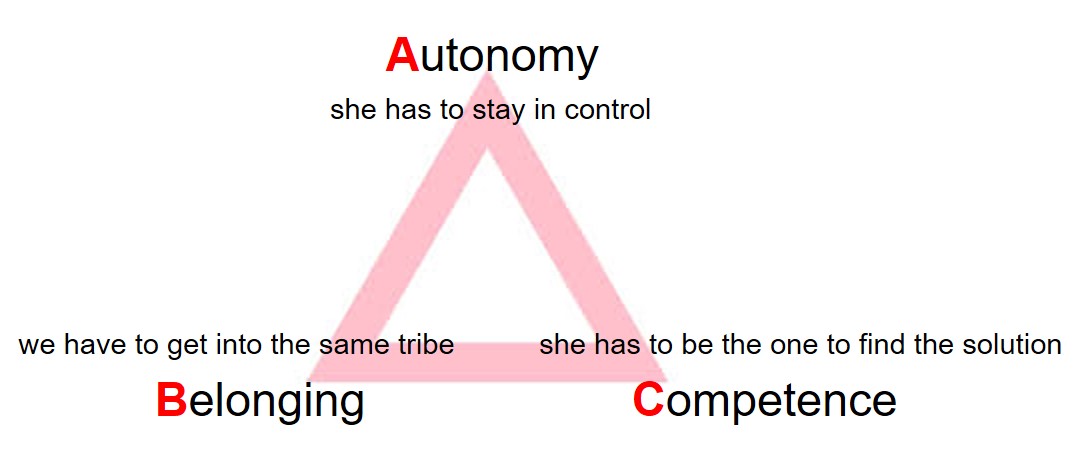
Once my PFC was in control of the situation, I knew I was in a classic ABC-M emotion game. And that meant if I was to be allowed to keep my bags it was necessary for me to get the Counter Agent feeling like her Autonomy, Belonging and Competence were heading in the right direction.
The ‘Belonging’ aspect seemed like it was the biggest challenge: she was in officious Virgin Atlantic Check-In Staff ‘us’ mode and I was ‘them’ – another troublesome passenger. If there was going to be a solution to this problem, my first challenge was going to be getting us both into the same tribe.
I looked around at the other passengers in the queue. Desperately trying to find a tribal link between me and the Agent. Then I said to her, ‘it looks like I’m the only non-tourist on the plane. Not sure how much work I’m going to get done on the plane.’
I wasn’t sure this was going to work, but when she smiled, I had an inkling we were now both in the same tribe. The tribe of ‘people working when everyone else around them is on vacation’.
Next up Autonomy and Competence. I looked at her and shrugged my shoulders.
There was a pause.
‘I expect you have a bottle of water in your bag,’ she said.
I looked at her. My turn to smile. ‘I expect I do,’ I replied.
‘Make sure you drink it before you board.’
‘Definitely,’ I responded.
‘Here’s your boarding pass,’ she looked into my eyes, ‘I moved you away from the worst of the small children’.
‘Thanks,’ I said, ‘my hero’.
We both knew there was no bottle of water in my bag.
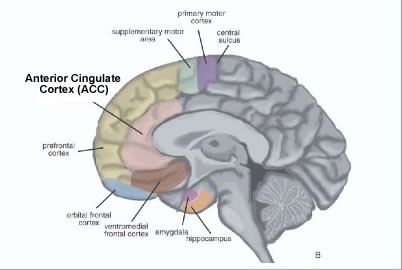
The human brain is a thing of wonder. Even more wonderful now I know there’s a bit of it – the Anterior Cingulate Cortex (ACC) – that has the job of identifying conflicts and contradictions. This is pretty important from an innovation perspective. Innovation overwhelmingly starts from conflicts and contradictions. In theory, the ACC ought to help. In practice, it tends not to.
Here’s how I think the story works.
Most of the decisions in our life get made in our rapid-acting, emotional (limbic) brain. We make decisions for good reasons and real reasons. The ‘real’ reason is the one our limbic brain makes. Then, because this decision can often sound a bit dumb when we try and describe why we made it, along comes our much slower, pre-frontal cortex (PFC) to rationalise the decision and work out what the ‘good’ reason is that we’re going to share with others when they ask us why we just did what we just did.
The PFC is the part of the brain that does all of our ‘creative’ work. It helps us to analyse a situation, work stuff out and, if we put enough information in and give ourselves enough incubation time, start generating creative solution ideas. Because it has a lot of work to do, it does it much more slowly than our limbic brain.
Our PFC is triggered to do this creative problem-solving job when our ACC identifies a conflict. Two (or more) pieces of conflicting input data trigger the ACC, and it then passes the conflict to the PFC to be solved.
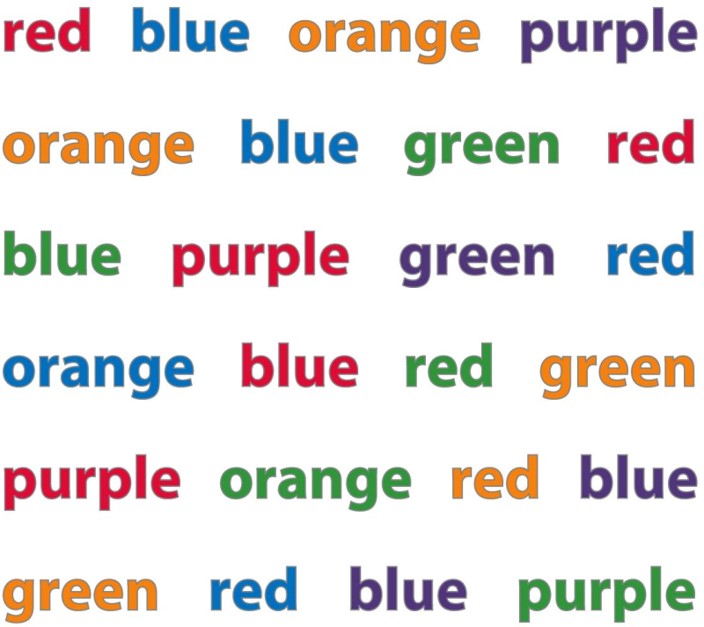
There are three important kinds of conflict as far as the way our brain works. Each relates to our prevailing relationship with our surroundings. The first is what might best be described as a ME-versus-ME conflict. This is where we receive different inputs from different sensors that are in some way inconsistent. A classic example is the psychologist’s favourite, the ‘Stroop Test’. This is the test where a poor unfortunate participant is shown lots of words where the meaning of the word and the colour of the writing used sometimes don’t match. Something like this:
The reason we’re often ‘slow’ at working our way through this kind of occasionally-conflicting list is because our ACC has spotted conflicts which require our PFC to unravel.
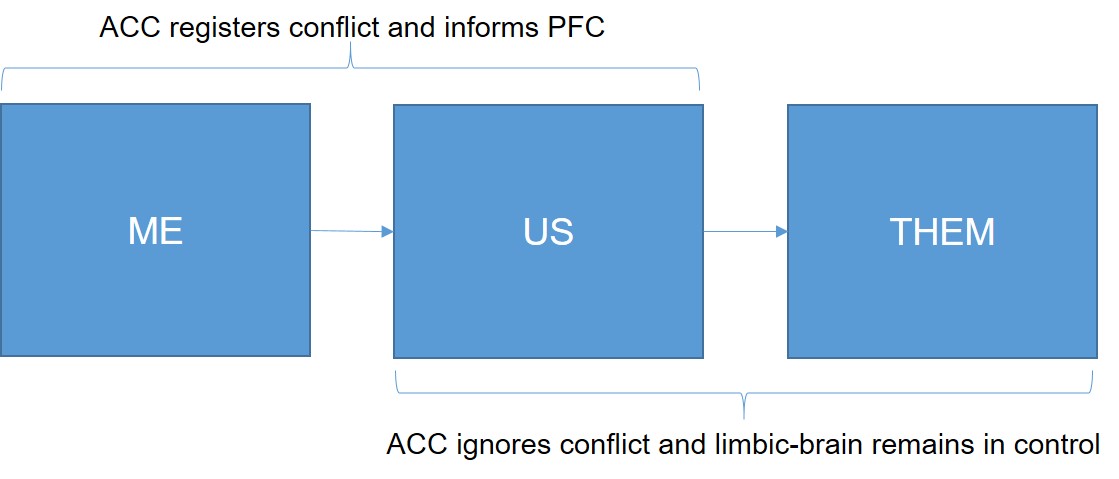
The second kind of conflict involves ME-versus-US situations. These occur when, for example, my other half tells me that, yes, she’s interested in going to see the new Planet of the Apes movie with me, but all of her body language says she’d actually much rather be pulling out here finger-nails with a pair of rusty pliers. The me-versus-us conflict my ACC registers is that I want to go see the movie and she doesn’t. And so my PFC, very wisely, steps in to solve the conflict. Which means neither of us have been to see the new Planet of the Apes movie, and I have my fingers crossed that it will be showing on my trans-Atlantic plane at the weekend.
The ACC has evolved to be very good at spotting these ME-versus-US conflicts because, from an evolutionary advantage perspective, it’s important to our individual survival that we remain part of the tribe. And remaining part of the tribe means we sometimes – more often than not – have to sacrifice our personal needs and desires for those of the group.
Then comes the third kind of conflict situation: ME-versus-THEM. ‘Them’ being all of those other people that aren’t a part of my tribe. ‘Tribe’ in this context meaning any kind of affinity group that I might wish to feel myself being a part of. Whether it be my family, the millions of fans of Bradford City Association Football Club, left-handed guitarists, ‘European’ or ‘people-in-favour-of-stricter-gun-control’.
Now something strange happens with our ACC. It becomes conflict-blind. Which means that our response to whatever situation we might find ourselves in is going to be driven by our limbic brain and not our rationalising PFC. Thus, if I should find myself in the horrific situation of having a person wearing a Leeds United shirt approach me with a smile on their face, my limbic brain immediately tells me to prepare for trouble. The reality of the situation, when they walk past me and sit at the empty seat at the next table is that a) the subnormal oaf was merely looking for somewhere to drink his coffee, and b) I’m not wearing anything that reveals my own rather more refined footballing tastes, so he didn’t know that I was a THEM. The reality is that I’ve just experienced two conflicts, but my ACC has registered neither and hence my limbic brain is still making all the decisions. That’s why my hackles continued to be up, and I sit there dreading the possibility he might ask me to pass the sugar.
In the bigger scheme of things the Bradford/Leeds version of the US-versus-THEM scenario is pretty trivial. In other words, of course I passed the sugar. At the end of the day, we both turn out to be part of another tribe – the tribe of holidaymakers having the good sense to come and enjoy this café on a drizzly Wednesday afternoon.
On the news tonight, they showed scenes of the protests outside the Trump rally in Phoenix. Some of the protestors were exercising their right to carry arms. I know that, were I to find myself in that situation, my limbic brain would’ve pressed hard on the ‘flight’ button and got me the hell out of there. Guns plus beer plus tear-gas plus 30,000 people thinking with their limbic brains does not feel to me like a winning combination. The only outcome, in fact, is that the two THEM’s are going to be further apart after the evening ended than before it began.
What is happening with these kind of ME-versus-THEM conflict situations is that our limbic brain immediately explains them away by, in effect, saying this situation is outside the tribe, and if it’s outside the tribe then it’s to be expected that things aren’t normal. If it’s outside the tribe, from an evolutionary perspective, it’s all about fight-or-flight and so our PFC has no role to play. And, moreover, is given no role to play by our ACC.
The reason this happens is because there has never been a situation in which there’s been an evolutionary advantage to creatively solving ME-versus-THEM conflicts. And that’s the major flaw. Now we live in our highly complex, highly interdependent modern world, crammed full of US-versus-THEM situations it is all too easy to retreat into our US tribes. Moreover, we retreat automatically. Rather than do what we perhaps ought to do, which is to recognise that Tribe A and Tribe B have different views of the world and that our real – innovation – opportunity is to get past our limbic brains and allow our PFC to see things from that more considered perspective. So that, when they do the same, we can – together – solve the conflict and create solutions where we both win.
I don’t know for sure, but maybe that’s the dominant – ‘first principles’! – societal conflict that needs to be solved right now: we’re trying to live in a 21st Century society armed only with our prehistoric brains and semi-automatic pistols. Maybe, it’s time for our Anterior Cingulate Cortex to step up a gear.
A few months ago, when I inadvertently revealed to a friend that I’d run out of useful non-fiction to read, I was pointed in the direction of philosophy books. Wow. What a sad, sorry journey that’s turned out to be. At least from a TRIZ perspective. If only this philosopher knew about TRIZ, I kept saying to myself, they wouldn’t keep saying such dumb stuff. Dumb trade-off stuff. I’m-right-you’re-wrong kind of stuff. It was like being back in Debating Society. A very bad version of Debating Society where everyone is stuck in an infinite loop. One full of all the people that ended up becoming politicians.
Plus, now I can’t get the idea of a Third-Way politics out of my head (see previous blog article), it feels like the Philosophy Departments have a lot to answer for. Especially in terms of the mess the career-politicians and ‘swamp-draining’ political disruptors seem to be making of things right now. Why can’t they see that the right answer to any kind of debate is not ‘I win’ or ‘you win’ or ‘let’s meet in some kind of please-nobody halfway point’.
Think about any of the big political arguments these days and it ought to take no more than five minutes to work out that the halfway compromise is never going to appease anyone. Whether it’s pro-life-versus-pro-choice or Brexit-versus-Bremain, or ‘alt-left’-versus-‘alt-right’, the answer is never going to come by trying to find a point at any kind of magical intermediate point between the two extremes. In the same way that you can’t cross a chasm in two jumps, you can’t solve a dilemma problem by building a rope bridge and expecting everyone to go and stand in the middle.
Last week I hit upon what has started to feel like some kind of root (-contradiction) to why the politicians and philosophers are floundering so badly. What I hit upon was the ‘trolley problem’. One of those morality tales Debating Societies seem to love getting their teeth into. Seemingly for ever, if evidence from around the Internet is anything to go by.
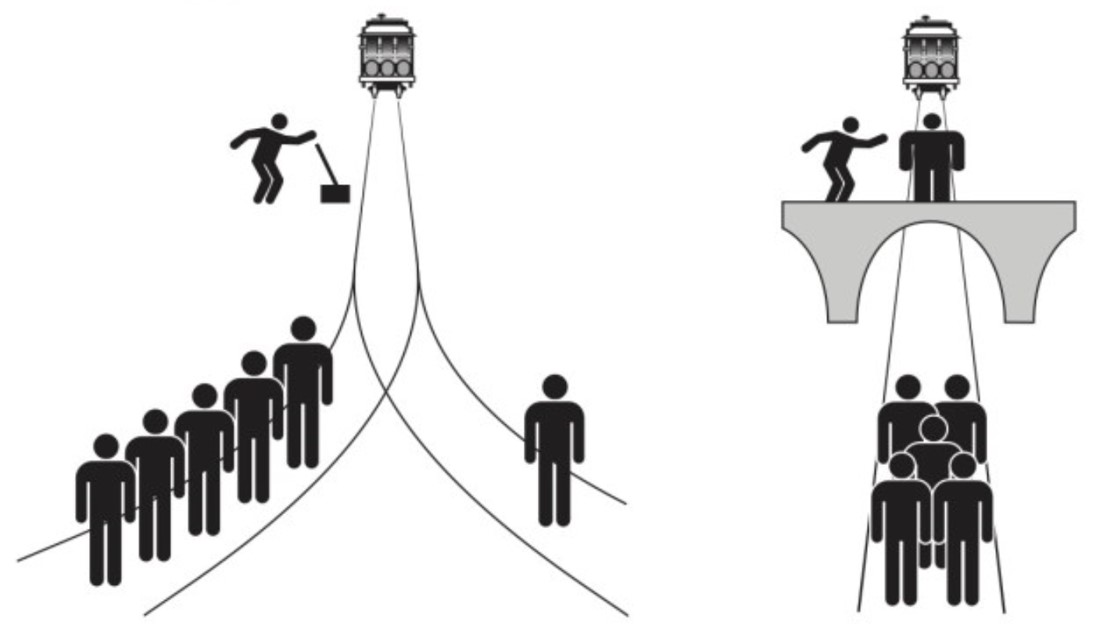
Just in case you don’t know what it is, the scenario involves a runaway trolley car. The car is trundling along the track which, as only philosophers with too much time on their hands and too little common-sense would configure, has five people tied to the rails. When the trolley hits the five, they will all die. Sad.
Fortunately, as luck would have it, you’re standing by a switch that, should you pull it, will divert the trolley off on another track, thus saving the five people. The only problem is that, on this new bit of track, there’s another person tied to the rail. Thus, pulling the switch to save the five people will cause the death of one. The deep philosophical question then being, ‘would you pull the switch?’
Not satisfied with this apparently dubious scenario, several new variants of the problem have subsequently appeared. One of the more interesting ones sees you on top of a bridge running over the top of the trolley track next to a person wearing a heavy back-pack. By pushing this person over the bridge onto the track, you’re able to save the five people tied to the track, but sadly, kill this poor unfortunate, back-pack toting stranger. Again, the question is, would you do the deed?
Now, when I declare this variant of the trolley problem ‘interesting’ what I mean is that when lots of people are surveyed about the two questions, a lot more people (just over double the number) would push the switch than would push the person with the back-pack off the bridge. This is interesting, I think, because it helps us to reveal the real problem. Sadly, the philosophers don’t see things through to this next stage. All they seem to be interested in is tackling the problem as an optimization challenge. They’re caught, in other words, in the usual either/or trap Socrates taught them to think about.
Seeing the problem as an either/or situation allows the philosophers to identify two kinds of people: Utilitarians – people who make a tangible value calculation that concludes saving five lives is better than one – or Deontologists – people who take the categorical moral imperative stance that prevents them from partaking of an action that causes harm to others.
Drawing a line between Utilitarians and Deontologists and measuring where people are along the spectrum is frankly a dumb waste of time. Both for the people being asked and the even dumber people designing the experiments in the first place.
It’s a contradiction, stupid.
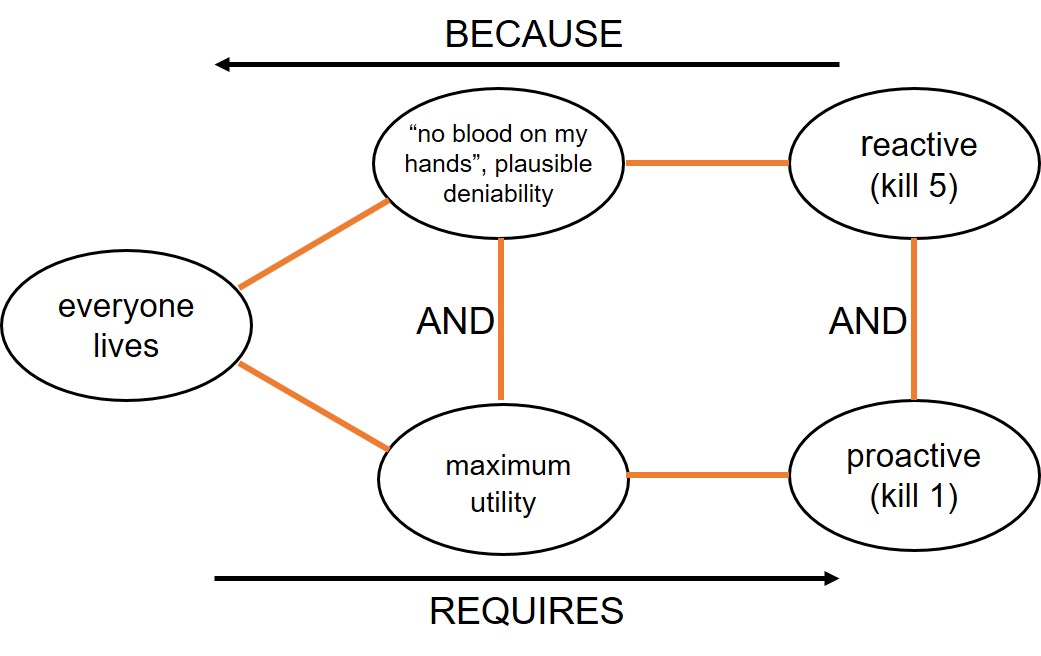
If you wanted to really solve the problem, what you ought to do is draw a picture that looks something like this:
Then, you can look at the TRIZ Contradiction Matrix and see how others have been there before you and actually solved the contradiction.
Which, if I look the trolley problem up as a technical problem seems to most likely be solved using Principles 28, 7, 19 or 24. Or, if you treated the problem as a ‘people’/’psychology’ problem, you’d start by looking at Principles 7, 2, 24 or 10.
Using one or a combination of those strategies, should give a dozen ‘third-way’ solution options.
I could write a bunch of them down for you, but I know that the philosophers and politicians would tend to think of all of them as ‘cheating’. What they mean when I experience these kinds of people using this word is, ‘stop being creative and answer the damn question: are you going to push the dude off the bridge or not?’
And thinking about those annoying kinds of situation, it suddenly hit me what ‘third way’ means at a much more general level. And how people actually think. Or at least how designers think. Or rather, how people that haven’t been infected by terminal either/or- disease think.
Pose the trolley problem to a designer and they won’t see it as a utilitarian value trade-off between saving five people or saving one. What they rather do is think about the ideal outcome. In this case the ideal being that no-one of the six people dies. Then, having defined where the solution needs to get to, they start to think creatively about how that ideal outcome might be achieved. They’ll look for resources, and any damn way possible to ensure everyone walks away alive.
If that’s ‘cheating’ then so be it. That’s what creativity and innovation is all about. Breaking rules to find better rules. It’s a way of thinking fundamentally different to the ones the philosophers and politicians have been taught to use.
One that, if we give ourselves permission to use it, allows us to stop spinning the wheels for the next three hundred years pointlessly debating Utilitarianism versus Deontologicalism, we can all move on to more interesting problems. Ones that solve the contradiction. And the next one. And the one after that.
‘Third-way’ thinking means not meeting halfway, but rather somewhere else. Somewhere where we get a much more ideal solution. One in which everyone is and feels better off than they were before.
I have a feeling that deep-down we all naturally think in this idealistic way. At least that’s how we start. We naturally look for ideal solutions. And it’s only when apparently smart people – like the philosophers and politicians – bludgeon us into thinking we have to make trade-offs and that we ‘can’t cheat’ that we end up dropping ourselves to their meaningless, pointless, no-skin-in-the-game level. No-one actually dies in the trolley problem. I know that if it was a real situation and someone was actually going to lose their life, I’d put my faith in the person who was more than happy to think (‘cheat’) their way out of the either/or trap and make sure we ended up with everyone still alive at the end of the story. Cogito ergo tertium. I think, therefore I find the third way.