Yes, That Is Correct. But Is It True?

One of the sad consequences of a world in which no-one knows what is real and what is made-up is that it becomes increasingly difficult to have a sensible conversation about anything. Is gender binary or non-binary? Is being a member of the EU a good thing or a bad thing? Instead of answers we drown in noise.

Maybe the heart of the problem is the word ‘or’. Which implies a contradiction. Which in turn is trying to tell us that we could have a much richer, infinitely more meaningful conversation if it was somehow possible to separate the contradictory sides of the argument. One side of the argument could be ‘wrong’ of course – especially in a world where students are being taught that their opinion is somehow equivalent to fact – but it is also highly possible that both sides of the argument could be ‘right’. A contradiction is when one right meets another, different, right.

One of the least well used means of synthesising a contradiction-busting higher ground involves exploring the differences between correctness and truth.

Correctness is all about tangibly measurable properties. A tomato is a fruit.

Truth is all about the experiential aspects of phenomenology. It is about knowing whether or not it is a good idea to put the tomato into my fruit-salad.

Truth and correctness can be the same thing, but we’ll only establish whether this is so by escaping from our day-to-day existence and allow ourselves to think.

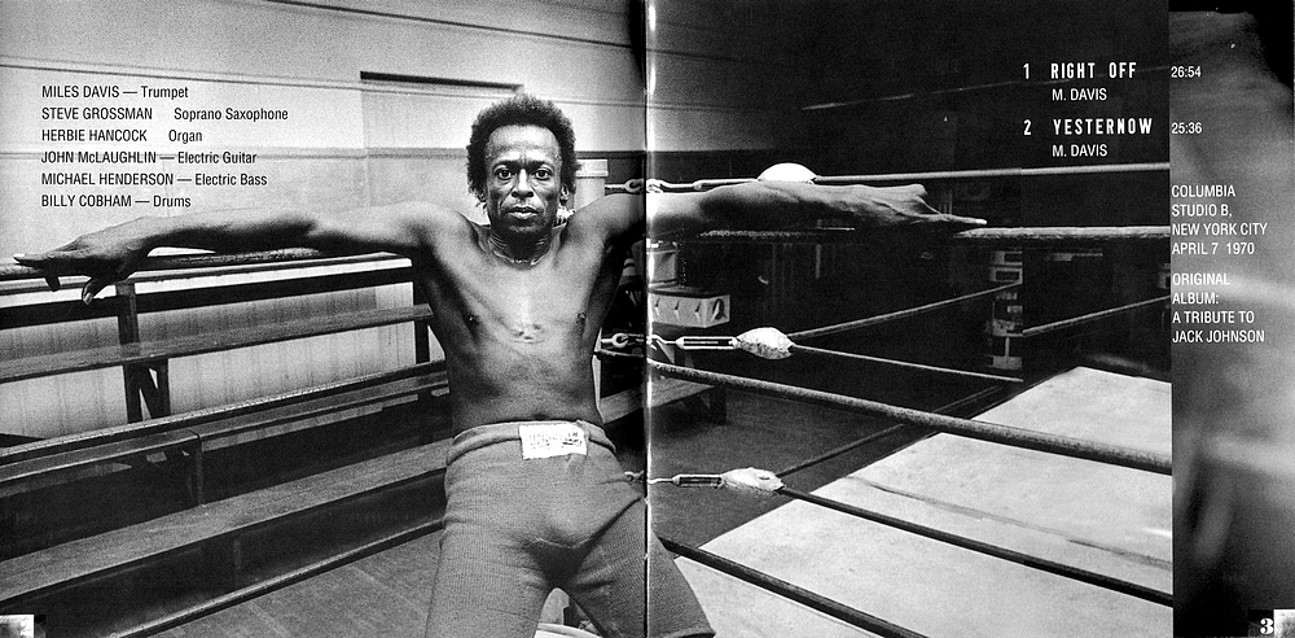
I struggle to get myself into the zone where I can achieve such thinking. More often than not, if I get there, it will be while listening to or playing music. And more often than not I’ll find it easier to get there while listening to Miles Davis.

In my more naïve moments, I might take a look at a score for a piece of Davis’ music. My all time favourite of which is ‘Right Off’ from the album A Tribute To Jack Johnson. Naïve is the right word here because guitarist, John McLaughlin is about as far removed from my level of playing capability as it is possible to be. Nevertheless, if I scan the Right Off score, I can see I am looking at something that bears all the properties of correctness.

I’ll never get to play like McLaughlin. For a long time I found this a depressing thought. Then I heard the Miles Davis quote, ‘don’t play what’s there, play what’s not there’ and, after it finally sunk in, I realised I was listening to an important truth. An incorrect one from the tangible perspective of the measurable properties of the Right Off score, but truth nevertheless.

If I was looking for ‘truth and correctness’ I believe that is what the Jack Johnson record actually achieves. It is unarguably one of the most enduring and significant moments in jazz and rock history. If only for having the audacity to disrupt both so radically.

This, despite the fact that the record company, Columbia was so un-enthused by the record when Miles handed over the master tapes, they couldn’t even be bothered to check they’d put the right artwork on the album cover. Columbia, in their negligence, were neither correct or truthful. Which is kind of shabby, but does at least allow me to draw this 2×2 matrix:
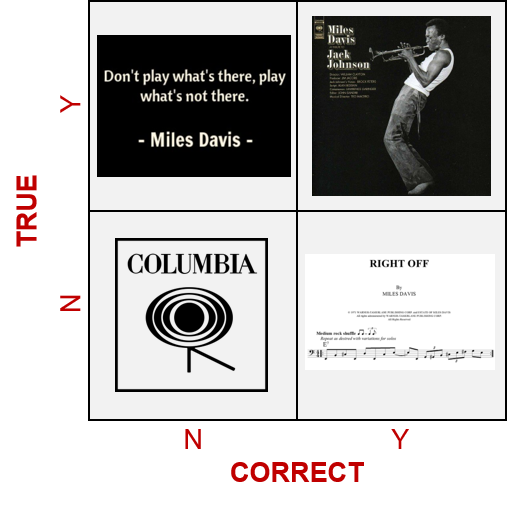


And once I realise truth and correctness form two orthogonal axes like this, I might just give myself the opportunity to make some meaningful progress on whatever issue I might find myself working on.
Shrödinger’s Brexit #27

Now that every last semblance of rationality has well and truly left the Brexit building, all I’m left with is a bunch of potential new TRIZ case studies. Every cloud of stupidity has some kind of silver lining I suppose.

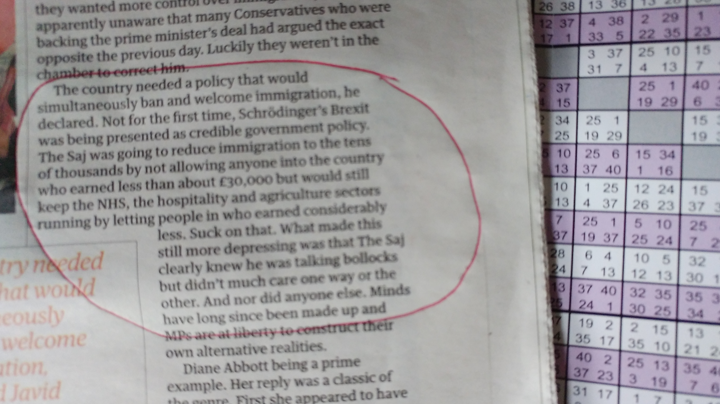
Today’s started with an unusual situation while reading the paper this morning. Normally I love what John Crace has to say, and feel somewhat the opposite about Home Secretary, Sajid Javid. Today everything got flipped the other way.

Crace was having a go at Javid’s comment that the UK needs a policy that would ‘simultaneously ban and welcome immigration’. Crace, like most people, appears not to be able to comprehend the idea of a contradiction. So much so in this case that he used the apparent illogicality of Javid’s statement to highlight how ridiculous our politicians are these days. Still, I suppose it gave him an opportunity to repeat his witty Shrödinger’s Brexit label. Which I now – blinding flash of the obvious – understand to be a pretty good label for political contradictions in general.

Solving contradictions is the very core of breakthrough and innovation. In a political context it is exactly what I’ve been talking about when I rant on about ‘Third Way’ perspectives on society. Stop being bound by the tyranny of the ‘or’ and start actually thinking.

Crace is so far away from understanding this concept I think I have to re-calibrate just how far away TRIZ is from most people’s consciousness. Perhaps to the point that I sy to myself, if Crace doesn’t get it we really are doomed.

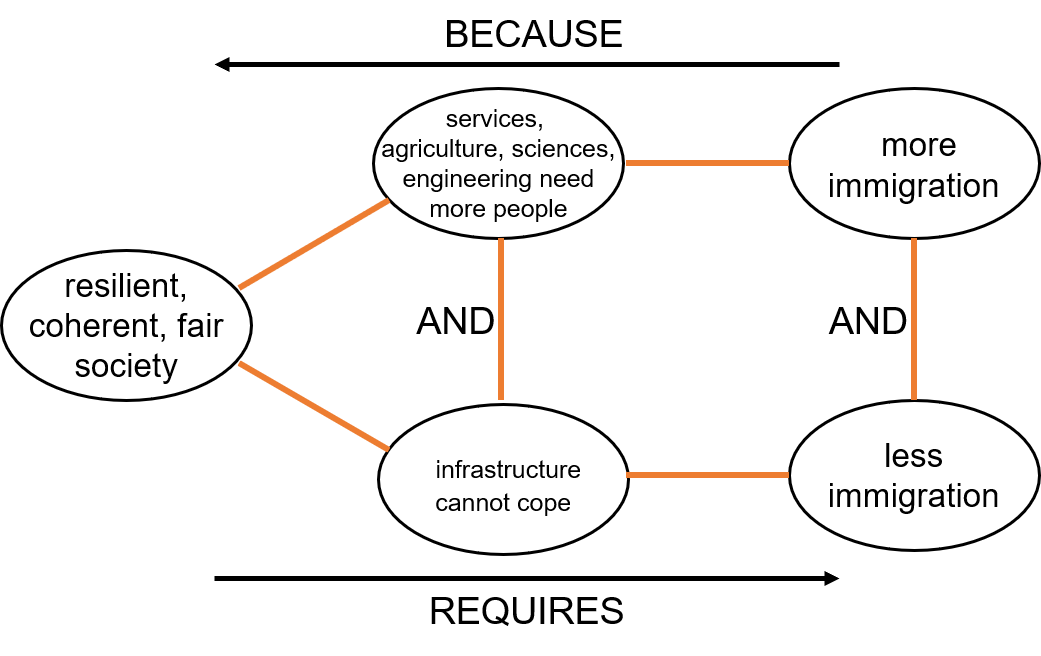
Javid expressed the contradiction, but then, as far as I can tell, he gets stuck. Yes, British society needs more and less immigration. But unless you can construct a model like this…

…you will end up with the usual half-arsed compromise non-solutions politicians always end up inflicting on us all.

I think we need another pair of new rules. One: no-one is able to enter politics until they’ve successfully completed TRIZ 101. Two: no-one is allowed to write about politics, Mr Crace, until they too have completed the same course. Then they might stop looking for cheap opportunities to regurgitate cute clickbait phrases and start actually helping to solve the contradiction so we can all move on to better things.


The John Crace column is here: https://www.theguardian.com/politics/2019/jan/11/brexit-debate-day-six-if-no-one-else-was-trying-why-should-the-saj

Uncoddling The (American) Mind

I bought a copy of The Coddling Of The American Mind. Two reasons. One, it sounded like another interesting data point to challenge or verify the GenerationDNA model. Two, it talks about antifragility. Specifically, antifragility – or the lack thereof – in the current generation of students. Recent experiences with students almost everywhere I travel is that there’s a fragility problem. Over-protection is endemic. Lack of critical thinking even worse. Which is not good from a future-of-innovation perspective.

I’m not sure I got too much out of the book to be honest. It certainly serves to confirm the GenerationDNA story, so while that’s ‘nice’, it didn’t open up any new lines of enquiry that might help strengthen the theory. It does, however, contain a few juicy snowflake horror stories, which are always nice to shock audiences with. On the negative side, half the time it felt like I was being sold a CBT course, and there’s not much I dislike more than buying something that then feels like an advert asking me to buy something else. Never mind, I’m resolved to let these things wash over me in 2019. So that just leaves the somewhat bigger problem of just how facile and trite the book’s ‘solution’ recommendations were. The problem, here, I think is that beyond identifying a number of candidate factors that have contributed to the coddling problem, the authors had no idea how to make sense out of them. And if they don’t know what the real problem is, no wonder their suggested remedies end up being glib.

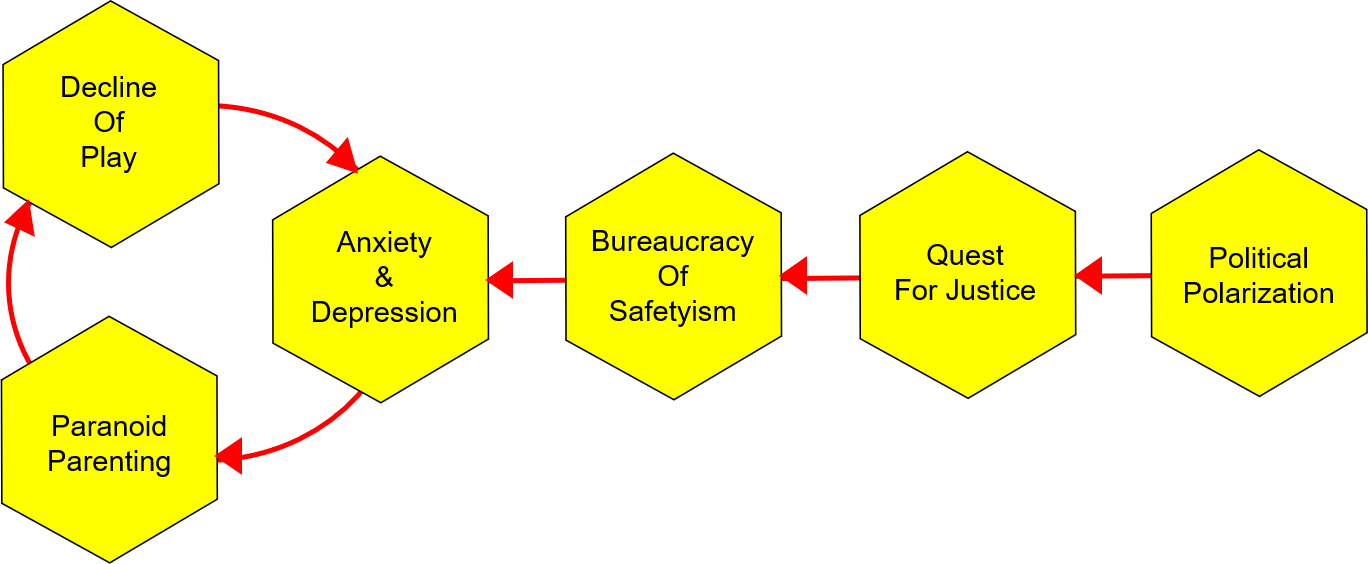
What they were missing I believe – I would say this wouldn’t I? – is a sensemaking tool. Good to identify six contributory factors; not good failing to understand that it’s the relationship between these factors that determines what the real problem is. It felt like time for a Perception Map. As it happens, a really simple one, seeing as there are only six ‘perceptions’ to be mapped.

The six Coddling-causing factors are:

Polarization Cycle – left/right polarization with, particularly, the left being dominant within academia.

Anxiety & Depression – the rise in adolescent anxiety and depression, starting around 2011.

Paranoid Parenting – moving away from antifragile towards fragile, and the three great untruths – what doesn’t kill you makes you weaker; always trust your feelings; life is a battle between good people and evil people

Decline Of Play – decline of unsupervised play, play being crucial to neural development

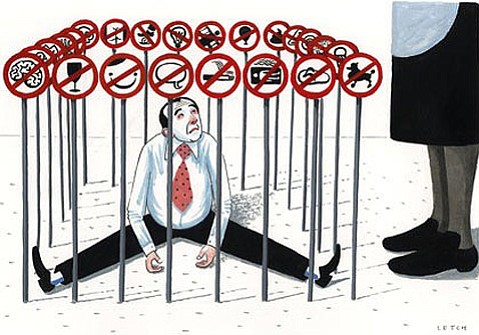
Bureaucracy of Safetyism – campus bureaucracy increasingly about ‘covering your ass’, expansion of its protective mission and concept-creep of what counts as ‘violence’, also increased competition means treating students as ‘customers’ (who are, by definition, ‘always right’)

Quest For Justice – students responding to powerful political events with a commitment to social justice activism.

And when I map out which one of the others each perception leads-to, I ended up with this picture:

It’s sometimes difficult to generate any kind of insight from such a small map, but in this case the vicious cycle that has to be broken seems quite clear, and the simplest way to break it seems clearer still: let kids play again. Get them out of their anxiety downward spiral and it doesn’t matter how polarized the politicians get, or how idiotic the university administrators become, the students will work out what they need to do. You’re welcome.


Is Mesoscience The New Word For TRIZ, Or Is TRIZ The New Word For Mesoscience?

Late as usual. I’m writing a paper for the big Sustainable Innovation conference in March. Before I start assembling all the intended content, I thought it might be a good idea to read the referees’ comments on my abstract. It turned out not to be. Unless the aim was to make me laugh out loud.

The reviewers are – I think – supposed to be anonymous, but one of them had magically managed to identify themselves by ‘suggesting’ that my paper might like to refer to and build from some of their previous work. I’m not sure this is totally ethical, but seems about par for academia these days, so, what the hell, I thought I’d take a look at the hyperlink they kindly included in their review. You can take a look yourself here at http://english.cas.cn/bcas/2018_2/201809/P020180905630348554064.pdf. If you’re in any way associated with TRIZ, you might like to take a few deep breaths before you click. The ‘paper’ is a fairly overt advertisement for a ‘new’ branch of science the authors label mesoscience. The culmination of the ‘paper’s content is this picture:

Its hypothesis is that if the world chose to look across all of the various scientific disciplines, maybe there may be some common principles. If you didn’t laugh you’d cry.

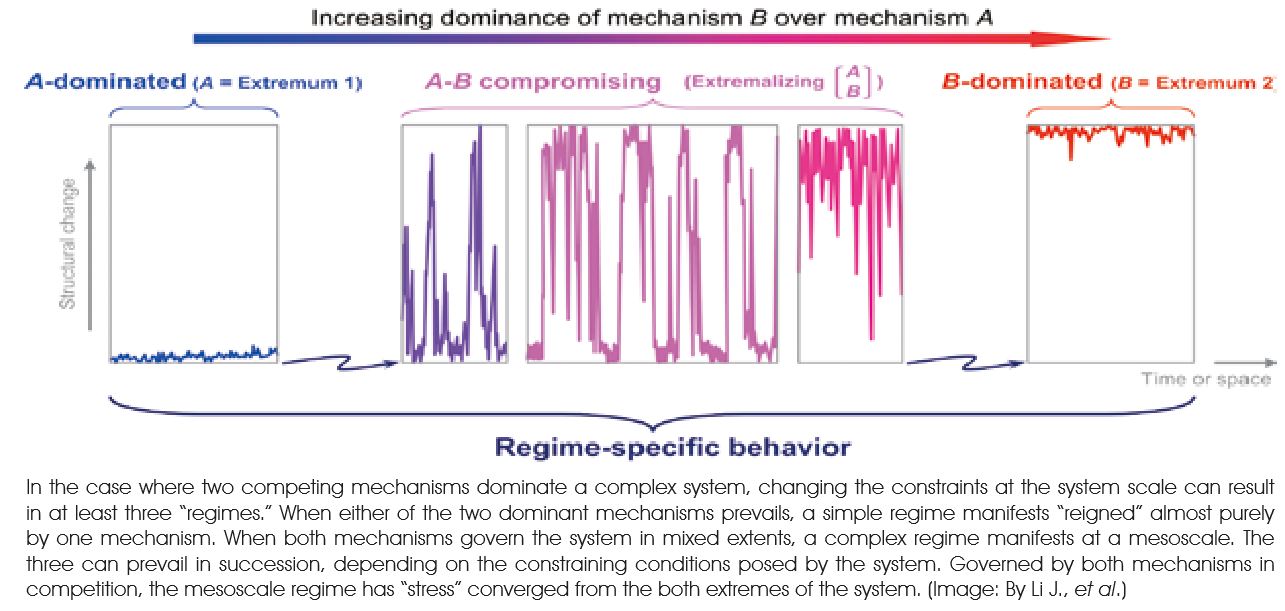
I usually tend to veer in the ‘laugh’ direction when encountering this kind of stuff. In this case, however, an earlier section of the ‘paper’ had speculated that ‘compromise in competition’ was one of the common principles. The point got reinforced by this graphic:

The bit I like best is the ‘at least three regimes’ comment. The graph plots the three regimes, but chooses not to plot the only one that’s important.

TRIZ, of course, has spent the last 70+ years doing precisely what the mesoscience ‘paper’ calls for. ‘Someone somewhere already solved your problem’ is one of the main findings. Meaning that there are very clearly a number of cross-domain common principles. One of which is very definitely that compromise is not a good thing. Compromise in competition is called, by other academic charlatans that also don’t understand how the world works, ‘red ocean’ territory. When we compromise, we end up with a bloodbath where nobody wins. Success is all about creating ‘blue oceans’ and the way this is done is by solving contradictions. So that everyone can win.

Funny how academics extolling the need for looking across domains – and supposedly, if I can believe their ‘paper’, have been at it for coming on 60 years – have a) failed to find TRIZ, and b) failed to identify that compromise is completely not a ‘common principle’ but rather a common mistake.

Thinking about it, maybe they did find TRIZ and realised it was safer to pretend they hadn’t. Acknowledging someone somewhere had already solved their problem likely as not meant no more grant money. And a need to engage their brain and go find a new question to go work on. Like I said, if you didn’t laugh, you’d cry. Academic crocodile tears.

Colombo’s Contradiction Radar

One of my favourite TV detectives when I was growing up was Colombo. Although I wasn’t quite aware of it at the time, looking back, I think the thing that made me like actor Peter Falk’s character so much was that he was simultaneously a dishevelled nincompoop and as smart as a whip. It was a great contradiction. Criminals often got tricked by the former trait and then caught by the latter. Call it the old Principle-22-Switcheroo.

I was flicking through the channels the other day and noticed a re-run of an episode called, ‘A Bird In the Hand’. I joined the action after the murder had taken place. Someone was being filmed getting in to their Rolls-Royce and when they started the engine, the car blew up. Colombo had been watching the film. Looking for contradictions.

Lots of people seem to love watching detective programmes. I think its because they’re a type of puzzle. Can we work out who the perpetrator of the crime is before the detectives do. I’d have to say the genre became less appealing to me after I learned TRIZ. Mainly because TRIZ taught me that detection of a crime is all about contradictions. Someone is lying. They’re pleading their innocence, when in fact they did it. Spot the contradiction and you’re well on your way to solving the mystery. Connect the contradiction to an Inventive Principle (or perhaps more than one if the writer has done their job well), and the mystery is solved.

What Colombo had spotted in the film, as the cameraman panned across the car scene was that one of the peripheral characters flinched and closed their eyes tight before the explosion. Only someone with a devil-in-the-detail detective’s eye would’ve spotted it. A fraction of a second in a grainy panning film. But enough to give the game away. The flinching character was flinching before the explosion happened because they knew it was about to happen. Bam. Principle 10, Prior Action. Contradiction solved. Crime solved.

I’m not sure I have the energy to go through all the other 70+ Colombo episodes to reverse engineer the contradictions and their resolution, but I’m willing to make a fairly safe bet that a big part of the success of the series, and the reason I loved it, is that the contradiction resolutions could be connected back to a broad spectrum of the Inventive Principles. Most scriptwriters keep re-using the same old tricks. Colombo’s writing team, in my memory at least, was a cut above.

How about that for a Masters thesis dissertation topic?

Nanny States?


Imagine the level of creativity that must have been involved to convince hundreds of millions of people to pay you money to consume something will cause them long term damage. Now imagine how much more cretative you’d need to be to keep convincing them even after they know what you’re doing to them. That’s a lot of creativity. And a big testament to the idea that if you pay people a salary to be creative, they will deliver.

That’s the state much of the world finds itself in these days. Large corporations that have done enormous damage to society by getting society to inflict damage on itself.

Not surprisingly, the public sector eventually woke up to the problem. The large corporations have been terrifically creative at ‘externalising’ a lot of the harm they’ve caused. Encourage 30% of the population to become obese, but don’t worry about it because the healthcare system will take care of it. Encourage people with limited resources to pour most of their money into your fixed-odds betting terminal, but don’t worry about it because Social Services will mop up the broken homes and bankrupcy.

So, the public sector fights back by telling people to be careful. All totally logical. A balance has to be struck. Although – hmm – having successful big corporations in your neighbourhood is also a good thing, because look at all of the jobs they provide, and the taxes they pay. So local governments also play the externalisation game. Even so, there seems to be a growing perception ‘higher up’ that the scales of justice seem to be tipping in the wrong direction.

The large corporations response? The organisations that employ all those creative people? They put the creativity to work. And in a stroke of sublime genius they come up with expressions like ‘nanny state’. They then convince the mass media to pick up on the phrase and turn it into a libertarian meme. And they in turn convince poor Joe Public that the Government is evil because they’re ‘taking away your liberties’. They’re telling you what you can and can’t do. Take back control. Show them who’s boss.

Taken at a certain level, you have to take your hat off to the genius of it all. Get the consumer to defend the evil you’re making them pay to do to themselves. You couldn’t make it up.

You couldn’t make it up, because the journey has taken several decades and dozens of iterations. Each one more subtle than the last. The slippery slope to complete consumer control has been a long and winding one. To the point where it’s now difficult, if not impossible, to see what life was like while we were still at the top of the hill.

From a TRIZ perspective, of course, the current corporation-versus-nanny-state battle is merely a contradiction. Albeit one that looks a lot like a David versus Goliath fight. Quite romantic in some ways, except for the fact that we all remember the story because it’s the rare exception rather than the rule. 99 times out of a hundred, Goliath beats David to a pulp.

Perhaps the real point of the parable is that David wins by being creative? If the odds are stacked against you, the only way you win is by being able to out-smart than your opponent.

It’s time for the Nanny State to step up to the plate. No more public information diatribes, no more ill-thought penalising taxes, no more ‘expert opinion’, because all they do is play the game the creatives at the big Corporations want you to play. Time instead for the public sector to get properly creative. Play the corporations at their own game. Think about it, if they managed to convince all of us to pay to harm ourselves for their benefit, surely it must be possible to convince the population to get the pendulum swinging in the win-win direction where everyone actually wins instead of killing themselves?

We can all start by remembering that each time someone uses the expression ‘nanny state’ to argue against a point you’re trying to make, your job is not to argue back, it’s to reveal to them which Corporate puppeteer has snuck the empty phrase into their head.

Failure To Tip – Iced Tea

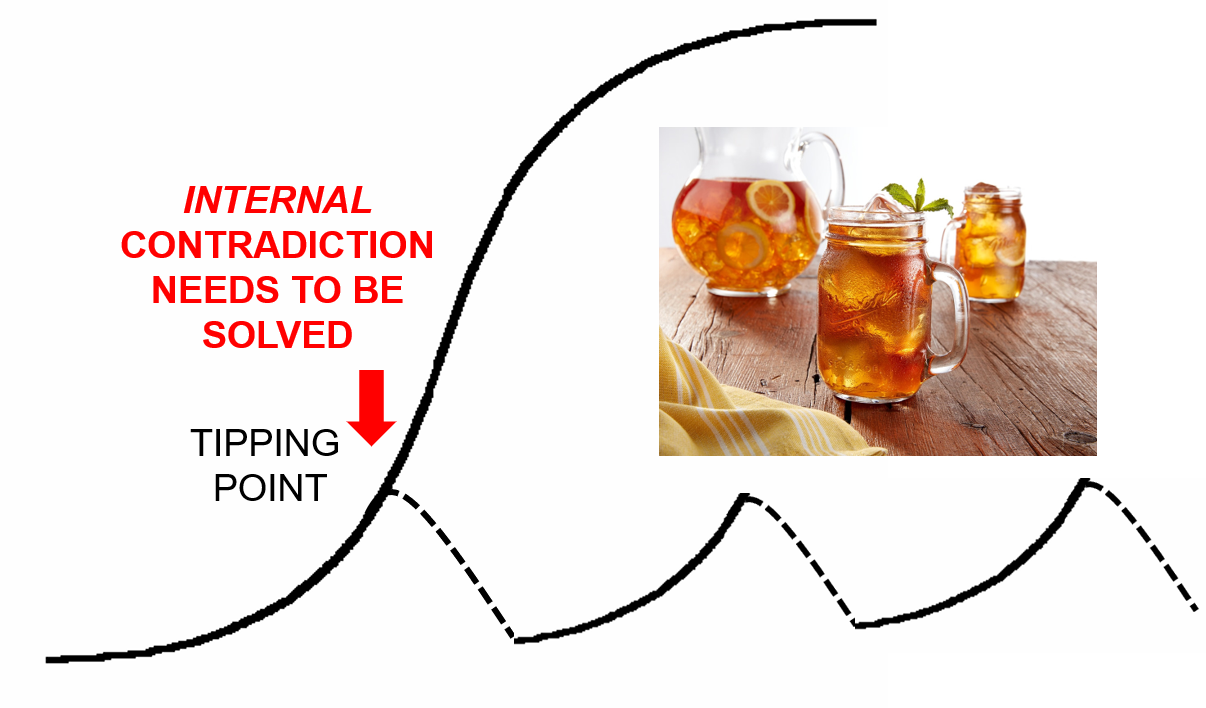
A quick follow-up from yesterday’s blog about Tipping Points. I’ve had occasion to ‘assist’ more than one FMCG organisation in their ill-starred attempts to encourage the British public to take on board the habit of drinking iced tea. They’ve all failed. I haven’t been involved for a few years now, but I still keep watch of the market closely enough to know that – regular as clockwork – one player or another will make a futile re-launch attempt at the start of each summer season. A new brand name. A new twist. A new camera angle. The next inevitable failure.

It’s always been my hypothesis that the combination of (relatively) cold-climate and highly ritualised drinking of tea at work (‘builders’ tea’) just mean that iced-tea makes no sense to the vast majority of British consumers. Iced-tea makes complete sense if its 30degC outside in the same way that hot tea makes no sense if you try and make it with lukewarm water. And yet the FMCG companies keep plugging away trying to get a product past it’s early-adopter Tipping Point to become – commercial heaven – a staple of the British fridge.

I still kind of believe that mis-fit is there. These days, I also know that getting past Tipping Point has little or nothing to do with external contradictions, but is rather about the FMCG companies resolving some of the internal ones. They’d be far better off, in other words, looking at Bruce Springsteen’s Born To Run or U2’s Joshua Tree as a model for success as the latest piece of expensive, ill-conceived consumer feedback from the advertising agencies.

Tippping Point Fruit Flies

When we’re trying to reduce the world and how it works down to first principles, there aren’t that many universals. One of the clearest – if you know what you’re looking for – is the S-Curve. S-Curves are literally everywhere. Because they describe the fundamental behaviour of systems, and systems are everywhere. When a system experiences a (positive feedback) virtuous cycle, we get the first, rising, half of the curve, then, eventually the system will experience a (negative feedback) vicious cycle which will cause the second – diminishing returns – part of the curve.

Most ‘systems’ aren’t planned, but emerge naturally. A murmuration of starlings being a good example. Our planet, to take a rather bigger example, is another emergent system. That’s what James Lovelock’s ‘Gaia’ idea is all about (despite the fact that the woo-woo, Pagan-gods-and-incense, New Age brigade would like to thing otherwise).

Any system that humans intentionally create is subject to the laws of the S-Curve, but because we’re deliberately trying to design a successful new product, or encourage customers to subscribe to a new service, if we want to achieve a successful climb up the curve, we need to understand what we need to do (and not do) at each critical stage. How to create a virtuous cycle? How to delay the arrival of vicious cycles? Or, better yet, how to overcome the vicious cycles and enable a discontinuous shift to a new curve?

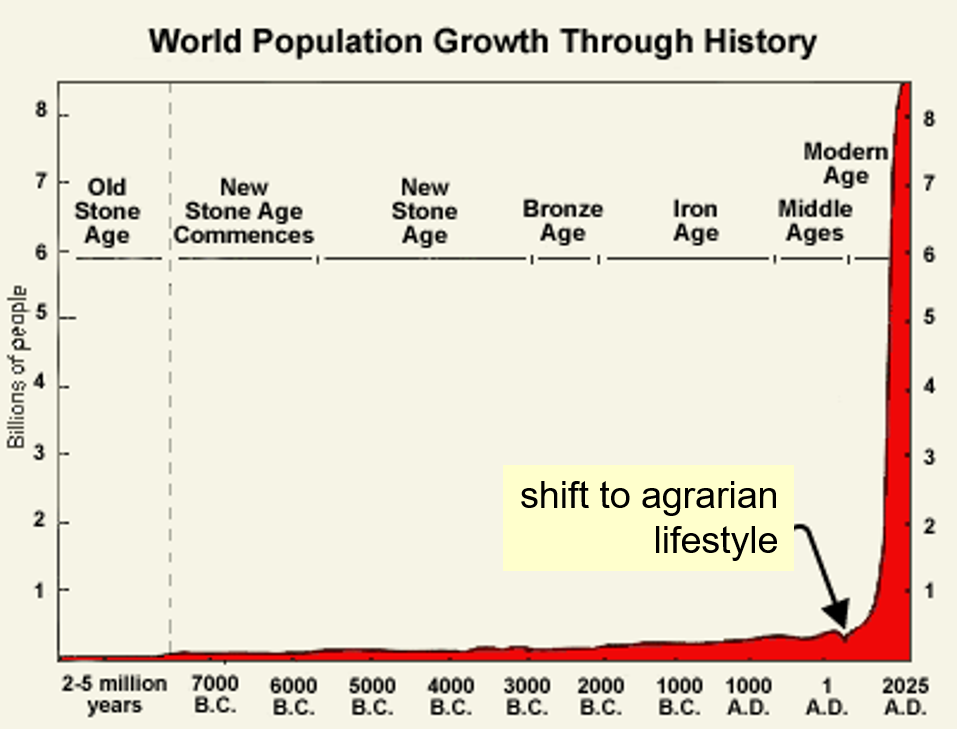
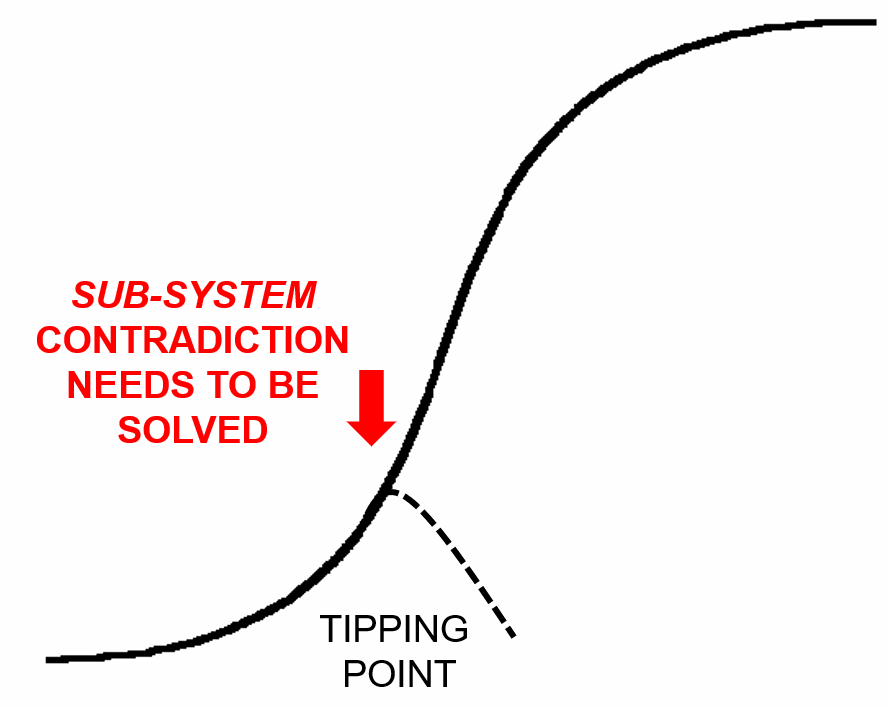
One of the more subtle, but nevertheless fundamentally-present and critical points on the curve is what we currently know as the ‘tipping point’. This is the point when a system successfully transitions from the early struggle and on to the steeply rising part of the curve. This Tipping Point is usually very subtle in nature since natural systems often emerge over quite long periods of evolutionary time. The easiest way to see them therefore involves zooming-out and looking at things over long periods of time. If we zoom out far enough, the human Tipping Point begins to look very obvious:

One could say that for most of our evolutionary history, humans played a tiny role in the ecology of the planet. Humans were a niche and the S-Curve of human population shows near stagnation. We only hit our Tipping Point after our long-ago ancestors invented farming. Once we stopped having to be nomadic and started building stable settlements that we started to achieve the economies of scale that meant new born infants were more and more likely to survive, and then, post Tipping Point, began the steep rise to levels that appear today – somewhere near the top of the curve – to no longer be sustainable.

A bit like the way biologists do a lot of their experiments with fruit-flies because the breeding time is so rapid, one of the best places to see a more detailed picture of the dynamics of the Tipping Point is to look at popular music. An industry where we get to see many thousands of attempts to create ‘hit’ artists every year. Almost every musician strives to be popular (if only to pay the bills), but the vast majority find themselves unable to get past a Tipping Point of popularity that allows them to sustain a long term career. Better yet from a study perspective, every artist is expected to create new music on a regular basis. Musicians are in many ways the fruit-flies of the S-curve world.

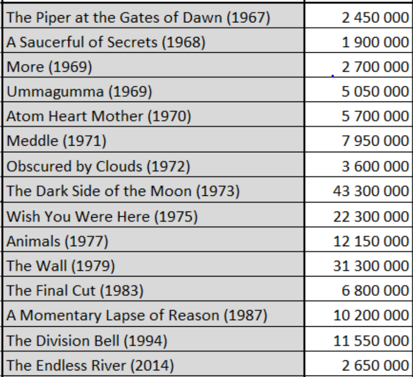
Take one of the best selling artists of all time, the band Pink Floyd. Here’s a chronologically ordered list of the sales of their albums:


The band hit the world in the late 60s and made an immediate impression on the record-buying public. They sold enough of their debut album to be afforded the opportunity to record a second. The second one, by all accounts, wasn’t as good, but it still sold enough copies that the record company sanctioned a third. This did a bit better. The fourth did better again. And so did the 5th. But it was only when 8th album, Dark Side of the Moon hit the shops in 1973 that the band found their Tipping Point. 5 million sales per album now jumped to 43 million. The band was, quite literally, set for life.

We can plot similar trajectories for other artists that successfully crossed this ‘set for life’ Tipping Point. Here are a few you, depending on your age, probably know:

The main thing to note with all of them, I think, is that Tipping Points don’t happen right away. Radiohead managed to go stratospheric after only their 3rd album, but it took Stevie Wonder 15 attempts before he properly climbed his popularity S-Curve and became a global superstar. On average, artists seem to need somewhere between five and six attempts.

So, one characteristic of the journey to Tipping Point seems to be trying different things. The other, more subtle one is that in each case some kind of internal (i.e. directly related to the artist rather than their audience) contradiction was solved. With Dark Side Of The Moon, the band finally worked out how to write songs, and, crucially, Roger Waters had the good sense to connect them all to an over-arching theme that would resonate with large swathes of music fan. With Stevie Wonder it was successfully fighting against his record company that he was a serious album artist and not just about pop singles. With Radiohead it was being allowed to produce the album themselves and not be bound by a similar record company pressure for singles. Aretha signed with Atlantic and went to Muscle Shoals. Springsteen stopped trying to be Van Morrison, dumbed-down the words, turned up Clarence’s saxophone and started listening to music journalist come-strategist, Jon Landau. And so on. The basic – universal, first principles – message being, if you want your system to get successfully beyond its Tipping Point, you need to find the internal, sub-system, contradiction(s) and solve them.


Jane Austen As A (Life) System

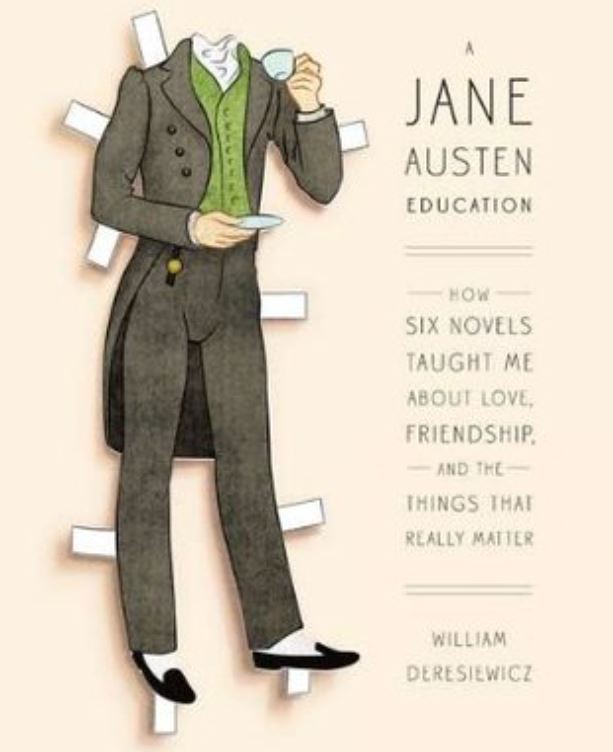
After enjoying William Deresiewicz’s book, ‘Excellent Sheep’ (see this month’s SI ezine ‘Best Of’), I thought I’d continue the journey and go straight in to one of his earlier books, ‘A Jane Austen Education’.

It didn’t take me too long to make a connection to Deresiewicz’s connection that Austen’s six novels have something to say about ‘love, friendship and the things that really matter’. Austen tells us about life, Deresiewicz says. She tells us that it is a system is what I say.

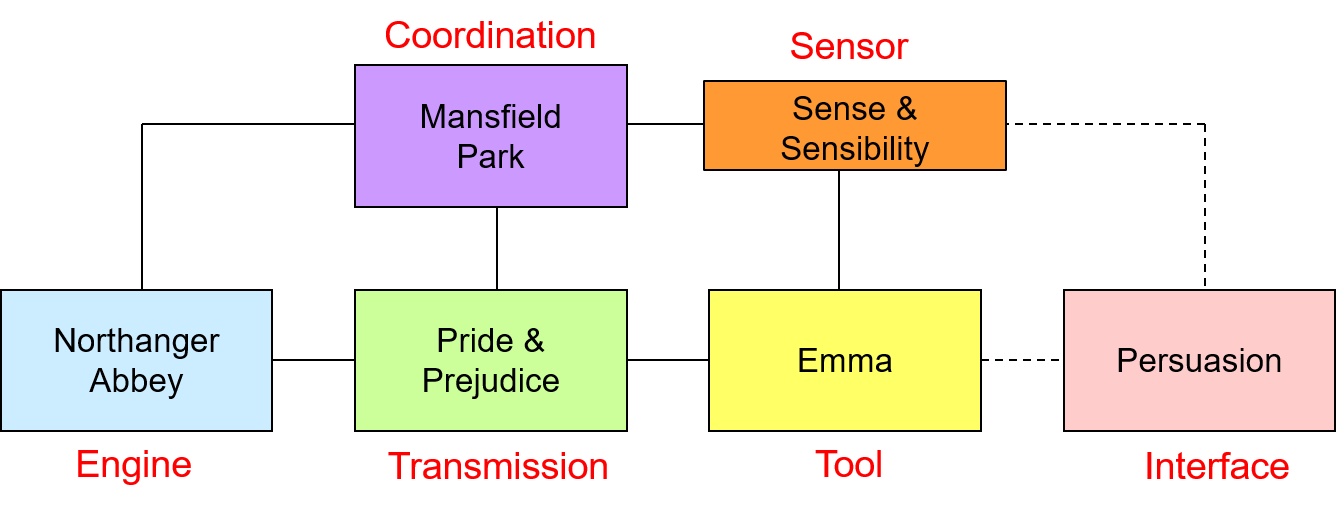
TRIZ tells us, via the Law of System Completeness, that ‘a system’ must comprise six essential elements. Six Austen novels, six elements. Hmm.

Here goes…

Mansfield Park (COORDINATION) – being entertained is not the same as being happy. Perpetual amusement leads only to the perpetual threat of boredom. The keys to true happiness, purpose and meaning lie elsewhere. Il faut souffrir. We all need to find our direction and navigate accordingly.

Emma (TOOL) – pay attention to the everyday things – those little things that happen hour by hour to the people in your life: what your niece said, what your friend heard, what your neighbour did. This is what the fabric of our really consists of. This is what life is really about. The devil in the detail.

Persuasion (INTERFACE) – be honest with your friends. Unconditional acceptance is not real friendship. A true friend wants you to be happy, but being happy and feeling good about yourself are not the same thing. A true friend points out your mistakes – even at the risk of losing your friendship.

Northanger Abbey (ENGINE) – Stay awake; don’t take things for granted. By renouncing certainty and cynicism, by opening yourself to new experiences, you can turn your life into an adventure that will never end.

Pride & Prejudice (TRANSMISSION) – you aren’t born perfect. You are born with a whole novel’s worth of errors ahead of you. But making mistakes is the only way to grow up, the only way to connect your need for new experiences with the daily grind. Being right might get you a pat on the head, but being wrong is the only way to help you find out who you really are.

Sense & Sensibility (SENSOR) – Love is about growing up, not staying young. It means a never-ending clash of opinions and perspectives. A true lover is someone who is different from you and willing to challenge you. If your lover is already just like you, then neither one of you has anywhere to go. Being aware of (sensing) differences is essential.

It’s like a whole new world… “But, in spite of these deficiencies, the wishes, the hopes, the confidence, the predictions of the small band of true friends who witnessed the ceremony, were fully answered in the perfect happiness of the union.”

If Creatives Were Creative…


More of those worried emails from people looking at breakthepatentstranglehold.com:
If the TRIZ Trends tell us all the future and prevents any future patentable inventions, what happens to my creativity? Why do we need creative people? What do the creative people do? Is there a point to our existence any more?

Sometimes, I wonder whether there ever was. I can be too sceptical sometimes.

I think creative people have a place in life. Albeit not the one most of them think it ought to be. If they don’t know TRIZ, frankly they’re not going to help anyone ‘be creative’. If they do know TRIZ, their creative value is in going beyond the Trends. It is in revealing the Trends we don’t know are Trends yet.

It is jumping off the intellectual cliff, finding the new ‘creativity S-Curve’.

It is about thinking harder and better than we currently do.

Perhaps the real problem with so-called creative people is they’re the ones – in my experience at least – who are least willing to get outside the ‘comfort zones’ they’re always accusing others of being stuck in.

It seems the least creative people I ever encounter are the people working in the creative professions. Most of them seem blind to the problem. All they seem to see is a world full of non-creative people that never listen to their ‘out of the box’ ideas. Never realising that the reason no-one listens is lack of ideas was never the problem. The real issue is lack of good problem definitions. Definitions like, ‘what happens when we go beyond this Trend pattern? Why does the Trend end here? What’s the contradiction between this Trend and that one?

Finding answers is easy. The true creatives are the ones who create better questions. That’s the new job. Same as the old job. Except now TRIZ confirms it for us.