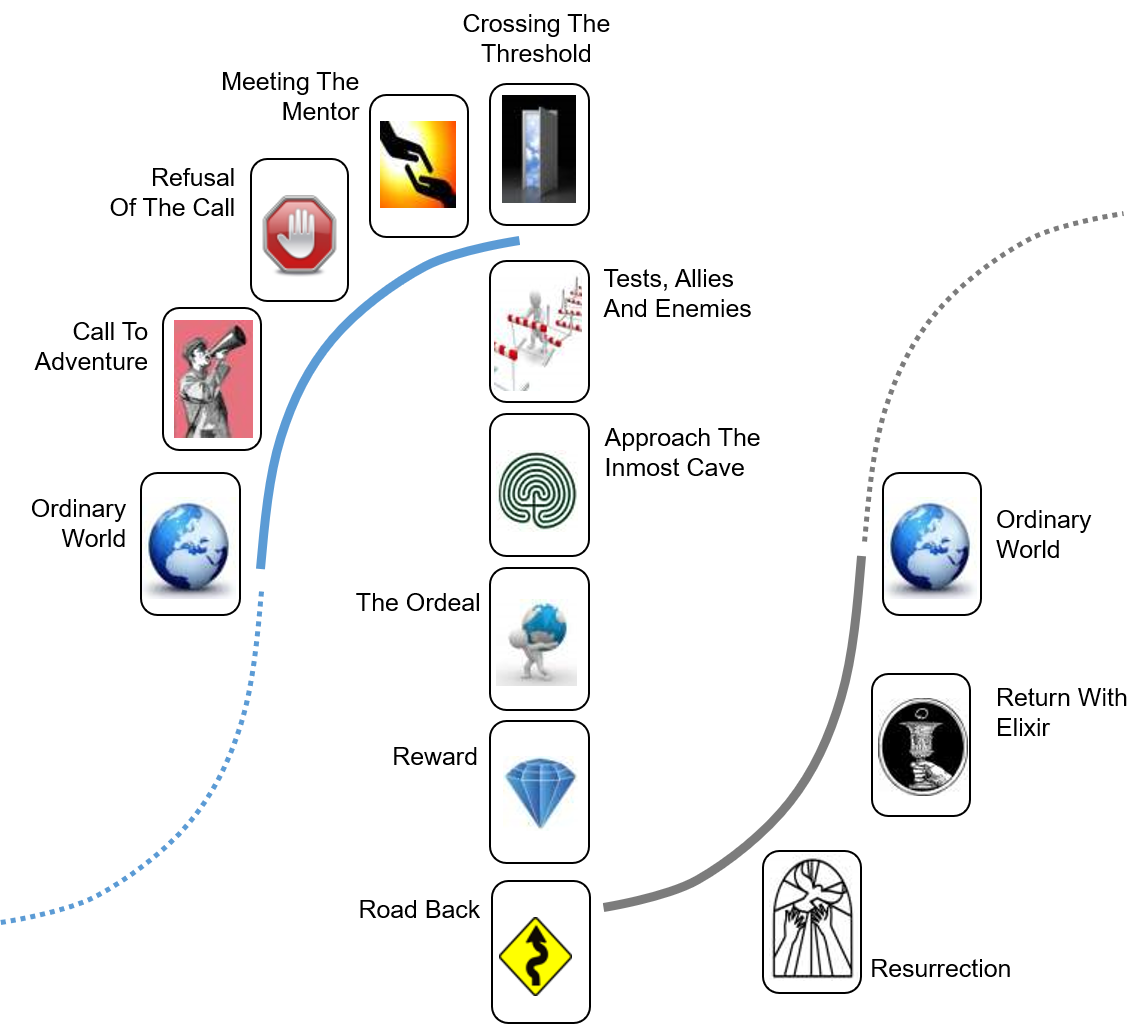
I’ve long been a fan (and user) of Joseph Campbell’s Hero’s Journey. We’re in the discontinuous change business. Which means s-curves. And specifically the jump between s-curves. The Hero’s Journey provides a compelling, stage-by-stage description of what these s-curve jumps look like. I’ve yet to meet an innovator yet that isn’t able to empathise with the model and recognise all of the stages their innovation project passed through.
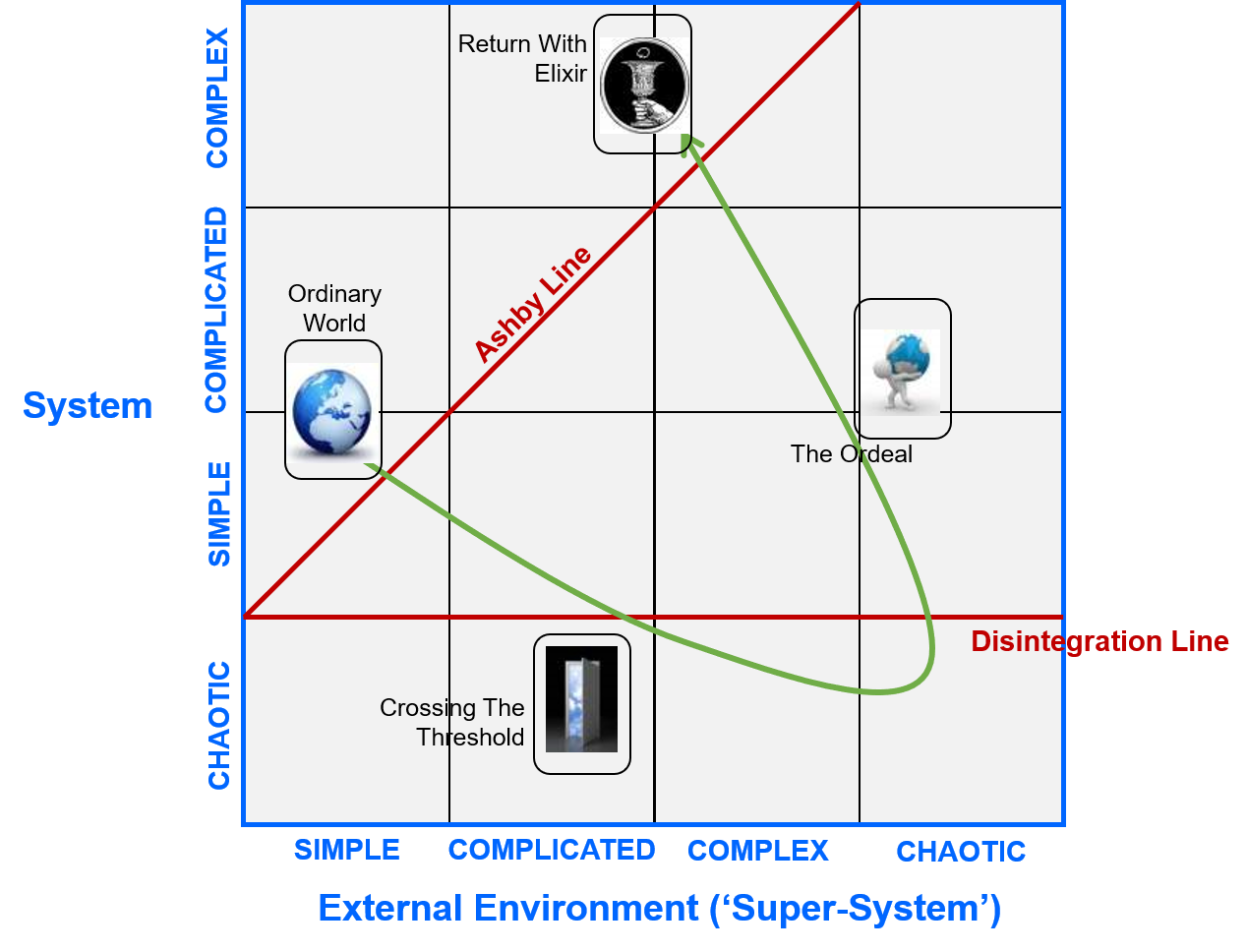
My new favourite thing is our Complexity Landscape Model (CLM). It was only a matter of time before we sought to try a mash-up with the Hero’s Journey. The results felt important. Here’s where we’re at so far:
Ordinary World – the start of the Hero’s Journey sees the Hero in their ‘normal’, usually calm and ordered world. From a CLM perspective, this equates to where many of us aspire to live our lives – in a stable state in the Simple-Simple zone.
Call To Adventure – something goes wrong. The Hero doesn’t always realise it at the time, but what’s happened is something in their environment changes and that change drops the Hero below the Ashby Line. Resilience and stability are no more.
Crossing The Threshold – after initially refusing the Call (a thwarted attempt to get back above the Ashby Line), and receiving the wise words of the Mentor, the Hero crosses the Threshold into Campbell’s ‘Special World’. For the Hero, this means that they have entered Chaos. They know they have to jump off the metaphorical cliff, but they also have little if any idea what’s coming next, or what they’re going to do about it.
Tests, Allies & Enemies – here are usually the most exciting parts of the Journey, certainly if it is a Hollywood movie manifestation of the Journey. Not only is the Hero’s ‘system’ in chaos, but so now is their surrounding environment.
The Ordeal – Chaos is a very unstable state and because of this it tends not to prevail for very long. Sooner or later, the Hero’s David-versus-Goliath contradiction emerges from the mess. The environmental chaos subsides and some kind of complex order appears.
The Reward – if the contradiction is to be solved, the Hero’s ‘system’ needs to become increasingly smarter. Solving contradictions demands at least a Complicated-capable means of taking on the world, and quite possibly a Complex one.
The Road Back – the Hero’s way of dealing with the situation increasingly comes to match the level of complexity of their surroundings. When the Hero enters the Complex-Complex zone, its possible to leave the Special World and enter ‘Ordinary World’ of the new s-curve.
Return With Elixir – somewhere on the road back, a death and resurrection is required. This may be the Hero, or, more usually it is redundant knowledge. Only after this has happened can the Hero cross the Ashby Line and claim the Elixir.
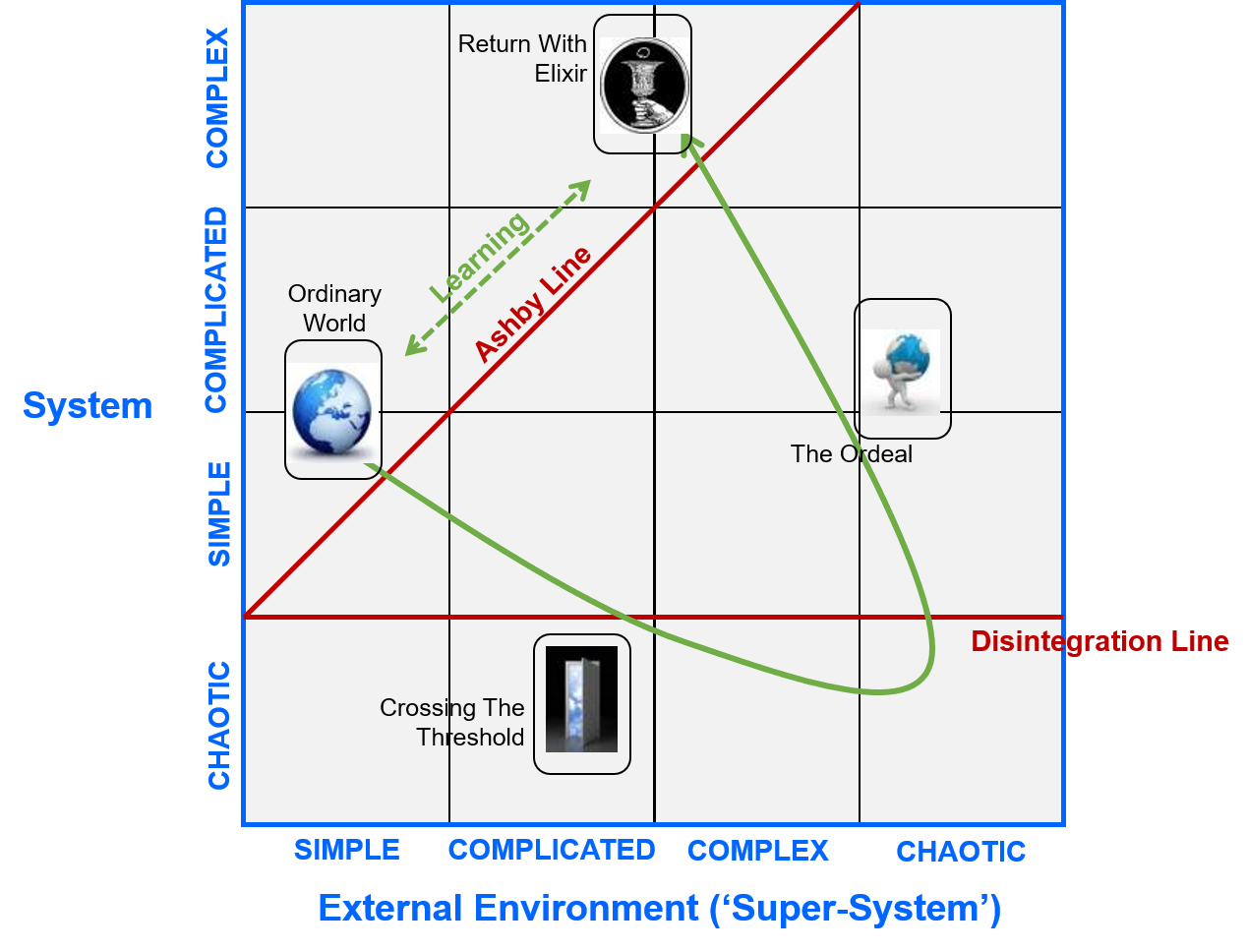
Crucially, at the end of the story, the Hero (and by proxy, the audience) is supposed to have learned something. This learning is symbolised by the fact that the end position on the Complexity Landscape is usually higher up than the position at the start of the Journey. This is the case even in Hero’s Journeys that fall into the Tragedy category. Tragedies, Rags-To-Riches, Icarus, Man-In-A-Hole or Oedipus stories in fact all follow the same basic trajectory. I expect I’ll be intrigued enough to go and explore the subtle differences between each of these various different story types in future posts. Probably in the context of studying specific books or films. Spending my afternoons watching movies… sounds like my favourite kind of research…
Ever wondered why the world is full of cracked paving stones?
I finally worked it out. A couple of years ago, I had someone come and lay a paved path outside my house. I watched the process as it progressed. I also asked the people doing the job why it was that there were so many cracked paving stones in the world. ‘Bad construction’ was the gist of their reply. Which I took at the time to mean, ‘cowboy builders, at the opposite end of the construction industry spectrum to us’.
But – of course – here we are two years later and several of my non-cowboy fitted paving stones are cracked.
Having watched the installation process, and now seen that it’s pretty much the same process you’ll read about on any of the thousand plus online tutorials, the likelihood or otherwise that a person will end up with cracked paving slabs outside their house has virtually no correlation with the skill or lack of skill of the builder, but rather the fact that the whole premise of how paving slabs are laid is dumb.
That premise starts with an assumption that the earth under the slab, the mortar that sits below the slab, and the sub-base that sits below the mortar doesn’t move. This is pretty much the same assumption used when roads get built and the track for railways gets laid. The only difference being the thickness and type of the sub-base layers.
This feels to me a bit like builder version of King Canute. That, by drawing a line in the metaphorical and actual sand, they might order the tide not to come in. In the fight between regal dictat and Mother Earth, however, Mother Earth wins approximately 100 times out of 100.
One of the principle characteristics of the Earth is that it moves. (A geologist friend once tried to amaze me with the ‘interesting’ (his word) factoid that the Earth’s crust has the same basic strength, stiffness and viscosity properties as toothpaste).
This being the case, one would have expected that someone by now might have worked out how to design structures that remained stable despite the fact that the ground they were built upon was moving. Sure enough, lots of people have solved this problem. They just never told the paving slab industry. Or the people that sell beautifully sieved ballast to hold railway sleepers in place. If such discussions had taken place, the railway ballast experts would have realised that what they’ve created is just about the worst possible ballast stone size profile. And paving slabs and the bases that sit under them wouldn’t keep looking like they have done for the last n-thousand years.
None of this is rocket science. Rather it’s a little bit of zero-cost geometric cunning. Something I’m in the process of integrating into my replacement paved path. Something I’m also pretty certain the path-laying, road-constructing, railtrack-laying industries have no interest in at all. After all, if paving stones didn’t crack every couple of years, if potholes didn’t appear in our roads every winter and if rail crews didn’t have to make daily checks on the integrity of the track, they’d run out of work for everyone within a year. And who’d want that?
Is Cher’s 1989 album, Heart Of Stone, the greatest album ever? That’s the question.
I’m joking. It has a couple of okay singles on it, but I’ve yet to see the album in anyone’s Top Fifty.
Cher, in any event is much busier with other things these days. Like this pair of Tweets, which appeared within a few minutes of each other the other day. My good friend Costas found them and challenged me to resolve the global conundrum they seemed to convey:
I looked at Cher’s outpurrings. Then I looked again. And then again some more. I could see she had a point. Or was it two? My contradiction-radar is usually quite finely tuned, but I was struggling. Was it an immigration-and-no-immigration contradiction? Or a climate-change-and-no-climate change problem? Or both? Or neither?
Just like Jesse James, I needed some incubation time.
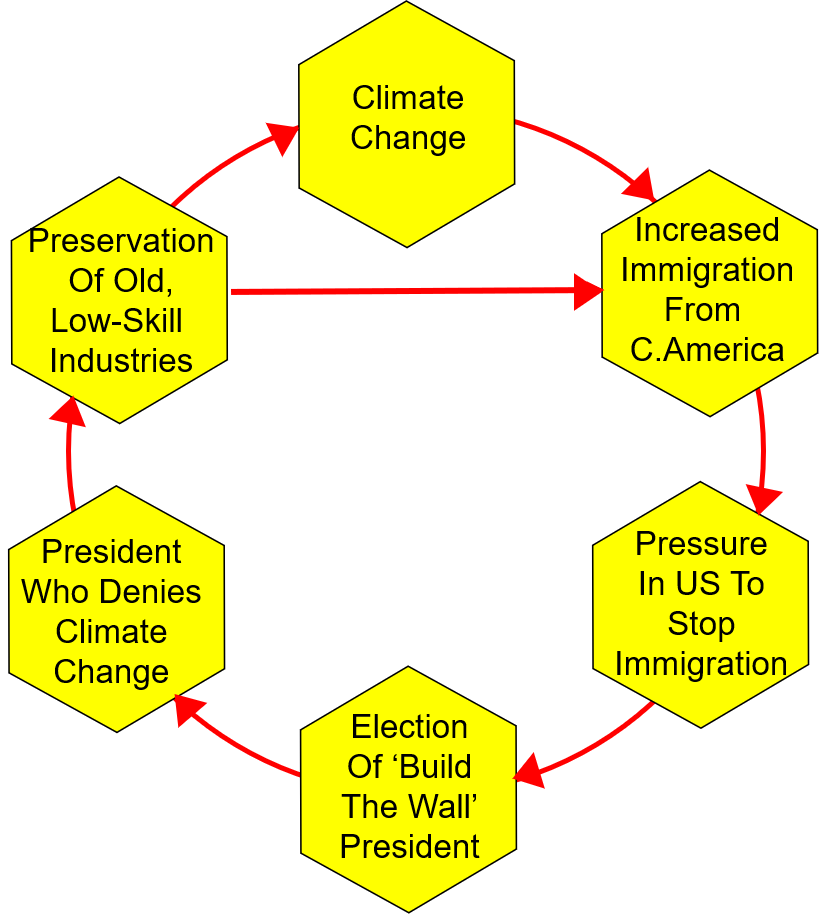
Was there a way to combine the two contradictions into one vicious cycle? Was it possible to get two pairs of conflicting perceptions into one coherent loop, where each ‘leads to’ link between one perception and the next made logical sense?
It was like doing a jigsaw puzzle when it isn’t clear the pieces are all from the same picture. Plus, half the pieces are missing.
When trying to make sense of a complex problem, there’s no rule to say there has to be one vicious cycle, but if you can find one, you’re well on the way to an opportunity to gain some real insight into what the ‘real’ problem might be. Time to start starting over. Bring on the title track. And some emotional fire…
After all that, there it was. Problem clear. Solution clearer. If I could turn back time…
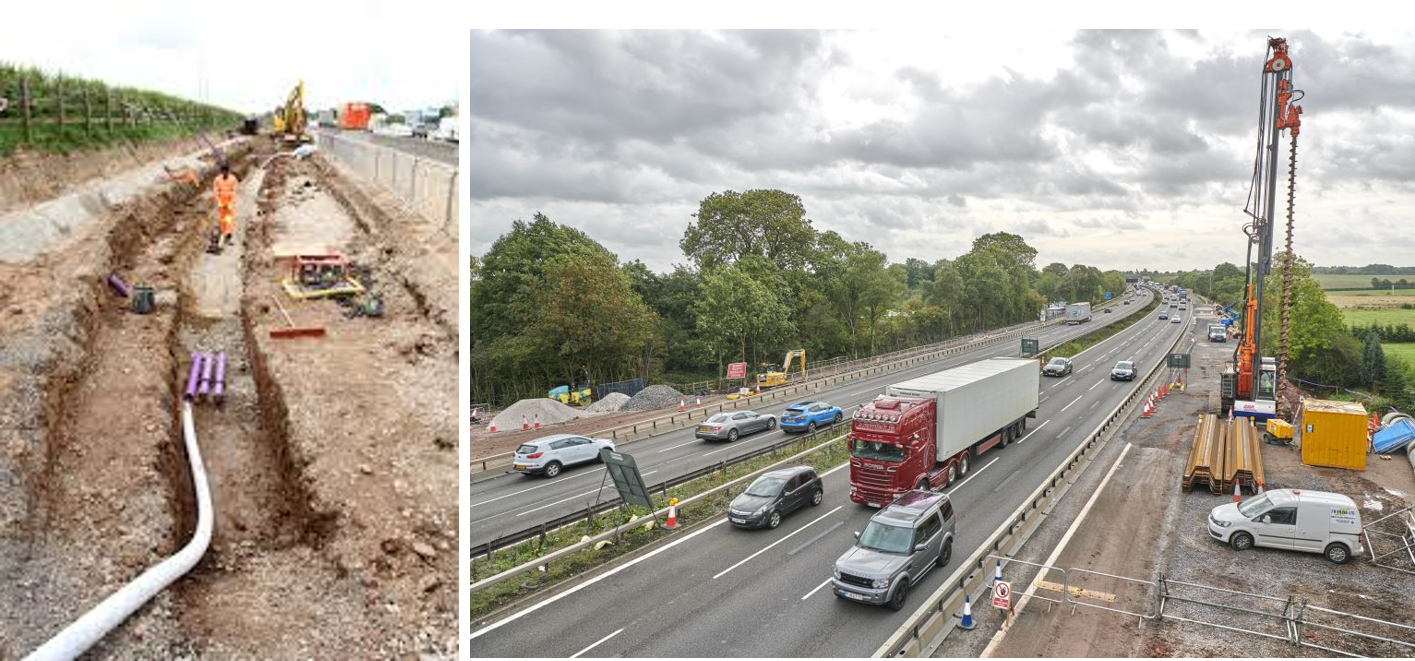
For the last thirteen months I’e been forced to add an hour’s worth of contingency to my journeys to Heathrow thanks to the UK Government’s programme to turn a 32 mile stretch of dumb M4 motorway into a shiny new smart motorway.
The UK has a traffic problem. I get that. More cars, same infrastructure, no money equals more queues. Except that the M4 smart motorway scheme is scheduled to cost £848M by the time they finish next year. So there is money. And, by the looks of the equally disruptive smart motorway projects elsewhere in the country, several billion pounds worth. The only problem then is just how pathetic the whole thing is.
Because, rest assured, anyone with the slightest bit of common sense, when you see what the smart motorway actually consists of, will realise it is a really, really dumb solution. The stupidity goes something like this. When motorways like the M4 were built, cars weren’t as reliable as they are today, so in addition to the three lanes of motorway, there was another ‘hard-shoulder’ lane built next to the inside lane. The idea being that, if you broke down, you pulled off the road, onto the hard shoulder, got out of your car and waited for rescue to arrive. Now cars have become more reliable, someone has made the decision to turn the hard shoulders into a fourth lane. Bingo. Another 33% capacity added to the motorway network. Or, that’s the way it looks until you start actually thinking about it.
Not that anybody apparently did. A bit like the German newspaper Brexit-related headline from the other week, the UK version of a smart motorway is ‘Der große Clusterfuck’. Three things in particular should have rung alarm bells:
1) Hard-shoulders weren’t universally provided (e.g. adjacent to bridges), so turning hard-shoulders into fourth lanes can often mean, where there was no hard-shoulder in the first place, the four-lane motorway periodically shrinks to become a three-lane motorway. So a three-lane motorway with no bottlenecks now becomes a four-lane motorway with multiple bottlenecks. Which in effect means that the traffic is effectively still constrained to flow the same amount of traffic as the original three-lane road. Except now with added stop-start blockages.
2) In order to allow broken-down cars to find refuge, every two miles or so, a short ‘emergency refuge area’ has been built. This is in effect a new fifth lane. Except it is about six car lengths long. I’ve never tried to decelerate my car from 70mph to zero over emergency-stop like distances to get into one of these areas so far, but I imagine the skill required to do so is akin to that used by stunt drivers performing the trick of driving towards a parallel parking space between two cars at 90degrees, slamming on the handbrake and spinning into the parking space. Surprise, surprise, those poor unfortunate souls that have had to make use of the emergency refuge areas have frequently found themselves not just broken down, but also crashed into. That is, provided there wasn’t someone already parked up in the Refuge area for a comfort break. Or because they felt sleepy. Or had an incoming call to take. All of which, according to a recent survey, is what 83% of users are using them for. Net result: the Government has now had to embark on a national TV advertising campaign to tell people what they can and can’t use the Emergency Refuge Areas for. And so another £10M gets flushed away.
3) Finally, and worst of all, is the ‘smart’ part of the smart motorway system. In order to compensate for the potential problem of broken down cars struggling to get into the Emergency Refuge Areas, there is a system of sensors built into the roads and a host of overhead signs to actively vary the speed limit. This is the part of the debacle that’s responsible for a big part of the £848M. Digging up the roads to lay miles and miles of sensor cable is utterly dumb.
It’s dumb because all the information required to tell vehicles to slow down if there’s a problem ahead is already available. For free. In the ether. On everyone’s mobile phone or satnav signal. As the TRIZ trend tells us, mechanical solutions always evolve to ‘field’ based solutions. You don’t need cables when the field-based signal is already there. You don’t need to dig the roads up. And you don’t need to keep digging the roads up when the cables start failing. As cables and their connectors are apt to do. There’s nothing magic about this evolution trend. Except, of course, as far as the construction companies are concerned, they wouldn’t get to charge £848M any more. And they lose all of the maintenance charges they’ll no doubt accrue over the course of the next twenty years. Another few billion dollars down the drain. And twenty years during which British drivers will be stuck with a ‘smart’ system that was outdated before it was even commissioned.
Yes, but, I hear the construction companies say, mechanical sensors are more accurate than the wifi signals. What happens when the wifi is down? They have a point. The ‘field’ based solution isn’t as accurate today as the mechanical sensor system will be. But by next year it will be. And it will give a whole bunch of side benefits that the mechanical system will never be able to reproduce. How do we know this?
Answer because, when we go look at Alibaba’s ‘City Brain 2.0’ smart motorway solution for big cities in China that’s precisely what it does. But not just 32 miles of one motorway. No. Because it is cloud-based, it automatically covers every road. None of which need to be dug up. If I was a betting man, I’d be willing to bet that the UK Government could have made a City Brain 2.0 solution covering the whole of the Union for a fifth of the price of the stupid 32 mile stretch of wire and duct tape bollocks on the M4. Think about that, politicians and construction company managers as you spend an hour sitting in stationary traffic, late for your next Heathrow flight to Idiotsville.
A just-fledged blackbird flew into my window yesterday.
It fell to the ground, stunned.
I guess blackbird nature doesn’t yet include hard transparent surfaces.
Call that one for nurture.
The blackbird sat on the ground, panting,
Looking at me,
To see which one of us was the most confused.
The blackbird opened its mouth.
Nature again.
Feed me, its instincts seemed to be saying, feed me.
A magpie flew by, screeched to a halt on a nearby branch.
Feed me, its instincts seemed to be saying, feed me.
The blackbird didn’t move.
Through the window, I tried to shoo the magpie away.
The magpie looked at me,
One for sorrow,
The magpie looked at the still not moving young blackbird.
Two for joy.
Two more blackbirds arrived on the scene.
On male, one female. Two parents.
They started shouting,
Hassling the magpie.
The magpie kept right on looking at the young blackbird.
Trying to work out its best strategy.
The two adult blackbirds kept shouting.
I wasn’t sure whether they were trying to scare the magpie,
Or tell their scatterling to move,
But it just sat there, looking confused.
It flapped its wings,
But nothing happened.
It got onto its feet, and tried to run for cover,
But nothing happened.
The noise got louder.
A robin turned up.
It landed directly between the young blackbird and the magpie.
And started shouting too.
This prompted the arrival of a sparrow.
It landed next to the young blackbird,
Kept flapping its wings, ‘like this’, dummy, ‘like this’.
The noise kept getting louder.
Two blackbirds, a robin and a sparrow all shouting at the magpie,
Shouting at the young blackbird to do something. Anything.
The young blackbird, looked at me again,
Looked at the chaos,
Finally decided, time to get out of here,
This place is mad.
Started flapping its wings,
Started running for cover.
The magpie twitched.
The robin and the sparrow formed a wall.
The magpie twitched.
The young blackbird dived into the undergrowth.
The robin and the sparrow high-fived.
The magpie shrugged its shoulders,
You win some you lose some.
Three species against one, you probably lose.
“If someone says it’s raining & another person says it’s dry, it’s not your job to quote them both. Your job is to look out of the f**king window and find out which is true.”
Jonathan Foster (possibly)
I’ve yet to hear an apology from John Redwood following his astonishing on-screen battle with Krishnan Guru-Murthy on Channel Four news this week. I’m not holding my breath. Rather, Redwood, like a lot of politicians in these days of Fake News has learned that all that’s required to get away with a lie is to bury it in one or two layers of molasses.
KGM was absolutely right to call the liar out. Its time more journalists did the same.
Except, of course, if you were already pre-disposed to side with KGM, Redwood was lying whether he was or wasn’t. And if you were pre-disposed to side with Redwood, you believed him when he said the polls were saying ‘a majority’ of UK citizens wanted a No Deal exit from the EU. Irrespective of how true it was. The problem with a population as divided as the UK now is, is that Confirmation Bias dominates everything. We only listen to what we already agree with. Helped in no small part by Facebook and Social Media, which all serves to reinforce the effect by only feeding us stuff that is consistent with our existing Bias. It’s a horrible vicious cycle that isn’t going to end well. And I think people like John Redwood not only know it, they see it as part of their role to actively encourage it.
Redwood’s thousand-yard-stare through most of the interview, meanwhile, was a clue that he knew he was lying. The problem of proof, however, is somewhat more troubling. There was indeed a recent poll that sort of confirmed Redwood’s assertion.
It was a poll conducted by Sky News. This is what they reported:
“Forced to choose between no deal, Theresa May’s deal or a long delay with EU elections, 41% prefer no deal, 35% a long delay with EU elections, with just 16% favouring the prime minister’s plan – nine percent answered, ‘don’t know’.”
At the bottom of the article, readers were then told:
“Sky Data interviewed a nationally representative sample of 1,295 Sky customers by SMS on 5 April 2019. Data are weighted to the profile of the population. Sky Data is a member of the British Polling Council and abides by its rules.”
What this basically all means is that a biased, bullshit question was asked through a bullshit medium to a bullshit sample.
So where was the lie?
Was it Redwood? Did he use deliberately weasel-y words to cover his back? Did he take the time to investigate the validity of the Sky News survey?
Was it Sky News deliberately formulating a survey question where the majority of possible answers were omitted and then posing it in a dumb way?
Or was it someone behind the scenes, recognising that there was a need for more pro-Brexit ‘balance’ in the political discourse, who commissioned such a disingenuous survey? Someone, perhaps, being paid by someone to do bullshit-science, safe in the knowledge that the people who’s biases the results confirmed wouldn’t dream of challenging? Or could, at a convenient later date, say was ‘a mistake’?
The only meaningful answer is that it was all of them. Redwood included. He might at some point in the future, when the dust has finally settled on this seemingly never-ending Brexit pantomime, claim that he couldn’t have known that the survey was bullshit. If, however, you are a public figure living a public life, just like the law for Company Directors and other members of society living in the real world, ignorance is no excuse. You have a moral obligation to the public you serve to do your homework. You have a moral obligation to ‘own your shit’. And you have a moral obligation to get beyond your party-political Confirmation Bias and tell the truth.
I was reading Patrick Hoverstadt’s 2008 book, ‘The Fractal Organisation’ this week. Hoping it was going to turn out better than it actually did. The world of work requires more people understanding complex systems theory in general and Stafford Beer’s Viable System Model in particular, but no author, it still seems, has unlocked the formula that will get sufficient people started on the journey to make any difference.
In the end Hoverstadt’s book seemed more about making sly digs at corporate fads than making VSM seem more than abstract theory, but the section on measurement did at least trigger a thought that I think makes it possible to help teams to better understand the complexity landscape within which we are all operating. And if we can do that, we give ourselves a higher likelihood that we might end up being successful with our change efforts.
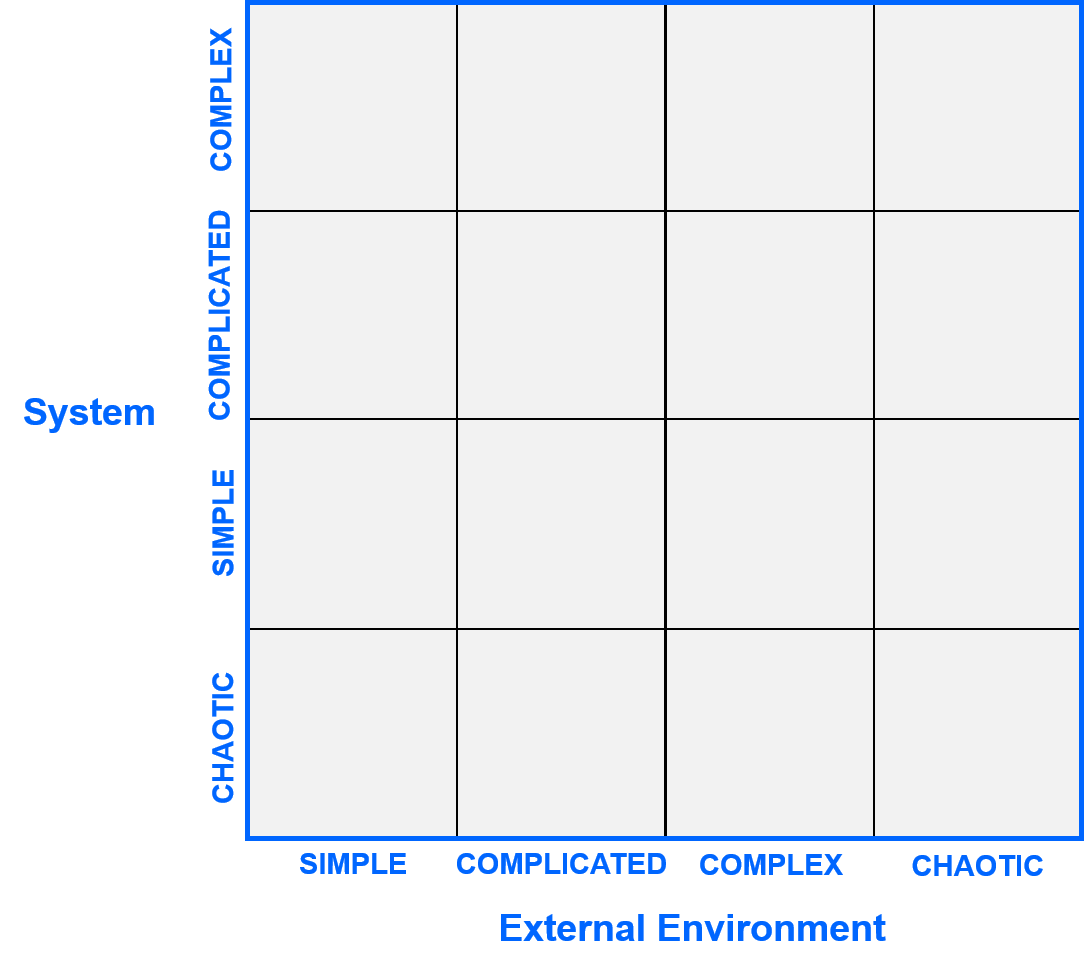
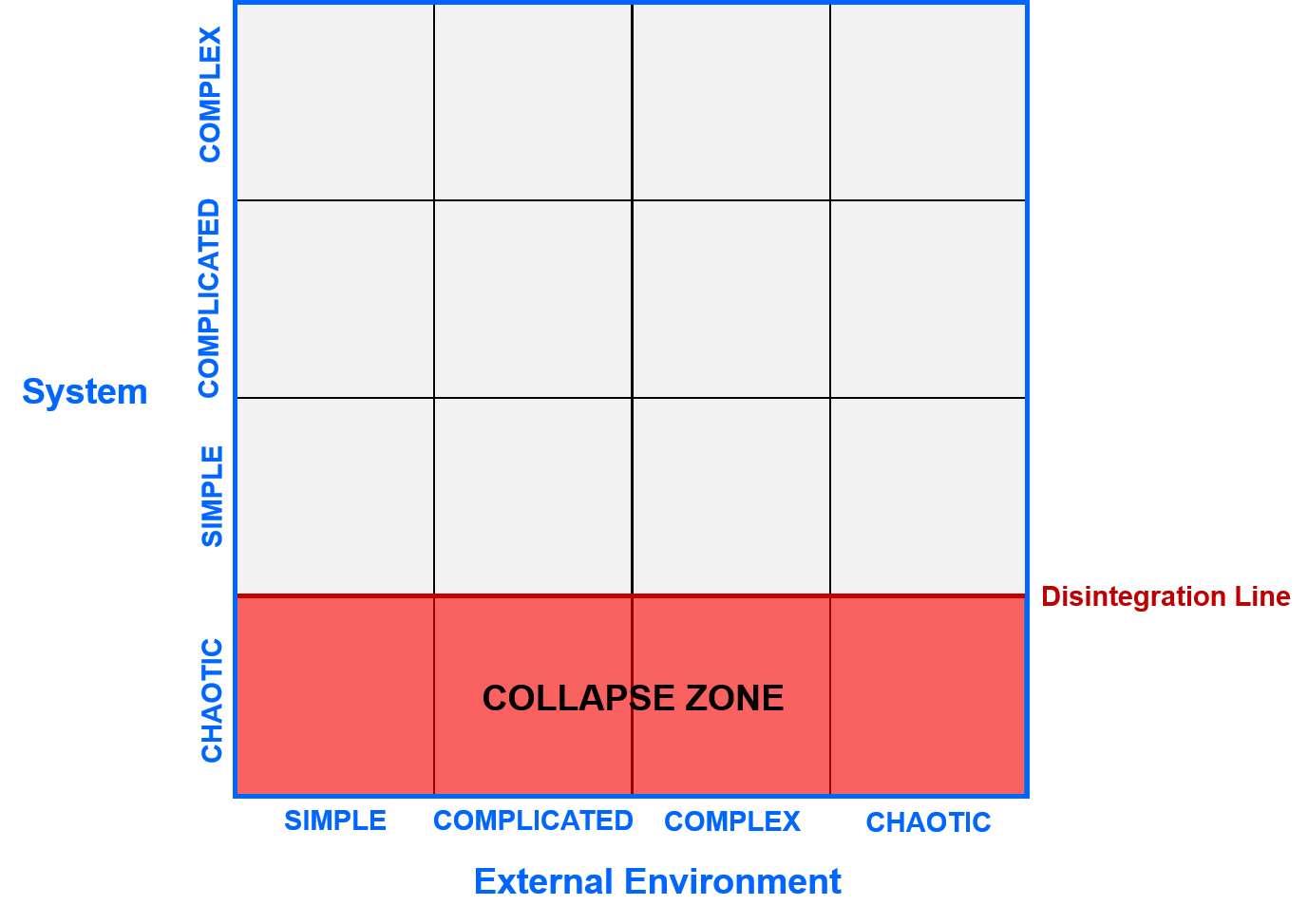
The start of the new complexity landscape model comes from a recognition that the manner in which a team might be operating may well be different from the environment that surrounds them. When I plot internal and external complexity as the two dimensions of a graph, I end up with something that looks like this:
Both dimensions are split into the four basic types of complexity scenario that might be present: simple, complicated, complex and chaotic. Nothing magic in this segmentation model, it being pretty much the same as Cynefin, which in turn is built on the recognition that there is a discontinuous shft between each of the four possible states. I’ve labelled the horizontal external complexity axis as a spectrum in which the overall complexity increases as we travel left to right. For the vertical internal system axis, I’ve done something slightly different and placed the chaotic scenario at the bottom of the graph.
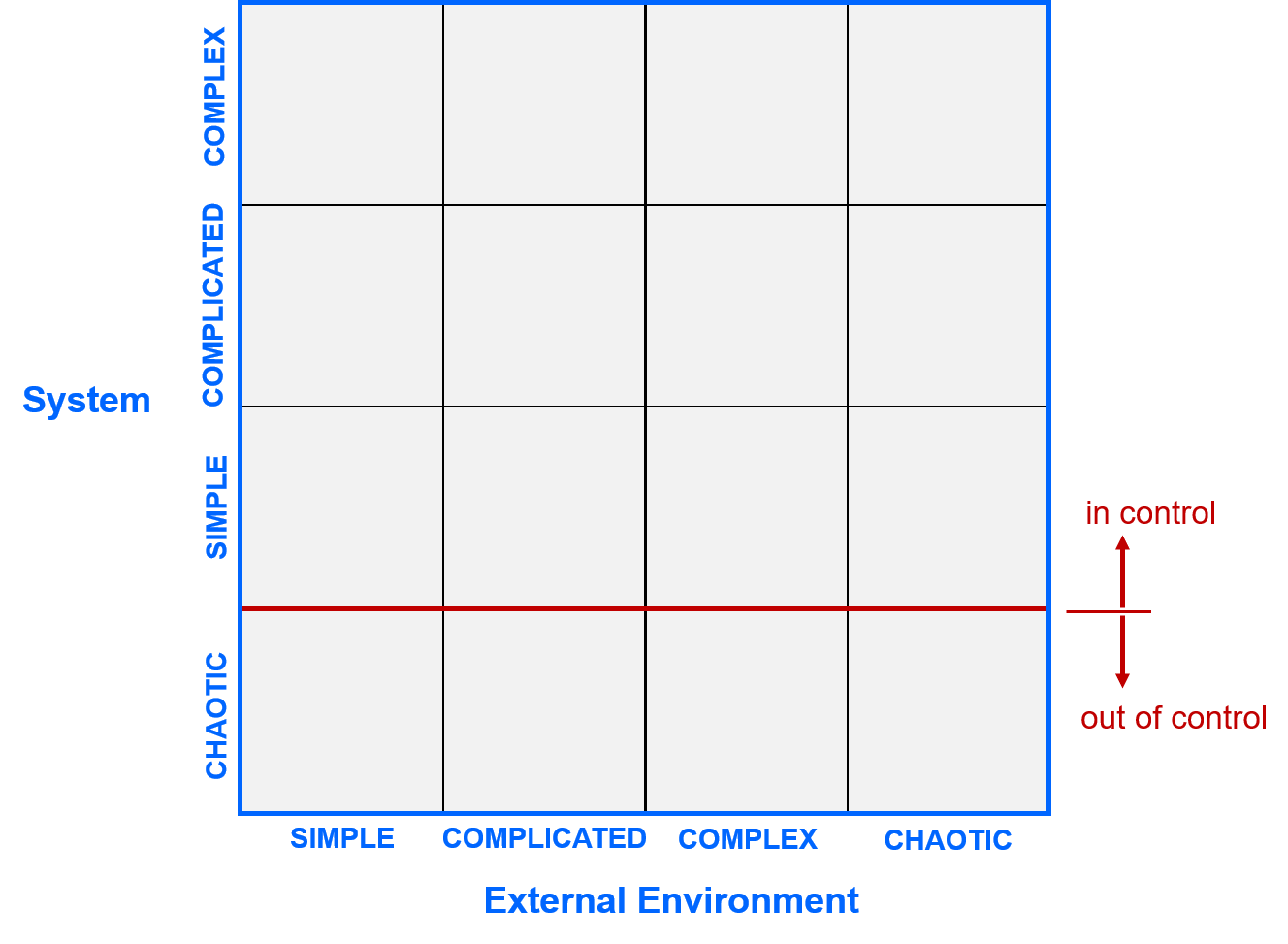
The reason for doing this is that when I add this line to the graph…
…I’m able to differentiate between ways of managing the system that are ‘in control’ and ‘out of control’. Below the axis line, the system is chaotic and out of control; above the line, we see the same simple-complicated-complex sequence as found for the external environment dimension.
I can then describe the in-control/out-of-control boundary as a Disintegration Line, such that if I find myself operating below the line for any sustained amount of time (chaos can be really useful in short bursts), my system is very likely to collapse:
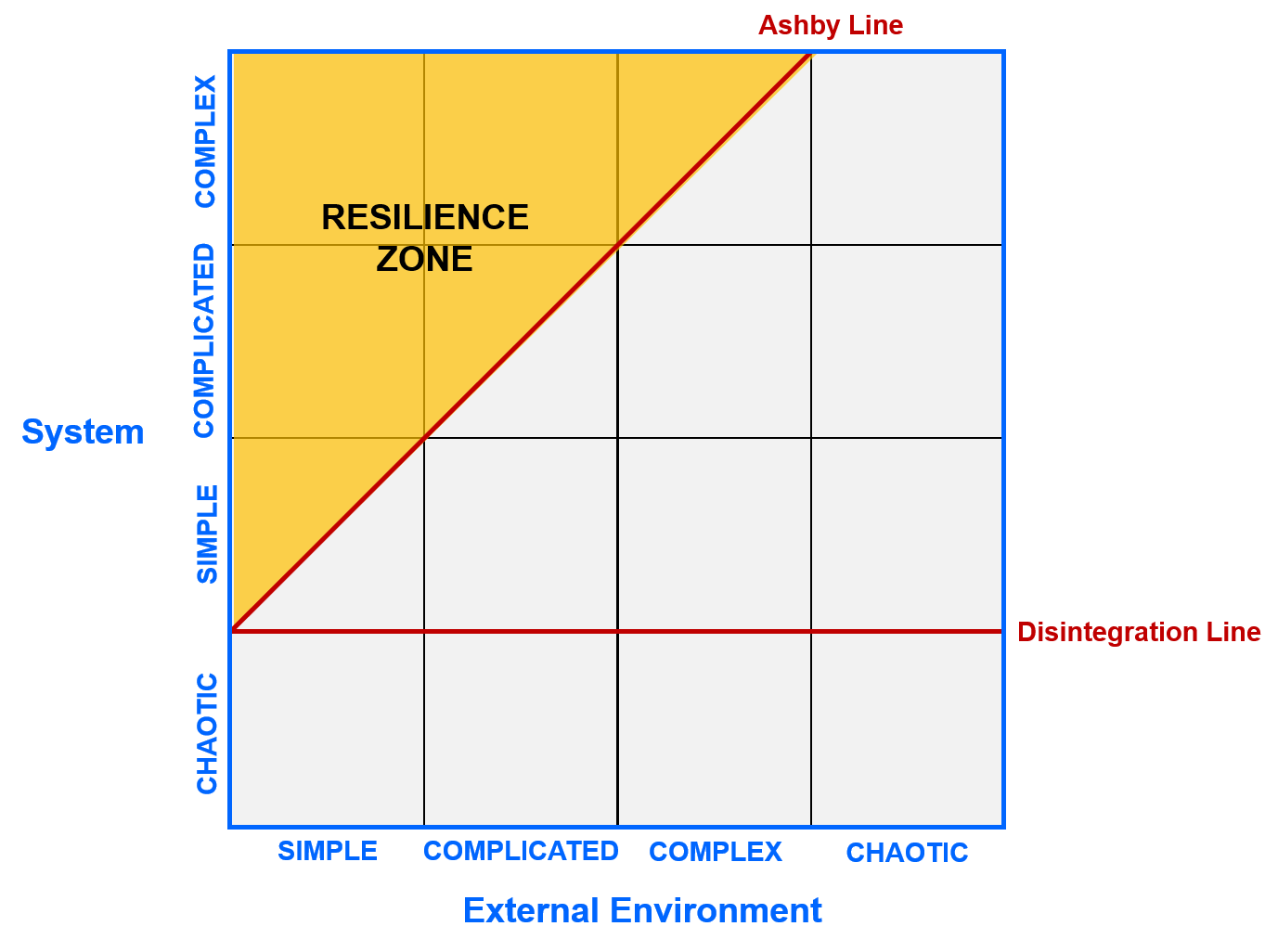
Next, I’ve added another important line onto the graph. This is what I’ve labelled the Ashby Line after cybernetician, W. Ross Ashby, who gave the world a vital first principle way of looking at systems: ‘only variety can absorb variety’. Above the Ashby Line, and my system will be a sustainably resilient one; below the line and I disobey Ashby’s law and hence make myself vulnerable to its consequences.
The idea of this Landscape now is that, assuming I’m able to measure internal and external complexity (and I recognise that’s a big ask… more on which in a subsequent article), I should be able to work out how best to operate, or whether I need to change in order to get into or stay within the Resilient Zone.
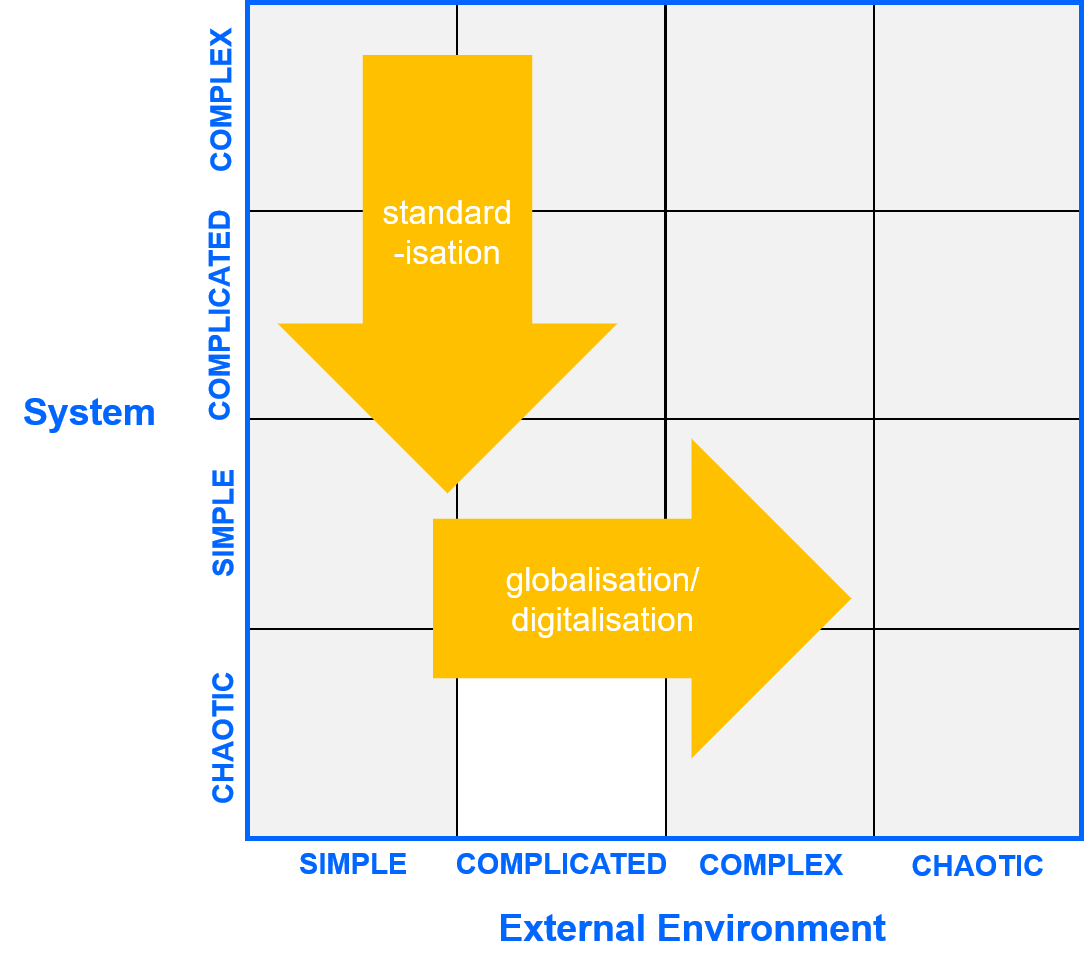
Getting into this Zone, and staying in it is made difficult by two fundamental forces of nature. The first is the downward pull of ‘standardisaton’ as found in most organisations thanks to Lean and SixSigma thinking and their urge to reduce waste and variation. The second then is the increase in external complexity resulting from massive globalisation and digitalisation and resultant speed-of-light feedback loops:
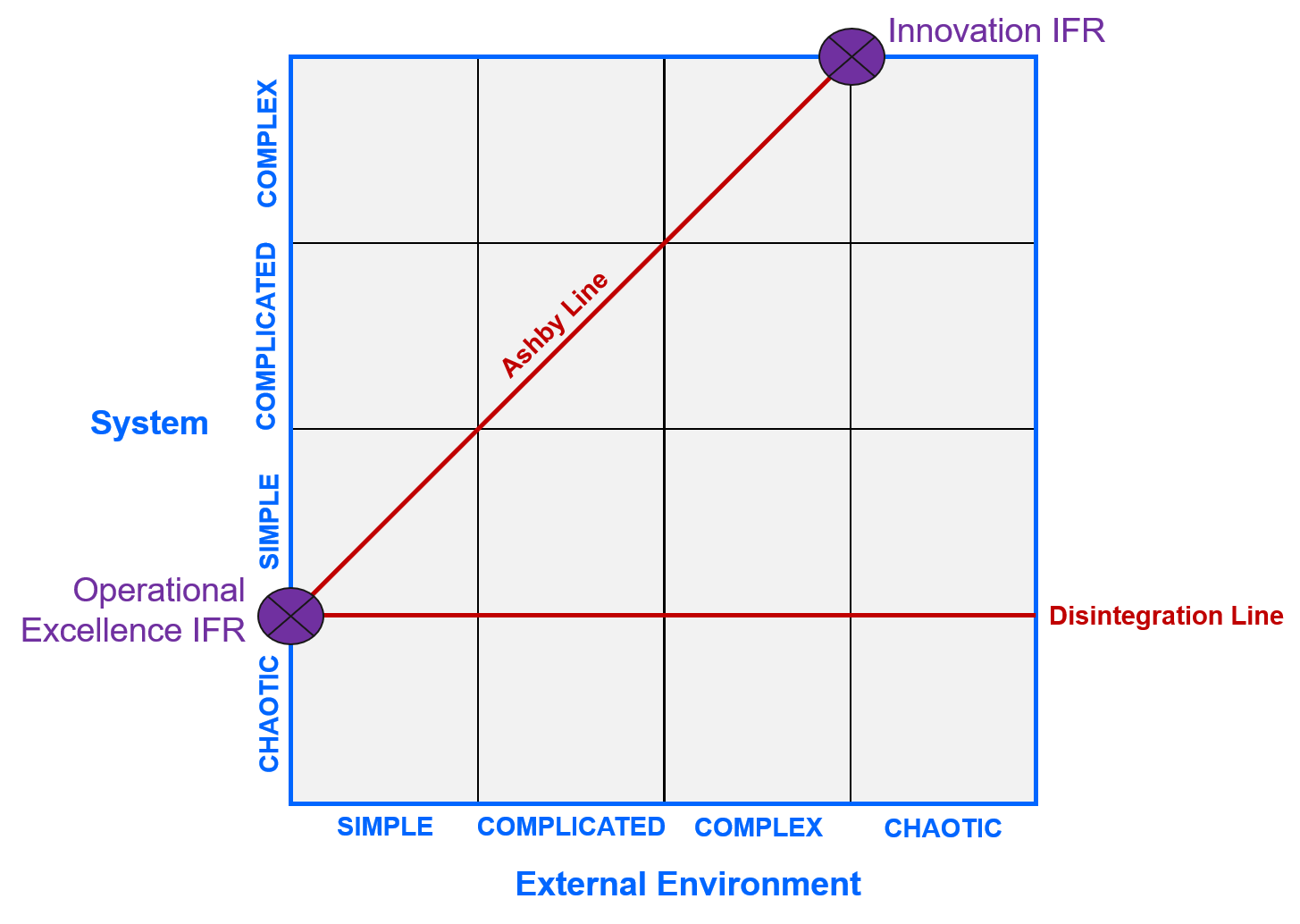
Neither of these forces helps enterprises as a whole. In no small part because, when we look at the Ideal Final Result state of the two different worlds the enterprise has to embrace, there is a fundamental conflict needing to be addressed. In an Ideal world, the Operational Excellence mode of thinking seeks to maximise efficiencies by standardising everything and making life as simple as possible, and for customers (the outside world) to similarly never change its simple existing needs. Workers in the Innovation World mode of thinking on the other hand, knows that they have to embrace complexity if they are to be successful in understanding where in the outside world the next round of paying customer are going to come from and what they are going to demand from providers:
The more I look at this overall model, the more I think I’m going to be writing more about it in the future. Amplifiers and attenuators. Requisite Damping. Variety Flux Index. Understanding the precipice the automotive industry is about to fall off. Understanding Brexit. I filled six pages of notes yesterday afternoon. It might all explode into nothing. Or it might turn out to be the seed of a new Systems Thinking workshop…
Aah, tribute acts. Bringers of light. Who doesn’t love a good tribute band?
I’m joking. No-one should. No-one in their right mind says to their loved one, ‘let’s go out for some tip-top entertainment tonight’, and ends up watching a bad impression of a musical act they love.
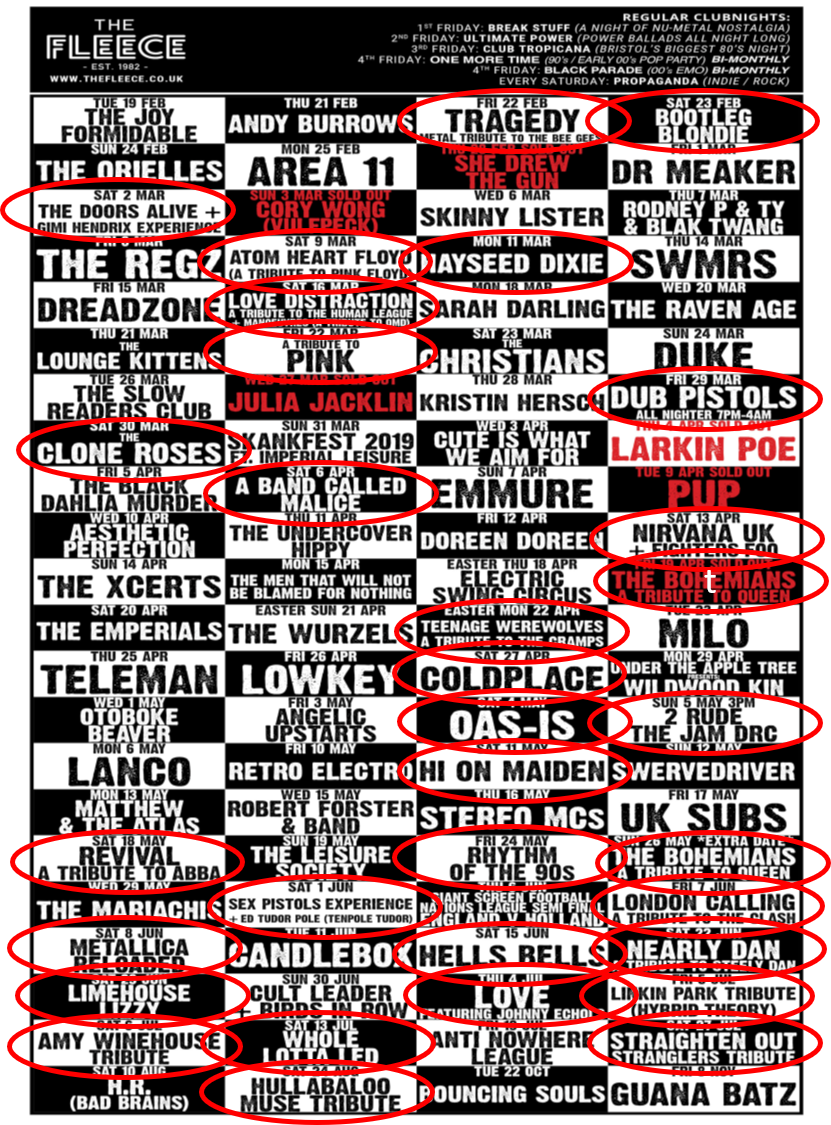
Except they do. I was staggered to realise while waiting for the (real) band to come on at Bristol’s finest music venue, The Fleece, the other night, that over a third of all the bands scheduled to play were tribute acts.
Clearly something is not right in the world.
Every half-way decent band, and a lot of really bad ones these days have at least one pun-tastically titled mock version. Pink Floyd currently has over fifty copy versions doing the rounds. Some of them selling out quite large venues.
I decided to investigate.
The problem, it rapidly transpires, has its origins with the Millennial generation.
When two trends collide, a third emerges.
Millennials are ‘Heroes’. They have also rejected the ‘live to work’ attitude of their parents and have gone for much more of a ‘work to live’ perspective on life. Fair play. If you’re a plumber. But combine the desire for heroism with the corresponding lack of desire to do the hard yards, and the result is fifty tribute acts to every musician. Or worse. Tribute acts of trbute acts. In which Radiohead tribute act, and arch music-killers, Coldplay, now find themselves competing with half a dozen Coldplay tribute bands.
Lowest common denominator heroism. No need to bother with the challenges of writing new songs. Or doing any thinking to advance the state of the art. Or learning how to play your instrument. Just download a few Oasis chord sheets, borrow a dodgy wig and some sunglasses, and hey presto, two weeks later you’ve got 500 people cheering you on at Bristol’s finest music venue on a Friday night. Not to mention the poundshop groupies.
Rest assured, this doesn’t end well. Not for the Millennial quarter-life crises. Not for the sanity of people who actually enjoy music. Or for the next generation of Artists, that are going to have to pick up the pieces in the coming years.
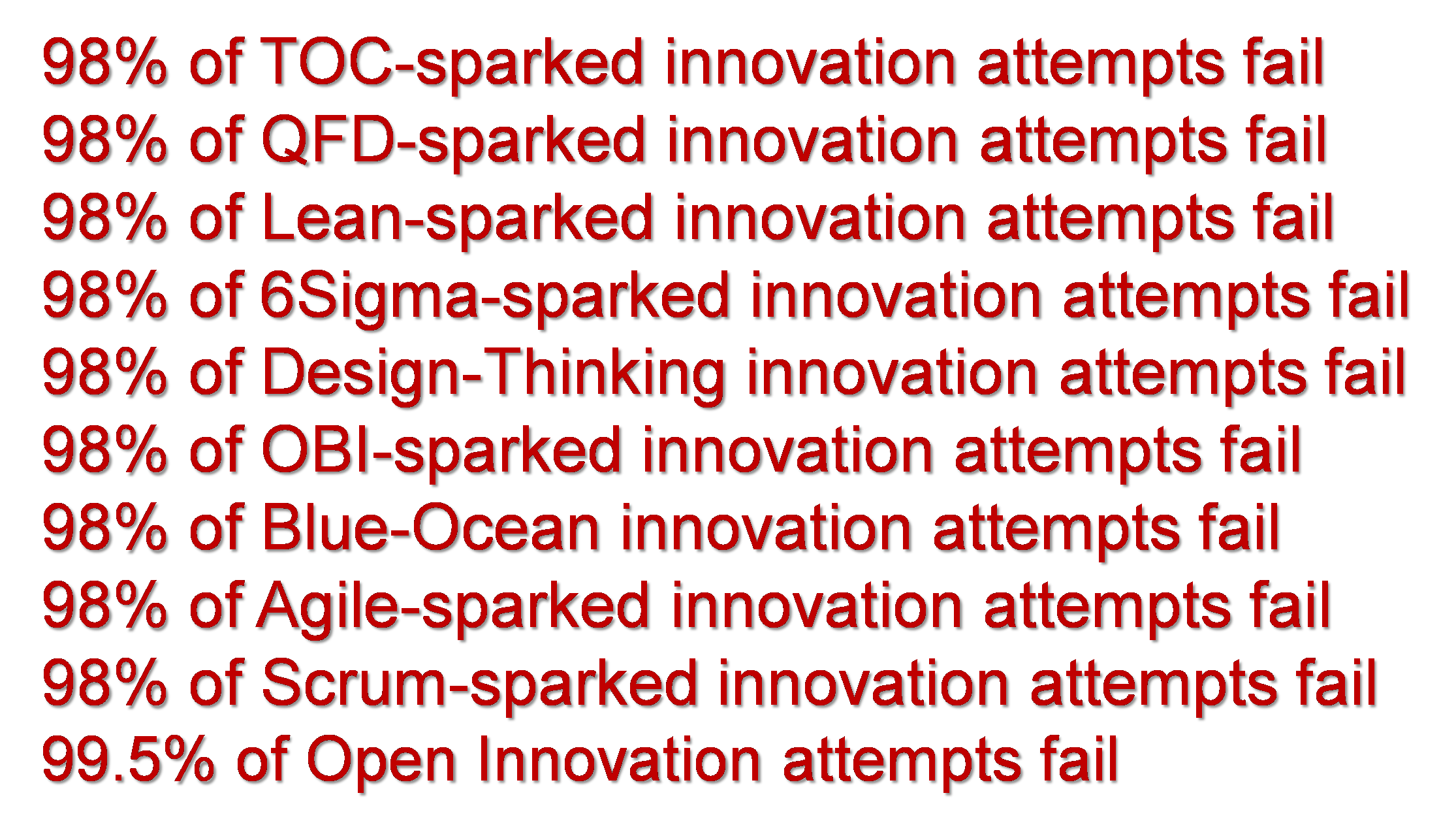
Based on a running total approaching ten million case studies, we know that 98% of all innovation attempts end in failure. Put into context, that represents about $120B per year of wasted resource, globally. One might imagine that organisations would make some kind of investigation to understand why so much money is thrown away, but it seems very few are brave enough to commission the work. Perhaps this is because the leaders in the world’s enterprises may discover an uncomfortable truth: they are the heart of the problem.
This is not necessarily to blame them for that fact. In almost every case, what allows a person to rise to the top of the hierarchy within their organisation is their ability to demonstrate good Operational Excellence characteristics. Which means people that consistently hit their targets, people that consistently did what they were told, people that followed the rules, people that made sure everyone that worked for them also followed the rules.
Organisations need such people. Operational Excellence pays next month’s salaries. But organisations also need people that are able to innovate. And in many ways, the skills required to be a good innovator are 180 degrees opposite to those required for Operational Excellence. The better a person is at doing the Operational Excellence job, the worse they are likely to be at innovating. Almost no-one that has reached the top of a modern enterprise, therefore, has the first clue what innovation is really all about.
That’s not to say that business leaders won’t pronounce the need for innovation. It is a very brave CEO indeed that will stand up and say, ‘we don’t want innovation’. Markets expect innovation to happen. Innovation is the future. Innovation pays everyone’s salaries (and gives shareholders their dividends) in three years, five years and ten years’ time.
But when a leader who doesn’t understand innovation stands up and asks for innovation, the way those words are heard is, ‘bring me lots of exciting new ideas, but don’t you dare change anything’. And so what most organisations end up with is a depressing internal game. Design Thinking is currently very fashionable, so someone in a position of authority declares that, in order to innovate, everyone needs to be taught Design Thinking. After a couple of years of zero impact (except some of your best people will leave the company to set up Design Thinking consulting companies), leadership looks for another, different, strategy. And so something like Open Innovation becomes the new plaything. Two more years go by and then that fails. All the time leaving the scientists, engineers and designers feeling more and more like they’re caught on a merry-go-round that never stops and quite literally never goes anywhere.
So, a few years ago, we thought, if the leaders in large companies don’t want to understand the problem, we will have to understand it for them. We study innovation all the time, and have been doing so for the last 20 years. What we started to do five years ago is examine the causal links between innovation and the tools and methods organisations supposedly use to help spark those innovations. We’ve been fortunate along the way to be able to conduct the research in conjunction with some of our clients and frustrated Innovation Heads (Note: almost everyone inside a large organisation with ‘innovation’ in their job title, is a very frustrated person) to try and reveal the under-pinning DNA of their innovation success stories. Attempting such a feat is difficult at the best of times; doing it in the complex/chaotic environment that invariably accompanies any kind of discontinuous jump is a particularly hazardous job. A big part of the challenge, therefore, is to somehow parallel-test the negative hypothesis. In this case, that goes something like this:
a) Identify the tools, methods and processes that we think contributed to the success of an innovation project.
b) Identify the tools, methods and processes that were utilized during innovation projects that subsequently proved to be unsuccessful
When it is possible to meaningfully grasp the answers to these two questions, ‘success’-contributing methods turn out to be no more or less likely to be present as the answers to both questions. Thus, as 98% of all innovation attempts fail, so we see that those that claim to have made use of Agile methods – to choose another currently very fashionable Weapon of Mass Distraction – will also fail 98% of the time.
The only vaguely meaningful way to test the efficacy of one method over another would be to conduct some kind of parallel set of innovation-project experiments: one using Agile, for example, one using (another random choice), Outcome Based Innovation, and one – the ‘control group’ using no formal support method at all. Such experiments are both expensive and fraught with the difficulties of trying to compare the un-compare-able. There are one or two examples, but really precious few that would pass any kind of academic scrutiny. That’s one of the big challenges of working in complex environments, of course: its never possible to step in the same river twice.
The most usual ‘alternative’, historically, is the Jack Welch SixSigma ‘myth-builder’ strategy. Which basically involves never doing any kind of double-blind experiment, and instead telling people that ‘quantifying how much Six Sigma helped is good for your career’. Then, hey-presto, and surprise-surprise, any piece of moderately successful work ever done thereafter gets a Six Sigma label attached to it, until Jack is able to announce to the world’s media that the savings amount to ‘$9B’. Every cent of which is utterly fictitious.
Then there’s a final twist of the knife pertaining specifically to the tools and methods that might be brought to bear during the ‘fuzzy-front-end’ period of an innovation project. By the time the project gets somewhere near to delivering success, this fuzzy-front-end is a long distant memory, and, unfortunately, if you’re part of the method team, participants’ memories tend to be short. After the 99% perspiration, people, in other words, tend to have forgotten where the 1% inspiration came from. It was the perspiration that delivered the success, not the weird bit at the beginning.
Taken all together, the overall picture can tend to make people in the innovation world depressed if you’re not careful. Well, actually, the reaction can be quite amusing if you’re that way inclined. Which we tend to be on occasion since it turns out to be a good initial filter mechanism for sifting out the pretend-innovators from the potentially real ones.
The real ones, when they’re exposed to these kinds of result are much more inclined to ask whether there is anything at all that meaningfully distinguishes the 98% of innovation attempt failures from the 2% that end up being successful.
Ten million case studies later, it turns out there is.
In the world of tangible tools, here are the things that we can safely say have a statistically significant likelihood of contributing to innovation success and a corresponding absence in innovation attempt failures:
– The ability to identify and resolve trade-offs & compromises – Having a clear meta-level compass heading relating to customer value – Systems Thinking – Management of the unknowns trumps management of the Gantt Chart – Clear understanding of complexity – rapid-learning cycles, ‘first principles’, s-curves, patterns – and need for requisitely fast learning cycles – Clear understanding of (von Clausewitz) ‘critical mass at the critical point’ – Requisite understanding the customer/consumer say/do gap and how to deal with it
Important as these tangible – i.e. very teachable – elements are, they tend to get dwarved by the intangibles. Which look something like this:
– An excess of influencing skills – Strong ability to working together in cross-disciplinary teams – Persistence/bloody-mindedness/willingness to stick-with-difficult-stuff – Strong ability to live with continual ‘failure’ – Acknowledgement that ‘ideas’ have zero value – Ability to design and manage a clear sense of progress across the team
This stuff is much more difficult to teach. Not impossible, but it does require a heap more time than most organisations are prepared to devote to the task. Interventions, these days, able to be assisted by the fact that we’re able to measure a lot of these intangible success-driving elements, including the ones that spill over into the tangible arena.
Repeatable innovation success ultimately means getting all of these tangible and intangible things right, but any thousand mile journey necessarily begins with the first few baby steps. The best two seem to involve a) creating a sense of progress, and b) the best way to do this is to start looking at some of the many trade-offs and compromises that sit at the heart of Operational Excellence, and saying to ourselves, we’re not going to make those trade-offs any more.
Almost everything that happens in British politics these days is enough to make even the most ardent defender of politicians hold their hands up in despair. I suspect we hit at least three new nadirs this last week. The most pitiful of which was, for me at least, when Shadow Chancellor John McDonnell called Sir Winston Churchill a “villain”. The minor debacle started when McDonnell was asked at a Politico website event, for a one-word answer on whether Churchill was a hero or villain. McDonnell paused and replied: “Tonypandy – villain”. Showing, in true modern-politican fashion that he could neither follow the simple instruction or come up with a sensible answer.
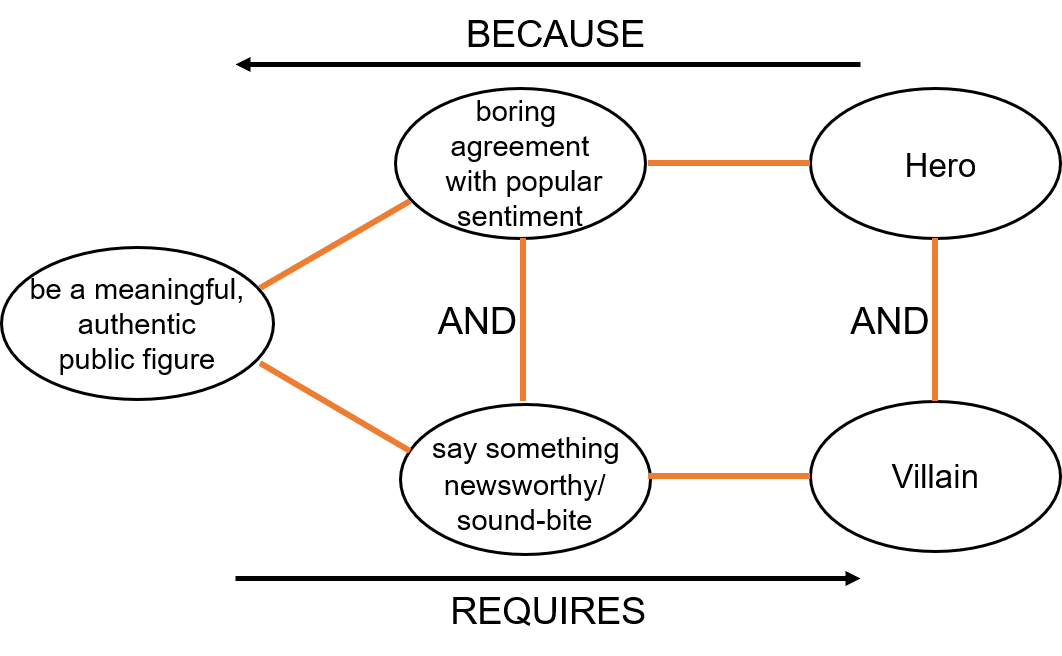
The moment the question is posed, I can imagine the panicked turmoil in McDonnell’s head. He’s just been set an impossible question and now has a contradiction to solve. One that, if he understood this kind of thing, looks something like this:
In the coin-toss of political fates, sadly for McDonnell, he decided to go down the tasty sound-bite route. And as a consequence found himself on the main news for 24 hours, the focus of a question on Question Time and the easy target of every newspaper column writer for the next three days. So, I guess, on some level his choice was a good one.
If the aim was also to increase national left/right polarisation, he can tick that box too. Well done, asshole.
What depresses me most in all of this, however, is nothing to do with McDonnell at all. He’s just the poor schmuck who couldn’t think his way out of a contradiction if you wallpapered him in TRIZ posters.
What depresses me first is that we now have a ‘media’ that is so far down the slippery slope of their clickbait-hunt that insisting politicians must answer their questions with one word answers is now considered valid journalism. We all like a soundbite. But I think we all realise there’s a time and place for them. Churchill himself was a master of the art. Content and timing-wise.
What depresses me second is that we have politicians that feel obliged to comply with the dumb questioning.
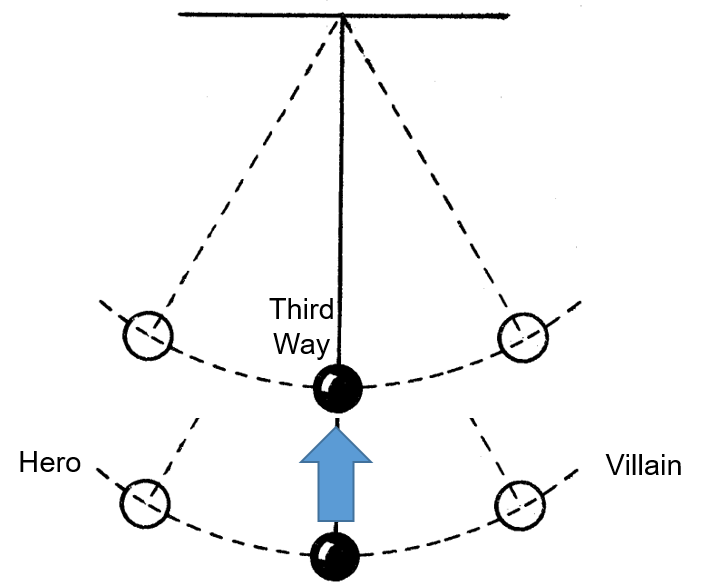
Everyone is caught on yet another either/or pendulum swing. The correct answer to which can never be left or right. The only way is the third way.
McDonnell could’ve shifted the pendulum in any number of creative ways. No TRIZ required. Just an ounce or two of creativity.
He could have played the hack journalist’s game and answered ‘both’. That would’ve been newsworthy too. And somewhere closer to a genuine truth. Less imaginative, but he could also have answered, ‘neither’. At least that would have prevented him having to spend the next 24 hours defending himself. Or how about, ’99.9% hero’. People would’ve understood that too. No-one, least of all Churchill, is or ever has been perfect, but some try harder than others to overcome the manifestly inherent human weaknesses.
He could also have completely ignored the ridiculous ‘one-word’ part of the question and gone off on a 45-minute diatribe. Not great from a news perspective either, but at least it would make future interviewers think harder about the stupidity of the questions they pose.
A little more brave, but if I’d been in his position, I like to think I’d have opted for, would have been to call the journalist out by saying something along the lines that this kind of either/or questioning is dumb and that I wasn’t going to play the game. ‘I’ll give you the properly considered, 10,000 word essay answer if you like, but stop looking for elevator-pitch nonsense’. One way of saying this, which I might also have been tempted to explore, would be a polite, smiling, ‘stop being a prat. Grow-up.’ That would have been newsworthy too for all the right reasons. Except the journalist, probably would’ve covered it up at that point. Hopefully in the shameful realisation that they’d just been caught in their own tawdry little trap.
Two wrong answers, or a thousand and one third-way right ones. Guaranteed with all of our politicians right now, we know we’re going to get one of the two wrong answers.