Entrepreneur chef, Davide Cerretini’s business strategy is one that most restaurant owners probably wouldn’t endorse: trying to become Yelp’s lowest-rated restaurant in the San Francisco area.
“I really don’t want to be in the Yelp listing,” Cerretini has said, “so we decided if you can’t beat them, try to play the same game. If I can’t be removed from that list, I’m going to do everything in my power to be the most unreliable restaurant ever.”
Cerretini started offering incentives to customers to post one-star reviews on Yelp of his restaurant, Botto Bistro in Richmond, California. Anyone who posts an on-site poor review of the restaurant receives an immediate 25 percent off their bill.
Reviews range from sarcastic (“I might as well have been in Italy. YUCK!”) to supportive (“I can only give this place one star. To do so otherwise would show them disrespect. The pizza is fabulous and I want to support any business that’s willing to expose Yelp’s unhelpful review manipulation policies.”), but they all come with a one-star rating.
“Knowing we’re confident in our food, we decided, ‘Let’s go the other way. Let’s make fun of ourselves,” Cerretini explained.
Cerretini decided to start the rewards program in response to what he sees as Yelp’s manipulation of reviews and unfair practices to “blackmail” restaurants into advertising on the site.
“We did advertising, we tried to play the game, we tried to do what every other restaurant has to do to the point where finally one day we decided the harassment was enough. No more phone calls for advertising; no more worrying about the review,” he said. And there began the ‘25% off for a bad review’ idea.
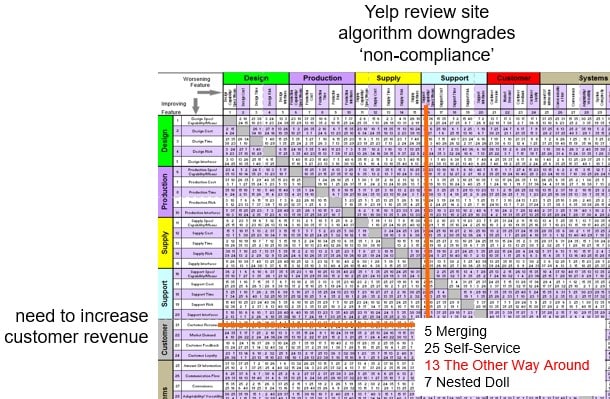
From a Contradiction Matrix perspective, Cerretini’s problem looks like this:
And his solution presents us with a inspiringly brave illustration of Inventive Principle 13, The Other Way Around.
The result? A ten-fold increase in business. Then Yelp complained. So Cerretini got himself an interview on Trevor Noah’s Daily Show to announce his new offer. 50% off the price of your meal for a bad review.
He now also offers blockbuster-success ‘One Star’ Italian cooking courses. Not sure if that counts as an example of Principle 5 or 7?
Here more about Cerretini’s inspiring little-guy-fights-back story at https://www.bbc.co.uk/sounds/play/m001rym0.
I had the great privilege of presenting a plenary address at the once-every-four-years, World Engineers Convention last month in Prague. The Seventh one. The theme this time around was the 17 UNESCO Strategic Development Goals. The opening address included a specially recorded video message from (gulp) the UN Secretary General, Antonio Guterres. I hadn’t realised the event was so prestigious. That aside, the thrust of Guterres’ message seemed to be that UNESCO was failing on all seventeen of the Goals, that things were getting worse rather than better, and, please, engineers of the world, could you try a little bit harder.
It couldn’t have made for a better lead in to my plenary later in the day. The thrust of which was how the Basic Laws Of Human Stupidity pointed towards the likelihood that the Law of Unintended Consequences was likely to kick in and conspire to ensure that all seventeen of the Strategic Development goals would not be met. Good intentions is not enough. Good intentions – of which there was probably a hundred nation’s worth of amongst the conference attendees – plus inadequate knowledge always serve to deliver the precise opposite of the intended outcomes.
The heart of the problem is this. Forgive me if I’m starting to sound like a broken record. The reason the Law Of Unintended Consequences comes into play is because when people focus on the achievement of multiple targets they almost always ignore the inevitable relationships between those targets. Take any of the individual targets and sooner or later, it will conflict with with any – and eventually ‘all’ of the others.
Every SDG Conflicts With Every Other SDG
If there are different teams working to achieve each of the individual goals, they never see these conflicts. All they get to see is the frustration when all of their hard work results in going backwards.
In theory, it is only the leaders responsible for coordinating the collective work that get to see the ‘between’ part of the story. Except, in nearly every case, they’ve never been told to look at it. And, even if they had, and then began to see the conflicts, they have no idea what to do with them. Other than compromise, of course, which is where the rot sets in.
I suspect UNESCO is too far down the slippery trade-off slope to be able to salvage any positive outcomes from the SDGs. The simple choice right now, seems to be to either decide which sixteen are going to be sacrificed in order to have a chance of succeeding with one. Or to start teaching people how to look for and solve contradictions. Starting, most likely with Antonio Guterres. Who might then learn that the worst thing he could possibly tell people to do in the future would be ‘work harder’. Please, don’t work harder. Teach people how to work smarter. Teach them that good intentions are toxic if they aren’t complemented by sufficient cross-disciplinary wisdom. It’s not rocket science. Just not accepting trade-offs.
The World Engineer’s Convention was a great social event. Especially the eye-popping 120Euro per head President’s Dinner. As is usually the case when people haven’t met up for four years, there’s lots to catch up on. Alas, when a thousand delegates are in ‘transmit’ mode rather than ‘receive’, things rapidly descend into noise. Signal gets lost. Which, I guess, is my way of saying I don’t think I’ll be heading to the Eighth World Engineer’s Convention in four years time. Unless someone manages to get the UN Secretary General to attend one of our workshops next year. Or maybe, at a pinch, the WEC President.
One of the no-doubt apochryphal TRIZ stories concerned the consultant brought in to solve the problem of elevators for high-rise buildings. Lifting people fifty storeys into the air was slow. Passengers hated the thought of long elevator rides several times a day. The elevator company was trying to design faster solutions. They weren’t working, and they were expensive. Millions of dollars worth of expensive. The consultant offered a solution that would cost a couple of hundred dollars. A solution that is still in use today. The solution involved putting mirrors inside the elevator car. People, he realised, didn’t care how slow elevators were, they cared about losing their precious time. Once the mirrors were in place, we’re able to check we don’t have cabbage in our teeth, haven’t spilled soup over our shirt and practice our empathic smile skills. Simple.
Not that there’s a direct corollary I’m sure, but it feels to me that the huge national embarrassment, HS2, the proposed new high-speed rail link from London to what now looks like North London rather than Manchester and Leeds, a link promising to save people twenty minutes, would do well to think about the twenty-first century version of fitting mirrors rather than destroying several thousand acres of green-belt land. And spending what now looks like five times the originally estimated cost. Which is ultimately most likely the point: politicians like big, sexy projects. They like their names on plaques.
Mirrors and plaques aside, HS2 is now also the talk of anyone interested in project management around the world. As a prime example of how NOT to do projects. Whatever HS2 managers are doing, the logic now goes, good project management means do the opposite.
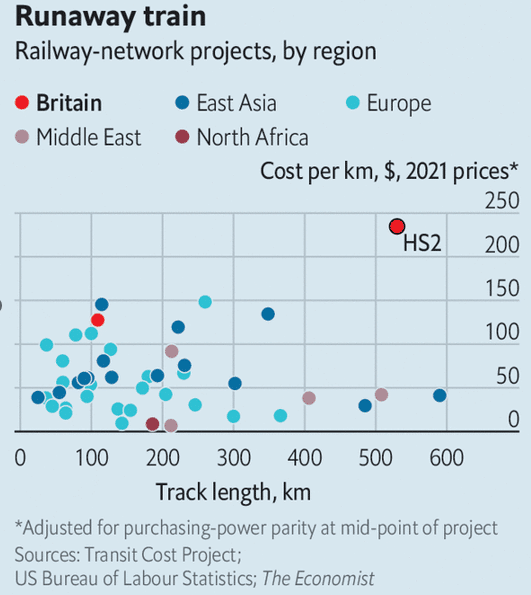
Here’s an example. The current (nobody believes anyway) estimate for the project is around £207B. Or, mile for mile, over ten times what it would have cost in Germany, and almost twenty times what it would have cost to build in China.
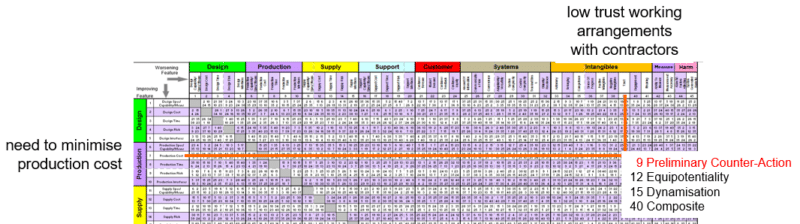
As is the norm these days, all the work is competitively tendered. Which in turn means that prospective contractors put in unrealistically low bids, knowing that if they put in realistic ones, they won’t get the job. They then ‘solve’ the job under-estimate problem by writing into their bids a series of Get Out Of Jail Free cards that, as soon as anything in the specification changes, opens up the opportunity to renegotiate the contract value. Only this time without the annoying competitive tender process. In summary, the result is a working environment that might best be described as ‘low-trust’.
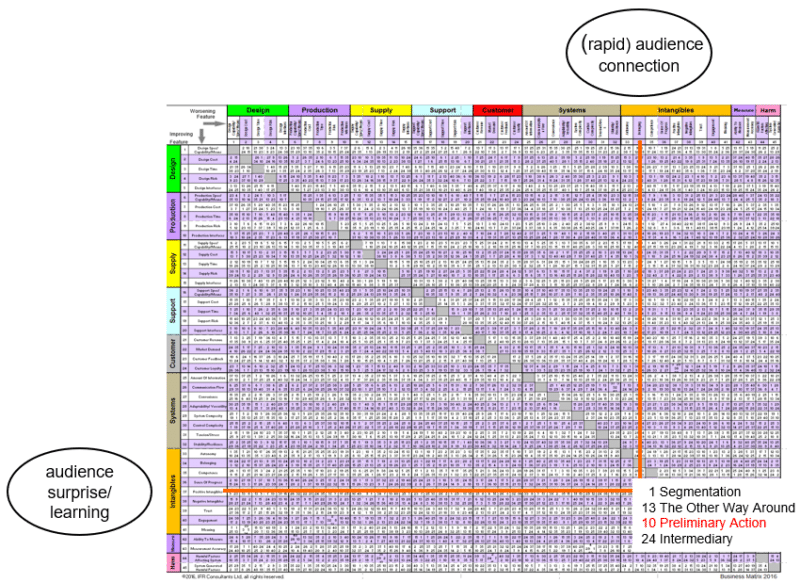
Enter TRIZ again to say that HS2 is not the first time in the world there has been a conflict between a contractor’s desire to minimise production costs and having to contract to a low-trust market. Here’s what the Business Matrix has to say about how the problem has been successfully addressed by others in similar situations:
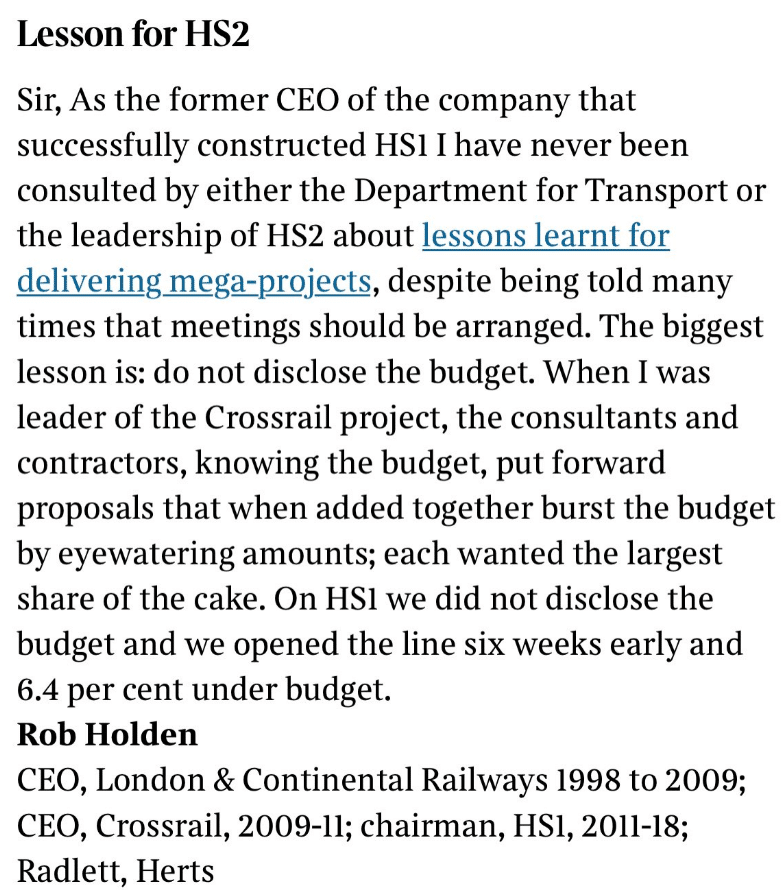
Seeing one of my favourite Principles at the top of the recommendations list triggered a search that picked up this recent letter from The Times, from the CEO of the rather more successfully managed HS1 project. Here’s what he had to say:
I don’t think he knows Inventive Principle 9, Prior Counter-Action explicitly, but the way he managed contractors during HS1 offers up a nigh on perfect illustration of the Principle anyway.
The HS2 CEO clearly didn’t know or understand Principle 9 either. Here’s hoping the CEO of HS3 (sometime in the 23rd Century most likely) remembers again. Probably aided by a Business Matrix equipped digital twin. That way we don’t miss a generation again. Just a thought.
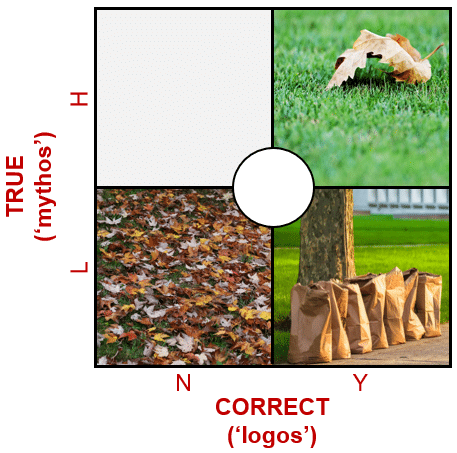
My quest for example of the Correct/True matrix continues. Zen Buddhism seems to contain a rich seam of examples. Albeit there doesn’t always appear to be a great deal of consensus among the community about what any of them actually mean. Maybe that’s the point?
Anyway, here’s one of my favourites:
One day, a novice was told that important guests were expected. Immediately, he set about tending the garden. He removed weeds, pruned tree branches and shrubs. He even brushed the moss. Since it was autumn, the ground was untidy with dry leaves. The novice raked the leaves with great zeal and then painstakingly scooped them all into bags.
All this while, the old master was watching him from across the wall. The novice finished with his labour of love. A look of satisfaction spread across his face. “Doesn’t it look beautiful now?” he said, turning to the master.
“Indeed it does,” replied the master, “but something’s not quite right. Here, give me a hand over this wall and I’ll fix it for you.”
Puzzled, the novice did as he was asked. The old master made his way slowly to a tree in the centre of the garden, gripped its trunk and shook it gently, releasing a small scattering of orange, russet and brown leaves onto the freshly tended ground. “There,” he said, “that’s better.”
The novice in this parable thinks his job is to make the garden ‘tidy’. As in, the correct form of a perfectly tended garden should be mess-less. A garden full of fallen leaves is not correct. One that has had all those fallen leaves removed is. But its only when the master shakes the tree that we achieve a scene that is both correct and true. Something like this:
“When people believe that the form is more important than the Truth, they will not find truth, but will stay with form.” Idries Shah
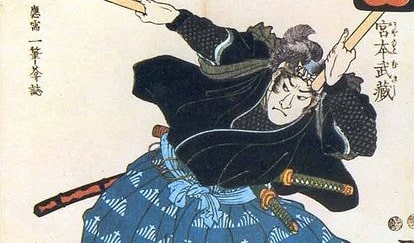
I was reading The Book Of Five Rings the other day (don’t ask!). Purportedly a book relevant to business strategy, it is essentially the legacy of Miyamoto Musashi’s learnings as Japan’s ‘greatest swordsman’. I’m all for a good analogy, but I’d have to say that there are a lot of things Musashi san recommends, that feel like the precise opposite of good 21st Century business practice. Anyway, taking the perspective that there’s good in everything, two things struck me about the Five Rings.
The first is that it was full of contradictions:
Picking up on these contradictions, rather than being a criticism of the book, I propose is actually its essence. The contradictions are in effect the good questions that force the reader to think.
A warrior should have a teacher and not have a teacher.
They need to understand the peaceful arts as well as the killing arts.
‘The end result of any study is a kind of death before the attainment of perfection.’
The need to devote all available time to being a warrior and also to be knowledgeable of other domains (‘to learn the sword, study the guitar’).
‘There is no purpose in trying to determine whether one is better than another. If anything is anything, then everything is everything.’
‘Do not confuse profit with profitability.’
Rules are rules, but some rules ‘can be changed to suit a particular need.’
Have complete confidence but also have contingency plans.
‘To know ten thousand things, know one thing well.’
The ‘spirit’ should be large and small.
‘The ultimate weapon is “thing-no-thing”.’
‘Timing and rhythm – they are one and the same thing, yet they are different’.
‘See that which cannot be seen.’
They must be alone and interact with society.
‘Learn to see things far away and close up.’
‘Remember, as you submit to the “spirit of the thing”, that the “spirit of the thing” will submit itself to you.’
‘The grip (on the sword) should be both loose and tight at the same time.’
‘An attack must be conducted with quickness, not speed.’
‘Attack with power not strength.’
‘The strategy of “attack-no-attack.”’
Be relentless and direct… but always have an escape route.
‘The warrior first understands being a warrior when he no longer concerns himself with being a warrior.’
‘Become the enemy.’
‘To suffocate a shadow.’
Shout to scare the enemy… but not too much.
All attacks should be direct… but look for and chip away at the weak spots.
‘Thinkof strategy as being a snake’s head and a snake’s tail.’
‘Attitude/no-attitude.’
Your sword should be long… but not too long
‘The spirit of the universe is an emptiness which is no-thing.’
‘In the universe, no-thing-ness is not a thing that is true and not a thing that is not true.’
‘Because all the universe is simply no-thing-ness, there is no reason to pursue any attempt at perfection. Perfection is all there is and when you come to realise this, you will have understood my Way.’
(Not that I’m a big fan of the bible, but I was struck by similarities with the research project identifying all the 400+ contradictions it contains (https://philb61.github.io/index.html). Scanning through the list, it looks like half of the ‘contradictions’ are more like discrepancies (like, how many sons did Absalom have), but the actual contradictions (‘is it okay to covet?’) are there, I think, to make readers think for themselves. Or at least that’s the strategy I would’ve used if I were writing a book designed to make readers think. Hmm.)
Meanwhile, biblical diversion over and back to the Book Of Five Rings, the second thing that struck me was a series of things that I thought were contradictions that Musashi’s warrior philosophy told me weren’t. They include:
There can be no difference between frivolous contests/training and a real fight-to-the-death battle – encounters are only meaningful if physical death is a reality.
There are no shortcuts.
‘All things can only be built from the ground up and in one stage at a time.’
Always have a sword in each hand.
‘Whether on or off the battlefield, there is no difference in spirit. The warrior sees all life as the battlefield.’
‘Always fight with your spine erect and unbent.’
‘Do not show your enemy false bravado.’
‘The only reason to draw your sword is to cut the enemy down.’
‘There is no difference between walking and running into battle or walking and running in everyday life.’
‘Do not be a “righty” or a “lefty”. Become both by practicing your movements from all directions.’
Use your enemy’s strength as your own.
‘Everything emanates from a central core. This is true of all things regardless of their appearance.’
‘An attack of any kind must originate from the centre of the warrior and go direct to the centre of the enemy.’
Always remain calm.
‘Always return your weapon along the same path it travelled out on.’
‘The swordis an extension of the body.’
‘Stick to the enemy like glue.’
‘In fighting itis always best to go straight in.’
‘Do not attempt to be clever with your feet.’
‘Everything is within. Everything exists. Seek nothing outside of yourself.’
Ultimately, both strategies – revealing contradictions that are and contradictions that aren’t – in Musashi’s philosophy are intended to achieve the same goal. And that is to force people to do what people normally avoid doing: think. And maybe that’s ends up providing the main connection between being a great warrior and a great business leader?
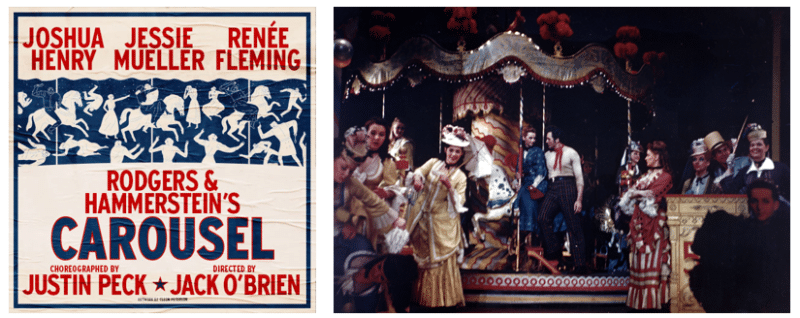
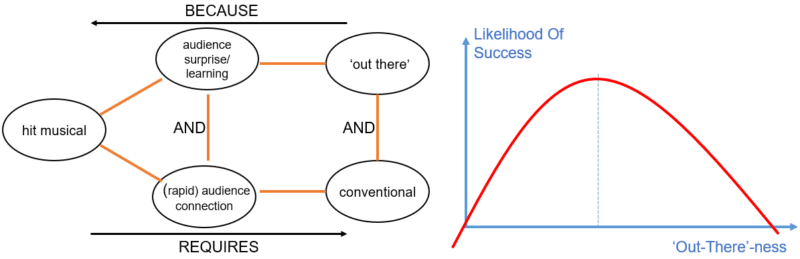
I just finished reading Albert-László Barabási’s book, The Formula (see review in next month’s SI ezine). The Formula is built around five Laws of success, each of which is cunningly illustrated through a cluster of mini-case study examples. Some of them contain contradictions. One of my favourites concerns the story of the 1945 musical, Carousel, a mid-century update of a failed 1909 play, Liliom, by Ferenc Molnar. In their bid to turn the failure into a success, songwriting duo, Rodgers & Hammerstein, seemed to have instinctively understood that a hit musical needed to comprise the right balance of familiarity and novelty in order to engage audiences. A contradiction that looks something like this:
At a more detailed level, they also understood that one of the main difficulties with the romantic story-line is that the boy-meets-girl-boy-loses-girl-boy-gets-girl-back-again dynamic means the happy couple are only allowed to be happy at the end. Great for the purposes of having a big happy song to climax the show, but not so great in terms of making the audience have to wait before getting the ‘big number’. Ideally, the songwriters speculated, the audience got the thrill of the big romantic songs earlier in Act 1. The problem then being that, early in the story, the couple weren’t in love yet. Plus, of course, regular theatre go-ers, wouldn’t be expecting the big numbers at the beginning either. This is a bit of an odd one to map onto the Contradiction Matrix, but here’s how we might best map R&H’s dilemma:
The duo’s solution to the dilemma sounds totally obvious today: give the couple their first big romantic songs at the beginning of the show by having them singing about hoped-for love. I say obvious, because I think its fairly safe to say that just about every romantic musical since Carousel has performed pretty much the same contradiction-solving trick. Back in 1945, however, the elegant convention-break hit the peak of the ‘out-there’ Goldilocks Curve nigh on perfectly. In Matrix terms, Rodgers & Hammerstein did a Principle 10 on the convention-and-innovation challenge.
In 1999, Time magazine named Carousel the best musical of the Twentieth Century. Not bad for a Preliminary Action twist.
Hiding a small action with a big action is a fundamental of magic. A magician makes a big sweeping motion with one hand and releases a dove. Our eyes instinctively follow the hand, then the dove. Meanwhile, the magician does their magic with the other hand. All magicians know this. The fine art of misdirection.
The British media has spent the last few years mastering the opposite version of the trick. A perverse reverse magic in which the small motion hides the big. On one hand you kind of have to admire them. On the other it has now reached a level where society is literally being pulled apart at the seams.
This week’s amazing piece of media perpetrated reverse magic involved BBC newsreader, Huw Edwards. Famous person uses dating app. Links up with an adult. Nothing comes of it, they never meet. The adult threatens to write about it online. Famous person is very angry. Literally not a story at all. And yet somehow, thanks to the inverse sorcery of The Sun, this non-news ends up being the lead item on BBC News. The BBC fell into the trap, and then we all did.
Meanwhile, the real news went unreported. Boris Johnson’s contempt of court. A crime that would put any other citizen in jail. Or, how about, if you were prepared to dig hard enough, it was possible to discover 5% of UK adults reported that in the past two weeks they had ran out of food and had been unable to afford more, Richi Sunak quietly exploded a bomb in the further education sector by capping the numbers of students on ‘low-value’ degrees, and – ‘don’t mention the word ‘Brexit’’ – it was announced that, now we don’t have enough workers for all the jobs that need doing, the Government is exploring a reciprocal visa scheme so that under-35s can work across the EU and Britain. That’s ‘announced’ as in you probably needed to read a French or German newspaper to find out. Your guess is as good as mine regarding the things that happened that never received a mention anywhere in the media.
The small story hides the big. The non-story hides the biggest.
Huw Edwards, Phillip Schofield, Prince Harry, Stop The Boats. Smokescreens all. Innocent chaff. Sacrificing innocent individuals to protect guilty press barons. We see you. We see what you are doing. When the smokescreens dissipates, you will not be forgiven.
At this point in my life, I have zero interest in the following:
NBA
NFL
NHL
Kylian Mbappé
Bolton Wanderers FC
Ruben Dias
Marvel
Ed Sheeran
Nike
A holiday in Fiji
People being overcharged for Uber journeys
Cage fighting
Pokemon trading cards
Solar lighting
Maps of the world re-arranged to look like farm animals
The Journal of Pharmaceutical Analysis
A career in healthcare
Innovative blockchain platforms
Spectacular Hawaiian shirts
Fae Farm
WHO Council on the Economics of Health
Colour-changing unicorn mugs
Tesco (or anyone else’s) cucumbers
Disaster Capitalism
The Hankyu Hanshin Express
72 hour deodorants (is there something I should know?)
Sadiq Khan
Simply Red
Digital Marketing News
Moms Against Vaping
Pistachios
SAP
XBrain Total Brain Optimizer®
Videos of people performing the Heimlich manoeuvre
The town of Barnsley
Nigel Fucking Farage
Darren Fucking Grimes
The Order Of St Andrew
The new all-electric Ford Explorer
Pet insurance
The latest jacuzzi innovation
Surveys from people who have no idea how to conduct surveys
The Raina Indian Restaurant in Amsterdam (unless you’re thinking of flying me over?)
Miracle axes
Waterproof silicone shoe covers
Tamil cinema actors
Bears shitting in the woods
Celine Dion
I have nothing against anyone that likes any of these things, and won’t rule out the possibility that, one day in the unknowable future, I might become interested in them, but right now my rather small brain spends most of its time buffering, and generally operating significantly beyond its depressingly meagre capacity for new information.
I mention this because – not sure if you’ve noticed it? – but someone seems to have been tweaking the Twitter algorithm in recent months. Before, if I wanted to find out about something new, the convention was that I did a search for it. Simple. Now, on the other hand, Twitter thinks it has an obligation to prompt me with several dozen shiny new things in my timeline every day. Thus forcing me to spend time telling the algorithm that I’m not interested in any of them. Given that the things I’m not interested in probably outweigh the things that I am interested in by a factor of around 18 million to one (guess), the prospect of having to tell Twitter about each of the millions of things I’m not interested in is somewhat daunting. To the point of recognising that, now I’m spending more time telling Twitter what I’m not interested in than looking at what I am interested in, I’ve reached the point of exhaustion.
I realise too that there is a contradiction here. Sometimes it is a good thing to jump me (and everyone else) out of our comfort zones and have a peak at something new and potentially exciting. This is the way of helping to prevent the problem of getting trapped inside radicalising echo chambers.
I want to be nudged outside my comfort zone and I don’t want to be nudged outside my comfort zone.
This is not a difficult contradiction to solve. Just give people a dial somewhere in their settings where we can select what percentage of wildcard ‘come and look at this’ provocation we get to receive.
When I’m in the middle of a project (and probably shouldn’t be looking at Twitter at all), surprise me, say, 0.01% of the time. When I’m on vacation, or clearly exploring (the algorithms know what I’m doing), then up the wildcard content to, say, 0.04% 😉
It’s not rocket science. It might help restore a little of our collective insanity.
One day, someone needs to make a TRIZ analysis of Nikola Tesla. Even a cursory examination of the myriad inventions he left behind gives a clear impression of a person that knew about TRIZ before there was a TRIZ. Here’s a simple illustration.
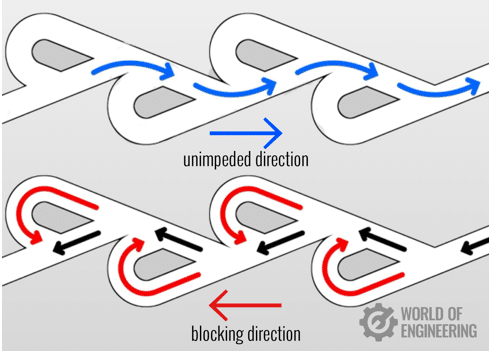
The Tesla Valve is a fixed-geometry passive check valve. It allows flow preferentially in one direction, with no moving parts. Tesla was granted US Patent 1,329,559 in 1920 for the invention.
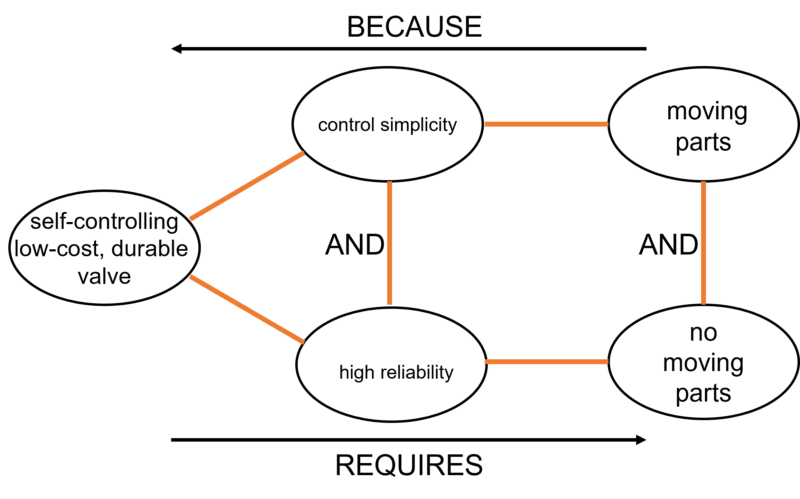
Looked at from a contradiction perspective, the problem Tesla solved looks something like this:
On the one hand, check-valves (traditionally) need moving parts to allow good flow control, on the other, moving parts should be avoided because they reduce reliability. Here’s what the Contradiction Matrix tells us about how people who aren’t Nikola Tesla solved similar control complexity versus reliability problems:
Sure enough, the Inventive Principle recommendations make several connections to the Tesla valve, most notably in bifurcation of the flow (Principle 2) and the division of the valve operation into multiple segments (Principle 1). We might also accept that when the flow is in the blocking direction, one of the flow channels is reversed in order to impinge on the other flow, and hence looks something like a Principle 13 strategy.
Strictly speaking, however, the key to this invention is Principle 14, Spheroidality, and specifically 14C, ‘use rotary motion’. And no matter how else we might interpret the conflict being solved – system complexity, ease of operation, adaptability, etc – a Principle 14 recommendation is nowhere to be seen in the Matrix.
No doubt Tesla’s 1920 invention will now find its way into the Matrix database for future problem-solvers to find. I’m now wondering what his other hundred plus patents might reveal. My suspicion is that if we compiled a league table of inventors using both the most and the most counter-intuitive Inventive Principles, Nikola Tesla is going to be somewhere near the top of the list. Let’s see…
As I was reading Vlatka Hlupic’s book, Humane Capital (see Best-of-the-Month review in the current issue of the SI ezine) I was struck by the apparent similarities between her Emergent Leadership Model (ELM) and our Innovation Capability Maturity Model (ICMM). Both contain five stages, and both recognise that each stage is a step-change jump from the previous stage. Both, too, recognise that the jump from Level 3 to Level 4 is all about making the leap from managing an organisation as a Complicated entity to one that is Complex. From an innovation perspective, Level 3 is called ‘Managed’. In Hlupic’s world it is called Orderly, and in effect describes the leadership modus operandi for to achieve a ‘well-run’ command-and-control hierarchy. The sort of management structure first devised by F.W. Taylor. And the sort still taught in the large majority of MBA programmes around the world today. A big thrust of the Human Capital book is that the shift from Level 3 to Level 4 in effect is about abandoning Taylorism and starting to treat employees as intrinsically motivated, wanting to make a difference, meaning-seeking human beings. And if that sounds kind of scary, that’s kind of the point. Level 4 is a sea-change different to Level 3. Fortunately, Hlupic’s book is written for Orderly Level 3 managers. Primarily by making an evidence-based, Taylor-compatible argument that evolving to Level 4 is good for the business, customers and everyone else in a value ecosystem.
In the Innovation Capability Maturity Model, Level 4 in effect needs a leadership model that matches Level 4 on Hlupic’s scale.
Importantly, that is not the same as saying that an enterprise that achieves Level 4 on the Emergent Leadership scale will also have achieved Level 4 on the ICMM scale. Indeed, the majority of Level 4 companies found in Hlupic’s analysis are nowhere that Level when it comes to innovation. A Level 4 Emergent Leadership Capability, in other words, is necessary but far from sufficient to achieve a Level 4 Innovation Capability Maturity.
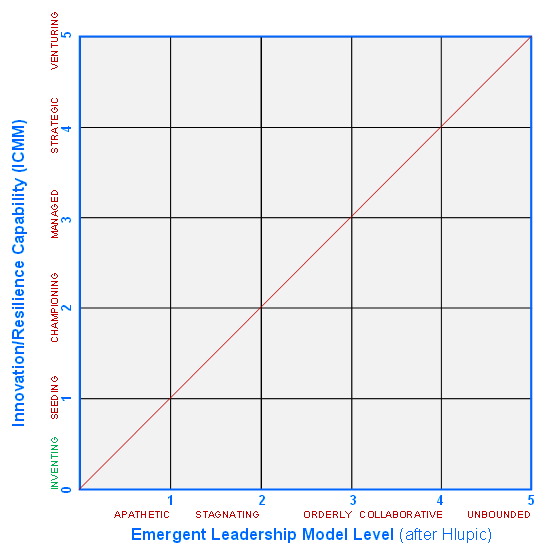
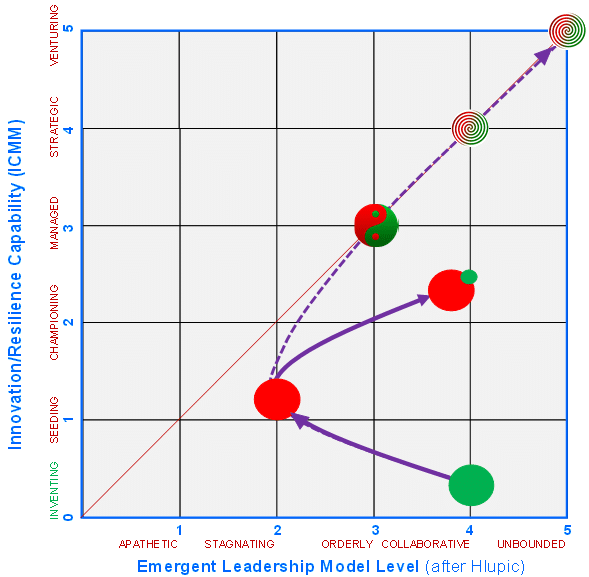
In many ways, but particularly when organisations operate at Level 3 or below on either scale, there is very little correlation between Emergent Leadership and ICMM. To the point in fact, where it is probably prudent to consider the two models as orthogonal axes on an overall organisational capability map. A map that might look something like this:
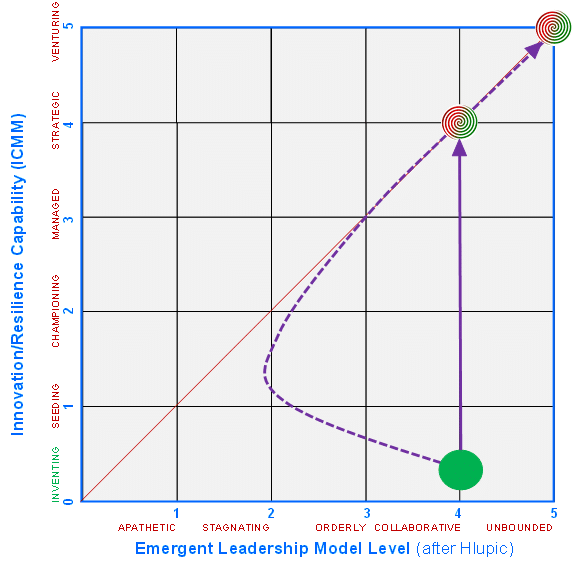
One of the most striking differences between the two models begins with start-up enterprises. From an Innovation Capability perspective, any start-up that is in business to offer the market something new is in effect operating at ICMM Level 0. The Hero’s (Start-Up) Journey book is in effect all about what these start-ups need to do to survive long enough to reach the revenue/profit making goals that help characterise a Level 1 enterprise. It is important to note that there is no Level 0 in the Emergent Leadership Model (ELM). Rather, the start-up leaders Hlupic interviews for her book more often than not already exhibit ‘Collaborative’ Emergent Leadership Level 4 Capability. In that small, cash-hungry, fighting-their-way- through-the-jungle start-ups pretty much by definition need leaders that are able to embrace the complexity and chaos that surrounds (and frequently engulfs) them. They tend to be flexible, agile teams where everyone is expected to get stuck in to whatever needs to be done to keep the boat afloat.
This ICMM/ELM start-up mismatch reveals something of a quandary. Why, if enterprises start as Collaborative Level 4’s, does their survival past the start-up stage cause their Leadership Capability to fall? Or why, expressing things in ICMM terms, is it that once organisations have successfully built a stable, efficient, Operational-Excellence capability do they end up with dysfunctional, Taylorised management hierarchies? Or, to express the quandary in more blunt terms, why did Hlupic need to write her book?
In graphical terms, the problem looks something like this:
The answer to the puzzle, I think, starts with investors. A community of people that tend to look at the apparently ramshackle nature of leadership in the start-ups they’re thinking about investing in and feel a need to make their investment dependent on the recruitment of ‘professional’ managers. A COO. A CFO. Numbers people. Red World people. People with a track record of managing businesses. People – and here comes the second answer to the puzzle – that have a Taylor-merit-badge MBA. People that, not coincidentally, look the same as the investors.
Hlupic’s book is in effect all about how to re-educate those Red World professionals to understand that EQ is massively more important than IQ. And leads to more successful enterprises.
While applauding that ambition, my work is in Innovation World – also known as, noting the added word in the ICMM axis of the above graphs, Resilience World. Given the choice of working with an ICMM Level 2 (I pretty much refuse to work with Level 1 organisations these days) with ELM Level 1, 2 or 3 or one with ICMM Level 2 and ELM Level 4, I will take the latter any day of the week.
That said, sweeping aside the minor problems of an out-of-touch academia and naïve (ELM Level 3 at best) investors for a second, the new ELM/ICMM framework makes me wonder whether the world of work would be a whole lot more productive, profitable, meaningful and fun if we stopped corrupting Collaborative start-up leadership teams and designed a more direct route to Level 4?
As with all things, it’s usual for things to get worse before they get better, but it’s not compulsory.