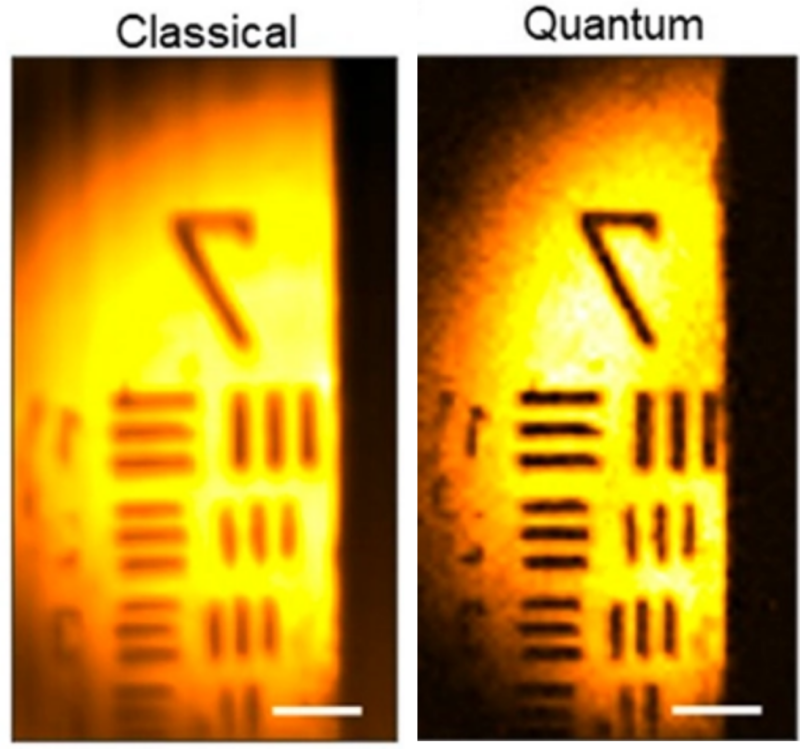
Quantum mechanics. If you think you understand it, to paraphrase Richard Feynman, you don’t understand it. But just because we don’t understand something doesn’t mean we can’t make something useful out of it. Enter a group of researchers from Caltech and their quantum microscopy by coincidence (QMC) solution for doubling the resolution of microscope imaging. And more specifically, contradiction-wise, without the usual complication of dramatically increasing the amount of energy required to do the job.
The problem they’ve solved is the easy part of the sort of reverse-engineering process conducted by the SI research team. Mapped onto the Contradiction Matrix, QMC looks something like this:
Now for the tricky part. How did the research team solve the conflict?
As far as I can tell, there are three parts to the solution.
The first relates to quantum entanglement, a phenomenon that describes correlations between objects – photons in this case – that have a shared history prior to being observed. Or, as the researchers tell it, ‘just as two shoes bought at a store are correlated to fit a right foot and a left foot, particles can be mathematically correlated in a variety of ways too. Only in a quantum system, things like shoes and electrons don’t truly settle on any of those states until they’re observed. They’re merely probabilities best described as a wave of maybes’.
If that hasn’t blown your mind, they go on to say, ‘One photon is sent through the material being studied, while the other photon is analysed. Being entangled, the correlations measured in either photon will also say something about the journey of its partner. It’s the basis of another fairly novel technology called ghost imaging’. From an Inventive Principle perspective, I think this correlation between two photons idea is a fairly clear illustration of Principle 37 in its ‘Relative Change’ form.
(For future reference, the ‘ghost imaging’ quantum phenomenon underpinning the Relative Change measurement, and the idea that one photon carries ‘a memory’ of another sounds like Principle 7, Nested Doll. Or possibly Principle 23, Feedback.)
The second aspect of the solution, meanwhile, is a little easier to describe. Here are the authors again, ‘In QMC, the particles involved were photons, or light particles, which are known as biphotons… a very small fraction of the photons – only around one in a million – are converted into biphotons’. Here’s Principle 3, Local Quality in action.
Finally, the easiest bit… the one-in-a-million biphotons were created by passing a laser light (Principle 28) through a special kind of crystal made from β-barium borate (BBO). Hello, Principle 35, Parameter Changes.
All in all, even though the Matrix knows less about quantum mechanics than me, I’d have to say that it did a pretty good job of identifying the Inventive Principles we can see in the QMC solution. I can’t yet go so far as to say that the Matrix is quantum compatible, but when things like quantum entanglement and ghost imaging sit well within the bounds of the 40 Inventive Principle, I continue to be confident that the $250k reward I’ve been offering for the last decade to anyone that can find me a genuine 41st Principle remains safe.
The general consensus in the SI research team is that there is a Goldilocks curve for just about everything in life. You can’t keep increasing something and expect that the outcome the something is supposed to produce will also keep increasing. What goes up must come down, and all that.
The key to establishing the truth behind such hypotheses – the difference between a Law and a heuristic – is an active search for exceptions. Things that not only don’t fit, but aren’t exceptions that serve to prove the rule either.
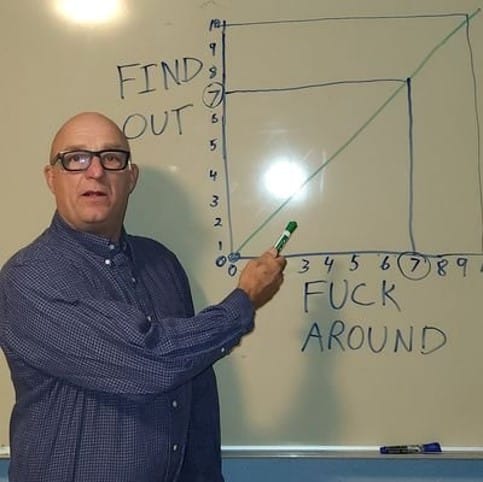
Enter the rather lovely and brilliant video from @rogerskaer (https://twitter.com/i/status/1576025818182332416) and his bluntly stated insight that the best way to find stuff out is to fuck-around. And that if we want to find out more, then we need to fuck-around more:
Because the act of ‘fucking-around’ is, by definition, about not trying to be productive. Or perhaps more appropriately, recognising that when it comes to learning something new, the best strategy is to try and turn off the conscious parts of your brain – the parts that think they already know and don’t need to find out any more.
As far as we can tell, thanks to this consciousness constraining element, there is no immediately apparent Goldilocks Curve associated with fucking-around. More leads unendingly to more.
On the one hand, this is quite encouraging. On the other, as we’ve found to our own cost when it comes to missing the promised deadlines for delivering the expected results to clients, the practicalities of life often prevent us from being able to carve-out enough fucking-around time to get where we’d like to be, when we need to get there.
What to do about this problem?
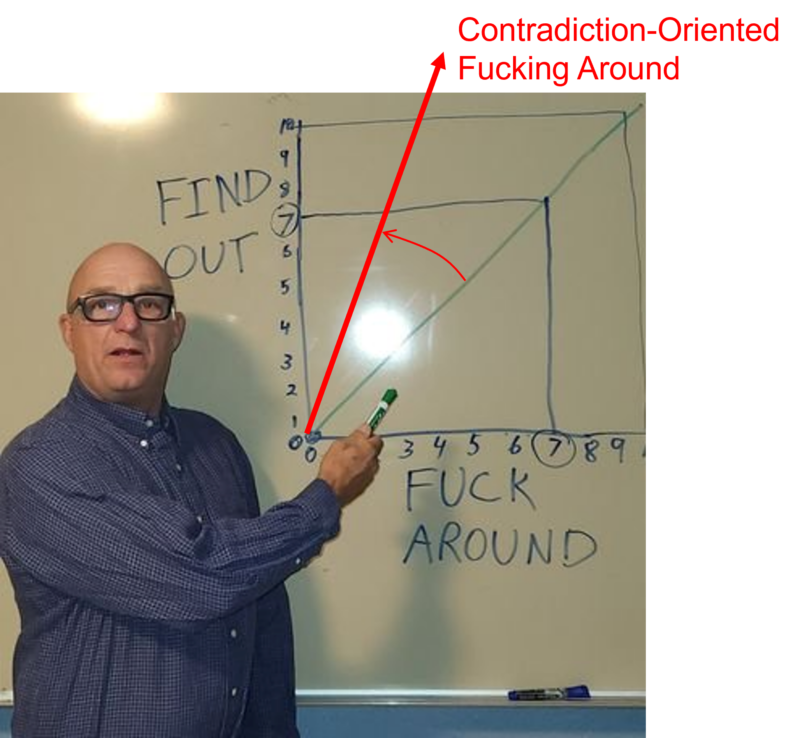
Here’s where we might want to try and evolve Roger’s sage advice. It’s an evolution we think stems from a recognition that not all fucking-around is equal. Some forms of fucking-around are more effective than others. Meaning that if we want to find out faster, we can’t just fuck-around faster, we need to fuck around more effectively. The person (or team) that fucks-around better than other people (or teams) is the one that finds out first.
So, what counts as effective fucking-around?
Well, it starts – we think – from recognising that, unlike the belief held by many in the Complex Adaptive Systems World that the future is completely random. Stupid as humans might be in the short term, in the longer term, all the TRIZ research tells us that things get better. Value goes up. More benefits, less cost, less harm. And, moreover, it also tells us that the very best way to ensure things travel towards the shiny-bright version of better called ‘Ideal Final Result’ and away from the ego-driven delusional-droolings of populist politicians, is to be constantly looking out for conflicts and contradictions. And then, once we find one, to overcome our natural Zero-Sum Bias and actively seek ways to transcend them.
The faster we find and solve contradictions, the faster we find out. So, rather than just randomly fucking-around, we need to spend more of our time fucking-around with contradictions. The fucking-around-finding-out relationship remains linear, but the slope of the line is in our control:
“It might take our producers five minutes to find 60 economists who feared Brexit and five hours to find a sole voice who espoused it. By the time we went on air we simply had one of each – we presented this unequal effort to our audience as balance. It wasn’t.”
Emily Maitlis
Both-sides-ism. I’m a big fan of journalist, Emily Maitlis, especially now she’s free of the BBC editorial shackles. She gave a talk at the TV Festival in Edinburgh last year. During the talk she described some of the impartiality policies at the Corporation. As hinted by the above quote, they didn’t sound good. Presenting a balanced view, it turns out, is not an easy thing. Especially, when we live in a world still dominated by Socratic either/or thinking. And, for the most part, don’t understand the contribution of science and scientific thinking to the story.
Take Maitlis’ challenge of attempting to present a balanced view of Brexit fears. The point she was trying to make in Edinburgh was that if, in the course of trying to find two people to discuss ‘both’ sides of an argument, there were hundreds of people willing and able to talk about one side, and only one or two to discuss the other, the eventual two-sided discussion couldn’t possibly be ‘balanced’.
The key danger with this kind of logic can be seen in the murky waters of climate change science at the moment. ‘97% of climate scientists agree…’ is not a justification for declaring the argument as being settled. That’s not the way science works. Science is supposed to be about actively engaging with the 3% that don’t agree, filtering out the nutjobs, and then actively seeking out the contradictions between the different perspectives in order to begin the work of solving them. Science is specifically not about cancelling the 3% just because we don’t like what they have to say. In this kind of situation, it would be entirely appropriate to create a ‘balanced’ argument involving a representative from the 97% and another from the 3%. Hopefully after filtering out the nutjobs on both sides. That filtering job might actually be the bigger problem, but let’s leave that discussion for another day.
The point here is that just because ‘everyone’ believes the Sun revolves around the Earth doesn’t necessarily mean we should exclude the one or two out-of-sync individuals who believe it is the other way around.
The key to getting ‘balance’ right in this kind of situation starts by thinking about factual correctness. No-one today would argue the case that the Sun rotates around the Earth because we have incontrovertible proof that the Earth rotates around the Sun. There’s no need for ‘balance’ here. Similarly, there is no need for ‘balance’ regarding the question of whether the Earth is flat or spherical. There are some people who still believe the Earth is flat, despite the incontrovertible evidence to the contrary, but we don’t need to include them in the argument because we can prove they are nutjobs. And, much as it can be entertaining to interview nutjobs, I think we currently live in a world where there are more constructive ways of using our collective time.
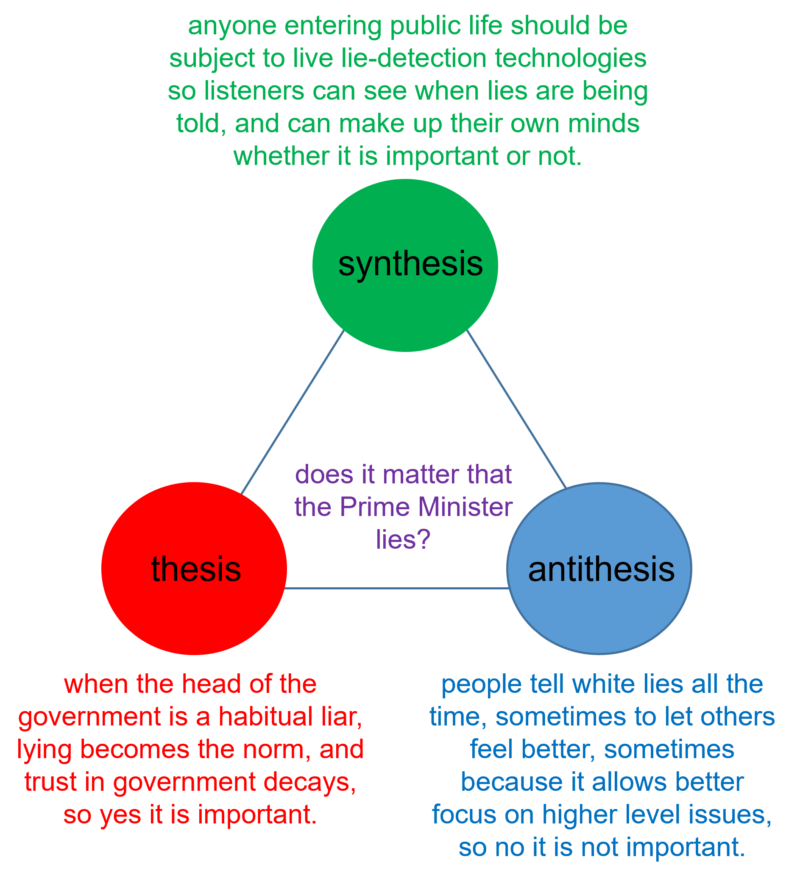
The same applies when we take another, perhaps to some, more controversial fact-based ‘debate’. Is Boris Johnson a liar? To which the factual answer is, of course he is. His many supporters might not wish to acknowledge the enormous body of evidence demonstrating just how much he lies, but that doesn’t make the evidence go away. Johnson is a habitual liar. He says whatever he needs to say to get through his next five minutes – either to say something ‘pithy’ or, more usually, to weasel his way out of a difficult conversation – and he’ll then worry about the consequences later. Usually by throwing his colleagues under a bus. A big red one with ‘Take Back Control’ written down the side. Meanwhile, the need for ‘balance’ is irrelevant if the question we’re trying to answer is about whether or not lying has occurred.
So far so good. But here’s where matters switch from complicated to complex. If the producers chose to reframe the Boris Johnson lying question into something like, ‘Does it matter that Boris Johnson tells lies?’ then the debate immediately shifts from being a fact-based one into one that centres around morality and ethics. And, as I’ve written elsewhere (‘Covid, Complexity & Contradictions’, http://systematic-innovation.com/assets/iss-225-Jan-21.pdf), when it comes to matters of fairness, liberty and the other elements of a system of morals…
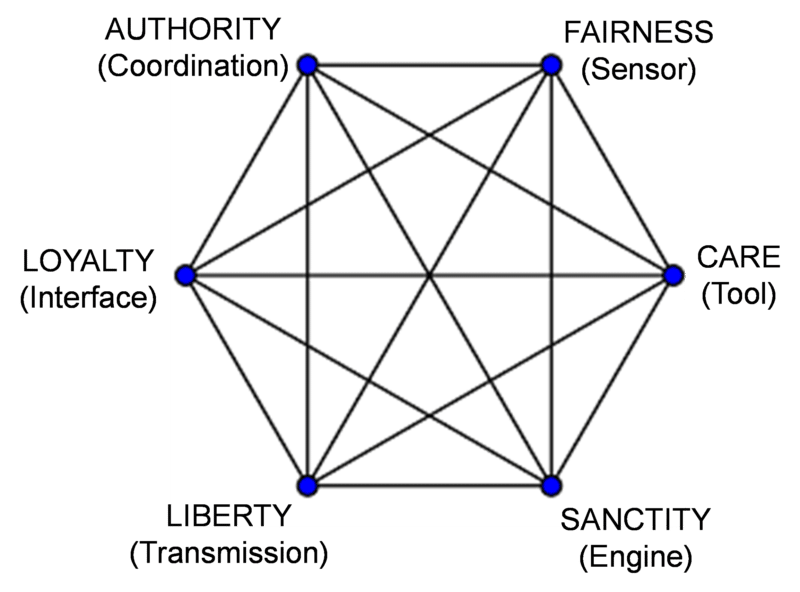
… there is no longer such a thing as an either/or ‘right’ answer any more. The reason being that all of us, to some extent recognise and value all six of these moral components, so none of them can be ignored. Or, put another way, any argument that explicitly or implicitly pits one of the elements against another is futile. A meaningful answer to this kind of either/or question can only ever be ‘both’. And if the argument is allowed to continue, it will quickly devolve into an unanswerable debate about which one might be more or less important than the other. They’re both important, dummy.
The ’does it matter that ClownBoy lies?’ question is a moral one. If we want to pursue a balanced version of a debate on this question, while it might be much more difficult – per Maitlis’ producer challenge – to find a person to argue the ‘it doesn’t matter’ side of the discussion, that doesn’t justify stopping the search. Even if the ratio of does/doesn’t speakers ends up being 1000 to 1, ‘balance’ means both sides of the argument should be allowed to make their case. Nutjobs excepted, of course.
If that message doesn’t sit right with you, the first thing I’d say is ‘welcome to freedom of speech’. A concept that seems to increasingly be forgotten by a lot of very polarised, social-bubble-trapped individuals. Freedom of speech notwithstanding, the other reason the message might not sit right with you is that we’re still stuck in the Socratic thinking paradigm. When what we should be trying to do is solve the contradiction rather than merely try and pretend it hasn’t happened.
The simplest way to do this – or at least to better ‘manage’ the contradiction – is for the journalist to mention the fact that it took them five minutes to find a million people to represent one side of the debate and five hours to find one person to represent the other side. That way the audience is able to make their own informed decision about how much credence to give each side of the debate.
That would be a start. Far better would be to make the shift from Socrates to Hegel and include the missing third voice in the discussion. Thesis, Antithesis, Synthesis. Present the status quo, the Thesis that is currently accepted and widely held, then present the Antithesis, articulating the problems with the Thesis (Hegel also called this phase “the negative.”), then bring in a third voice, a person tasked with generating the Synthesis, a new viewpoint that resolves the contradiction and thus demonstrates that it is possible to escape the tyranny of trade-off thinking.
Now, there’s the kind of debate I’d take time to listen to.
And if there’s a need for volunteers to come and do the third-way part, include me in.
A long time ago, before I’d heard of TRIZ, one of the coolest aerospace projects I worked on was knitted turbine blades. This was the early days of fibre-reinforced composite materials, and one of the biggest challenges was packing as much fibre into the structure as possible, because they were the things that gave the bulk of the overall strength of the blade. The big idea was that if we knitted the fibres (well, strictly speaking, we outsourced the knitting to a company that had machines for knitting garments), the prize would be enormous. Just the idea of knitting turbine blades was enough to convince the sponsors to fund the development (aerospace R&D Rule #1 – always use other people’s money). The ultimate win-win-win project – sponsors get something cool to talk about, we get a stronger, more capable turbine blade and the knitter earns a lot more money knitting blades than they do knitting M&S jumpers. The only slight problem was it didn’t work. Safe to say we got carried away with the sexiness of the idea rather than the practicalities. The forces on a spinning turbine blade are enormous. Imagine tying a human hair to a double-decker bus and then holding one end of the hair and using it to spin the bus and that should give you a pretty good idea of the problem. When we were just using straight fibres everything was okay. But when we knitted the fibres, they weren’t arranged in straight lines anymore, they were wavy lines. Which meant that when they were put to work spinning the bus, they didn’t want to be wavy, they wanted to be straight. In these kinds of fight, the double-decker bus tends to win. The good news was that the composite material placed around the knitted fibres did a pretty good job of keeping the fibres in their wavy shape in the short-term. The problem was that it didn’t take long before the filler started to crack. If that doesn’t sound like good news, you’re probably right. Apart from the fact that the blade failure was relatively slow rather than sudden and catastrophic. This meant that, in theory, it would be possible to inspect the blades between flights to make sure they weren’t cracked. Some theory. The sort that is the exact opposite of Ideal Final Result engineering. And so the project sadly fizzled out and everyone walked away a little bit embarrassed.
That was the 1980s. Nothing really happened between then and now. The prize of fibre-reinforced composites with very high fibre density is still enormous. Solving the problem just needed a jump in thinking. A jump that recognises there’s a contradiction – the blades (or aircraft wings, or medical devices) need to be tough and also deformable without damage (i.e. capable of withstanding high levels of strain, if you’re a mechanical engineer). Here’s what the Contradiction Matrix has to say about solving that conflict:
Now, I grant you that it’s a fairly big leap to go from Inventive Principles 3, Local Quality, 17, Another Dimension, and 31, Holes to the idea of tying knots in the fibres, but then again until such times as there’s a specific Principle called ‘knots’, 3, 17 and 31 are the only way TRIZ is going to get us there.
Anyway, that’s kind of beside the point. The point is that tying knots in the fibres turns out to be an exceptionally good way of challenging the toughness-versus-strain conflict. According to the inventors – a team of engineers at Caltech – the micro-scale (~70micron diameter) knots give a doubling of both parameters. In material property evolution terms, that’s quite a prize. Here’s a recently published image of their knotty fibre structure…
Time for me to go revisit the old knitted-blade patents. And, thinking about the Matrix result, to also have a deeper look at what Principle 13, The Other Way Around is trying to tell us about this new knot-based paradigm…
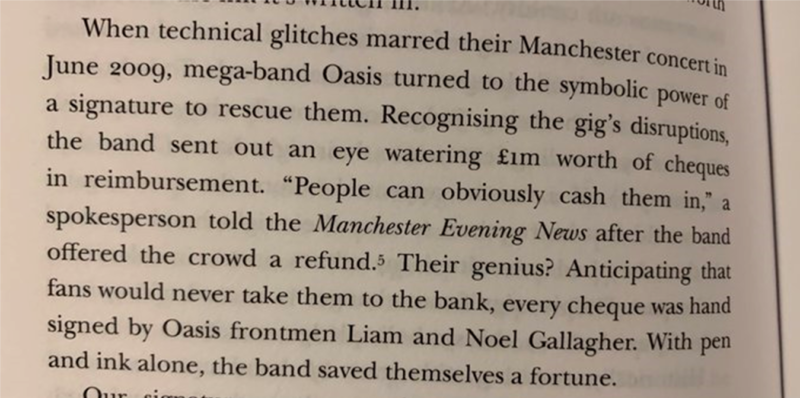
Here’s an excerpt from a Guardian review of the first of a series of homecoming gigs at Manchester’s Heaton Park by the band Oasis in 2009:
The last line is quite amusing in light of what happened next. Here’s the follow-up story as described in the Sam Tatum book, Evolutionary Ideas:
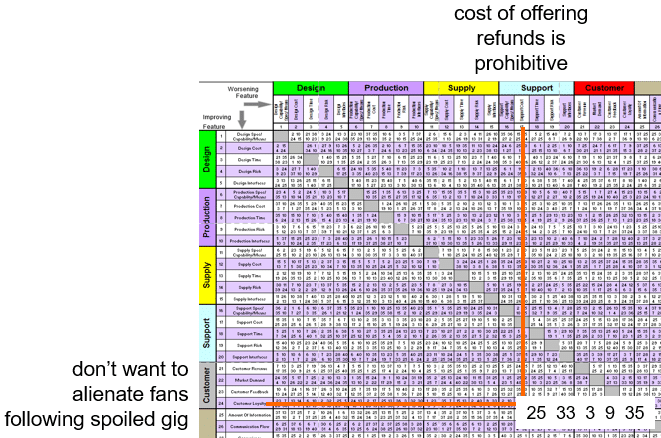
And here’s what the problem and solution look like when mapped onto the 3.0 business version of the Contradiction Matrix. Essentially, the thing Noel Gallagher was seeking to improve through his refund offer was ‘Customer Loyalty’. The problem his offer created was the potential loss of several million pounds – a Support Cost issue…
There are a number of ways of interpreting Noel’s ‘send them handwritten cheques’ solution to the dilemma, but probably the best two correspond to Principles 9, Prior-Counteraction and 35, Parameter Changes. The former because what the band did is sent out cheques that they were pretty certain wouldn’t be cashed by most fans… the reason being – per Principle 35C – that most fans wouldn’t see the cheques as money, but rather a personalised autograph from their hero. i.e. the actual function was shifted from the usual function of a cheque.
I haven’t found one of these cheques for sale on eBay yet, but it will only be a matter of time. My guess is that it will sell for something well in excess of the original £38.30 ticket price. I say that because, what is on eBay at the moment are several ticket stubs for the June 4 Heaton Park show and even they are selling for more than the original ticket price.
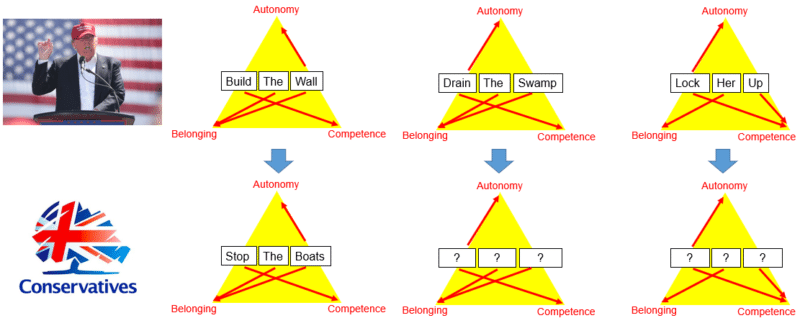
Per prediction, the increasingly desperate Conservative government in the UK has taken its next step towards matching Donald Trump’s ‘Nine Syllables That Changed The World’ trick from his 2016 election campaign (Nine Syllables That Changed The World? | Darrell Mann). The first three of the nine magic syllables being ‘Stop The Boats’. The literal UK equivalent to Trump’s ‘Build The Wall’. The same dog-whistle meaning.
Which leaves six more syllables to start appearing in the Conservative lexicon in the coming months. Your job is to work out what they will be before the Tufton Street thinktanks work their distorted magic. Here are a couple of clues to help guide your thinking:
Three syllables attacking the leader of the opposition, and three attacking the Labour equivalent of the ‘swamp’. Probably connecting to the ongoing slow poison of Jeremy Corbyn or Momentum. All six – crucially – needing to tap into the Autonomy-Belonging-Competence Dog-Whistle DNA.
Your time starts now.
Extra bonus marks if you can work out what the Labour Party equivalents are going to be. Bearing in mind that last time around, they completely misunderstood the game (Seven Syllables That Sank Labour? | Darrell Mann). With that dismal memory in mind, here’s a nine-syllable starter: Lockdown Parties. Beach Sewage. Turnips. Or maybe: PPE. Braverman. Tomatoes?
Reading Jeff Schmidt’s 2000 book, Disciplined Minds, recently delivered one of those unsettling blinding flashes of the obvious. The sort that make you question, in my case, several decades of assumptions about how the world works. I opened the book as part of a programme of research into leadership, and specifically and attempt to try and understand why all the leaders seem to have disappeared. Schmidt’s addition to the long list of other reasons is that professionals – people I assumed were first and foremost recruited for their subject matter skills – are more likely to be able to build a career as a result of their ideological skills. By which Schmidt means the closeness of match between the ideology of the individual and those of their employer.
If I look at the situation from the employers perspective, they’re paying the professional salaries they pay not just for the technical knowledge that a professional brings, but also on the understanding that they will also comply with the reasons why the enterprise is working on the things they’re working on. The definition of professional, in other words, is someone that does what they’re employed to do, and buy-in to the ideological constraints that their work involves. Speaking as someone that worked for fifteen years in the defence industry, I get it. Designing boundary-pushing jet engines was exciting, but only possible if I either ignored their purpose, or, better, bought into the belief that the work was being done to ensure the future security of the nation.
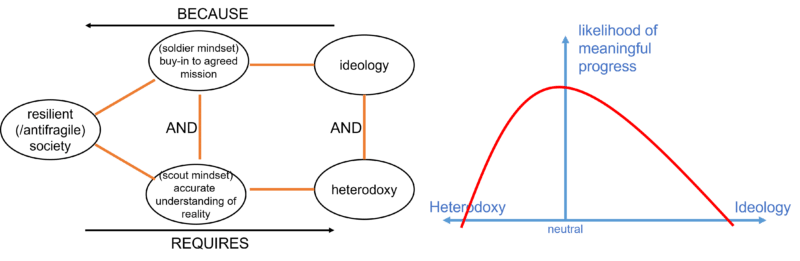
Ideology in this context is a good thing. But like everything else in life, it is possible – nay, inevitable – that at some point you realise that you know have too much of that good thing. Ideology, in other words, offers us yet another example of a Goldilocks Curve: The ideology-based constraints imposed upon professionals are both good and not good.
On the too-much end of the spectrum, (corporate) ideologies are rigid systems of belief that can lead to dogmatism, intolerance, and violence. They are often based on false assumptions and – here’s the kicker – prevent individuals from engaging in critical thinking and considering alternative perspectives. Over-ideologised professionals fail to question their own beliefs and stop being open to changing their minds in light of new evidence. Here’s what an ideology/heterodoxy Goldilocks curve might look like for a typical professional:
The point being that, once we’ve recognised the existence of the contradiction, it is incumbent upon the professional to either manage or transcend it. Managing it in this case largely means understanding where the peak of the curve is in space and time and then doing the best we can to remain at that position. Transcending it, I think, means understanding that all ideology is counter to truth-finding, and that if a person (‘professional’) seeks to be in the change or innovation business, truth-finding is essential. And, moreover, largely emerges through the distillation of the world to meaningful first principles.
Schadenfreude is the second cousin of innovation. One of my favourite January sights was a video of German security forces getting stuck in mud during an attempt to disperse a group of protesting wizards. You can find a copy of the video here: https://www.youtube.com/watch?v=muNtOwLqoO8. In fairness to the victims, by the end of the incident, I think they were also struggling to avoid laughing at one another. Pure slapstick. And yet, such a simple problem. But here we are, ten thousand years since humans first invented footwear, and still we can’t reliably find our way across a muddy field.
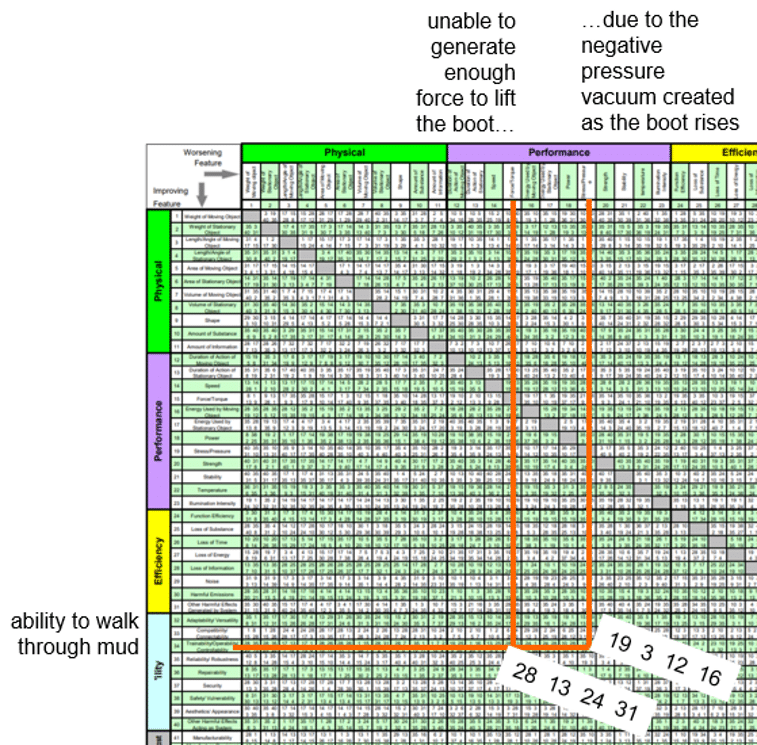
Or maybe, strictly speaking, the problem is complicated rather than simple. Complicated because it involves a contradiction: we want to be able to walk across the muddy field, but when we sink into the mud, it forms a pretty good seal, so that when we try and lift our feet, a negative pressure vacuum is formed under the sole of the boot. The more force we try and apply to lift the boot, the bigger the vacuum. Net result: mocking wizards.
Here’s what the Contradiction Matrix has to say about the problem:
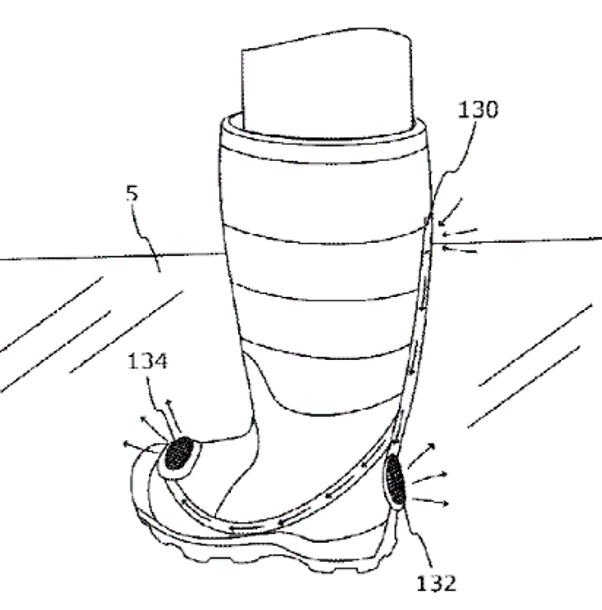
Over the years, in fairness to the Schadenfreude-inspired inventors of the world, there have been numerous solutions attempts. All of them, as far as I can see, making elegant use of Inventive Principles 12, Equipotentiality, and 31, Porous Materials (or ‘Holes’). The former sounds fairly obvious as a direction – if a vacuum is being formed, reduce it. Probably a little too obtuse for most tastes. Rather more explicit in terms of working out how to reduce the pressure difference is the second Principle: add holes. One of those often counter-intuitive solutions that requires us to overcome an initial piece of psychological inertia. And that, in this case, is probably something like, ‘if there are holes in the boot, doesn’t that mean my feet will get wet?’ Well, of course, not if we think carefully about where to put the holes. The first hole-based solution I saw came in the form of an interview on a local TV news channel, probably twenty years ago. The inventor in the article, had solved the problem by introducing a hollow tube extending from the heel of the boot up to the rim at the top. I don’t know what happened to it. The TV demonstration looked pretty convincing at the time. Convincing enough that, if I’d been in charge of procurement for the German security forces, I would probably have gone out and order a couple of dozen pairs. As far as I can see, no-one submitted a patent application. Which is a shame because, 2018 saw the submission of another bottom-to-top pressure-relieving tube solution. It’s slightly more complicated than the one I saw twenty years ago, but it uses essentially the same principle. And that is allowing air to be drawn down the tube to relieve the vacuum that would otherwise have formed when the wearer tried to lift their feet. Here’s what the 2018 solution (US20180199662 if you’re interested in reading more) looks like:
In the end, this might just be another case of solving one contradiction creating a good solution, and only when we solve the next contradiction do we turn it into a ‘wow’ solution. All well and good to introduce a pressure-relieving tube, but the combination of ‘tubes’ and ‘mud’ doesn’t sound like a particularly synergistic one. I don’t doubt the negative pressure aspect of the design will be good at ensuring the tube doesn’t block up with mud. But I’m also pretty certain that when I’ve safely round up the annoying wizards and gone back to base, there will be some level of residual mud on the boot and in the tube. If I then allow that mud to dry in readiness for the next wizard protest, the combination of tube and dried mud sounds like a problem I don’t want to have to deal with. But then again, its merely the next contradiction, right? Time to get the patent generation boots on…
I’ve spent a lot of time in the past couple of years talking to enterprises of various sizes about what might just be the dominant business contradiction of the times: the parallel need to maximise near-term operating efficiencies and ensure longer-term survival. The two sides of the contradiction have been encapsulated in Red-World and Green-World analogies. Red-World being all about the mindsets, operating philosophies, methodologies and tools required to deliver the simplification and standardisation necessary to maximise operating efficiencies. And Green World being all about those required to venture into the complex, chaotic unknown future, be able to make sense of it, and then ensure the future resilience of the enterprise. Here are the two world expressed in terms of the Complexity Landscape Model (CLM):
Essentially, enterprises need both Red and Green World capabilities. Which in turn means managing or, ideally, transcending the fundamental contradictions between the two. The simplest contradiction management strategy in effect segments Red World and Green World into two wholly separate entities. This is the Skunkworks model still pervasive in and around the aerospace industry: put all the Red people in one building to ensure the production of safe, standardised, efficient, follow-the-rules, profitable products, and put all the Green people in a completely separate building to do all of the confusion-ridden, going-boldly-where-no-one-has-gone-before, breaking of rules stuff. The big problem with this model is that it continues to be extremely difficult (and expensive) for the exciting new technologies to make the transition out from their Green origins and into their future Red revenue-generating home. In effect, the aerospace industry is able to ‘get-away’ with this difficulty because it is a mature industry with a very slow disruption cadence.
Faster moving industries that have tried the Skunkworks segmentation approach have usually failed to make it work for them. They need something more akin to Red/Green solutions that transcend rather than merely manage the contradiction. Here’s what the contradiction Matrix has to say about how others have successfully evolved these more effective solutions:
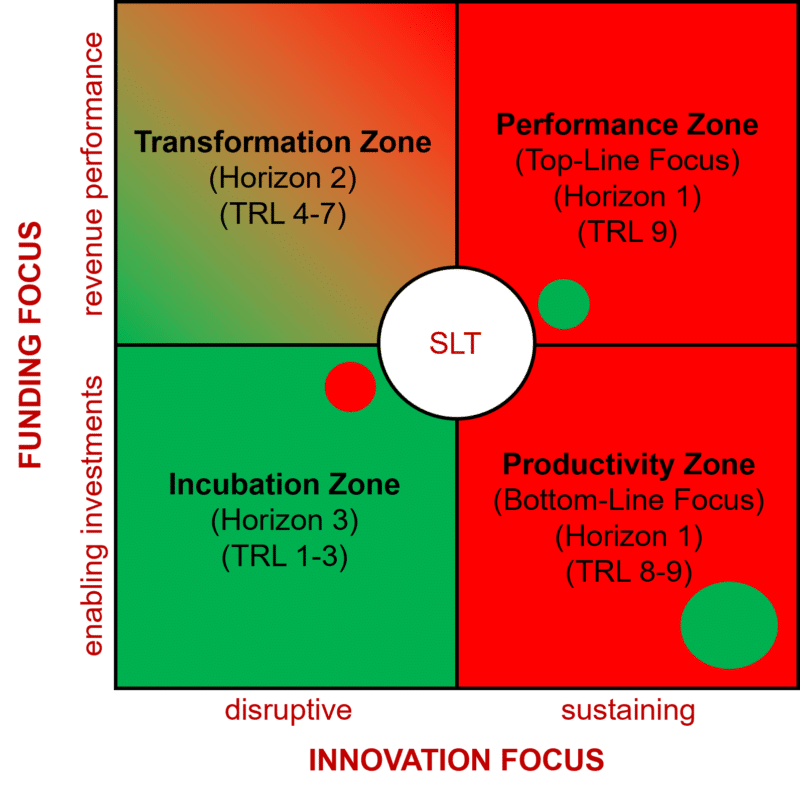
The fourth most frequently used strategy, Principle 1, Segmentation, takes us into the world of the 2015 Geoffrey Moore book, ‘Zone to Win’. On one level, the book describes a segmentation model that divides an enterprise into four domains rather than the two found in aerospace. Two of the four correspond directly to the Red-World/Green-World ends of the contradiction spectrum. Taking all four segments together produces a model that looks like this:
It is the third most frequently used solution strategy, Principle 15, Dynamisation (15A: ‘Allow an entity or system to change to achieve optimal operation under different conditions’), however, that takes us to the real essence of Zone To Win. It is one thing to segment Green and Red Worlds, quite another to be able to dynamically shift the emphasis and relative importance of the four zones according to the prevailing and emerging market conditions.
Most insightfully, I think, is Moore’s ‘Transformation Zone’, the place where, in effect, the enterprise must deal with the ‘D’ part of R&D. This is the TRL4-7 transition between Green and Red World, and as such, Moore recognises that this Zone only really gets switched on once either a disruptive threat emerges to jeopardise Red World’s Production Zone, or, if the leadership team are braver, the enterprise decides to proactively become the disruptor.
Moore’s Zoning model doesn’t incorporate the usual circle I’ve drawn in the middle of the 2×2 matrix, but because Zone To Win is written as a playbook for the Senior Leadership Team of an enterprise, it is the place where they sit. In effect, above the four zones, coordinating the transitions between each of them, shifting the relative resources each needs as market conditions shift, and, switching on the Transformation Zone as and when the disruptive threat or opportunity arises.
If there’s a failing to the book it is that, because it is written as a How-To guide for senior leaders, it fails to cover the ‘Why-To’ part of the story. Probably because Moore assumes that only the senior leaders need to worry about that part of the story. And that they’re the only people in the enterprise that ultimately need to know. Part of that knowledge being that disruptive times – whether proactively launched, or reactively responded to – are inherently traumatic to everyone, and probably more so the further down the hierarchy one goes. While I can see the traditional leadership logic of keeping bad news away from people, I also get to see the damage it causes. In many ways that’s why I’ve been evolving the whole Red-World/Green-World story: if a leader genuinely wishes to lead the team through a Hero’s Journey, better to equip them with the necessary skills and mindsets. People love change, they hate being changed. Too often, Red-World gets things done using Parent-Child management strategies, whereas Green-World understands that Heroism works far better when everyone is being treated as an Adult. And therefore knows why they’re there, and has the requisite autonomy to do what needs to be done. Why and when to be Red, and why and when to be Green.
I’m sitting in a depressing Starbucks, drinking an even more depressing Latte. Everything (in the UK) is breaking. I start wondering how long it will be before we hit bottom. A calculation that demands some systems thinking.
Although there are myriad definitions of what a ‘system’ is, there is some kind of consensus to say that it is a combination of elements that ‘do something’. Such that, for example, in order to do something like achieve an Apocalypse, it will require the presence of a system. According to http://systematic-innovation.com/assets/iss-205-apr-19.pdf, there are three kinds of system.
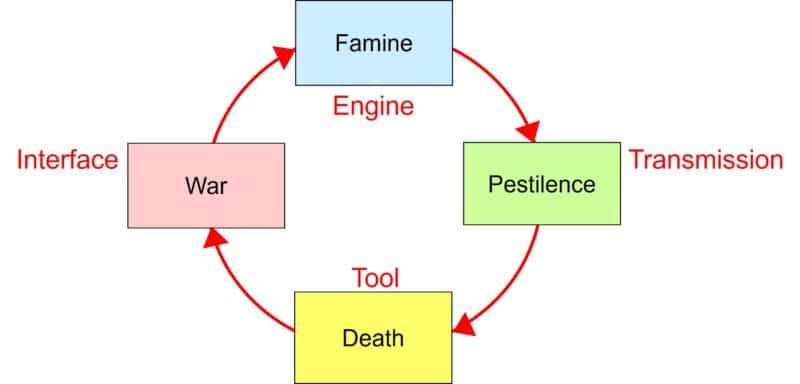
The second of the three types is one that is ‘uncontrolled’. That is, a system that will deliver the desired outcome – ‘Apocalypse’ in this example – but the speed and manner by which the outcome is delivered is not under control. This type of system needs a minimum of four elements: A source of energy (‘Engine’), a means of connecting (‘Transmission’) that energy to a ‘Tool’ that delivers the outcome by acting on an Interface.
The biblical Four Horsemen of the Apocalypse, correspond fairly accurately to these four elements. Something like this:
They typically form a self-perpetuating cycle, in this case, something like this:
So far so bad.
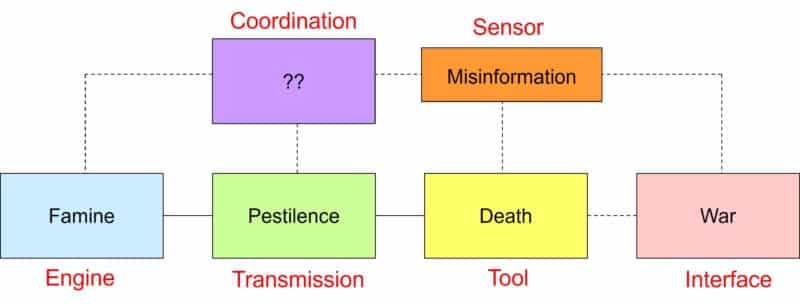
There have been several – usually semi-humorous – attempts to identify additional Horsemen. Some have suggested things like climate change, inflation or debt, but my recent favourite has been ‘misinformation’:
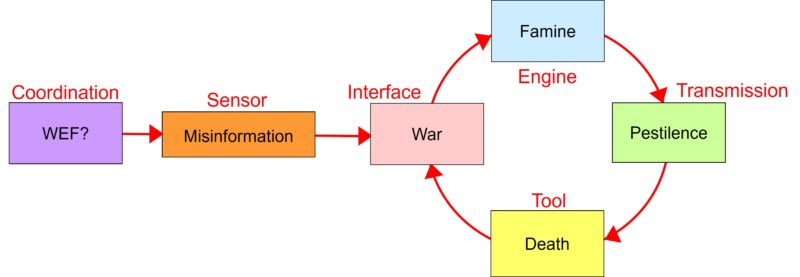
What I like about it – although I’m not certain that ‘like’ is the correct expression – is that it points clearly to one of the two elements that would be required to turn an uncontrolled system into one that becomes ‘controlled’. According to the Law Of System Completeness, if someone wanted to achieve a controlled Apocalypse, they would need to add a Sensor and a Coordination element to the Engine, Transmission, Tool and Interface contained within the uncontrolled system. Misinformation fulfils the role of the ‘Sensor’ quite nicely. Which then just leaves us missing the Coordinator:
What might that be, I wonder? Who or what might be the Coordinator of a controlled Apocalypse?
First thoughts head in the direction of the Conservative Government in the UK. Mainly because, per the reason I’m sat in this Starbucks, it feels like everything from the NHS to the transport infrastructure to the fact that I’m told it will be a week before I get an internet signal in the office again, is collapsing around me.
Prior to the disappearance of my internet, the last thing I saw was Rishi Sunak’s, delivered-with-a-knowing-grin, New Year message of doom. Maybe this was a sign? Except no. The UK has already descended into insignificance in global terms. If there’s to be a controlled Apocalypse, I needed to think bigger. What cabal’s of dysfunction is Rishi Sunak connected to? The G7? Not secret enough. How about the World Economic Forum? Here’s what their website currently says:
“The Forum engages the foremost political, business, cultural and other leaders of society to shape global, regional and industry agendas. It was established in 1971 as a not-for-profit foundation and is headquartered in Geneva, Switzerland. It is independent, impartial and not tied to any special interests. The Forum strives in all its efforts to demonstrate entrepreneurship in the global public interest while upholding the highest standards of governance. Moral and intellectual integrity is at the heart of everything it does.”
Hmm. Law Of Unintended Consequence-wise, that seems to fit the bill perfectly. Insert image of a Sixth Horsemen here. It is Klaus Schwab. On a lizard. Wielding a broken abacus and a syringe.
Gotcha. Controlled Apocalypse, come in please, your time is up.