Spinal Track?

I was on Lundy this week. For a small island, it is surprisingly full of examples of how the (British) world of management has a long pedigree of incompetence. Mainly, in the case of Lundy, incompetence of the Victorian kind. Which, given the size of the British Empire at that time, probably says a lot about the more general state of the management art. The most famous example of Lundy management incompetence came when they decided to build a lighthouse on the highest point of the island. I guess, in theory, the thinking went something along the lines that the higher the light, the further away ships would see the three-mile by half-mile obstacle in the Bristol Channel. In practice, sadly, the times when a light was most useful usually coincided with the times it was foggy. And, Lundy being the latitude it is, most of the time it was foggy, the light was just the right height above sea-level that, unlike lower parts of the island, it was lost in the fog.

Eventually, three generations later, the powers that be abandoned the project, built two new lights closer to sea-level at the north and south tips of the island, and turned what was now called the Old Light, into a viewing point. The intricate and cunning combination of candles and mirrors replaced with a pair of folding deckchairs.

My favourite example of management incompetence, however, is less well known, albeit slightly more tragic. It was decided that there should be a cart track built up the spine of the island from the village to the northern point. The island being mainly formed from an inconvenient lump of ex-volcanic granite meant that the track was mainly formed by scraping off the accumulated topsoil and peat to leave the granite exposed. This was probably somewhat sensible, although, given the fact that the track was mainly going to be used by humans and their assorted beasts of burden, I think I would’ve voted for keeping the topsoil in place. I imagine the relative lack of traffic up and down the track might’ve meant a danger the track would disappear, though, and heaven forbid those using the track might have to improvise. As a further guarantee that no-one would stray from the exposed granite, especially at night, it was further decided that they should lay some marker stones along the side of the track.

Here’s where we get to the good bit. The bit that mimicks one of the best scenes in one of the best movies ever, Spinal Tap. In the movie, when the band’s US tour turns out to be going not so well, guitarist, Nigel Tufnel, suggests they should revive one of their earlier classics, Stonehenge. Tufnel sketches out a drawing of the required stone formation and hands it to a handy prop-builder. Come the night of the first show to feature the prop, we get to see an eighteen-inch-high Stonehenge arch being slowly lowered onto the stage. Then a troupe of small-people dance around it. This is still funny after a hundred viewings. But still not quite as funny as the band conference after the event.

Anyway, the gist of the Stonehenge joke is that Tuffnell has got his feet and inches mixed up. He thought he was ordering a more representative of the real thing, eighteen-foot-high Stonehenge. Meanwhile back on Lundy, management had their own equivalent of Nigel Tufnel. Only he got his feet and inches mixed up the other way around. Meaning that a 3-mile-long line of four-inch-high marker stones actually became a 3-mile-long line of four-foot-high marker stones.

Admittedly, over a hundred years later, they still do the track marking job pretty well. No-one quite remembers, though, precisely how many donkeys were killed during the transportation of the monoliths. I suspect it was double figures. I suspect too that, after the first expired donkey incident, the workers had realised something was wrong with the drawings, but none had the bottle to go tell management. That or – more likely – management realised what had happened and didn’t have the humility to admit their mistake. As ever, the overriding Victorian problem-solving strategy was, and to a large extent continues to be, ‘if in doubt, leave things as they are’.

Too Much Equality?

Metaphor makes the world go round. Some metaphors make it go round faster than others. All have their inherent limits. The worst kinds manage to combine half-bakery and high virality. One such example, it seems to me, is the currently highly fashionable unfair-race metaphor.

The basis of this metaphor is that it’s not fair that some people are given a head start in life. In an equal world, the race metaphor tells us, everyone should start at the same point on the same starting line. More recently, some have tried to take the half-bakery a step further by suggesting that the aim should be for all of the competitors to reach the finish line at the same time. This scenario is supposed to represent the idea of ‘equity’. Taken at the metaphorical level, the equitable-finish idea sounds pretty good to many people. And, to those that recognise the deeper fallacy it contains (I might want to win an Olympic sprint gold medal, but that doesn’t mean I should be given an infinite amount of resources to achieve the goal – probably an IronMan exoskeleton and copious amounts of pain killing drugs in my case), they are likely to agree with the slightly more practical goal of having everyone start from the same point on the track. ‘All men created equal’ and other self-evident truths.

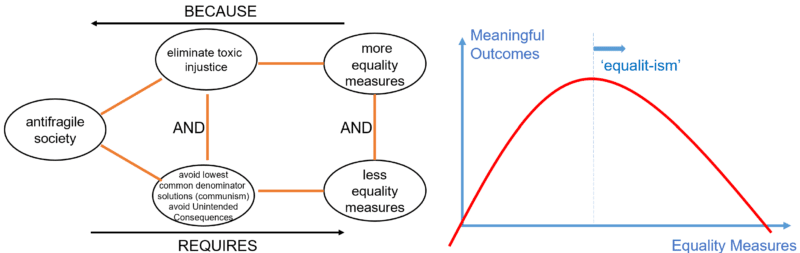
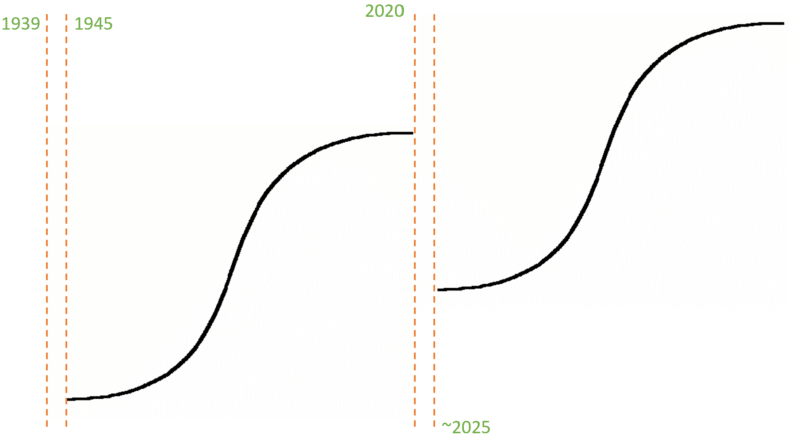
But even that image only works up to a certain point. Equality is good, but too much of it definitely isn’t. Or rather equality measures are good, but having too many of them is bad. Equality, like everything else in life, is subject to Goldilocks Law, and the presence of a Goldilocks Curve. Something like this:

This picture perhaps begins to highlight some of the limits of the unfair race metaphor. I’ll come back to them shortly. In the meantime, there’s a bigger flaw with the metaphor. One that relates to the meaning of the finish-line at the end of the race. In the metaphor, as in actual running races, it is clear the first to reach the finish line is the ‘winner’. And, therefore, those that start the race several hundred metres ahead of others are somehow unfairly advantaged.

The finish-line makes sense in the context of a race. But to what extent is life a race? What exactly is the finish-line supposed to represent in the real world beyond the metaphor? Is life a race to have the most money? Or everlasting life? Or good health? Or a high quality of life? A beach house in Malibu? High functioning offspring? What? Until we can answer that question, it’s not really possible to conclude that the person starting the race ahead of others is at an advantage or not. I suspect many people look at the race metaphor and the unfairness of those given a head-start and assume that the race has something to do with material wealth. Many of us live in a capitalism-based economy, and so money is often seen as the goal. The one with the most toys wins, and all that. But is that what life is really about? I can easily imagine that someone with nothing looks at someone who apparently has multiple silver-spoons sticking out of their mouth with some kind of envy. But at the same time, I can also imagine the same person waking up in their 200-room mansion one day having fought to get to the front of the race and realising they now hate their life. Having enough money is good. Having too much rather less so. In other words, the amount of money we end up with is also subject to Goldilocks Law.

So, the unequal-race metaphor fails at this level. The one with the most toys is not the actual winner. But, let’s assume for a moment that it is. The reason being that apart from the finish-line flaw, there’s an even bigger problem with the metaphor.

Let’s think about the runner with the unfair advantage, the person that starts half a mile ahead of everyone else. For them, life is easy. They don’t have to try. They’ve been educated at Eton and then walked into a cushy job in the City, they have attractive members of the opposite sex throwing themselves at them, they get to drive the best cars, sail the biggest yacht and fly the most expensive executive jet. Well done. One might say that their biggest problem is making sure they don’t lose all the wealth and privilege they had handed to them. That probably doesn’t sound like such a big problem to have given the alternatives. But all the evidence tells us that this ‘don’t-screw-up’ mindset pretty well guarantees they will screw-up. We see exactly the same thing inside the enterprises and institutions of the world. As soon as the leadership team start focusing on not being the ones to sink the ship, they make it much more likely they will indeed sink the ship. Protecting what we have puts us in defensive mode. Which is mainly significant because it is the polar opposite of the type of thinking required for innovation.

Innovation, when it comes, almost invariably originates with the person that has nothing to lose. The cash-poor start-up that has to bootstrap anything and everything to make ends meet while they try and work out how to encourage reluctant customers or investors to part with their money. This lack of money is the thing that drives creativity, persistence and the grit required to succeed. The lone entrepreneur doesn’t get angry with the big incumbent companies with their bigger bank balances, they use them as fuel to find better ways of getting things done. These are the people that actually make the world go round. The people that create new value. The people that see the enormous problems present in the world and set about fixing them.

These are the people that, back to the unequal-race metaphor, look at the runners starting half a mile ahead of them, and use the unfairness as a resource. The motivation to find better ways of running the race. Building a jet pack. Maglev running shoes. Anything that allows them to beat those that ‘cheated’ and now spend their time looking backwards rather than forwards. None of this stuff is easy. But then its not supposed to be. Il faut souffrir. Whining about it doesn’t help. Turning the anger and frustration at the unfairness into fuel absolutely does.

Forget equity. Equity leads to communism, and we know that doesn’t work.

Forget equality. Equality leads to lowest common denominator solutions and then communism.

The world needs innovation, and unfairness (aka ‘frustration’) is the mother of innovation. Yes, unfairness is also bound by Goldilocks Law. Meaning there are limits to how unfair things get before those left behind give up rather than fight. But yes, too, we know that giving the disadvantaged free hand-outs and mollycoddling them with blankets and platitudes doesn’t help either. All these things do is make the whole of society weaker. We call that the Law Of Unintended Consequences, and we see it happening everywhere. Well-intentioned governments that end up delivering the precise opposite of what they set out to deliver. Take away unfairness, in other words, and we take away progress.

Micro Case-Study: Picture Hanging

I bought a painting. A big one. Big enough that there was only one bit of wall large enough to accommodate it. The only problem was that the wall was half way up the stairs, and the picture was heavy. Not so heavy that I couldn’t lift it, but heavy enough that I couldn’t lift it to the required height for very long. Not long enough as it turned out to be able to manipulate the cord at the back of the picture to sit on the pair of screws I’d put in the wall.

A possible solution, of course, would have been to construct some kind of platform on the staircase so that I could support the weight of the painting while I stuck my head over the top or around the side to see when the cord was in the right position over the screws. Or, I suppose, I could’ve got someone to help me. The problem there was that the someone has a bad back at the moment. And, in any event, I’m too lazy to consider the possibility of creating and assembling the stable platform.

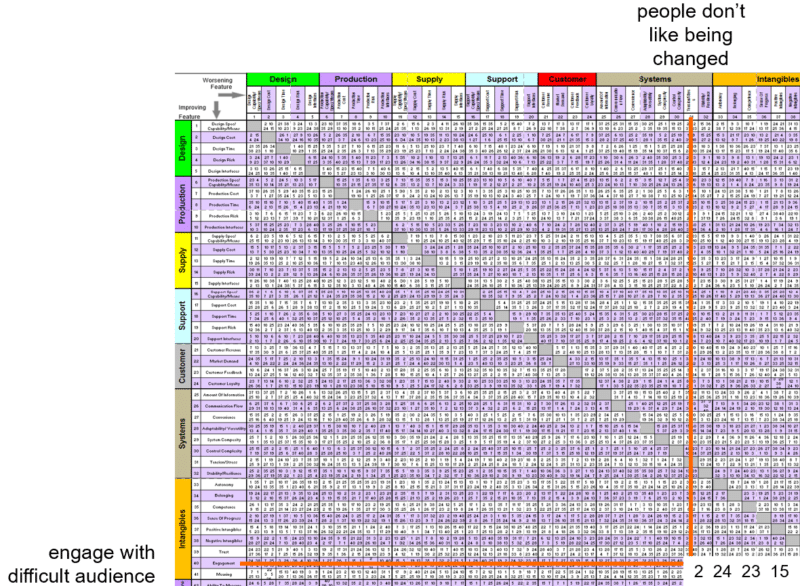
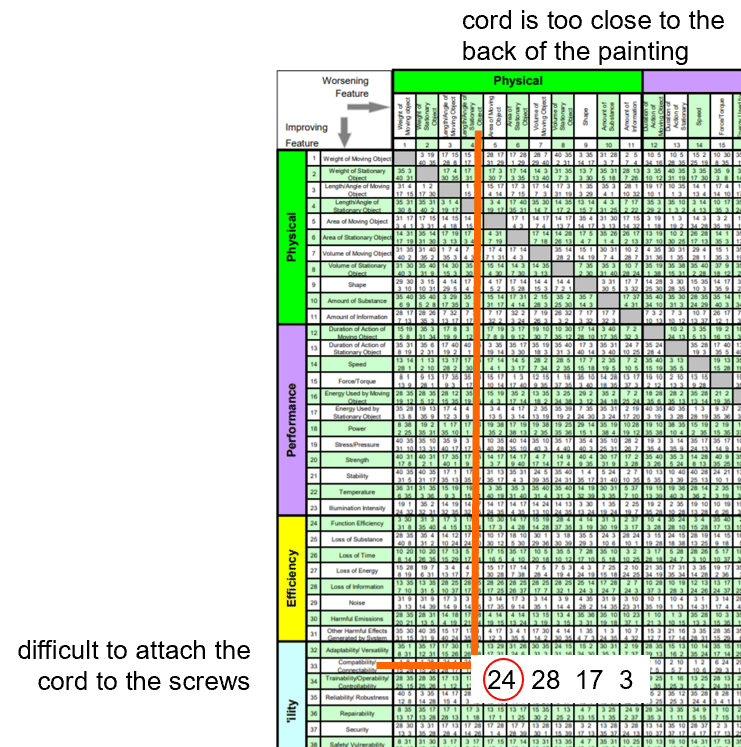
And so, in a classic case of laziness being the step-mother of invention, it was time to get out the Contradiction Matrix, and recognise that I wasn’t the first person in the world to want to be able to connect something to something else, and was struggling to do it because there wasn’t sufficient gap at the back of the painting to either see what I was doing or to ensure the hanging cord was sticking out far enough to ensure it would hook onto the screws. Here’s what that looks like when mapped onto the Matrix:

The most frequently used strategy used by people before me was Inventive Principle 24, Intermediary, one of the options of which told me that I might want to use an intermediary that was temporary in nature. Something that might hold the cord away from the back of the painting so that the likelihood of hooking on the screws was good, but that then disappeared so that after the cord was in place, the painting wouldn’t be sticking out.

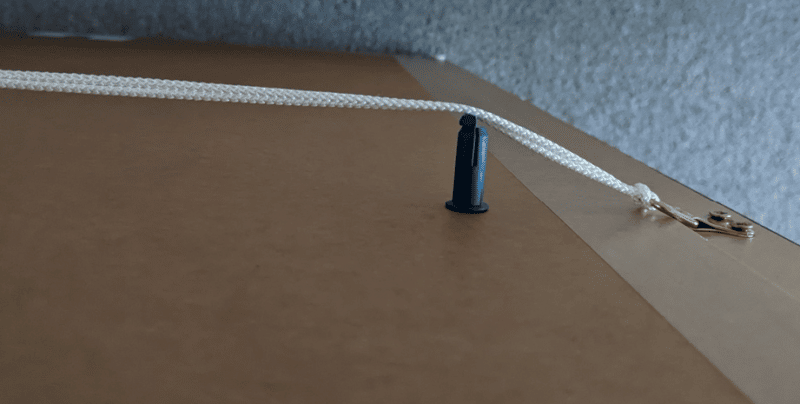
Here’s the temporary Intermediary I ended up with – a deliberately slightly-unstable pair of rawl plugs, one on each side of the painting. Lift the painting up, ask the bad-back inflicted assistant to stand at the top of the stairs to tell me when the cord was above the screws, and hey presto, a few seconds later, there’s a beautifully hung painting and two rawl plugs waiting to be picked up at the bottom of the stairs.

‘A New Life Begins’, Irene Jones

Five And A Half Societal First Principles (And The UKs Perfect Storm)

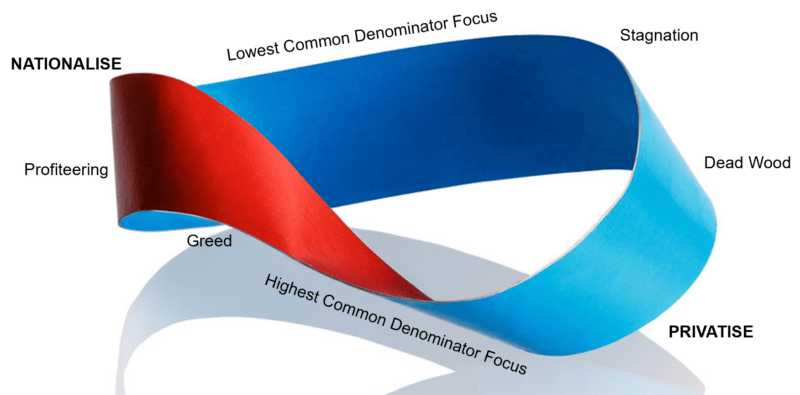
My stock answer when friends outside the UK ask me what on earth is happening inside the UK is either that I have no idea, or that the Government is deliberately creating a metaphorical forest-fire in order to clear out the non-metaphorical dead wood that, like all non-metaphorical dead wood stops the rest of the wood from thriving. Which one of the two I offer up depends on my prevailing level of contempt for the those purportedly in control and the latest act of lose-lose self-harm they just proudly launched.

For a long while now, my working theory has been that it doesn’t particularly matter whether I know what’s behind the ongoing shitshow-of-shitshows, my only job in life is to make sure the people I love and respect are antifragile enough to come out the other end stronger than we went in. And that the best way to achieve this is to do what anyone familiar with complex adaptive systems would do when the dial shifts to ‘chaos’ – try to make sure you learn faster than everyone else.

I realise neither my what or my how are good enough. And that both are made an awful lot easier to think through only when you understand the why.

That in turn means facing some difficult truths. It also means tracking back through history looking for examples of the Law of Unintended Consequences. AKA times when those in charge decided to break the fundamental first-principles of life.

So, when has that happened? Or, more pragmatically, when during the current UK society s-curve has that happened?

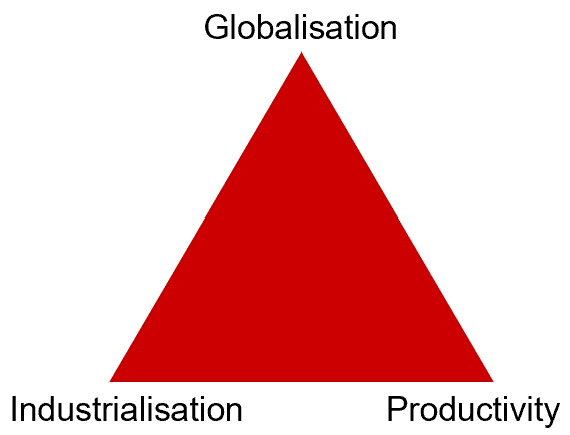
I think the first deviation from principle-based reality started in the 1970s. The economy was pretty bad for much of the decade. The slippery slope of post-WW2 decline was getting steeper. Something needed to be done. Enter Margaret Thatcher and her Government’s decision to switch from being an industrial nation to a ‘post-industrial’ one. Nothing wrong with this per se, but when making such a step-change, it’s usually a good idea to think about what kind of ‘post’ you’re aiming for. Given the prevailing urgency, however, Thatcher decided that the best shift to make was from an industry-based economy to one that was finance based. Deregulate the banks and become the banker (and insurer) for the world. In the short term this worked spectacularly well. Or at least it did if you were a banker. Things were less good if you were a miner. Or manufacturer. Or a person that did entropy-reducing creative work.

The fundamental principle-contravening problem with the world of finance is that it is a zero-sum game. Which, in the stark reality terms of the Second Law of Thermodynamcs means a slightly-worse-than-zero sum game. The act of moving money from one place to another place might create wealth for the person that works out a better place to send it than the next person, but in a complex world full of what are essentially one-eyed gamblers, it is only a matter of time before the 2nd Law will come and get you.

It probably took a decade of me-generation money-grabbing before the first of these inconvenient 2nd Law truths started to become apparent. Moving money around is largely frictionless so there’s nothing to wear out. In the real world, on the other hand, everything wears out eventually. Things like plumbing for example. Or power stations. Or the transport infrastructure.

Who was going to make sure all that stuff still worked? Maintenance and repair activities that meant people would have to get their hands dirty. Enter the next deviation from core principles. The right thing to have done was to ensure that the country maintained the requisite skills to keep the physical world working. Or, better yet, built the skills to design better, more efficient ways of keeping things working. This was the choice that recognised the vital importance of things like education, training and productivity improvement. The choice the UK Government took – ironically this time via Tony Blair’s (‘New’) Labour Government – was that education, training and productivity improvement was too expensive and that the best option for the UK was to import cheap, already-trained labour to do all the inconvenient, usually unpleasant, hard graft.  

A big part of the failing of this lazy, again short-term, decision was a failure to recognise that there are two very different kinds of hard work. One kind of hard work – growing and preparing food, for example, or looking after the infirm and elderly – is highly meaningful, and the other kind – putting people on production lines expecting them to repeat the same monotonous action for eight-hours a day – is utterly meaningless. Or, put another way, soul-destroying. Once this distinction has been recognised, the first-principle imperative underpinning the desire for ‘productivity improvement’ is that ‘management’ works to either eliminate or automate all the meaningless jobs and properly rewards people (humans) for doing all the meaningful jobs.

Whether by plan or through abject failure to think, the UK decided to take the meaningless road. So now we live in a society that, by way of a vivid recent illustration, has seen a 50% decline in automatic car-washing machines and a 50% rise in the number of people that spend their working day washing cars. Worse, no-one in the automotive industry made any visible attempt to try and eliminate the problem by designing self-cleaning cars (perfectly possible if they had even contemplated the idea) – a solution we could’ve then sold to the rest of the world. Almost as bad, was the failure to recognise that, while cleaning cars is essentially a meaningless job for adults, it is actually quite meaningful when the task stays within the family. All my pocket-money when I was a kid came from cleaning my dad’s car on a Sunday. I hated every second of it. All it taught me was that if I did unpleasant jobs I would be given money. This, in retrospect, was the wrong lesson. The right one was that doing things as a family for the family (‘if the car is clean it will last longer and we can spend the money we save on a replacement on trips away’) helps build community and is therefore about as meaningful as things get.

Meanwhile, spool the clock forward another decade and all those convenient short-cuts begin to have consequences. Namely a population increasingly made up of one part lazy, untrained, entitled ‘nationals’ and another part an (sorry to have to use the phrase) underclass made up largely of hard-working ‘immigrants’. Enter Brexit. Otherwise known as the revenge of the former of these two groups. And now, for the last six years, another core principle of life is being contravened. This one’s a little more controversial, but essentially revolves around the question of globalisation, and how open or closed a nation is to people from outside. Whether or not you subscribe to the ignorant-racist Brexit-voter argument, what’s abundantly clear is that the UKs decision to make it more difficult for people to come into the country was the wrong one.

In a globalised world, small countries (and make no mistake, unlike 120 years ago, the UK is once again a small country) have no choice but to be more open than closed. In a globalised knowledge economy, the nation with the most productive brains wins. Nations with fewer brains don’t have the opportunity to be ‘world class’ at everything. They have to focus on what they’re uniquely good at, and trade the outcomes of that stuff for all the things they’re not good at. And as the world becomes progressively more interdependent, that need for trade in turn means that every innovation or change is inherently connected to everything else. The Covid-19 pandemic might have caused many governments to temporarily wonder about the wisdom of global trade, but nevertheless, every innovation these days is an ecosystem innovation.

Which then leaves the whole system somewhat stuck. The Government in a small room stuck between an 800lb gorilla and an elephant. On the one hand they ‘Got Brexit Done’ and gained election victory by telling everyone this was the case, and on the other, it has become abundantly clear to almost everyone that in the process of getting things ‘done’, they agreed to a whole suite of things that made life extremely difficult. Most pertinently, no more access to cheap labour on the one hand and no-one in the UK that wants to do the largely meaningless, unpleasant work that needs to get done on the other. The Government, three Prime Ministers later, is still unable to break out of the Get-Brexit-done lie. Now they find themselves in a vicious cycle of deceit and lies spinning so quickly that we’re forced to measure the half-life of our ‘leaders’ in weeks. With each new ‘famous for fifteen seconds’ egomaniac progressively less likely to admit the truth than their predecessor.

So where does that leave us?

First of all, hopefully, some learning for future generations:

Break one core principle of life – favouring the short-term over the long term – and you’re in trouble.

Break a second – favouring easy-work over hard work – and you’re in trouble-squared.

Break a third – favouring meaningless work over the meaningful – and it’s trouble-cubed.

Break a fourth – favouring a closed economy over an open one – and a trouble-to-the-power-four exponential-storm is an inevitability.

Nothing will tangibly improve until all four of these fundamental errors are corrected. Exponential storms mean things will get exponentially worse. A lot of good wood will now – tragically – be destroyed along with the dead. Maybe this is when another principle finally kicks in – the so-called British ‘bulldog spirit’. Dunkirk. The Blitz. Etc. World War Two. Another time in history where utterly hopeless leadership created a disaster that only the collective will, blood and guts of the people kicked into action to repair the worst of the damage. On my good days I’d like to think that such a thing still exists, and that everything will come good again. On my bad days I think the same. The only difference between the two days is how low things go before we hit the bottom of the political barrel.

Expressed more generally, this fifth principle is one that tells us politics needs to be everyone’s business. It’s a principle that I and, I think, most people of my generation have been guilty of ignoring. Much as it might be tempting to distance oneself from the world of politics, the fact that so many British people did exactly that over the last fifty years, has now finally made us realise that if we ignore what’s important, we open the door for sociopaths, egomaniacs and criminals to step in. Nature abhors a vacuum and – as we now clearly see in the Houses of Parliament – will fill it with any old shit if we let it.

Break a fifth principle – favouring an apolitical life – and the four-principle driven perfect storm turns into a shitshow so big it will take some of us the rest of our lives to fix.

Oh well. What doesn’t kill us makes us stronger, I suppose. Call that the sixth principle in the societal set. Or maybe five and a half.


Micro Case-Study: Walls

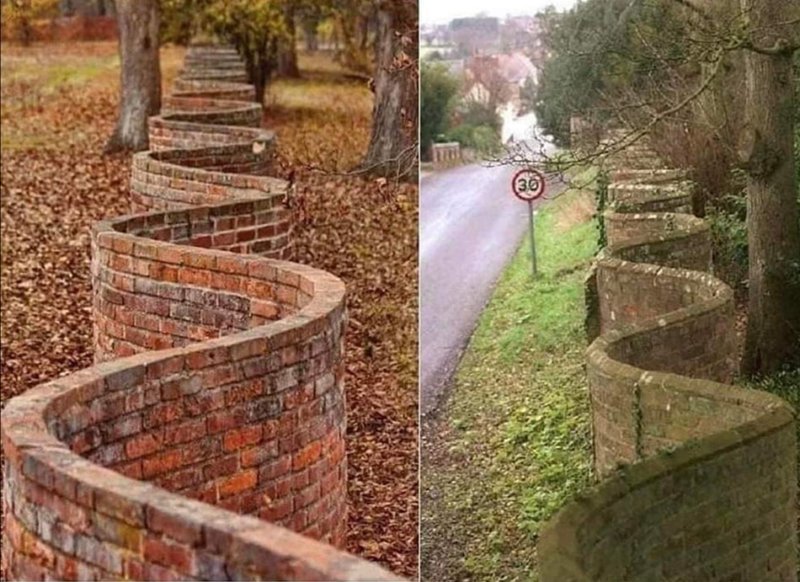
In England you sometimes see these ‘wavy brick walls. Curious as it may seem, this shape uses fewer bricks than a straight wall. A straight wall needs at least two layers of bricks to make is sturdy, but the wavy wall is fine thanks to the lateral support provided by the waves.

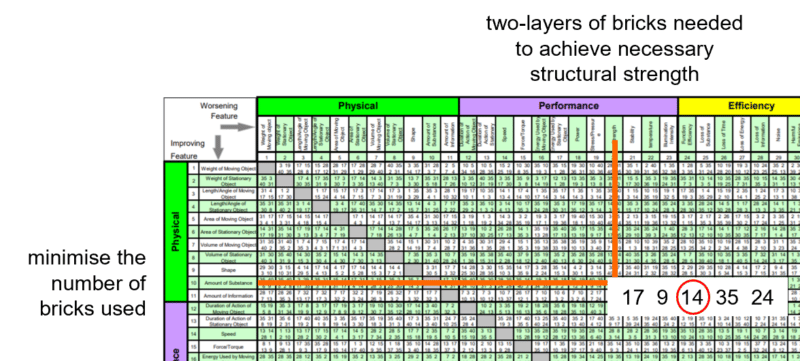
These curvaceous structures offer up a classic illustration of a contradiction jumping solution: the desire to use a minimum number of bricks is impeded by the lack of strength of the resulting wall. Here’s what the Contradiction Matrix has to say about how others have solved this conflict:

And there, in third place is Principle 14, Spheroidality, and specifically Principle 14A, ‘turn straight edges or flat surfaces into curves’. Easy.

Micro Case-Study: Leveraxe

I love chopping wood. There’s nothing like the feeling of accomplishment that comes with a well swung axe. Splitting the log cleanly in a single swing. The problem is that a fair proportion of swings don’t produce the desired effect. Partly because of my inconsistency swinging the axe, and partly because of the innate variability in the log I’m trying to chop. So, sometimes, the shape of the log causes the log to move when it gets hit, sometimes there’s a knot in the wood so the axe doesn’t make it all the way through. Or maybe I’m a bad workman blaming his tools?

Enter inventor, Heikki Kärnä, to help solve the problem. Or maybe Archimedes?

“Give me a place to stand on, and I can move the earth,” Archimedes once said speaking of the power of the lever. A lever amplifies an input force to provide a greater output force, which is said to provide leverage. While he did not invent the lever, Archimedes gave an explanation of the principle involved in his work On the Equilibrium of Planes.

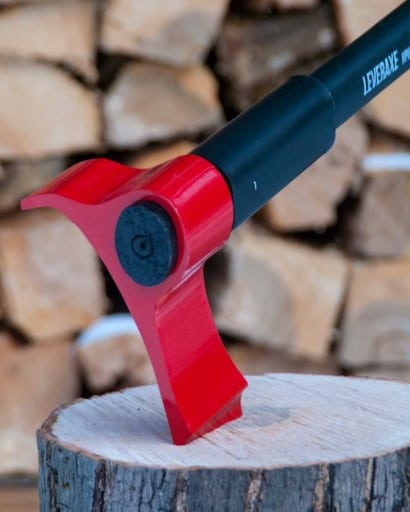
The physics of which finds its way into Kärnä’s 2kg ‘LeverAxe’ through the use of a cunningly shaped metal wedge mounted on a handle allowing all the swing momentum to be transferred to the log upon impact. It works like a lever because of the altered or offset center of gravity. When the blade hits the wood, energy that would have otherwise gone to waste is now put to good use in a turning effect. This makes it easier to split wood since a single strike is enough to open up the target by 8 cm. According to the tool’s inventor Heikki Kärnä, this is one very fast chopper:

“When using a chopping block with a tire setup, you can achieve a burst of strikes at a frequency of 100 strikes a minute. Thus, as an example, using 10 strikes to chop a log would take 6 seconds.”

“Everybody who has tried splitting wood with a traditional axe knows that it takes a lot of power to penetrate and split the wood. Now, you can easily and safely start splitting suitably sized logs from the sides by striking closer to edges. No more need for the futile first heavy strikes just to get the log split in two,” he added.

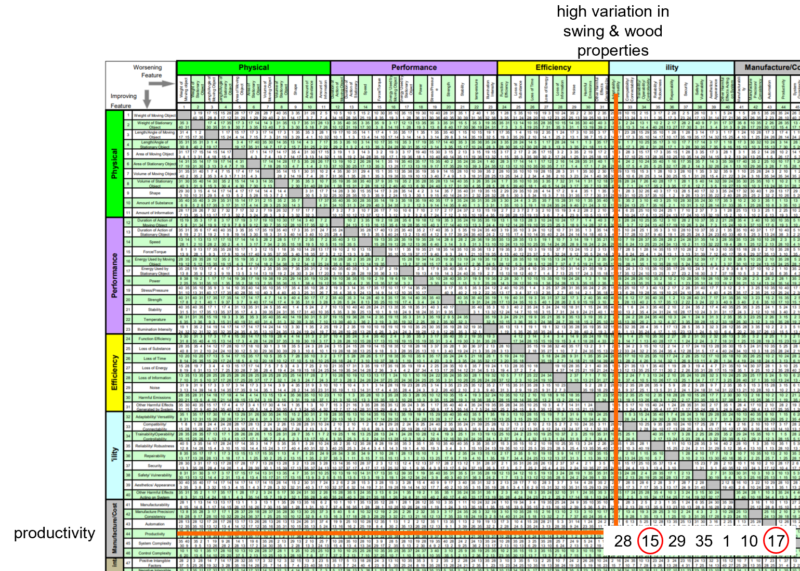
The Leveraxe offers up a solution to a classic TRIZ contradiction problem: we want to chop wood as quickly and efficiently as possible, and we don’t want to have to worry about all of the variables that will determine the success of each strike of the axe. Here’s what that problem looks like when mapped onto the Contradiction Matrix:

And there in the list of recommended Principles we see the two main rule-shifts incorporated into Kärnä’s design: Principle 17, Another Dimension (the deviation away from the traditional wedge-shaped blade) and Principle 15, Dynamisation (have the head of the axe free to rotate the blade to facilitate the splitting action).

I’d love to be able to report that I am currently the proud owner of a Leveraxe. Alas, at £200 a throw (excuse the pun), I think I’ll wait for the next contradiction to be solved before I dip my hand in my pocket. Or maybe I should stop wasting time chopping logs and solve the contradiction myself. I think I might know a suitable low-cost manufacturer…

(in the meantime, check out a lovely video of the Leveraxe in operation here:  https://youtu.be/ABI7go8IKL8)

A System Of (Societal) Stories

  1. Since the beginning of the pandemic, Society has been in transition.
  2. Society is a system.
  3. Homo narrans. Humans are story-tellers. Stories are the way we learn.
  4. The best way to change systems (human ones at least) is to change the stories we tell.
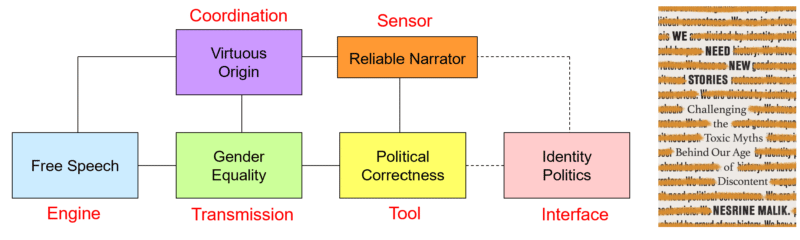
  5. The Nesrine Malik book, ‘We Need New Stories’, recognises this. The book describes six foundational untruths (‘myths’) and how they need to be corrected and evolved.
  6. The Law Of System Completeness has six essential elements.
  7. Nesrine Malik’s six new stories fit the Law. Like this:

COORDINATION (Virtuous Origin) – ‘history is written by the winners’… which means that the stories nations tell have little or no resemblance to the actual reality of what happened in the past. The historical record needs to record truth. When it doesn’t, it lays the seeds of future turbulence and chaos.

ENGINE (Free Speech) – ‘The claim that free speech is under attack is often a mask for other political frustrations and fears’… everyone should have the right to free speech. They should also recognise that every right comes attached to a responsibility

TRANSMISSION (Gender Equality) – ‘the social contract between the state and its female citizens is broken.’

TOOL (Political Correctness) – it is good to be ‘awake’, ‘wokism’ is when we become too awake and over-sensitised to what is happening around us. ‘Cancelling’ people for their unpopular views only makes matters worse. The Tool of positive societal change is all about resolving right-versus-right conflicts in a way that creates higher level (thesis-antithesis-synthesis) truths.

INTERFACE (Identity Politics) – ‘there is simply no electoral benefit to be gained from abandoning identity politics because voters are increasingly sorted it such a way that those who support economically progressive policies are also supportive of racial justice and gender equity’… society is full of contradictions… they should be embraced and challenged (transcended) rather than brushed under the carpet.

SENSOR (Reliable Narrator) – ‘If someone says it’s raining and another person says it’s dry, it’s not your job to quote them both. Your job is to look out the fucking window and find out which is true’… journalists, in other words, are the needed objective seekers of truth and voices of reason

8. Looking at the state of the current societal S-curve transition, most politicians seem stuck on a left-right pendulum that tries to solve the problems at one end by reverting to the other. In a complex world this can never work.

9. I’m not certain (m)any of our politicians are ready to recognise the need for new stories, but the System-change roadmap is there when they are. And that feels like a pretty good start.

Micro Case-Study: Zebra Stripes

It’s a cow. I know. But it’s a cow that happens to provide another important clue as to why zebras have stripes. The first thing the SI research team encountered (SIEZ, Issue 113) was the fact that the stripes acted as camouflage and confusion against big predators: when running the stripes turn into a savannah-coloured blur. Principle 19 evolutionary genius.

Now, thanks to some recently published Japanese rearch, we also know the stripes help protect the zebra against much smaller predators. Namely, flies. Here’s what the researchers’ slightly surreal (insert image of lab-coated scientist painting stripes onto a cow here) experiments have revealed:

Experimental and comparative studies suggest that the striped coats of zebras can prevent biting fly attacks. Biting flies are serious pests of livestock that cause economic losses in animal production. We hypothesized that cows painted with black and white stripes on their body could avoid biting fly attacks and show fewer fly-repelling behaviors. Six Japanese Black cows were assigned to treatments using a 3 × 3 Latin-square design. The treatments were black-and-white painted stripes, black painted stripes, and no stripes (all-black body surface). Recorded fly-repelling behaviors were head throw, ear beat, leg stamp, skin twitch, and tail flick. Photo images of the right side of each cow were taken using a commercial digital camera after every observation and biting flies on the body and each leg were counted from the photo images. Here we show that the numbers of biting flies on Japanese Black cows painted with black-and-white stripes were significantly lower than those on non-painted cows and cows painted only with black stripes. The frequencies of fly-repelling behaviors in cows painted with black-and-white stripes were also lower than those in the non-painted and black-striped cows. These results thus suggest that painting black-and-white stripes on livestock such as cattle can prevent biting fly attacks and provide an alternative method of defending livestock against biting flies without using pesticides in animal production, thereby proposing a solution for the problem of pesticide resistance in the environment.

From a contradiction-solving perspective, the stripe solution (a combination of Inventive Principles 32 and 3) seems to correspond closely to the usual strategies deployed by human problem solvers:

It’s still not clear why the stripes put off flies, but that shouldn’t stop us from wondering at the fact that the zebra has managed to evolve a single solution that stops both lions and flies.

Drucker On Red World/Green World

In the Winter of 1999, Peter Drucker published an article on “Knowledge Worker Productivity: The Biggest Challenge.” In it he said,

“The most important contribution management needs to make in the 21st century is similarly to increase the productivity of knowledge work and knowledge workers.”

A fifty-times increase in knowledge worker productivity. Something that requires, fairly obviously, a complete paradigm-shift in the way that people are managed. Or rather, ‘lead’. In the article, Drucker identified six major factors determining knowledge-worker productivity:

  1. Knowledge-worker productivity demands that we ask the question: “What is the task?”
  2. It demands that we impose the responsibility for their productivity on the individual workers themselves. Knowledge Workers have to manage themselves. They have to have autonomy.
  3. Continuing innovation has to be part of the work, the task and the responsibility of knowledge workers.
  4. Knowledge work requires continuous learning on the part of the worker, but equally continuous teaching on the part of the knowledge worker.
  5. Productivity of the knowledge worker is not — at least not primarily — a matter of the quantity of output. Quality is at least as important.
  6. knowledge-worker productivity requires that the knowledge worker is both seen and treated as an “asset” rather than a ”cost.” It requires that knowledge workers want to work for the organization in preference to all other opportunities.

These six elements, of course, need to form a coherent system, one that satisfies the Law Of System Completeness. Here’s what the six elements look like relative to the six elements that make up the Law:

The article then went on to describe some of the characteristics that these knowledge workers have or need to have in order to be distinguished from others. They include:

“…the burden of further development and innovation will be put on them…”

“…knowledge work is less standardised and structured…”

“before certain ends result it may be difficult to know whether knowledge workers are working or not”

“knowledge workers basically own their key production mean – brains”

knowledge workers need to be committed to and enjoy their jobs”

In so many words, what Drucker was talking about was the creation of Green World. The Twentieth Century transformation, in other words, was all about building Red World, and the business transformation of the Twenty-First is all about building a complementary transformation-delivering Green skills

SIO9001?

Rule One at SI-HQ is avoid working with Innovation Capability Maturity Level One organisations whenever possible. We now have a second Rule. It goes something like, especially avoid working with Level One organisations that also require their contractors to be ISO9001 Certified.

This new Rule came about as a result of a recent request from such an organisation. They wanted us, they said, to come and help them create ‘an innovation culture’. The fact that the response questionnaire their bean-counting Purchase people then forwarded to us nigh on dictated that we were only likely to get the work if we could demonstrate that we had the appropriate ISO9001 badge. ISO9001 is bad enough at its intended ‘quality management’ job – providing the perfect illustration that by setting a minimum standard, the world ends up with race-to-the-bottom quality management systems that succeed only in ensuring consistently poor quality – but to think that it has any relevance at all to the innovation story betrays a fundamental understanding of what innovation is. Funnily enough, ISO56000 looks set to do precisely the same thing and it was written precisely to help enterprises to manage their innovation processes. Fortunately, the prospective client didn’t appear to have heard of this ISO. Most likely because there’s no badge to collect yet.

Anyway, that’s another story. This story is about how we went back to the prospective client and told them our (polite version) thoughts about ISO9001, and asked whether our lack of badge would eliminate us from their consideration. ‘Not necessarily,’ came the reply, ‘providing you can send us a copy of your Quality Management System documentation’.

One step forward, one step back. We don’t have any Quality Management System documentation.

Irrespective of our feelings about ISO9001, however, this felt like a hole we needed to feel. We like to think we ‘do’ quality, but how do we all know what we’re doing? Or whether we’re heading in the direction of ‘better’?

It was time to document what we do to see how close to a Quality Management System it might be. Here’s the first version, now, for the moment at least, internally labelled, SIO9001. ‘SIO’ being interpretable as various things, starting with Systematic Innovation Operations, probably ending with Senior Investigating Officer (too much time spent watching Line Of Duty!), and passing through silicon monoxide and a small Danish island. Nearly all of which carry some kind of meaning.

Philosophy

  1. Roots – the roots of SI were formed through fifteen years working in the aerospace industry at Rolls-Royce. The aerospace industry is simultaneously the safest and most innovative industry on the planet (at least until Boeing 737max was certified). As such it has recognised that ISO9001 and related certification standards represent a minimum standard that the industry is so far beyond as to make them irrelevant to the business. Simultaneously, Rolls-Royce has represented a global quality benchmark for over 100 years and as such every client SI has ever worked with subsequently has not attained RR levels of quality. We start, in other words, from very strong foundations.
  2. AntiFragile – humans are the primary source of lack-of-quality in any system. In order to achieve the highest level of quality and safety, the only reliable means is to automate simple processes and remove humans from any and all safety critical position. Where humans are necessary (i.e. in any complicated or complex situation), it is important to build redundant, antifragile systems that ensure quality failures can, first, cause no harm, and, second, when inevitable quality failures do occur, the QMS learns from the failure and becomes stronger.
  3. Qualityism – we are in the innovation business, and as such failure (a.k.a. learning) is an inevitable feature of our work. It is very easily possible to insist on quality measures that inhibit the ability to innovate and also, therefore, detract from the delivered quality. We need to be aware of this phenomenon and always strive to put in place the requisite levels of quality measures to simulataeously maximise overall quality and minimise impedance to innovation.
  4. Humility – one of the biggest challenges to the pursuit of ever high quality is hubris. It is therefore necessary to be constantly challenging our current best practices, and to have the necessary humility to recognise when things are not as they should be. It is always painful to be ‘wrong’ about something, but that pain is an essential precursor to learning. We will actively look for quality-related contradictions and run towards them when they appear. Contradiction solving is the only meaningful way for any system to improve.
  5. Self-Organisation – having now worked with close to 500 MNCs, NGOs and public sector bodies, our desire to always adapt to the needs of the customer, rather than have them adapt to us, has become a living reality. This also applies to QMS. Time is too precious to jump through nugatory certification hoops that add no value to either ourselves or our clients. Beyond that, because our foundations are built from the best experience on the planet, it is a relatively simple procedure to relax behaviours and conventions as and when client needs permit. Our main ‘products’ are innovation ideas, processes and education, and as such the most significant outcome of ‘poor quality’ is we deliver a bad idea. In which case, we don’t get paid. In which case, we learn not to deliver bad ideas in the future.

The SI Quality Management System

  1. Use good judgement in all situations.
  2. If you have any doubt what ‘good judgement’ entails, refer to your client Quality Principles and Practices
  3.  If you have any doubt that the client’s version of ‘good judgement’ may be inappropriate to the innovation task at hand, refer to the SIN Handbook.
  4.  If you have any doubt over the veracity or appropriateness of the SIN Handbook, raise a concern with the CEO, and the Company will review and evolve the Handbook and/or QMS as appropriate.
  5. There is no 5)

  End