The lithium battery has provided an enormous leap forward for mankind. Smartphones, drones, long-distance electric cars, ebikes, all-day laptops, electric monowheels and skateboards – we owe them all to lithium.
They don’t go into thermal runaway and let go often, particularly if they’re well-built to tight standards and properly cared for, but there are so many now in our homes and businesses, garages, backpacks and vehicles – and so many cheap, non-standards-compliant cells out there – that spectacular TikTok’d and Tweeted lithium battery fires are now a fact of life,
“Fires” might not even be strong enough language; even a small one can explode with enough force to blow the windows out of a room. They can turn into molten-metal-spitting flamethrowers, setting fire to nearby buildings and vehicles. They can be very difficult to suppress once they get going.
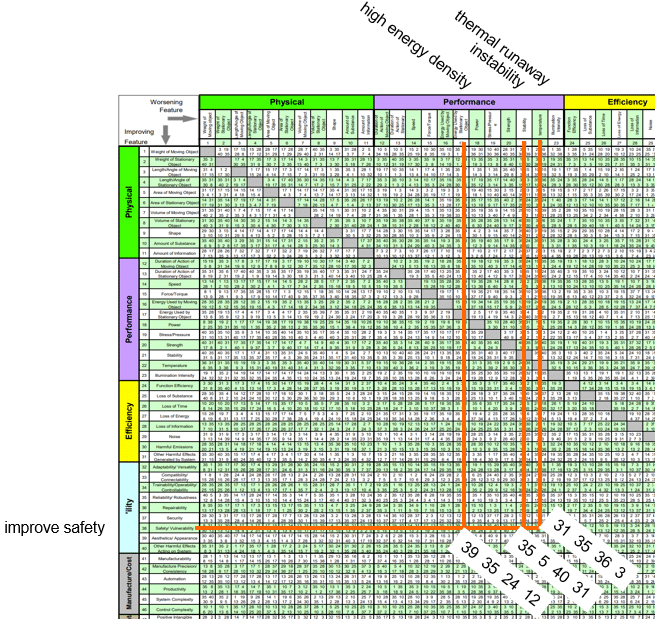
Here’s the basic conflict mapped onto the Contradiction Matrix: we need to improve safety, but can’t because of the high energy storage density, lack of material stability and vulnerability to thermal runaway…
Handle high-density batteries with care; know your limits; enough said. But researchers from Clemson University and Hunan University now say they’ve made a breakthrough.
The team has created a new type of rechargeable lithium battery by replacing the typical, highly-combustible electrolyte fluid with [Principle 35] … well, more or less the stuff you’d normally find in a fire extinguisher. Instead of using the normal, flammable organic solvents for the battery electrolyte, the researchers used a modified version of 3M’s Novec 7300 [Principle 39] non-flammable heat transfer fluid.
“An electrolyte,” writes one of the researchers in a piece for The Conversation, “allows lithium ions that carry an electric charge to move across a separator between the positive and negative terminals of a lithium-ion battery. By [Principle 5] modifying affordable commercial coolants to function as battery electrolytes, we were able to produce a battery that puts out its own fire.”
The self-extinguishing electrolyte performed well in both lithium and potassium-ion batteries, refusing to catch fire even when nails were driven through them.
The fire extinguisher solution performed well as an electrolyte, too, working well between -75 to 80 °C, handling extreme hot and cold significantly better than conventional electrolytes, and in some cases retaining battery capacity over a considerably higher number of charge cycles.
And the best news? It seems it should be remarkably easy to roll out at commercial scale.
“Since our alternative electrolyte has similar physical properties to currently used electrolytes,” write the researchers, “it can be readily integrated with current battery production lines. If the industry embraces it, we expect that companies will be able to manufacture nonflammable batteries using their existing lithium-ion battery facilities.”
That word ‘if’ is now the key. The Clemson researchers have done the ‘1% inspiration’ part of the innovation process, now its time for the ‘99% perspiration’. With maybe this time around half of the perspiration being directed towards overcoming ‘damn, why didn’t we think of that’, Not Invented Here syndrome.
Facts are simple and facts are straight Facts are lazy and facts are late Facts all come with points of view Facts don’t do what I want them to Facts just twist the truth around Facts are living turned inside out Facts are getting the best of them Facts are nothing on the face of things
Talking Heads, Crosseyed & Painless
I realise a lot of people have an aversion to 2×2 matrices. Usually, I find, because they’ve nearly always seen them as categorisation tools, rather than what I think is their actual purpose. Or purposes. The first of which is that the best ones help us to identify contradictions. The second is that they’re much more useful when viewed as a kind of map. One in which we work out where we are, where we’d like to be and then start thinking about how we can get from one position to the other. The third – more subtle – purpose is when they force us to think about the dynamic nature of the world.
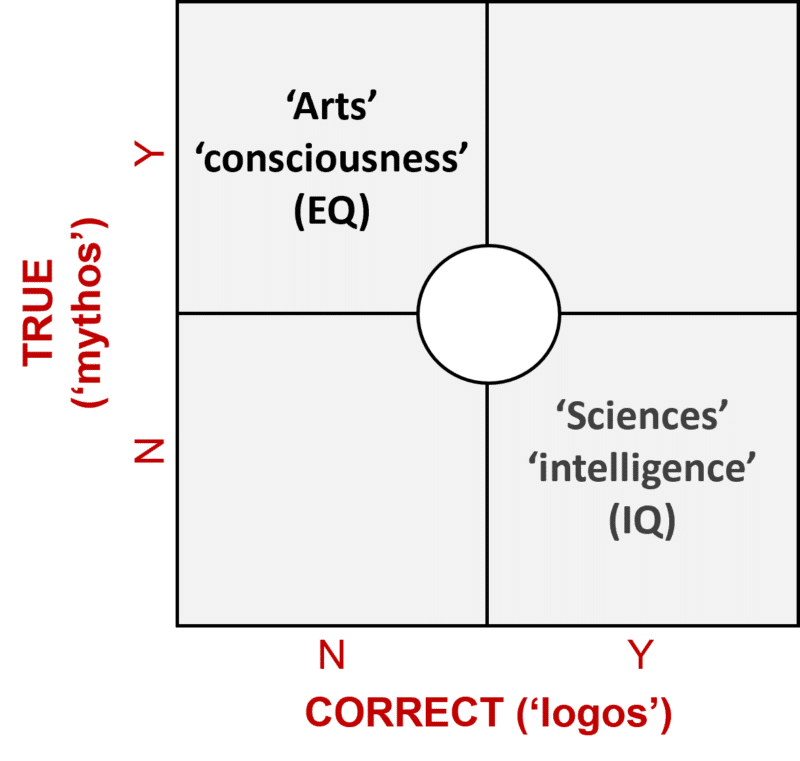
One of the 2×2’s that has had a big impact on how we conduct both our innovation and troubleshooting work is the True/Correct Landscape I first felt brave enough to talk about just over five years ago (https://www.darrellmann.com/yes-that-is-correct-but-is-it-true/). The realisation that provable, fact-based, ‘correct’ reality is not the same as ‘truth’ still takes a little while for people to get their heads around. Now comes the perhaps equally jarring realisation that both dimensions are also dynamic.
Here’s the original matrix:
Now let’s try a couple of thought experiments with it.
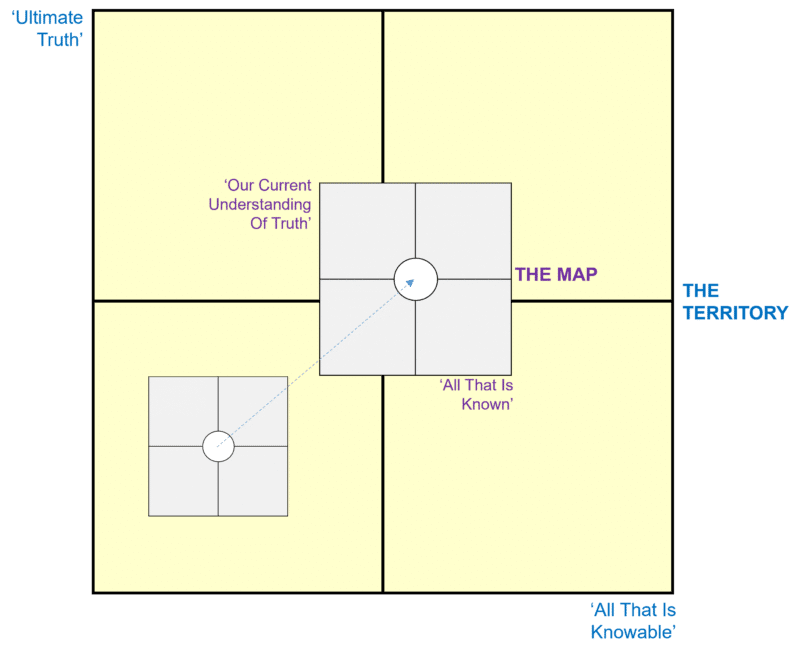
The first involves thinking about it as a map. In which case we need to become aware that this map is not the territory. The territory in this case, if we focus on the top right hand corner, ought to be defined by ‘all that is (factually) knowable’ in the x-axis direction, and ‘Ultimate Truth’ in the y-axis. These two axes define the yellow shaded territory in this image:
The True/Correct Landscape – ‘the map’ – then sits on top of this yellow territory. We might think of this grey area as mankind’s current understanding of knowledge and truth. The top right-hand corner of this area then in effect represents ‘all that is currently known’ in the x-axis direction, and ‘our current understanding of truth’ in the y-direction. Finally, we might imagine how, as our collective understanding of the world increases over time, the position of the grey area will both shift upwards and rightwards, and also increase in size. The grey area, in other words, is like a moving satellite, floating over the territory.
Now let’s try a second thought experiment. This time one where we zoom in and think about a more detailed and specific situation where a person might find the True/Correct Landscape useful. Think about an entrepreneur conceptualising a new enterprise, for example, or someone thinking about setting up a new charity organisation, or someone planning a new religion, political party, or maybe even a new educational institution.
During this person’s initial thinking, a smart move would be to think about where they would like to position themselves on the Landscape. Even smarter would be to aim for the top right-hand corner. In which case they would gather together the best of the globally available – known – factual knowledge, and they would define a mission and vision that was consistent with our best interpretation of ‘truth’. The institution should ‘do no harm’ for example, or encompass ideas around ‘always doing the right thing’, writing a code of ethics, determining to treat employees as fully-functioning adults wanting to do meaningful work, or, if we really wish to push the limits, to respect and assure sanctity of life.
We thus build the institution on as solid (and ‘futureproof’) a foundation as possible: we’re going to do the right things for the right reasons.
Then we start. It is now time to get our heads down and get on with the job of turning the idea into the reality. We find people to join us on the mission, and we form a huddle to work through all the gory details of who our customers are going to be, what they want from us, when and where they want it, and how much money they’re prepared to pay for the benefits we’re going to give them. As soon as possible, we’ll test the model, no doubt learn that many of our hypotheses were wrong, and that we therefore need to pivot to a Plan B. And then probably Plans C through W, until eventually, if we’re persistent enough, and and we earn enough money to keep going through all the scary going-backwards times, we become successful. Customers love us. Investors love us. We have ‘made it’. We grow market share. We become the dominant player. We have lots of spare revenue that allows us to re-invest and ‘stay ahead’ of competitors. Life is good.
Which usually then means that life is about to become less good. For two main reasons.
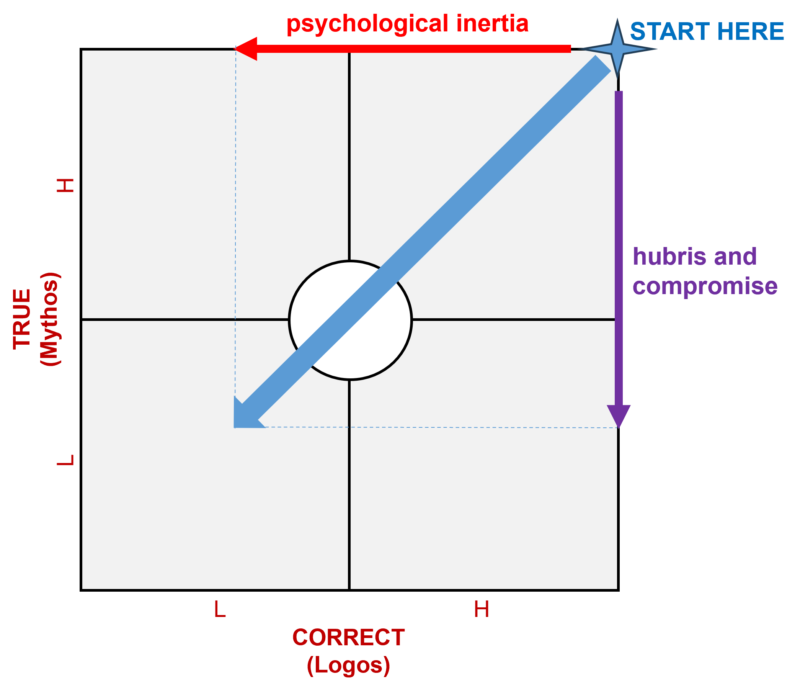
The first is that the institution begins to become much more insular. We develop psychological inertia. We focus on our solutions and our knowledge and forget that the rest of the world is also busy generating new knowledge, recognising that customer needs are changing and hence conceiving and developing new solutions. One day a disruptive threat arrives into our nice, comfortable market. We laugh at it, sure in the knowledge that it will never displace our great products and services. Our knowledge is expanding, but the rest of the world’s is expanding faster, and hence, in terms of the True/Correct Landscape, relatively speaking we’re heading backwards, away from the top right corner we started.
Even worse (usually), the success of our institution also leads to hubris, and a growing belief that our mission an vision in someway represent not just our ‘right way’, but everyone else’s too.
Even worse than that, the larger the institution becomes and the more customers we serve, the more we begin to encounter things that don’t fit our initially defined principles and values. Some customers become more valuable than others. Then we allow ourselves to think its okay to sacrifice one or two ‘outliers’ for the sake of the majority. Then, when it starts to become more challenging to meet the quarterly projections, comes a realisation that some customers are more valuable than others. Some lives are more sanctious than others. Then the slippery slope begins to get more steeply downwards pointing. Sanctity of life, except for those people over there. Sanctity of life, except our enemies. Sanctity of life, but its okay to kill enemies in order to preserve those on ‘our side’. And so on. The point being that ‘our truth’ becomes precisely that: a truth that shifts further and further away from what the rest of the world would recognise as the truth. Our hubris and increasing willingness to compromise our ideals drops us faster and faster down from the top right-hand corner of the Landscape, until one day we wake up and realise we’re no longer even in the top right hand quadrant. The world has moved on and therefore, in relative terms, we’ve gone backwards. We were once the lauded pioneers. Now we’ve become the protestor-surrounded evil empire.
Just a thought experiment. Or two.
Or maybe a reminder that the three biggest issues preventing an institution from being FutureProof are psychological inertia, hubris and (moral) compromise.
As a corollary to the Principle 9 solution from yesterday’s micro case study, here’s another, more recent example. This time from China. A place where, for various historical reasons, society’s elites attached a high level of prestige to the consumption of shark fin. Usually in the form of soup. Unlike sauerkraut, shark fin doesn’t taste of anything. It has virtually no nutritional value either. And, if the bowlful I was once ‘honoured’ with by hosts apparently keen to impress me is typical, it also has the approximate texture of old linoleum. As a dining experience, it ranks right up there with my experience at the ‘Total Cow Solution’ restaurant in Beijing, where I was encouraged to consume the ‘special’ nine-course dinner, each course of which featured a different part of a cow (the first course was testicle in blood jelly. I didn’t ask what was in the subsequent courses).
Anyway, cows aside, by 2010, the prestige-seeking masses of China were consuming seventy-three million sharks a year. Which, the authorities, calculated, was no longer sustainable.
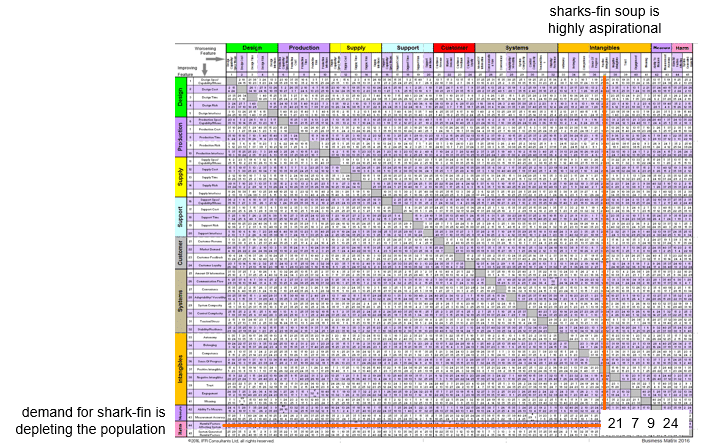
Something needed to be done. The shark carnage needed to stop, but eating shark fin soup was still very aspirational and being seen to be consuming it made people feel like they were somehow part of the elite. Here’s what the conflict looks like mapped onto the Business version of the Contradiction Matrix:
Enter Prior Counteraction, again.
Firstly, a public information campaign was launched. It was headed by a suite of prestigious celebrities and elites including basketball star Yao Ming and – importantly – the President, who instructed that sharks-fin be removed from all official banquets
Between 2011 and 2018 shark consumption in China fell by 80%. Not quite as effective as sauerkraut’s impact on scurvy, but on the other hand, nearly sixty million sharks a year are likely grateful.
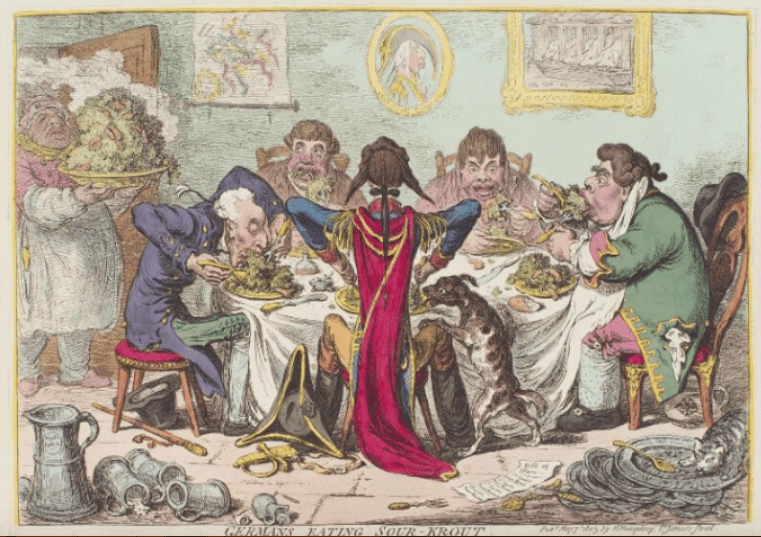
Scurvy, the disease known as the plague of the Sea, and the Spoyle of Mariners was responsible for somewhere around two million deaths between 1500 and 1800. In 1769, the English explorer, Captain James Cook set sail for the South Pacific with 7860lb of what he thought might be the cure. Sauerkraut. The only problem was that the pungent fermented cabbage looks awful, smells awful and pretty much tastes awful. And so he had a problem: how to convince the crew that they should chow-down and eat their daily ration.
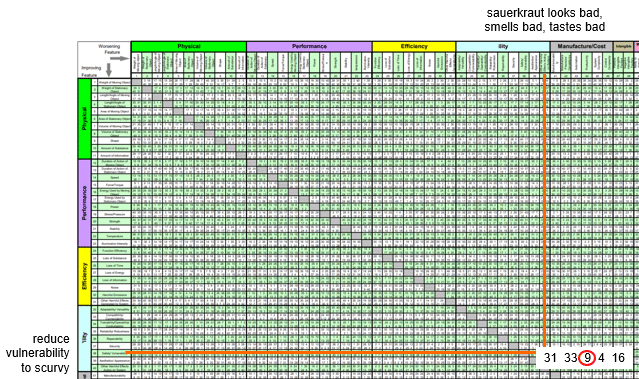
Here’s a classic contradiction situation. Cook wanted to reduce the vulnerability of his crew to scurvy but was being presented by numerous negative effects. Here’s what the Contradiction Matrix has to say about how other problem solvers have successfully dealt with this kind of problem:
Captain Cook’s solution was straight out of the Principle 9, Prior-Counteraction playbook. At the beginning of the voyage, he instructed that the foul foodstuff would only be available to the ‘Cabbin Table’ and not to the crew.
The crew, seeing the bosses eating something that they weren’t permitted to have played on their (and all of our) prestige and status needs.
‘The moment they see their superiors set a value upon it, it becomes the finest stuff in the world’, Cook wrote in his journal.
Sure enough, the lower ranked players began requesting it. Not long after that, such was the demand, sauerkraut had to be rationed.
The number of men that died from scurvy on that expedition was an unprecedented zero.
Humans love contradictions. We hate them too. We instinctively recognise them and outwardly purport to not know what they are. We can subconsciously solve them, but consciously we usually can’t.
Illustration. Here are a selection of some of the most admired opening lines from classic books. What do they have in common?
Answer: They all contain a contradiction. A contradiction that instantly hooks us into wanting to keep reading. A hook that is picked up by our salience network.
The salience network is a crucial neural network connecting various different parts of the human brain. It is responsible for detecting and filtering important information from the environment. It helps prioritise sensory stimuli, emotional cues, and other relevant signals to guide behaviour and attention. The network plays a vital role in various cognitive functions, including decision-making, emotion regulation, and social behaviour.
The salience network also plays a significant role in conflict monitoring and resolution within the brain.
The anterior cingulate cortex (ACC), a key component of the salience network, is particularly involved in conflict detection. It identifies discrepancies between different pieces of information – such as when we read an apparently nonsensical opening-line of a novel – or between internal goals and external stimuli. When conflict is detected, the ACC signals other brain regions to engage in cognitive control processes, such as attentional allocation, inhibition of irrelevant information, and decision-making.
Moreover, the salience network interacts with other brain networks, such as the executive control network and the default mode network, to facilitate conflict resolution. By integrating information from various sources and coordinating activity across different brain regions, the salience network helps prioritise relevant information and guide adaptive behaviour in the face of conflicting demands.
The reason we love reading stories – especially ones with great opening-lines – is that they teach us how the protagonist can overcome impossible odds to solve an ‘Ordeal’ and thus resolve the contradiction that hooked us in the first line. Stories are built on contradictions. We love stories. Therefore, we love contradictions. In the world of fiction at least. In the world of reality, after the age of eight we get taught how to make trade-offs and compromises and start to develop our zero-sum bias. After a few years of this ‘education’ we forget the lesson that stories are intended to convey. We call this replacement compromise perspective ‘optimisation’ to make it sound like a good thing. It isn’t a good thing. It simply means we turned ourselves into Sisyphus. Rolling immense compromise boulders up mountains and then watching them roll back down every time they near the peak. All the while, a distant clock striking thirteen.
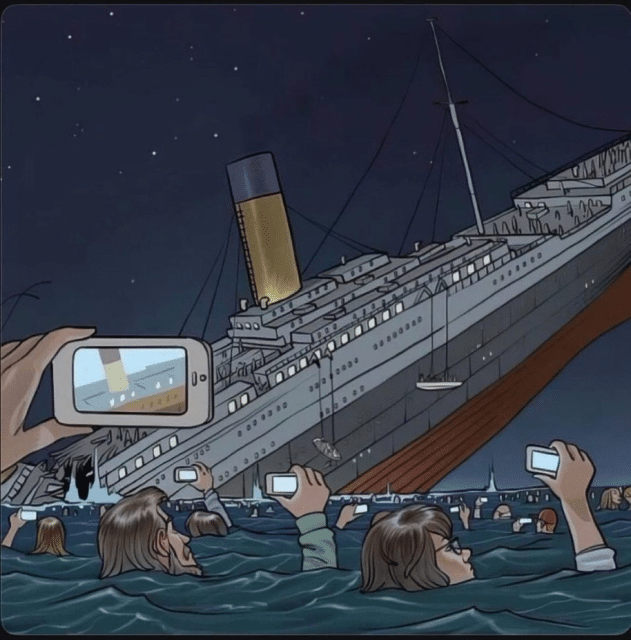
Almost everyone that has attended one of my workshops will have been forced to do the ‘save the Titanic’ exercise. The main point of the exercise is to demonstrate that, given the right instructions, people with zero domain knowledge can, in five minutes, generate plausible solutions that would have meant, at the very least, everyone on board the ill-fated ship would have survived.
One of the new difficulties when running this kind of exercise is that, in what feels like an attempt to prove my hypothesis that humans will do literally anything to avoid having to think, some delegates will make a sneaky Google search. More recently still, some have gone a step further and asked Chat-GPT.
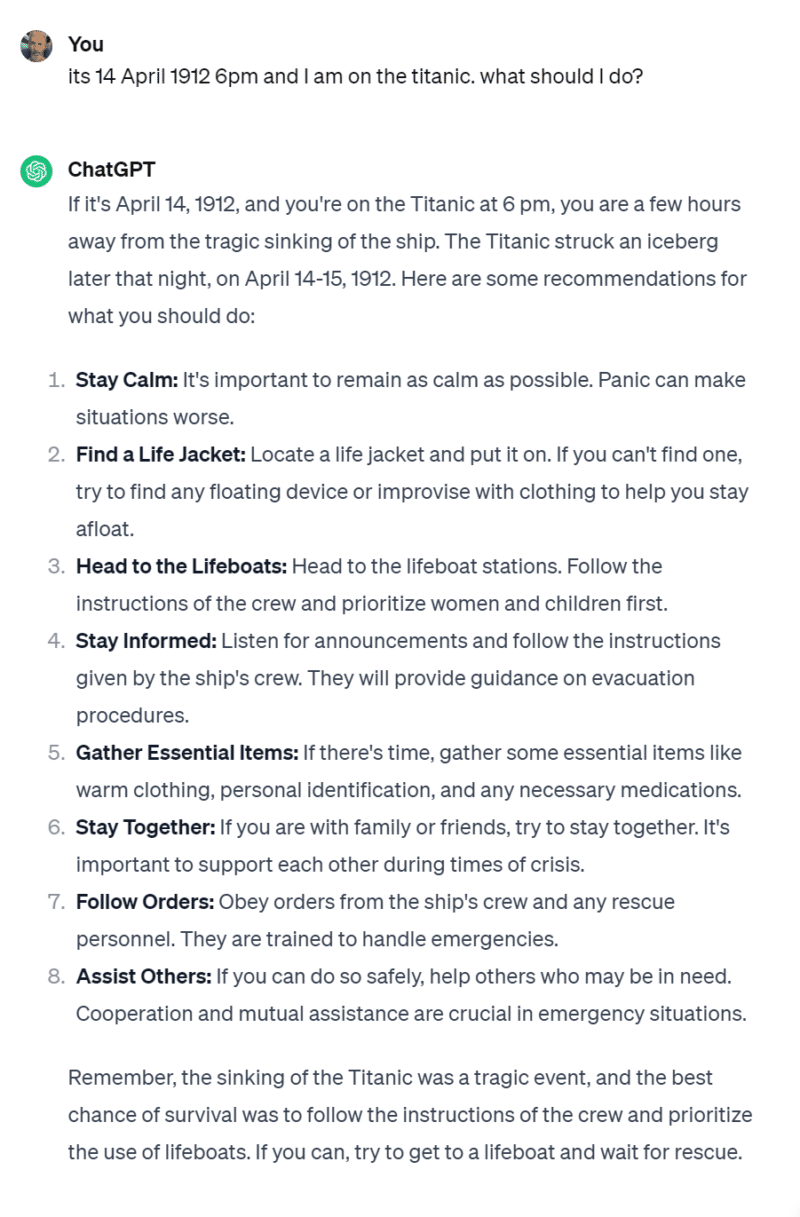
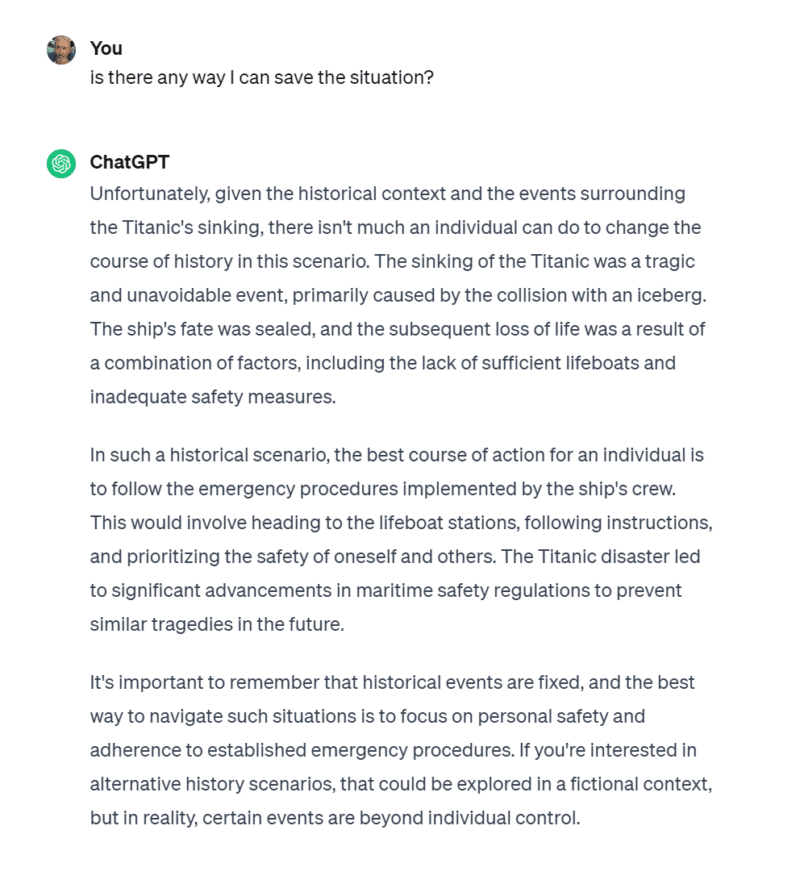
Fortunately for me, the answers that these people will find are terrible. Utterly useless. The results from Chat-GPT are worse than useless. In that if someone on an actual sinking ship followed the advice it offers they would almost inevitably die.
Here’s what the AGI non-oracle had to say:
And then a follow-up attempt to try and tap into the best of the internet’s creativity:
So much for the wisdom of the crowd. Or algorithm designer.
In fairness to the algorithm that purportedly scoured the best advice from the internet to formulate its response, the first answer would be sensible. Obvious but sensible. Common sense. All the other answers perhaps also sound sensible. Sometimes ‘sensible’ is the right way to go, and sometimes it isn’t. The sinking of the Titanic was one of the situations where sensible would have killed.
What was required instead was someone with the ability to first of all define the actual problem to be solved in a more effective manner. And then second, to look for ‘counter-intuitive’ solutions. That’s what the workshop exercise is all about. When the rules don’t apply anymore, the job is to go find better rules. Rules that by definition aren’t going to be found among the crowd. Or at least not in the form we expect them to be. In addition to my Titanic exercise torture, my workshop delegates will also hear me say, ‘someone somewhere already solved your problem’ about a million times. Someone somewhere will have solved your sinking ship problem. Just not people that were on sinking ships. Finding the right ‘someone’ is what TRIZ and the Systematic Innovation methodology have been about for the last eighty years. One day, perhaps, that domain-shifting horizontal knowledge will find its way into the AGI world. Until then were stuck with thinking. Or rather thinking better. Uncommon sense maybe?
In the quest for weight loss, individuals often endure intense diets, stomach-shrinking procedures, or invest in pricey medications like Ozempic. However, a recent breakthrough, detailed in Science Advances, introduces a gentler and potentially more affordable solution: a vibrating pill designed to activate stomach nerve endings, signaling the brain to halt eating.
Reported as a promising obesity treatment for humans, this innovative capsule significantly reduces food intake in pigs without apparent side effects. Described as a “credible and ingenious approach” by neurobiologist Guillaume de Lartigue, the concept leverages the stomach’s stretching mechanism, which triggers nerve signals informing the brain of fullness.
Conventional obesity treatments, such as fluid-filled stomach balloons or implanted nerve-stimulating devices, have limitations and potential risks. The newly proposed solution, a 31-by-10-millimeter pill with a tiny motor and battery, activates when exposed to stomach fluid. The resulting vibrations, lasting approximately 38 minutes, aim to stimulate stretch-sensing nerve endings, inducing a feeling of satiety.
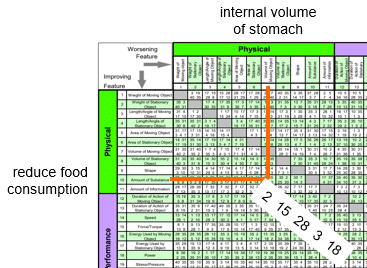
While the approach is applauded for its creativity and convincing data, some experts question its practicality as a weight loss therapy. Nonetheless, researchers led by Harvard’s Shriya Srinivasan and MIT’s Giovanni Traverso anticipate further development, potentially offering a safer and more accessible solution for combating obesity. All of these ‘practicality’ problems are merely the next conflicts needing to be solved. The most important one is the first one, the one delivering the principal inventive step. This is the one solving the first contradiction: we want to reduce the amount of food that people consume, but the empty volume of our stomach sends a message to our brain that we need to eat. Here’s what that problem looks like when mapped onto the Contradiction Matrix:
I’m still slightly amazed that Principle 18, Vibration, is one of the top recommendations. Having now received that insight, solving the problem of the pill-size (10mm!), durability, removal/disposal safety, cost and no doubt other currently-less-than-ideal attributes is merely about mapping and then solving the new contradictions. Or maybe short-cutting them all and creating a Principle 18 solution that is external and therefore doesn’t need to be ingested at all. Just a thought.
Do humans possess free-will or not? Innovation-wise, we know, of course, that any question containing the word ‘or’ I automatically the wrong question, but nevertheless the question hasn’t stopped the philosophers of the world from going around in ever decreasing circles for the last couple of centuries. According to them ‘the’ answer depends on one’s philosophical, religious, or scientific beliefs. Here are a few perspectives:
Compatibilism: Some philosophers argue for a compatibilist perspective, suggesting that free will can coexist with determinism. In this view, even if the universe operates under deterministic principles, individuals can still have meaningful choices and control over their actions within the constraints of those deterministic forces.
Determinism: Others adhere to a deterministic view, asserting that every event, including human actions, is predetermined by prior causes. From this standpoint, free will is an illusion, as choices are ultimately the result of preceding factors. This standpoint singularly fails, however, to recognise that in any complex system any links between cause and effect are tenuous at best, and non-existent in a majority of cases.
Libertarianism: Libertarianism, in the philosophical sense, not to be confused with the political ideology, argues for a form of free will that is incompatible with determinism. It posits that individuals have the ability to make choices that are not wholly determined by external factors.
Neuroscience and Science: From a scientific standpoint, some argue that advances in neuroscience challenge the notion of free will. Brain processes and neural activity could be seen as determining factors in decision-making, suggesting that choices are, to some extent, a product of physical processes in the brain.
Existentialism: Existentialist philosophers, like Jean-Paul Sartre, embraced a radical form of free will. They argued that individuals are condemned to be free, meaning that we are responsible for our choices even in the absence of external determinants.
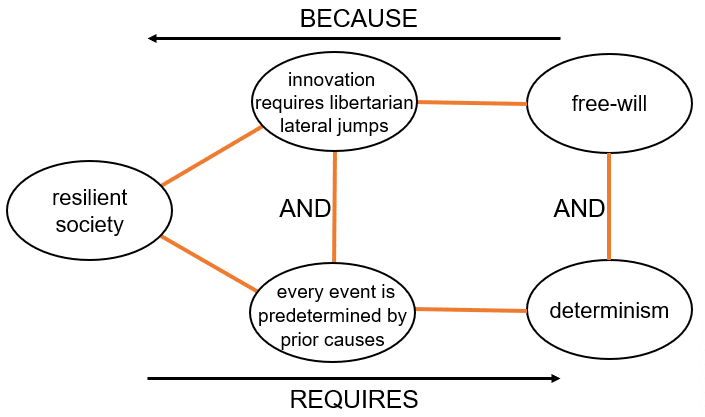
And then along comes WEF sock-puppet, Yuval Noah Harari, with the ‘thought’ that the ‘era of free will is over’. Thanks for that insight. Which, if I try and look at the statement without laughing is perhaps a piece of wishful neo-Marxist presuasion thinking. I don’t know. And I care less. Because, back to the original ‘to be or not to be’ question, the only meaningful answer is that the world needs both sides of the contradiction. Something like this:
What this bubble map in effect is trying to say is that we are all of us capable of exhibiting ‘free-will’. Watching my football team at the start of this season felt like a really good example of eleven players expressing their free-will by explicitly not doing what the, admittedly lost, manager told them to do. In a related vein, I could make a choice to swim across the Bristol Channel dressed in a doughnut-suit and singing The Beatles greatest hits in Danish. I’m pretty certain I’d be the first person in the world to think of this idea. The problem now is that I, like the Bradford City First XI, will quickly discover what most people instinctively understand: that most acts of free-will create outcomes that are worse than those that would have been achieved if we’d merely followed the well-established, ‘pre-determined’ success paths of those that had been there before us.
This is merely another way of paraphrasing Leo Tolstoy: every happy result of free-will is the same, each unhappy result of free-will is unsuccessful in its own way.
Free-will is what allows a person to break the established rules. The vast majority of broken rules – playing a 3-3-1-2-1 formation for example – deliver worse outcomes, but a tiny few end up giving the world the innovation it so desperately needs right now.
No free-will, no innovation.
Which I realise is what makes the removal of free-will so attractive to the WEF, perhaps the most un-inspiring, un-creative, un-impressive group of individuals ever to walk the Earth.
(Unless, of course, the whole thing is a massive double-bluff, and Klaus Schwab recognises that mankind will only solve its current problems if we can unite everyone against a common enemy. And that the only thing everyone on the planet can agree on right now is that we don’t want WEF looking after the future. In which case, I bow to their genius.)
Like it or not, the World throws Ordeals at us from time to time, and like it or not again, if we’re going to successfully complete the Hero’s Journeys necessary to overcome those Ordeals, it will be thanks to the blood-and-guts, rule-breaking, unchained free-will of the Hero.
A question from a prospective new client prompted me to remember the time I was at a music conference. I think it was 2017 and one of the authors of the newly minted Leeds Culture Strategy was extolling the virtues of creating an ‘innovation-friendly’ environment. I like innovation and therefore I like the idea of innovation-friendly. Then the speaker mentioned that they were using Austin, Texas as the model for what innovation-friendly meant. At the end of the presentation, I asked what musical innovation had emerged from Austin in the last ten years. The speaker looked at me as if I was from another planet (Bradford). The best he could come up with was the SXSW festival, but essentially, there was no sensible answer to my question. The reason being that what’s happened in Austin is what happens when most organisations decide they want to nurture an ‘innovation culture’ inside their business. Or city. They make the mistake of making life easy for people. SXSW is a great festival – one of the best nights of my life was talking to one of the organisers on an overnight flight back to London – but it has nothing at all to do with innovation. Rather, it is a place for self-congratulatory industry big-wigs to drink champagne while watching a bunch of pre-selected, up-and-coming, fit-the-formula bands and musicians perform for them. This is the Austin version of building an ‘Innovation Lab’. The sort filled with bean-bags, chocolate fountains, motivational posters, Gantt charts and high tech digital voting pads for times when the senior management team turn up for a handkerchief-waving state visit.
To the best of my knowledge, with respect to my Texan friends, nothing musically innovative has emerged from Austin ever. And certainly not since SXSW or Austin City Limits arrived on the scene. I hear the their offended shouts of Stevie Ray Vaughan. Definitely innovative, and definitely connected to Austin, but the innovation happened way before Austin became his adopted city. The innovation happened, I propose, after his birth in Dallas during the early years when his family moved around the South (Arkansas Louisiana Oklahoma and Mississippi) as his asbestos-worker father rattled from one crappy, poorly-paying job to the next.
Let’s not go too far down the rabbit hole. The point is that looking to create an innovation friendly environment by modelling yourself after an environment that is demonstrably the precise opposite is probably not going to go well.
In their heart of hearts, I think the L**ds Culture Strategy guru knew this. I think he knew that, if you look at all the places where musical innovation has actually happened, the only common factor is that they have always been shit-holes. The left-hand photo at the head of this post is the interior of CBGBs in the New York Bowery district. In the mid-1970s it was a piss-stained, vomit-soaked broken-bottle rat-hole dive, constantly half a step away being condemned. But it was also the crucible that spawned generation-defining artists like Patti Smith, Television, The Ramones, Talking Heads and Blondie. CBGBs was by all accounts of the time a health hazard. 1970s New York wasn’t much better. It was the time of near-bankruptcy, crime through the roof, garbage in the streets, drugs, prostitution and no way out. Only an idiot would chose to live there. Enter the poor idiots. The starving artists that couldn’t afford to live anywhere else. The people willing to live in derelict squats to pursue their art. Creative under-resourced people living amongst other creative, under-resourced people. A literal crucible for innovation.
At this point, we might feel some sympathy for the L**ds Culture Strategy guru. No-one in their right mind is going to go to the Local Government to ask them to turn the city into a shit-hole in order to help create an actual innovation friendly environment. For a start, if that’s what you ask for, you’re not going to be given large wads of cash to help make it happen. No possibility there for fully expensed fact-finding visits to Austin. Or music innovation conferences for that matter. No budget for converting old industrial buildings and filling them with bean-bags and chocolate fountains. Nothing pretty for the suits to come and admire.
Strangely enough, the Leeds music scene hasn’t produced anything innovative since 2017. Except maybe the Brudenell Social Club, which, loathed as I am to complement anything associated with L**ds, has become one of the best music venues in the country. Funnily enough, it is located in one of the worst parts of the city, and has stayed completely separate from the Culture Strategy. Brudenell kind of gets it.
I’m provoked to mention this subject at all, because now we’re all expected to go back to the office following the Covid-19 pandemic, we’re starting to get enquiries – like the one that provoked my memory of L**ds and Austin – usually from HR people, asking for advice on how to design and create innovation-friendly labs. I haven’t quite resorted to showing them photos of the inside of CBGBs, but I’m getting close. A deliberately created shit-hole is probably going to be as ineffective as the previously mentioned bean-bag filled labs. Or some of the other things you’ll find in the depressingly tragic cookie-cutter winners of the ‘Best Innovation Labs’ 2023 award winners exhibited at https://gfmag.com/features/best-innovation-labs-2023/. The only guarantee with all of them is they will produce zero innovation. Definitive unnovation.
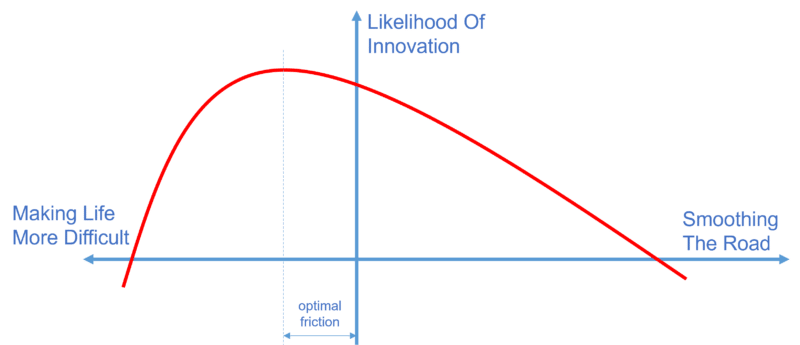
The real job is to define and manage another of our Goldilocks Curves:
Innovation doesn’t happen by smoothing the road for the team. It happens best when things are made just hard enough that it provokes the optimum amount of grit, persistence and rule-breaking bloody-mindedness. Successful innovation labs don’t get called ‘Skunkworks’ or ‘Pirate’s Cove’ or ‘Cockroach Corner’ for nothing. Make life the right amount of difficult and then keep (Red World) management the fuck away and leave the skunks, pirates and cockroaches to get on with doing what they do best.
“The bottom line on culture and grit is: If you want to be grittier, find a gritty culture and join it. If you’re a leader, and you want the people in your organisation to be grittier, create a gritty culture.” Angela Duckworth
Imagine you’ve got this fantastic contraption in the heart of a Persian desert dwelling—a “badgir,” (بادگیر) they call it. A 700-year-old air conditioner capable of cooling an environment up to 12°C with no power input. Picture a slender tower, made from mud brick or whatever materials the desert provides. Now, at the summit of this tower, there’s this ingenious setup: openings, like welcoming portals, facing the insistent desert winds. Then there are a series of vertical vanes, like nature’s own air conductors.
When those winds come sweeping in, they’re directed downward into the depths of the structure. But here’s the beauty of it—a concealed channel, a kind of architectural rabbit hole, guides this wind into the living spaces below. As this invisible breeze infiltrates the dwelling, it works a magic trick: it pushes the warm air out, creating a sort of natural air exchange.
In the dance between wind and channel, the interior gets a breath of fresh, cool air, and the oppressive warmth is cast away into the open. It’s a play of pressures and flows, a symphony of desert design that, prior to a recent sustainability-resurgence architects seemingly forgot. The desert’s answer to cooling, not with high-tech gadgetry, but with the elegance of a structure attuned to the rhythms of completely natural resources.
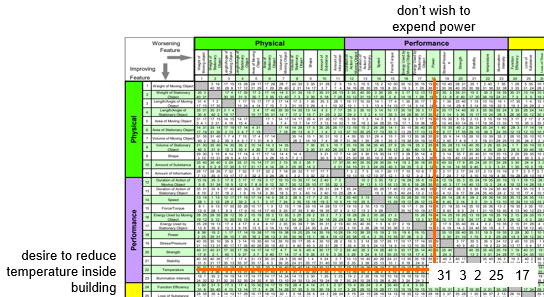
Here’s what the badgir temperature regulation versus power conflict looks like when mapped onto the Contradiction Matrix:
All in all, it looks pretty much like the architects of 700 years ago could’ve written their own version of the Matrix: Principle 25, Self-Service, tick. Principle 31, Holes, tick. Principle 2, Taking-Out/Separation (upwind/downwind sides of the tower), tick. Principle 17, Another Dimension (going underground, Qanat), tick. Principle 3, Local Quality (different rooms), tick: