The First Rule Of TRIZ Club

About a year ago we conducted a study to investigate the impact TRIZ had made inside organisations. To say the results were disappointing was something of an understatement. Even within ‘famous’ TRIZ users like LG and Samsung evidence that TRIZ was genuinely contributing to the success of either organisation was sparse to say the least. The problem we uncovered bears a lot of similarities to the GE Six Sigma story from a the last twenty years: first-up, no back-to-back experiments were ever conducted to demonstrate that the benefits being purportedly delivered by SixSigma wouldn’t have been matched or exceeded by any other toolset or method. Second, and probably more importantly, once CEO Jack Welch had stood up and said that the company had saved $9B through Six Sigma, whether it carried any truth or not, the method began carrying a ‘good for your career’ aura that quickly turned into a self-fulfilling prophecy: now anyone anywhere inside the organisation had a vested interest to attribute any money they saved on any kind of project to their use of the method, ensuring the real truth would never be known.

It has become a very similar thing at Samsung. Except. Despite the ever-growing number of employees who have attended workshops, the self-declared statements from the TRIZ team regarding the number of patents they’ve filed suggest TRIZ has contributed very little to the wave of success being experienced by the organisation. We only have to compare the number of patents being attributed to TRIZ to to the per-capita patents filed by the company as a whole to see that something doesn’t add up somewhere. According to this kind of comparison, the use of TRIZ would appear to impede the invention process by a factor of around three. Again, it is almost impossible to get to an objective truth, but the view from outside, it has to be said, doesn’t look great.

Anyway, following this disappointing result, we shifted our attention to individual TRIZ practitioners. If there was no evidence that TRIZ was good for organisations, we speculated, was there any to demonstrate that TRIZ proved to be good to a person’s career. We immediately, of course, fall into the same problems as occur at the organisational level since there have been no – nor could there be any – back to back trials comparing a ‘with-TRIZ’ person to an individual who knew no TRIZ or who maybe used another method. We can’t even realistically go and ask individuals what they thought TRIZ might have or have not done for their career since we felt it was a topic area that was very difficult to obtain objective truth about.

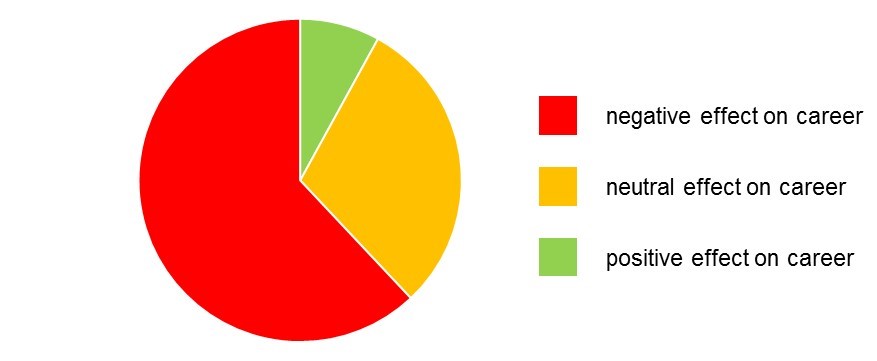
What we did instead is conducted an outsiders look at people we knew of in and around the TRIZ world – conference attendees, TRIZ Journal authors, etc – and looked for evidence of the likely impact of TRIZ on their careers. The big hope was that we would find compelling evidence to indicate that TRIZ was good for an individual. What we found was overwhelmingly the opposite. Here’s how the overall analysis stacked up:
triz career 1.1

In less than 10% of cases could we find evidence that TRIZ had been good for a person’s career. Evidence that TRIZ had had a negative effect was present in well over half of the cases we looked at. Her are a few examples of the sorts of problem we observed:

Exhibit A: mechanical engineer that has consistently generated a significant number of granted patents for his employer, and yet somehow finds himself frequently having to justify his continued employment at the company. While he has never been made redundant, he has been re-deployed several times over the course of the last decade, each time to a job that is increasingly peripheral to the company’s core business. There is no evidence that any of his patents have been commercialised.

Exhibit B: lead a management supported initiative to bring TRIZ into the organisation, organised the training of several dozen engineers, circulated regular TRIZ bulletins and ‘case studies’ across the organisation. Is currently perceived, following a leadership change, as the main instigator behind an ‘obscure cult’ and, despite delivering several successes to the organisation, is perceived as a person who ‘does not deliver’.

Exhibit C: a career academic that made the brave move of bringing TRIZ into their engineering department curricula, in the process alienating several domain experts who apparently felt the ability of TRIZ to transpose solutions from one domain into another was somehow threatening to their expertise. While there is no evidence of a personal vendetta, the tangible evidence is that the academic in question has still not secured tenure after over a decade, and finds themselves isolated within the department.

Exhibit D: chemist, one of a cluster of people trained in TRIZ by an outside consultant. Subsequently gained a reputation within his team of hampering progress on projects by ‘asking awkward questions’. When the business was forced to reduce head-count, he was one of the first people to be made redundant. At his exit interview, he was informed that his prospects of employment elsewhere would be greatly improved if he ‘became a better team player’.

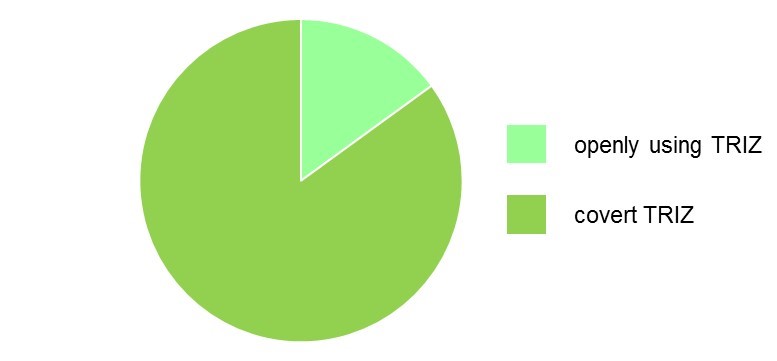
All in all, the picture looked somewhat bleak. Digging a layer deeper into the minority of people for whom TRIZ appeared to have benefited their career, however, and something significant emerged:
triz career 2

Nearly 90% of the individuals in this category had learned to keep their TRIZ skills hidden from the view of others. They used TRIZ in their work (and planning their career as far as we can establish anecdotally), but they had quickly learned that ‘using the T-word’ was career-poison and so best not to mention it or any of the surrounding jargon at all.

Again, it is very difficult to gauge whether even this group would have done even better had they devoted the time they spent learning TRIZ to something else. Maybe it was merely their inquisitive nature that has stood them in good stead over the years? But I’m not sure. From where I sit, it feels like TRIZ did play a role in helping them to create a clear compass heading for everything they did, and a confidence to know that whenever bumps in the road appeared, they had a great set of tools to overcome them. All they needed beyond that was a dogged persistence that meant they didn’t just dream up some cool solutions to the right problems, but they executed too. They put in the ‘99% perspiration’ hard-yards, in other words. We probably shouldn’t be too surprised. Maybe the real message here is a story analogous to Fight Club: the first rule of TRIZ Club is don’t talk about TRIZ Club.

The CEO’s Guide To Innovation #1: Should I Innovate?

Status

‘Innovate or die’ has become something of a truism in most realms of human endeavour. The big problem with truisms in the world of innovation is they have a horrible knack of sending organisations running after things that make very little sense. So is it really true? Does every organisation really have to innovate? And if they don’t, how does a leadership team know what they should be doing instead?


I’m in the very fortunate position these days of having the opportunity to talk to and work with a broad spectrum of leaders and leadership teams. Here’s a general version of the conversation I’m most likely to have with a CEO, CFO or COO:


CEO: I’m glad you’re here. We need your help. We need more innovation. We need an innovation culture.

Darrell: Great that you invited me. Thanks for the opportunity. I’m not sure we’ll be able to help, but I’m very happy to explore options with you. Probably best to start with, what yo mean when you say ‘innovation’.

CEO: Err. Better ideas I think. We never seem to be able to come up with the next big thing.

Darrell: Really? Why do you need more ideas?

CEO: To create new value. Get the shareholders engaged. You just have to look at our track record to see we haven’t created anything new for years now.

Darrell: Is it lack of ideas though? I almost never go to organisations and find that lack of ideas is the problem. For me innovation is all about successful deployment of ideas. The real challenges seem to be giving people the time to try stuff. To get things wrong. To learn from failure. To explore different options. To do things that challenge the staus quo. Break rules.

CEO: Oh.

Darrell: Challenging the prevailing common-sense.

CEO: (shaking head) I’m not sure that’s what I want.

Darrell: So what do you want?

CEO: New ideas. New thinking.

Darrell: Without breaking the rules.

CEO: Exactly.


By the end of these conversations things usually boil down to a leadership team that wants change without having to change anything. And certainly not anything they do themselves.  A tough nut to crack, but at the end of the day, it’s merely another contradiction, and any contradiction can be solved. The bigger question at this point, however, is do we need to solve it at all? Does the CEO really need to be putting the organisation through the inevitable trials and tribulations of delivering successful step change?


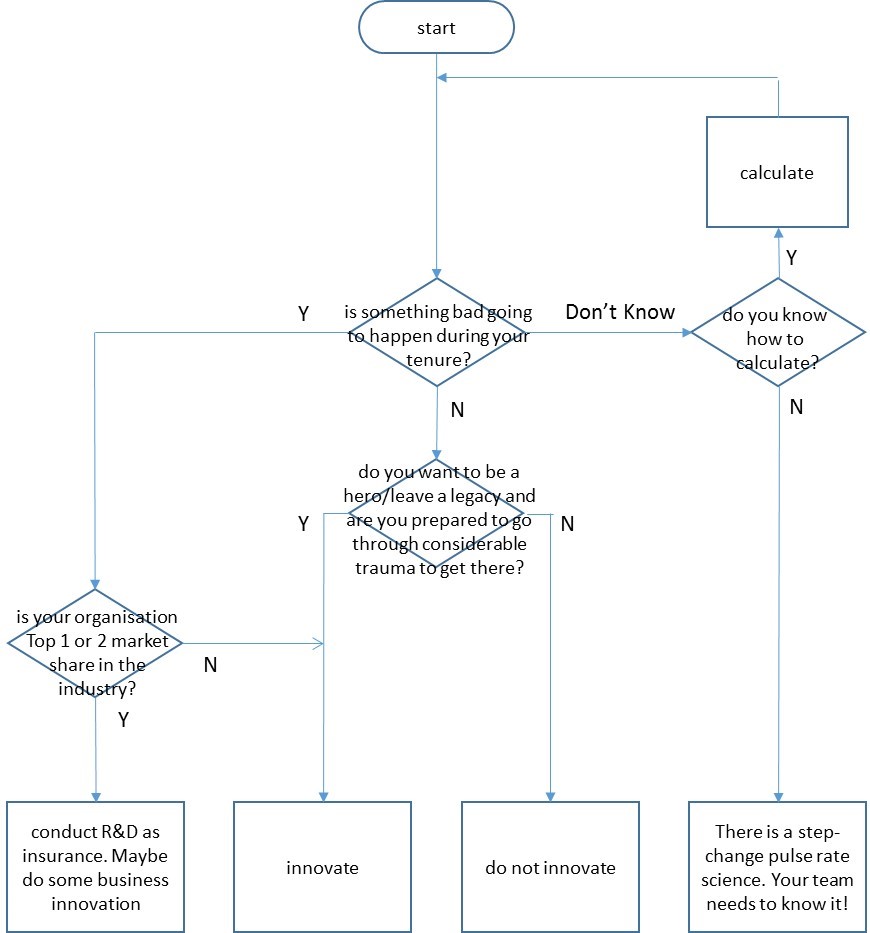
Here’s a simple flow chart designed to help C-Suite leaders to decide if they need innovation or not:

 ceo process chart

I’ve found it’s saved me and the leaders I’m privileged enough to get to talk to a lot of time in the months since I started using it. I’m not always convinced I get the whole truth and nothing but the truth when I hear CEOs walking through the process, but I think I get to know enough to know whether we’ll be seeing any innovation any time soon. In most cases we won’t. 


Crackpot Rigour #34

One of the reasons I left the academic world was that I got sick of having what I thought were really insightful papers rejected because they didn’t contain enough rigour. Now because I look after a team of 20 much-smarter-than-me full-time researchers, this sort of comment used to catch in my craw a little bit. They’d done rigour until they bled; my job was to try and turn their hard work into something interesting. Which in my mind meant getting through to the other side of the complexity, to something that was both simple and meaningful. So, whenever I questioned what sort of rigour referees were looking for what it seemed to always come down to was mathematical formulae. The basic correlating relationship is this: the higher the number of convoluted mathematical derivations per page, the higher the likelihood of acceptance, and the smaller the likely readership.

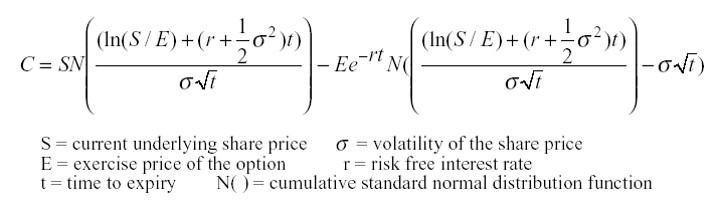
I used to be a mathematician, and I can still get excited by a good piece of mathematical genius, but when I saw this equation for the first time, I knew I had to begin weaning myself off the algebra and back into the real world.

This is a formulae that delivered a Nobel prize in Economics to the pair that came up with it a couple of decades ago.

carackpot 1

Today we know that it is meaningless crap. Nay, it’s worse than that, it’s dangerous meaningless crap. But because it came with a  ‘Nobel’ pedigree, and it made for some really great computer models, it in effect generated its own little industry. It’s the very definition of crackpot rigour. i.e., the unquestioning acceptance that sophisticated mathematical models must automatically be correct.

The clue to the problem here is in the word ‘economics’. Increasingly a terrific warning sign that what you’re about to hear next is also meaningless crap. Economists serve as the veritable archetypes of crackpot rigour. I blame the numbers. Economists live numbers and love numbers. Their problem is that the large vast majority of the important numbers in life are, to quote W Edwards Deming one more time, ‘unknown and unknowable’.

Any idiot, for example, can look at the patent databases of the world and count the number of times that a patent was cited by other patents. But the crackpot-rigour idiot (CRI) wants to turn it into this:

crackpot 2


A really beautiful picture, that – best of all for the CRI – clients appear willing to spend lots of money for. After all, it looks really scientific. Really plausible. Just think of all the data and all the intricate mathematical analysis that went into its creation.

Because these days my aforementioned researchers spend a lot of their time analysiing patents, this is the sort of picture guaranteed to make my blood boil. I know, I know, I should jump on the bandwagon and make some pretty pictures of my own, but sadly for me, I have the naïve desire to sleep at night without the feeling that I’ve been wasting people’s time and money.

The problem is this. When you really get down to it, and try and work out what’s meaningful and what’s relevant, if we want to really study what’s happening in the world’s store of intellectual property, the number of citations a patent receives has practically nothing of value to tell us. All it means is this is how many other inventors referred to this one. It doesn’t matter whether they might have referred to it as an example of a really bad invention that their’s is an improvement on, or whether they referred to it because it was one of their own earlier inventions that they’ve subsequently improved upon, the key thing is that the cited patent has now been improved upon, thus making the earlier patent somewhat redundant.

Add to that rather inconvenient reality the fact that citations can only ever happen after the earlier patent has been made public, and you’ve now just made a beautiful picture that’s also about two years out of date.

And if that’s not bad enough, some ornery new inventor might just come along tomorrow morning with a new invention (uncited by anyone, anywhere) that just made your invention completely irrelevant.

There’s the only meaningful stuff: how much is my patent worth? (easy one: probably zero) How likely is it that someone will come along tomorrow and design around it? Who could I license it to? How could I use it to block my competitors. All the stuff, in other words, that has nothing to do with mathematics at all. Much as the economists might deny it, there is no mathematical model that will ever be able to take due account of the testosterone-driven foibles of the business strategist. Well, unless it’s our PanSensics tools, of course, but that’s another story. Albeit one that also doesn’t produce pictures that are nearly as pretty as the crackpot rigour ones.

Big Data Analytics apologists will argue that meaning comes from the meta-data. i.e. we need to step far enough above the mathematical detail to see the bigger picture. The meta-data doesn’t lie they will argue. Well, there certainly no rule that says it will, but it probably does. If your starting assumptions were garbage (i.e. numerical), when you integrate it all together into your pretty picture, all you’ve really done is created meta-garbage.


Learned Helplessness #23

“It was vertigo. A heady, insuperable longing to fall. We might also call vertigo the intoxication of the weak. Aware of his weakness, a man decides to give in rather than stand up to it. He is drunk with weakness, wishes to grow even weaker, wishes to fall down in the middle of the main square in front of everybody, wishes to be down, lower than down.”

Milan Kundera, The Unbearable Lightness of Being


One of my longstanding theories, no doubt borne of the last twenty-some years of working with TRIZ, is that there aren’t that many problems in the world. In my mind I’ve imagined the total number is somewhere in the vicinity of a hundred. The more I think about it, the lower the number gets.

We’ve been doing lots of projects in the healthcare sector in recent months, trying to understand how to solve the crippling rock-and-a-hard-place contradictions in a system that everyone seems unable to change. We’ve also been doing some work with employment agencies, trying to get long-term unemployed people back into work. And then with transport sector bodies trying to reduce the number of complaints they receive from an ever growing, ever more demanding population of commuters.

Each of them thinks their problem is unique, but each time, when we’ve constructed a map to show how all the different opinions, policies and vested interests interact, we keep coming up with the same basic finding: as individuals we – all of us – increasingly find ourselves sliding down a slippery slope towards helplessness, and reliance on others – usually expensive officialdom – to sort out our problems for us.

How could that be? How can we find ourselves in a society in which literally millions of people find themselves on this slope. Do none of us have the gumption to say, ‘enough already’, or, per the words of pub landlord philosopher and comedian, Al Murray, ‘snap out of it’?

It felt like time to draw another map.

As usual, the start point was to define a question. In this case it was: ‘a culture of learned helplessness has arisen because…’

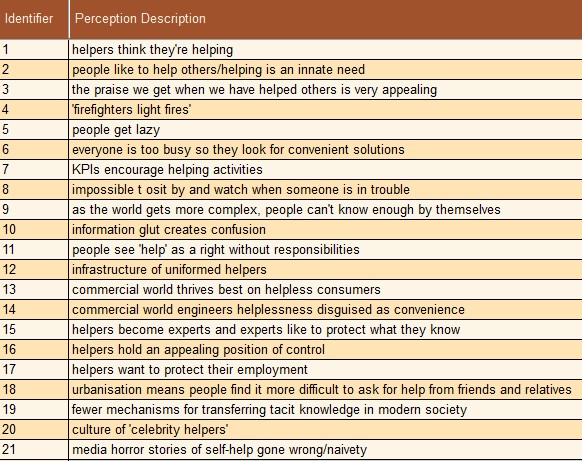
Then we set about scouring all the reasons we could find, across all the different sectors of society where we could see evidence of the slippery slope. We ended up with a list of just over twenty different answers:

learned helplessness 1Then we looked at the interactions between these answers by asking the ‘leads to’ question, ‘which of the other ones does this one lead to first?’

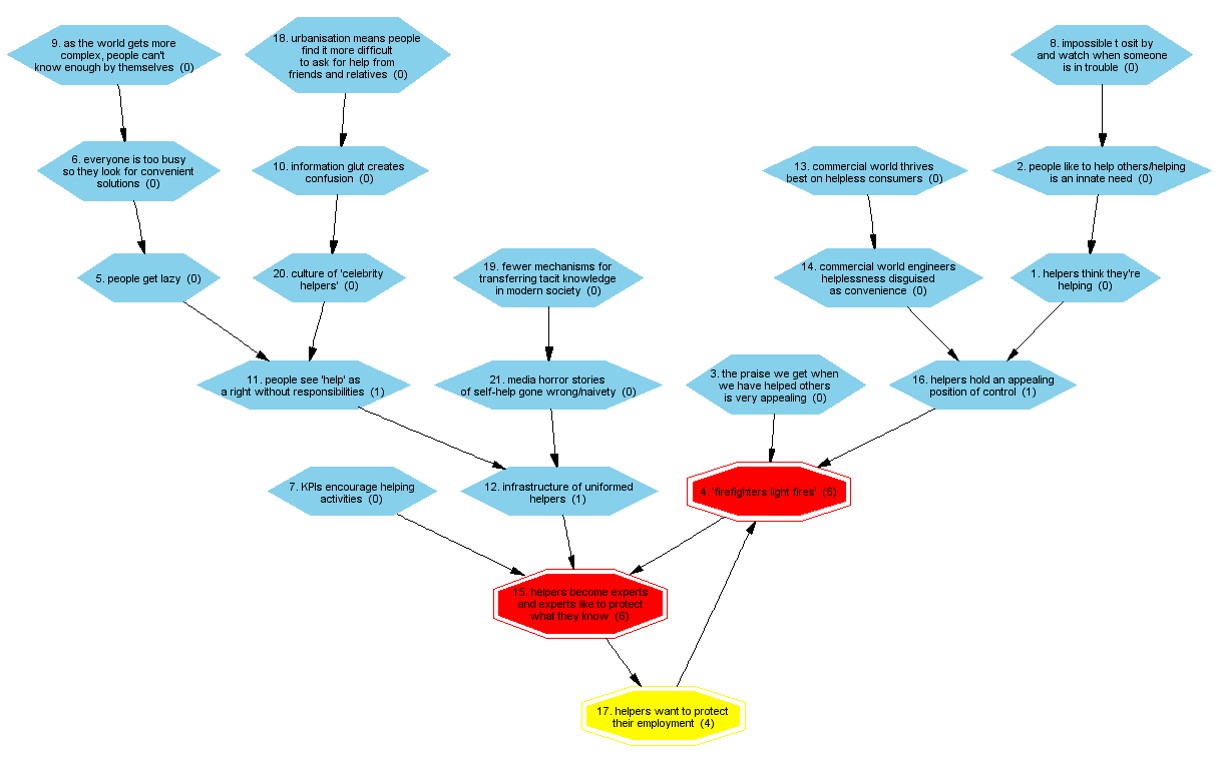
Here’s the map we ended up with:

learned helplessness 2

It clearly showed a single vicious circle. If there’s a slippery slope at play in the learned helplessness problem, chances are this is where it is. Which turns out to provide something of a shock. At least to my way of thinking. Here’s what the vicious circle looks like close up:

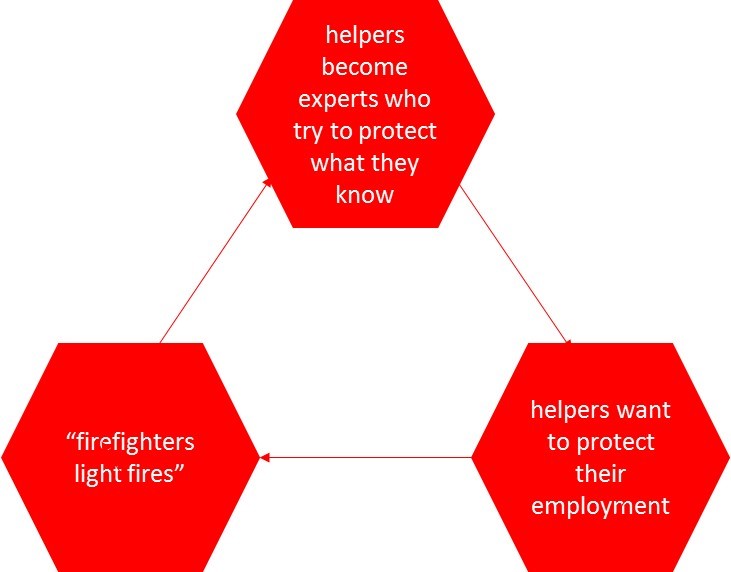
learned helplessness 3

What it basically says is that the principle driving force behind learned helplessness is… the helpers.

W Edwards Deming famously said that nearly all (he eventually ended up at 95%) problems come from the system rather than the individuals within it. No-one comes to work to do a bad job. It’s just that somehow, all that positive intent sometimes finds itself combining in ways that create unfortunate outcomes no-one could have expected. In other words, while the vicious cycle tells me that the helpers are the problem, the real problem is the emergent complexity of their combined actions.

Blame is not the point. The point – for all of us helpless ones – is that when we’re trying to change our behviours and finding it really difficult, the very people we go to for help, aren’t helping. In the words of Nicholas Taleb, society has inadvertently made us all much more fragile. We live increasingly on a fragile knife edge, and the only way to turn things around, to make ourselves ‘antifragile’ is to realise who the enemy is. The enemy is us. Us plural.

Homo Sudoku

It pays to be obvious, especially if you have a reputation for subtlety.

Isaac Asimov

And vice versa.


‘Someone, somewhere already solved your problem’ is one of the main tenets of TRIZ. There are some in and around the TRIZ community that appear to operate under the misapprehension that it is an expression that will encourage everyone to want to use TRIZ. ‘Who wouldn’t want their problems solving?’ they will very rationally argue. And they might have a point, if it weren’t for the fact that it’s rarely the rational argument that carries the day in any walk of life. The glaring absence of TRIZ use around the world is probably as good a piece of evidence to illustrate precisely how rare.

Tell some people that someone, somewhere already solved their problem and they’re not going to look at you with a smile on their face. You’ve just created an unhappy person. Someone who’s not going to be giving you a call wanting to know more any time soon. In extreme cases, you might just have created a person who has every incentive to make sure no-one else in the building hears what you’ve been saying either. Especially their management, who, the unhappy person probably quite rightly surmises, would very much like to know who this other ‘someone, somewhere’ might be.

And, hey presto, we just found ourselves another thorny contradiction: ‘someone, somewhere already solved your problem’ is both a good thing to say and a bad thing to sasudokuy:

Which side of the good/bad divide you find yourself depends on who you’re talking to, and when the words leave your mouth.

In terms of the ‘who’, you can make a fairly safe bet that the person tasked with solving a problem won’t want to hear what you have to say. The person who does want to hear is the person who merely wants the answer. Why would the problem solver not want to save themselves some hard work? Answer: because the work your ‘someone, somewhere’ statement has just questioned is the best part of their job. People love solving problems.

That’s why the newspapers of the world all have a crossword and puzzle section in them. They give us all the opportunity to solve a problem every day. We are Homo Sudoku.

When we use the ‘someone, somewhere…’ expression with a person in problem solving mode, what we’ve just done is pretty much the same as the annoying know-it-all dick looking over your shoulder shouting out the answer to 7 Across.

It’s not what you want to hear right now, thank you very much.

The only time you want to hear what 7 Across is, is just before tomorrow’s paper arrives. Only then can you admit defeat, because only then do you see you’ve also just been given a whole new problem to work on.

Actually, that’s not quite true. If you look at what a lot of crossword puzzle solvers do (I’ve visited Gemba!) when the tension of not-knowing 7 Across has reached a threshold level of agony is they’ve gone and had a sneaky peek in their dictionary. Or on Google. And rest assured, it will be a sneaky, highly covert operation. Having to admit you needed help to solve a puzzle rarely feels good to most people. And if you do find yourself in the position of needing some help, far easier to admit that need to a computer than to another person.

Which might just be another clue to the problem of knowing if or when to come out with your smart-aleck ‘someone, somewhere already solved your problem’ introduction to TRIZ. You can use it when:

  1. You’re talking to the person who wants the answer but won’t be doing any of the solving
  2. You’re talking to the stuck crossword solver, waiting for today’s newspaper to arrive (with a new problem to work on!)
  3. You want to wind somebody up or shock them out of some kind of paradigm paralysis (provided you can give them a sneaky, covert get-out-of-jail-free card).

If the situation is not one of those three, you probably shouldn’t let the ‘someone, somewhere’ words leave your lips. And in reality there’s a fair amount of doubt with Option 1 too if you’re the outsider, because the person is in all likelihood going to go ask the person they thought was working on the problem what they think. Option 1), in other words, is really nothing more than an indirect version of options 2) or 3).

Aagh, damnit, probably easiest to just not use it at all unless you’re absolutely sure what you’re doing. Careful with that axe, Eugene.

Good Procrastination?

“anyone can do any amount of work, provided it isn’t the work he is supposed to be doing at that moment.”

Robert Benchley


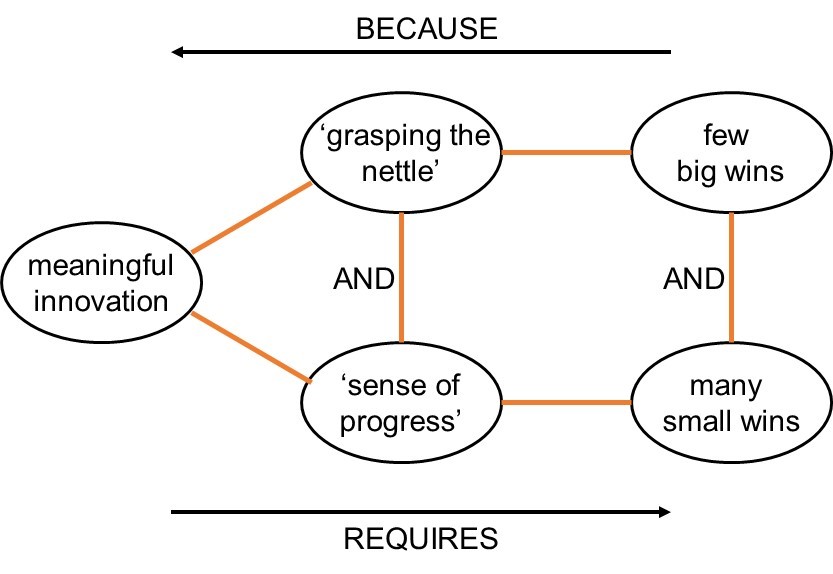
Eagle-eyed readers of my ramblings may have noticed an increasingly apparent contradiction. The contradiction exists between two pieces of consistent advice to innovators. One side of the contradiction says, ‘run towards the barriers’, or, put another way, ‘there’s little point working on all the easy problems if you never get past the difficult ones’. This is a piece of advice borne of watching organisations waste literally millions of dollars having project teams skirting around the potential project killers, only to then fail miserably when they can no longer put off the inevitable tackling of the real problem any longer.

The other side of the contradiction is the piece of advice discussing the critical importance of achieving a ‘sense of progress’ within innovation teams. People will keep going on a project when they feel like they’re moving in the right direction. No matter how slowly. The best way to create this sense of progress is to work on problems that are easy to solve, and allow everything to cross something off their job’s list at the end of the day.

So which is right? Quick wins or big wins?

Trick question, right?

No-one wants the either/or answer. Innovation is about solving contradictions, and achieving the both/and solutions. And the reason we spend time drawing pictures like this…

big wins

…is it allows us to tap in to the breakthrough solutions that have already been derived by others that have travelled the same road before us.

The generic solutions we can observe from others then need translating into something that works for us as individuals. From a personal perspective, I’ve spent a lot of time in the last couple of years working on my own walking-on-the-shoulders-of-giants solutions to the quick-win/big win conflict.

A lot of it starts from the state of mind I find myself in. Some mornings I wake up thinking I can change the world. Others I have a strong suspicion I’ll be lucky if I manage to get the breakfast cereal from the packet into my bowl. Some days will end up being big win days, and some won’t. The critical thing in the ‘won’t’ days is that you can still nod your head at the end of the day and say to yourself that some kind of progress on something has occurred. Even if it was just a tick in the box marked ‘cereal in bowl’.

One way to tackle the conflict, in other words, is to tailor what you work on during a given day to your prevailing mood. I’ve taken to keeping a pair of jobs lists in recent times, one for all the important, run-towards-the-difficult, ‘big win’ stuff I want to do, and the other for all of the handle-turning grunt work I don’t manage to foist on other people, but that I know needs to be done. The second list is the one designed to allow me a few easy ‘sense of progress’ wins during the day.

It’s a start, but then there’s the procrastination problem. We all have a tendency to procrastinate I think. The trick with procrastination is to allow yourself to procrastinate over some big task without feeling guilty because it meant you didn’t procrastinate over a cluster of lesser tasks. It’s amazing just how much you can get done this way. It all boils down to making the thing you allow yourself to procrastinate over bigger than anything you actually want to get done.

The other reason I allow procrastination is that I’ve learned to stop thinking of it as a bad habit, and started to reframe it as ‘situations where we don’t have enough information to meaningfully solve yet’.

One of the things that working with TRIZ for the last twenty-some years has taught me is that there is no such thing as a problem that can’t be solved. It has given me an absolute – really, absolute – confidence that anything is possible.

In parallel with that, one of the things that working through all of Edward Matchett’s ‘5M’ equation discoveries has taught me is the amazing power of the human brain to make sense of seemingly random clues and ideas. To the extent that, once you’ve piled in the requisite number and quality of inputs, you won’t be able to stop meaningful answers from popping out.

Taken together, I’ve grown in to the habit of piling as much information about a problem I’m working on into my head just before I go to bed or before I head out on a run, knowing that there’s a fairly good chance that, when I wake up in the morning, or get into my running stride, the answer or some important new question will appear. Sometimes it won’t, but mostly it will. Those times it doesn’t, I interpret the lack of progress as a sign that I just haven’t included sufficient clues yet. ‘Creating a ‘sense of progress’ in this situation becomes quite easy: ‘find something new to add to the mix today’.

Rethink your perspective on ‘procrastination’ and pile enough information on enough problems into your head, and I’d be willing to make a fairly safe bet that you’ll have found yourself a highly effective way of ensuring you get a regular supply of big wins, and a daily sense of progress.


Vultures In Wolf Suits?

One of the main reasons the divergence-convergence job doesn’t get done well in the majority of organisations is that the divergent part often feels very inefficient and a round-a-bout way to get to an answer that will – if its any good at least – will look completely obvious in retrospect. Edward De Bono talked a lot about this irreversibility in his early work. But, it appears, not too many people took too much notice.

Maybe it wouldn’t be such a big issue if it weren’t for the fact that such a horrendously high proportion of complex problem solving exercises end in abject failure.

One of the things we always try and impress upon delegates working in the session we run is that there is a very strong causal link between how much time people spend in the divergent parts of the process and the likelihood of a positive outcome. Similarly, the extent to which a team allows themselves to diverge, is also very closely related to the likelihood of that same positive outcome.

F Scott Fitgerald once famously said, The test of a first-rate intelligence is the ability to hold two opposed ideas in mind at the same time and still retain the ability to function. In divergence-world, the idea is to turn two into ten or twenty. Or more. The more you can force yourself to keep on diverging, the more you start to feel sick with confusion, the higher the likelihood something good is going to come from the session. ‘Diverge until you can’t see straight any more’ is my usual instruction to the SI team when we get to work on our own complex problems. It’s not easy, because it’s not supposed to be easy.

I once ran a session for a client where there were a bunch of people I’d never met before. I figured because it was a big multi-national organisation and the team was quite senior, that I might be able to get them to diverge more than the average. By morning coffee break it was clear I’d got it wrong. ‘Why would we use a process that didn’t make life easy for us?’ one of the delegates asked me during the break, ‘if it’s not going to be easy, no-one will adopt it.’ Needless to say, I don’t do much work with that client any more. After a while, running sessions that deliver mediocre ‘easy’ results can get a little bit soul-destroying.

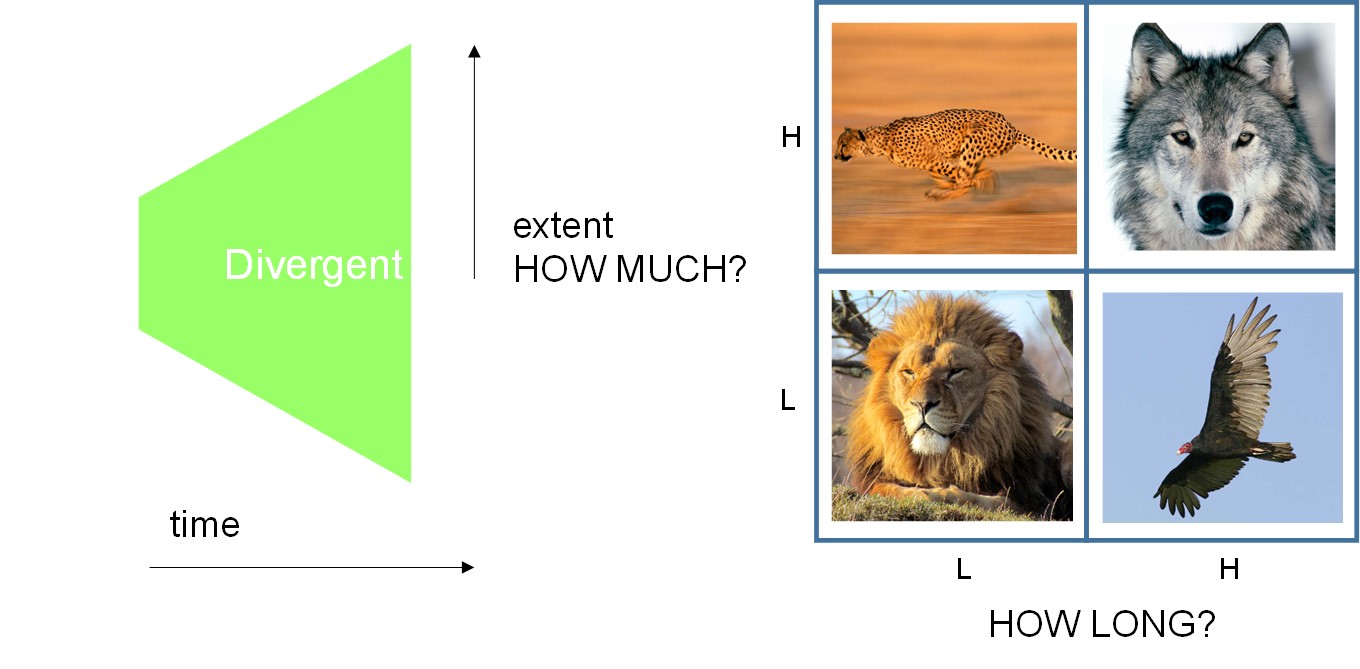
These days, rather than guess about the extent and duration of divergence that a team I’m about to work with is going to be up for, I try and assess where the team might be on another 2×2 matrix: wolf

Knowing that I have a room full of lions, cheetahs, vultures or wolves (or combinations thereof) before we get going means we can adapt how we do things.

Lions – like my ‘easy-life’desiring multi-national client – are not good at spending much time diverging or generating lots of divergent thoughts. This is a category with lots of multi-national organisations in it. Especially ones with lots of MBAs prowling around the building. Like lions, they’re already top of the food chain and, frankly, they don’t often have to try that hard to do anything. I try and avoid running sessions with lions, unless I’m allowed to bring a whip and a chair.

Next up, the cheetahs. These are the people – a lot like the ‘creativity consultants’ I ranted about in the previous diatribe – that love a Post-It party. Guaranteed they’ll fill any wall you might care to point at in under an hour. They’ve been there, done it, got the t-shirt as far as divergence sessions are concerned. In all likelihood they’ve become a little bit cynical about the process, due to the knowledge that they’ve done these kinds of things a million times before and nothing tangible ever came out of it, so why will this time be any different. I’ve even see one group sneak over to a cupboard and retrieve some of the Post-It posters they’d generated during a previous session. Cheetahs can put on a terrific busrst of speed when they have to, but don’t have a lot of staying power. Try to get a group of cheetah’s filling up Post-Its for more than an hour and you might have a mutiny on your hands.

The opposite end of the spectrum finds the vultures. These are the people that can circle around a divergence session until the sun goes down, probably thinking about stuff, but not actually getting that much done. They’re the ones looking for the already-dead prey. They’re definitely not going to bust a gut to fill you a wall of Post-It’s any time soon.

At least, though, the vultures have a solid understanding of the importance of biding your time. In complex problem solving world, ‘biding your time’ is better known as incubation. Incubation is really important in the complex problem solving world. Incubation is a skill that the final segment of the matrix, the wolves, have in abundance. Wolves represent the top of the evolutionary tree when it comes to stamina. They will chase prey for days if they have to. They’ll also work together. It shouldn’t be a great surprise to learn that it is the wolf groups – top-right hand corner of the matrix = best per convention – that are the ones generating the outcomes that are most likely to deliver meaning and success. They’re the dream groups to work with if you can find them. They’re the groups that will still be there at 6 o’clock in the evening, loading their brains up with stimulus so they can incubate it all over night, then come back at 8 the following morning all set to diverge some more.

In my experience, about 5% of groups have wolf-like characteristics. It’s a lucky day, in other words, if you find yourself working with one. Unfortunately, I haven’t reached a position in life when I can say no to 95% of my potential clients. Which means I find myself carrying around lots of wolf-suits for people to wear. For the duration of a session at least. Generally speaking, I find it’s easier to squeeze the cheetahs into them than the vultures or the lions. I’ve had some success taking a pair of clippers to lion manes, but am still at something of a loss with the vultures.


MBAs, Creativity Consultants & Other Hazards

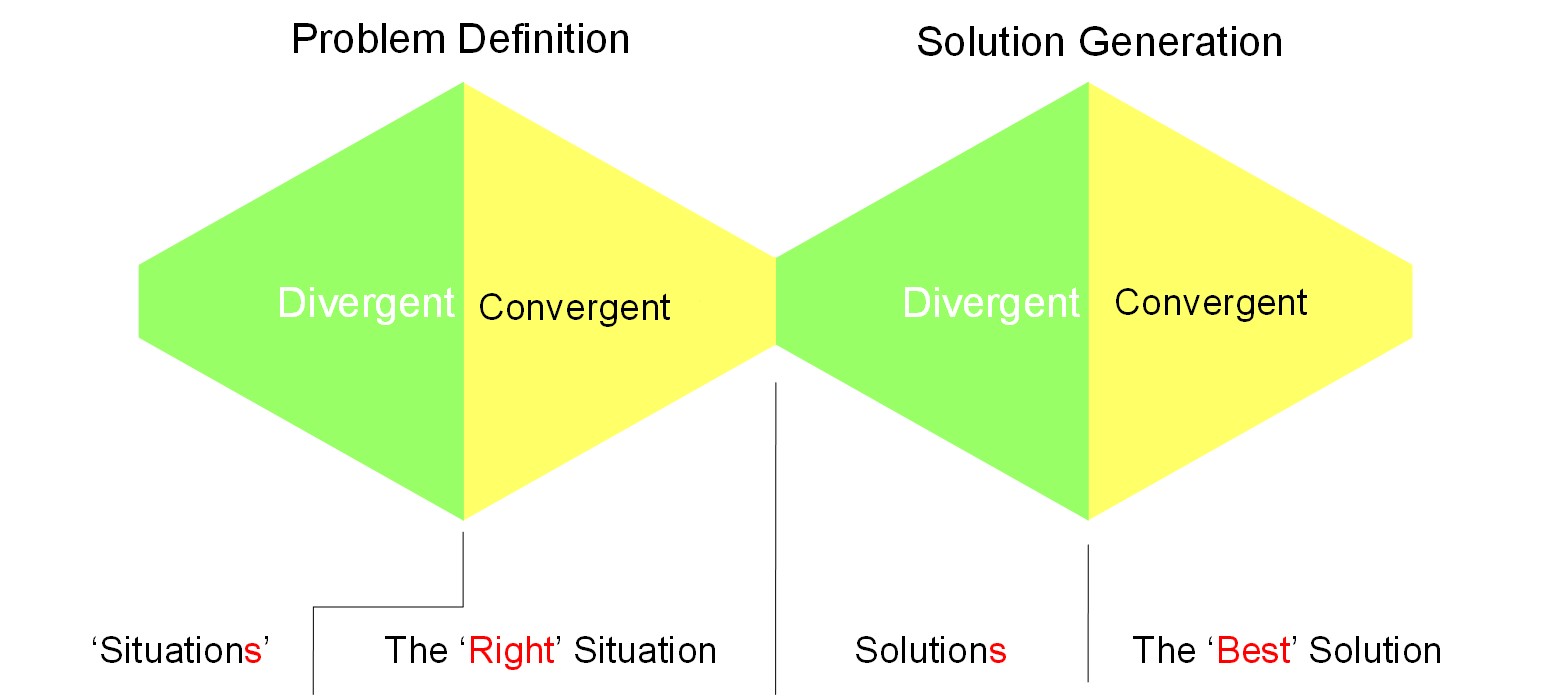
There isn’t much that the ‘creativity community’ agrees upon, but one thing that seems as near universal is it’s possible to get is the importance of divergence and convergence in the creative problem solving process. Divergence being the parts of the process where we open ourselves up to a greater number of possibilities and options; convergence being the parts where we home in on ‘the’ problem or ‘the’ answer. In our version of the divergence/convergence story there are a minimum of two divergence-convergence pairs in any problem involving a complex problem. There may be more, of course, as a project iterates its way out of the fog towards clarity, but, if a team gets really lucky, they might get away with a divergence-convergence pair to define what the right problem is, and then another pair to get to the best answer:

divergence blog 1

Irrespective of the actual number of divergence-convergence cycles might occur in a given project, one of the things that is often overlooked is the relative amount of time spent in each of the divergent and convergent phases of the cycle.

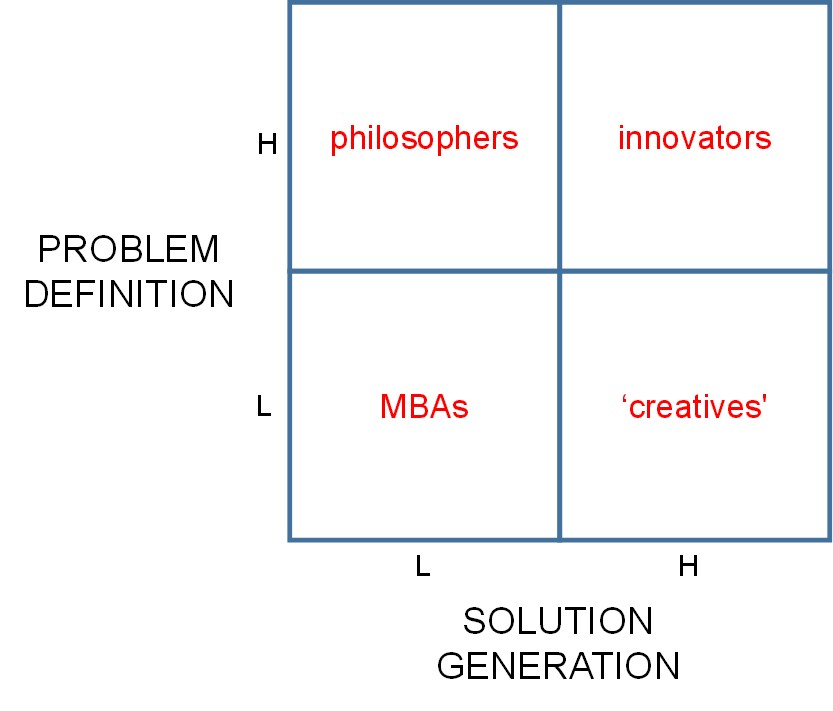
Based on our experience facilitating sessions over the years, it is a really good idea to have a prior indication of the preferred working practices of the team you’re working with. We’ve identified four main kinds:

divergence blog 1a


The most frequent kind of group is the type we might think of as the MBAs. These are the people that have been taught at one business school or another, that complex problem solving requires the same laser-like focus as any other kind of problem. Anything that feels like it’s deviating too far away from ‘the point’ of the exercise (i.e. is ‘diverging’) isn’t going to be looked upon with much positivity from this kind of group. And woe betide the facilitator if a clear answer hasn’t been delivered at the end of the session. From an innovation perspective, as well as being the most frequently encountered type of group it is also the one least likely to deliver any kind of useful output once the cold light of tomorrow arrives. Solving complex problems is not at all like the ‘usual’ MBA problem. Actually, neither is real life. Which is a whole other problem, albeit one that is beyond the scope of this rant.

The rarest type of group – unless you’re fortunate enough to work in the aerospace or other industry that innovates at glacial speeds – are the philosophers. These groups are the ones that totally get what Einstein was getting at when he said, ‘if I had an hour to save the world, I would spend 55 minutes defining the problem’. This is the group that will be very happy to spend a whole day drawing intricate function analysis diagrams, wall-size perception maps or any other kind of problem definition tool you might care to pass their way. They might well have a point. But they’re also very prone to ending the ideation parts of a project with a single ‘answer’. This is the type of group that, during the rare moments when solution generation can be contemplated, usually has the greatest amount of difficulty with instructions like, ‘I don’t care about the quality of the ideas at this point, let quantity come first’. The facilitator of this group might accrue – if he’s really lucky – half a dozen Post-It’s come the end of the session, and chances are all six will contain some well-thought through ‘competent’ answers. Sadly, however, they are very unlikely to have anything at all in common with ‘wow’ or ‘breakthrough’. What the philosophers find hard to grasp is the idea that wow comes from combinations of partial ideas and that you only get to make the combinations if somebody wrote down the dumb partial ideas in the first place.

The second most frequent type of group is the opposite of the philosophers. This is the group that will typically wish to spend no more than twenty minutes working out what the problem is, and then the rest of the day re-decorating the walls of the room with Post-It’s full of solution ideas. I tend to think of these types of groups as the ‘creatives’. Mainly because it tends to be the style adopted when a group is being facilitated by a ‘creativity consultant’. By all accounts a group of people that has fallen under the collective delusion that the reason most innovation attempts fail is that ‘people don’t know how to be creative’.

Looking back through the last two decades I think I’ve only ever experienced two groups that really didn’t know how to be creative. One was a session I ran with the UK Treasury, where approximately 5% of the delegates had heard of brainstorming. The other was a session with a group of Belgian automotive engineers. The look of panic in their eyes when we announced we were looking to spend the next hour using the TRIZ Inventive Principles to generate a target of 50 solution clues was a joy to behold. Their scared-out-of-their-wits cry of ‘but what would we do with all those ideas?’ can still bring a smile to my mouth fifteen years after the session.

Anyway, Treasury officials and Belgian automotive engineers aside, the problem of having ‘too many ideas’ is one I never experience. Which probably goes a long way to explain why I spend so much of my time avoiding and distancing myself from the ‘creativity consultant’ world. Never, to paraphrase Winston Churchill, have so many been so deluded for so long. To all intents and purposes their belief that ‘people don’t know how to be creative’ is one of the most damaging collective delusions of the last 80 years since Alec Osborn wrote ‘brainstorming’ on his forerunner version of a Post-It.

I have a sneaking suspicion this ‘creatives’ segment of the 2×2 matrix is the most dangerous one of all in terms of failing to deliver anything remotely resembling innovation (i.e. ‘successful step-change’). Probably in no small part because, having brought in a – the more expensive the better – creativity session facilitator and filled several walls with great solutions, management are lulled into a false sense of security. Or, failing that, at least a warm, fuzzy plausible-deniability answer for their bosses when everything goes pear-shaped six months further down the line, ‘we brought in the best consultants on the planet, what more could we have done?’ Well, how about, ‘spend more time making sure you’re working on the right thing’?

Which, finally, leaves the top-right hand box of the matrix, the ‘innovators’. As per usual 2×2 matrix convention, the top-right hand corner is the place everyone is supposed to aspire to. The box that means we get the balance right between divergence in the problem definition and divergence in the solution generation tasks. Or rather – again per convention – solve the contradiction between them. This is the box we’re always trying to get clients to operate in. If we say that 2% of all innovation attempts work out, you can place a safe bet that 1.999 of that 2% were groups that operated in this box. If more people knew that, maybe we might all stand a better chance of living in a world that was able to meaningfully tackle what lies ahead, as opposed to our continuing propensity to kick ever more dented tin-cans along rutted roads.


Big Data: More Hay, Same Needles

I enjoyed my first Trip Advisor navigated holiday a few weeks ago. The idea was that we’d go where the wind blew us, booking accommodation on the fly based on Trip Advisor reviews. After the third night we gave up and reverted to ‘turn-up-at-the-door-and-sniff’ instincts. When you find yourself confronted with a couple of hundred reviews of a hotel, many of which seemed to conflict with one another, it becomes very easy to conclude that we were dumber when we’d finished than we were before we’d started looking.

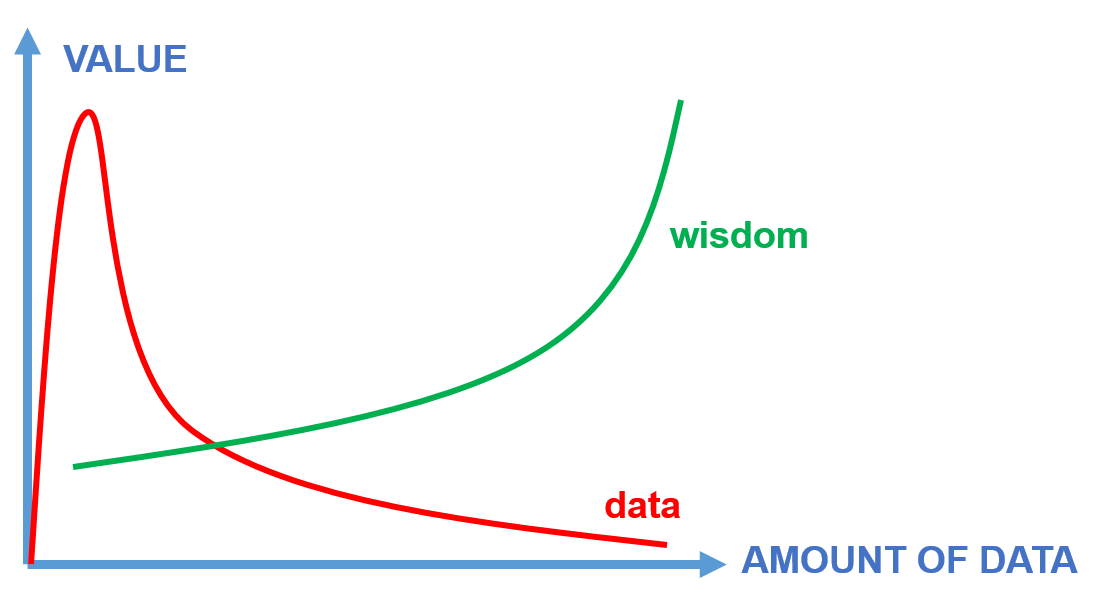
Much as Trip Advisor and the growing number of ‘Big-Data’ providers might not like to hear it, beyond a certain point, the more data there is, the lower its value inherently becomes. It’s a pure fact of nature. Data fundamentally wants and needs to be free.

The converse of this story emerges when we look at wisdom. The more data we have available to us – as I experienced on my holiday – the greater the potential for confusion, and consequently the more we are willing to pay for somebody or something to understand our context and our real needs and have the wisdom to be able to point us to a solution that meets those needs. The core paradox is that the more data we produce – the more hay we add to the haystack – the more difficult it gets to find the needle. The more available and freerblog data wisdom data becomes, the greater the value of wisdom.

In the needle-in-a-haystack metaphor, wisdom is all about being able to find the needles. One of the biggest misconceptions of the Big Data industry is that adding more hay to the haystack also increases the quantity of needles.

Not only does this sound nonsensical, it is nonsensical. The reason this is so is because wisdom is all about the ability to contextually distinguish the important from the trivial. And what’s important in life comes from our extremely finite set of needs and desires.

The TRIZ/Systematic-Innovation methodology, unbenknownst to the original researchers as it happens, was the ultimate study of the difference between the important and the trivial. Sixty plus years and 4 million case study analyses later, we can vividly see that the world spends most of its time and energy re-inventing wheels. Which is to all intents and purposes the same as making more hay. The total number of problems in life is measurable in the hundreds. The number of effective solutions to those problems is measurable in the tens. There are, in other words, tens of needles in the haystack. And, moreover, we’ve already found them.

Now the NHS, and much of the rest of the public sector has been tasked by their government masters to ‘measure the experience’ of their patients, staff and customers we’re very likely to see an exponential growth in Big Data projects in the coming months and years.

After that, if I had to make a prediction, someone is going to start asking difficult questions like, ‘now we’ve measured all this data, what are we going to do with it?’ The only point of measuring anything, in the real world at least, is to allow us to improve how things work. We measure patient experience in order to improve patient experience.

And it’s only at that point – the point where we switch from merely measuring to actively intervening to make changes to the system – that we really learn the truth of the Big-Data-Small-Wisdom paradox.

The NHS, being ‘ahead of the game’ is already drowning in Big Data. Terabytes of meaningless hay.

Actually, I suspect the situation is considerably worse than that. The meaningless hay is also toxic hay. Toxic because it hides the truth. Three months before the Mid Staffs debacle hit the public, a Big Data ‘Review’ of the Trust had been given a full set of green lights. Everything, according to the Data, was fine.

Except, of course, it very clearly wasn’t. The needles that would have revealed the real set of problems – and their solutions – had been hidden. The real tragedy when we consider this truth, is that we didn’t need a review at all in order for us to know what and where the needles were, and what could and should have been done to make a meaningfully positive impact on the experience of the patient.


Through An Intangible Lens

Many of us inadvertently shoot ourselves in the foot once in a while. Occasionally – and usually rather more spectacularly – we get to observe large groups of people embarking on a collective foot-shooting extravaganza. The expenses scandal by British politicians a few years ago was one of the most visible examples of such synchronized stupidity.

Not surprisingly, the aftermath of that scandal saw the introduction of a more rigorous set of expense-claiming guidelines. And thus the pendulum swings from ‘it’s okay to clean your moat on expenses’ to ‘itemise everything down to the last penny’. An outsider might nod at this point and say, fair enough, they’re public servants and they need to be punished for their excesses. What better way than forcing every politician to cram their pockets with receipts? Especially if we then make all of their transactions available for public scrutiny.

And so now, as a population, we’re able to sleep at night safe in the knowledge that David Cameron’s recent claim for the cost of a £4.68 glue stick and 8p for a box of clips has been duly claimed and paid. Or that Vince Cable legitimately spent 43p on scissors (which Poundsaver did he got to for them??), or that Kenneth Clarke charged the taxpayer 11p for a new ruler.

I don’t know about you but this is the sort of thing that tends to make me think the UK government accounting system is dysfunctional. Not because of the perception I have that the cost of processing the claim is likely to be much more than the claim itself, but rather because it demonstrates such a fundamental lack of understanding of human psychology.

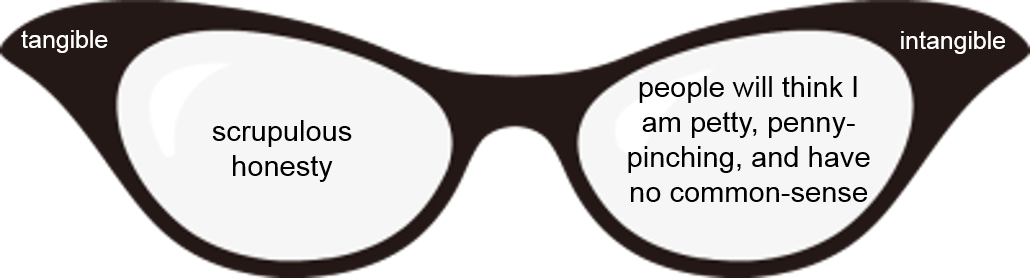
People do things for good reasons and real reasons. We all look at the world through tangible and intangible lenses. The tangible lens is the rationalizing lens, in this case, of the accountant. In the accountant’s eyes, accounting everything down to the last penny is the absolute right thing to do in order to demonstrate scrupulous honesty. The intangible lens, on the other hand, is the lens of emotions and difficult to quantify things like common-sense and gut-feel.

intangible lens

Looked at through this lens an expenses claim for 8p begins to look quite different:

  • How petty-minded does a person need to be that they even contemplated making a claim?
  • Did this person have so little common-sense perspective on the bigger picture costs of processing a claim?
  • And if so, and I extrapolate to everything else, what damage must they be causing to the country?
  • And, anyway, how incompetent must the Downing Street office staff be to have a stationery cupboard so poorly stocked that there was a need to pop-out to Staples to go buy a box of clips?
  • Bearing in mind his £142,500 salary, what possible difference could 8p have made to David Cameron?

All in all, what this tangible scrupulous honesty plus intangibles-blindness combination does is creates a perception that claiming for an 8p box of clips might be a far worse crime than the multi-thousand pound moat-cleaning claim. Looked at through the intangible lens, an 8p expense claim is likely to make people trust politicians less rather than more.

Any normal person would, I think, have been too embarrassed to enter such trivia on an expenses claim form. A normal person sees the world through both tangible and intangible lenses.

Not only that, all the research also tells us that we see things through the intangible lens before the tangible one. It’s our inbuilt instinct. Looking through this lens first is a really good way of avoiding shooting yourself in the foot. For some difficult to fathom reason, people in public life – or the pencil-licking, more-than-my-jobs-worth bureaucrats they recruit to look after them – seem to re-train their instincts to ignore the intangibles. On one hand, overriding ones natural instincts is quite a feat. On the other, the day you start believing that your rightful claim to that 8p is more important than the possibility that everyone around you might think you are a petty, no-common-sense dick is probably the day you should contemplate withdrawing to a quiet life of pottering in the shed at the end of the garden.