Top 12 New Online Multiplayer Games for Android

The majority of the moment you possibly look at video games as a wild-goose chase, or many individuals do anyway. They consume time that could be made use of for various other things, like analysis or hanging out in the outdoors. There are crucial points that you can get out of your time playing video games.

Yes, if your computer game having fun is maintaining you from caring for your youngsters, keeping your children from doing their homework, or it’s impacting the sanitation of your home, then maybe a poor point. Get coins on Madden NFL Mobile cheats and, Yet if you are monitoring your time, as well as your youngsters’s time, playing games, you can all get something great out of that game play.

BUILDS CRITICAL THINKING SKILLS

Whether you are playing games on a pc gaming console, on your computer, or you are simply playing among your favored Android video games on your mobile phone or tablet computer, you are establishing your vital reasoning skills. You have to choose which door to open, what passage to drop, as well as which zombies you have the time to quit and kills.

These essential thinking abilities can help you in the real life. You’ll find out more regarding fight or flight. And, you’ll also find out more regarding why it’s in some cases essential to assume prior to you act, and why in some cases you need to act because there is no time to think.

BOOSTS HAND-EYE COORDINATION

If you are playing video games on a console using a wand or controller, or even using a stick while pc gaming on your computer, you are establishing your hand-eye sychronisation in an extreme way to get klondike adventures cheats. Also simply pressing letters as well as arrow switches on a computer keyboard can aid with hand-eye coordination though.

CREATES CREATIVITY

Video game creation is an art kind. That being stated, like various other kinds of art, playing video games can influence creativity. While some could say that certain video games motivate individuals to deal with ladies severely which some of them might also influence people to hurt others, they also can influence individuals to become musicians, authors, movie producers, and also a lot more on herowarstips.fun.

Even musicians and songwriters have been inspired to create tunes because of their love for computer game. Allow your love of video games aid influence you. Possibly it will certainly turn you into a sketch painter, musician or artist. When it comes to private imagination, the sky’s the limitation.

IT’S FUN!

The last reason why playing video games can be great for you is that they are just fun. They are amusing, as well as they maintain your mind operating in a manner in which merely enjoying TV may not. While computer game playing is no substitute for checking out a great publication or taking pleasure in the great outdoors, it isn’t as poor for you as many would assume.

Most of the time you probably look at games as a waste of time, or many people do anyway. They take in time that might be utilized for various other things, like analysis or investing time in the outdoors. There are crucial things that you can get out of your time playing video games.

That being said, like various other kinds of art, playing video games can inspire creativity.

Good Agile/Bad Agile

agile

In my travels, I’m seeing a lot of Agile lately. That’s Agile with a capital ‘A’ as opposed to a small one. Mostly, what I see is pretty depressing. Irrespective, now I think bout it, of the size of the ‘a’. ‘Doing dumb stuff faster’ is my main take on what I see. ‘Start dumb, stay dumb’ is not far behind.

How quickly original intentions get corrupted. In theory, Agile is intended to be a smart response to a complex world in which there’s an awful lot of stuff you can’t know or can’t predict. The best way to respond in such situations is learn faster than everyone else. And the best way to learn is to try something, see where it goes wrong and then design your next iteration. The logic is infallible.

Or rather it would be if any learning or any ‘design’ actually took place. Instead what I usually see is an awful lot of wheel spinning. Apparently solving one problem, only to create another. Then solving that one and finding ourselves back at the place we started. Spinning wheels can feel quite exhilarating. Sadly, it’s only when all the rubber is evaporated away, we realise we haven’t made any tangible progress.

Solving one problem only to create another is the way of the world. ‘Progress’, to my mind, is ensuring the succession of problems and their solutions are good ones. Which means finding and solving contradictions.

When I ask Agile team members to show me the contradictions they’re challenging, the overwhelming reaction is a puzzled expression and a muttered response something along the lines, ‘please stop asking dumb questions, we’re busy trying to spin our wheels faster here.’ I’ve now learned that’s my signal to smile politely and walk away. Nothing I can do to help here.

Let’s keep this simple. Bad Agile is about moving trade-offs from one place to another. Good Agile is about solving contradictions. And the only Agile measure that makes any sense as far as I can see is contradiction-solving rate. On that scale, I’d have to say the current and future progress rate of well over 90% of all Agile projects is zero. Aah, the sweet, sweet smell of burning rubber. And burned up dollar bills.

Weapons Of Mass Distraction #23: ‘Lean Design’

One of the natural tendencies of the world is expansion beyond our core skill set. We are, to quote one of my favourite bands, ‘gluttons for our doom’ when it comes to our collective inability to say ‘enough’.

I see the problem a lot in the world of problem solving method developers. My first hands-on experience was with Axiomatic Design creator, and arrogant nut-job, Professor Nam Suh about a decade ago. Although massively over-complicated (I suspect to justify the blushingly-high consulting bills), when push comes to shove, the ‘axioms’, while they’re not actually Axiomatic, do provide some useful direction to designers in some situations. Then, no doubt, because once you start getting used to being paid blushingly high consulting fees, it becomes kind of addictive, so that when the fees start to dry up, its common to feel a need to broaden your horizons. And so Professor Suh, sensing that the innovation world was looking like a big opportunity, decided to start telling the world that Axiomatic Design was an innovation panacea. He persevered for a couple of years.

It took that long for the world to work out that Axiomatic Design was about as useful for the innovation job as digging a swimming pool with a plastic teaspoon, because when you’re methodology includes matrix algebra, it can very easily hypnotise people into believing you. Especially if they themselves don’t know what matrix algebra is. Fortunately, the world has now cottoned on to the idea that not only does matrix algebra have nothing at all to do with innovation, neither does any kind of mathematics. Innovation is pretty much all about putting the mathematics on one side until you’ve finished doing the innovation part.

Anyway, before I go off on too big a tangent, it seems we’re seeing the rise of ‘Lean Design’ as the latest output of a community of smart people that have hit the limits of their capabilities and are feeling the need to expand into new domains.

No-one in the Lean community can even define ‘lean’ it seems to me, so when I’ve been quizzing leading lights about the meaning of ‘Lean Design’ I get even less clarity.

I hear the phrase, ‘the designer casts the biggest shadow’ phrase a lot, but when I nod and respond with a ‘so what? or ‘and then what?’ question all I seem to get in response is something along the lines, ‘yes, but the designer casts the bigger shadow.’

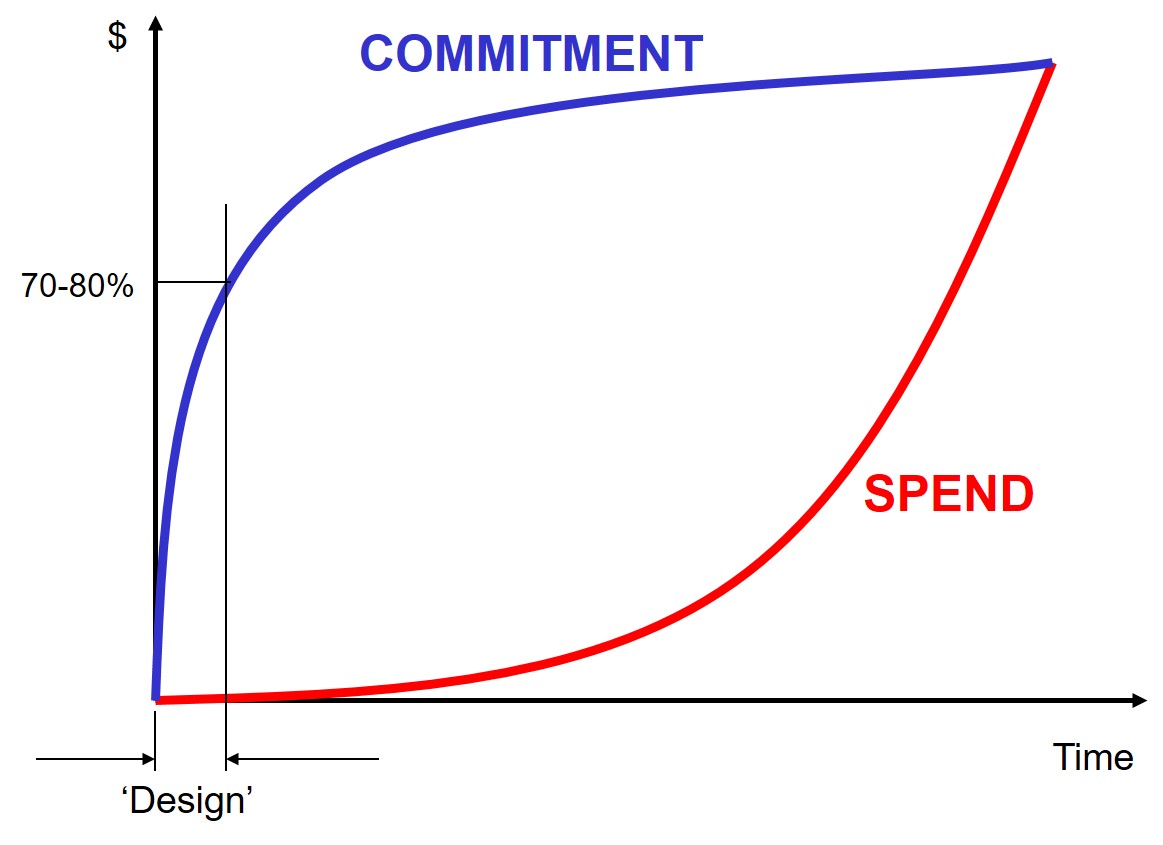
I know. It was drummed into my head from the first day of my first real job in the aerospace industry. A design project, it turns out, where my back-of-cigarette-packet design calculations transformed themselves, within a year, into about £20M worth of overall project cost. This is the picture we used to convince ourselves that we should make sure we were using the very best cigarette packets to do our calculations on:

lean desig 1

To me, ‘lean design’ is all about recognising and managing this massive hysteresis between the designers spend and the commitment that spend imposes on what happens after they finish.

And, to be as clear as I can, that management job had and still has absolutely nothing to do with the world of Lean.

‘Lean Design’ seems to be borne of a handful of ‘Lean experts’ that have traced back some of the ‘waste’ they’ve been told to go look for and found themselves in the Design department.

Sadly for all concerned – the Lean experts, the Designers and the poor project managers faced with the thankless task of making sense of what the experts and designers try and tell them – just because its possible to trace some apparent ‘waste’ back to a source, doesn’t mean that source is any kind of root cause.

The root cause is there is no root cause. Not in a complex environment. And Design is fundamentally about dealing with complexity. Complex environments require different ways of operating. Different, that is, from all of the ways that the Lean world currently thinks the world works.

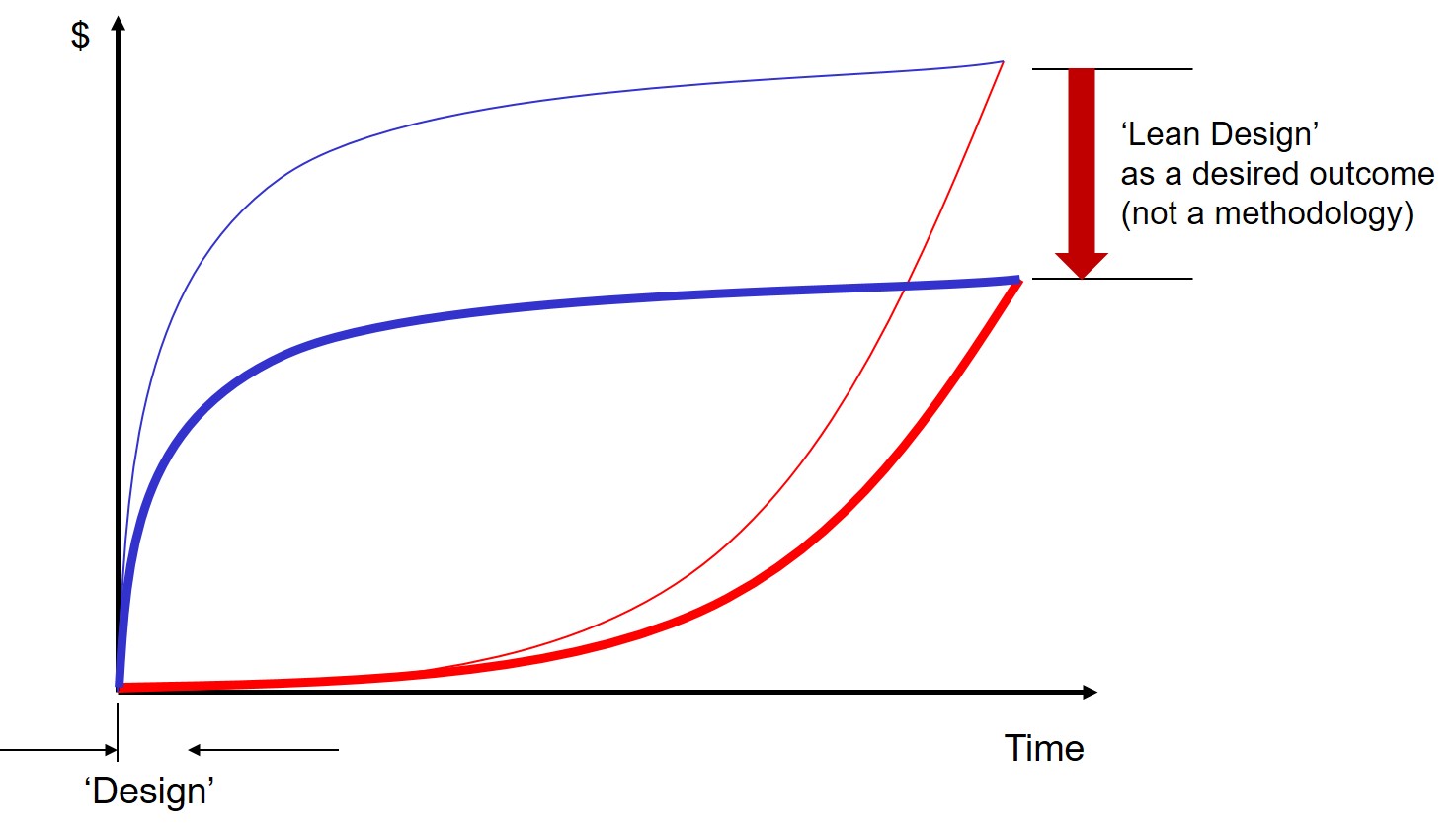
Reducing the overall cost of projects is a fine and noble ambition. You only have to see £20M disappear in a puff of smoke (quite literally, the day I exploded a jet-engine – fortunately not on that first project) to really understand the value of taking as much care to do the best job you possibly can during the design process. But in a complex environment, you realise too that, no matter how good your calculations are, there’s a whole bunch of stuff you don’t and can’t know yet. You have to try stuff out, learn from it, and make sure you operate in such a way that you’re always, at every moment, looking to spend the least amount of money to answer the greatest number of unknowns.

The only thing that ‘Lean Design’ contributes to this story is that it recognises the desirability of reducing the overall cost of projects…

lean design 2


…beyond that, rather like Axiomatic Design, it has nothing useful to contribute to the story of how to actually achieve the stated goal. The tools are wrong, the methods are wrong, and the overarching thinking is 180degrees wrong. If a ‘Lean Design’ consultant approaches you with a promise they can reduce your project ‘waste’ your best bet is to laugh at them.

If you’re feeling mischievous, you could ask them what they know about complex adaptive systems. Or contradictions. Or intangibles. Then notice the look of confusion and horror on their faces. And then laugh at them. With a following wind, like Professor Suh, garden slugs and Dengue-fever they should be gone within a couple of years. In the meantime, try and keep smiling.


Bad Design #2348

In the greater scheme of things, nearly all design problems are trivial problems. When a designer does a bad job, we compensate with workarounds. The more mediocre the job, the more creative the workaround.

I broke one of my rules. I stayed at an Ibis hotel. The wound was self-inflicted. In my defence, it was an Ibis in Singapore. So things weren’t as bad as they would have been had it been an Ibis in the UK, or – worse – France. In practical terms, an Ibis in Singapore means, a) the mattress is slightly more than 2” thick, and b) there’s something that resembles an actual bathroom rather than the all-in-one, claustrophobia-inducing, seasickness-inducing, artificial-plastic ‘pods’ that we get in Europe.

All was going swimmingly well until I stepped into the actual shower with it’s actual tile wall. Very thoughtfully, there was a bottle of shampoo and a separate bottle of body-wash. This is what they looked like:

bad design

Can you spot the flaw?

Admittedly, it’s a fairly subtle one, at least as far as the designer – I assume someone drew it at some point – and the installer were concerned. I think their primary motivation was aesthetic elegance. No, I think it was their only motivation. Neither person was ever likely to have to make use of the finished product. You’d have to be stood in the actual shower to do that.

The body wash on the right turns out to be the main problem. Squeeze it with your right hand in order to dispense soap into your left hand and everything works swimmingly. Try and squeeze it with your left hand to dispense soap into your right hand, however, and things get somewhat trickier. Mainly because there isn’t enough space between the bottles to fit your fingers.

Okay, I know it’s not a big problem. If I’d packed my lump-hammer, for example, it would’ve been easy to solve: club the bottle holders off the wall and phone down to reception for a bar of soap. Like in the good old days.

TRIZ is a great asset when it comes to solution ideas for problems like this. And I haven’t even started to think about Inventive Principles 24 or 25 yet. Or, for that matter, whatever the Principle is that tracks down the design schools that graduated the Ibis designers and remind them that just because they deal in trivia doesn’t excuse their inflicting never-worked-in-the-real-world incompetence on students. Design-Thinking my arse. Maybe that’s Principle 41?

Or maybe this is all about Ibis corporate philosophy: we’re cheap so people expect – nay, need – half-baked design. Maybe they’re just upholding brand value?

The Thin, Thin Line Between Mindful & Mindless

mindful 1

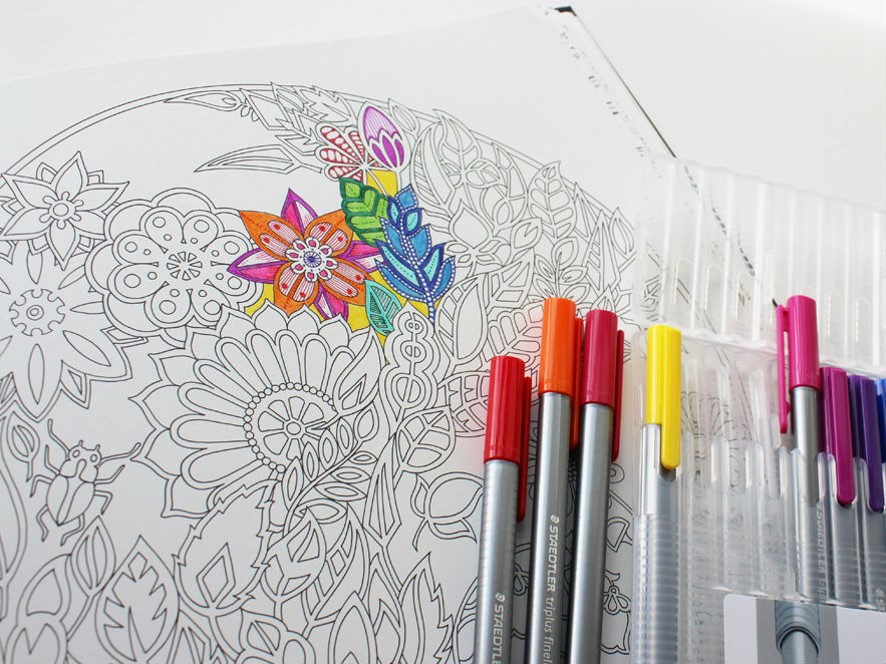
I visited my local bookshop this weekend. I noticed the Mindfulness section had grown since my last visit. Hmm. The next thing I noticed was the section’s expansion was largely accounted for by adult colouring books. In fact, about 80% of the total mindfulness shelf space seemed to have been allocated to colouring books. This doesn’t feel like good news to me. I’m sure it won’t be, either, to the mindfulness community.

I know the devolution of any new idea to its lowest common denominator is a fact of life. The usual trajectory seems to go something like this. Someone announces a new idea to the world. If it’s any good, other people endorse it. These people don’t understand the idea quite so well, but they can see certain attractions. They recommend the idea to others, via these summarised attractions. More people pick up on the idea. They understand it even less, so they simplify it even further and, if they chose the right simplification, the idea goes viral. The idea originator is torn. On the one hand, they’re about to make a lot of money. On the other, the original idea has been reduced down to a meaningless catch phrase. The publisher says, don’t worry, use the money to set up an institute. Or maybe a university. Life is sweet. And nothing changes. No-one, in this case, is any more ‘mindful’, and societal stress levels have gone up and not down.

What I think is so startling these days is just how quickly this lowest common denominator tailspin kicks in. The whole of Devon, going by the shelf-space in my local bookshop, is colouring in pictures of enchanted forests. The line between mindful and mindless has become razor- thin in less than a year.

Forget the meaningful intent of ‘being mindful’, instead we now get colouring books. And a revisionist interpretation of ‘carpe diem’ that now tells everyone it means ‘enjoy the moment’. We literally couldn’t have travelled further from what the poet Horace originally meant. ‘Seize the day.’ As in, do as much as you can today, because you many not have the opportunity tomorrow.

The problem is that sounds like hard work. It was meant to be. Today, though, there seems to be a strong aversion to hard work. Life is stressful. I get that. Great to ‘live in the moment’ and colour-in butterflies for a couple of hours, but please don’t expect to feel better at the end of it. The bills still haven’t been paid, the kids have wasted yet another evening playing Mortal Kombat XL, and tomorrow’s school lunches still haven’t been made. Still, your stress levels are lower, right?

If they are, it’s a temporary phenomenon. That beautifully coloured picture of the enchanted forest proudly taped onto the fridge door is living testament to your increased fragility. Your decreased ability to cope. Your wilful blindness. Whenever we choose the easy option we make ourselves more vulnerable to the bad stuff real life throws at us. By extension, when we see broad swathes of society deciding to take the self same low road, we make the world an awful lot more fragile too.

Still, not to worry, eh, we’ve got National Colouring Book day to look forward to. August 2. Be there or be mindful.

mindful 2

The Grit-Talent Contradiction

“You think intelligence and grit can succeed by themselves, but I’m telling you that’s a pretty illusion.” Nancy Kress, Steal Across the Sky

“Anyone can be tough for a season. It takes a special kind of human to rise to life’s challenges for a lifetime.” Chris Matakas, The Tao of Jiu Jitsu

We’ve been doing a lot of psychometric analyses of innovators in the past few months. Trying to establish whether there is some kind of universal ‘DNA’ of the successful. Turns out there is. At least on one or two dimensions. Talent is one. Having talent helps. But grit, it seems, helps more. Having both is better still.

And that’s where things seem to go astray. For the most part, it seems talent and grit form a relationship that is strongly either/or. People with natural talent tend to assume that it alone will help them to get on in life, and so they tend not to score highly on tenacity, persistence and all those other human attributes we integrate together to define ‘grit’. People with less natural talent, on the other hand, if they want to get on in life, usually do so by compensating for that lack of talent through large amounts of grit.

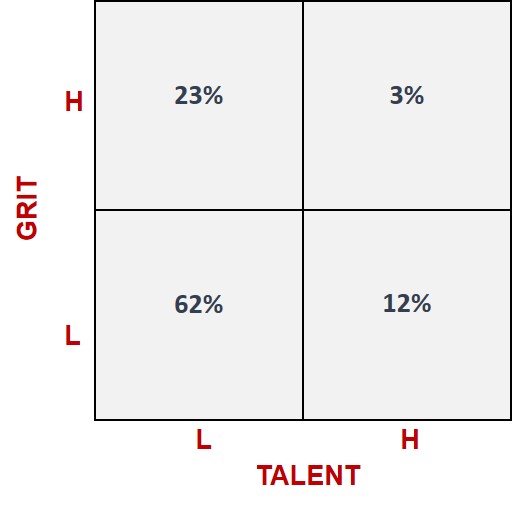
According to our measurements in and around the shady world of innovation professionals, we estimate the following split between the four different combinations of high or low talent or grit:

grit 1

Although we can’t definitively make a causal link between innovation success and where people sit within this 2×2 matrix, the evidence makes it pretty clear that the small proportion of contradiction-solving people in the high-grit-high-talent quadrant are the ones that generate the highest level of success.

Instinctively, I doubt whether many people would argue with the basic idea. That’s what ‘solving’ contradictions is all about: if we achieve the best of both conflicting attributes, good stuff happens.

The surprising part is perhaps why so few people end up in the quadrant. 3%? How could that be?

Maybe it’s a case of emergent behaviour? The world gets precisely the right amount of innovation because it has exactly the right number of high-talent-high-grit individuals? But then again, with 98% of innovation attempts ending in failure, maybe if organisations need to do better, they need to encourage a higher proportion of their people to get into the top right quadrant?

If that’s the case, what are the problems that needs to be solved?

As is often the case in these kinds of situation, it is instructive to look at extreme cases in order to really get to the heart of the problem. In this case, I think a really good extreme involves the music industry and famous musicians. Particularly solo artists.

Example one, Van Morrison. I love Van Morrison’s music. Or at least I love what he released before 1991. And, if I’m really being honest and look at the stuff I repeatedly listen to, before 1982. He’s a man with an enormous amount of talent, but it was only when he combined it with grit that he produced what – I think – is truly great music. During the 1970s he was, and no doubt, f you read interviews, felt massively mis-served by the music industry. He was the archetypal ‘musician’s musician’ gaining lots of critical plaudits, but very little apparent reward. He was angry at the world and he managed to direct the anger productively into the music. Then he got successful. The plaudits grew. He took his foot off the accelerator. Still the plaudits kept coming. He could virtually do no wrong in the critics’ eyes. The more half-hearted the music, the better they seemed to like it. So why try? The grit disappeared.

I’ve seen him five times in concert. Two times he was absolutely spell-binding. Three times he gave the distinct impression he wasn’t interested. Contractual obligation was the only thing keeping him on the stage. Needless to say the two times I stayed to the end were in the grit-and-talent years.

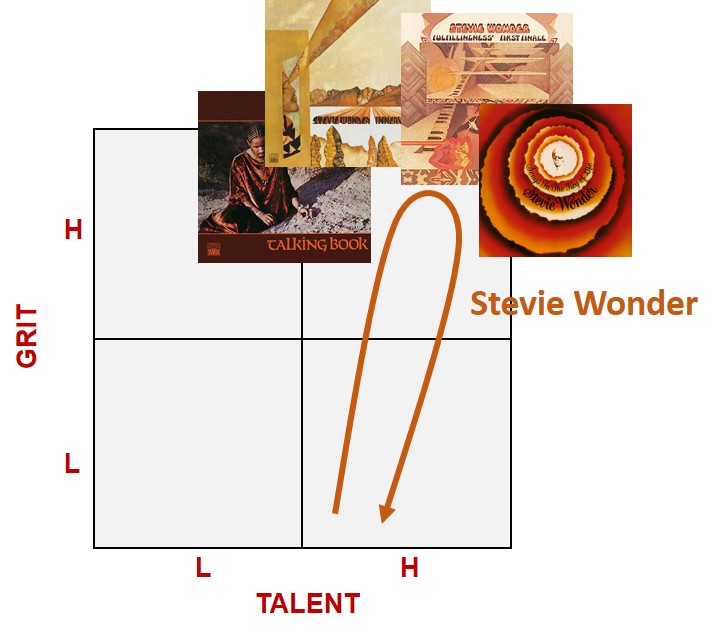
Example two, Stevie Wonder. Again massively talented. But only during the period 1972 to 1976 do I feel like he was really trying. Those were the grit years. Grit for a slightly different reason than Van Morrison. Wonder, from the age of 12, had always been a commercial success. His problem was that he wanted to travel his own path, not the one his record label wanted. He could’ve towed the line, but he had a bigger vision, and, after his 21st birthday, he put his foot down. Enter the grit. And a run of four consecutive classic albums.

grit 2

Check out http://www.i-sim.org/icsi2017/Keynotes&Tutorials.html a global compilation of every recording artist’s reviews ever, and notice just how far ahead of his other albums they are. After he’s proved is point, he again appears to take his foot off the pedal. Life gets easy and there’s nothing to fight against anymore.

It’s possible to do just about the same search for every other major artists. Check out their ‘best’ albums and they’re always from a ‘grit’ period. Rolling Stones? Threw away the grit after 1978. The Who? The grit disappeared in 1978. Eagles? 1976. The Beatles? 1970.

Actually, the Beatles appear to offer up an interesting new angle on the talent-and-grit story. The grit part stemmed first and foremost from the competition between Lennon and McCartney: if Lennon wrote something good, McCartney felt compelled to better it. And vice-versa. After they were unable to be in the same band together, neither of them produced anything truly great ever again. There’s a case to be made, too, I think, that McCartney was the talent and Lennon was the grit. Either way, the Beatles offer up the thought that talent-and-grit can be a collective affair. A lot of great songwriter pairings – Morrissey/Marr, Page/Plant, Goffin/King Strummer/Jones – seem to prove the point. Two points: two or more different individuals can serve up a talent-and-grit whirlwind if the conditions are right, and secondly, they tend not to be able to sustain it for very long. Fighting the talent-and-grit contradiction requires hard work.

Very few individuals manage the sustainability feat either if the music industry serves as any kind of model for the world. Prince, maybe? Miles Davis? Keith Jarrett? Maybe they’re the people we need to go study more deeply if we really want to solve the contradiction.

Suggestion Scheme Suggestions

Most Suggestion Schemes fail. Most fail dismally. The wasted effort is sad. But not nearly so sad as just how predictable the failures are. We’ve had a few jobs in recent times to advise enterprises on the introduction of a new Suggestion Scheme. Or (worse still) a Dragon’s Den/Shark Tank type innovation competition. Mostly, our advice has been either ‘don’t do it’, or ‘if you insist on doing it (or, more likely, if your boss insists you do it), make sure you present it in such a way that participants know it is merely a bit of fun, and that you’re ready to receive some ‘shooting the messenger’ flak from your boss.

We’re over-simplifying, of course. Answering questions like should we have or not-have a Suggestion Scheme comes attached to a minefield of dependencies. Ditto how many people to involve; what you want them to do; when you want them to do it; what you need management to do, etc.

Fortunately, we know what a lot of those dependencies are these days. Thanks to a longstanding programme of research to decode what works, what doesn’t work, when it works and when it doesn’t.

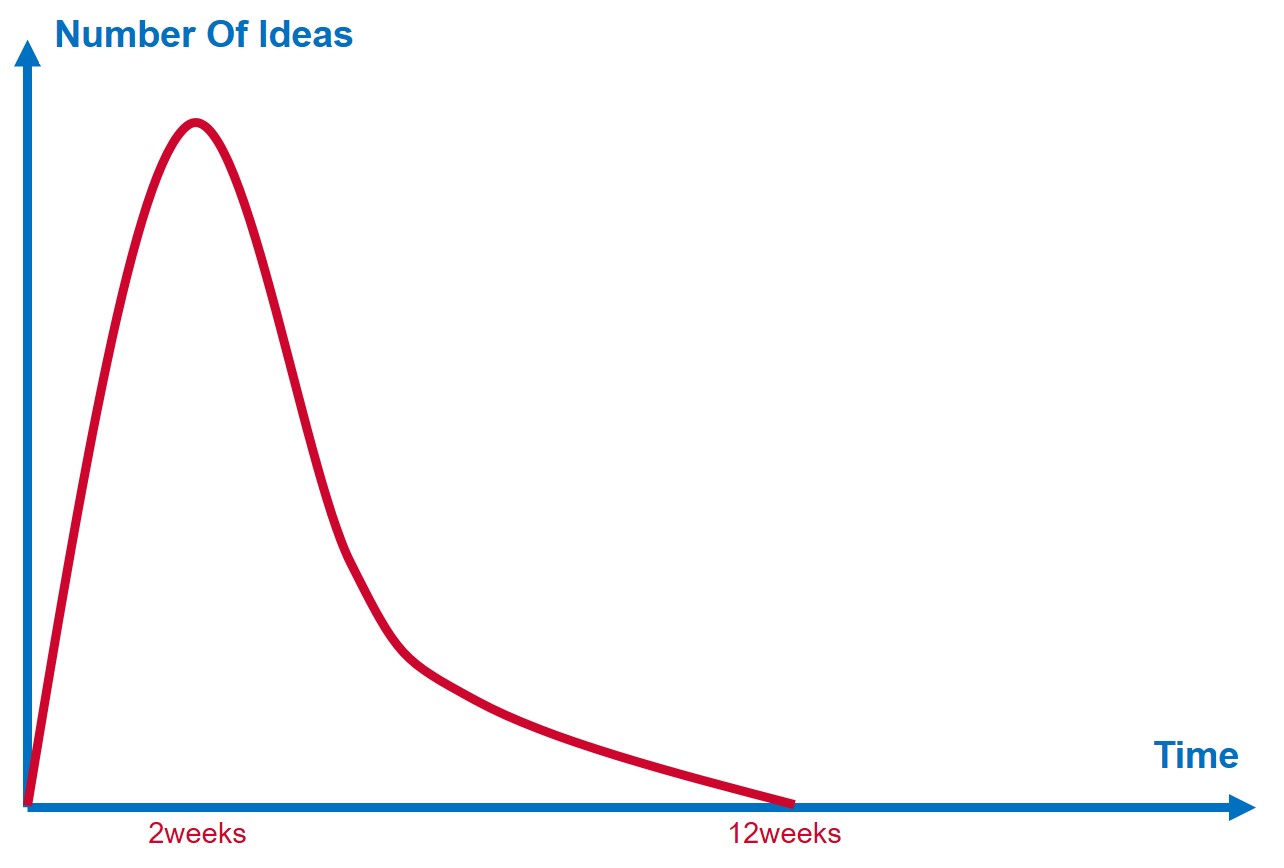
First up, a couple of universals. If it’s the first time an enterprise is considering having a Suggestion Scheme (alarm bells should already be ringing!), then what we know will happen is a massive backlog of frustrations will be unleashed. Lots of suggestions will arrive. The flood will continue for a while, but after it peaks there will be an initial sharp decline followed by an ever-slowing trickle down to an embarrassed zero. Something like this…

suggestion 1

…which, if it looks like the first half of the Hype Cycle curve, is probably no coincidence. A trigger followed by a ‘peak of over-inflated expectations, followed by a ‘trough of despondency’, followed, if matters aren’t corrected, into a lonely, curled-up-in-a-corner death.

Second universal: the Law of ‘Try Again’. When the dust has settled on the previous failed Suggestion Scheme attempt (and very likely when there has been an (in-)appropriate change of personnel) it is time to try again. The resulting idea-count curve will look the same. Only the peak will be lower, and the death will come sooner. This trend will continue in a patter of ever-decreasing circles each time there is a new iteration.

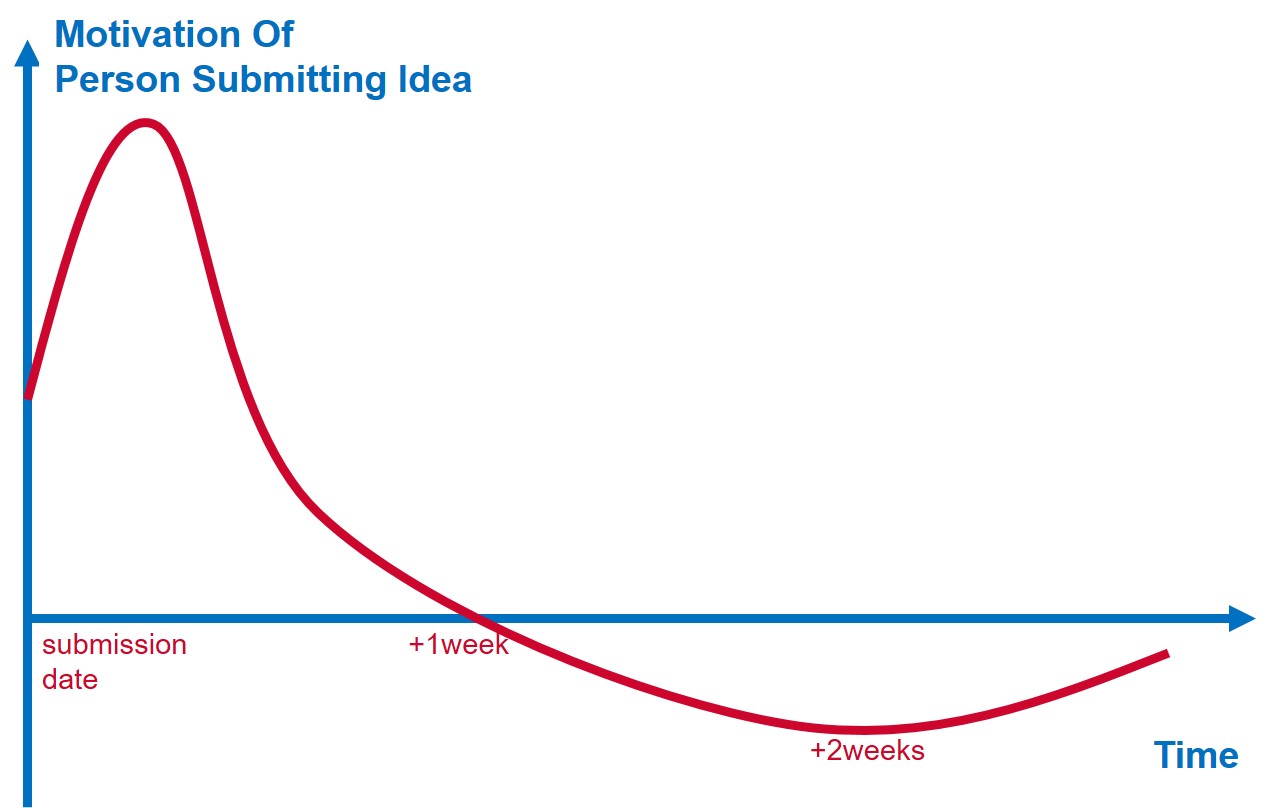
There are many reasons why Suggestion Schemes fail, but two stand out. The first relates to the amount of time it takes for management to respond when a person submits a suggestion. Here’s another curve…

suggestion 2

…it too looks a lot like the Hype Cycle. The vertical axis this time is about motivation of the person that’s just taken the brave decision to submit an idea. What the graph basically says is that if that person doesn’t get some feedback on their idea within a week, their motivation is effectively disappeared; if they don’t get feedback within a fortnight, their idea-submitting motivation has dipped below zero. Which effectively means they now see the Suggestion Scheme for the joke that it is. Not that it was ever funny.

The second reason for failure flips us to the management side of the equation. No-one – managers included – comes to work intent on doing a bad job. No manager sets out to de-motivate the people that work for them. The reason it ends up happening is because few managers understand the vonClauswitz ‘critical mass at the critical point’ rule. Which, in Suggestion Scheme terms means, if you need to respond to the suggestions that arrive into the Scheme within a week and there are only so many people able to provide that feedback, then that is the critical mass. If the critical mass isn’t capable of handling all the suggestions in a timely fashion, the critical point can’t be ‘every employee’. It’s only possible to launch the scheme, in other words, to the size of population that management can reliably respond to within a week.

This in turn requires us to think about a final ‘universal’: Innovation Capability Maturity. The type and size of Suggestion Scheme an enterprise might consider deploying, also depends crucially on the Level of Capability of that enterprise.

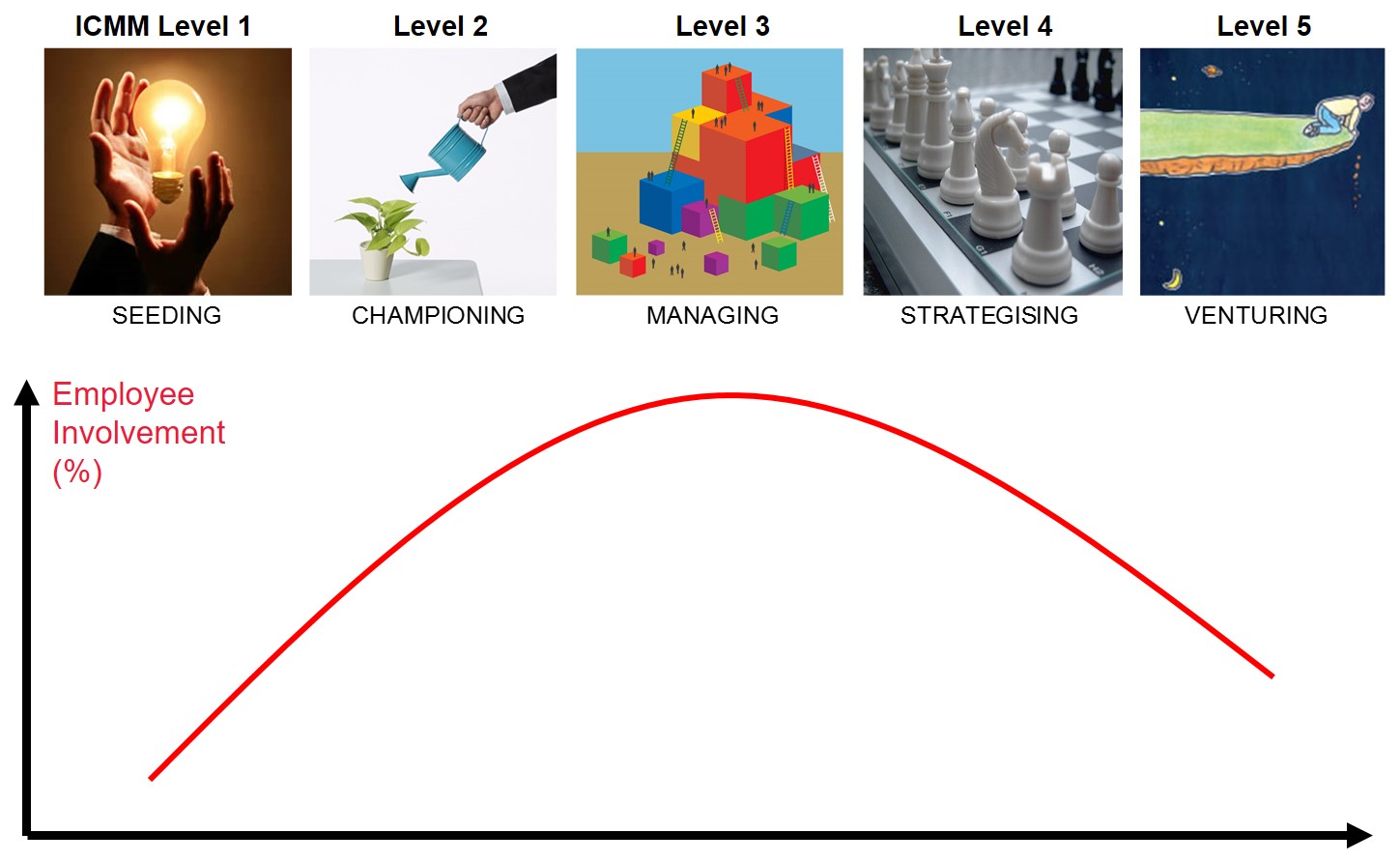
There are currently five distinct Levels in our Innovation Capability Maturity Model (ICMM). Each requires a different Suggestion Scheme strategy, with different objectives:

ICMM Level Primary Objective Key Contradiction Key Success Driver
1 getting anybody to buy-in lack of trust creating a ‘sense of progress’ – real success stories (size immaterial)
2 getting anybody to stay in insufficient (time) resources releasing time from day-to-day work to explore improvement ideas
3 getting everyone to buy-in suggestions get stuck at silo walls cross-functional teams and KPIs
4 getting people to suggest good questions rather than answers “a good question is worth a thousand answers” = undoing lots of previous suggestions good questions = contradictions, customer outcomes (tangible & especially intangible)
5 achieving requisite question/answer ratio prioritisation of questions and their multitude of answers embracing complexity, surfing the edge of chaos, and emergent markets

Taken all together, the very likely connection between ICMM Level and the number of employees productively engaged in Suggestion Scheme activities will tend to look something like this:

suggestion 3

Which means a Level 3 organisation like – all-time classic Suggestion-driven culture – Toyota will have everyone engaged in submitting and implementing improvement ideas. Versus a Level 1 organisation (i.e. most organisations on the planet), which really ought to have a much lower (‘critical mass at the critical point’) proportion of people asked to submit suggestions. But then also versus what we might expect to see in a Level 5 enterprise (of which there are probably, realistically, two or three on the planet), where there’s a living realisation that questions are much more important than answers, that important questions require a lot of time and effort to answer, and that the real trick in life involves understanding and embracing complexity – understanding how the world works at a ‘First Principles’ level, and looking for non-linearities in which small inputs create non-linearly spectacular outcomes.

Welcome to the machine.

When In Doubt, Do No Harm #1: Peanuts

peanut1


In seat 32F, Geoff Knight opens his snack-size bag of peanuts, tips a small pile of nuts into his hand and drops them into his mouth. The camera zooms in on a tiny, sub-micron shard of peanut debris that accidently finds its way out of Geoff’s mouth. The camera pans around, tracking the shard as it swirls upwards towards the overhead lockers.

45 seconds later, in seat 14A, four-year-old Holly Payne starts tugging on her mother’s arm. The first signs of anaphylactic shock begin to kick in.

Two minutes later, the cabin-crew are scrabbling around looking for the emergency epi-pen before Holly’s throat closes up completely. For a moment it’s touch and go whether Holly is going to make it or not. Some of the crew look frightened. Next time, they vow, we’ll make sure no-one eats nuts on the plane. Handing out pretzels and telling passengers not to eat nuts for a couple of hours is a tiny sacrifice. Who wouldn’t abide if they knew the stakes?

This is how fragile we have become. The bottom – hopefully the bottom – of a long, slippery slope of best intentions delivering worst possible outcomes. Doing incredible harm by mandating the opposite.

40 years ago kids ate dirt. I remember a friend of mine telling me how his parents had caught his little sister eating what they thought were raisins off the kitchen floor. They turned out to be woodlice. They stopped the child from eating any more, but the main thing my friend remembered was how they’d also burst out laughing. Partly because their daughter was eating woodlice, but also partly because they didn’t know exactly how many.

Eating woodlice is probably not such a good idea. If we eat them and they make us sick, that’s a precious feedback loop: now we know not to eat them again. If we eat them and we don’t get sick, it was probably okay. Natural systems are full of these kinds of feedback loops. They’re an important aspect of sustainable self-organising systems. They’re also an important way of making those systems more resilient. Natural systems need to be stressed. If we remove the stress, we make them weaker, and more fragile. During the last 40 years, by making the world a lot cleaner, more sterile place, we’ve made ourselves a lot more fragile. Allergies at epidemic levels; asthma at epidemic levels. We’re literally sanitising ourselves to the edge of oblivion.

Don’t get me wrong, I have massive sympathy for Holly Payne and her parents. Having a child so allergic to such small quantities of peanut dust (it’s a true story, by the way, albeit I changed the names) must be a living nightmare for them. But the answer to their tough problem really isn’t to start banning peanuts on aeroplanes for everyone else.

I don’t mean this in a selfish, ‘I like nuts, so why should I stop eating them?’ way. I’d be very willing to help arrange for Holly to walk around in her own hermetically-sealed flying suit with it’s own dedicated ultra-pure oxygen supply if needs be. What I’m trying to get at is that attempts to ban nuts on planes – or anywhere else for that matter – causes harm to all of us. The reason we’re not all – yet – allergic to peanuts and other ‘contaminants’ is that we get to breathe un-cleaned, un-conditioned air that’s full of all sorts of microscopic harmful crap. That’s the stuff that keeps us all resilient and healthy.


On Press Conferences And Emotional Maturity

I’m in the US at the moment. It’s the day after President Trump’s first big press conference. The media is in heaven. The polarization of the nation seems to be heading in to over-drive. Was Trump’s performance the first signs of a personality in meltdown? Or was it a double-bluff master-class in deflection and chaos-building? I thought I’d let our PanSensic tools have a little look-see.

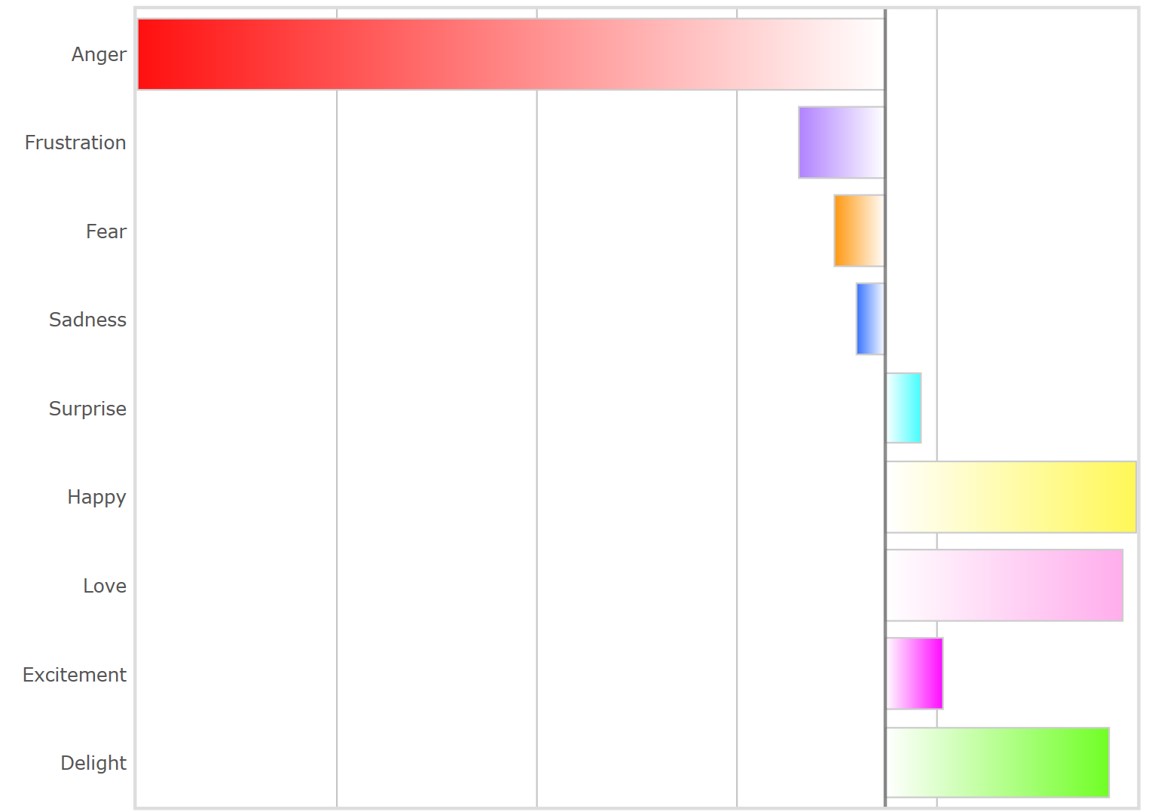
Here’s what emerges when I plugged a transcript of Trump’s words into the software. First up a basic sentiment analysis:

trump press 1

Not too much ambiguity there. Trump might have said he ‘enjoyed’ locking horns with the press, but I think this picture tells another story. For the most part, in lay-person terms, he lost it.

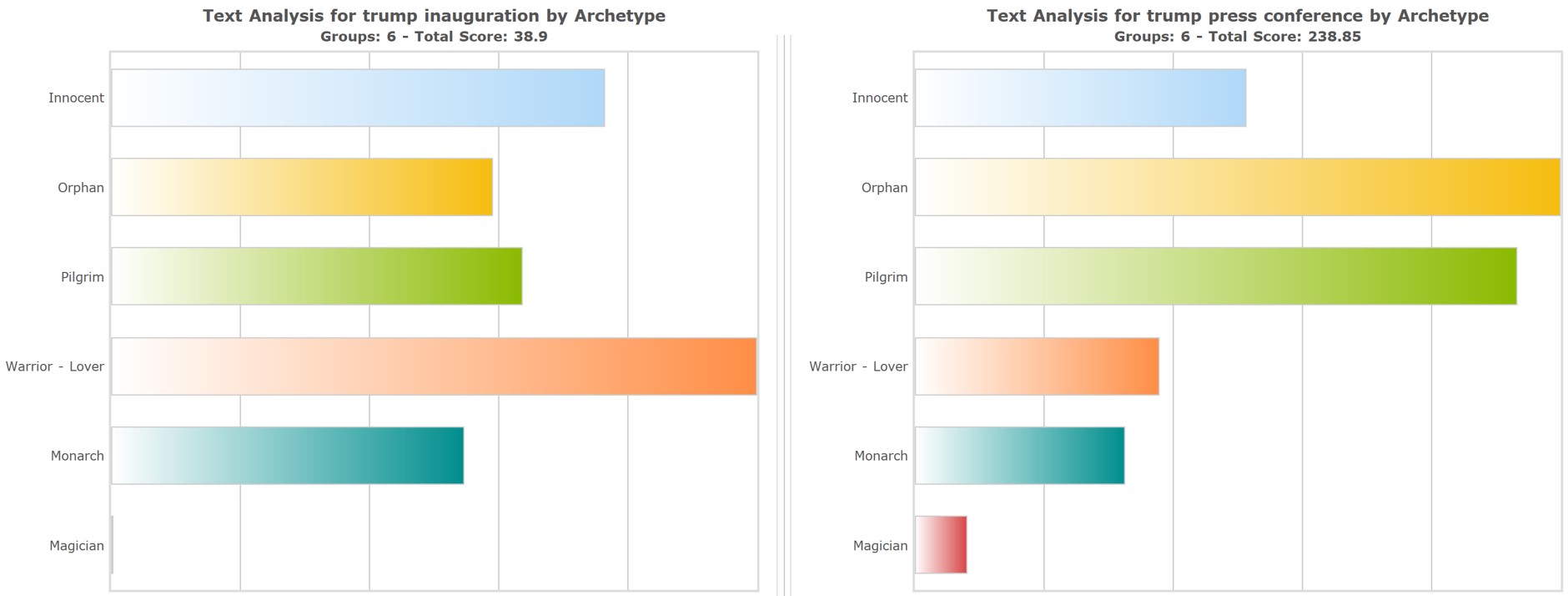
Then I plugged the transcript in to our Archetypes tool. This is the tool to gauge emotional maturity. Even without knowing the in-detail meaning of each of the elements the tool is measuring, hopefully the labels are somewhere close to self-explanatory. I thought it would be interesting to see if anything might have shifted between the 20 January inauguration speech and yesterday’s press conference. Turns out it has:

trump press 2

The Innocent-Warrior has turned into an Orphan.

I don’t think that’s good news.

Gravesian Psychology & Donald Trump

Okay, I know it’s difficult to read anything of any long-term significance from the analysis of one speech, but then again, it was an important speech. A speech intended to set the tone for the next four years. I’m talking about Donald Trump’s inauguration speech on January 20.

And the reason for being intrigued by the ‘only America first’ speech is how something had changed compared to what President Trump had been saying through the course of the election campaign. 

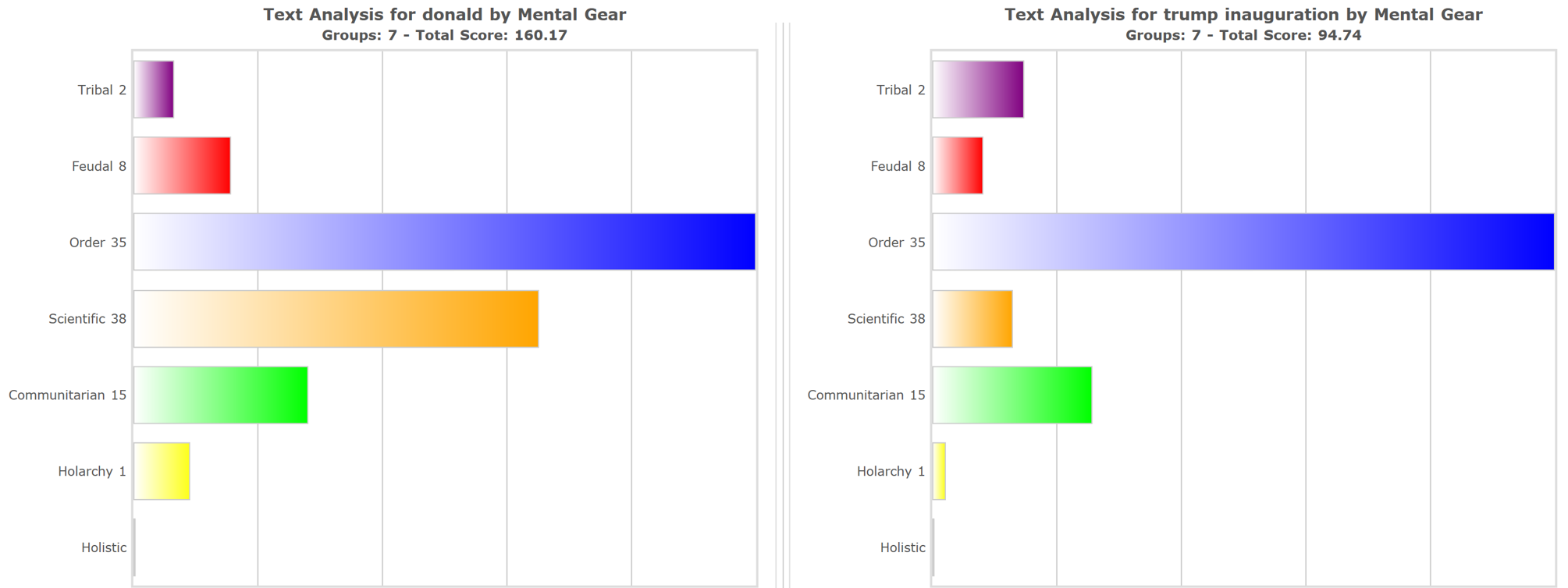
Here’s the results of our Mental Gears analyses. On the left-hand side is a composite of the various different speeches the President had made through the campaign, and on the right is the equivalent Mental Gear profile result when we analyse the inauguration speech.

 inauguration

Spot the difference?

No more ‘Scientific’ (Orange) calculation and desire to look at options, and lots more (Blue) Order. Which means goodbye ambiguity, and hello ‘with-me-or-against-me’ absolutism.

As I say, I’m not sure if anything significant can be read into the shift. If I was going to read anything significant into it, I’d say that the ‘allegiance to all Americans’ comment in the inauguration speech actually means something closer to its polar opposite.