One of life’s small annoyances. First up, a watched pan of water or milk never boils. So you go and do something else. Then, by the time you return, half the contents have boiled over and left you with a charred mess to clean up.
The simple
solution to this problem would be to just wait. Don’t try and do other things.
But that’s inefficient. In which case, it’s time to consider whether TRIZ might
be able to help solve the boiling over contradiction.
The problem is
basically a conflict between the desire to not have the pan boil-over
(stability) being prevented by the fact that there’s a continuing energy supply
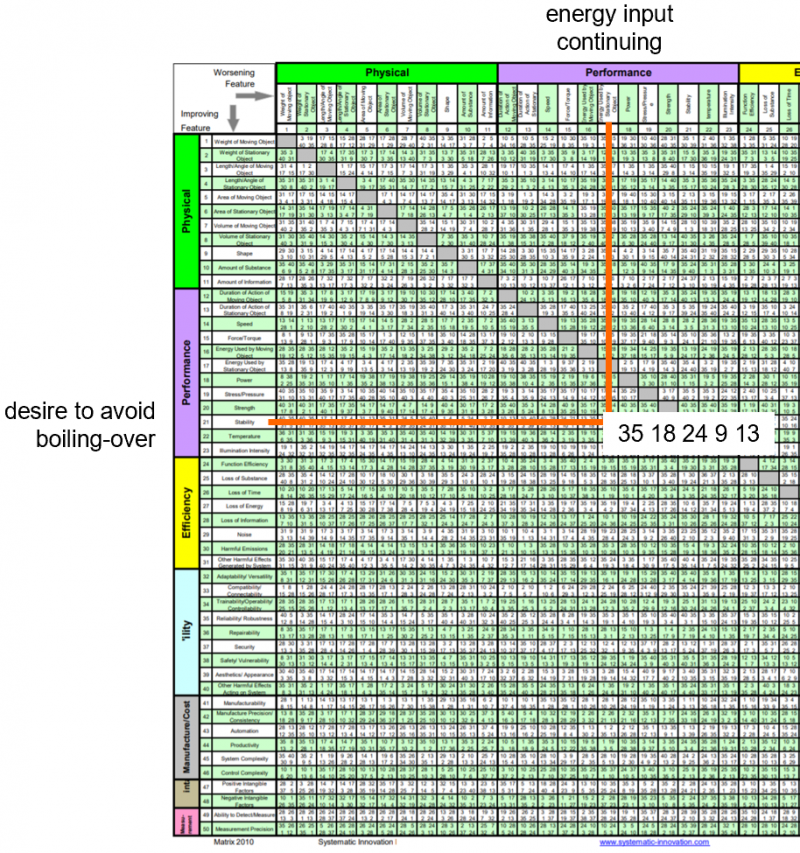
into the pan. Here’s what the problem looks like when mapped onto the Matrix:
Third on the
list of Inventive Principle suggestions is number 24, Intermediary. Which in
this specific case equates to perhaps one of the simplest use of existing
resource solutions ever… place the wooden spoon you were probably using anyway
on top of the pan. Something like this…
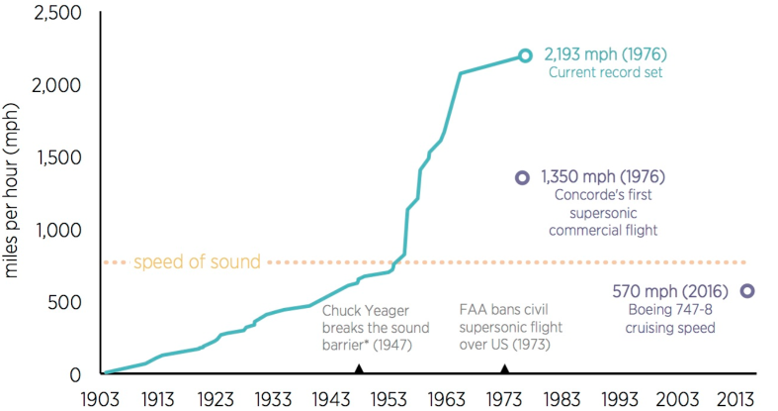
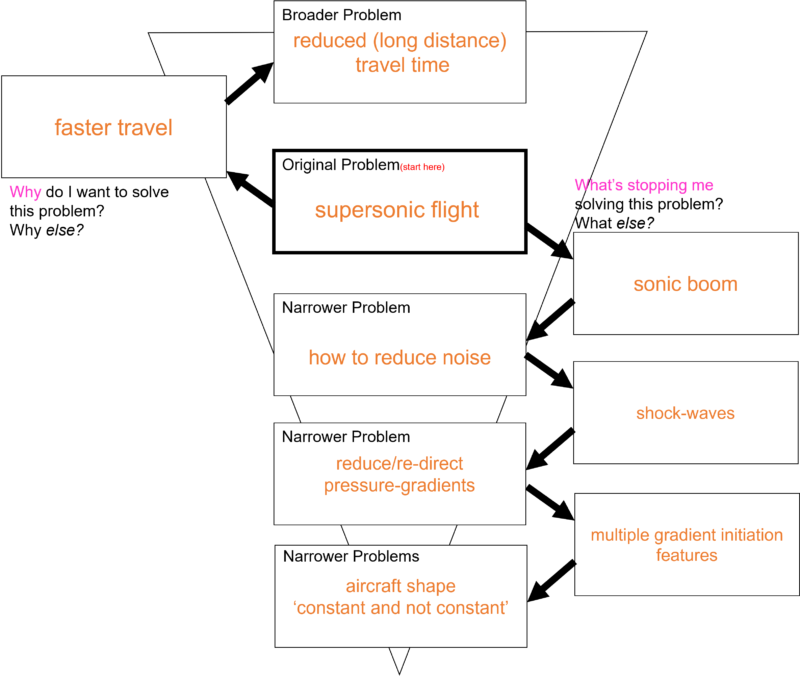
It seems strange to say it, but the speed record for atmospheric flight hasn’t changed since 1976. The speed-versus-date graph shows a pretty good approximation of an s-curve. Which should tell aircraft designers that there’s a contradiction to be solved. Actually several. Aircraft designers, even though they tend not to possess a lot of TRIZ awareness, almost invariably have the luxury of having plenty of time to think about problems. In theory, this means that they will get there in the end. If they had known TRIZ, meanwhile, they might have conducted a root-contradiction analysis. Something like this:
At the root contradiction level, as has been known by designers for some time, any big variation in shape on the body of the plane, like the cockpit jutting up at the front or the tail sticking up at the back of the plane, will produce a shockwave. To minimise the shockwaves that travel down to the ground, you need to change the shape of the plane and make it far more streamlined, smoothing out the variations in shape and spreading them out across a much longer body.
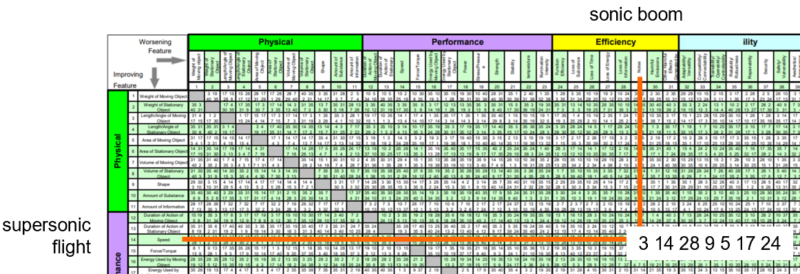
At its surface level, though, the speed contradiction is all about sonic boom. And the fact that, when an aircraft flies supersonically over urban areas, it is likely to cause a fair few broken windows and phone-calls from citizens thinking the world is ending. Here’s how this speed versus noise problem is mapped onto the Contradiction Matrix:
From this list, Principle 17, Another Dimension forms the most immediately visible feature of NASA’s current X59 project. The plane is 99 feet, 7 inches long, roughly a third of which is an extended, flattened-tip nose leading as seamlessly as possible back to the swept-back wings and a single engine at the rear.
Look a little closer and we can see another example of Principle 17 in action: The engine intake and exhaust, both of which are traditionally housed on the underside of the plane, have now been shifted to the upperside. Through this geometry shift, the wing blocks and prevents the exhaust from interacting with the shock waves on the bottom of the aircraft.
Zoom in further
still and we see all the necessary (Principle 3, Local Quality) geometric
features positioned in such a manner that the shock waves each one instigates are
kept parallel and separated from each other, so they don’t combine into a loud
sonic boom:
traditional versus X59 shockwave patterns
The X59 is scheduled to fly for the first time next year with these Principle 3 and 17 features incorporated. The theoretical modelling seems to suggest that the sonic boom power levels will be reduced by a factor of somewhere between 8 and 10, making the traditional ‘boom’ into a less intrusive ‘thump’. Time will tell whether society says this will be good enough. If it isn’t, my Contradiction-Matrix influenced bet is that the designers will need to get beyond geometry and start thinking about Principles 28 and 9. You heard it here first. No pun intended.
Following on
from yesterday’s Grey Swan Top 5 blog, I thought I’d spend a few minutes
thinking about the ‘betweens’ aspect of the story. That’s ‘betweens’ as in ‘it’s
not so much the things that are important as the relationships between those
things’.
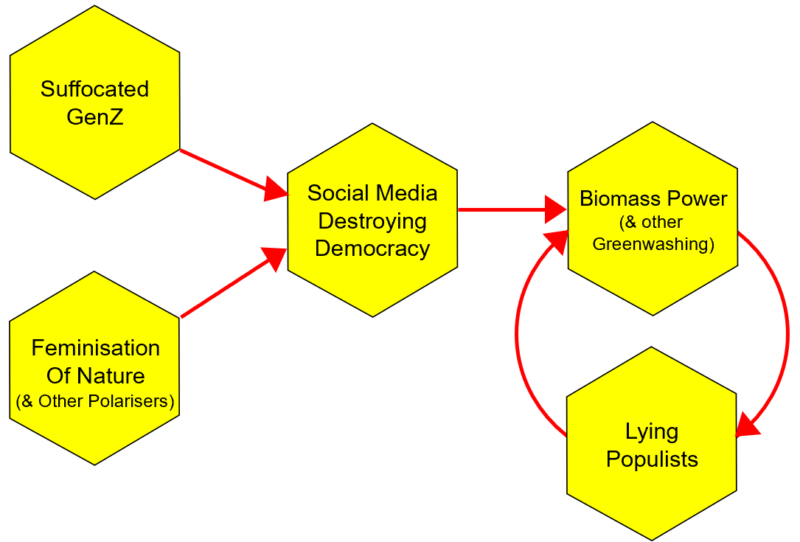
Here’s the
resulting Perception Map (which, I have to say, became quite a bit easier to
create after I’d generalised two of the more specific of yesterday’s definitions):
I’m never sure whether a Perception Map with five components is going to reveal much that we didn’t know already. In this case I surprised myself a bit. Especially regarding the greenwashing-populists vicious cycle. Not so much the idea that Social Media’s unwitting destruction of democracy is the primary driver of the cycle.
COP26 should be
fun later this year… don’t believe (any/every)thing you read.
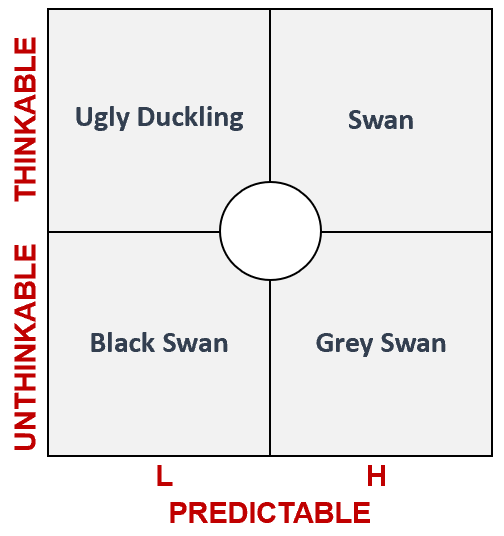
It seems like everyone knows what a Black Swan is by now. The jury is still out on Grey Swans. Black Swans are unpredictable, unthinkable high impact events. The most useful Grey Swan definition, I think, also involves unthinkable high impact events, but unlike Black Swans, Grey Swan events are highly predictable. We can now see that Covid-19 falls into this Grey Swan category. Everyone in a position of power knew that it was only a matter of time before the world would experience a pandemic, and almost all decided to bury their heads, ostrich-like, in the sand and hope it wouldn’t happen on their watch.
These kinds of unthinkable event are supposed to serve as a reminder that not-thinking about something because it sounds bad is not such a smart life strategy. From where I sit, I don’t think many people have taken the Covid-triggered hint. So, let’s try pushing the idea a little further: thinking about predictable-but-unthinkable events doesn’t just save lives, it makes society as a whole more resilient. And, if you’re that way inclined, it also highlights future innovation hot-spots.
Here, according to our research, are the current predictable-but-unthinkable Grey Swan Top Five. In something like ascending order of hot-spot-creation potential:
#5 Suffocated Generation Z – one being predicted as long ago as the mid-1990s in the Strauss & Howe Generations model. Over-protect kids and they’ll grow up to be fragile adults with few life skills. And therefore limited ability to thrive in a chaotic world. Locking kids down for a significant proportion of their childhood turns out to be the best over-protection mechanism ever invented. And the global chaos half of the story isn’t going away anytime soon. The oldest GenZ’s are now looking to enter the workplace. Ideally in a job that can be done over Zoom while sitting in a domestic cocoon. Following an interview they attended alongside their parents. When it comes to this ‘Artist’ generation’s inevitable turn to take over the reigns of power, things won’t go well. The standard of movies on the other hand will rise considerably. So it’s not all bad, I guess.
#4 Biomass
Power Stations –
becoming an iconic example not just of greenwashing, but how to sound like a
sustainable solution when in reality you’re making the problem you purport to
fix several times worse than it would have been if you did nothing. The second Law
of Thermodynamics tells us there’s no such thing as a free ride. It doesn’t
always tell us just how much collateral damage doing dumb things can do.
#3 Social Media Kills Democracy – Turns out that the innocent, sort-of well-intentioned act of personalising a person’s newsfeeds and recommendations doesn’t end up producing a world in which everyone is joyfully connected to everyone else. Instead what we end up with is a billion-and-one echo-chambers and a population that, as every day goes by, becomes less and less able to get along with people who’s opinions are slightly different to their own. How Mark Zuckerberg sleeps at night, I have no idea.
#2 Lying Populist Politicians – one of the lessons of Covid was supposed to be that anytime there’s a fight between a real virus and fake news, reality wins. The other thing that’s supposed to happen is that by making the world more transparent, anyone in public office is supposed to realise they can’t hide their shady-dealings anymore. Unfortunately, in the UK at least, the appalling performance of the Government – the polar opposite of a King Midas administration – has only served to reinforce the idea that those in power can say literally anything and get away with it. Couple that with opposition parties that still naively think revealing nitpicking truths is a vote winner, and its only a matter of time before a truth-less slippery slope turns into a cliff edge. Walk this way, confirmation-bias lemmings.
#1 The Fertility Timebomb – the greyest of the Grey Swans. The story that literally no-one wants to contemplate. Spray the planet with oestrogenic pesticides for a few decades and, surprise, surprise, it starts to play havoc with the reproductive systems of every lifeform. You start looking in to this one – starting with ‘The Feminisation of Nature’, a first warning shot published in 1997 – then look around at the myriad already visible manifestations and get so scared, you can see why Wilful Blindness is sometimes the only sensible way of maintaining our ability to function.
Finally, if your
own wilful blindness gene hasn’t kicked in yet, #0 on the Top Five Grey
Swan list is what happens when any of the five combines with any of the others.
That’s when the contradictions really start to become visible. Inside every
Grey Swan is an opportunity. Between every pair of Grey Swans is where the
opportunities become exponential.
“Ben Rogers: Say, Tom, let me whitewash a little. Tom Sawyer: No, no, I reckon it wouldn’t hardly do, Ben. You see, Aunt Polly’s awful particular about this fence – right here on the street, you know – but if it was the back fence I wouldn’t mind.”
1876 saw publication
of Mark Twain’s classic, The Adventures Of Tom Sawyer. It was a book ahead of
its time. Managing to pull off the rare feat of being both a rattling good read
while also being filled with meaning and symbolism. It was a story about the
titular mischievous young boy, who wittingly tricked his way to get everything
he wanted.
One of the most
prominent scenes in the book is the “fence scene”, where Tom Sawyer was tasked
by his Aunt Polly to whitewash their fence as a punishment for a prior
mischief. Tom Sawyer, being young, wished he could play instead, naturally. Ben
Rogers, one of his friends saw him doing this job and did his best to ridicule
the boy for his penance.
Most people
would bow their heads and take it in the chin. But Tom Sawyer not only turned
the situation around, he spun it like a top on his palm. At the end of that
day, a dozen boys painted the fence for him while he played to his heart’s
desire. Not only that, but he also convinced the willing volunteers to pay him for
the privilege.
The fence scene
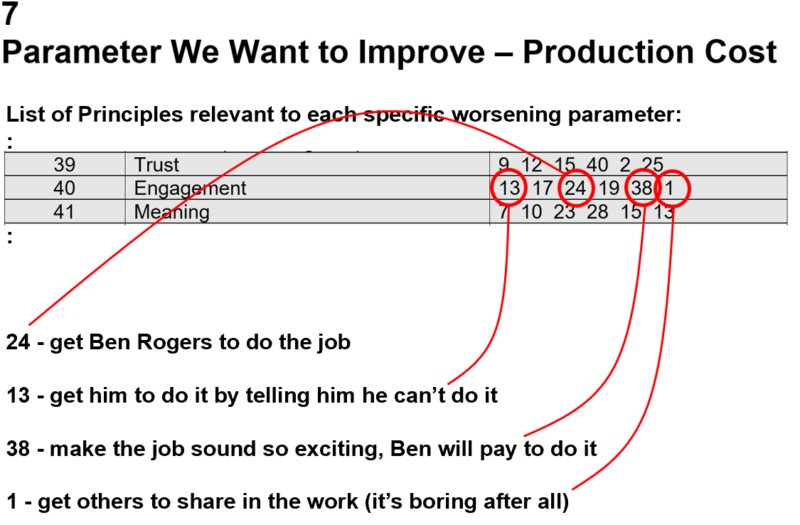
makes for a lovely ‘people’ contradiction example: Tom is forced to paint the
fence, but painting fences is a dull, tedious job. Here’s what the conflict
looks like when mapped onto the Business Matrix:
The overall life lesson being that there are no dull, tedious jobs. Or, as Mark Twain put it, “work consists of whatever a body is obliged to do. Play consists of whatever a body is not obliged to do.” Every job is an opportunity to tap into an intrinsic motivation. Every job is an opportunity for a (Principle 13) breakthrough solution.
I think I was probably thirteen when I first read Eric Berne’s book, ‘Games People Play’. Which, when I think back is a borderline weird thing for a thirteen year-old to be reading. I’m not how much I got out of it at the time, except, safe to say, enough for me to have periodically re-visited it ever since. Especially, this century, when I encounter the monster that is Transactional Analysis and need to remind myself of the dangerous propensity of cults to corrupt the original message.
The main point I took from Games People Play was that there are basically two ways if getting someone to do what you need them to do. The first way is for you to act as a ‘Parent’ and to treat the person you’re talking to as a ‘Child’. The second involves both of you behaving as ‘Adults’.
In a traditional hierarchical work situation, the modus operandi is typically Parent-Child, with ‘the boss’ acting as the instruction-giving, carrot-and-stick bearing Parent and the long-suffering underling serving as the recalcitrant, unruly Child. If nothing else, this approach is deemed to be efficient. So long, of course, we discount the cost of the passive-aggressive resistance of the masses. Which, because its not easy measuring that kind of thing, the bloated, wilfully-blind bean-counters at the top of the hierarchy have conveniently been able to ignore.
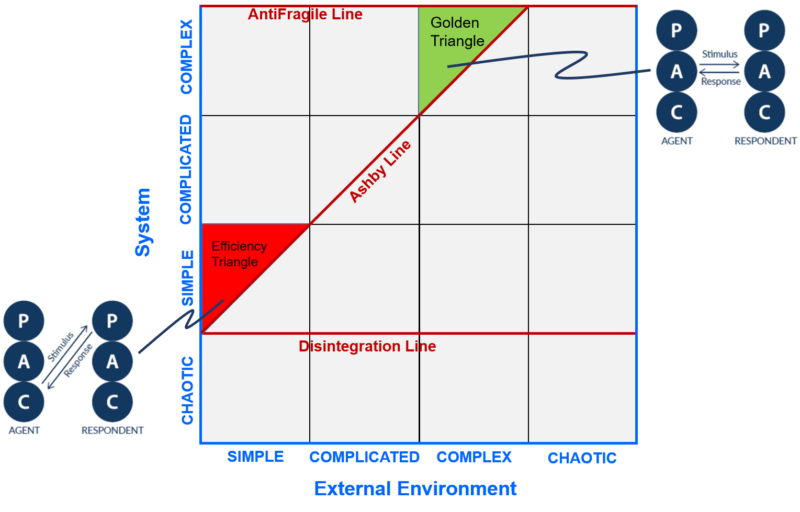
In Complexity
Landscape terms, this Parent-Child relationship is typically what we would expect
to find in the ‘Efficiency Triangle’. A place where the innate complexities of
the world and human relationships are stripped down to a list of ‘do that’ and ‘don’t
do that’ instructions. Which, if the work you’re asking people to do is largely
meaningless anyway (insert image of script-following call-centre workers here),
probably makes sense. Especially, again, if all the Parents are measuring is
number of rings before a call is answered and how many calls are handled per
hour.
Having observed a host of different call centres ‘in operation’ over the years, I’m pretty certain that without the Parent-Child communication method, all the Children would play truant most days.
Humans, on the other hand – e.g. call-centre workers ten minutes after the end of their shift – tend away from the Simple and towards the Complex. Or, put another way, turn into anxiety-ridden yet high-functioning, autonomy-seeking adults.
Acknowledging
the fact that humans are Complex means that the only sensible progress-making
option is to adopt the other communication strategy. Treat people like adults
and they will respond as adults. It’s not rocket science Part 387. Adult-Adult
is the form of communication required if we want to operate our enterprises and
teams in the Golden Triangle portion of the Complexity Landscape.
The Golden Triangle is a place built on transparency and trust. It’s a place where everyone understands there are crappy jobs that need to be done (‘clear your mess at the end of the day’), and that the best way to get them done is make sure everyone knows why tidy is good, shares the crappy load equitably, calls out freeloaders, and, perhaps most important of all, avoids the temptation to descend back into a Parent-Child world of stick-wielding tidy-police and increasingly resentful passive-aggression.
By my estimate, over 80% of the Systematic Innovation work we did last year related to what I think of as ‘business innovation’. Which in reality usually meant ‘people innovation’. Developing breakthrough technical solutions is now by far and away the easiest part of almost any innovation project. The real difficulties only begin to appear when people are asked to change from what they’re currently doing to what’s needed. People love change. They hate being changed.
Which sounds
like a contradiction. And, surprise, surprise, the vast majority of ‘people
innovation’ challenges also involve contradictions. Hence the reason for the
big leap in ‘intangible’ related parameters in the third edition of the
Business Contradiction Matrix.
The biggest challenge populating the tool has been finding a critical mass of real-world case studies to reverse engineer. The business literature has been a primary source of information, but when it comes to conflict situations at the personal level, the well is mostly dry. In true, ‘someone, somewhere already solved your problem’ fashion, we’ve long speculated on the rich outpourings of the world’s agony aunts and uncles. In a world where almost every newspaper or magazine includes a daily personal advice story, theoretically it shouldn’t take long to be able to accumulate tens of thousands of stories. In practice of course, the moment we find ourselves talking about humans, we’re also talking about complexity. Which in turn means that any agony aunt/uncle takes a tightrope walk as far as being able to offer meaningful advice to a correspondent that has probably only supplied a couple of paragraphs of background information. Couple that with the even bigger problem that once the aunt or uncle has dispensed their sage advice to said correspondent, the loop rarely if ever gets closed. Meaning that the efficacy of their advice remains largely unknown and unknowable.
This latter problem has ultimately been the one that caused us to shy away from the whole agony domain. Well, that plus the fact that most of us are engineers and therefore assumed to be somewhere along the autistic spectrum. Usually, in my own case, at the non-empathic end.
Anyway, a year and a half of lockdown ends up having an impact, one of which being what feels like an explosion in the number of people seeking advice, another being that I’ve now read enough of said ‘advice’ to recognise the whole agony aunt & uncle game is largely, like large parts of the psychiatry/psychotherapy world, a quasi-scientific sham. We might not be able to close the loop on the efficacy of agony-relieving advice, but we can at least take a heap of randomness out of the advice being dispensed to the lost, lonely and confused.
The gist of this
week’s contradiction is as follows:
“My partner and I are getting
married this summer. It is a small wedding, and I have invited my mum and
siblings. However, most of my family members are not supportive of my
relationship… My partner and I are worried about how they might behave at the
wedding, but I am concerned that disinviting them would be seen as
aggressive… I feel torn: I don’t want to deepen the rift that exists, but
at the same time I don’t want their behaviour to ruin our wedding.”
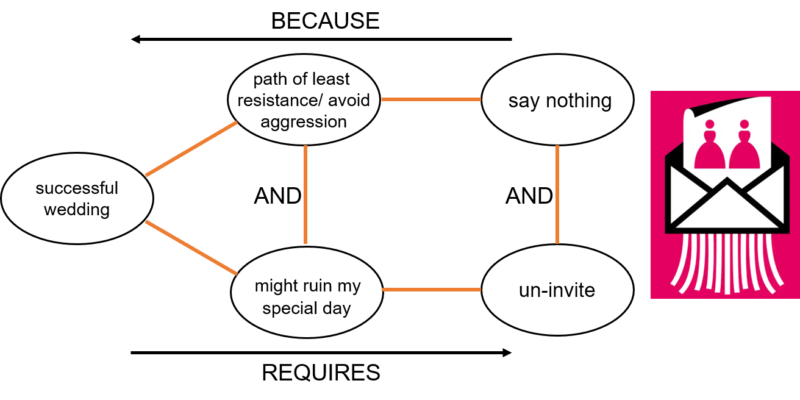
All in all, a fairly clear contradiction: should the worried bride-to-be un-invite her relations from the wedding, or allow them to potentially show-up and disrupt proceedings. Here’s what the problem looks like when mapped onto a Bubble Map:
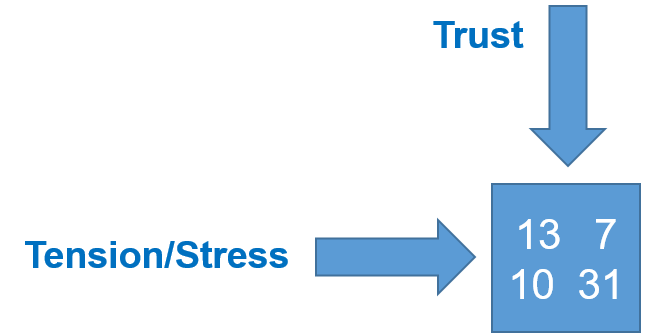
As far as the Matrix is concerned at this point, the big idea is that the bride to be is not the only person in the world seeking to avoid aggression and crossing their fingers and trusting that the invited relatives won’t disrupt the day. The conflict, in Matrix terms, is a classic tension/stress versus trust conflict pair. For which the Matrix tells us the most frequently used contradiction-solving strategies are:
Which, when I look at Ms Barbieri’s advice (or rather psychotherapist, Henry Adeane, who she asked to tackle the problem) seems to fit rather well.
The main crux of that advice makes for an elegant illustration of Inventive Principle 10, Preliminary Action – or ‘do something in advance’:
“… inviting your mum and the difficult sibling to a meal, “somewhere neutral. Be kind and gentle but firm, and say something such as, ‘I don’t think you want to be at the wedding, and I don’t want you to be there if you’re not comfortable with my relationship and marriage.’”
Then, the follow-up, this time an on-the-money illustration of Principle 31, ‘Pause’:
“…looking at the way you respond to what they say: if you feel peaceful and as if you’ve cleared the air, then possibly this is a goer. But if you feel tense and wrongfooted, then it’s best if you disinvite them. And, remember, it’s fine to take a day or two after the meeting to think about the way you feel and decide what to do.”
One bride-shaped swallow doesn’t make a summer of course, but we’ve now analysed enough of these types of case (one of the non-engineer member of the SI Network has been using TRIZ in marriage-guidance counselling for several years now) to see a relevance that begins to turn the quasi-science story around the other way. If the Matrix is pointing in the same directions as the psychotherapists, and is based on cases where we have been able to close the loop (so we know the directions have delivered success in business settings), does that mean it becomes the ‘evidence-based’ data that the psychotherapists always want but have never thus far had? It’s probably a long road ahead, but there’s no better time to embark on long roads than times of crisis. Like the pandemic-driven mental-health tsunami heading our way.
Risk. It’s not
rocket science, but it might just as well be, given how badly it is managed in
most organisations. We’re talking about another key difference between Red
World and Green World here. The difference between Operational Excellence
thinking and the Innovator’s Mindset. The difference between systems at the mature
end of their S-curve and those still at the beginning. The difference between working
assumptions that glasses are half full or half empty.
There are
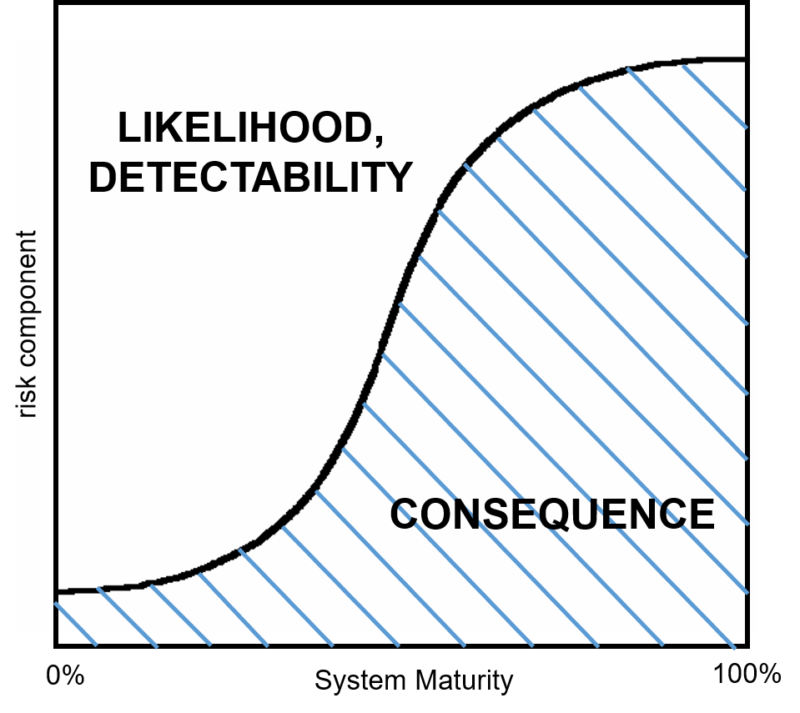
various ways to calculate risk, but likely the most effective one incorporates
measures of the likelihood of an event happening, the consequences if it does,
and the difficulty of detecting the arrival of the event. The level of these
three factors changes quite significantly as a system travels along its
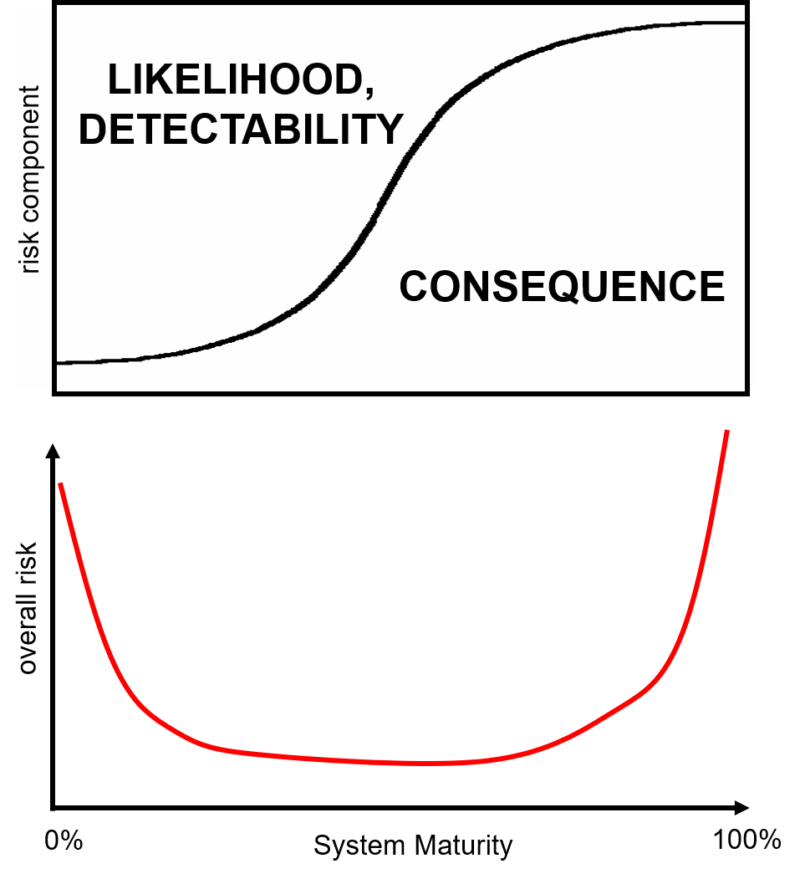
s-curve. The general pattern looks something like this:
At the immature
end of the s-curve the likelihood and detectability of risk events tend to be
at their highest, while the consequences are at their lowest. Then, as a system
matures, the situations get reversed, such that, by the time the system has
plateaued at the top of the curve and all of the associated operational
excellence related checks and balances are in place, the likelihood of adverse
events has reached a minimum and there are procedures in place to track and trace
all the myriad ‘known knowns’. The converse problem is that the few remaining ‘unknowns’
(think ‘black swans’) become progressively more difficult to detect, and at the
same time, because the system has been optimised to the end of a dead-end road,
the consequences when something does go wrong are potentially catastrophic.
We could see
this vividly in mature, top-of-s-curve, operationally excellent enterprises deploying
just-in-time supply chains at the start of the Covid-19 pandemic. We can also
see it in society at large, where we also have a global ‘system’ at the top of
its s-curve.
The problem at
both ends of this size spectrum is ultimately the same: that the overall risk,
when we integrate likelihood, consequence and detectability together gives a classic
bath-tub curve profile. Something like this:
Which is probably
another reason why this is the time for innovation. Or, better yet, systematic
innovation.
Stock sentence of 2021: ‘intellectually, people get-it, but when it comes to reality, they don’t’. Case in point – contradictions and contradiction solving. I spend several days with a group, at the end of which almost everyone is sick to death of me hammering them over the head with the c-word. They get it. Then I see them a month later, and people are still asking either/or questions, beating their heads against walls, still be going around in circles, moving their trade-offs from one place to another, and wondering why nothing is getting better.
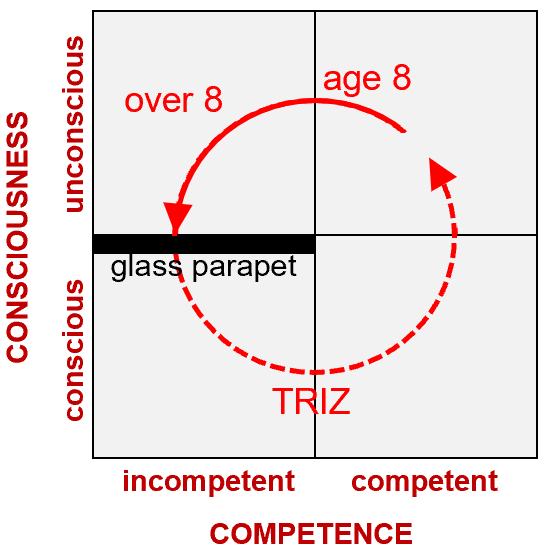
These are the times I kind of wish everyone in the sessions was still eight-years old. Eight is the age when we’re generally considered to be ‘at our most creative’. Latterly, I’ve come to realise what that really means is that when we’re eight, we still think that everything is possible. Contradiction-wise, in other words, eight year-olds are unconsciously competent. They don’t understand what a contradiction is, so they haven’t yet intellectualised the (erroneous) thought that they can’t be solved.
Alas, everything that happens to us after the age of eight teaches us that ‘impossible’ is everywhere. And that it dominates everything. This is how the real world works we get taught. You can’t have your cake and eat it. We all have to make compromises. Progress is trade-offs. After eight, we shift from contradiction-blind to contradiction-bound. And, irony of ironies, we shift from being unconsciously competent to being unconsciously incompetent. Needless to say, this is rarely a good place to be. Especially when we find ourselves surrounded by a world full of populist politicians who not only exhibit the trait, but also extol it’s virtues.
Probably best
to not dwell on that thought too long.
It’s probably too late for politicians. More productive to think about ways of getting a critical mass of actual humans out of the unconscious-incompetence quadrant and into the scary-place called conscious incompetence. A place that has traditionally been fairly easy to hide from. Contradiction-wise, for the last forty years, it has been relatively easy to hide behind the parapet. Far easier to keep our heads down and do the ‘continuous improvement’ optimisation work Japanese manufacturers taught us all was important back in the 70s. Except, we now know that it’s not possible to continuously improve for ever. Sooner or later, a pandemic comes along and shows us the error of our ways. Continuously improving your way along a dead-end road isn’t nearly so much fun when your nose ends up pressed against a mile-high, million-tonne parapet with a ‘no further’ signing hanging off the crenellations, and there are thousands of people still pushing you forward.
They say change only happens when there’s chaos. A fact Steve Bannon and his nut-job cronies were all banking on. A fact that, I suspect, the puppet-master pulling Bojo The Clown’s strings are still kind of banking on. Chaos happens, more and more people are beginning to see, because we’re all very, very visibly incompetent.
We’re able to intellectualise ‘win-win’ solutions, but we don’t know what they feel like in reality. Or how to make them happen. Everything we’ve been taught is wrong. Literally wrong.
The million-tonne parapet is transparent. That’s what everyone that bravely makes the leap into conscious incompetence is able to look back and see. A mile high wall of pressed noses hiding behind a wall they can’t see is transparent.
No-one likes
being wrong. Innovator’s, however, have learned that being wrong is an
essential part of the process. And that it’s okay to be conscious of your
incompetence. The pain that comes with that knowledge is the pain that drives you
forward to try and become less incompetent. It’s the pain, too, that eventually
brings the realisation that true progress starts with finding contradictions
and continues by then persisting until they’re solved. This is the main
learning of TRIZ. Or the Theory Of Constraints. Or Edward De Bono’s parallel
thinking. Learnings that, until now, most people have filed away in the ‘intellectual-curiosities’
part of their brain.
Now, though, is the time to stop hiding behind the parapet. Those that have admitted their contradiction-incompetence can see you. They’re waving to you. Beckoning. ‘This way,’ they’re miming, ‘don’t worry, it’s not so bad. All you have to do is remember back to when you were eight. Impossible was nothing back then. And it can be again. All we need to do is tap into the knowledge of those that passed through contradiction-incompetence before us. Those brave souls that now realise, whatever the contradiction, someone, somewhere already solved it. Someone that became consciously contradiction competent. And maybe then went one step further and used that competence often enough to re-train their instincts sufficiently to make it unconscious again. Like when we were eight. Only now with the added ability to distinguish the genuine breakthroughs from the currently impossible.
Once in a while I find myself building a model to help explain an idea or principle to a client. The emphasis in these situations is usually to build something quickly. Which in turn usually means not worrying too much about consistency with other spur-of-the-moment models. Most of the time this works out okay. Sometimes a model takes on a life of its own and finds its way into the language with several different clients. For some reason its often the colour aspect of the models that helps with its spread. And that’s where things can easily start to turn out not okay.
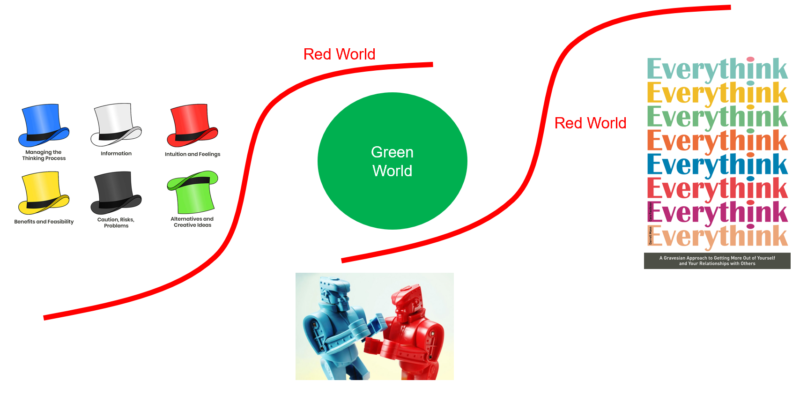
The most recent series of colour clashes have come through the Red-World/Green-World discussion I started in the wake of the Innovation Capability Maturity Model book. An attempt to get people to recognise that Operational Excellence (‘Red World’) and Innovation (‘Green World’) are polar opposites. After I’d decided I needed a model to compare and contrast the two Worlds, I spent about 5 minutes thinking about the best colours to characterise them. The logic behind the use of green was, a) green is the colour of the ‘creativity’ Hat in Edward DeBono’s Six Thinking Hats model, and, b) green is the colour of the Systematic Innovation logo. Having chosen green, and recognising that I needed a second colour to describe green’s polar opposite, I went to the colour wheel and, hey presto, red was that colour. Decision made.
Spool the clock forward a couple of years and the colours of the different Value Systems in the Everythink book also started to connect with a number of clients. Which meant the arrival of questions like, ‘is the green of Green World the same as the Communitarian green found in Everythink?’ To which the answer, sadly, is no it isn’t.
Then someone
else hears me talking about the Intel-initiated, only-the-paranoid-survive idea
of companies comprising a Red Team and a Blue Team. The Blue Team being the
majority of people in the existing business, and the Red Team being a small
group of lateral thinkers whose job was to try and find ways to put the Blue
Team out of business. Now the colour problem becomes much worse. Now I find
myself describing how Blue Team lives in Red World and Red Team lives in Green
World. And, worse again, that Red Team people in Green World will work best if
they they’re thinking with the Yellow value system. It was only small
consolation to then be able to say that they should be wearing Green Hats most
of the time.
Act in haste,
repent at leisure.
Innovator’s live in Green World, wear Green (and sometimes Black – like baddies) Hats, have Yellow value-systems and one of their roles is to act as a Red Team.
Operational Excellence workers live in a Red World, wear mainly White Hats (like goodies), ideally have Blue value-systems and are Blue Team.
Not that it helps an awful lot, but if I had my time again I’d re-label Red-World and Green World as, respectively, Blue World and Yellow World. That way at least there’d be a consistency between ICMM and Everythink. And that would then just leave the tiny inconvenience of having companies like Intel and people like Edward DeBono in the world. Messing things up as usual. With their Purple ways.