
The Innovator’s Dilemma Redux

The paradox explored in my book ‘The Innovator’s Dilemma’

is that successful companies can fail by making the ‘right’ decisions

in the wrong situations.

Clayton M. Christensen

This year marks the silver anniversary of Clay Christensen’s classic text, The Innovator’s Dilemma, a book that, unlike the vast majority of business titles, is still being referenced twenty-five years after publication.

There was a time during the mid-noughties when I spent a lot of time working with the senior leadership team of an American-headquartered MNC. It felt like they were alternating between me and Professor Christensen: I would be in there one month telling them one thing, and he’d then be in the next month telling them something different. Well, hopefully different. Although, hopefully also, not too different.

In one of those blinding flashes of the obvious that has somehow managed to take fifteen years to arrive, the other day I finally recognised a missing connection between Christensen’s Dilemma and TRIZ. One that, I believe, helps to eliminate some of the criticisms of Christensen’s work. Work that, according to my MNC leaders at least, started with a useful but incomplete theory and gradually, over the remaining course of his career, became increasingly convoluted in an ultimately vain attempt to try and make the theory complete.

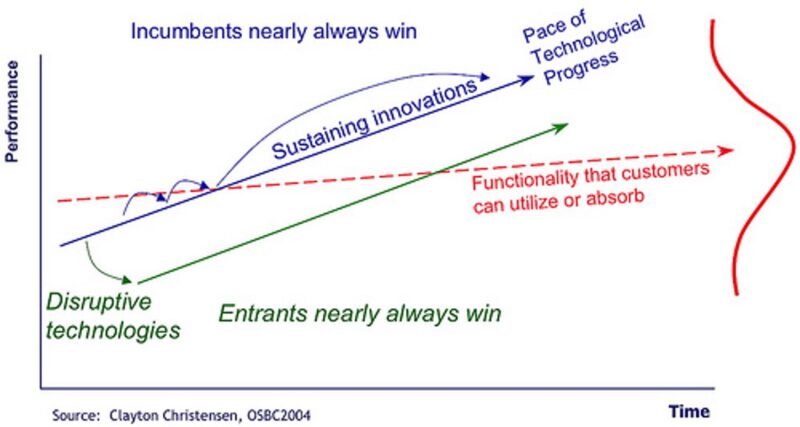
For those that aren’t familiar with the Innovator’s Dilemma (full title: ‘When New Technologies Cause Great Firms to Fail’), it works something like this:

  1. Someone, often a new player, enters a market with a product or service that has ‘inferior’ performance (and usually lower price) to the existing and established offerings coming from the large incumbent players.
  2. Because the new offering is ‘inferior’ it attracts the lower end of the incumbents’ customer base. Then, because the incumbent likes the idea of being able to focus on their more profitable higher-end customers, they are inclined to welcome the new player into the market and to take over the hassle and low margins associated with the low-end customers.
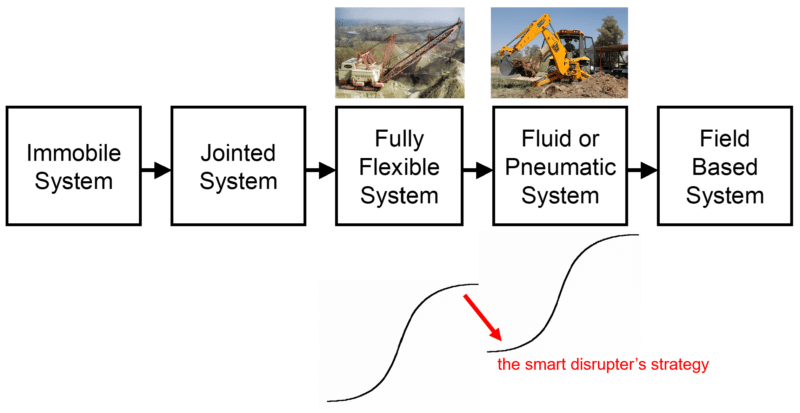
  3. The entrant improves the likelihood and speed of their future success by identifying a new measure of performance that they can sell to customers alongside their inferior performance against the traditional measures of performance established and being monitored by the incumbent providers (e.g. when hydraulic earth-moving machines first appeared, their earth moving capacity was massively inferior to that of the incumbent cable-driven machines, but they were much more maneuverable; similarly – one of Christensen’s most widely cited case studies – new generation computer disc-drives had inferior memory but offered the benefit of being physically much smaller).
  4. Engineers and designers, given half an opportunity, will work diligently to improve the performance and value of the products and services under their care. The rate at which they are able to make these improvements tends to be greater than the average rate of increase of customer need. Inside the large incumbent organisation, the engineers focus on meeting the future needs of their highest value customers. For the new entrant engineers, their improvement efforts increasingly attract not just the low-end incumbent customers but also progressively more of the middle and higher end customers. Hence the innovator’s dilemma: incumbents want entrants to take away their least valuable, ‘worst’, customers, but in so doing sow the seeds of the progressive loss of their more valuable customers as the entrant improves their offering. They invite an ‘inferior’ player into the market only for that player to then kill them.

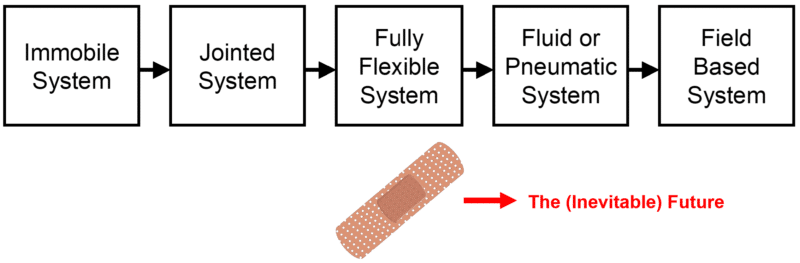
The book was initially written for leaders working in the large incumbent companies. Perhaps ironically, today it more often gets used as a kind of playbook for the so-called ‘inferior’ entrants. And it is from their side that we see the vital missing connection to TRIZ: In the same way that the disrupting entrant makes their journey easier by finding a new performance measure to attract incumbent customers, they can also increase their likelihood and speed of success by following the TRIZ Trends of Evolution:

These trend patterns show engineers, designers and scientists of all industries a clear route-map to more ideal solutions. Prospective market entrants looking for their disruptive ‘inferior’ solutions could choose to find them by looking backwards along the Trends. This would definitely achieve the goal of delivering an ‘inferior’ solution, but it will almost certainly not allow them to win the Innovator’s Dilemma game. To do that they need to recognise that their ‘inferior’ solution needs to be based on forward jumps along at least one of the Trends.

The reason this works is that, because the Trends are built on patterns of successful s-curve jumps: whenever an industry makes a jump from one stage of a Trend to the next, they are effectively jumping from the top of the current curve to the bottom of the next. In such situations, the performance of the new solution will almost inevitably be inferior to the matured old solution. But – crucially – because the Trend pattern has provided us with a roadmap to future success, we can be certain that as the new solution makes its inexorable rise up the new s-curve, it will eventually reach a point where its performance will exceed the maximum capability of incumbent solutions still stuck at the top of the previous s-curve.

The TRIZ Trends in other words serve as the disruptive innovator’s near perfect play-book. Any prospective market entrant can find an ‘inferior’ solution to try and do the job with, but only those using the Trends will be able to identify the ‘inferior’ solutions that will inherently turn into the solution that will dominate the future market once the engineers work their improvement miracles. Good for the new entrants. Less good for incumbents… until we show them a better Innovator’s Solution…

Mini-Case Study: Hades’ Dilemma

Aah, Joseph Campbell. The Hero’s Journey. The DNA of successful literature. Literature that survives through the centuries. A DNA that has contradiction resolution – ‘The Ordeal’ – at its heart. Like the story concerning the fateful love of Orpheus for the beautiful Eurydice. A universal tragedy currently on show as a Broadway musical by one of my all-time favourite artists, Anaïs Mitchell (Reference 1). In Mitchell’s version of the story, one of the most vivid Ordeals comes to king of the underworld, Hades: Orpheus enters hell (‘Hadestown’) in order to rescue Eurydice, who has been seduced by Hades. Should Hades allow Orpheus to leave with Eurydice or not? Here’s how his dilemma is introduced in the musical:

Gotta think quick

Gotta save face

Caught ‘tween a rock and a hard place

What you gonna do?

What you gonna do?

What you gonna do?

What you gonna do now?

If you tell ‘em no, oh, you’re a heartless man

And you’re gonna have a martyr on your hands

If you let ‘em go, oh, you’re a spineless king

And you’re never gonna get ‘em in line again

Damned if you don’t

Damned if you do

Whole damn nation’s watching you

What you gonna do?

What you gonna do?

What you gonna do?

What you gonna do now?

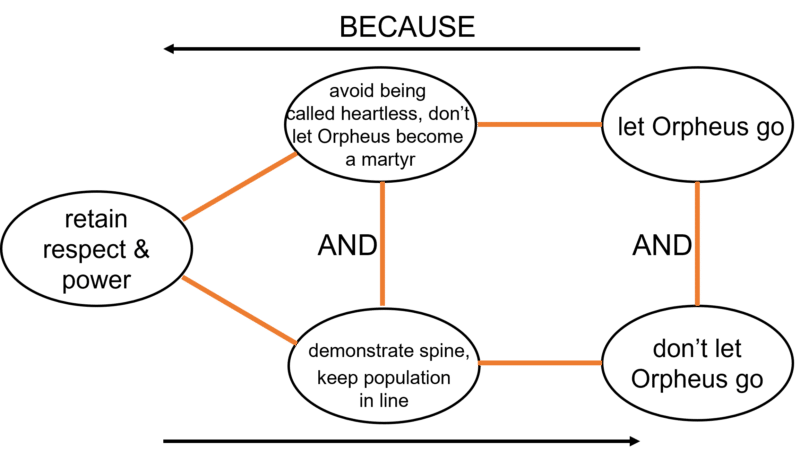
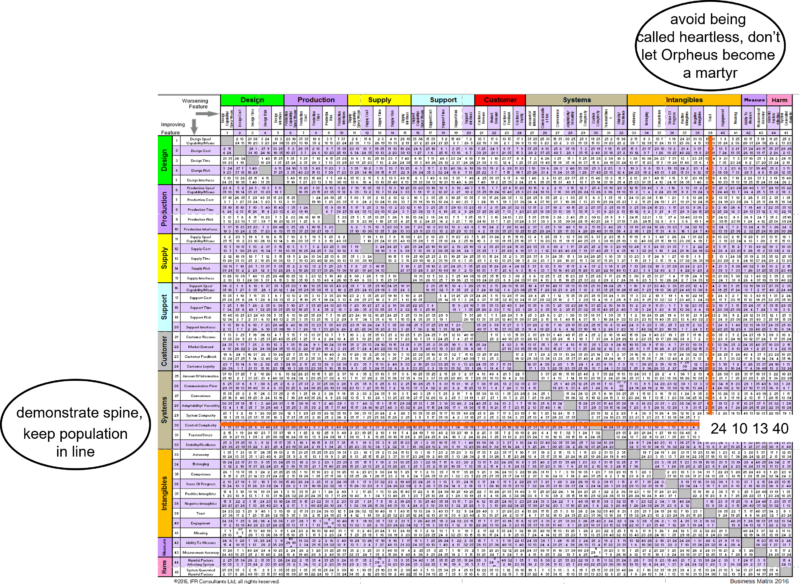
Here’s what Hades’ contradiction looks like in terms of our rather less poetic bubble-map:

By way of helping Hades to resolve his contradiction, the overseeing ‘Fates’ characters offer up a clue:

Here’s a little tip

Word to the wise

Here’s a little snippet of advice

Men are fools

Men are frail

Give them the rope and they’ll hang themselves

And here’s the equivalent set of clues offered by the again less poetic Contradiction Matrix:

We then hand over to narrator, Hermes, revealing to Orpheus, Eurydice and the surrounding ‘Workers’ how Hades decided to solve his contradiction:

Hermes: Well, the good news is, He said that you can go

Eurydice: He did?

Orpheus & Workers: He did?

Hermes: He did…, There’s bad news though

Eurydice: What is it?

Hermes: You can walkBut it won’t be like you planned

Orpheus: What do you mean?

Eurydice: Why not?

Hermes: Well, you won’t be hand in hand, You won’t be arm in arm, Side-by-side and all of that. (to Orpheus) he said you have to walk in front, And she has to walk in back

Orpheus: Why?

Hermes: And if you turn around, To make sure she’s coming too, Then she goes back to Hadestown, And ain’t nothing you can do

Eurydice: But why?

Hermes: Why build walls? Make folk walk single file? Divide and conquer’s what it’s called

Orpheus: It’s a trap?

Hermes: It’s a trial. Do you trust each other? Do you trust yourselves?

Orpheus & Eurydice: We do

Hermes: Well, listen, brother, If you wanna walk outta hell, You’re gonna have to prove it Before gods and men. Can you do that?

Orpheus & Eurydice: We can

Hermes: Alright… time to go

Orpheus: Mister Hermes!

Hermes: Yes?

Orpheus: It’s not a trick?

Hermes: No – It’s a test

Hades’ solution, his metaphorical (Principle 24, Intermediary) ‘rope’, was to force a (Principle 10, Preliminary Action) pre-condition on Orpheus: a trial.

One that, since the myth is a tragedy, Orpheus somehow manages to fail. But that’s another contradiction. Maybe for another day.

Reference

  1. Mitchell, A., ‘Working On A Song: The Lyrics Of Hadestown’, Plume, 2020.

Mini-Case Study: Armour

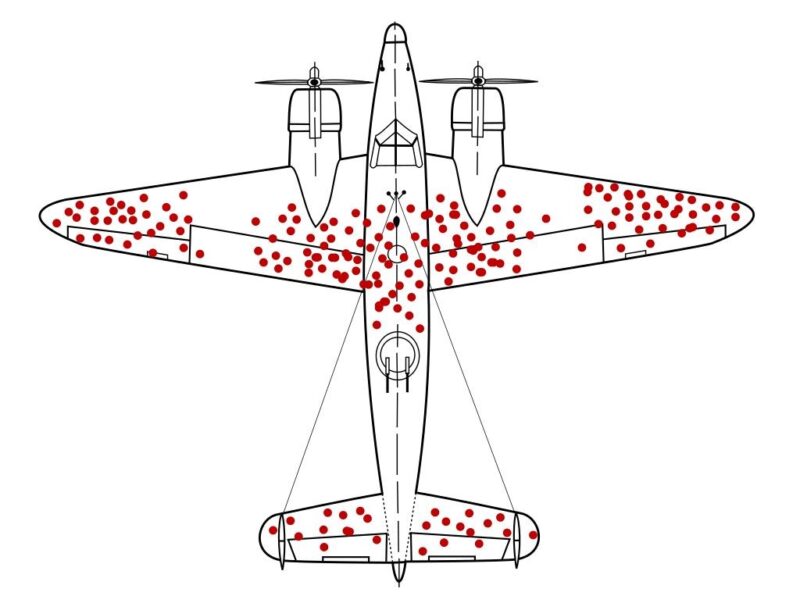
World War II. An important time for making sure your planes don’t get shot down by enemy fighters. Oftentimes, planes would return from battle covered with bullet holes. The damage wasn’t uniformly distributed across the aircraft. The data gave insight into where armour plating should be added. Adding armour, of course, comes with a significant trade-off: adding more armour made the planes less vulnerable to bullet damage, but it also makes the plane heavier, and heavier planes are less maneuverable and use more fuel. Armouring the planes too much is a problem; armouring the planes too little is a problem. So the traditional response was to find an optimum middle ground. And the bullet-holed aircraft data perhaps presented a way to manage the contradiction.

Enter mathematician, Abraham Wald. He was asked to look at the data. The Air Force was expecting to receive recommendations to strengthen the most commonly damaged parts of the planes to reduce the number that was shot down. Counter-intuitively, Wald had some rather different – contradiction-solving – advice: perhaps, he speculated, the reason certain areas of the planes weren’t covered in bullet holes was that planes that were shot in those areas did not return. This insight led to the armour being re-enforced on the parts of the plane where there were no bullet holes. A classic illustration of Inventive Principle 13, The Other Way Around.

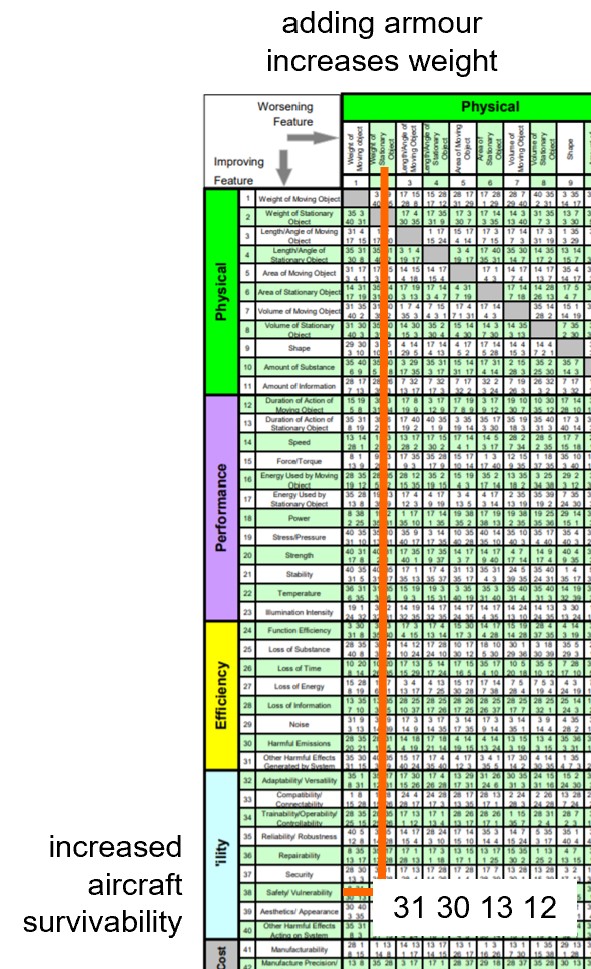
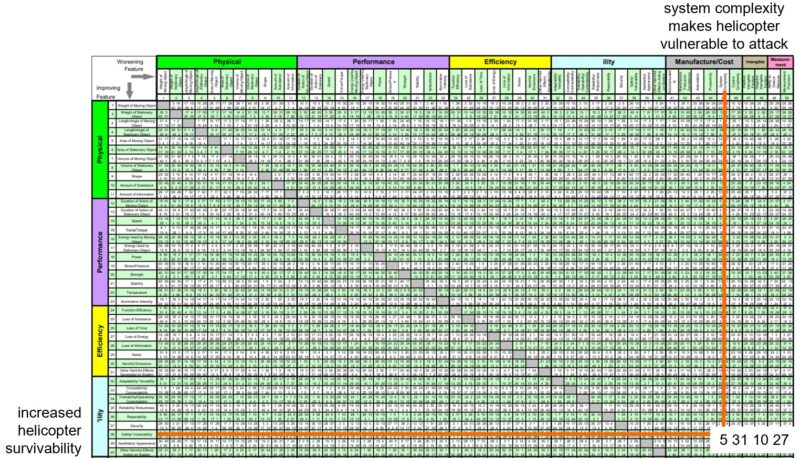
Wald didn’t have access to the Contradiction Matrix back in 1943, when his insight came to light. If he had, it would have told him something like this:

At first sight, Principle 13 is definitely a strange looking answer to a Safety-versus-Weight problem. And making best use of the strategy indeed demands a high degree of lateral thinking. What are we supposed to do the opposite of? How can we sensibly do the opposite of what the data is apparently telling  us? Or, how might the missing pieces of data turn out to be more meaningful than the data we have?

Mini-Case Study: Chaff (x2)

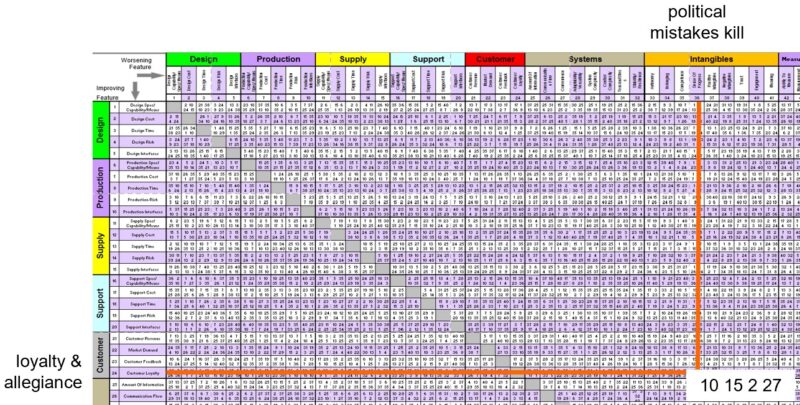
“I’ve got a brilliant new strategy which is to make so many gaffes, that nobody knows which one to concentrate on… they cease to be newsworthy… completely out-general the media in that way, and they despair. And so… they leave you alone. You shell them. You pepper the media… you pepper their positions with so many gaffes that they’re confused. It’s like chaff. It’s like a helicopter throwing out chaff. And then you steal on quietly and drop your depth charges wherever you want to drop them.”

So said truth-vacuum Boris Johnson in a 2006 interview. For the first time I found myself quite impressed by the Clown. Not that I believe the chaff/error analogy was his idea. But, from a contradiction-solving perspective, it makes for a rather elegant illustration of how the Business Matrix works. Here’s how we might best map Mr Pants-on-Fire’s contradiction:

Hey presto, out comes Inventive Principle 27, ‘Cheap Disposable’. Definitely the best match to the uber-liar’s still evident ‘gaffe-chaff’ strategy.

Meanwhile, just for interest, here’s the more usual use of chaff in its defensive context:

And here’s how we might best get to that solution. This time using the technical version of the Contradiction Matrix:

Not quite the same problem, but the fact that we end up with the same Principle 27 solution strategy is hopefully telling. All we need to do now is hope that Principle 2 – one of the other recommended solution strategies for the business version of the problem – will soon be on its way. Fingers crossed y’all.

Mini-Case Study: Protecting The Long-Term Future

‘Democracy is the worst form of government’, Winston Churchill famously said, ‘except for all the others that have been tried’. Which is to say that, despite the fact it is currently stuck at the limits of its current capabilities, it has done a pretty good job of increasing the quality of life for a large majority of citizens. The current swathe of wobbling institutions, though, perhaps indicates that we’re not too far away from some kind of a step-change. What such a discontinuity might look like is still massively uncertain. Much less uncertain is the fact that many of the underlying contradictions are very plainly visible. One of the biggest of them is the growing mismatch between the growing imperative to build long term sustainable solutions and short election cycles. The latter forcing political parties to promote short-term, expedient vote-winning measures to help improve their chances of being re-elected. How to solve this contradiction?

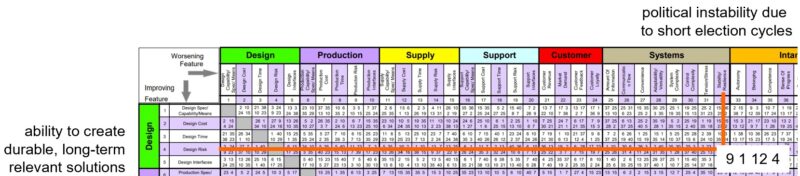
Here’s what the Business version of the Contradiction Matrix has to say about the problem:

Principle 9, Prior-Counteraction doesn’t appear very often in the Matrix, and appears as the most frequently used Principle in only a handful of places. So, to see it heading the list in the Design Risk versus Stability box means we have to have collected several thousand examples of it being used to tackle the conflict. Here’s one of them: the Welsh Government’s creation of the world’s first ‘Future Commissioner’:

With a remit set out in law to be “the guardian of the interests of future generations in Wales”, Sophie Howe’s role is to provide advice to the Government and other public bodies in Wales on delivering social, economic, environmental and cultural well-being for current and future generations and assessing and reporting on how they are delivering.

Sophie took up the post in 2016 and has led high profile interventions around transport planning, education reform and climate change challenging the Government and others to demonstrate how they are taking account of future generations. Described by the Big Issue Magazine as one of the UK’s leading Changemakers, her interventions have secured fundamental changes to land use planning policy, major transport schemes and Government policy on housing – ensuring that decisions taken today are fit for the future.

Fingers-crossed they’re using TrenDNA to help decode what the future might look like. Or at least remembering that there’s a difference between long term planning and long term responsibility. That the former is largely futile, but not using it as an excuse to give up on the latter.

Mini-Case Study: Strike

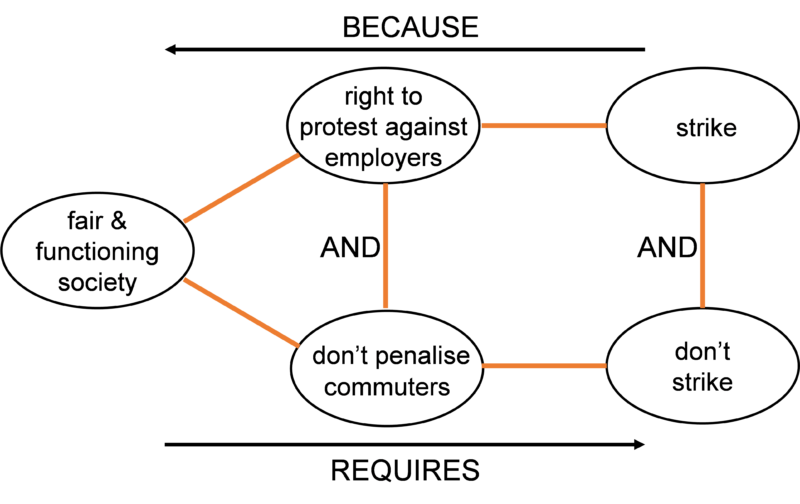
The local bus drivers are threatening to go on strike again. In a rural community like ours, when the buses aren’t running, half of the population is literally cut off from many of the basics of life. I’m sure the drivers are very apologetic when they eventually decide to come back to work. In the same way, I’m pretty certain many of the commuters are sympathetic to the drivers’ plight. That’s the way strikes work in the UK. Workers protest, customers sympathise, customers suffer. Surely, there’s a better way? A way that recognises a contradiction – we want strikes and we don’t want strikes:

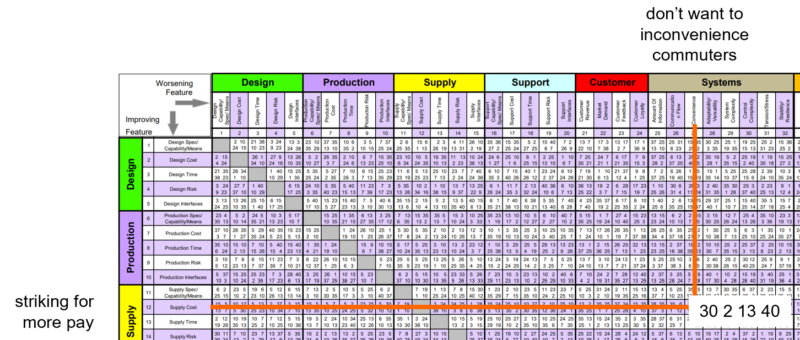
The problem can be mapped onto the Business Contradiction Matrix as a Supply Cost versus (in)Convenience conflict. Here’s what the Matrix has to say about how others have successful transcended such problems:

A lovely example of a joint Principle 2, Taking Out and Principle 13, The Other Way Around, solution to the problem can be found in Japan. Drivers continue to drive their usual routes but refuse to take payment from the commuters. Commuters get to work on time, and the bus company has a greater incentive to settle the dispute because as well as the lost revenue, they’re also having to pay for fuel. One suspects that both bus company and drivers continue to earn the respect and sympathy of the commuters.

Simple when you know how.

Expedient Art?

Gigs are back. Actual, live, face-to-face, beer-and-sweat gigs. Last week I went to see one of my favourite artists. One of the brave, dipping-her-toes-in-the-world-again, pioneers. The theatre was half-empty, so I guess not everyone is ready yet. Probably thanks to a large scale loss of trust in anything said by politicians, media, medics or experts of any kind anymore. But that’s another subject. This one is about how the gig was full of old songs. A lot from the 2019 album, which I happen to like a lot, but only one new song. ‘I was supposed to be launching a new album now,’ she announced from the stage, ‘but then what happened happened, and time seemed to slip on by’.

My instinct at this point said, it was a pandemic, damnit, there was nothing else for a musician to do but make the next record. Then I thought about all the new music released in the last eighteen months. And how almost none of it was any good. There were a couple of great records, I think, made despite the pandemic, but so far as I can tell, none made because of it.

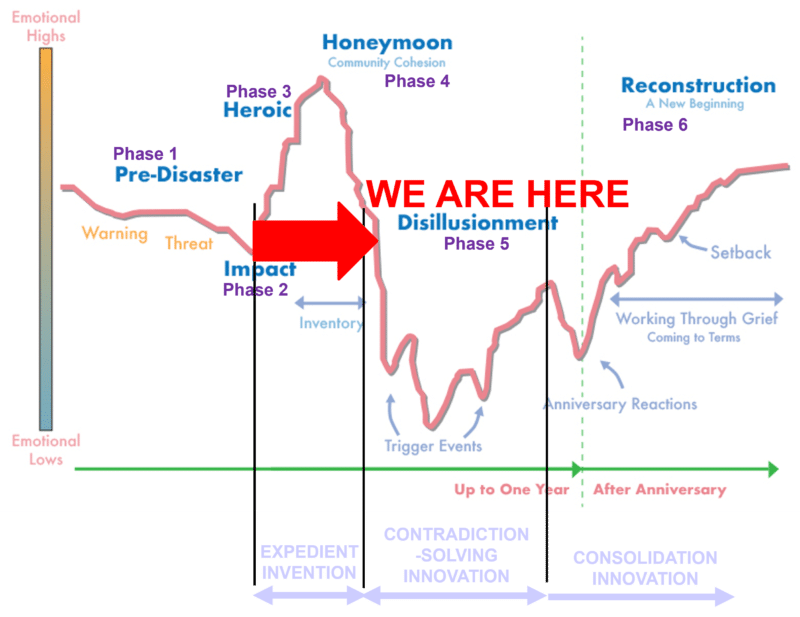
We’ve spent a large part of this same eighteen-month period talking about the Disaster Cycle, tracking society’s progress through the various different stages. Mainly the Heroic and Honeymoon phases, where the emphasis is on finding expedient solutions to the firt tranche of crisis-generated challenges. I had thought that this expedience applied to public and private sector enterprises. But reflecting on the poor quality music being produced at the moment made me realise that musicians caught in the pandemic are going through a period of expedience themselves. Great art, in other words, shouldn’t be expected to happen when society’s metaphorical roof is leaking. Rather it happens during the later ‘disillusionment’ phase. The place we now find ourselves:

The place where it’s been possible to reflect on the disaster, and then hopefully synthesise meaningful conclusions. Great art reveals universal truths. If the artist gets lucky, as well as seeing these truths, they get to describe a way forward through them. A way forward to better truths.

Which in turn means I’m supposed to be thankful that my favourite artists have largely stayed quiet since Covid-19 arrived. And that I’m supposed to be patient. Better truths need a critical mass of disillusionment and reflection time. No pressure.

Mini-Case Study: Boiling Over

One of life’s small annoyances. First up, a watched pan of water or milk never boils. So you go and do something else. Then, by the time you return, half the contents have boiled over and left you with a charred mess to clean up.

The simple solution to this problem would be to just wait. Don’t try and do other things. But that’s inefficient. In which case, it’s time to consider whether TRIZ might be able to help solve the boiling over contradiction.

The problem is basically a conflict between the desire to not have the pan boil-over (stability) being prevented by the fact that there’s a continuing energy supply into the pan. Here’s what the problem looks like when mapped onto the Matrix:

Third on the list of Inventive Principle suggestions is number 24, Intermediary. Which in this specific case equates to perhaps one of the simplest use of existing resource solutions ever… place the wooden spoon you were probably using anyway on top of the pan. Something like this…

Easy when you know how.

Mini-Case Study: X59

It seems strange to say it, but the speed record for atmospheric flight hasn’t changed since 1976. The speed-versus-date graph shows a pretty good approximation of an s-curve. Which should tell aircraft designers that there’s a contradiction to be solved. Actually several. Aircraft designers, even though they tend not to possess a lot of TRIZ awareness, almost invariably have the luxury of having plenty of time to think about problems. In theory, this means that they will get there in the end. If they had known TRIZ, meanwhile, they might have conducted a root-contradiction analysis. Something like this:

At the root contradiction level, as has been known by designers for some time, any big variation in shape on the body of the plane, like the cockpit jutting up at the front or the tail sticking up at the back of the plane, will produce a shockwave. To minimise the shockwaves that travel down to the ground, you need to change the shape of the plane and make it far more streamlined, smoothing out the variations in shape and spreading them out across a much longer body.

At its surface level, though, the speed contradiction is all about sonic boom. And the fact that, when an aircraft flies supersonically over urban areas, it is likely to cause a fair few broken windows and phone-calls from citizens thinking the world is ending. Here’s how this speed versus noise problem is mapped onto the Contradiction Matrix:

From this list, Principle 17, Another Dimension forms the most immediately visible feature of NASA’s current X59 project. The plane is 99 feet, 7 inches long, roughly a third of which is an extended, flattened-tip nose leading as seamlessly as possible back to the swept-back wings and a single engine at the rear.

Look a little closer and we can see another example of Principle 17 in action: The engine intake and exhaust, both of which are traditionally housed on the underside of the plane, have now been shifted to the upperside. Through this geometry shift, the wing blocks and prevents the exhaust from interacting with the shock waves on the bottom of the aircraft.

Zoom in further still and we see all the necessary (Principle 3, Local Quality) geometric features positioned in such a manner that the shock waves each one instigates are kept parallel and separated from each other, so they don’t combine into a loud sonic boom:

traditional versus X59 shockwave patterns

The X59 is scheduled to fly for the first time next year with these Principle 3 and 17 features incorporated. The theoretical modelling seems to suggest that the sonic boom power levels will be reduced by a factor of somewhere between 8 and 10, making the traditional ‘boom’ into a less intrusive ‘thump’. Time will tell whether society says this will be good enough. If it isn’t, my Contradiction-Matrix influenced bet is that the designers will need to get beyond geometry and start thinking about Principles 28 and 9. You heard it here first. No pun intended.

Grey Swan Gaggle

Following on from yesterday’s Grey Swan Top 5 blog, I thought I’d spend a few minutes thinking about the ‘betweens’ aspect of the story. That’s ‘betweens’ as in ‘it’s not so much the things that are important as the relationships between those things’.

Here’s the resulting Perception Map (which, I have to say, became quite a bit easier to create after I’d generalised two of the more specific of yesterday’s definitions):

I’m never sure whether a Perception Map with five components is going to reveal much that we didn’t know already. In this case I surprised myself a bit. Especially regarding the greenwashing-populists vicious cycle. Not so much the idea that Social Media’s unwitting destruction of democracy is the primary driver of the cycle.

COP26 should be fun later this year… don’t believe (any/every)thing you read.