When is an innovation not an innovation? One of our perennial problems when trying to establish whether an innovation attempt has transitioned to become an innovation is working out how to account for integrated clusters of innovation attempts. The most visible forms of attempt-clustering being those found in new cars.
Because OEMs tend to inject new models onto the market in three, four or five year cycles, what usually happens is that some or all of their Tier 1 and beyond suppliers turn up before design-freeze day with a catalogue of new ideas and concepts. Some of these will be adopted into the new car design and some won’t.
So far so good. Here’s the problem though. Let’s assume that the new car becomes a hit, and that the OEM ends up repaying the cost of developing the vehicle and, miracle of miracles, gets to turn an actual customer-money-in-the-bank profit. Does that then mean that all of the innovative features present on the vehicle get to call themselves innovations?
The extent of the problem recently became apparent when a friend succumbed to some heavy OEM advertising propaganda and went out and bought a new car. Being his only engineer friend, I was forced to sit in the car so that he could inflict his version of the showroom demonstration on me. There were so many ‘innovations’, the demonstration lasted several hours. Or maybe that’s just what it felt like. Grinning can give you cramp after a while.
After a while, when
I’d start become conscious of impending smile-muscle spasms, I thought I’d try
and apply a bit of TRIZ Principle 22 to calm my misery. Turn new-owner-pride
lemons into research lemonade.
So, after each
new feature demonstration, I started asking whether he thought it was something
he could see himself using after the initial novelty had worn out.
That worked for a while. Then, when we got onto things like ‘automatic handbrakes’ or ‘heated indicator switch’ (I’m joking – everything was becoming surreal by this stage), the answer to my question turned into variants of the sentence, ‘err, yes, because, I can’t turn it off/get rid of it’.
To cut a too-long
story short, the upshot of the analysis was that 98% of the new features were precisely
that. Features. As in features with no discernable benefit.
Now, I have to say that this 98% number is rather convenient. Because that’s precisely the percentage of all innovation attempts that end in failure.
Only now, we’ve got to take into account that, because the overall car under consideration has sold well, all of the new features contained in it get to call themselves innovations. Even though 98% of them clearly aren’t. Which means our 98% number is actually recursive.
Stepping back a little before we get ourselves stuck in a nest of recursions, the situation is rather worse than it might already sound. That’s because when my poor friend purchased the car, he had little or mostly no option to not have the feature. Which basically means that he’s paid for a pile of digital and hardware crap that has zero utility. Which, when brought into my Yorkshire-Economics, no-way-am-I-paying-for-that mind, means I’ll probably never be able to buy a car made after, by current reckoning, 2008.
From a more pragmatic innovation-accounting perspective, it means that we need to be very careful about labelling ‘all’ the novel features in any kind of integrated cluster as innovations just because the overall cluster turns into an innovation. Rather, we need to take into account a 98% nested-dysfunction effect and recognise that the large majority of those features are junk.
Which then just leaves the final challenge of somehow isolating them so the OEMs can gain a better understanding of which of the 2% of the new features they’re inclined to keep adding to the cluster are the ones worth spending time and money on. Sounds like a job for PanSensic. Or diverting some of the OEM research funding towards asking their customers better questions. Hopefully in time for the day I have to finally replace my (2007) car.
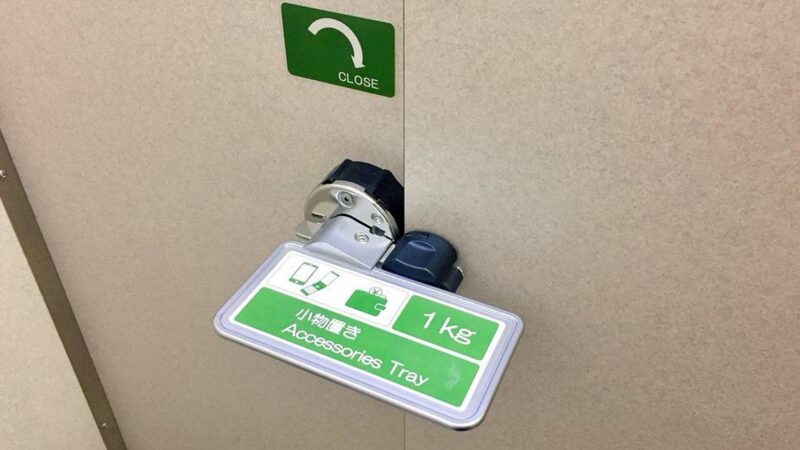
It is one of the more annoying first-world-problems of 21st-century living: a hurried stop at a public convenience, a quick exit and in the rush leaving a mobile phone behind. After realising some of their rest-room staff were having to spend 30 or more hours a month re-uniting left-behind phones with their owners, Japanese authorities set out to devise a simple, self-organising way to prevent people from losing things.
It is called an ‘accessory tray’ and consists of a shelf attached to the lever which holds the toilet door shut, giving a convenient place to put a mobile phone, wallet or a small bag. Because the shelf must be flipped up to open the door, it is impossible to leave things behind.
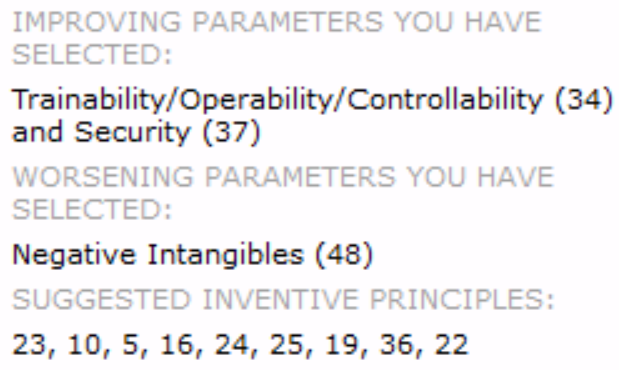
The innovation makes for a simple illustration of contradiction solving in action: we don’t want people to leave their possessions behind, but we know that they’re often distracted when in a rush. Not the easiest conflict to map onto the Contradiction Matrix, but if we had to make the best connection it would likely look something like this:
As far as the ‘accessory-tray’
solution is concerned, we can see evidence of several Inventive Principles in
action:
Principle 23,
Feedback – possessions are placed on the door unlock mechanism so are
inherently visible at the critical ‘leave-behind’ moment.
Principle 10, Preliminary Action – users are encouraged to pre-place their possessions at the right position to ensure they can’t be forgotten.
Principle 5, Merging – the accessory tray is integrated into the door-lock mechanism.
Principle 24,
Intermediary – the accessory tray!
Principle 25, Self-Service – the whole system is self-organising and self-correcting.
I’ve just finished reading Gary Hamel’s new book, Humanocracy, the best chapter of which offers up an in-depth analysis of white-goods manufacturer, Haier’s, business model. The book is about the need to eliminate bureaucracy from organisatons, and Haier is used as an exemplar of what’s possible. Even if, like Haier, you have 84,000 employees to look after.
The overall bureaucracy story makes for a classic business contradiction: the bigger an organisation becomes, the more layers of management it requires in order to make sure everyone is doing what they’re supposed to be doing in order to, in turn, maximise the efficiency of the business. Or at least that’s been the traditional thinking since the advent of large organisations, and particularly the arrival of Frederick Winslow Taylor’s ‘Scientific Management’.
There are various ways of looking at the contradiction. At the physical contradiction level, we want bureaucracy and we don’t want bureaucracy: we want it because it enables stability and, assuming we do it right, operational efficiency; we don’t want it because, as the organisation gets bigger, controlling it becomes progressively more complex, it stifles employee autonomy and therefore innovation, and it impairs agility because the multiple layers of hierarchy each add friction that impedes communication.
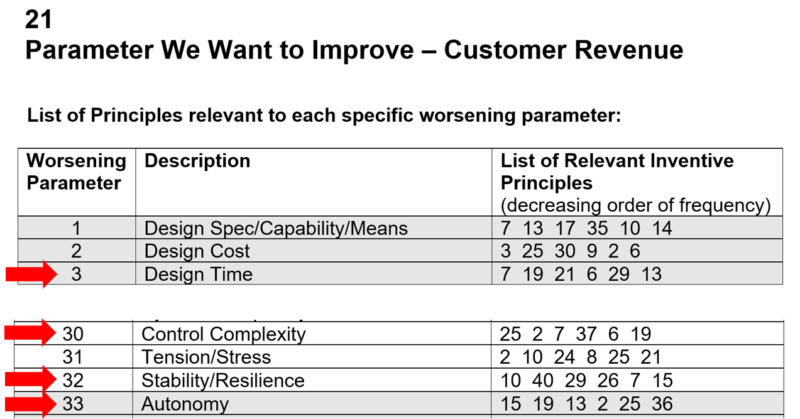
We could also shift the problem to a higher level by focusing on the primary job of the organisation, which in Haier’s case is to generate sustainable revenue/profit from customers. What then prevents this is control complexity, the simultaneous need for stability and rapid creation of new offerings, and the lack of employee decision-making autonomy. When we have a multi-faceted set of contradictions like this, often the best way to map it is to revert to the tabular form of the Contradiction Matrix. Something like this:
By forcing
ourselves to look at several conflict pairs like this, we obtain a long list of
Inventive Principle suggestions. The majority of which, in this case, we can
see have been implemented at Haier:
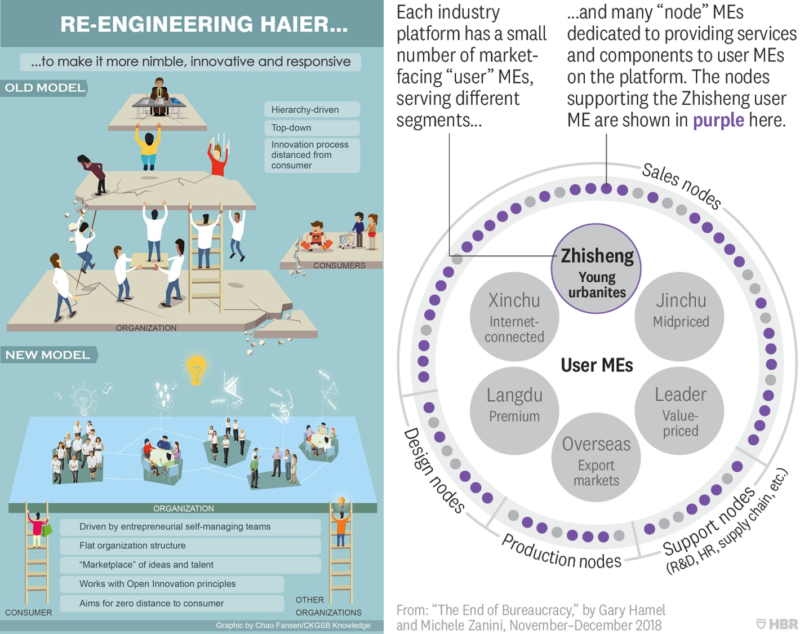
Principle 2, Taking Out – in the drive to eliminate the gap between customer and employee, over the course of the last 10 years the company has eliminated 10,000 middle management positions; then the business has been separated into more than four-thousand ‘micro-enterprises’ (MEs).
Principle 13, The Other Way Around – top-down command-and-control management structures have been replaced with bottom-up autonomy; every employee becomes an entrepreneur rather than an employee.
Principle 25, Self-Service – each of the MEs operates largely autonomously; when potential new customer opportunities are identified, they are free to build new offerings to meet those needs.
Principle 6, Universality – each of the MEs, in keeping with the universal size of human empathy group, has between 10-15 people within it.
Principles 15, Dynamics/29, Fluid – as the overall business grows its web-centric ecosystem, more MEs are formed; as business needs shift, MEs are able to decide how best to morph to suit emerging needs.
Principle 7, Nested Doll – each of the MEs is situated within a higher level ‘platform’ (see figure below).
Principle 40,
Composite – each ME incorporates all of the requisite skills required to
deliver their intended outcomes; thanks to the entrepreneurial spirit, individuals
recognise the need to be multi-skilled rather than specialised in just one area.
On every meaningful metric, Haier is now out-performing its competitors. This won’t be too much of a surprise to TRIZ aficionados: when a business is designed along ‘self-x’-based Ideal Final Result lines (Haier calls it ‘rendanheyi’), traditional to-down, command-and-control enterprises stand no chance.
Anything I say here about the enormity of Haier’s achievement will inevitably sound glib. Anyone interested in digging deeper, should check out Humanocracy. Anyone interested in digging deeper still, should go and talk to people in any of the company’s MEs.
For me, meanwhile, I’m just happy that the world now has a second addition to the Innovation Capability Maturity Level Five club. I suspect, this being the case, the Haier journey is still just beginning.
I’ve written several times now about the idea of every aphorism having its equal and opposite analogue. What I haven’t worked out yet is whether they all therefore ultimately cancel out – a zero-sum feast of smart sayings – or whether they lead to some kind of higher truth. A truth emerging from Hegel’s dialectic method of progress that postulates a higher level proposition synthesised out of a reconciliation of a conflict between thesis and antithesis. I guess I was hoping that someone would pick up the challenge and that, one day, I’d receive the definitive dissertation in the mail. Sadly, still nothing has arrived.
Which I guess
means that if there is an answer out there, I’m going to have to be the person
that does the hard yards required to find it. Damn.
So, in true,
how do you eat an elephant fashion, here’s what I hope will become a series of
bite-sized attempts to try and synthesise something meaningful from pairs of opposing
aphorisms.
Here are two of
my simultaneous favourites:
“When the pressure is on, you don’t rise to the occasion – you fall to your highest level of preparation.” Chris Voss
“To achieve great things, two things are needed; a plan, and not quite enough time.” Leonard Bernstein
The underlying
physical contradiction between Voss and Bernstein centres around pressure: Voss’
thesis is that pressure is basically bad, while Bernstein’s is that, by not
quite giving ourselves time to do a job, the resulting pressure is good. Can
both be right? Can we construct a picture that allows both aphorisms to hold
true?
I think so. I
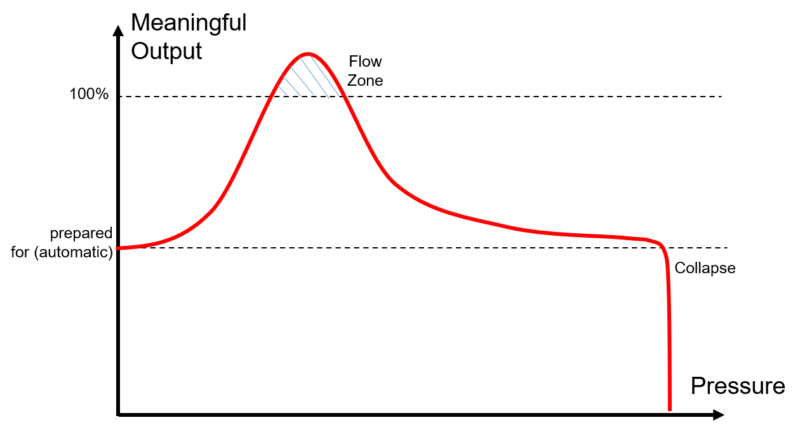
think it looks something like this:
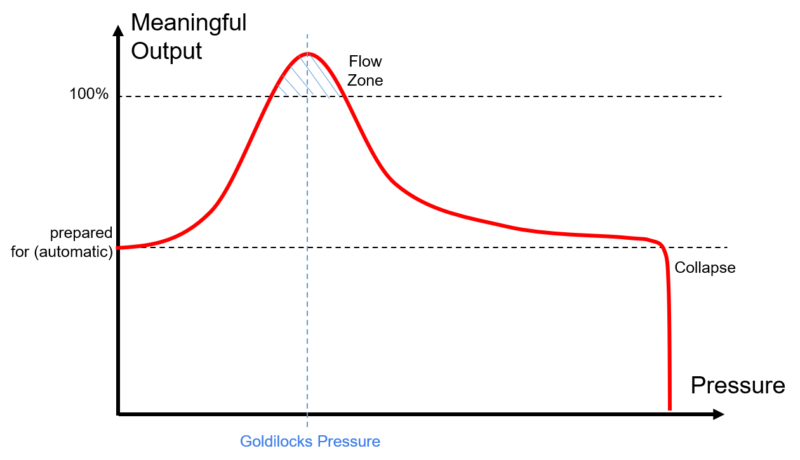
The upshot of which, I believe, is that both esteemed thinkers are indeed correct. Provided we understand the varying impact on outcomes attributable to varying levels of pressure. To Voss’ point, if we put too much pressure on people, they stop thinking, and hence revert to ‘automatic pilot’ (plus, if we keep increasing stress sufficiently, we eventually cause a cliff-edge collapse). To Bernstein’s point, if we put people under ‘Goldilocks’ conditions (i.e. just the right amount of pressure), we can attain a one-plus-one-is-greater-than-two level of output. Getting the level of pressure right allows people to enter a ‘flow’ state in which their creative juices come to the fore and difficult problems get solved.
I’ve deliberately used the idea of achieving ‘more than 100%’ outcomes in the figure, knowing that I regularly encounter individuals who become very uncomfortable at the thought. I have some sympathy with their view. Usually, when I hear naïve Millennials (yes, it is still possible to be extremely naïve when you’re in your late thirties) claiming they’re going to put ‘110%’ into their next relationship, or that they’re committed ‘120%’ to the project goals. Most times when people say these things they’re merely regurgitating a modern-day trope and don’t know what they’re talking about. But occasionally they do. In the jet engine business, for example, engines are designed to have a series of different power ratings. One of which is ‘100%’. This is the maximum level of power the engine is designed to be able to deliver continuously over the entire scheduled life of the engine. The jet engine industry being very safety conscious, its also standard practice to recognise that in some situations an engine might fail unexpectedly – e.g. by ingesting a wayward goose. If an aircraft loses an engine, the other engine(s) are then able to be operated at power levels greater than 100% to compensate for the power lost from the non-functioning engine. These higher power levels – in extreme cases 160% – can’t be sustained indefinitely, but they can be used for long enough that the aircraft can either safely return to the ground or, more usually these days, fly for several hours to reach the intended destination. At which point the over-exerted engine will be inspected and its remaining life re-calculated.
Exactly the
same ‘extreme situation’ capability is available to humans. We are usually
calibrated to be able to work a 40 or 50 hour week (120 if you’re a Systematic
Innovation person). Whatever our normal week looks like, that’s our ‘100%’. We
also know, I think, that occasionally we’re able to go beyond the 100% level.
The ‘all-nighter’ to submit the final report for example, or the ‘hackathon’ to
solve a knotty problem. The key point being – like in the jet engine – that we
do it for a short period of time and not (as some employers seem to think) for
ever.
I believe many individuals instinctively understand this ‘more than 100%’ capability. We take advantage of it when, like Bernstein, we deliberately don’t quite leave ourselves enough time to finish what we’ve been tasked with. Back to the figure again, if we get the pressure level ‘right’, we get to take advantage of a flow-based synergy effect.
And maybe that’s the higher-level synthesising third-aphorism takeaway from Voss and Bernstein’s apparently contradictory quotes: if we manage to hit the Goldilocks pressure level, we win, if we miss it, we get what our automatic pilot is prepared for. Or collapse.
Anyone foolish enough
to contemplate writing a book on leadership (e.g. me at the moment), might like
to know what they’re up against, competition-wise.
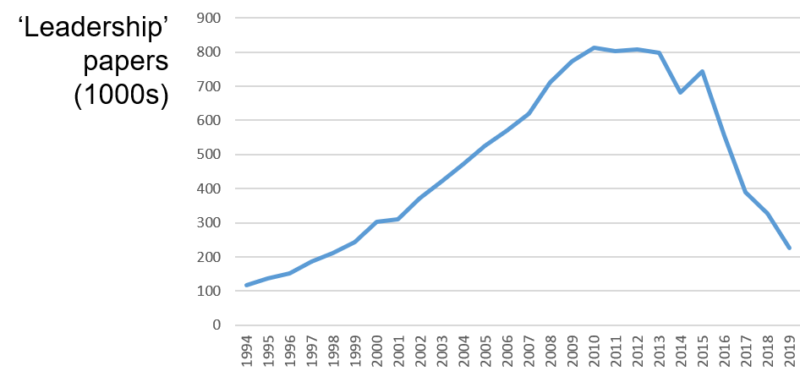
According to Google Scholar, last year there were 226,000 books, papers or articles published on the subject of leadership. A number I found difficult enough to compute inside my very small brain, that I was forced to look and see whether 2019 had just been a particularly bad year. Turns out that it wasn’t. Here’s what the scholarly output on leadership looks like for the last 25 years:
If you thought 2019 was bad, it turns out it was but a fraction of the ‘content’ published in 2010. A year in which an astonishing 812,000 pieces of leadership advice were flushed out of the minds of the leadership glitterati and into the corporate waste-bins of the world.
The curve made me think that leadership and people writing about leadership were somehow inversely proportional: the last time the world had any real leaders was probably in the 1960s. A time when people actually lead rather than taking the much safer route of writing about how to lead. By 2010 – in the wake of the GFC I imagine – the world had apparently no leaders at all, but rather lots of people carving a niche for themselves as leadership authorities. Not that I’m ever going to do the research, but I have a fairly strong instinct that the focus of many of the 812,000 leadership publications was ‘where have all the leaders gone?’ The answer to which, we can now see, was ‘writing papers about where all the leaders have gone’. And lo, the serpent began to eat its tail.
If this inverse correlation is in any way correct, the falling pattern since 2010 is probably a good sign. When people stop writing about leadership, maybe we might get some actual leadership back again? It would certainly fit with what happens in the sort of Crisis period most people on the planet now find ourselves in.
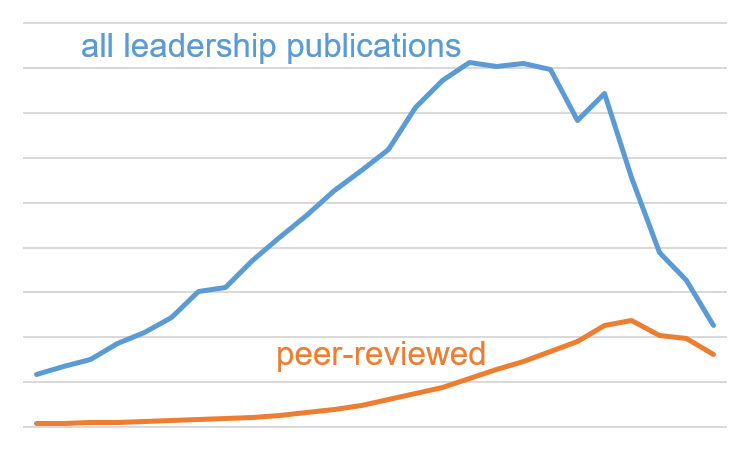
Meanwhile, before getting my hopes up too high, I thought I’d zoom in a little and restrict the analysis to leadership content that had been peer reviewed. In 1960, it turns out there were 2995 peer-reviewed research papers published about leadership. In 2017 the annual figure had jumped to 114,422. If my maths is correct, a 38x increase. In 2017, just to let you know they weren’t all writing about where all the leaders went, there were 31,339 papers published about leadership styles. This figure was up from 499 in 1960. A 62x increase in blind professors leading the blinder corporate flunkies.
When I plotted the trajectory of
peer-reviewed papers against the total scholarly output, the two graphs look
like this:
This data helped clarify another hypothesis. The peer-reviewed academia peak didn’t happen until 2016. Perhaps the most surprising conclusion that could be drawn here is that leadership ‘experts’ in academia are only six years behind the real world. If you’d asked me to guess, I would have gone for a higher number. Thirty years maybe? Forty? A hundred and fifty?
So, anyway, the upshot is, if both academia and the real world are on a downward trajectory, publication-wise, maybe those of us writing a book on leadership get to cling on to the hope that we end up writing the last book on leadership. That’s what’s keeping me going anyway. That plus the fact that by 2025 we might have some real leaders in our midst again. Ideally ones that received their Call to Action after reading the last book 😉
In an average
year, I probably get asked to review a couple dozen academic papers. I usually
accept, figuring that if the paper is any good, I might learn something, and if
it isn’t, I get to write comments that will hopefully enable the authors to
learn something. In the last couple of years, I’ve noticed a distinct shift from
the former to the latter category. Which basically means that either I’m
getting grumpier as I get older, or the quality of the papers being written is
on a sharp decline. Probably a bit of both.
July turned out
to be a pretty bad month. Three reviews to do and each paper exponentially
worse than the one before it. Which meant that, ten minutes after opening the
third paper, I was all for picking up a baseball bat and heading off to the Journal
of Civil Engineering and Management to conduct a more physical version of
author learning.
This first ‘paper’ reported an exercise to translate the original Altshuller Contradiction Matrix into a business matrix. Anyone that knows me can probably already guess where this might go. Anyway, the authors tried to justify this rather stupid decision by listing a page full of references. None of which were relevant. Including the reference to one of my papers. Which, if memory serves me correctly, was trying to make the point that it was barely acceptable to try and use the original Matrix for architecture problems. Never mind project management ones. This in turn made me realise that the authors very likely hadn’t read my paper at all. Rather they’d more likely done a five minute SCOPUS search for ‘TRIZ and architecture’, then copy-pasted the results into the back of their paper, and randomly allocated some reference numbers into their equally random sequence of words. It’s better than working for a living I guess.
The second paper related to an attempted de-bunking of so-called Generation Theory. Definitely a paper that should have been up my street, since, if anyone has heard me talking about Generation Theory during workshops will know we’ve spent the last twenty years trying to achieve precisely such a de-bunking. Therein lies the only similarity in approach though. We’ve tried to use some actual science in our attempts to dis-prove the model. Whereas the author of this paper hadn’t understood the ‘theory’, hadn’t attempted to, and was instead intent on executing what the popular press likes to call a hatchet job. So we end up with an argument that goes something like: generation theory sounds too good to be true. Therefore, it can’t be true. Therefore, let’s simplify it down to something a lay-person (or ‘reviewer’) can understand. Then make a few naïve and/or disingenuous assumptions. Then formulate a meaningless research question. Then misinterpret the results. Then swing the hatchet. Publish. Rinse. Repeat.
The third paper was so bad I really don’t know where to begin. Except maybe to say that the researchers in question had very likely picked up the half-science manual by mistake when they were looking for some authoring advice. Here are a few words from the abstract at the beginning of the paper. In theory, these are supposed to be the most readable part of the paper:
Since reliability and validity are rooted in positivist perspective then they should be redefined for their use in a naturalistic approach. Like reliability and validity as used in quantitative research are providing springboard to examine what these two terms mean in the qualitative research paradigm, triangulation as used in quantitative research to test the reliability and validity can also illuminate some ways to test or maximize the validity and reliability of a qualitative study.
This word salad indeed turned out to be the most readable part of the paper. It was definitely the bit that made the most sense. To say the work was ghastly is an insult to ghastly things.
It felt like time to offer up some advice. Initially, I figured this would best be directed at the researchers, but then the more I thought about it, the more I realised my anger was perhaps better directed at the supervisors that were directing their researchers to do dumb things. Or, perhaps more likely, didn’t know the difference between dumb things or smart things in the first place (one of the hazards of becoming a career academic?). But then again, no. The current round of ‘supervisors’ are probably a lost cause by now. Any researcher worth the name should be able to work out their supervisor was deluded, dumb or distorted within a couple of weeks of starting their research. That’s what literature reviews are supposed to be about. You know, like finding out that someone’s already created a Contradiction Matrix for Business problems fourteen years earlier before spending six months doing ball-aching, nugatory work.
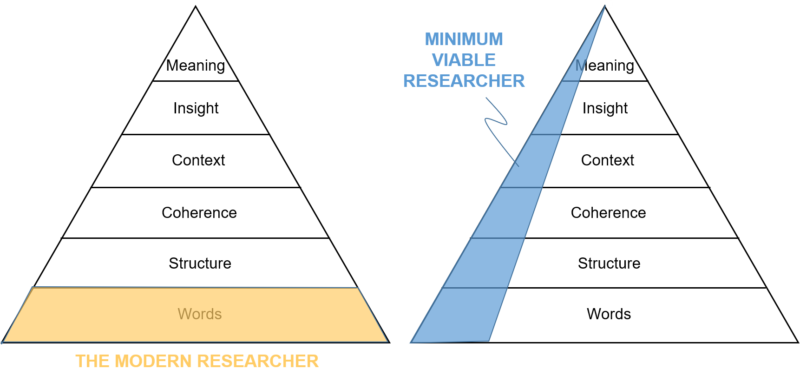
So, anyway, here’s my non-exclusive set of suggestions for a minimum
viable researcher:
A minimum two-days learning some of the basics of TRIZ at the beginning. The main aim being to understand that when we say, ‘someone, somewhere already solved your problem’ researchers not only begin to realise it is actually true, but also know how to go and find the somebody. The secondary aim being to get them to realise that research means advancing the chosen subject. Which to all intents and purposes means that if we haven’t revealed or solved at least one contradiction before we’ve finished, we haven’t been doing research but re-search.
A minimum three days learning the basics of Complex Adaptive Systems. Enough that they can grasp some of the basic tenets as they apply to their research topic. Like, for example, to choose a contentious area, appreciating there’s no such thing as ‘clinical evidence’ when we’re dealing with a complex problem. Quite simply because its never possible to step in the same river twice. Then appreciating that it’s perfectly possible to design experiments that are less than complex and still valid, provided you understand the first-principles from which the overall complex system has emerged, and are extremely cunning with your experiment design. This then leads to…
A minimum of two days uncovering and understanding those first-principles. Add another day to ‘really’ understand them.
A minimum of three days on human psychology. The main purpose of which will be to equip the researcher with the necessary gumption to go back to their supervisor to tell them that the research they’ve been asked to do is pointless. And, so we don’t come across as unduly negative, that we’ve found the critical contradictions needing to be addressed and now have a plan to start tackling them.
A minimum of three days on the science of measurement. Specifically, to learn that it is vital for researchers to measure what is important rather than merely expedient.
A minimum three days learning about the structure of story. That way, when it comes to finally writing up the brilliant contradiction-solving piece of research we’ve just done, we don’t bore the reader shitless when they have to read about it.
TRIZ. Complex Systems. First Principles. Psychology.
Measurement. Story.
Seventeen days.
All in all, quite a big investment of time. But then again nothing compared to the two years that seems the new normal as far as doing pointless re-search is concerned. Even if – and I say this because I’ve seen it apply to a majority of ‘researchers’ – your primary motivation is to emerge from the train-wreck with a bright shiny qualification, your soul will thank you for spending those two years doing something meaningful.
The destination
of choice for anyone wishing to engage in meaningless, going-around-in-circles
debate about the important issues of the day.
Like masks, for example. A topic guaranteed to bring out a whole rainbow’s worth of factless opinion and unlogic. The café is a place where customers can debate whether the mask issue is an epidemiology problem, or a fat-tailed risk problem, or a sociology problem, a psychology problem or a fluid-dynamics problem, an electrostatics problem, or, heaven forbid, a two-phase flow with a double evaporation somersault and a half twist problem. All the time forgetting that the real problem is a combination of all of the above, and where none of the individual pieces can be ignored.
The café has become a safe place where the person with the simplest message and the most trustworthy face wins. So that, now we’ve elected a Government of bare-face liars, when we try to work out who the most trustworthy face is, the preferred choice turns out to be, wait for it… Gary Lineker. With David Icke in second place, BoJo the Clown and his troupe of devolved jabbermonkeys in third, anybody with a recognisable professional qualification from the adjacent Half-Science University – someone with a ‘Dr’ at the beginning of their name for example – comes fourth, and anyone with a genuine desire to establish the truth gets to sit with a dunce’s cap on in the far corner facing the wall. But, hey ho, either way, visitors will be guaranteed to leave the café with a doggy-bag and a cunning sound-bite answer they can use should anybody question their subsequent mask choices back in the outside world.
The Half-Science Café is a place, too, where its possible to watch literary magicians weave their wit-filled hypnotic spell in such a dazzling way that we end up thinking cooking chickens and washing dishes are somehow equivalent to mask wearing. That the ability to put a chicken into a 190degC preheated oven for 20 minutes per pound, plus 20 minutes has some kind of analogous relationship to the problem of keeping 80nanometre diameter particles out of harms way when they’re sneezed out of a symptomless infected person. After, crucially, a couple of minutes of droplet evaporation time.
The staff here at the café love their work. They know the customer is always right. If the customer concludes that a lovable football commentator (7.6 million Twitter followers can’t be wrong) is the way to go, that’s clearly the way to go. Even if it only saves one life, why wouldn’t we all wear a mask, right? Never mind the fact that the advice turns precaution into precautionism (https://www.darrellmann.com/precautionism/). Which in turn means we’re a whisker away from extending the unlogic to mean we’ll all be wearing full NBC hazmat suits come the Autumn… because, guaranteed, that will save at least one life.
Here at the Half Science Café, we are also able to offer counselling to anyone that accidentally snaps out of their hypnotic trance and starts to experience one of those awful, stomach-churning moments when we realise – tragically – how all of this blather is utterly trivial compared to the real issue. The issue that reveals how we now live in a world in which there’s so little common sense and so little leadership, that no one even thinks to go and find the actual truth anymore. That not a single Government, not a single Chief Scientific Officer, not a single WHO executive has had the gumption to stand up and say, you know what, let’s get all the different domain experts – the epidemiologists, the risk analysts, the fluid dynamicists, the sociologists, the psychologists, those annoying two-phase flow geeks – together into a room and lock the door on them until they’ve either worked out what the proper questions to ask are, they’ve answered them, or worked out what information is still missing in order to come back and answer the question properly next week. Because, until that happens, were all forced to live in a Russian-bot guided world filled, courtesy of Cummings and his Nudge Squad, with empty safetyism-provoking slogans like this week’s stroke of anti-genius, ‘Hands. Face. Space’.
In the Netherlands, a combination of geographical size, flat landscapes and frequent flights conspired to makes aircraft noise a vexing problem.
In the early 2000s, Amsterdam locals, frustrated with sound pollution, demanded the city do something to address the problem. Faced with lots of flat land around the airport, it was understood that traditional barrier solutions would not work for the most disturbing low frequency/long wavelength parts of the noise spectrum. Airport staff, once they began to look for alternative solutions, realised that plowed fields in the area seemed to help dampen the noise. Especially ones with a particular spacing of ridges.
Reverse-engineering
this phenomenon, landscape architects worked with artist Paul De Court and drew
on the work of acoustician Ernst Chladni to create over 100 grassy pyramids
specifically designed to address this site-specific problem.
From a TRIZ
perspective, the problem being solved represents a classic contradiction: we
want to reduce noise, and what stops us are the long wavelengths of the most
troublesome low frequencies. Here’s what this problem looks like when mapped onto
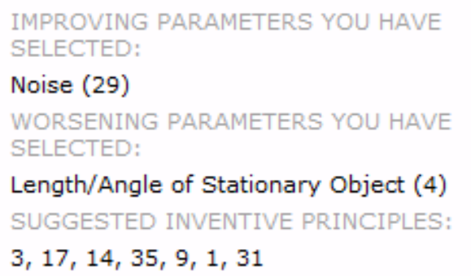
the Contradiction Matrix:
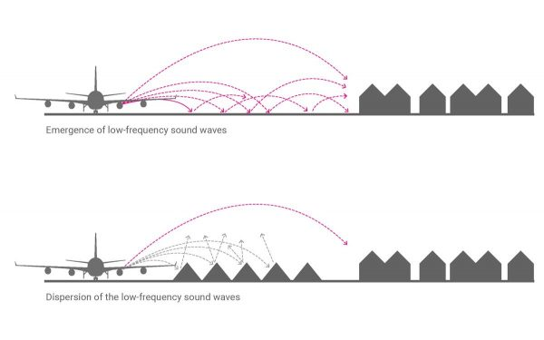
And there is Principle 17, Another Dimension as the second most frequently used solution strategy for this conflict pair. Here’s how this solution works from an acoustic perspective at the Land Art Park:
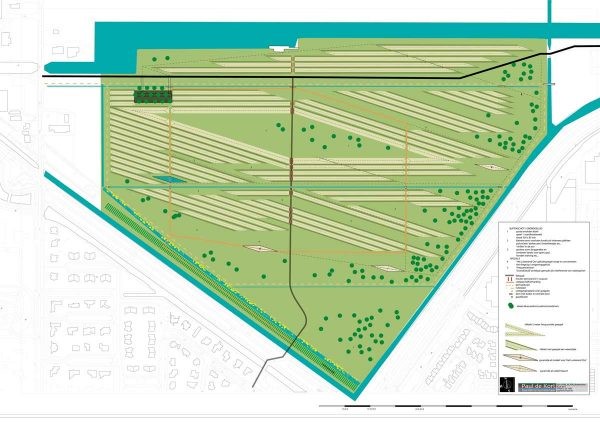
Interesting, too, if we look at the overall pattern of ridges used by the architects, is how they’ve incorporated several Principle 3, Local Quality strategies so not all of the ridges are the same height, shape or orientation:
That solution alone would have merited looking at this story. The architects on the project, however, also went a step further by thinking about the next contradiction: we need ridges to solve the noise problem, but we don’t want to lose the potential to use the ridged area for other things. One of the Inventive Principles the Matrix recommends always considering for this kind of unwanted side-effect problem is 22, Blessing in Disguise.
A strategy the architects used with some aplomb. Firstly, by instead of simply disrupting sound waves, incorporating paths for cyclists and pedestrians, and then creating ‘…vistas and lines of sight, smaller and bigger allowing ‘rooms’ to emerge, which can be used for sports and cultural events. To the north and south the grassy ridge structure extends until it dissolves into longitudinal pyramids, distributed along the edges. Unique art objects are placed on the pyramids, inspired by parabolic sound mirrors, exploring the meaning of sound in this soundscape.’
Then, in a final Blessing in Disguise masterclass, the architects also engineered spaces that specifically amplify rather than reduce the aircraft noise, turning a former regional frustration into a highly localised aural experience.
One Inventive Principle good; three, better. Same as it ever was.
Mercedes surprised no one by regularly topping the timing screens in Formula 1 testing at the start of this year. They did, however, manage to spring a surprise when one of the enabling innovations was revealed: DAS or, to give it its full name, dual-axis steering.
On-board
footage showed both Lewis Hamilton and Valtteri Bottas pulling the wheel
towards them on the straights, before pushing it away when reaching the
corners. They could not hide it any longer, and technical boss James Allison
was seemingly happy to confirm its existence – if very little about what it was
actually doing.
The innovation,
it later transpired, was all about dynamically altering the toe-angle of the
front wheels of the car.
Why would
Mercedes want to do this? To briefly explain, toe is the angle that the wheels
sit in relation to dead ahead when the steering is straight. If the front of
the wheels are pointing out, this is known as toe out, the opposite and they
are toed in.
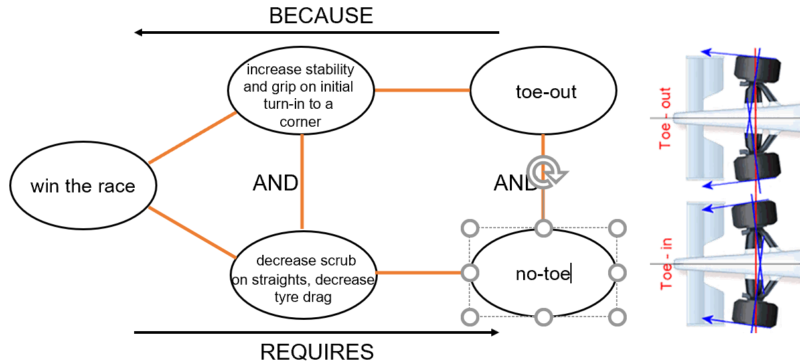
The toe angle
has a significant effect on a car’s handling and changes how the tyre interacts
with the road surface. Generally, a degree of toe out will aid both stability
and grip on initial turn-in to a corner, however, too much toe out means the
tyre scrubs – effectively it is dragged rather than rolled across the track
surface.
TRIZ-wise, here’s a classic physical contradiction: the car wants toe-out and it doesn’t want it. Something like this:
Once we know there’s a contradiction to be solved, all we need to do is think about the three different separation strategies and we’re half way to a solution. Actually, in this case, all we need to do is think about the first of these strategies, separate in space. Where do we want toe-out? Where do we not want it? As soon as we realise the two questions have a different answer – corners versus straights – we can start tapping in to the solution strategies of others. The most common of which is Principle 1, Segmentation.
Simple when you know how. As ever, the real trick is giving yourself permission to believe that contradictions don’t have to be solved by the usual trade-off strategies.