My good friend, Professor Toru Nakagawa asked to make a Japanese translation of the virtual presentation I prepared for this year’s US TRIZCON. I happily agreed. Then we found out that my colloquially-dominated English commentary was a major hindrance to effective translation. Partly, I suspect, because there was never a script, and that I merely recorded my commentary on the sequence of slides. Worse still, I did it in one take.
So, anyway, if you want the Japanese translation, you’ll still have to wait a while. In the meantime, having now made a transcription of the commentary, I thought I’d publish it here. The slides, in the meantime, can be downloaded from the link found in the News section on the SI home page. The full paper, if you’re feeling particularly masochistic, is the lead article in the October issue of the SI ezine.
The transcription:
Slide 1
Hello, TRIZCON. Long time no speak. Great to be a part of this years conference and to share with you some of the things we’ve been doing with our clients this year. Helping them to make sense of the world we now all live in, and to see what’s likely to happen in the coming years.
Slide 2
I’ve got four parts to the presentation. First of all, I thought I’d look at society as a whole, and where we think society might be heading in the next ten years. We’ll then zoom-in to focus on the world of business and how it may be changing. Then zoom-in one step further and look at the world of innovation, and what’s likely to happen there. And then, finally, use those three levels to try and understand a little bit better how the TRIZ-world might change in the coming years.
Slide 3
As soon as we say we’re going to try and predict the future, then we’re in fundamentally complex territory. Which means that there are an awful lot of things that we can’t know about what’s going to happen. But at the same time as that, we know that’s not the same as saying there is nothing we can know about the future. And, particularly if we look at things from a bottom-up perspective, if we look at things from a first principles perspective, we can do a pretty good job, I think, of seeing how the world emerges from where it is to where it is going to end up in the next ten years.
Slide 4
A big part of the problem of predicting the future is the ‘Black Swan’ side of the story. This relates to the Nassim Taleb concept of the highly unpredictable, high consequence event in life. What we know to help us on such a journey is that even though events happen at random, society’s reaction to those events is conditioned by fundamentals associated with the behaviour of human beings. And so, if we can build that stuff into our prediction models and our evaluation of what’s happening then we stand a pretty good chance of identifying some of the key things that are likely to be ahead of us. Ironically, perhaps with the Covid world that we now live in, Covid was not a Black Swan, but rather a highly predictable event. And really the only surprising part of the story, perhaps, is the fact that so few Governments decided to prepare for the pandemic. And then, because of that lack of preparation, as soon as you see that has happened, it sets in place a sequence of events that are now unfolding.
Slide 5
Let’s start with the Societal level perspective. I’m using Nikola Tesla here as a marker to distinguish between the different sections of the presentation.
Slide 6
At the Societal level, what’s happening at the moment is completely consistent with some of the things we talk about in the TrenDNA book, and in turn, where we got that from was the work of Strauss & Howe looking at generation cycles. I think they’re a little bit mis-understood in that they’re perceived as being top-down analysts of the world, whereas in actual fact, the premise of their work was very much a first-principles idea. One which says the way you were raised by your parents will impact the way you raise your own children should you choose to have them. This model tells us that the years 2000-2025 is a Crisis period if the previous pattern is allowed to repeat. And, so far it has done. We’ll dig a little bit deeper into that in a second. I’m conscious with this presentation that I’ve got a lot of material to try and cover and so the way I’m trying to handle that is by providing, as you’ll see on the bottom of a lot of the slides, a reference for further reading. We’ve published a lot of material this year, and if anyone’s interested in any particular part they can go and look at whichever bits they feel they’d like more information on.
Slide 7
We also know that there are an awful lot of things we can’t predict as described earlier. We do know that in the Crisis period there are lots of wobbling dominoes. And while it’s difficult to predict which domino will fall over first, once one domino falls over it gives us a good indication of what the next domino and the domino after that will be to fall over.
Slide 8
So, whether it’s trade, employment, politics, we’re now in a situation where the pandemic has already severely impacted other dominoes and we’re starting to see some of those also falling over.
Slide 9/10
Right at this moment we’re coming to the climax of the Strauss & Howe predicted Crisis period, and, if the pattern plays out, it tells us the next four-to-five years, things will get worse than where they are today. And then hopefully, somewhere around 2024/2025, things will settle down into a ‘New World’. In effect what the model says is that the world is currently in transition from one s-curve to the next.
Slide 11
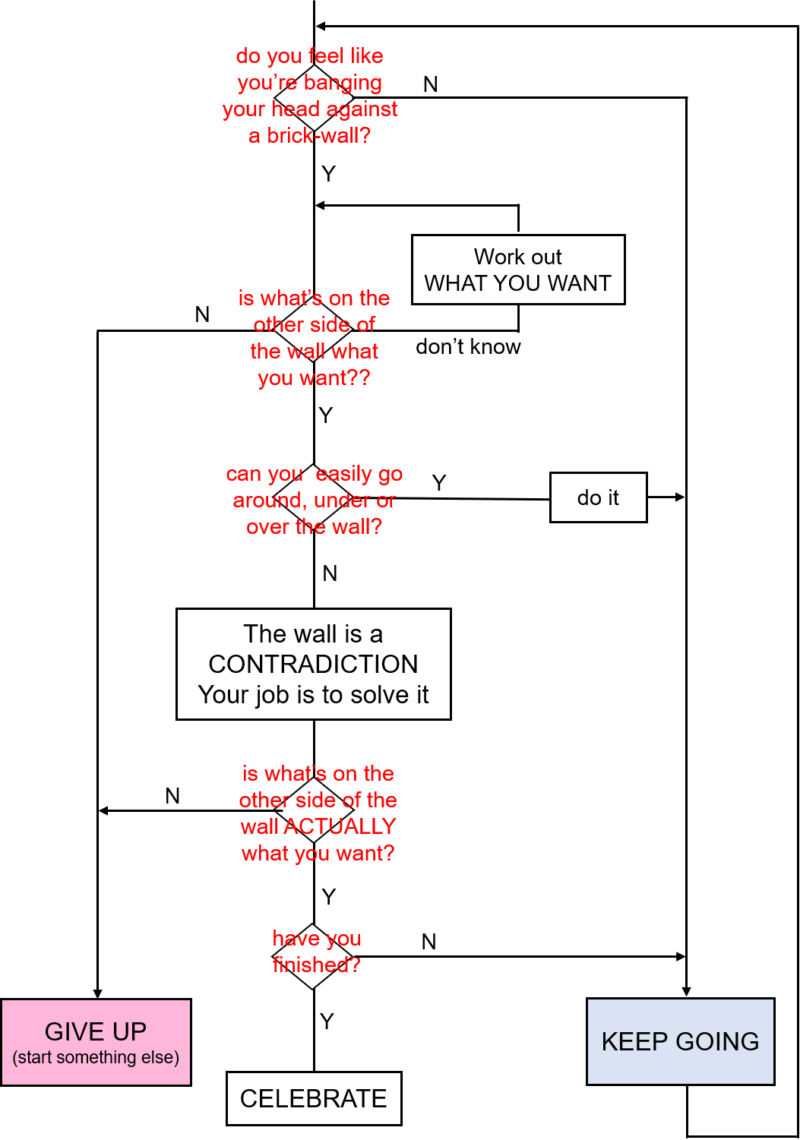
Another model that’s useful in these kinds of situation is the Hero’s Journey. Here, as soon as we understand there is an s-curve shift taking place, the work of Joseph Campbell tells us that there are some clear milestones that occur during those transitions. One of the key ones being that, once we’ve jumped off an s-curve, there will be an ‘Ordeal’, or, from a TRIZ perspective, a contradiction that needs to be solved. Trying to look at previous cycles of the pattern and where we are right now, the analogy I would draw is that the pandemic is the equivalent, in the US at least, of Pearl Harbour in the last cycle. Pearl Harbour was a clear signal to the United States that their current way of living wasn’t going to prevail any longer, and triggered the start of a transition to a New World. So, right now with Covid, if the pattern repeats, then we have four or five years to unravel the Ordeal, make sense of it, solve the problem and – hopefully – solve it well.
Slide 12
We also know that we’re in a situation here of ‘punctuated equilibrium’. So, for large periods in history, things are relatively calm. Then one domino will fall over, and it will trigger the fall of a number of other dominoes and we’ll see lots of change, and then things will settle down again. So, again, right now we’re in one of those punctuated equilibrium situations. And one of the things we know from previous cycles is that these periods of instability are really important from an innovation perspective.
Slide 13/14
Here’s another model of the world offering a classic case of someone, somewhere having done some hard work for us. This is the Disaster Cycle. A piece of knowledge concerning the occurrence of bad events, that what follows from them forms a very consistent pattern. So, we have the impact of the event, there’s a subsequent ‘honeymoon’ period when everyone pulls together to try and fix things, followed by disillusionment, where we realise that the temporary fixes that have got us out of the initial emergency aren’t innovation at all, but rather merely expedient, and that the real innovation job starts during the Disillusionment phase. We’re heading in to that phase right now and a lot of the expedient solutions are becoming innovation opportunities.
Slide 15
This is another piece of research looking at the world from a societal perspective, and again, looking at disaster and situations where society jumps off its s-curve. This is the work of Dmitry Orlov. His scenarios for the world where it is now are all quite bleak to be honest. The best of which is that we do what Iceland did at the end of the GFC and thus allow ourselves to stay, or return to where we are. He didn’t have one of the good scenarios that we think is a possibility. We just published the ‘Everythink’ book, and that talks about a breakthrough situation where we jump to a ‘higher’ level s-curve than the one we’re on right now. We think it’s a fairly low probability, but its not possible to say at this point in time which of those scenarios, whether it’s the optimistic one that we’ve got, or the five pessimistic ones that Orlov has got, is the one that will happen. I think what we do have though is the opportunity to identify some of the signals that will tell us which of those scenarios is the most likely to play out.
Slide 16
In order to make any kind of meaningful prediction about the future, we need to take all the uncertainties and try and bracket them. So, what we’ve done with several clients this year is build a number of scenarios which together cover the range of possible changes in the world. In this picture here we’re essentially looking at four scenarios along two different axes. One looks at society – which either stays in the doldrums that its in right now or it undergoes a significant step-change. And on the other axis we look at the world of business and again have one scenario that says the current systems remain locked-in where they are right now, or, at the other end of that spectrum, there’s some kind of a major breakthrough. That could either be a technological breakthrough (for example the energy sector, probably the most likely), or its some kind of legislative breakthrough and shift. The most likely scenario there, I think, is the power of the Big Data companies and the likelihood that Governments will try and break them up. So, we look at those four scenarios and then, if we identify something that occurs in all four scenarios, then we can say with a degree of confidence that its likely to happen whatever the reality turns out to be. We’ve done that analysis. I don’t have time to go through it here, but…
Slide 17
Pointing out what we have seen from those scenarios is that in Crisis periods, whatever the scenario turns out to be, looking at those four extremes, there are always winners, winners that are consistently winners, and then there are winners that are likely to be winners in this particular cycle. The headlines on the slide are essentially the findings that we’ve published, and we think are going to inform the innovation side of our story.
Slide 18
It’s sometimes nice to look also at some of the losers. Without wanting to get too depressing about things, there’s a few references I think give us some signals. One of the most likely ones is, looking at the book, ‘Bullshit Jobs’ by David Graeber, who sadly passed away recently. During Crisis periods a lot of those meaningless jobs that currently exist in the world will disappear. That could mean 30% of the jobs in the world according to Graeber’s research. I think also highly likely is the fact that when we’re in a period of chaos and high instability, optimisation is not the right strategy anymore, and so things like Lean, SixSigma will fade into the background. Providers of those kind of services are going to have a tough time.
Slide 19
Let’s now zoom in and look at the world of business…
Slide 20
…and introduce this model. Again, it’s all written up elsewhere so I’m not going to spend too much time describing it here. One of the things that we’ve been saying quite strongly to our clients is that you need to understand the capability of your organisation in terms of complexity, and you need to set that in the context of the surrounding environment that you’ve got. So, you’ve basically got four scenarios you need to be thinking about. One is that the world you’re operating in is ‘simple’. Another is that it is ‘complicated’. Then it’s complex. Then it’s chaotic. If you don’t know which of those scenarios you’re in then it’s highly likely you will find yourself doing the wrong things at the wrong time. So, know where you are, know where the context is…
Slide 21
…One thing we know from before the pandemic hit is that the prevailing business model for most organisations was efficiency-driven. And so what that meant was a desire to simplify things inside organisations…
Slide 22
…ever since Taylor came along and studied work, ‘standardisation’ has been the dominant model. The converse of that is Nassim Taleb again, and his 2012 book, looking at AntiFragile. Which is kind of the opposite view that says you should be aiming for a situation in which the more your organisation is stressed, the stronger you become…
Slide 23
…that’s the line at the top of the 4-by-4 picture. The natural world tries to take us away from this line. So standardisation and Taylor’s work tries to simplify everything; the 2nd Law of Thermodynamics and the reality of life push us towards the boundary with chaos. Boththese forces combine to make it difficult for organisations to get to where they’d like to be… which is where they are ‘efficient’…
Slide 24
…there are certainly things we can do in order to achieve that. Some of them quite drastic – for example, if we look back at the beginning of the automotive industry and Henry Ford, ‘any colour you like as long as it is black’ was a great way of simplifying their market. If you wanted to buy a Ford, it was going to be one that had a black paint-job.
Slide 25
Where you’d like to be, where Taleb encourages us to be is up in the ‘Golden Triangle’ at the top of the picture. That’s the place that says we acknowledge the world is complex, and we have processes in place inside our organisation which are consistent with that complexity. Above the diagonal line – the Ashby Line – says that the capability of our system is greater than the level of complexity of the world around us. Hence it makes a great target for organisations to be. The distance between the previous green triangle, the Efficiency Zone and the Golden Triangle, unfortunately, makes life quite difficult for most organisations. It’s a big shift that needs to take place…
Slide 26
…the book we published at the beginning of lockdown is all about start-up companies, but it’s also about the journey of getting out of the ‘ordinary’, efficiency-dominated world and into a complex environment. Almost fundamentally that means going through a period of chaos. I think many people will recognise that the world only really changes when we are in such a situation of chaos. Because, if nothing else, chaos teaches us that the existing rules don’t apply any more.
Slide 27/28
I think, just looking at business, and how it’s changed by this s-curve shift that society is taking, there’s another book that has come out recently, which we think is relevant. That is Gary Hamel’s latest book, ‘Humanocracy’. It talk about a shift in paradigm that’s taking place in the workplace. He’s another person who understands ‘first principles’. Humanocracy in effect talks about the shift that is taking place away from the efficiency-dominated world in which people employed by organisations are effectively given tiny, segmented, easily-trainable jobs… into one in which efficiency shifts to effectiveness, and where we need people to bring their brain to work and to think creatively. Now, whether that creates any innovation opportunities remains to be seen, but that paradigm shift is certainly something we can see on the horizon…
Slide 29
…I’m not sure every organisation is going to be able to make it. I’m not sure many actually want to make it. If we look at what’s happening in the media at the moment, there’s lot’s of talk about a K-shaped economy. All of our scenarios predict the same thing. Which basically means that we’ve got three types of organisation: Type 1 is the organisations that are currently part the way up their s-curve and get to keep going; Type 2 is the type of organisation that, unfortunately, doesn’t make it through the societal shift; and Type 3 is the organisation that makes a shift to the new paradigm described in Gary Hamel’s book: the ‘effectiveness’ world rather than the efficiency world.
Slide 30
I think there are clear signals, and certainly looking at Hamel’s book we can see examples of these ‘new world’ organisations – where they’ve engineered completely different organisation structures: structures that are consistent with empowering people, eliminating the ‘bad’ jobs, creating ‘self-organisation’. In many ways, very consistent with TRIZ. Haier, WL Gore are the two prime examples of what the new world could look like. The ‘command and control’, Type 1. Organisations, those are the Facebooks, the Amazons of the world, the ones that have become highly dominant in the past decade or so because they’ve tapped into the virtuous cycle that comes from owning peoples’ data and using that data to better understand what it is that customers will want in the future. And then, the Type 2 downside sees the ‘command and control’ dinosaurs, the top-down driven organisations… I think automotive is going to be one of the biggest sufferers in this domain. Aerospace not far behind it. Unless these companies are able to make a marked transition to a new way of doing things then they’re going to be in serious trouble.
Slide 31
From an innovation perspective then, what have we heard so far? From a societal perspective we have difficult times, but good times for innovation. Business on the other hand, has got to undergo a significant shift away from an efficiency model towards an innovation model. And one of the challenges of that is, do the skills exist inside organisations…
Slide 32
…to enable it? Certainly if we look at the Big Five consulting companies there’s a strong case to be made to say that they’re the cause of the problem that the world’s in right now, because what they’ve been doing is teaching client companies about operational efficiency for the last 40 years, and have taken companies too far down that efficiency road. To the point where many of them are unable to come back and rethink how they do things. We think they’re in trouble. We think there are signs, if you look at the companies the Big Five consulting companies are buying at the moment – eg buying ‘Design Thinking’ boutiques and innovation boutiques – its clear they fundamentally don’t understand what innovation is about yet. They could be a solution in the future, but in the short term are very definitely not going to be…
Slide 33
…part of the reason for that is there is still an awful lot of confusion about what we mean when we use the word ‘innovation’. We published this article a couple of months ago looking at the different definitions that are out there. The one that we use is the one that defines innovation as ‘successfully implemented ideas’. In other words, it is making money for the organisation. But it turns out that our view represents a minority perspective on what innovation means. The majority of innovation authors think it’s about an ‘implemented idea’, irrespective of whether it has been successful or not, and about a third of authors still think that ‘innovation’ means ‘generating ideas’. It’s only the green definition on this slide that actually makes any kind of sense in terms of the TRIZ story, and the future for the innovation world – that you’ve got to deliver success to your clients, otherwise you’re basically not innovating, but rather merely preserving the status quo.
Slide 34
Something we’ve known for a long time is that TRIZ over-shoots the market to a high degree. It was 2012 when we published the Innovation Capability Maturity Model, where we’d identified five different Levels of Capability to innovate inside organisations. TRIZ really becomes a valuable tool for Level 4 and Level 5 organisations, but, as shown in this picture here, there aren’t many of those organisations. The majority of organisations have never really had to think about innovation, and so have really been thrown in at the deep end when the Covid domino fell over. This is a problem for the TRIZ World… a lot of the tools are useful, but actually quite dangerous if the Capability to innovate inside the organisation is low.
Slide 35
What do we also know? We know that other methods struggle similarly to deliver success inside organisations. So, 98% of all innovation attempts fail. And if we look at innovation attempts that purportedly use Design Thinking, Or QFD, or Open Innovation, they really do nothing to impact the overall success or failure rate. The problem is something deeper than methodology. We could easily add TRIZ into that story too. It’s a necessary part of the innovation story, but it’s not a sufficient part when we’re dealing with complexity.
Slide 36
So, what we’ve tried to do over the years, we did it with the Capability Maturity Model back at the beginning of the last decade, is try to look at the 2% of organisations that were successful, and reverse engineer what they did. This year’s book, the Hero’s (Start-Up) Journey is really been about the start-up organisations and the 2% of those that are successful, and reverse engineering what is it about their capabilities that allow them to succeed where their competitors did not.
Slide 37
So that takes us to TRIZ. And how TRIZ becomes a big part of that success story…
Slide 38
…’necessary but not sufficient’ is the way we’ve been describing it for a number of years. Some of you may be familiar with the ‘Hype Cycle’ from Gartner. We’ve been tracking TRIZ’s along this Cycle for a number of years. It makes for a great case study. One we’ve written up a couple of times now, looking at some of the key events that took place in the 1990s – the arrival of the first consulting companies, the software, and the deployment inside companies like Samsung. The pinnacle of TRIZ so far was probably the Samsung medal awarded to the TRIZ team. Everything after that has seen TRIZ on a downward trajectory, completely consistent with what the Hype Cycle tells us. I’d have to say, where we are right now is right at the bottom of the ‘Trough of Disillusionment’… which is a dangerous place to be. Ideally, we get through it, and up the ‘Slope of Enlightenment’ – so people begin to understand what TRIZ actually does, But, when you’re in the steep downward trajectory, sometimes it’s the case that we can’t climb out of the descent fast enough and we end up crashing everything completely.
Slide 39
So, what do we conclude from our analysis? The answer takes us back to our Complexity Landscape again. One of the reasons why TRIZ has struggled s because if we look at original, Classical TRIZ…
Slide 40
…it really sits in the ‘Complicated’ domain. It’s not designed for complex problems, but rather, complicated technical problem where the system is in control. The clue is in the name – ‘theory of inventive problem solving – it tells us something about the problem, but the crux of the method really resides with the problem solving part of the story…
Slide 41
…it’s only later on when we have what might be called, TRIZ 2.0, where we start to bring in some of the Western influences. So, Function Analysis gets added to the story, for example, and it’s then that we can look at complicated problems where the definition is very unclear. What we’ve been trying to do is, because of the work we do with marketing functions and looking at ‘business’ is create a TRIZ 3.0, or, more appropriately, ‘Systematic Innovation’ these days, is to get into that complex world such that we can deal with complex situations. And where we’re trying to get to at the moment, the upcoming TRIZ 4.0, or ‘Systematic Innovation 4.0’ more properly, is enabling organisations to work no matter where we are on the Landscape. So, if the environment is in Chaos, for example, we know there are things that can and should be done in order to get the organisation out of that chaos. The idea here is, again, diagnosing where an organisation is and then bringing along the appropriate sets of tools and methods for that particular situation. So, if it’s a complicated situation then Classical TRIZ is a perfectly adequate, and a perfectly sensible thing to bring to the story. If you’re in a complex environment then, unfortunately, Classical TRIZ is really not going to help you. It will point people in fundamentally wrong directions. What’s required is to acknowledge and embrace the complexity that’s there. When we’re dealing with chaos, what that essentially means is that we have to be able to do things an awful lot faster…
Slide 42
…and so when we start attaching methodologies to these different scenarios then, in the Chaos world, we’re looking at the work of John Boyd and his OODA model – the idea of rapid learning cycles, which may well have a TRIZ element to them, but it is the cycling and the rapid learning that is the key to survival and thriving in those environments. The model basically gives us an indication that, once we’ve understood where an organisation is and where their market is, we get a much better chance of bringing along the right combination of tools and methods to deal with the situation.
Slide 43
As far as TRIZ itself is concerned, then, I’ve used this slide way too many times in recent years. The UK has some of the worst politicians on the planet at the moment. Historically, we’ve had some of the best, and I think, the best was probably Winston Churchill, who, famously talked about democracy as being the worst form of government… apart from all the others. I think TRIZ finds itself in a similar situation, in that it is the worst innovation method… apart from all the other ones. This is a problem. It’s certainly a problem for the TRIZ community. But it’s a problem for organisations that are trying to innovate also, because there’s a lot of stuff out there – with 1500 books a year published on innovation – and none of it really seems to help…
Slide 44
…so, the prognosis for TRIZ… what are the ‘yes, buts’ first of all? A constant frustration, certainly inside our organisation, is the bickering and argument that still takes place in the TRIZ world. Fighting over crumbs instead of growing the pie. I look at some of the Big Five consulting companies that have got zero innovation capability, and the TRIZ world really should be destroying those organisations. And yet, here we are, literally scraping a living, especially those that are trying to do it with purely TRIZ. There are too many TRIZ providers… many of whom are not users of TRIZ. Again, it’s an enormous frustration of mine that TRIZ tells us the customer wants the function, and still we hear TRIZ consultants saying you have to use TRIZ. It’s completely inconsistent with the reality of the world and, because a lot of the TRIZ providers aren’t innovators – they’ve never innovated, they’ve never seen a project all the way through to its end, its really difficult for them to understand the complexity of the world, especially the 99% perspiration that follows the 1% inspiration at the beginning. We’ve talked a little bit already about complexity and using compatible strategies for a complex world, but Classical TRIZ is still stuck in the ‘complicated’ world. That’s clearly a problem. Where we do try and take TRIZ out of the technical world and into the business world, we immediately fall into the trap of, looking at the history of TRIZ and its Soviet origins, raising eyebrows with organisations who cannot connect the idea of ‘business’ and the Soviet Union at all. That is a really enormous problem. Both for the organisations that are trying to innovate and don’t know where to go to look to find solutions, but also for the TRIZ community, because, its very clear that the people with all the money inside organisations are the people that sit in the boardroom. If we take all of that stuff and think about how we solve all these contradictions, what do we get left with?
Slide 45
Fundamentally, I think we can say very safely that, when we take things down to a first principle level, innovation is largely about contradiction solving. The vast majority of all innovations – in other words the 2% that have been successful – they’ve identified and they’ve solved a contradiction. TRIZ is the absolute home of contradiction-solving. Theory of Constraints is perhaps the only other methodology that gets anywhere close to it. Recognising the importance of contradictions, philosophically speaking we’re looking at Hegel and his insights about the importance of contradiction solving. So, the good news as far as the TRIZ community is concerned, is that, whatever happens, when the world understands that innovation is contradiction solving, TRIZ has an enormous advantage over just about everything else. I think, unfortunately, the down side, and I guess the bad news, which isn’t going to make me popular with a lot of people is, whichever way we look at it, the TRIZ name makes no sense in the world we’re heading into. You’ve got to deal with complex problems, you’ve got to deal with business situations, and its just not possible to overcome the stigma that comes with the Soviet roots of the methodology. So, I can’t see that, by 2030 the TRIZ name will be anything other than a footnote in history. I think a lot of Altshuller’s research, on the other hand, and the contradiction-solving part of the story in particular will be right there in the centre of whatever the innovation world ends up being. I think, if we come back to the societal level part of this presentation’s story for a second, we’ve got four or five year’s worth of Crisis and Chaos ahead of us. I don’t think that’s a great time to be launching on to the world a new TRIZ or whatever the successor to the TRIZ name ends up being. It’s a time to stay underground. People want to innovate, they don’t want to learn innovation methods. They need the output, they need the success stories, and so, certainly we’re not going to put any effort at all into promoting new methodologies in the next four/five years. What we are going to be doing is getting ourselves ready for the period when things settle down, when society has found it’s new s-curve and is stabilised in that New World, because that’s the end of the punctuated equilibrium and we’re back to equilibrium, and it becomes a much more sensible time to start thinking about creating innovation capability in a wider number of organisations and a wider range of the population inside those organisations. If we look at the Haier business model, however, its difficult to see them outsourcing a lot of innovation activity, simply because, when you have a self-organising system, and you’ve got lots and lots of tiny organisations within the overall organisation, all of them empowered to do whatever they need to do in order to innovate, its difficult to see them going out to innovate with large consulting companies. And so the TRIZ opportunity there is going to be a highly segmented one, and one that is still largely unclear. It’s a case of being underground at the moment to get some success stories, getting ready for whatever the New World turns into. In my most optimistic days, I have the probably naïve expectation and hope that the TRIZ community will get together in this four/five year period such that we can make a positive difference to the rest of the planet. On my more realistic days, I think what’s going to happen is that an outsider – again applying TRIZ to itself – is going to come along and cherry-pick the important parts of TRIZ, combine them with other things, and they’ll be the ones that end up being the big success and will reap the rewards of surviving the chaos period and prevailing then in the New World.
Slide 46
So, a mix of good and bad news. Thanks again for the opportunity to let me speak. I’m conscious that I’ve thrown lots of information at people. If anyone wants to know more information, I’m always happy to start a conversation. Either through email or, these days, through Twitter. Enjoy the rest of the conference, and thanks very much.