Given the enormous acceleration in the corruption of the word ‘innovation’ in recent months (the stupid and dangerous ‘Investors in Innovation’ scheme from the UK Government being something of a last straw), the Systematic Innovation team have been spending a lot more time thinking about the reactive version of innovation, ‘organisation resilience’. It’s often difficult to get a senior leadership team to engage in actual innovation activities. Sure, they will nod sagely and say that they want an ‘innovation culture’, but the bottom line is the vast majority only want it if it doesn’t require them having to change anything.
Talk to them about organizational resilience, on the other hand, or rather the lack of resilience in their organisations, and they’re – thus far at least – much more inclined to actually listen. And then actually do something when they learn they’re not a ship-shape and Bristol-fashion as they thought they were.
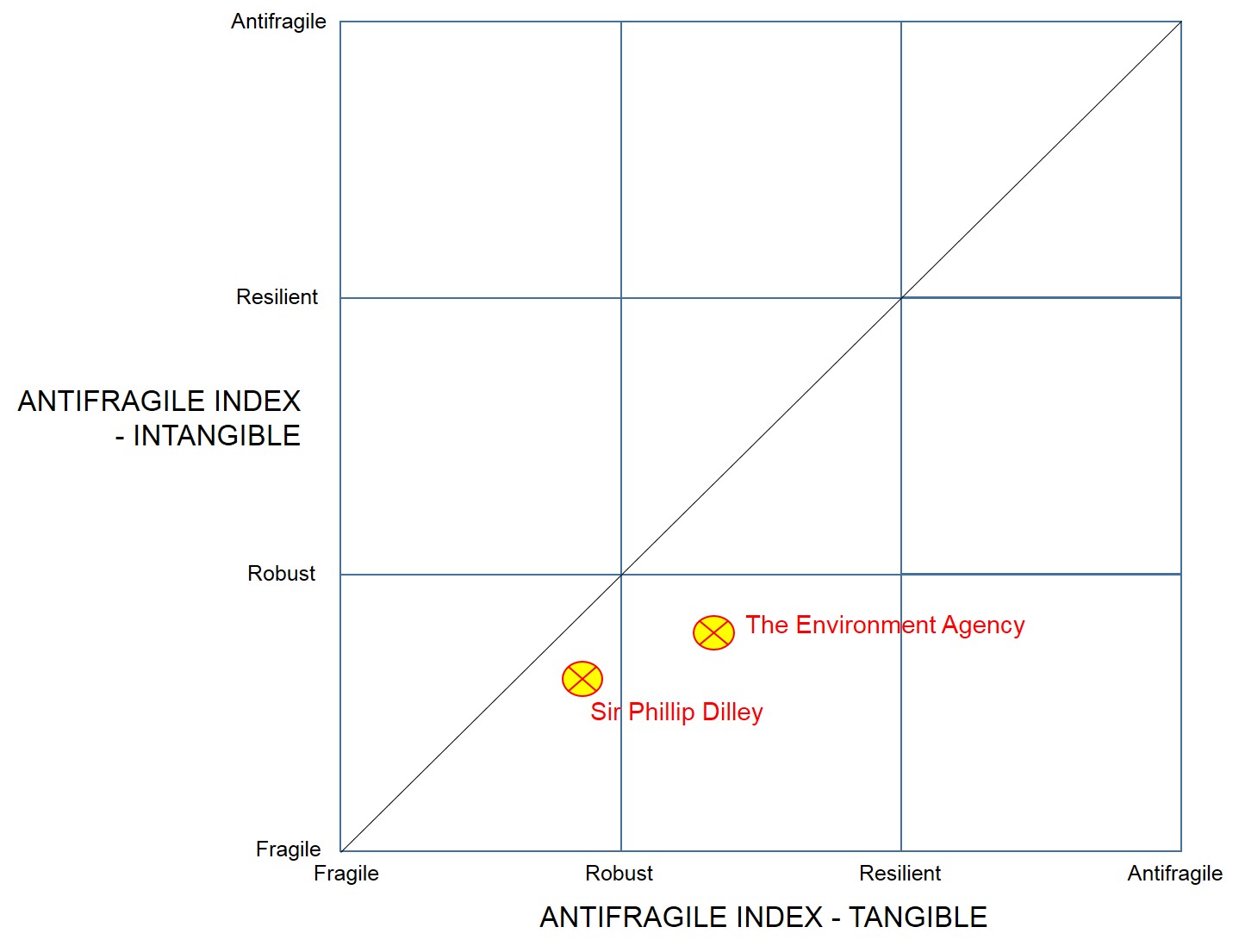
It turns out that measuring the resilience of an organisation (actually, we’re probably going to go a step further and call it an AntiFragile Index) requires a very broad lens indeed. Not only do we have to think about each of the (six) essential elements of a system for resilience, but we also have to look at what effectively becomes a hierarchy of such systems. Right at the top of that hierarchy sits the CEO of the organisation. They are the ones that in effect determine the attitudes towards the resilience of an organisation, and not just from the words they use to communicate the importance of resilience, but from the way that they themselves behave. Do what I say not what I do, much as some CEOs might think otherwise, really doesn’t hold true when it comes to organizational culture.
Take the UK Environment Agency.
One of the worst aspects of the first week of January is that I almost inevitably find myself stuck in the UK. Which in turn means I end up listening to the UK news. Aside from the swelling cocktail of global catastrophes, the prevailing news story inside the UK for the last few weeks has been flooding.
Enter head of the Environment Agency, Sir Phillip Dilley, the man responsible for coordinating things when flooding occurs.
Or rather, when we learn that Sir Phillip is on vacation in the Carribean while the floods are happening, we quickly realise his ‘entry’ into the situation is largely going to occur by phone.
Strike One. By choosing to stay in the Carribean Sir Phillip fails a very basic organizational resilience test: failure to understand the importance of basic (ABC) human emotion. I’m pretty certain Sir Phillip was sitting happily in his deckchair offering up sage advice to his troops thinking that it made absolutely no tangible difference whether he was sat in the sun, or next to a collapsing bridge in Tadcaster. In this regard, he was absolutely right, it made absolutely no tangible difference at all.
But this was never an issue of tangible reality. People make decisions for two reasons, the good one and the real one. The tangible one and the intangible one. And in forgetting – or being blindly unaware of – the second reason, Sir Phillip failed a very important test. Perception is reality. Tangibly it made no difference where he was physically located. Intangibly it made all the difference in the world. People – the flood victims for example – want to feel that ‘the authorities’ are empathizing with their situation, and when you’ve just been flooded out of your house, the last thing you want to hear is that the person responsible for putting things right is over 4000 miles away sipping tequila on a beach.
Failing to grasp the importance of intangibles is a naïve mistake in resilience terms. Sir Phillip’s second strike is somewhat more serious. Also a tad less visible in the media at the moment because the media tend not to understand resilience either.
This week, now he’s back in the UK, he was called to London to explain his actions and the actions of the Agency during the floods. And in particular why the flooding has been so bad so recently after the last round of flooding a few years ago. Here’s what he said:
“Everyone that I’ve spoken to in the affected communities said the same thing: something is different, we have never had something like this before. “That means we have to think differently.”
And then, to para-phrase, ‘if I’d been asked these questions before the floods started, everyone would’ve said we were ready’.
Now some people might look at these statements and think, aah, poor Agency, the situation was unprecedented, and therefore there was nothing they could be expected to do about it. While that might have been true (in reality, the situation wasn’t unprecedented at all), the bigger issue is the statement reveals a very non-resilient attitude to natural disaster. The statements reveal a glass-half-full attitude to the world.
When it comes to someone serving me ice-cream in my favourite ice-cream parlour, I think it’s important that the server has precisely that kind of glass-half-full positive view of life when they approach me carrying my usual order of too-much ice-cream. I’m about to enjoy myself and I really don’t want a grumpy, negative person coming along to remind me how many calories I’m about to consume.
When it comes to protecting the country from natural disasters, on the other hand, I really don’t think that a glass-half-full perspective on life is appropriate any more. Ask any aerospace engineer, and they’ll tell you the reason it’s the safest industry on the planet is because everyone takes the opposite glass-half-empty view of the world. If you want to design resilient systems, you take a very keen interest in worst-case scenarios. And then, typically, you double whatever you find, just to be sure.
There aren’t many rules in the Mann clan, but one of the very basic ones is ‘don’t live in a house that’s less than 200m higher than either the sea or nearby rivers’. It’s a rule that comes from that kind of beyond-worst-case-scenario thinking. The thought of being flooded sounds terrible, so don’t allow yourself to ever get put in that situation. It’s a rule that comes with a downside, of course. My current one being that, unless I stand on top of my chimney stack, I have no sea view. Somehow, though, it feels like a small price to pay. Especially now I’ve put a webcam on the chimney.
So No-Resilience-Strike-Two to Sir Phillip. If the CEO of the organisation is walking around thinking optimistic thoughts about how well they’re doing, they just instilled a culture of everyone else doing the same. It’s all very well to say, ‘we need to think differently’, the resilence issue is you should have known to be thinking differently twenty years ago.
‘It’ll be all right on the night’ is classic glass-half-full thinking. Except in this case it wasn’t, was it. The Environment Agency has such a glass-half-full view of the world, it seems, one might say the glass runneth over. Mostly over the Northern half of the country.
But the worst is still to come. Strike Three is perhaps even more subtle than Strike Two. But also more profound still in terms of organizational resilience or the lack thereof. It comes in two parts: the first not understanding the difference between robust and resilient; the second in not take advantage of already existing wisdom.
It has also become clear in the current flooding that the Environment Agency has taken a very robust attitude to flood defence. We know this is true because all of the language they’ve been using – and that again goes particularly for Sir Phillip – pretty much boils down to making flood defences higher. This represents a classic robust attitude to the world: make it higher, make it thicker, make it stronger. It’s a dumb way of looking at things. I can say that with confidence because – and here’s the real sin – there is very clear and widespread evidence from many previous cases around the world that it’s a dumb thing to do. Like in The Netherlands. They too adopted a very expensive, very robust, (‘Delta Works’) ‘build the dykes higher’ view of the world in the 1950s when they suffered very bad flooding from the North Sea. That worked fine until 1993, when the flood water very inconveniently decided to arrive from the non-Dutch mountains in the East instead of the sea in the West. Now those wonderfully robust dyke walls served only to keep the flood water in and 250,000 people found themselves flooded out of their homes. Robust very definitely wasn’t the same as resilient, and finally the Dutch government understood the difference. Enter the resilience-centric ‘Room For The River’ strategy. Which works on the basic assumption that when ‘unprecedented’ amounts of water arrive, the water has to go somewhere, and hence the job is to manage where that water goes. It turns out to be a very effective and proven strategy. Sir Phillip’s Strike Three sin is not instigating the adoption of a similar resilience-based approach in the UK.
Now, if I understand the rules of baseball correctly (I have no idea why I even started the baseball ‘strike’ analogy at all, thinking about it), three Strikes means you’re out.
I think if the British press had their way, Sir Phillip should’ve been kicked out of his job after Strike One. It’s still not entirely clear that that won’t happen anyway.
Personally, I think it’s very important to avoid these kinds of knee-jerk reaction. Three Strikes – especially such fundamental ones – is a lot, but the bigger question right now ought to be ‘is there a better person for the job than Sir Phillip?’ Is there anyone else in or around the Environment Agency that understands these Three Strikes of Resilience?
At this point in time, if there is, they’re keeping their head well and truly below the flood defence wall. Which, if its right there really is no-one else better qualified to do the job, means Sir Phillip should get to live another day. And in so doing get to face the Resilience ‘Strike Four’ test: does he have the humility to understand and accept that in complex situations – like weather – the most important thing is learning. Learning about how complex systems work being a pretty good start. My (PanSensic-driven) assessment of Sir Phillip Dilley is that he does not possess the requisite level of humility. I don’t see him understanding that what got him to where he is now, will not keep him there. The problem is I don’t think he understands – or has the bravery to understand – what that really means. I hope I’m wrong. PanSensic, meanwhile, rarely is.
Very occasionally, somewhere on the planet, a rare individual with a unique way of looking at thinks reveals an insight that develops into a big new idea. Edward de Bono’s conception of how the human brain works and ‘lateral thinking’ for example. Or Taiichi Ohno with the Toyota Production System and ‘Lean’. Taguchi method. W. Edwards Deming’s System of Profound Knowledge. Or Genrich Altshuller and TRIZ.
Sometimes these ideas seem to take off very quickly, while others, important though they may be, end up discarded in a locked cupboard. Why should this be so? If something is inherently a good idea – like TRIZ – why doesn’t it get adopted by everyone?
We thought we’d explore the reasons.
What we found was, to say the least, a tad depressing.
The good news, though, as with so many things in life, is that there is a very repeatable pattern of evolution.
One of the inevitable ‘next stages’ of the evolution of a Big Idea is that it needs some kind of a ‘real-world’ proof point. DeBono’s work with Shell, for example. Or the rise of Toyota. Or Samsung saving $91M on their first TRIZ project.
This ‘proof-point’ results in a wider awareness of the Big Idea. Success acts like a magnet. Managers in other enterprises look at the success and say (or are told), ‘we want some of that’. And so a Hype Cycle kicks in. The Big Idea gets oversold and quickly starts to create a backlash and assorted cries of ‘foul’. At least that’s what we can visibly see happening. Perhaps the bigger unanswered question is why does it happen? If the world knows about the Hype Cycle, why doesn’t it do something about the Hype Cycle?
Here’s why. An unholy Trinity of Dysfunction. First up a growing cohort of anxious and uncertain managers who know where they want to get to but don’t know how to get there. This knowledge vacuum leads to the second part of the vicious cycle, hungry, bandwagon-jumping consultants. Which then, thanks to the way publishing and copyright law works, results in a myriad variations on the initial Big Idea.
Think, for example, about how DeBono’s insights about lateral thinking and ‘parallel thinking’ have been turned into a thousand shade of ‘Design Thinking’. Almost invariably, these variations involve simplification of the Big Idea. So TRIZ gets devolved into a dozen versions of SIT. 15 Wastes get trimmed to 7. 14 Points gets stripped out to 4. And so on.
Looking at the vicious cycle that results, these ‘simplifications’ can perhaps be seen in a new light: Managers don’t understand (and probably don’t have time to understand) the full intended implications of the Big Idea, they just want something that’s easy to grasp. At the same time the cconsulting community has its own learning problem: how to teach large numbers of consultants to sell and assist their clients to adopt the Big Idea? They have profit margins to think about too. So they have every imperative to strip out the inconvenient ‘difficult bits’ of the Big Idea – they have less to learn, and it’s easier to sell the simplified idea to their gullible, give-me-anything-that-sounds-vaguely-like-what-I’ve-been-told-to-go-do clients.
And so we end up with this horrible self-fulfilling cycle of doom:
Which in turn leads to the next ‘inevitable’ evolution stage of the Big Idea: Corrupting Simplification. Classic example: one of the key tenets (we now know) of the Toyota Production System is the elimination of waste. One of those wastes is ‘the waste of a lost customer’. That’s a difficult one for many companies because the ‘customer’ is to all intents and purposes outside their control. Especially so if you’re the manager in charge of a production line. Far easier to strip out waste from the production line than some ethereal, invisible, and fickle customer. And so ‘Lean’ gets corrupted to mean ‘stripping out waste from the factory’. Which, as most companies get to experience, works fine for a while, but then quickly devolves into elimination of ‘waste’ that later transpires to have not been waste at all. Leaving the factory looking like an embarrassed Dodo: too late to re-evolve wings.
Many Big Ideas fail to make it through this Trinity-of-Dysfunction-driven ‘Trough of Disillusionment’ part of the Hype Cycle. TRIZ is on the cusp right now. It could make it through or it could find itself in the cupboard of lost ideas.
The Big Ideas that do make it through the downward spiral do so because, out of all the failures that the spiral produces, what we might think of as the ‘true DNA’ of the Big Idea emerges. In many cases, ironically, what emerges doesn’t look too far different to the initial rare individual’s initial conception of the Big Idea. But, importantly, what the world now gets to see is precisely why the Big Idea was expressed in the way that it was. Deming ended up with ’14 Points’ in his Profound Knowledge System because that’s how many turn out to be necessary. Companies (and consultants) get to see evidence that stripping out the rather inconvenient, say, Point 1 (constancy of purpose) was very demonstrably a dumb thing to do. We can all intellectualise these things, but, weird, contrary creatures that we are, it’s only when we live through the actual consequences that we finally accept a truth.
More importantly still, by understanding the ‘why’ the Big Idea is the way it is makes it much easier to engage people – managers and consultants – in the process of learning it. Which in turn means that it’s easier all around to learn it.
Hype Cycle-wise, the Big Idea’s ‘True DNA’ triggers the final climb up the ‘Slope Of Enlightenment’. Slowly but surely the Big Idea finds its way into the collective unconscious. Eventually to the point where it reaches what we might think of its final evolutionary state of ‘MetaStability’.
And so, finally, here’s what we think the overall Big Idea evolution pattern looks like:
Given the rather unfortunate ‘Trinity of Dysfunction’-driven ‘Corrupting Simplification’ stage of the trend it is perhaps tempting to now ask the same question we might ask of the Hype Cycle: if we know the problem is there, why don’t we just solve the problem.
To answer that question it is perhaps helpful to bring in to the story another Big Idea. J.P. Morgan’s ‘people do things for two reasons, a good reason and a real reason’. The good reason for adopting a Big Idea is that it derives a tangible benefit. The real reason why Big Idea’s tend not to get adopted is that humans have evolved, let’s not beat around the bush, to be lazy. We like staying inside our lovely, warm comfort zone cocoons. Whenever someone brings us a new problem to work on, the very first thing we do is ask ourselves, ‘have I seen this problem before?’ We ask that question in the hope that we have already seen the problem, such that we can then save ourselves a lot of time, effort and emotional discomfort in having to think up a new answers. We’re evolutionary ‘satisficers’. If the answer is ‘good enough’ to get the boss off our backs for a while, it’s the answer we’re programmed to go with.
Taguchi’s Design Of Experiments is mathematically provable to be massively more effective than traditional ways of doing things. And yet it’s viewed as cult’ish voodoo by most people. Why? Because it hasn’t been sufficiently ‘proved’ to those people (or their bosses) that Design Of Experiments is the ‘right’ thing to do. That plus the fact it’s got matrix algebra in it.
The point being that Taguchi Methods, like TRIZ, like every other Big Idea, needs the Trinity of Dysfunction to do its work before the ‘TrueDNA’ becomes emotionally visible. And the problem for both right now is that they’re both so difficult the community of hungry consultants is able to find much easier pickings elsewhere. Which is why the only way to sell Taguchi is to hide it in a piece of software that does other – easier to grasp – things. And why in many countries right now the only way to sell TRIZ is to call it a Design Thinking tool.
Cream always rises. Someone will unlock the lost Big Ideas from their cupboard when the time is right. And sometimes the trick is to hide Big Ideas in a Trojan Cupboard.
“I shall not today attempt further to define the kinds of material I understand to be embraced within that shorthand description [“hard-core pornography”], and perhaps I could never succeed in intelligibly doing so. But I know it when I see it, and the motion picture involved in this case is not that”
United States Supreme Court Justice Potter Stewart
When I tried to find a coherent definition of ‘Design Thinking’ I quickly discovered some very murky waters. “Design Thinking is a methodology used by designers to solve complex problems, and find desirable solutions for clients.” Or, “Design Thinking draws upon logic, imagination, intuition, and systemic reasoning, to explore possibilities of what could be, and to create desired outcomes that benefit the end user (the customer)”. Or how about, “a discipline that uses the designer’s sensibility and methods to match people’s needs with what is technologically feasible and what a viable business strategy can convert into customer value and market opportunity.”
Personally, I’m inclined to side with Supreme Court Justic Potter Stewart when in 1964 he was asked to judge whether Louis Malle’s film, The Lovers’ was obscene or not., I know good Design Thinking when I see it. Or, actually, more often, I know good Design Thinking, when I observe it’s opposite.
And very often that ‘opposite’ looks an awful lot like ‘Operational Excellence’. Operational excellence is all about removing waste and maximizing the efficiency of a system, reducing things to procedure and simple instructions. It is the way of thinking given to the world by Frederick Winslow Taylor: systematically study a system, break it down into its smallest parts and find the ‘one best way’ of doing each of those small parts. Whereas design is all about escape from the norm and creation of new solutions.
The key tenets of Design Thinking involve mass collaboration, empathy with the customer, and, perhaps most importantly of all, the idea of earlist possible prototyping. Give the customer something to play with as quickly as possible so you can begin to learn what they really want. Fail fast, fail forward.
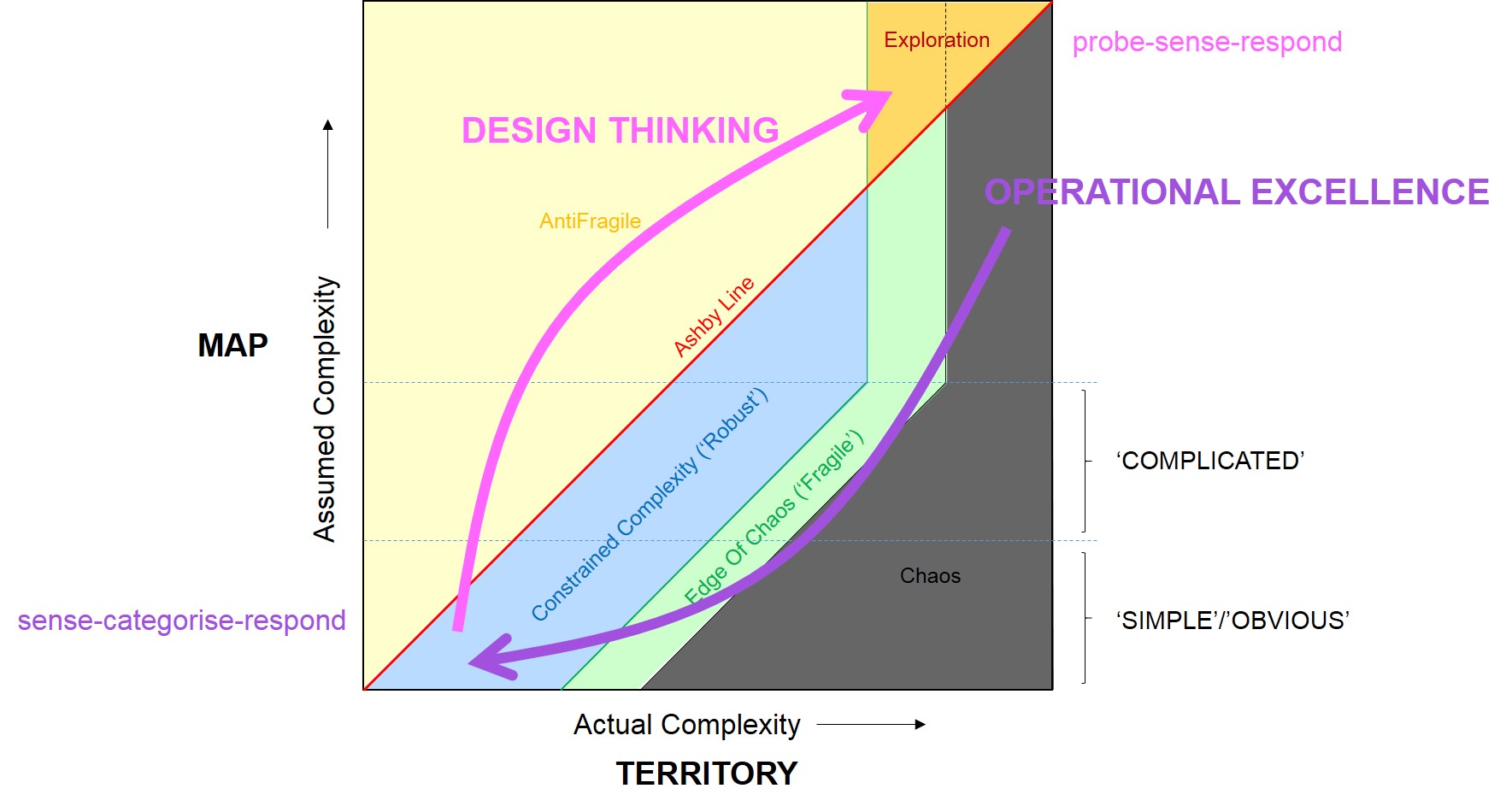
I was recently running a Design Thinking workshop and was trying to talk about the polar opposite differences between Operational Excellence and Design Thinking in terms of complexity. I drew a version of this picture:
It’s a model from an article I wrote in the September 2014 issue of the Systematic Innovation ezine (Issue 150) about one of our PanSensic complexity measurement tools. Plotted onto this picture of the actual-versus-assumed complexity of a situation, the polar opposite differences between Operational Excellence and Design Thinking become quite vivid. In Operational excellence, we’re trying to remove complexity such that we can manage the business through highly scalable sense-categorise-respond feedback loops. In Design Thinking we’re trying to embrace complexity by adopting exploratory, ‘probe-sense-respond’ approaches.
The picture also, I think, provides a pretty good illustration of what Design Thinking really is: a procedure for getting problem solvers into an exploration mindset that proactively utilises system complexity.
Okay, I realise this definition is no less fuzzy than any of the others. But now the connection to complexity is explicitly made, I realise I shouldn’t ever expect it to be.
While I understand that no-one goes to work to deliberately do a bad job, oftentimes merely turning up with good intentions is enough to cause an awful lot of inadvertent damage. There’s nowhere this applies more than in the healthcare sector. Everyone I’ve ever met there is passionate about making a difference. But all too often they fall into the trap of thinking their energy to do the right thing will carry the day.
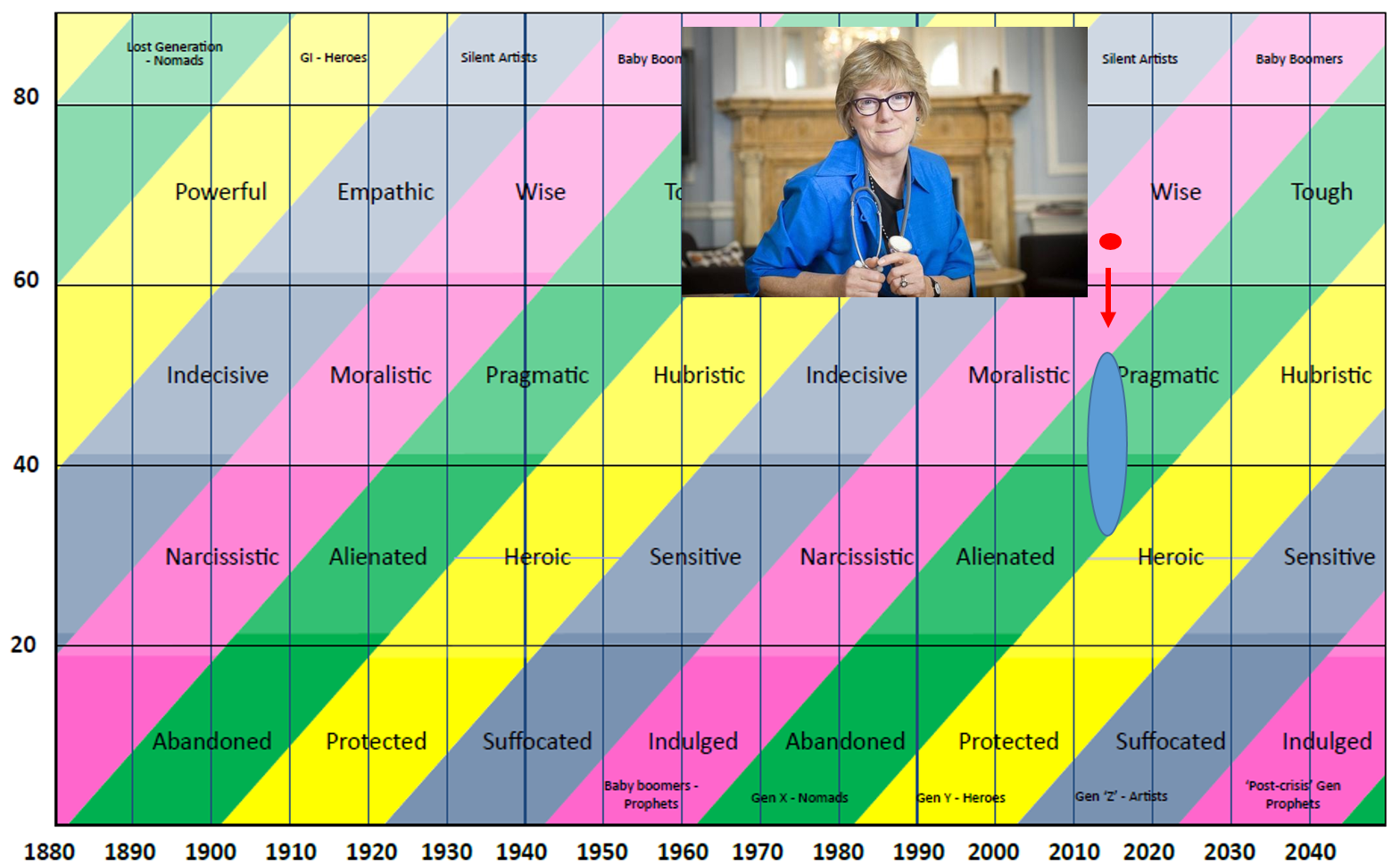
We’ve seen a terrific example of thst this week from the very top of the NHS. Chief Medical Officer, Sally Davies has been telling the nation that obesity is a bigger problem than terrorism or climate change. The majority of her message was aimed at women in the mid30s to mid 40s (over 50% of whom are overweight or obese), and women in their mid40s to mid50s (nearly two-thirds of whom are overweight or obese).
Following the news headlines, I’ve overheard several conversations involving the target group, the gist of which seemed to be a fairly consistent, ‘this makes me more inclined to pile on the pounds’.
Whether the obesity issue is as dangerous as terrorism or climate change is difficult for a sane person to gauge I think. But what does seem clear to me is that, while Dr Davies’ comments were no doubt made with the very best of intentions – obesity is a big problem – she’s completely failed to understand her intended audience.
A lot of which comes down to understanding generational differences. When a 66 year-old Baby Boomer tries to tell Alienated Generation X’ers what to do, it comes across as sanctimonious, holier-than-thou haranguing. Especially as she is clearly not overweight herself.
Generation X ‘Nomads’ are a contrary bunch. The archetypal cut-your-nose-off-to-spite-your-face generation. They don’t respect what Moralising elders tell them because it was the very same elders that abandoned them as kids and declared them to be ‘slackers’ and ill-educated when they grew up. All their lives they’ve learned not to trust Boomers. When a Boomer says ‘white’, a Nomad immediately sides with black.
Had Sally Davies understood this, she might well have said what needed to be said differently. Or, better yet, got a Nomad colleague to convey the message instead.
It’s not rocket science. It’s having the humility to recognize that your lifetime’s accumulation of wisdom and best intentions might be interpreted others in entirely the wrong way.
After a while you begin to spot a pattern. Introduce the PanSensic ‘read between the lines’ capability to managers or any of the Systematic Innovation problem definition tools and there’s a moment when their smile turns to a worried frown. “If these tools help to reveal the truth about a situation, what if the truth is that I’m the problem?” You can almost hear the brain cogs whirring. The words don’t always come out quite so overtly, but you can see the concern is there. And unless you nip the question in the bud very quickly, the conversation can very easily turn into an increasingly frantic search for a plausible deniability excuse to tell their boss why they’d been wrong to ask me to come and talk to them in the first place.
When I hear the ‘what if this shows I’m the problem’ question, I’m often tempted to respond perhaps we now already know what the problem is. No smoke without fire, right?
Of course, the conclusion I just jumped to is almost inevitably erroneous. I’m not sure if it’s just me, but it seems like a natural human reaction to conclude that when someone acts defensively about something, they have something to be defensive about.
Because I was (and in many ways still am) a big fan of W Edwards Deming, I’ve managed to train myself to recognize that these defensive feelings of guilt that managers sometimes reveal are misplaced. “90% of all problems are problems of the system,” Deming famously declared back in the 1970s. By 1982 and the publication of Out Of The Crisis, the percentage had risen to 94%. By the time he passed away in 1993, the number had grown again to 96%. Whatever the number is, it suggests that an awful lot of people are feeling unnecessarily guilty about the work they’re doing.
Now, of course, ‘the system’ is the responsibility of the management team. They’re the only ones with the authority to formally alter how things are done within an organisation. But ‘being responsible’ is not the same as ‘my fault’ when things go wrong.
Especially as our world and the enterprises we operate within become ever more interdependent and complex. The more complex things become, the more likely it becomes that the silos managers are expected to operate within become increasingly artificial and increasingly problematic. And the more likely, to paraphrase the words of the cliché, the butterfly wing flap over in the warehouse causes a tornado in the Accounts Department.
I suspect that today Deming’s number is somewhere even closer to 100%
When a manager – implicitly or explicitly – asks the question, ‘what if PanSensic shows everyone I’m the problem?’ the right response is that PanSensic will reveal where in the system the problems are. And it will do it in such a manner that the manager can do what he or she is there to do… work ‘on the system’ to improve it. And maybe then become the hero they deserve to be, so they can go home at night not just with a clear conscience, but a healthy glow of pride.
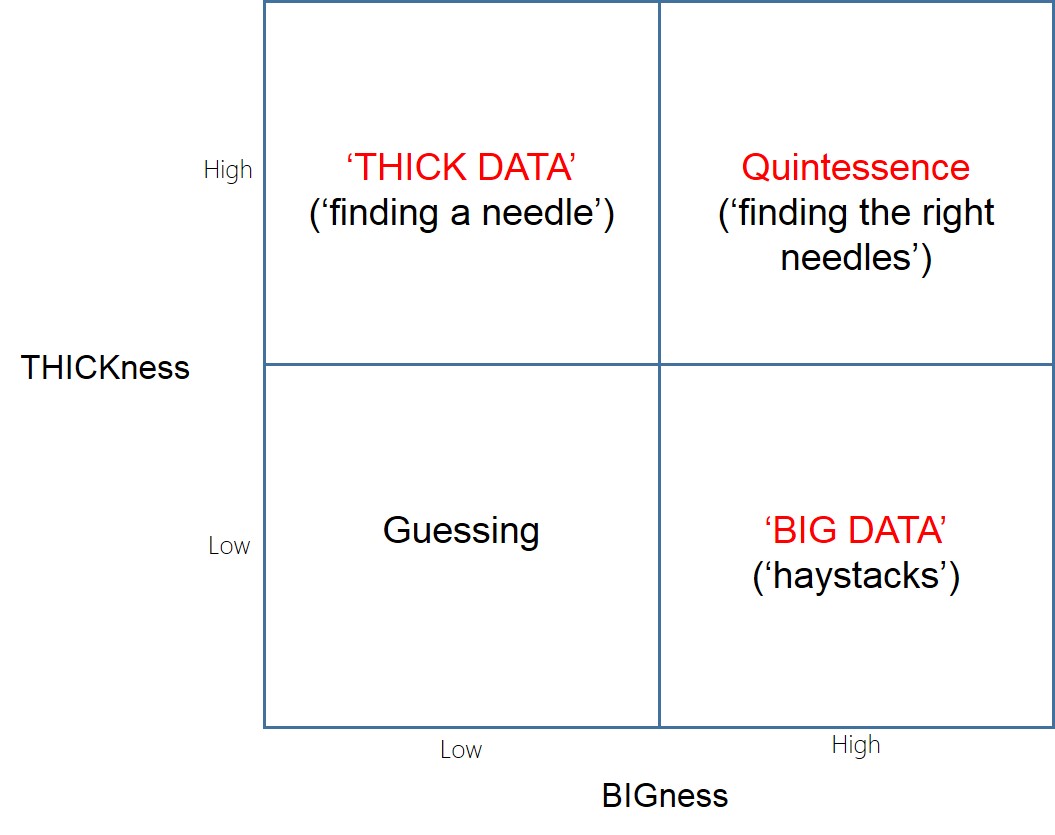
The best thing about 2×2 matrices, apart from their deceptive simplicity, is they help make visible the contradictions that need to be solved.
Here’s one we’ve spent a lot of our time worrying about over the course of the last few years:
In either/or world, people are generalists or specialists.
They are deep and narrow or broad and shallow.
Education is either deep or broad.
Data is either BIG or THICK.
BIG (Broad)
THICK (Deep)
What is happening?
Specific & Focused
Analysing the past
Source
Detailed
Correlation
Behavioural analysis:
What people do
Helps identify issues
Reliability & Generalisation
Optimization
Shows a reality
At a distance
Algorithms do interpretation
What does it mean?
Open-ended
Designing the future
Resource
Holistic
Causation
Cultural analysis:
How what they do connects to social meaning
Helps inspire possibilities
Credibility & Transferability
Innovation
Constructs a reality
Close-in
Interpretation is a collective process
Most of us go through life assuming we can either have our cake or eat it. We’re expected to make choices: live in the top-left box in the 2×2 or the bottom right.
Being broad means being a source. Being deep means being a resource. Sources are many, resources are few. Sources compete on price, resources compete on expertise. When I want to source the latest Courtney Barnett album, I go to Amazon. When I need a resource to help me work out who’s the next best new artist of the year, I choose my local music shop, where they have a Sam that knows me and knows about what’s happening in the industry. Amazon is very scalable, Sam is not. At least not traditionally. It took her five years to get to know me and what I do and don’t like, and fifteen more before that getting to know the industry.
Traditionally I have to make the choice between breadth or depth. Buy something randomly on Amazon, or spend several years fostering a relationship with Sam.
But if I allow myself to contemplate the impossible – having my cake AND eating it – I realise the top right hand box is the place I’m supposed to get to.
QUINTESSENCE: the fifth and highest element in ancient and medieval philosophy that permeates all nature and is the substance composing the celestial bodies; the essence of a thing in its purest and most concentrated form.
It’s what PanSensic is all about. Big narrative. Giving managers and leaders the confidence to act. Extracting meaning from the past to help design the future.
Solving contradictions. Bigger And Deeper. Quintessent.
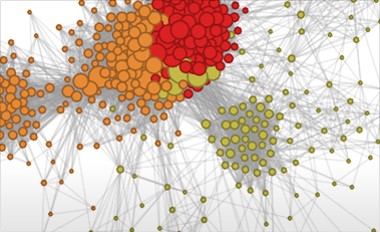
People love pretty pictures. There’s no doubt some of the prettiest pictures being created these days are coming from the word of social network analytics. Better yet to know that it’s really easy to construct pictures that look like they took a long time to produce. Things like this map of email traffic flows within an organisation:
I’ve had several rather depressing conversations this week with HR-types that seem to be under the mistaken impression that this kind of picture is useful as well as pretty. The depressing bit being that they don’t seem to want to see why the picture is pointless nonsense. Maybe it’s because they’re still at the stage that the people sponsoring them to create the pictures haven’t gone past the pretty-picture wow effect themselves yet? I don’t know. I’m not sure I want to. I suspect I won’t like the answer.
I don’t think the social analytics ‘solutions’ providers want to know either. They’re too busy turning the nonsense into even more detailed micro-nonsense. Why restrict yourself to merely plotting email connections when you can also build a host of quasi-scientific sounding dashboard diagnostics.
Response Rates – how quickly do people respond to their emails?
Inside/Outside Ratios – how much correspondence occurs within the organisation relative to the outide world?
Key Players – who receives or sends the most email?
It all sounds great. Right up to the moment you start to think about it.
Should that accidently start to happen, there comes the frightening realization that none of this stuff is in any way actionable.
It’s not actionable because it’s missing a number of very important pieces of additional information. The fact that you emailed me is meaningless. The fact that you were frustrated or angry or (preferably) happy starts to give me some kind of context. What you were writing about gives me more. Was it chit-chat or did it contain some useful content? A question? An answer? Factually correct? Mis-informed? Your Mental Gear? Whether you were telling the truth? Only when I know this kind of stuff do I have the opportunity to learn anything useful.
Don’t show me a social network picture unless it shows me frustration levels. Or where the meaningful traffic is coming from and going to. These, too, might still look like pretty pictures, but now they might actually allow me to do something useful to improve the network.
Or maybe I’ve got the wrong end of the stick again? Maybe the point of the pretty pictures is to cover the cracks in the office wall? As opposed to working out why the cracks seem to be getting bigger?
‘That’s cheating’ is a frequent reaction when any of us hear an inventive solution to a problem for the first time. Cheating in the context of inventive problem solving is all about breaking rules. Sometimes breaking rules is a good thing. And sometimes it isn’t.
The recent VW emissions testing debacle is a good illustration of breaking the rules in a bad way. We still don’t really know what’s happened for sure, but the fact that the company has admitted that cheating took place probably tells us enough to speculate on the reality: cars are subject to increasingly strict emissions legislation and VW found themselves in a position whereby they were unable to meet those targets. Faced with the prospect of not being able to sell their cars, the engineers must have somehow found themselves in a horrible ‘rock and hard place’ conflict. Sadly, it appears they took a ‘bad cheat’ approach to their conflict. Better, someone in the company decided, to cheat the tests than to potentially put the company out of business because they didn’t have a legislation-compliant product.
I had a similar legislation-compliance cheating situation myself in the 1990s. We’d invented a low water consumption toilet and were busy trying to license it to one of the UK manufacturers. A big part of our rationale was that the legislation was changing and the toilets being produced by the industry would no longer be compliant. I quickly became frustrated by the lack of interest in our invention. Not only did it exceed the new water consumption regulations, but it was cheaper to manufacture, more compact and more hygienic. None of the manufacturers seemed to care. Finally, I got one of them to explain why they weren’t interested in the new design, despite the fact that their current designs were about to become illegal. “You don’t understand how this industry works,” said the chief engineer, “we can’t afford to innovate. Far easier for us to write to the Government and tell them that if they insist in enforcing the new legislation, they will kill the industry and risk losing thousands of jobs.”
To my mind, although this wasn’t an illegal response like VW’s, it was still an unpleasant case of ‘bad-cheating’ in action. Especially when looked at from the societal and environmental perspective with literally billions of gallons of wasted water at stake: we were all cheated by an industry that thought it was easier to write a letter than think about the problem.
I guess a part of my frustration arose from my previous experience in the aerospace industry. Just as in other sectors, the aerospace industry is heavily regulated. The pressures on manufacturers to improve energy efficiency and reduce emissions have been just as high as in the automotive sector. But the response of the industry to these ever more stringent requirements has been somewhat different.
In the case of VW and the UK water industry, the reaction to a requirement that was beyond the realms of current capability was to break the legislator’s rules. In the aerospace industry, on the other hand, there is a clear understanding that the regulations exist to advance our understanding of how the world works.
When the aerospace regulators specified parallel reductions in NOx and SOx emissions, for example, they knew, as did engineers in the industry, that the two requirements were in many ways contradictory. Increasing combustion temperature improved one but made the other worse. And vice versa. ‘The Science’ said we could have low NOx or low Sox, but not both. In TRIZ terms, we can see the challenge to be a classic contradiction: we want combustion temperature to be ‘high and low’. And that’s the convention the industry set about challenging, fairly rapidly turning the paradox into a suite of combustion system designs that achieved the ‘impossible’: designs that had both high and low combustion temperature, and both low NOx and low SOx. The designers here too had to break the rules. But the rules they broke were the ‘laws’ of physics and chemistry. Or rather mankind’s rather limited understanding of those ‘laws’ and the hidden incorrect or incomplete assumptions they contained.
That’s good cheating: Breaking rules that we had wrongly assumed were rules. The ‘laws of physics’ that turn out to be nothing of the sort. The trade-offs that we’d assumed were inherent, but turned out to be merely the next contradiction to be solved.
Once upon a time there was a land where everyone kept losing their keys. That’s everyone as in everyone. People lost their keys all the time. No matter what they did to try and make sure they didn’t lose them. Tie them on a chain around their necks, leave them in a safe space under the doormat, or put them in a safety deposit box at the bank. Nothing worked.
Now, one would have expected when society has a problem like this, necessity being the mother of invention and all, surely someone would have found a solution. Like inventing locks that don’t need keys for example. But the truth is, no-one could remember a time when keys didn’t get lost, and so the whole situation was viewed as normal. That plus the fact that the locksmiths of the land kind of liked things the way they were. And had created themselves a quite envious position at the top of society. Everyone knew it was a good idea to have a locksmith as a friend. Otherwise, next time you lost your front door key, you might find yourself having to stay in a hotel for a couple of nights until one would deem to turn up to replace your locks and give you a new key.
This was just how things were in the land of Emba. Whenever they lost their latest key, people just shrugged their shoulders, sent a message to their locksmith to the effect that, unfortunately, they’d done it again, and then waited for him to turn up and put things right again.
Most of the houses in Emba were built around the foot of a big mountain. Actually it was an enormous mountain. So high that no-one had been to the summit. So high that it always disappeared into the clouds. Even when the sun shone and the skies were blue, still the mountain seemed to disappear upwards into the unknown. Generally speaking, Emba was quite a hierarchical place. The higher up the hierarchy you were – like the locksmiths – the higher up the side of the mountain you tended to live. Were a visitor to arrive in Emba and were he to decide to climb one of the roads up the side of the mountain, the thing he’d notice before anything else was how the houses became grander and grander the higher he climbed. The locksmiths’ houses being the biggest and highest. Unless you count the professors who taught at the locksmith college. Their houses were highest and biggest of all. Every parent in Emba hoped their child would pass the locksmith entrance exam. Every parent knew it probably wasn’t going to happen. The only children who seemed to get a place at the locksmith college were the offspring of locksmiths. Again, this was just the way it seemed to be. No-one complained about it. Everyone just got on with whatever they were supposed to get on with. It was the way it was, it was the way it had always been.
This was the Emba that Oleg and Irwin arrived at one dull, lifeless day. The day after a big storm. The two of them hadn’t known each other for very long, but had already realised that rats stand a better chance of surviving if they travel together. Safety in numbers. Even if the number in this case was two. As in most parts of the world, rats were viewed as, how can we put this politely, vermin. People, when confronted by a rat, were more likely to scream or fetch a broom than they were to bend down and stroke between his ears and call him cute. Oleg and Irwin were used to this now. Again, it was just the way things were.
Oleg had been born in the faraway land of Russia. Russia was a whole other mountain to Emba. Oleg was extremely proud of being a Russian rat and, given half a chance, would invariably declare where he came from. No-one ever needed to ask Oleg where he was from. He’d already told you. That plus his Russian accent tended to give the game away right from the get go.
Irwin used to calmly raise his eyes to the sky whenever Oleg was doing his I’m-from-Russia-you-know thing. He’d got used to it by now, but Irwin definitely wasn’t Russian and he didn’t understand why coming from Russia was such a great thing to be proud of. Irwin didn’t actually know where he’d been born. His parents had been pretty much nomadic, and in any event had disappeared fairly soon after they’d seen Irwin fending for himself the first time. Irwin had pretty quickly learned what needed to be done in order to survive. In general it meant doing stuff that other people didn’t want to do. Like scratching around waste-dumps when there was no money or food to be had.
As it happens, it was at one such dump, on the far outskirts of Emba that Irwin and Oleg had met. Oleg, too, had learned that needs must. When you were hungry and in a strange land and looked like a rat, you did whatever needed to be done to get by. And if that meant rooting through other people’s trash that’s what he’d do. Even though he knew one day he would make his way in life and never have to do it again. The first thing Irwin noticed about Oleg was he was from Russia. The second thing was he knew where he was going. And that was to the top, where any self-respecting Russian rat deserved to be.
After they first bumped in to each other at the dump, they nodded politely to each other and went their separate ways. But then, after they met again a second and then a third time at the same sustenance-rich pile of garbage, they decided they might as well stick together.
One day, around the second week of their combined trash-hunt, Oleg noticed a shiny object sticking out of a pile of discarded papers. After he’d spent a few minutes freeing it, Irwin noticed that, unlike other finds the two of them had made, Oleg surreptitiously stuck the shiny object in his pocket and then went calmly back to sniffing out dinner. Like most things in life, Irwin shrugged it off.
That afternoon, Oleg disappeared for a couple of hours, only returning so the two rats could enjoy the sunset together as had become their end of day custom. This day, after the pinks and oranges and reds had bowed away to night, the sky was filled with a big bright full moon. Life didn’t get much better than this if you were a rat. Oleg smiled at Irwin, and Irwin smiled back at Oleg.
In the morning, Irwin found himself alone. No sign of Oleg anywhere. All of his things were gone. Irwin shrugged his little rat shoulders and set about finding breakfast. When you’re hungry, you’re hungry. And that’s all there is to say on that subject. Especially when it takes the whole day to still not quite fill your stomach. It wasn’t until he settled down to watch the sunset by himself that he had a chance to wonder again what might have happened to his Russian friend.
After a week of wondering, he found himself wondering what he was wondering about. Maybe Oleg had been a figment of his imagination? Or maybe he’d decided to go back to his beloved Russia?
In the end it was some days after the next full moon when the days had begun to shorten and the weather started to turn chilly before Irwin finally found out what had happened to Oleg. He was rifling through a newly tipped load of old newspapers on the hunt for bedding material when he suddenly found himself staring at a photograph of Oleg. Admittedly it was only on page 17 of the newspaper, but nevertheless, there was Oleg smiling at the camera.
‘Oleg’s Magic Key?’ read the headline. Apparently it was a miracle. Oleg had discovered a key that could open any lock. Mrs Samson, 47, of Lower Emba had been locked out of her house, the locksmith couldn’t come and along came Oleg to the rescue. ‘He just waved the key in front of the lock’, said a clearly amazed Mrs Samson, ‘and there it was open. It’s the most amazing thing I’ve ever seen’. Irwin read further through the article. Oleg was trying very hard to be modest. ‘It was nothing,’ he said, ‘I saw this problem back in my home country of Russia a few years ago, and merely used what I learned then to open the door.’ When the reporter pushed further, all Oleg would say was that he just liked helping out when he was needed. When asked if he could see the magic key, Oleg merely shook his head and said that it was a very delicate matter and that he didn’t want to reveal what the key looked like lest it fell into the wrong hands.
‘Magic key?’ thought Irwin, how strange that Oleg had never mentioned it before. Then he remembered the shiny object and had another thought. And off he scuttled back to the place where he thought the two rats had been when Oleg found it. Maybe what he’d picked up and hidden in his pocket was a magic key?
If it was, there was certainly no evidence of any more shiny magic keys in the vicinity. After two hours of scrabbling the closest he’d come to a magic key was a rusty paperclip. It didn’t look like it would open too many doors.
The next day, Irwin resolved to spend all of the time he wasn’t looking for food or sunsets, continuing the search for another magic key. By the time the pinks and reds had turned to night, all he had to show this time was one very rusty half of a key. It was another two days before he found an actual whole key. But even this one was too rusty to be of any use to anyone.
Irwin was close to giving up. Maybe, he thought, what makes magic keys magic is that there is only one of them, and that Oleg had just been in the right place at the right time.
Or maybe not. A couple of weeks later, when the weather was even colder, Irwin found himself back at the place where yesterday’s newspapers got dumped. This time there was no photograph of Oleg to be found. Just a headline about how the locksmiths were up in arms because the demand for their services seemed to be on the decline. ‘Locksmith prices tumble’ read the headline.
Irwin resolved to keep an eye on the story, and decided to spend less of his time looking for magic keys and more time reading up about the price of locksmiths.
By the time the first snows arrived, Irwin had amassed a grand total of four and a half rusty keys and three more newspaper articles. The oldest of these articles mentioned Oleg again, and how the locksmiths had accused him of being a fraud. The middle one talked about a surge in burglaries. And the most recent was another interview with a locksmith who’d put two and two together to make five and was accusing Oleg of not only being a fraud, but also somehow who preyed on the weak and vulnerable.
This didn’t sound like the Oleg that Irwin had known. It was very unfair. Irwin decided he should head into the town and see what was going on.
Irwin Goes To Town
The following morning he roused himself early, packed an overnight bag and headed out of the waste dump for the first time since he’d arrived over two months ago. As he looked back, he felt sad. Sad as if he was leaving home.
It took the best part of the whole day before Irwin reached the first signs of civilisation, a jumbled street of shops. Outside one of the shops he saw another newspaper headline, ‘I’ll pass any test’ says Oleg the Great.’ Irwin sneaked a peak at the rest of the story. There was going to be a demonstration the following day. Oleg would demonstrate how the Magic Key would only work if someone was locked out of their house. It was Oleg’s way of demonstrating that the burglaries were nothing to do with him.
Irwin resolved to go and watch the demonstration. Not so much to see the demonstration, but he thought it would be nice to catch up with his old friend again.
The town square where the demonstration was due to take place was packed with onlookers. Irwin could see Oleg up on his recently installed platform, but when he waved, it was clear Oleg couldn’t see him. No doubt he was concentrating on his demonstration. Open the lock where the owner had lost their key; fail to open the lock where he had not been given permission. The demonstration had been very carefully set up, and the MC went to great lengths to let the throng know that Oleg didn’t know which lock was which.
Needless to say, the whole thing worked like a charm. The lock that was supposed to open opened and the lock that was supposed to stay locked stayed locked. The crowd shouted and cheered, and Oleg beamed as he looked out at the crowd. He bowed deeply, raising what looked like a new top hat. Irwin couldn’t help but clap and cheer along with everyone else. It was nice to watch one of his friends do well. Irwin smiled as he left the square and headed back to the dump. All was well in the world. The search for another magic key would begin again tomorrow.
Oleg Thinks About His Business
Oleg, meanwhile, smiled down at everyone from the platform. It was good to know that everything had gone to plan. He knew he’d made many enemies amongst the locksmith community despite his attempts to show them he wasn’t a threat. As an outsider, he’d known he would have to move carefully. That’s why he’d deliberately sought to help only those people the locksmiths hadn’t helped or were too slow to help. In Oleg’s eyes, he was doing them a favour. They kept all of their most profitable customers, while he made a pretty good living from all the lost key customers who were mainly just seen as a nuisance. The people at the bottom of the Emba mountain.
But Oleg also knew that sooner or later he’d have to sort out some kind of arrangement with the locksmiths. If only because there was only one of him and only one Magic Key. If Oleg wanted to grow his little business he’d either have to start working with others, or start moving up the mountain to the locked-out customers with more money. Neither seemed ideal. The former because, who could he trust? The latter because the higher up the mountain he went, the more likely it would be that the locksmiths would have to do something to stop him.
But there was another problem too. One bigger than both the other two. The Magic Key didn’t work in every lock. Fortunately for Oleg, only he knew this. He’d been able to find out in secret which sorts of lock he could open and which ones he couldn’t and therefore only endeavoured to help those customers he knew he’d be able to help. Even more fortunately, these customers were the ones lower down the mountain.
Oleg stood in front of the mirror in his new house, took the Magic Key out of his pocket and stared at it. Then looked at his reflection. Then back at the Key. He felt proud of how he had advanced so quickly in Emba, how he had worked hard to get here, and how he knew he deserved more. A plan began to form in his mind. Maybe the Magic Key really was magic. Maybe it was able to open other kinds of lock.
In the morning, Oleg awoke bright and early. Today was the day he would begin selling Magic Keys. Just a few. To just the right people. For just the right amount of money. He sent a small advertisement to the classified section of the local newspaper: ‘Oleg is looking for apprentices’.
Within a couple of days he had more replies than he knew what to do with. Everyone in Emba, it seemed, was interested in owning a Magic Key. Including, Oleg noted with no small amount of glee, one or two locksmiths. He made up a short list of likely candidates and set about preparing his first Magic Key training programmes.
Magic Keys was the easy part, he wrote in the course notes, the real skill comes with how you use the Key. There’s a knack. And to teach you this knack, you will have to enrol for at least three months. And you will have to do exactly as I say. That will be Rule One. Follow the recipe. Do not deviate. Do not try and reverse engineer Magic Key Technology.
When he arrived at his first class, the room was full of willing apprentices, ready to subscribe to Oleg’s every word. They wrote down everything he said. And were even patient when he refused to let them practice with the replica Magic Keys he only occasionally allowed them to touch. ‘Until you know the knack,’ he scolded them, ‘you will do more harm than good. Nobody wants a lock with a broken key stuck in it do they’. His students nodded understandingly.
Finally, the three month programme was coming to an end. Oleg had realised he didn’t need to go and help people solve their lost key problems anymore. Far easier to have a crowd of advocates clinging to your every word. Even though many of them were being made up on the spot. Or contradicted what he’d told the students earlier in the programme. Not that any of the students noticed. He’d worked that trick out very early on in the programme. Step one of the Knack, he told them, is don’t think, rely on the Knack. If the Knack doesn’t work, it’s because you’re too busy thinking instead of focusing on the Knack. If he said so himself, this was the most brilliant part of the training programme.
Or at least it was up until the first student cohort arrived at their Magic Key Master Graduation Ceremony. After today, they would be sent out in to the big wide world with their own Magic Keys. Oleg felt an uneasy feeling in his stomach at the prospect.
Sure enough, not long after graduation, he started to receive communications from the loudest of his former students. ‘It doesn’t work,’ the graduate student shouted at him, ‘the lock didn’t budge’. Oleg promised to come along and work out what was happening. You probably over-thought the situation, he said. But when he went to the lock the following day, in his heart of hearts, the moment Oleg first saw what type of lock it was, he knew he was in trouble. This was one of the locks he’d failed to open during one of his early covert experiments. Now his former student was going to see Oleg failing too. Oleg took the Magic Key out of his breast pocket and looked at it. His reflection seemed to wink back. He nodded sagely, ‘this lock,’ he said calmly to the former student, ‘requires Advanced Knackery.’ The student looked crestfallen. He had already invested a lot of money he didn’t have and this sounded like he was about to be asked for more. ‘Don’t worry,’ said Oleg, ‘Advanced Knackery classes are not expensive. I will show you how to open this stubborn lock tomorrow. We will meet at noon.’ And with that, he tipped his latest new top hat, and bade the former student adieu.
The following day Oleg failed to show. The former student waited for a couple of hours, then headed to Oleg’s home to see what had gone wrong. Maybe he had misunderstood the instruction? Maybe he had misheard the timing? He knocked on Oleg’s door. Nothing. He knocked again. And then again. Finally an old man appeared. It was Oleg’s butler. ‘I’m sorry,’ the butler said, ‘Oleg had to attend an emergency lost-key situation of a very important customer. I’m sure he will come and meet you tomorrow.’ The former student nodded. He understood the situation, and offered his apologies to the butler.
But then, sadly, Oleg didn’t show the next day. Or the day after that. On the fourth day, the former student didn’t turn up either. By now the locksmiths had come and fitted a new lock and the customer was no longer interested in Magic Keys.
The former student would have forgotten about the incident, but when he accidently bumped into one of his fellow Magic Key Master Graduates in a café one afternoon a few weeks later the incident came back to him. The other former student nodded. The same happened to me he said. And Mr Procter. And Mr Lever. The two students looked at each other. Something was beginning to smell fishy. They decided to phone the newspaper.
The following morning, when Oleg’s butler opened the curtains in Oleg’s bedroom, there was a flurry of flashing cameras. The butler handed Oleg his usual newspaper. When he saw the headline, he knew he didn’t need to read any further. Emba had turned against him. The Magic Key was one great big fraud.
Even though it’s not, sighed Oleg to no-one in particular. It’s not the Magic Key that’s the problem, it’s the occasional un-magic lock. Nevertheless, as the flashbulbs continued to light up the sky outside his window, Oleg knew he needed another plan. Or possibly two. One to tr to work out what Advanced Knackery might actually mean. The other trying to find a new audience. Either one where the people were desperate enough to try anything, or, hmm, one where the people in charge of the people needed something to help them stay in charge: maybe a Magic Key would give people hope when in reality there was none? It was a thought. I need to let that one percolate, Oleg nodded to himself, as he went over to his wardrobe and started packing a few bags.
Meanwhile Back At The Dump
Irwin had returned to the dump determined to re-double his efforts to find his own Magic Key. Now, two months later, he had accumulated a pretty decent pile of retrieved keys. None looked particularly magic. Indeed, most were broken or bent or rusty, but the amazing thing was how many of them there were once you knew where to look. The more he found, the more he came to realise that he was merely re-finding all the lost keys. And once that thought dawned on him, the more likely it seemed that he might also be able to help people that had lost their keys. It was merely a matter of numbers. Find enough keys and eventually one of them would be the right one for whatever lock might need opening he surmised. The only question then was what constituted ‘enough’ keys to try out the theory.
Two more months of unearthing keys went by. By which time the answer to Irwin’s question answered itself. Enough keys was precisely the number he was able to carry with him when he walked in to town to test out the theory. Which in turn meant he needed something to hold all the keys he had accumulated. He looked around. And looked some more. Until he saw something glinting in the sun. It turned out to be an old bucket that someone had thrown out. Irwin picked it up. And then immediately dropped it again, yelped and thrust his paw into his mouth. The reason the bucket had been thrown out, Irwin realised as he tried to stem the flow of blood, was because the handle was full of sharp edges.
Still, apart from that, the main thing was the bucket didn’t have any holes and was big enough to hold all the keys an Irwin-sized rat could hope to pick up and carry. After bandaging his cut paw, Irwin proceeded to fill the bucket with his keys. Tomorrow he would take them to town.
His first opportunity to test his theory couldn’t have gone worse. Finding a person who had lost his door key was easy enough. Convincing him to let Irwin have a go at opening the lock was almost as easy. Especially after he’d offer to open the door for free. Pretty soon all the neighbours had come over to watch Irwin set to work. Taking one key out of his bucket at a time, Irwin, tried them in the lock, then, after they didn’t work, placed them on the ground and tried the next one. After thirty or forty attempts the crowd began to snigger. After the hundredth, someone shouted out that Irwin was an idiot. And then everyone laughed. And then when they saw the doubts creeping in to Irwin’s eyes for the first time, the laughter turned to tut’s and boo’s. And within a couple more minutes of failed key matching attempts, they began to shake their heads and walk back in to their homes. In the end it was just Irwin and the person with the lost key. All Irwin could do was apologise. And then, when that didn’t seem to help, volunteer to go find a locksmith. The final insult came when the locksmith offered to forego his fee in exchange for Irwin’s bucket of scrap metal.
Tempted as he was – especially after he saw the locksmith’s bill – he knew there was something in the theory that meant he couldn’t give up just yet. He paid the locksmith and headed back to the dump with his tail well and truly between his legs.
Sometimes, you need to reach the lowest of lows before things become clear in your mind. It was all very well to have lots of keys. But ultimately pointless if you had no way to connect the right key to the right lock. And for that you need a system. And that more often than not, you can only see the system by working through lots of variations.
It was another two months, then, before he dared to venture out into the public eye again. Two months of blisters and frustration. And more rusty keys. Which, now the pile was even bigger, Irwin could see formed a kind of pattern. Finally he felt it was time again. No more mistakes.
This time it was more difficult to get anyone to volunteer their lost key problem. Word had clearly got around of yet another charlatan rat. Nevertheless, it still wasn’t too long before someone was desperate enough to get back into their house that they were prepared to give Irwin’s new theories a try. This time around, it took a dozen attempts before he found the right key. But sure enough, when he did, the door popped open and the distraught homeowner clapped her hands with glee.
The next time it took just nine attempts to fit the right key to the right lock. The time after that eight. Then six. Then he started attracting a small crowd wherever he turned up with his bucket of keys. A week after that, he was averaging four attempts before the lock would obligingly click open. And now he was getting a round of applause. His efforts weren’t earning him much money, but they were already enough for him to take on an assistant to stay back at the dump and look out for more keys.
Then came the day when someone shouted out from the crowd that Irwin’s secret was a Magic Bucket. That brought a news reporter to come and talk to him. And then a small article in the newspaper. And then a bigger one. Irwin’s Magic Bucket was beginning to attract wider attention.
At The Dump Again
Not long after this headline, Irwin was at the bottom of one of the holes he’d excavated, looking for more keys, when he noticed a familiar face looking down at him. Irwin smiled up at the face. The face smiled back. ‘Hello, Irwin,’ Oleg shouted down, still smiling, ‘you haven’t changed a bit.’
Irwin shrugged his shoulders and started climbing out of the hole, ‘what about you though? You’re looking much smarter.’
Oleg admired his new silk cape and nodded in agreement, ‘I came to see your Magic Bucket.’
Irwin paused, ‘there is no magic,’ he said, finally, ‘it’s just a system.’
Oleg waved his hand dismissively, ‘the papers say it’s Magic. The people who see you call it Magic.’
Irwin shook his head, ‘it’s just learning how to put the right pieces together.’
‘That’s not what people want to hear,’ Oleg responded.
Irwin looked at Irwin with a confused expression on his face.
‘Systems. And learning,’ Oleg shook his head solemnly, ‘they sound like hard work. People don’t want hard work. They want someone to turn up with a Magic Bucket, shake it a couple of times, pull out a Magic Key and unlock their door for them. Bam. Just like that.’
Irwin laughed, ‘it really doesn’t work like that.’
‘You’re missing the point,’ Oleg responded, head still shaking, ‘the Magic Bucket idea. It’s not even a very good metaphor.’
‘What do you mean?’
‘I mean, who’s going to believe in the powers of a rusty bucket with a broken handle? A bucket for goodness sake.’
‘It’s not the receptacle that’s important,’ Irwin sounded a little bit hurt, ‘it’s…’
But Oleg held up his hand, and before Irwin could finish his sentence, interrupted, ‘it can’t be a bucket,’ he paused a moment, ‘we need something else. Something more believable. Something…. Something like a samovar. How about a Samovar?’
‘Samovar?’
Oleg nodded, ‘a Magic Samovar. Someone loses their key, they call for help, we turn up with our Magic Samovar, tap it a couple of times, lift the lid, and, hey presto, lift out a Magic Key that will open their door.’
Irwin shook his head, ‘it sounds like you have this all worked out.’
‘I know what the people want,’ Oleg smiled, ‘that’s why we always made such a good team.’
‘Team?’
Oleg nodded, an even bigger smile on his face, ‘you work out the system, I work out how to make it believable.’
‘Well…’
But Oleg interrupted again, ‘what do you say? Do we have a deal? I can give you money. I can take the Magic Bucket back to town with me. We can help everyone. There won’t be anything the locksmiths can do. We’re unstoppable.’
‘You want to buy the bucket? Even though you know it’s not really magic?’ Irwin looked puzzled.
‘And all the keys. Of course,’ Oleg held out his hand, ‘and a promise that you’ll stay out of the way. Let me do the selling.’
‘You want it that badly?’
‘Just tell me how much you want.’
Irwin shook his head, ‘you can have it. If it means that much to you, I will let you have it.’
‘Really,‘ Oleg hesitated, then extended his arm further towards Irwin’s, ‘you’d do that for me? You’d stay here? What would you do?’
Irwin looked deep into Oleg’s eyes and thought for a moment. Then his turn to smile, ‘there’s still work to be done. The locks in the houses at the top of Emba.’
‘The ones where no key works?’
Irwin nodded, ‘the further up you go, the more complex the system gets.’
‘You can work it out?’ Oleg looked confused.
‘I think I can,’ Irwin nodded slowly, ‘I just need to work out what holds Magic Samovars’
Oleg looked back at him, confused.
Irwin smiled some more, ‘if Magic Samovars hold Magic Keys,’ he stroked his whiskers, ‘what holds Magic Samovars? That’s the question.’
“I can’t complain, but sometimes I still do.“ Joe Walsh
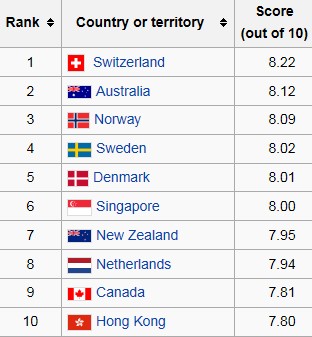
It’s that time of year when under-employed, over-bored economists publish their ‘Quality of Life’ indices for the different countries of the world. As ever, they seem to be extremely good at finding things that are easy to measure and correlating them to a desired result. It’s easy, for example, to measure the GDP per capita or life expectancy of people within a country, or stick up a few thermometers and rain gauges and measure climate, or even count the number of women working as members of parliament. Not so easy then, though, to relate that to ‘quality of life’ or ‘happiness’ or ‘where to be born’. Does the knowledge that there aren’t enough female politicians in my part of the world make me depressed? Does knowing that we had no summer this year make me sad? The answer to those kinds of thorny question only emerge when we are able to escape from the highly quantifiable tangible world, and allow ourselves to enter the murky, unstructured waters of human enotion. Which is why the resulting tangible-only indices tend to be utterly meaningless. It’s one thing to know that you’re life expectancy is 95, quite another altogether if you spend all that time surrounded by people whining about the difficulty of finding a good oyster fork.
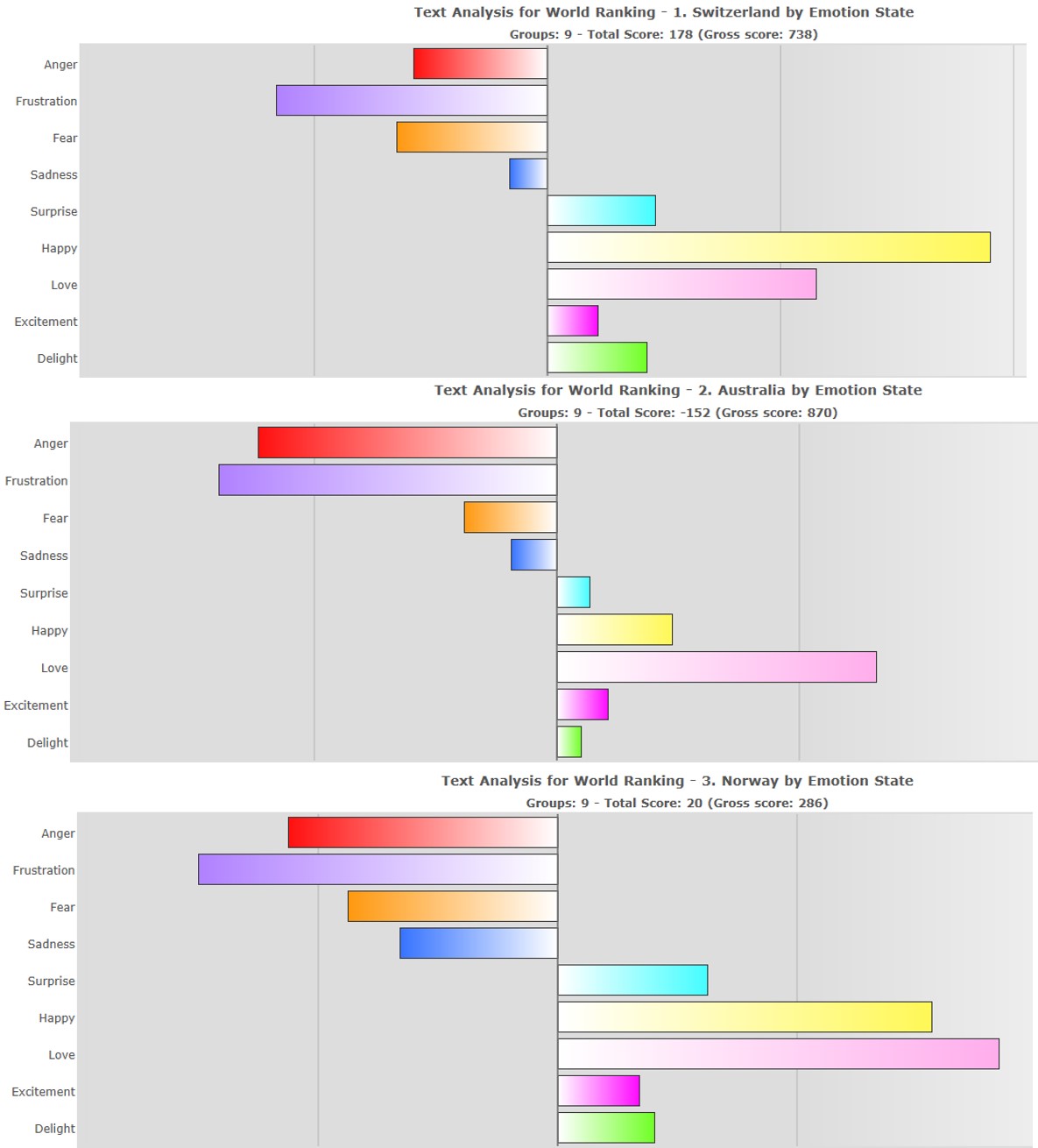
So, by way of a small experiment, we thought we’d start applying some of the PanSensic emotion lenses to the problem and see what happens. What happens when we analyse the sentiments being expressed on social media, in the popular press and in magazines in the various countries of the world.
We thought we’d start with the ‘official’ Top Three places to be born, Switzerland, Australia and Norway. Here’s what we found:
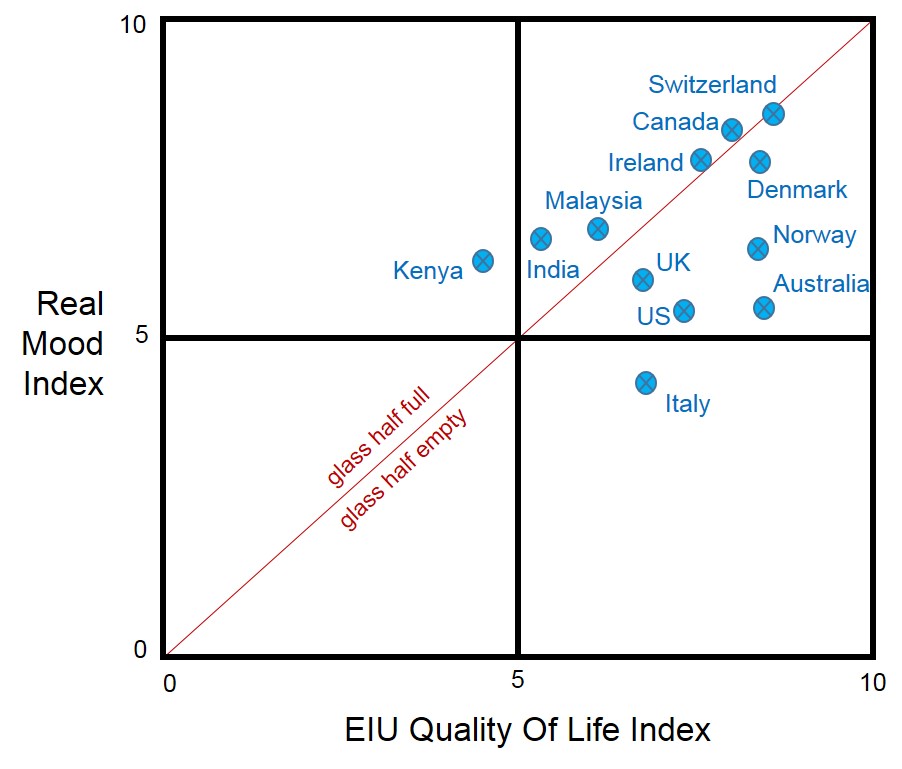
We then found a way to calibrate this kind of emotion data relative to the ‘official’ tangible Where-To-Be-Born scores. What we effectively then get is a tangible-intangible graph that looks something like this:
It seems to offer a quite different view of the best place in the world to be born. Perhaps the first thing to look at is the Half-Glass diagonal line. Below this line are countries where people see their glasses as half empty. Life might be tangibly great, but intangibly, people, as in the Joe Walsh song, would still prefer to focus on the negative. The further below the line a country is, the emptier the glass. Conversely, where a country finds itself above the line, it’s a sign that people are happier with their lot than their actual circumstances might otherwise suggest. These are the glass-half-full nations.
Right now the data isn’t as rich as we’d like, but already it feels like we’ve uncovered something a tad more meaningful than the economists have come up with. The nice thing is that, having connected up to a host of different live data streams, it’s very easy to add in data for other countries, and to start plotting trends over time. Enabling us to see just how transient some of the emotional scores can be. When a national cricket team loses the Ashes, for example, or loses the rugby final that can have a very definite negative effect on societal mood. Albeit a quite temporary one.
Meanwhile, sticking with our consolidated averages for 2015, it looks like Switzerland is indeed the place to be born right now. If you can’t manage that feat, though, your next best bet is Canada or Denmark. Or, if you’re happiest when you’re surrounded by other optimists, maybe India. Or how about Kenya?