“If someone says it’s raining & another person says it’s dry, it’s not your job to quote them both. Your job is to look out of the f**king window and find out which is true.”
Jonathan Foster (possibly)
I’ve yet to hear an apology from John Redwood following his astonishing on-screen battle with Krishnan Guru-Murthy on Channel Four news this week. I’m not holding my breath. Rather, Redwood, like a lot of politicians in these days of Fake News has learned that all that’s required to get away with a lie is to bury it in one or two layers of molasses.
KGM was absolutely right to call the liar out. Its time more journalists did the same.
Except, of course, if you were already pre-disposed to side with KGM, Redwood was lying whether he was or wasn’t. And if you were pre-disposed to side with Redwood, you believed him when he said the polls were saying ‘a majority’ of UK citizens wanted a No Deal exit from the EU. Irrespective of how true it was. The problem with a population as divided as the UK now is, is that Confirmation Bias dominates everything. We only listen to what we already agree with. Helped in no small part by Facebook and Social Media, which all serves to reinforce the effect by only feeding us stuff that is consistent with our existing Bias. It’s a horrible vicious cycle that isn’t going to end well. And I think people like John Redwood not only know it, they see it as part of their role to actively encourage it.
Redwood’s thousand-yard-stare through most of the interview, meanwhile, was a clue that he knew he was lying. The problem of proof, however, is somewhat more troubling. There was indeed a recent poll that sort of confirmed Redwood’s assertion.
It was a poll conducted by Sky News. This is what they reported:
“Forced to choose between no deal, Theresa May’s deal or a long delay with EU elections, 41% prefer no deal, 35% a long delay with EU elections, with just 16% favouring the prime minister’s plan – nine percent answered, ‘don’t know’.”
At the bottom of the article, readers were then told:
“Sky Data interviewed a nationally representative sample of 1,295 Sky customers by SMS on 5 April 2019. Data are weighted to the profile of the population. Sky Data is a member of the British Polling Council and abides by its rules.”
What this basically all means is that a biased, bullshit question was asked through a bullshit medium to a bullshit sample.
So where was the lie?
Was it Redwood? Did he use deliberately weasel-y words to cover his back? Did he take the time to investigate the validity of the Sky News survey?
Was it Sky News deliberately formulating a survey question where the majority of possible answers were omitted and then posing it in a dumb way?
Or was it someone behind the scenes, recognising that there was a need for more pro-Brexit ‘balance’ in the political discourse, who commissioned such a disingenuous survey? Someone, perhaps, being paid by someone to do bullshit-science, safe in the knowledge that the people who’s biases the results confirmed wouldn’t dream of challenging? Or could, at a convenient later date, say was ‘a mistake’?
The only meaningful answer is that it was all of them. Redwood included. He might at some point in the future, when the dust has finally settled on this seemingly never-ending Brexit pantomime, claim that he couldn’t have known that the survey was bullshit. If, however, you are a public figure living a public life, just like the law for Company Directors and other members of society living in the real world, ignorance is no excuse. You have a moral obligation to the public you serve to do your homework. You have a moral obligation to ‘own your shit’. And you have a moral obligation to get beyond your party-political Confirmation Bias and tell the truth.
I was reading Patrick Hoverstadt’s 2008 book, ‘The Fractal Organisation’ this week. Hoping it was going to turn out better than it actually did. The world of work requires more people understanding complex systems theory in general and Stafford Beer’s Viable System Model in particular, but no author, it still seems, has unlocked the formula that will get sufficient people started on the journey to make any difference.
In the end Hoverstadt’s book seemed more about making sly digs at corporate fads than making VSM seem more than abstract theory, but the section on measurement did at least trigger a thought that I think makes it possible to help teams to better understand the complexity landscape within which we are all operating. And if we can do that, we give ourselves a higher likelihood that we might end up being successful with our change efforts.
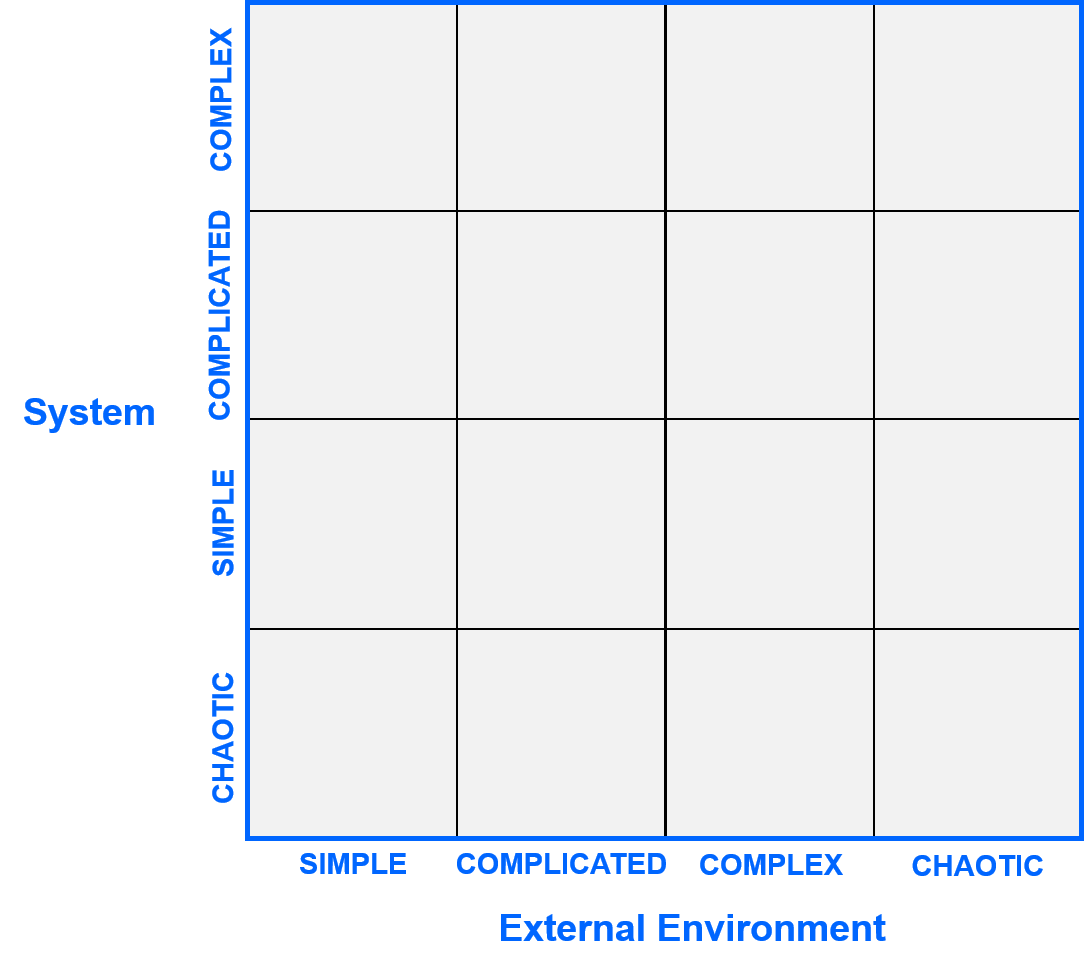
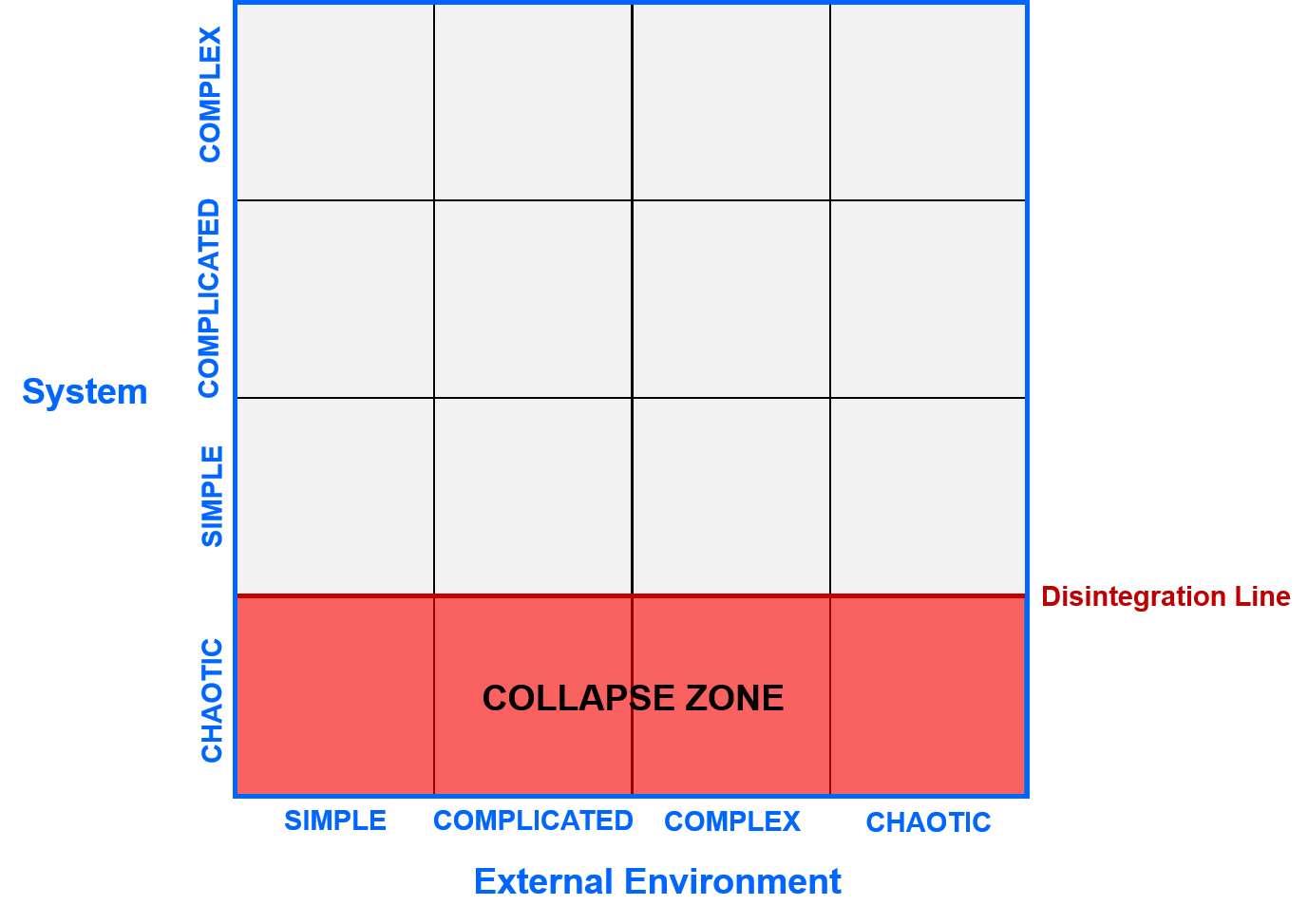
The start of the new complexity landscape model comes from a recognition that the manner in which a team might be operating may well be different from the environment that surrounds them. When I plot internal and external complexity as the two dimensions of a graph, I end up with something that looks like this:
Both dimensions are split into the four basic types of complexity scenario that might be present: simple, complicated, complex and chaotic. Nothing magic in this segmentation model, it being pretty much the same as Cynefin, which in turn is built on the recognition that there is a discontinuous shft between each of the four possible states. I’ve labelled the horizontal external complexity axis as a spectrum in which the overall complexity increases as we travel left to right. For the vertical internal system axis, I’ve done something slightly different and placed the chaotic scenario at the bottom of the graph.
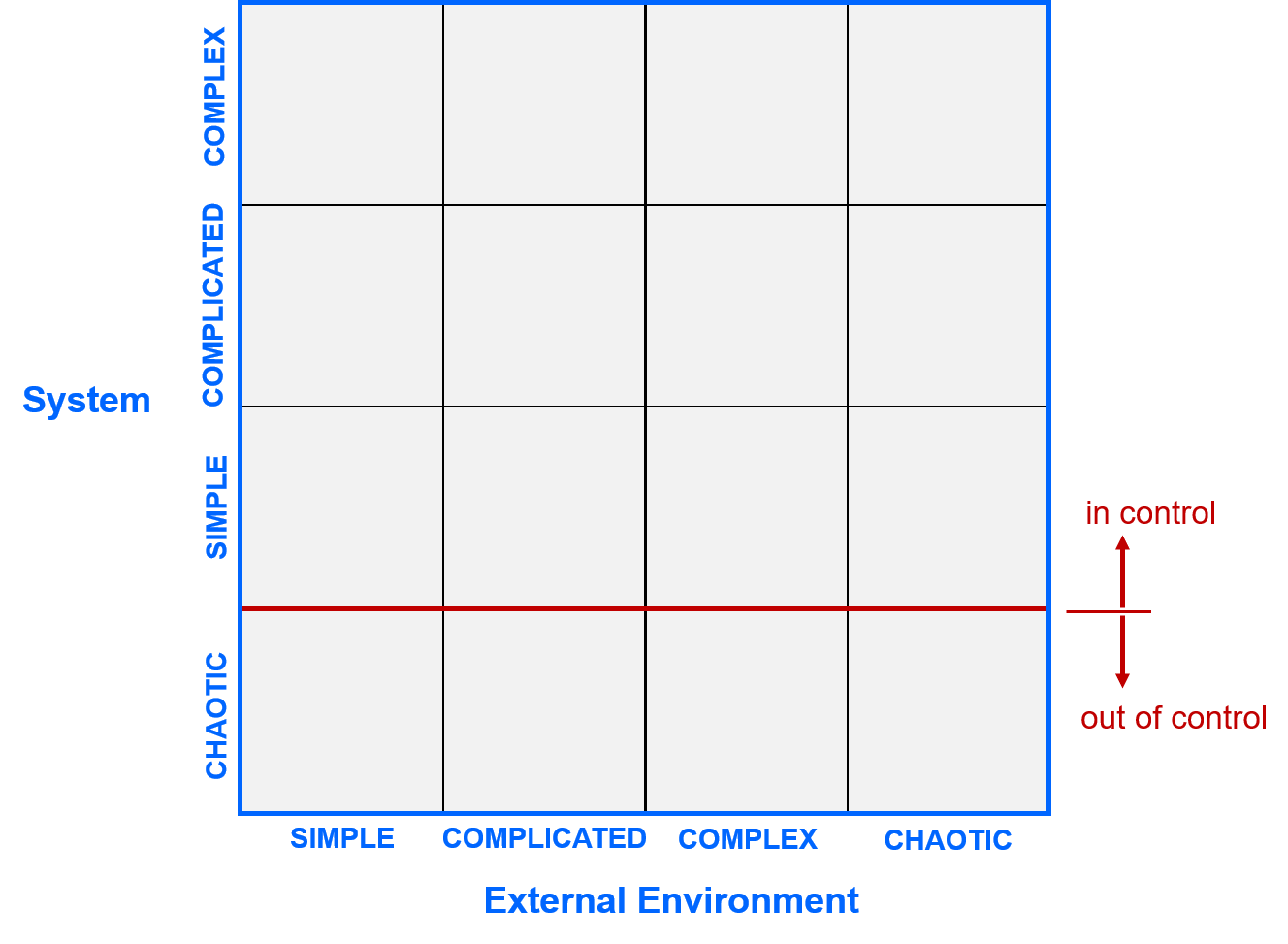
The reason for doing this is that when I add this line to the graph…
…I’m able to differentiate between ways of managing the system that are ‘in control’ and ‘out of control’. Below the axis line, the system is chaotic and out of control; above the line, we see the same simple-complicated-complex sequence as found for the external environment dimension.
I can then describe the in-control/out-of-control boundary as a Disintegration Line, such that if I find myself operating below the line for any sustained amount of time (chaos can be really useful in short bursts), my system is very likely to collapse:
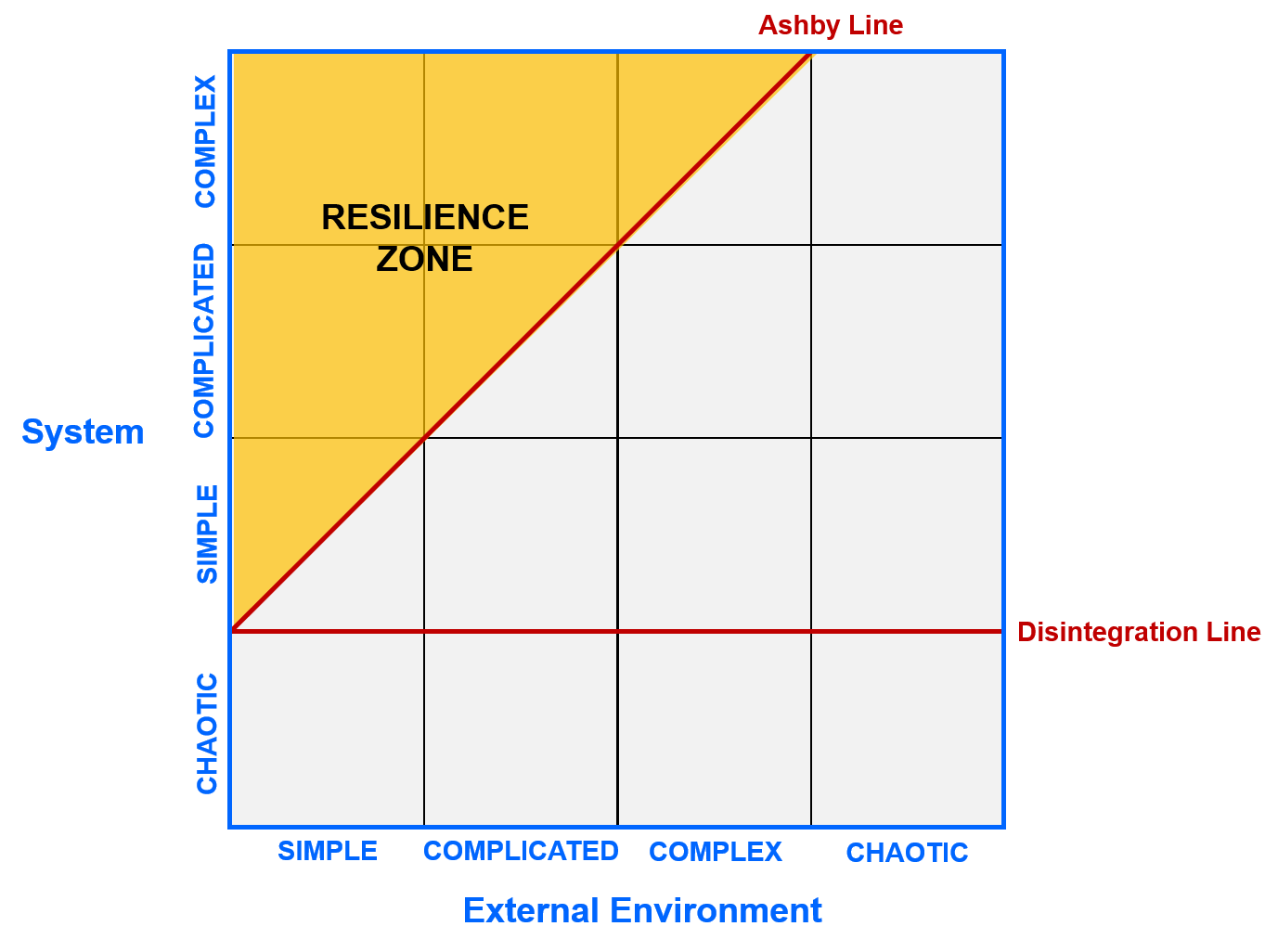
Next, I’ve added another important line onto the graph. This is what I’ve labelled the Ashby Line after cybernetician, W. Ross Ashby, who gave the world a vital first principle way of looking at systems: ‘only variety can absorb variety’. Above the Ashby Line, and my system will be a sustainably resilient one; below the line and I disobey Ashby’s law and hence make myself vulnerable to its consequences.
The idea of this Landscape now is that, assuming I’m able to measure internal and external complexity (and I recognise that’s a big ask… more on which in a subsequent article), I should be able to work out how best to operate, or whether I need to change in order to get into or stay within the Resilient Zone.
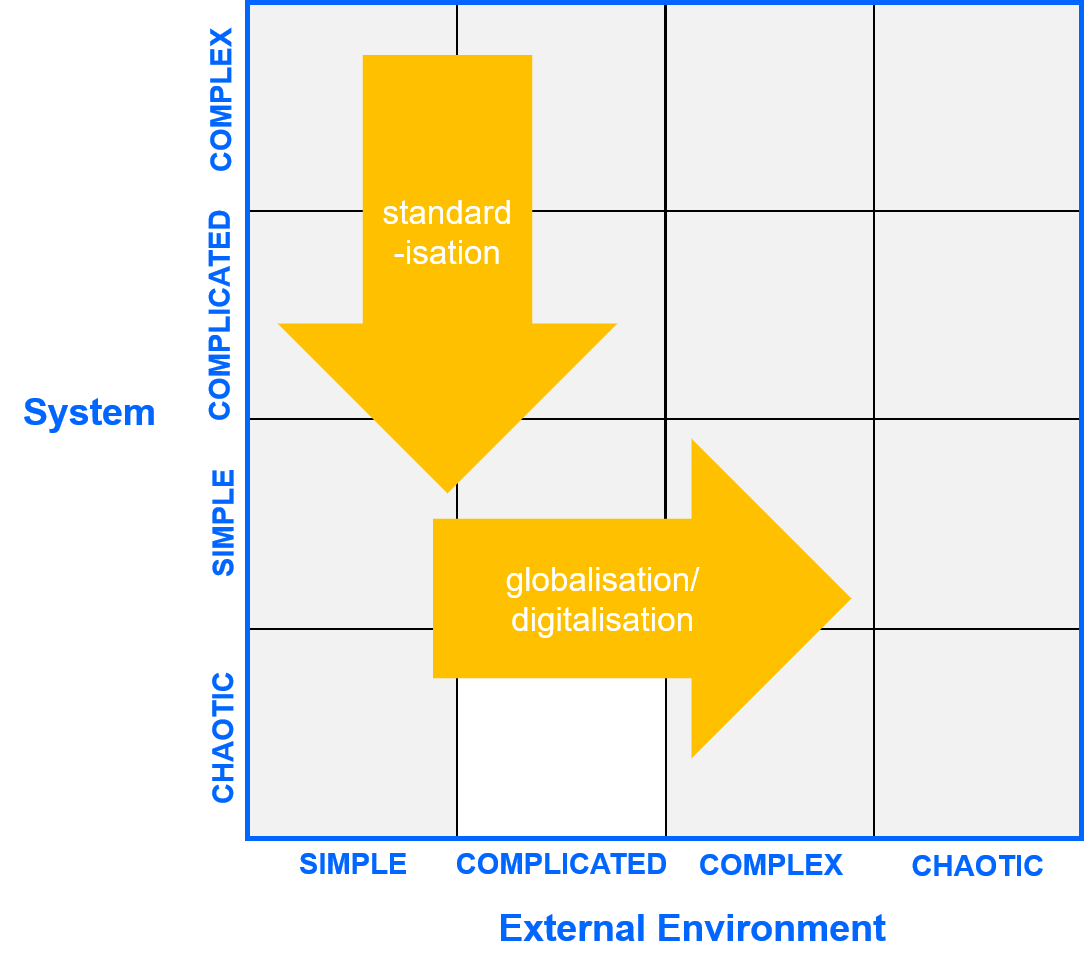
Getting into this Zone, and staying in it is made difficult by two fundamental forces of nature. The first is the downward pull of ‘standardisaton’ as found in most organisations thanks to Lean and SixSigma thinking and their urge to reduce waste and variation. The second then is the increase in external complexity resulting from massive globalisation and digitalisation and resultant speed-of-light feedback loops:
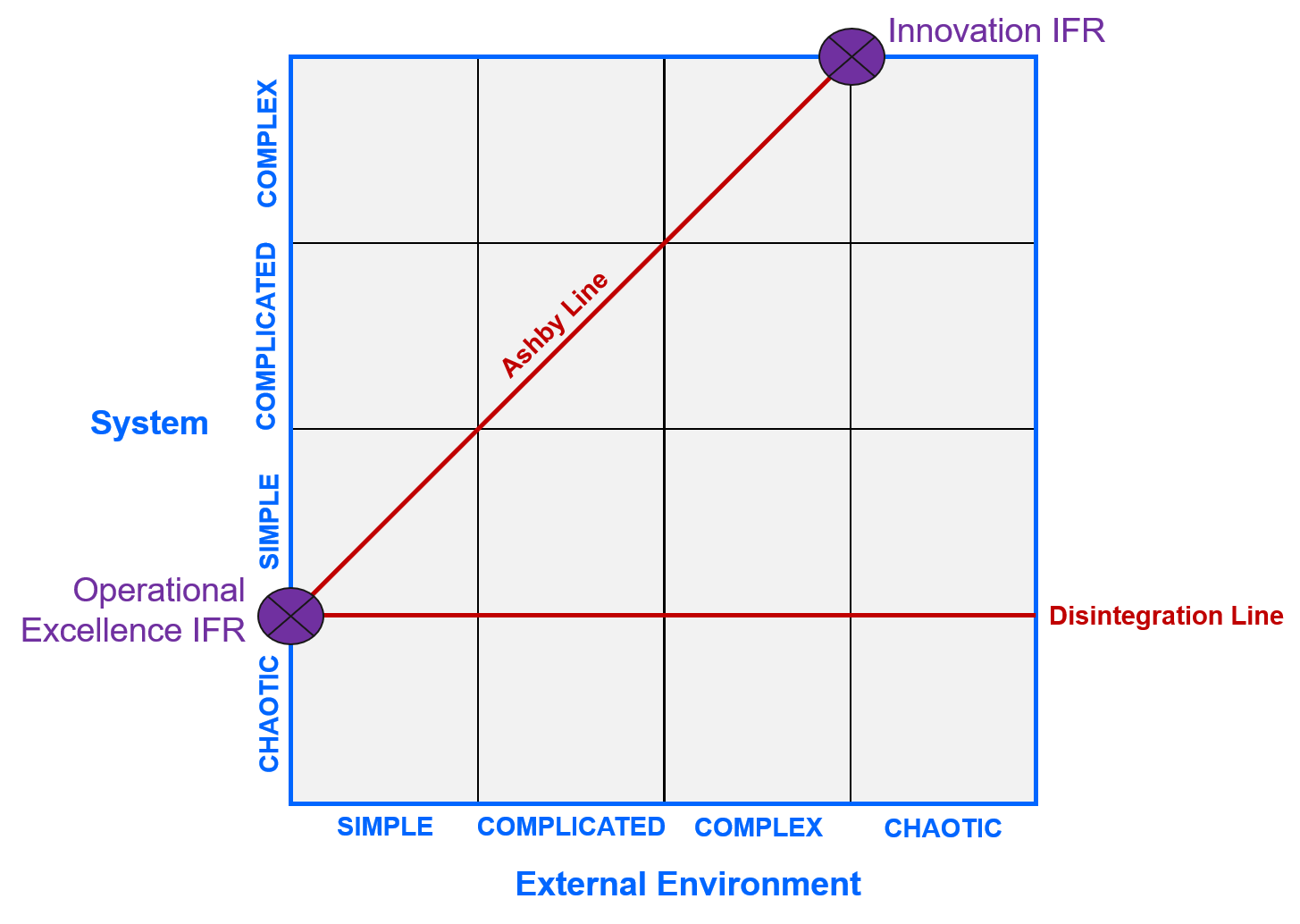
Neither of these forces helps enterprises as a whole. In no small part because, when we look at the Ideal Final Result state of the two different worlds the enterprise has to embrace, there is a fundamental conflict needing to be addressed. In an Ideal world, the Operational Excellence mode of thinking seeks to maximise efficiencies by standardising everything and making life as simple as possible, and for customers (the outside world) to similarly never change its simple existing needs. Workers in the Innovation World mode of thinking on the other hand, knows that they have to embrace complexity if they are to be successful in understanding where in the outside world the next round of paying customer are going to come from and what they are going to demand from providers:
The more I look at this overall model, the more I think I’m going to be writing more about it in the future. Amplifiers and attenuators. Requisite Damping. Variety Flux Index. Understanding the precipice the automotive industry is about to fall off. Understanding Brexit. I filled six pages of notes yesterday afternoon. It might all explode into nothing. Or it might turn out to be the seed of a new Systems Thinking workshop…
Aah, tribute acts. Bringers of light. Who doesn’t love a good tribute band?
I’m joking. No-one should. No-one in their right mind says to their loved one, ‘let’s go out for some tip-top entertainment tonight’, and ends up watching a bad impression of a musical act they love.
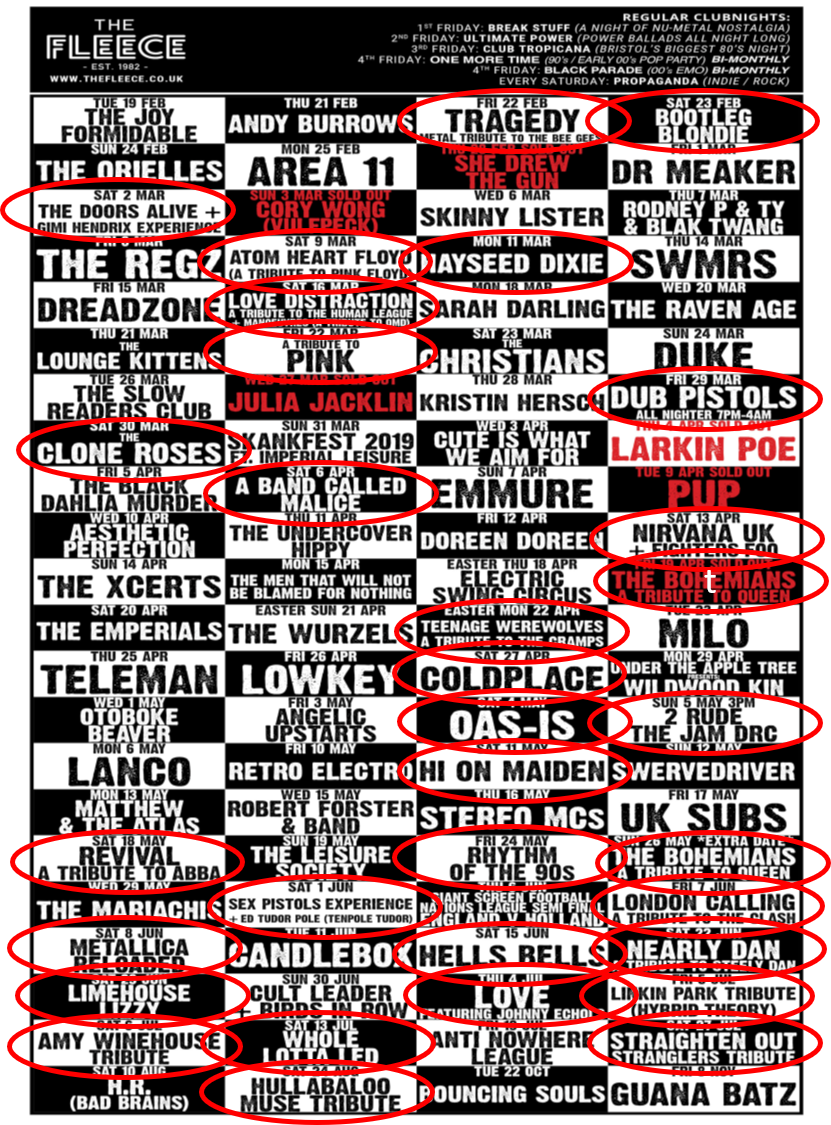
Except they do. I was staggered to realise while waiting for the (real) band to come on at Bristol’s finest music venue, The Fleece, the other night, that over a third of all the bands scheduled to play were tribute acts.
Clearly something is not right in the world.
Every half-way decent band, and a lot of really bad ones these days have at least one pun-tastically titled mock version. Pink Floyd currently has over fifty copy versions doing the rounds. Some of them selling out quite large venues.
I decided to investigate.
The problem, it rapidly transpires, has its origins with the Millennial generation.
When two trends collide, a third emerges.
Millennials are ‘Heroes’. They have also rejected the ‘live to work’ attitude of their parents and have gone for much more of a ‘work to live’ perspective on life. Fair play. If you’re a plumber. But combine the desire for heroism with the corresponding lack of desire to do the hard yards, and the result is fifty tribute acts to every musician. Or worse. Tribute acts of trbute acts. In which Radiohead tribute act, and arch music-killers, Coldplay, now find themselves competing with half a dozen Coldplay tribute bands.
Lowest common denominator heroism. No need to bother with the challenges of writing new songs. Or doing any thinking to advance the state of the art. Or learning how to play your instrument. Just download a few Oasis chord sheets, borrow a dodgy wig and some sunglasses, and hey presto, two weeks later you’ve got 500 people cheering you on at Bristol’s finest music venue on a Friday night. Not to mention the poundshop groupies.
Rest assured, this doesn’t end well. Not for the Millennial quarter-life crises. Not for the sanity of people who actually enjoy music. Or for the next generation of Artists, that are going to have to pick up the pieces in the coming years.
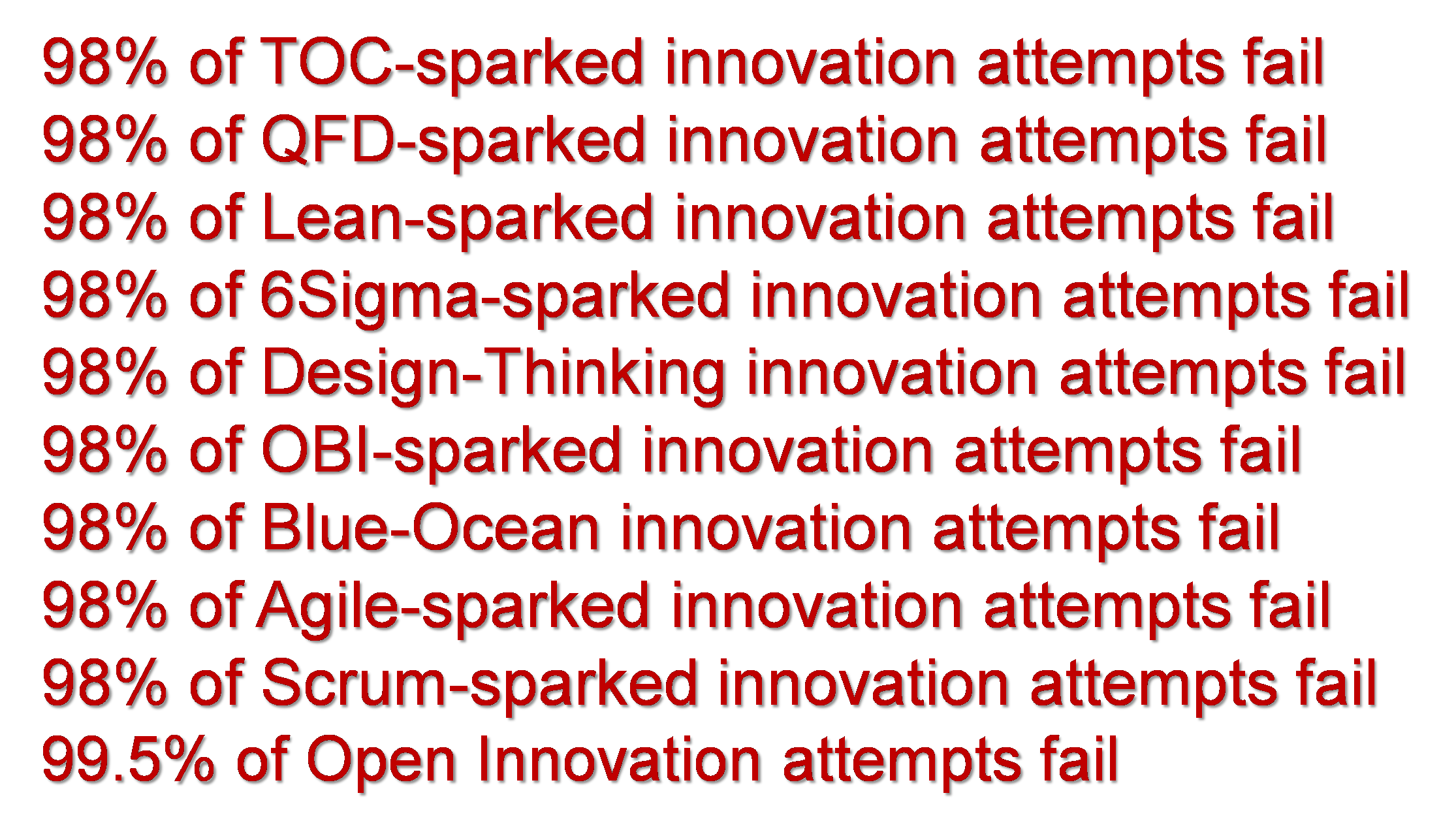
Based on a running total approaching ten million case studies, we know that 98% of all innovation attempts end in failure. Put into context, that represents about $120B per year of wasted resource, globally. One might imagine that organisations would make some kind of investigation to understand why so much money is thrown away, but it seems very few are brave enough to commission the work. Perhaps this is because the leaders in the world’s enterprises may discover an uncomfortable truth: they are the heart of the problem.
This is not necessarily to blame them for that fact. In almost every case, what allows a person to rise to the top of the hierarchy within their organisation is their ability to demonstrate good Operational Excellence characteristics. Which means people that consistently hit their targets, people that consistently did what they were told, people that followed the rules, people that made sure everyone that worked for them also followed the rules.
Organisations need such people. Operational Excellence pays next month’s salaries. But organisations also need people that are able to innovate. And in many ways, the skills required to be a good innovator are 180 degrees opposite to those required for Operational Excellence. The better a person is at doing the Operational Excellence job, the worse they are likely to be at innovating. Almost no-one that has reached the top of a modern enterprise, therefore, has the first clue what innovation is really all about.
That’s not to say that business leaders won’t pronounce the need for innovation. It is a very brave CEO indeed that will stand up and say, ‘we don’t want innovation’. Markets expect innovation to happen. Innovation is the future. Innovation pays everyone’s salaries (and gives shareholders their dividends) in three years, five years and ten years’ time.
But when a leader who doesn’t understand innovation stands up and asks for innovation, the way those words are heard is, ‘bring me lots of exciting new ideas, but don’t you dare change anything’. And so what most organisations end up with is a depressing internal game. Design Thinking is currently very fashionable, so someone in a position of authority declares that, in order to innovate, everyone needs to be taught Design Thinking. After a couple of years of zero impact (except some of your best people will leave the company to set up Design Thinking consulting companies), leadership looks for another, different, strategy. And so something like Open Innovation becomes the new plaything. Two more years go by and then that fails. All the time leaving the scientists, engineers and designers feeling more and more like they’re caught on a merry-go-round that never stops and quite literally never goes anywhere.
So, a few years ago, we thought, if the leaders in large companies don’t want to understand the problem, we will have to understand it for them. We study innovation all the time, and have been doing so for the last 20 years. What we started to do five years ago is examine the causal links between innovation and the tools and methods organisations supposedly use to help spark those innovations. We’ve been fortunate along the way to be able to conduct the research in conjunction with some of our clients and frustrated Innovation Heads (Note: almost everyone inside a large organisation with ‘innovation’ in their job title, is a very frustrated person) to try and reveal the under-pinning DNA of their innovation success stories. Attempting such a feat is difficult at the best of times; doing it in the complex/chaotic environment that invariably accompanies any kind of discontinuous jump is a particularly hazardous job. A big part of the challenge, therefore, is to somehow parallel-test the negative hypothesis. In this case, that goes something like this:
a) Identify the tools, methods and processes that we think contributed to the success of an innovation project.
b) Identify the tools, methods and processes that were utilized during innovation projects that subsequently proved to be unsuccessful
When it is possible to meaningfully grasp the answers to these two questions, ‘success’-contributing methods turn out to be no more or less likely to be present as the answers to both questions. Thus, as 98% of all innovation attempts fail, so we see that those that claim to have made use of Agile methods – to choose another currently very fashionable Weapon of Mass Distraction – will also fail 98% of the time.
The only vaguely meaningful way to test the efficacy of one method over another would be to conduct some kind of parallel set of innovation-project experiments: one using Agile, for example, one using (another random choice), Outcome Based Innovation, and one – the ‘control group’ using no formal support method at all. Such experiments are both expensive and fraught with the difficulties of trying to compare the un-compare-able. There are one or two examples, but really precious few that would pass any kind of academic scrutiny. That’s one of the big challenges of working in complex environments, of course: its never possible to step in the same river twice.
The most usual ‘alternative’, historically, is the Jack Welch SixSigma ‘myth-builder’ strategy. Which basically involves never doing any kind of double-blind experiment, and instead telling people that ‘quantifying how much Six Sigma helped is good for your career’. Then, hey-presto, and surprise-surprise, any piece of moderately successful work ever done thereafter gets a Six Sigma label attached to it, until Jack is able to announce to the world’s media that the savings amount to ‘$9B’. Every cent of which is utterly fictitious.
Then there’s a final twist of the knife pertaining specifically to the tools and methods that might be brought to bear during the ‘fuzzy-front-end’ period of an innovation project. By the time the project gets somewhere near to delivering success, this fuzzy-front-end is a long distant memory, and, unfortunately, if you’re part of the method team, participants’ memories tend to be short. After the 99% perspiration, people, in other words, tend to have forgotten where the 1% inspiration came from. It was the perspiration that delivered the success, not the weird bit at the beginning.
Taken all together, the overall picture can tend to make people in the innovation world depressed if you’re not careful. Well, actually, the reaction can be quite amusing if you’re that way inclined. Which we tend to be on occasion since it turns out to be a good initial filter mechanism for sifting out the pretend-innovators from the potentially real ones.
The real ones, when they’re exposed to these kinds of result are much more inclined to ask whether there is anything at all that meaningfully distinguishes the 98% of innovation attempt failures from the 2% that end up being successful.
Ten million case studies later, it turns out there is.
In the world of tangible tools, here are the things that we can safely say have a statistically significant likelihood of contributing to innovation success and a corresponding absence in innovation attempt failures:
– The ability to identify and resolve trade-offs & compromises – Having a clear meta-level compass heading relating to customer value – Systems Thinking – Management of the unknowns trumps management of the Gantt Chart – Clear understanding of complexity – rapid-learning cycles, ‘first principles’, s-curves, patterns – and need for requisitely fast learning cycles – Clear understanding of (von Clausewitz) ‘critical mass at the critical point’ – Requisite understanding the customer/consumer say/do gap and how to deal with it
Important as these tangible – i.e. very teachable – elements are, they tend to get dwarved by the intangibles. Which look something like this:
– An excess of influencing skills – Strong ability to working together in cross-disciplinary teams – Persistence/bloody-mindedness/willingness to stick-with-difficult-stuff – Strong ability to live with continual ‘failure’ – Acknowledgement that ‘ideas’ have zero value – Ability to design and manage a clear sense of progress across the team
This stuff is much more difficult to teach. Not impossible, but it does require a heap more time than most organisations are prepared to devote to the task. Interventions, these days, able to be assisted by the fact that we’re able to measure a lot of these intangible success-driving elements, including the ones that spill over into the tangible arena.
Repeatable innovation success ultimately means getting all of these tangible and intangible things right, but any thousand mile journey necessarily begins with the first few baby steps. The best two seem to involve a) creating a sense of progress, and b) the best way to do this is to start looking at some of the many trade-offs and compromises that sit at the heart of Operational Excellence, and saying to ourselves, we’re not going to make those trade-offs any more.
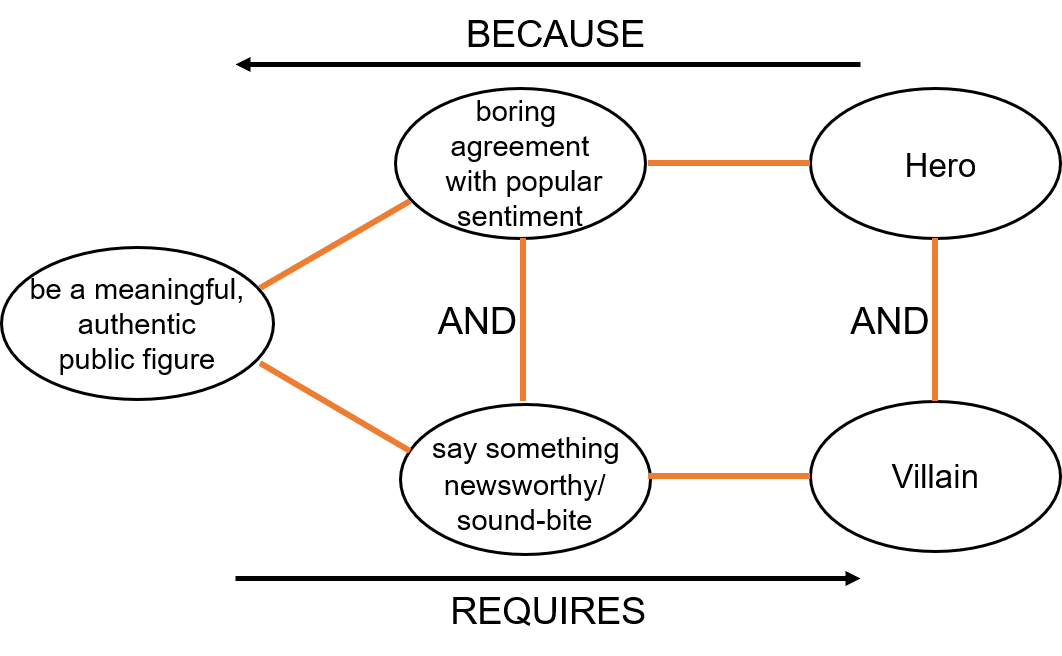
Almost everything that happens in British politics these days is enough to make even the most ardent defender of politicians hold their hands up in despair. I suspect we hit at least three new nadirs this last week. The most pitiful of which was, for me at least, when Shadow Chancellor John McDonnell called Sir Winston Churchill a “villain”. The minor debacle started when McDonnell was asked at a Politico website event, for a one-word answer on whether Churchill was a hero or villain. McDonnell paused and replied: “Tonypandy – villain”. Showing, in true modern-politican fashion that he could neither follow the simple instruction or come up with a sensible answer.
The moment the question is posed, I can imagine the panicked turmoil in McDonnell’s head. He’s just been set an impossible question and now has a contradiction to solve. One that, if he understood this kind of thing, looks something like this:
In the coin-toss of political fates, sadly for McDonnell, he decided to go down the tasty sound-bite route. And as a consequence found himself on the main news for 24 hours, the focus of a question on Question Time and the easy target of every newspaper column writer for the next three days. So, I guess, on some level his choice was a good one.
If the aim was also to increase national left/right polarisation, he can tick that box too. Well done, asshole.
What depresses me most in all of this, however, is nothing to do with McDonnell at all. He’s just the poor schmuck who couldn’t think his way out of a contradiction if you wallpapered him in TRIZ posters.
What depresses me first is that we now have a ‘media’ that is so far down the slippery slope of their clickbait-hunt that insisting politicians must answer their questions with one word answers is now considered valid journalism. We all like a soundbite. But I think we all realise there’s a time and place for them. Churchill himself was a master of the art. Content and timing-wise.
What depresses me second is that we have politicians that feel obliged to comply with the dumb questioning.
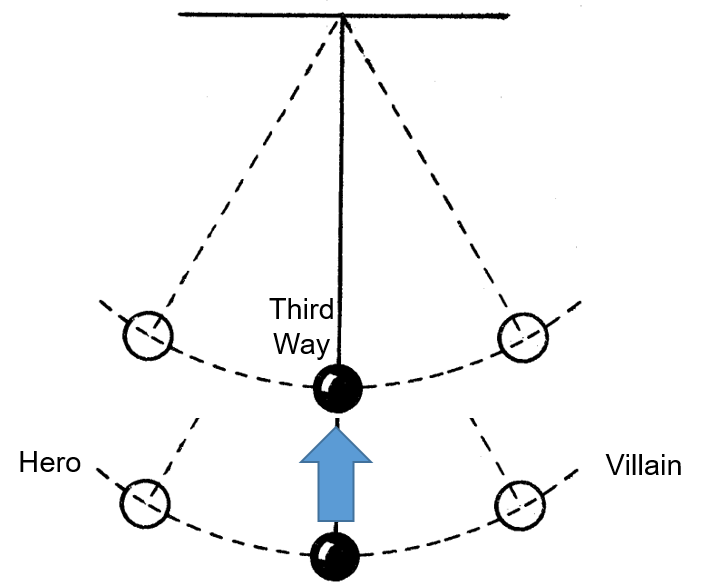
Everyone is caught on yet another either/or pendulum swing. The correct answer to which can never be left or right. The only way is the third way.
McDonnell could’ve shifted the pendulum in any number of creative ways. No TRIZ required. Just an ounce or two of creativity.
He could have played the hack journalist’s game and answered ‘both’. That would’ve been newsworthy too. And somewhere closer to a genuine truth. Less imaginative, but he could also have answered, ‘neither’. At least that would have prevented him having to spend the next 24 hours defending himself. Or how about, ’99.9% hero’. People would’ve understood that too. No-one, least of all Churchill, is or ever has been perfect, but some try harder than others to overcome the manifestly inherent human weaknesses.
He could also have completely ignored the ridiculous ‘one-word’ part of the question and gone off on a 45-minute diatribe. Not great from a news perspective either, but at least it would make future interviewers think harder about the stupidity of the questions they pose.
A little more brave, but if I’d been in his position, I like to think I’d have opted for, would have been to call the journalist out by saying something along the lines that this kind of either/or questioning is dumb and that I wasn’t going to play the game. ‘I’ll give you the properly considered, 10,000 word essay answer if you like, but stop looking for elevator-pitch nonsense’. One way of saying this, which I might also have been tempted to explore, would be a polite, smiling, ‘stop being a prat. Grow-up.’ That would have been newsworthy too for all the right reasons. Except the journalist, probably would’ve covered it up at that point. Hopefully in the shameful realisation that they’d just been caught in their own tawdry little trap.
Two wrong answers, or a thousand and one third-way right ones. Guaranteed with all of our politicians right now, we know we’re going to get one of the two wrong answers.
One of the sad consequences of a world in which no-one knows what is real and what is made-up is that it becomes increasingly difficult to have a sensible conversation about anything. Is gender binary or non-binary? Is being a member of the EU a good thing or a bad thing? Instead of answers we drown in noise.
Maybe the heart of the problem is the word ‘or’. Which implies a contradiction. Which in turn is trying to tell us that we could have a much richer, infinitely more meaningful conversation if it was somehow possible to separate the contradictory sides of the argument. One side of the argument could be ‘wrong’ of course – especially in a world where students are being taught that their opinion is somehow equivalent to fact – but it is also highly possible that both sides of the argument could be ‘right’. A contradiction is when one right meets another, different, right.
One of the least well used means of synthesising a contradiction-busting higher ground involves exploring the differences between correctness and truth.
Correctness is all about tangibly measurable properties. A tomato is a fruit.
Truth is all about the experiential aspects of phenomenology. It is about knowing whether or not it is a good idea to put the tomato into my fruit-salad.
Truth and correctness can be the same thing, but we’ll only establish whether this is so by escaping from our day-to-day existence and allow ourselves to think.
I struggle to get myself into the zone where I can achieve such thinking. More often than not, if I get there, it will be while listening to or playing music. And more often than not I’ll find it easier to get there while listening to Miles Davis.
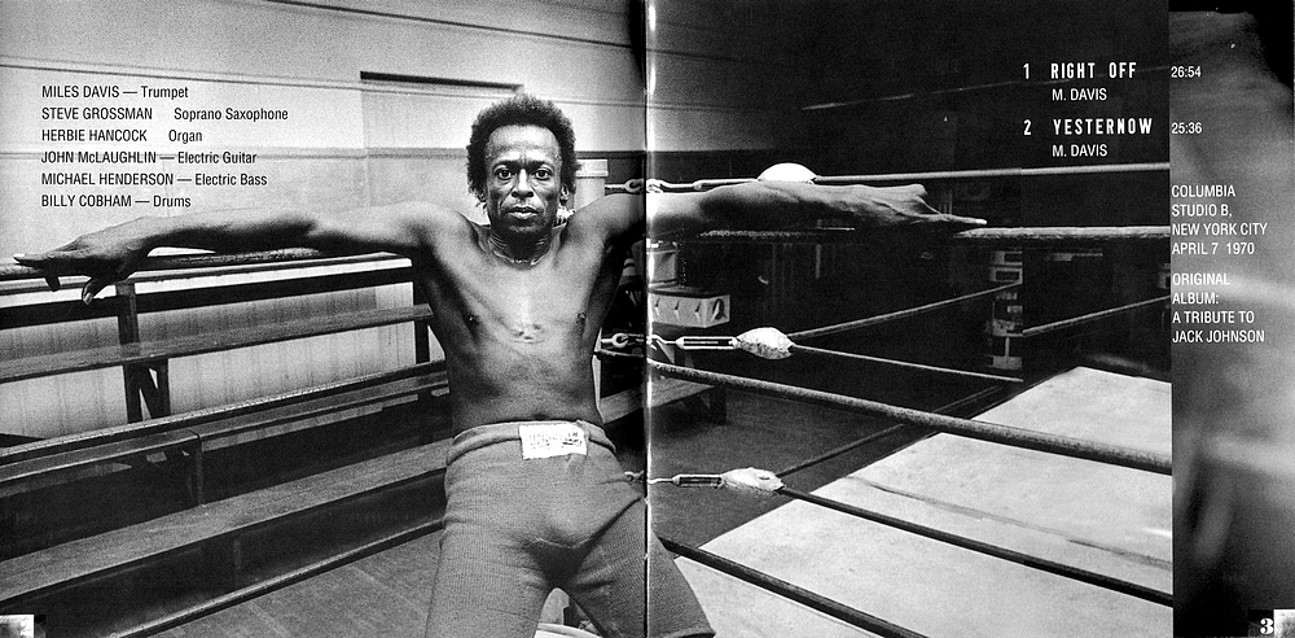
In my more naïve moments, I might take a look at a score for a piece of Davis’ music. My all time favourite of which is ‘Right Off’ from the album A Tribute To Jack Johnson. Naïve is the right word here because guitarist, John McLaughlin is about as far removed from my level of playing capability as it is possible to be. Nevertheless, if I scan the Right Off score, I can see I am looking at something that bears all the properties of correctness.
I’ll never get to play like McLaughlin. For a long time I found this a depressing thought. Then I heard the Miles Davis quote, ‘don’t play what’s there, play what’s not there’ and, after it finally sunk in, I realised I was listening to an important truth. An incorrect one from the tangible perspective of the measurable properties of the Right Off score, but truth nevertheless.
If I was looking for ‘truth and correctness’ I believe that is what the Jack Johnson record actually achieves. It is unarguably one of the most enduring and significant moments in jazz and rock history. If only for having the audacity to disrupt both so radically.
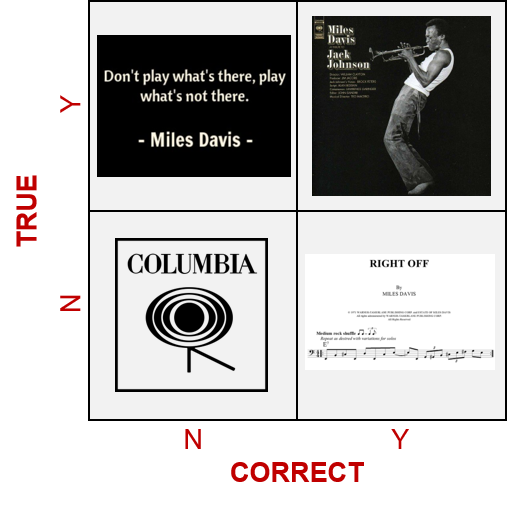
This, despite the fact that the record company, Columbia was so un-enthused by the record when Miles handed over the master tapes, they couldn’t even be bothered to check they’d put the right artwork on the album cover. Columbia, in their negligence, were neither correct or truthful. Which is kind of shabby, but does at least allow me to draw this 2×2 matrix:
And once I realise truth and correctness form two orthogonal axes like this, I might just give myself the opportunity to make some meaningful progress on whatever issue I might find myself working on.
Now that every last semblance of rationality has well and truly left the Brexit building, all I’m left with is a bunch of potential new TRIZ case studies. Every cloud of stupidity has some kind of silver lining I suppose.
Today’s started with an unusual situation while reading the paper this morning. Normally I love what John Crace has to say, and feel somewhat the opposite about Home Secretary, Sajid Javid. Today everything got flipped the other way.
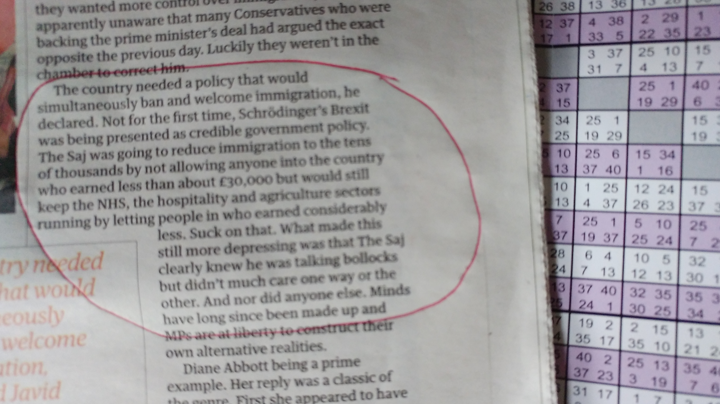
Crace was having a go at Javid’s comment that the UK needs a policy that would ‘simultaneously ban and welcome immigration’. Crace, like most people, appears not to be able to comprehend the idea of a contradiction. So much so in this case that he used the apparent illogicality of Javid’s statement to highlight how ridiculous our politicians are these days. Still, I suppose it gave him an opportunity to repeat his witty Shrödinger’s Brexit label. Which I now – blinding flash of the obvious – understand to be a pretty good label for political contradictions in general.
Solving contradictions is the very core of breakthrough and innovation. In a political context it is exactly what I’ve been talking about when I rant on about ‘Third Way’ perspectives on society. Stop being bound by the tyranny of the ‘or’ and start actually thinking.
Crace is so far away from understanding this concept I think I have to re-calibrate just how far away TRIZ is from most people’s consciousness. Perhaps to the point that I sy to myself, if Crace doesn’t get it we really are doomed.
Javid expressed the contradiction, but then, as far as I can tell, he gets stuck. Yes, British society needs more and less immigration. But unless you can construct a model like this…
…you will end up with the usual half-arsed compromise non-solutions politicians always end up inflicting on us all.
I think we need another pair of new rules. One: no-one is able to enter politics until they’ve successfully completed TRIZ 101. Two: no-one is allowed to write about politics, Mr Crace, until they too have completed the same course. Then they might stop looking for cheap opportunities to regurgitate cute clickbait phrases and start actually helping to solve the contradiction so we can all move on to better things.
The John Crace column is here: https://www.theguardian.com/politics/2019/jan/11/brexit-debate-day-six-if-no-one-else-was-trying-why-should-the-saj
I bought a copy of The Coddling Of The American Mind. Two reasons. One, it sounded like another interesting data point to challenge or verify the GenerationDNA model. Two, it talks about antifragility. Specifically, antifragility – or the lack thereof – in the current generation of students. Recent experiences with students almost everywhere I travel is that there’s a fragility problem. Over-protection is endemic. Lack of critical thinking even worse. Which is not good from a future-of-innovation perspective.
I’m not sure I got too much out of the book to be honest. It certainly serves to confirm the GenerationDNA story, so while that’s ‘nice’, it didn’t open up any new lines of enquiry that might help strengthen the theory. It does, however, contain a few juicy snowflake horror stories, which are always nice to shock audiences with. On the negative side, half the time it felt like I was being sold a CBT course, and there’s not much I dislike more than buying something that then feels like an advert asking me to buy something else. Never mind, I’m resolved to let these things wash over me in 2019. So that just leaves the somewhat bigger problem of just how facile and trite the book’s ‘solution’ recommendations were. The problem, here, I think is that beyond identifying a number of candidate factors that have contributed to the coddling problem, the authors had no idea how to make sense out of them. And if they don’t know what the real problem is, no wonder their suggested remedies end up being glib.
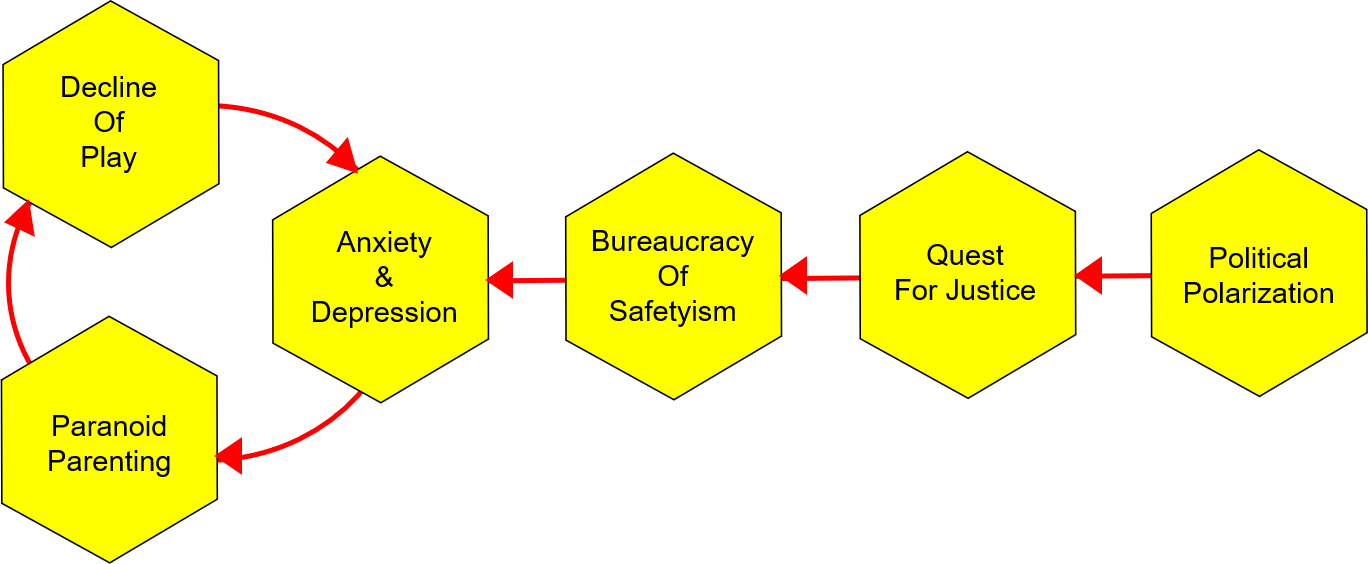
What they were missing I believe – I would say this wouldn’t I? – is a sensemaking tool. Good to identify six contributory factors; not good failing to understand that it’s the relationship between these factors that determines what the real problem is. It felt like time for a Perception Map. As it happens, a really simple one, seeing as there are only six ‘perceptions’ to be mapped.
The six Coddling-causing factors are:
Polarization Cycle – left/right polarization with, particularly, the left being dominant within academia.
Anxiety & Depression – the rise in adolescent anxiety and depression, starting around 2011.
Paranoid Parenting – moving away from antifragile towards fragile, and the three great untruths – what doesn’t kill you makes you weaker; always trust your feelings; life is a battle between good people and evil people
Decline Of Play – decline of unsupervised play, play being crucial to neural development
Bureaucracy of Safetyism – campus bureaucracy increasingly about ‘covering your ass’, expansion of its protective mission and concept-creep of what counts as ‘violence’, also increased competition means treating students as ‘customers’ (who are, by definition, ‘always right’)
Quest For Justice – students responding to powerful political events with a commitment to social justice activism.
And when I map out which one of the others each perception leads-to, I ended up with this picture:
It’s sometimes difficult to generate any kind of insight from such a small map, but in this case the vicious cycle that has to be broken seems quite clear, and the simplest way to break it seems clearer still: let kids play again. Get them out of their anxiety downward spiral and it doesn’t matter how polarized the politicians get, or how idiotic the university administrators become, the students will work out what they need to do. You’re welcome.
Late as usual. I’m writing a paper for the big Sustainable Innovation conference in March. Before I start assembling all the intended content, I thought it might be a good idea to read the referees’ comments on my abstract. It turned out not to be. Unless the aim was to make me laugh out loud.
The reviewers are – I think – supposed to be anonymous, but one of them had magically managed to identify themselves by ‘suggesting’ that my paper might like to refer to and build from some of their previous work. I’m not sure this is totally ethical, but seems about par for academia these days, so, what the hell, I thought I’d take a look at the hyperlink they kindly included in their review. You can take a look yourself here at http://english.cas.cn/bcas/2018_2/201809/P020180905630348554064.pdf. If you’re in any way associated with TRIZ, you might like to take a few deep breaths before you click. The ‘paper’ is a fairly overt advertisement for a ‘new’ branch of science the authors label mesoscience. The culmination of the ‘paper’s content is this picture:
Its hypothesis is that if the world chose to look across all of the various scientific disciplines, maybe there may be some common principles. If you didn’t laugh you’d cry.
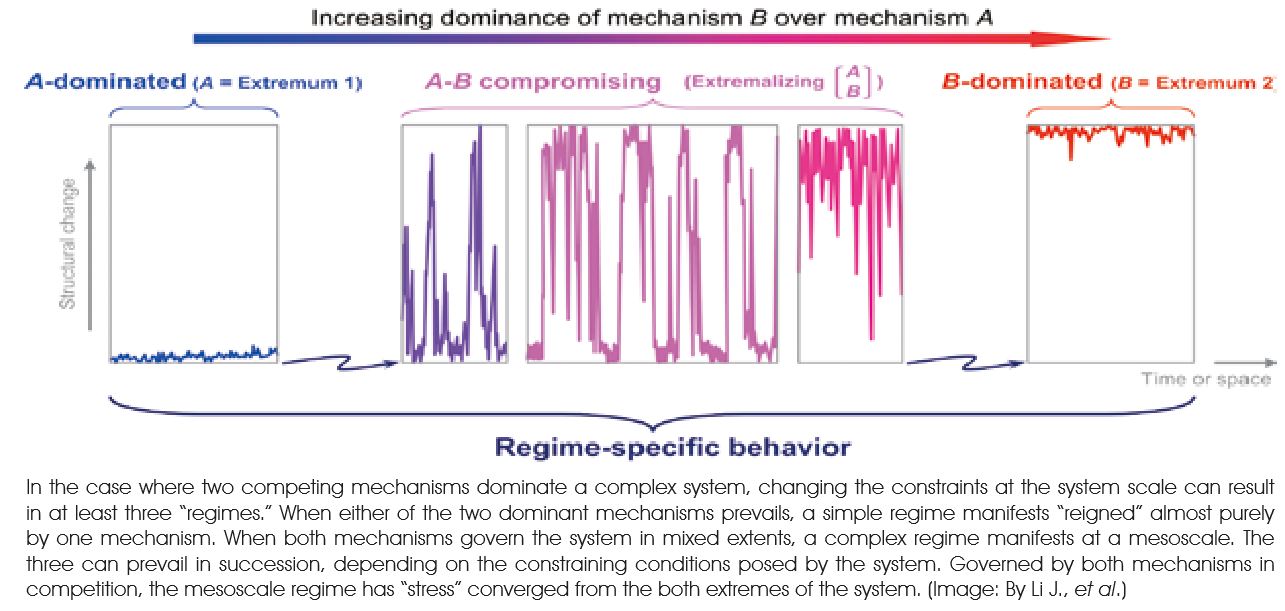
I usually tend to veer in the ‘laugh’ direction when encountering this kind of stuff. In this case, however, an earlier section of the ‘paper’ had speculated that ‘compromise in competition’ was one of the common principles. The point got reinforced by this graphic:
The bit I like best is the ‘at least three regimes’ comment. The graph plots the three regimes, but chooses not to plot the only one that’s important.
TRIZ, of course, has spent the last 70+ years doing precisely what the mesoscience ‘paper’ calls for. ‘Someone somewhere already solved your problem’ is one of the main findings. Meaning that there are very clearly a number of cross-domain common principles. One of which is very definitely that compromise is not a good thing. Compromise in competition is called, by other academic charlatans that also don’t understand how the world works, ‘red ocean’ territory. When we compromise, we end up with a bloodbath where nobody wins. Success is all about creating ‘blue oceans’ and the way this is done is by solving contradictions. So that everyone can win.
Funny how academics extolling the need for looking across domains – and supposedly, if I can believe their ‘paper’, have been at it for coming on 60 years – have a) failed to find TRIZ, and b) failed to identify that compromise is completely not a ‘common principle’ but rather a common mistake.
Thinking about it, maybe they did find TRIZ and realised it was safer to pretend they hadn’t. Acknowledging someone somewhere had already solved their problem likely as not meant no more grant money. And a need to engage their brain and go find a new question to go work on. Like I said, if you didn’t laugh, you’d cry. Academic crocodile tears.
One of my favourite TV detectives when I was growing up was Colombo. Although I wasn’t quite aware of it at the time, looking back, I think the thing that made me like actor Peter Falk’s character so much was that he was simultaneously a dishevelled nincompoop and as smart as a whip. It was a great contradiction. Criminals often got tricked by the former trait and then caught by the latter. Call it the old Principle-22-Switcheroo.
I was flicking through the channels the other day and noticed a re-run of an episode called, ‘A Bird In the Hand’. I joined the action after the murder had taken place. Someone was being filmed getting in to their Rolls-Royce and when they started the engine, the car blew up. Colombo had been watching the film. Looking for contradictions.
Lots of people seem to love watching detective programmes. I think its because they’re a type of puzzle. Can we work out who the perpetrator of the crime is before the detectives do. I’d have to say the genre became less appealing to me after I learned TRIZ. Mainly because TRIZ taught me that detection of a crime is all about contradictions. Someone is lying. They’re pleading their innocence, when in fact they did it. Spot the contradiction and you’re well on your way to solving the mystery. Connect the contradiction to an Inventive Principle (or perhaps more than one if the writer has done their job well), and the mystery is solved.
What Colombo had spotted in the film, as the cameraman panned across the car scene was that one of the peripheral characters flinched and closed their eyes tight before the explosion. Only someone with a devil-in-the-detail detective’s eye would’ve spotted it. A fraction of a second in a grainy panning film. But enough to give the game away. The flinching character was flinching before the explosion happened because they knew it was about to happen. Bam. Principle 10, Prior Action. Contradiction solved. Crime solved.
I’m not sure I have the energy to go through all the other 70+ Colombo episodes to reverse engineer the contradictions and their resolution, but I’m willing to make a fairly safe bet that a big part of the success of the series, and the reason I loved it, is that the contradiction resolutions could be connected back to a broad spectrum of the Inventive Principles. Most scriptwriters keep re-using the same old tricks. Colombo’s writing team, in my memory at least, was a cut above.
How about that for a Masters thesis dissertation topic?






 It’s sometimes difficult to generate any kind of insight from such a small map, but in this case the vicious cycle that has to be broken seems quite clear, and the simplest way to break it seems clearer still: let kids play again. Get them out of their anxiety downward spiral and it doesn’t matter how polarized the politicians get, or how idiotic the university administrators become, the students will work out what they need to do. You’re welcome.