MBAs, Creativity Consultants & Other Hazards

There isn’t much that the ‘creativity community’ agrees upon, but one thing that seems as near universal is it’s possible to get is the importance of divergence and convergence in the creative problem solving process. Divergence being the parts of the process where we open ourselves up to a greater number of possibilities and options; convergence being the parts where we home in on ‘the’ problem or ‘the’ answer. In our version of the divergence/convergence story there are a minimum of two divergence-convergence pairs in any problem involving a complex problem. There may be more, of course, as a project iterates its way out of the fog towards clarity, but, if a team gets really lucky, they might get away with a divergence-convergence pair to define what the right problem is, and then another pair to get to the best answer:
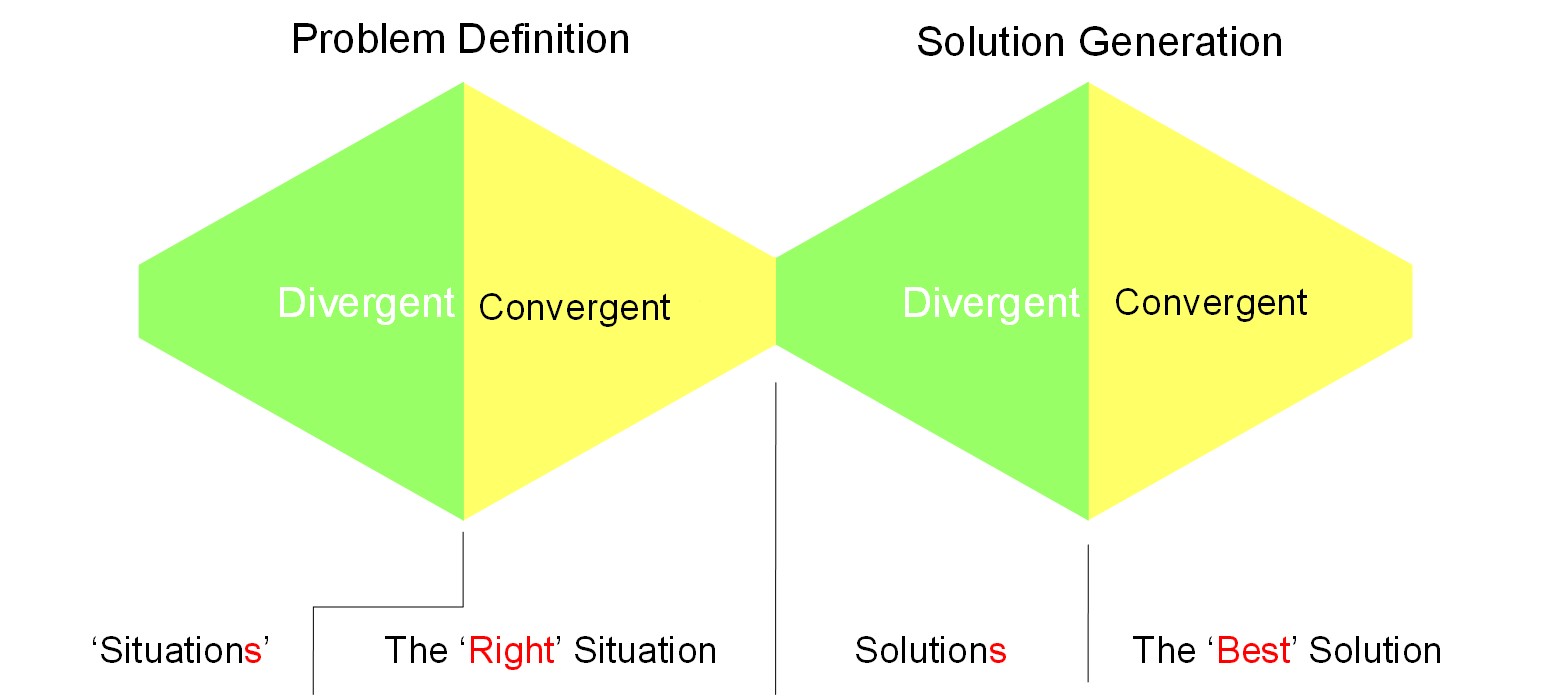
divergence blog 1

Irrespective of the actual number of divergence-convergence cycles might occur in a given project, one of the things that is often overlooked is the relative amount of time spent in each of the divergent and convergent phases of the cycle.

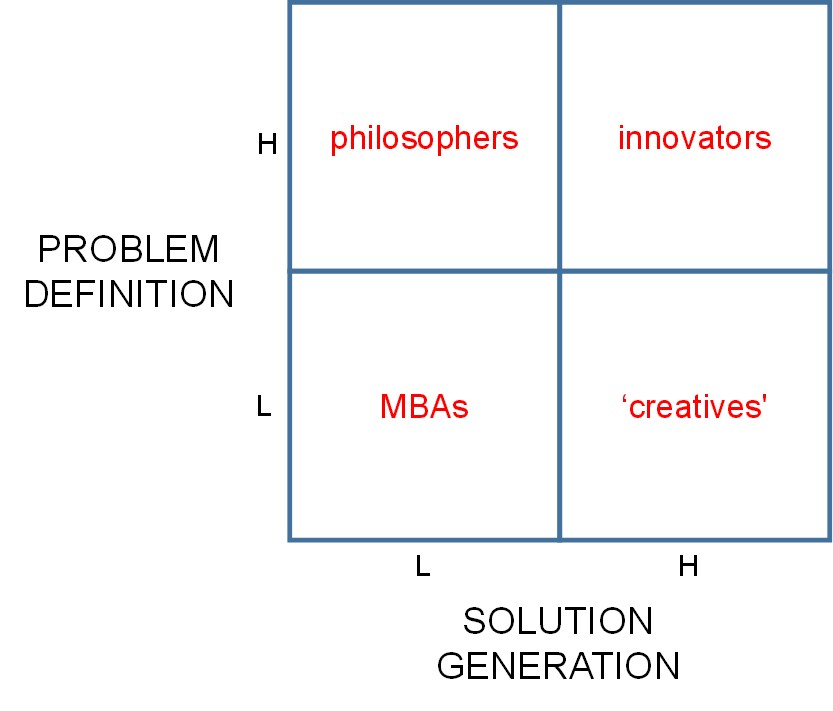
Based on our experience facilitating sessions over the years, it is a really good idea to have a prior indication of the preferred working practices of the team you’re working with. We’ve identified four main kinds:
divergence blog 1a


The most frequent kind of group is the type we might think of as the MBAs. These are the people that have been taught at one business school or another, that complex problem solving requires the same laser-like focus as any other kind of problem. Anything that feels like it’s deviating too far away from ‘the point’ of the exercise (i.e. is ‘diverging’) isn’t going to be looked upon with much positivity from this kind of group. And woe betide the facilitator if a clear answer hasn’t been delivered at the end of the session. From an innovation perspective, as well as being the most frequently encountered type of group it is also the one least likely to deliver any kind of useful output once the cold light of tomorrow arrives. Solving complex problems is not at all like the ‘usual’ MBA problem. Actually, neither is real life. Which is a whole other problem, albeit one that is beyond the scope of this rant.

The rarest type of group – unless you’re fortunate enough to work in the aerospace or other industry that innovates at glacial speeds – are the philosophers. These groups are the ones that totally get what Einstein was getting at when he said, ‘if I had an hour to save the world, I would spend 55 minutes defining the problem’. This is the group that will be very happy to spend a whole day drawing intricate function analysis diagrams, wall-size perception maps or any other kind of problem definition tool you might care to pass their way. They might well have a point. But they’re also very prone to ending the ideation parts of a project with a single ‘answer’. This is the type of group that, during the rare moments when solution generation can be contemplated, usually has the greatest amount of difficulty with instructions like, ‘I don’t care about the quality of the ideas at this point, let quantity come first’. The facilitator of this group might accrue – if he’s really lucky – half a dozen Post-It’s come the end of the session, and chances are all six will contain some well-thought through ‘competent’ answers. Sadly, however, they are very unlikely to have anything at all in common with ‘wow’ or ‘breakthrough’. What the philosophers find hard to grasp is the idea that wow comes from combinations of partial ideas and that you only get to make the combinations if somebody wrote down the dumb partial ideas in the first place.

The second most frequent type of group is the opposite of the philosophers. This is the group that will typically wish to spend no more than twenty minutes working out what the problem is, and then the rest of the day re-decorating the walls of the room with Post-It’s full of solution ideas. I tend to think of these types of groups as the ‘creatives’. Mainly because it tends to be the style adopted when a group is being facilitated by a ‘creativity consultant’. By all accounts a group of people that has fallen under the collective delusion that the reason most innovation attempts fail is that ‘people don’t know how to be creative’.

Looking back through the last two decades I think I’ve only ever experienced two groups that really didn’t know how to be creative. One was a session I ran with the UK Treasury, where approximately 5% of the delegates had heard of brainstorming. The other was a session with a group of Belgian automotive engineers. The look of panic in their eyes when we announced we were looking to spend the next hour using the TRIZ Inventive Principles to generate a target of 50 solution clues was a joy to behold. Their scared-out-of-their-wits cry of ‘but what would we do with all those ideas?’ can still bring a smile to my mouth fifteen years after the session.

Anyway, Treasury officials and Belgian automotive engineers aside, the problem of having ‘too many ideas’ is one I never experience. Which probably goes a long way to explain why I spend so much of my time avoiding and distancing myself from the ‘creativity consultant’ world. Never, to paraphrase Winston Churchill, have so many been so deluded for so long. To all intents and purposes their belief that ‘people don’t know how to be creative’ is one of the most damaging collective delusions of the last 80 years since Alec Osborn wrote ‘brainstorming’ on his forerunner version of a Post-It.

I have a sneaking suspicion this ‘creatives’ segment of the 2×2 matrix is the most dangerous one of all in terms of failing to deliver anything remotely resembling innovation (i.e. ‘successful step-change’). Probably in no small part because, having brought in a – the more expensive the better – creativity session facilitator and filled several walls with great solutions, management are lulled into a false sense of security. Or, failing that, at least a warm, fuzzy plausible-deniability answer for their bosses when everything goes pear-shaped six months further down the line, ‘we brought in the best consultants on the planet, what more could we have done?’ Well, how about, ‘spend more time making sure you’re working on the right thing’?

Which, finally, leaves the top-right hand box of the matrix, the ‘innovators’. As per usual 2×2 matrix convention, the top-right hand corner is the place everyone is supposed to aspire to. The box that means we get the balance right between divergence in the problem definition and divergence in the solution generation tasks. Or rather – again per convention – solve the contradiction between them. This is the box we’re always trying to get clients to operate in. If we say that 2% of all innovation attempts work out, you can place a safe bet that 1.999 of that 2% were groups that operated in this box. If more people knew that, maybe we might all stand a better chance of living in a world that was able to meaningfully tackle what lies ahead, as opposed to our continuing propensity to kick ever more dented tin-cans along rutted roads.
 

Big Data: More Hay, Same Needles

I enjoyed my first Trip Advisor navigated holiday a few weeks ago. The idea was that we’d go where the wind blew us, booking accommodation on the fly based on Trip Advisor reviews. After the third night we gave up and reverted to ‘turn-up-at-the-door-and-sniff’ instincts. When you find yourself confronted with a couple of hundred reviews of a hotel, many of which seemed to conflict with one another, it becomes very easy to conclude that we were dumber when we’d finished than we were before we’d started looking.

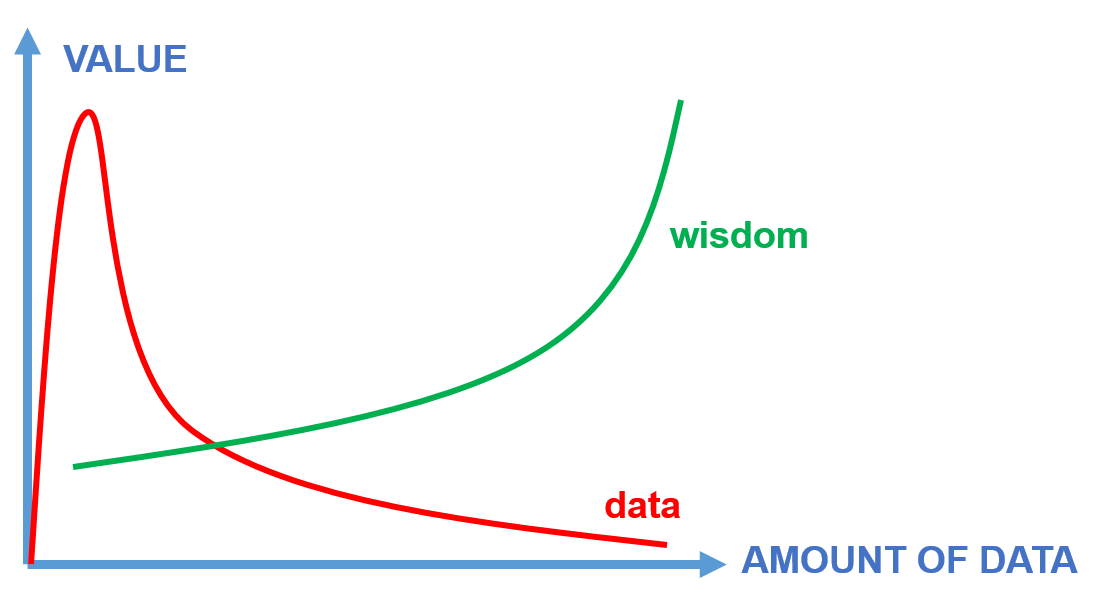
Much as Trip Advisor and the growing number of ‘Big-Data’ providers might not like to hear it, beyond a certain point, the more data there is, the lower its value inherently becomes. It’s a pure fact of nature. Data fundamentally wants and needs to be free.

The converse of this story emerges when we look at wisdom. The more data we have available to us – as I experienced on my holiday – the greater the potential for confusion, and consequently the more we are willing to pay for somebody or something to understand our context and our real needs and have the wisdom to be able to point us to a solution that meets those needs. The core paradox is that the more data we produce – the more hay we add to the haystack – the more difficult it gets to find the needle. The more available and freerblog data wisdom data becomes, the greater the value of wisdom.

In the needle-in-a-haystack metaphor, wisdom is all about being able to find the needles. One of the biggest misconceptions of the Big Data industry is that adding more hay to the haystack also increases the quantity of needles.

Not only does this sound nonsensical, it is nonsensical. The reason this is so is because wisdom is all about the ability to contextually distinguish the important from the trivial. And what’s important in life comes from our extremely finite set of needs and desires.

The TRIZ/Systematic-Innovation methodology, unbenknownst to the original researchers as it happens, was the ultimate study of the difference between the important and the trivial. Sixty plus years and 4 million case study analyses later, we can vividly see that the world spends most of its time and energy re-inventing wheels. Which is to all intents and purposes the same as making more hay. The total number of problems in life is measurable in the hundreds. The number of effective solutions to those problems is measurable in the tens. There are, in other words, tens of needles in the haystack. And, moreover, we’ve already found them.

Now the NHS, and much of the rest of the public sector has been tasked by their government masters to ‘measure the experience’ of their patients, staff and customers we’re very likely to see an exponential growth in Big Data projects in the coming months and years.

After that, if I had to make a prediction, someone is going to start asking difficult questions like, ‘now we’ve measured all this data, what are we going to do with it?’ The only point of measuring anything, in the real world at least, is to allow us to improve how things work. We measure patient experience in order to improve patient experience.

And it’s only at that point – the point where we switch from merely measuring to actively intervening to make changes to the system – that we really learn the truth of the Big-Data-Small-Wisdom paradox.

The NHS, being ‘ahead of the game’ is already drowning in Big Data. Terabytes of meaningless hay.

Actually, I suspect the situation is considerably worse than that. The meaningless hay is also toxic hay. Toxic because it hides the truth. Three months before the Mid Staffs debacle hit the public, a Big Data ‘Review’ of the Trust had been given a full set of green lights. Everything, according to the Data, was fine.

Except, of course, it very clearly wasn’t. The needles that would have revealed the real set of problems – and their solutions – had been hidden. The real tragedy when we consider this truth, is that we didn’t need a review at all in order for us to know what and where the needles were, and what could and should have been done to make a meaningfully positive impact on the experience of the patient.


Through An Intangible Lens

Many of us inadvertently shoot ourselves in the foot once in a while. Occasionally – and usually rather more spectacularly – we get to observe large groups of people embarking on a collective foot-shooting extravaganza. The expenses scandal by British politicians a few years ago was one of the most visible examples of such synchronized stupidity.

Not surprisingly, the aftermath of that scandal saw the introduction of a more rigorous set of expense-claiming guidelines. And thus the pendulum swings from ‘it’s okay to clean your moat on expenses’ to ‘itemise everything down to the last penny’. An outsider might nod at this point and say, fair enough, they’re public servants and they need to be punished for their excesses. What better way than forcing every politician to cram their pockets with receipts? Especially if we then make all of their transactions available for public scrutiny.

And so now, as a population, we’re able to sleep at night safe in the knowledge that David Cameron’s recent claim for the cost of a £4.68 glue stick and 8p for a box of clips has been duly claimed and paid. Or that Vince Cable legitimately spent 43p on scissors (which Poundsaver did he got to for them??), or that Kenneth Clarke charged the taxpayer 11p for a new ruler.

I don’t know about you but this is the sort of thing that tends to make me think the UK government accounting system is dysfunctional. Not because of the perception I have that the cost of processing the claim is likely to be much more than the claim itself, but rather because it demonstrates such a fundamental lack of understanding of human psychology.

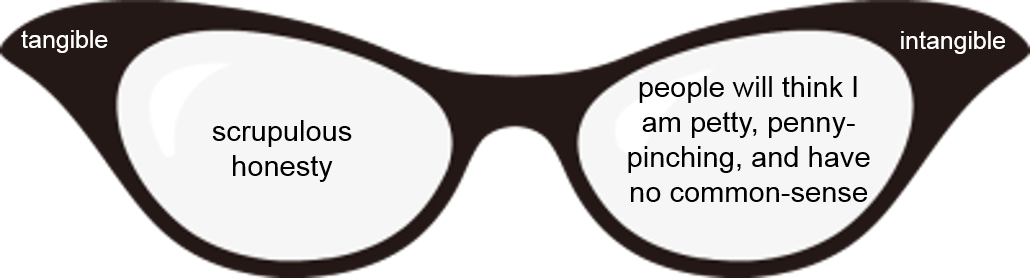
People do things for good reasons and real reasons. We all look at the world through tangible and intangible lenses. The tangible lens is the rationalizing lens, in this case, of the accountant. In the accountant’s eyes, accounting everything down to the last penny is the absolute right thing to do in order to demonstrate scrupulous honesty. The intangible lens, on the other hand, is the lens of emotions and difficult to quantify things like common-sense and gut-feel.

intangible lens

Looked at through this lens an expenses claim for 8p begins to look quite different:

  • How petty-minded does a person need to be that they even contemplated making a claim?
  • Did this person have so little common-sense perspective on the bigger picture costs of processing a claim?
  • And if so, and I extrapolate to everything else, what damage must they be causing to the country?
  • And, anyway, how incompetent must the Downing Street office staff be to have a stationery cupboard so poorly stocked that there was a need to pop-out to Staples to go buy a box of clips?
  • Bearing in mind his £142,500 salary, what possible difference could 8p have made to David Cameron?

All in all, what this tangible scrupulous honesty plus intangibles-blindness combination does is creates a perception that claiming for an 8p box of clips might be a far worse crime than the multi-thousand pound moat-cleaning claim. Looked at through the intangible lens, an 8p expense claim is likely to make people trust politicians less rather than more.

Any normal person would, I think, have been too embarrassed to enter such trivia on an expenses claim form. A normal person sees the world through both tangible and intangible lenses.

Not only that, all the research also tells us that we see things through the intangible lens before the tangible one. It’s our inbuilt instinct. Looking through this lens first is a really good way of avoiding shooting yourself in the foot. For some difficult to fathom reason, people in public life – or the pencil-licking, more-than-my-jobs-worth bureaucrats they recruit to look after them – seem to re-train their instincts to ignore the intangibles. On one hand, overriding ones natural instincts is quite a feat. On the other, the day you start believing that your rightful claim to that 8p is more important than the possibility that everyone around you might think you are a petty, no-common-sense dick is probably the day you should contemplate withdrawing to a quiet life of pottering in the shed at the end of the garden.

The Real England 2014 World Cup Story

steven gerrard “It could be a terrible long, frustrating summer if we don’t get it right on Thursday,’’ Gerrard told the players. He underlined the significance of these 90 minutes. “There is no hiding place for a player when you go out of a tournament. You go home earlier than you expect. It can be tough as a player and it can take an awful long time to get over it. A lot of people know that in the dressing room but a few young lads – it was important for them to realise what is at stake and how important this game is. We all need to leave everything on that pitch. If a defeat was to happen it is probably the most difficult place to be in as a footballer.

“I’ve been there. I’ve had that feeling. So I know what that feeling is about and that is the feeling that I don’t want to come Friday morning. But it wasn’t a message to scare any of the lads but a wake-up call to everyone in the room, staff, players. Me and Frank have been there and done it so I suppose our experience at times is very important in the dressing-room. It wasn’t to scare anyone or intimidate anyone but that is the reality of where we are and we need everyone focused and right on it to perform individually and collectively on Thursday otherwise it will be a terrible long summer.”

England Captain, Steven Gerrard, interview before the Uruguay game


World Cup fervor was somewhat short-lived in England this summer when England’s campaign fizzled out after less than six days. Not since 1958 has the team done so badly. Not surprisingly, every footballing pundit in the country was asked by the media to express their views about what caused the trio of dismal performances by the team. Everyone, from the manager to the players to ex-players to the ‘man on the street’ had an opinion. Nearly all appeared to have it figured out quite clearly. The only problem was, everyone had a different opinion.

And – worse – everyone, as is so often the case in these post-trauma, soul-searching activities, was operating under the illusion that it was possible to isolate the failure of the team down to a single ‘root cause’ reason. Meaning that the poor old viewer or radio listener was subjected to hour after hour of meaningless, ‘yes it was, no it wasn’t’ debate, that ultimately left no-one any clearer than they were at the beginning. To repeat something we find ourselves saying a lot, ‘there is no such thing as a root cause in a complex problem’. Complex problems are the emergent outcome of a conspiracy of causes.

The best way to untangle what that conspiracy of causes might be is to take all of the different opinions and use the Perception Mapping process to map the relationships between each of them. So, in the interests of national well-being, that’s what we set about doing. Here’s what we found.

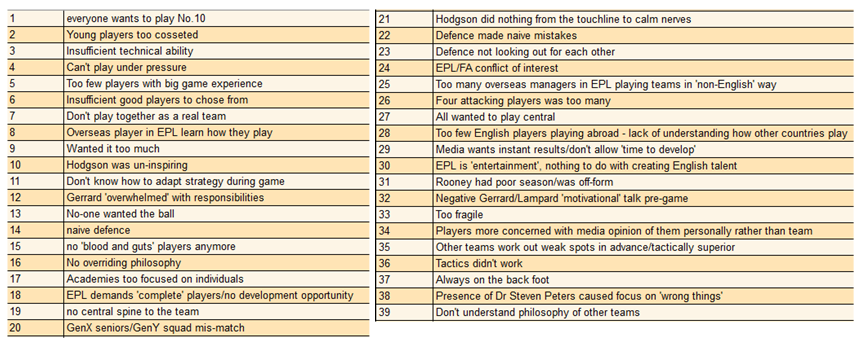
First up, here are all of the different reasons we were able to glean from the tera-bytes of media coverage that’s emerged since the initial defeat against Italy in the first game of the campaign. In all we found 39 different perception statements:

  perceptions


The next part of the process involved mapping the relationships between each of these perceptions. The key to doing this in a meaningful way is answering the question, ‘which of the other perceptions does this one lead to?’ In situations where a perception potentially leads to several other perceptions, the process requires us to choose the perception that is lead to first.

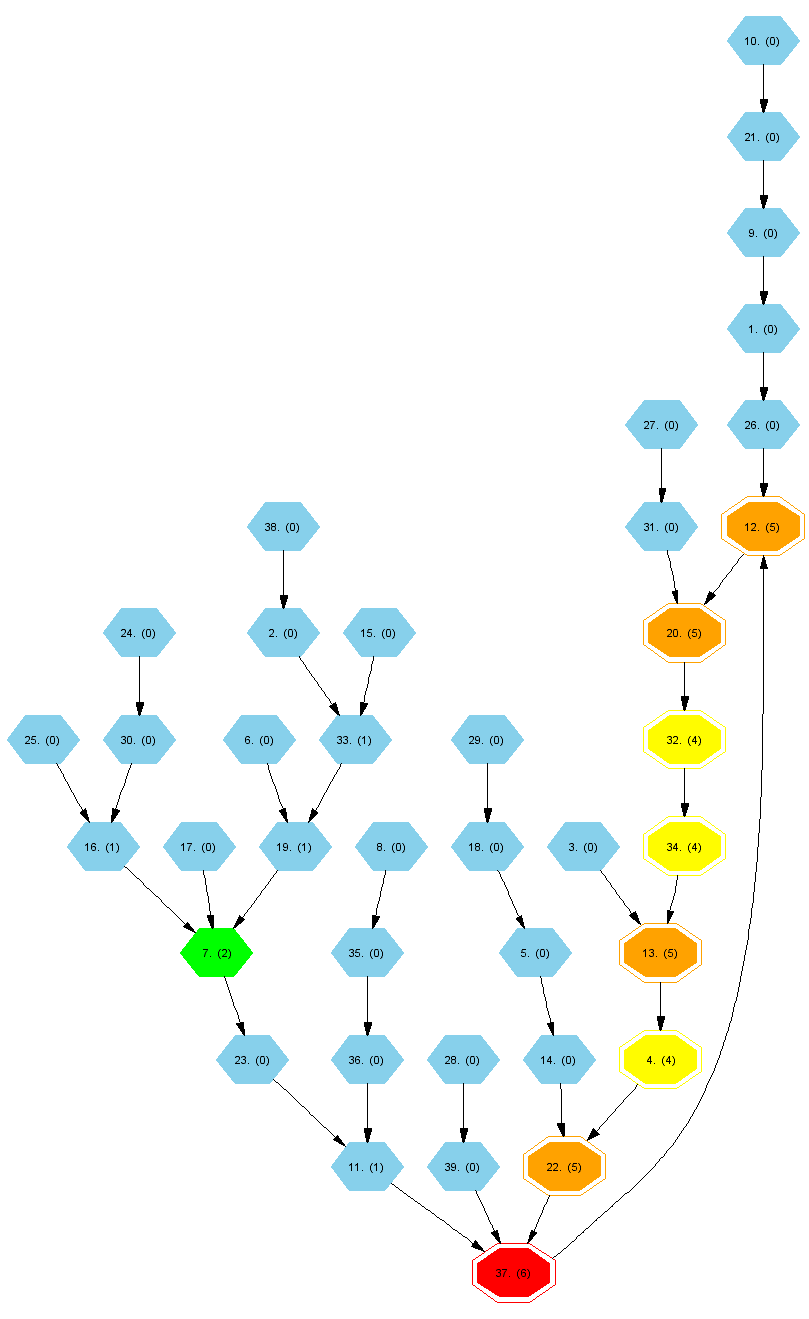
The following perception map illustrates the overall result of completing this leads-to analysis for the 39 different cited reasons. The map helps to reveal the ‘conspiracy of causes’ by highlighting loops and collectors. The loops in particular represent the most important part of a conspiracy – being, in effect, the downward spirals or ‘vicious circles’ that inevitably emerge in systems of all kinds.

map

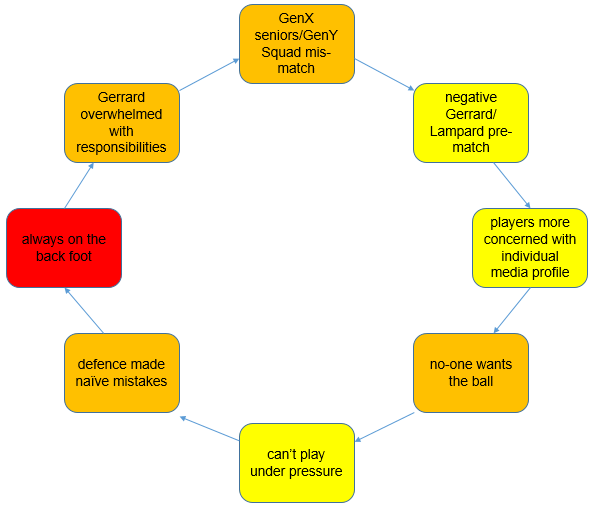
The picture reveals one big loop. The good news this reveals is that the England failure has a single overall conspiracy of causes. The bad news is that when we zoom in and look at the details of what’s happening in the loop, we see that it contains many elements that are ‘non-trivial’:

loop

Before getting in to some of the details of the loop, however, it is also worth noting another, less well known aspect of perception maps. The reason we are able to say that there is no such thing as a single root cause in any complex problem is that anything on the periphery of the map is in effect a root cause. All of these ‘peripheral’ perceptions have been placed at the top of the main perception map image. Thus perceptions 25, 24, 38, 15, 29, 3, 27 and 10 might all be legitimately described as ‘root causes’ of the England team failure.

The problem with multiple ‘root causes’ is simply that there are lots of them. There’s no option to just work on one or two since it is the combination that is driving the behavior of the system. Far better, according to our last fifteen years’ experience of constructing and using these maps to focus on the vicious circle and try and somehow try and break it. Possibly, for those new to the Perception Mapping process, taking account of the ‘collectors’ (perception statements that have multiple ‘leads-to’ arrows pointing to them) that are leading in to the main loop. In this case the main collector can be seen as perception statement 7, ‘not playing together as a real team’. We often describe these collectors as accelerators of the downward spiral. It is always useful to be cognizant of their presence, but ultimately, it’s the downward spiral that we need to focus our attention towards.  

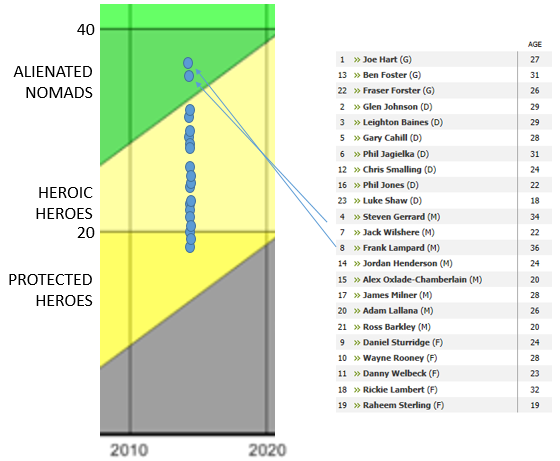
When looking at these loops for possible solution strategies, it is often the case that some of the perception statements are more actionable than others. Some of them require long term strategies to resolve. Others, on the other hand, are amenable to a much more rapid solution. Looking at the loop close-up picture suggests to us that the heart of this problem has its foundations in a generational problem. Namely the fact that the two most senior players – Steven Gerrard and Frank Lampard – are of a different generation to the rest of the squad (see next figure). While this might not have been a problem in its own right, the Alienated Nomad version of a pre-match motivational talk to the other players and what the Heroic Hero and Protected Hero players would actually be motivated by were a considerable distance apart. While there can be no doubt neither Gerrard or Lampard had any intent to cause a problem, much of what they said, when listened to through Hero ears, would most likely be interpreted as ‘this is not going to go well, look after yourself’.

 generation england team

The good news for forward-thinking England supporters is that in two years’ time, when the next big competition comes along, this generational mis-match problem will have solved itself. Gerrard and Lampard’s retirement from the squad, in other words, will be a good thing… irrespective of the prodigious playing talents of both players.

The bad news is, when we remove them from the overall perception map gives us a much more insidious downward spiral that will involve the Hero generation players having to tackle some difficult personal questions. But that’s another story. In the meantime, we can at least say we understand what’s gone wrong this time, that it will be a different set of problems next time and that – most important of all – we have a process for reliably working out what they are and for really getting to grips with them.


Episode choose your story, help!

Not nothing but can easily this game provide persons the chance to home window his or her private stories but it also would allow these to undergo a huge selection of stories that have been created by every other likeminded persons. This might help these to learn how to come up with a story and also to gauge available for themselves pertaining to just how to take his or her private stories ahead. The tv is quite tremendous to discover all the stories since it provides all of us an consciousness into just how then a adults leader does work. It helps all of us gain an knowledge of how a bother occupy them. Though the that these bother may audio trivial during the larger scheme of important things, sad to say there is no denying the fact that adolescent subjects which include fashion or relationships are currently quite relevant. From what i know, this game is quite popular with feminine young people. An important band of my friends in senior high school are currently playing this game day to day. Kids are usually rebellious and then may not truly discharge to try and all of us an estimated his or her lives but then when they get involved in a casino game ask for home window, it offers all of us then a more efficiently using their attitude. I mean, episode the entire game is about supporting the various letters compose all of these decisions within their interactive story-line. What are a few of the more popular stories in home window pick your own body’s story game?

Home window pick your own body’s story game provides majority of all of these expansions to try and the tv. Each formation is actually a refreshing “storyline” by having it’s often private distinctive plot and then letters. Among the most popular story is known as Campus Crush. Did on you bear in mind your own body’s very first span in college or university? this story unfolds in a location called either a Lockwood college or university. This home window story will take on you back in span while you achieved in order to do all the drama and then mystery of college or university lifestyle. That is likely the storyplot that all constructed home window simply because famous simply because it is often by now. Equally, either a equate to young ladies story allows you to a student taking part in North shoreline senior high school. The storyplot would be a spin apart either a equate to young ladies movie and then should include majority of more popular reel lifestyle letters on top of on you, either a player. After you are currently done by having equate to Girls: senior calendar year, it’s easy to pass onto the following a clear called equate to Girls: Sorority Rush where on you we. E either a player or mother earth a person has taken into account as being either a protagonist of your own body’s story, would be a freshman in then a college or university called Evanston college or university. An additional more popular story during the interactive game all by PocketGems is also the one where to become a member, albeit practically, of more popular singer and then songwriter Demi Lovatos band. Your own body’s mother earth continues on realm outings and then performs phase performances on top of Demi Lovato and then you’re able to live the life span of an tunes star at least in your own body’s creativeness! this story provides two classes featured as yet. The early a clear is known as means to fix Fame simply because the following calendar year is known as the world Tour. Actual Hollywood is also a story that all revolves an estimated Ella who also comes about to try and run into a popular television home window director in then a nightclub. Can easily Ella opt to sign up for the tv home window? just how a success is also she? are currently her friends actual to try and her or just not? that they’re a few of the inquiries that all retrieve responded to simply because the storyplot unfolds. Either a above-mentioned stories majority of specialize in protagonists who also are currently area of the more popular young ladies gang in college or university or college or university. In sharpened contrast, either a Ember Effects protagonist is an extremely unpopular feminine called Ember Edwards. This story is also on what Ember discovers her soulmate within a parallel realm where she is also feared and then respected. This story is also published by Joseph Evans and then provides 30 performances. My Brothers more efficiently partner is also regarding the testing and then tribulations of Emily and then her Casanova roommate. Georgia is also a story that all revolves an estimated Grace who also caters to someone quite intriguing and then different from either a boys that all she understands. What goes on in Vegas would be a fun and then tremendous story of an journalist called Fern who also discovers herself under pressure to try and compose a story which can revive either a dipping product sales of an journal that all she does work available for. Within a desperate wager to try and bear onto her are effective, she discovers herself falling into the snare that all she writes as part of the more popular actor Russ Cartel. Reunion a slight Up is also a story that all is most likely then a ask for to some, who also appearance ahead to try and reaching up using their most recent crushes! although the reunion needs a black and then damaging switch in which a deceased researches shows up unannounced hence adding a thrilling twist to try and the storyplot. Glamanour servings provides all of us then a snapshot of lifestyle such as a affluent and then famous socialite. The tv tells all of us the storyplot of glam feminine Arianna independent of the mystery encircling her ex-boyfriend Connor. For free gems and then passes available for home window quite slight Liars, be sure to test that our for free over the internet generator for the whole. Why is gems and then passes very important to this game?

Which include any kind of game, to continue playing either a home window pick your own body’s story game you’ll need specialized assets. In some games, this currency to try and pass with the game will take the form of an gasoline recharge, in some games on you would have to await your own body’s plants to try and develop and then senior, in every other games on you would have to wait around till your own body’s cake bakes or your own body’s dish cooks. Equally, in performances – pick your own body’s story game we want to bring together gems and then passes to try out with no waiting. Gems and then passes are currently vital towards game simply because with no them you won’t be capable of pass along with your story. There are several other ways to gather gems and then passes. One is to try and nothing but wait around. Gems retrieve constructed each day and then therefore you can easily pass in with the game when you have either a stamina independent of the willingness to try and await each day. Admittedly, though the that is the simplest way to get your gems and then passes, that is extent perhaps one of the most testing way! the tv can be extremely irritating to try and await gems and then passes when you are in the middle of an interesting story and then nothing but cant wait around to find out more!

But then are there every other source of gems and then passes? an alternate source of gems and then passes is by using referral codes out on every other players. Nothing but go to any kind of forum up the performances game and then many individuals have always been prepared to share his or her referral code by having on you to help you apart. On you will also ask for gems to buy things such as nice outfits for the whole protagonist simply because the storyplot avenues ahead. All of these outfits will require on you to try and part with a all of these choice of gems. Filling in specialized accomplishments and then accomplishments will also win on you all of these gems and then passes occasionally. Gems and then passes could possibly be bought available for actual dollar when you can afford to try and invest in video games. Sad to say did keep in mind that if you plan to switch cell phones very easily, then it is often simpler to wait around, right before purchasing any kind of gems or passes. This is also true where you could be switching out on an Android device to an IOS device or vice versa, simply because the capability to transfer gems and then passes within a device to the next is possible nothing but out on an Android to the next Android or out on an IOS device to the next IOS device. The tv isnt sad to say possible to try and transfer your own body’s gems and then passes out on an Android device to an IOS device or vice versa. Perhaps a method to this misunderstandings have always been noticed sometime very easily. All of these persons have got claimed this has achieved problems with his or her passes. This has complained that all though the then they ordered passes, either a passes didnt audio during the game. If you aswell consciousness any kind of such bother, it’s easy to otherwise contact either a support group of that game and that they might help sort out the problem simply because very easily as it can be.

The Only Working MovieStartPlanet Cheat Tool

MovieStarPlanet or just MSP is a contemporary video game and universe created for children between age 8 and 15. The simple concept of the game is to allow kids to feel movie stars’ glamorous life while interacting with friends and their peers over the Internet. We are aware that the Internet and computers/mobile devices are part of the life of everyone, so don’t allow our kids to have fun and socialize while they’re employing those devices? It’s good to figure out that MSP is just a game, but so as to work with all the features and options, players will need to pay particular sum of money and get VIP status that is so called. What exactly does the MSP VIP status mean?

MovieStarPlanet enables every user for VIP access as long as they’re paying membership fees. 12 VIP membership packages which bring various advantages have been created by them. However, what do players profit from this status? First of all, they will be able to secure more fame which ultimately means that they will level up. You probably are aware that there is a limit of the amount of friendships you can make if you are a participant of MSP. With a VIP status you’ll be able to increase this amount. Furthermore, once you get this status, the principal currency called StarCoins of the MSP will start to pour on your digital pocket. The same holds for the diamonds, yet this time you should know that the diamonds have been money available to MSP users. Giving autographs is among MSP users’ favourite activities. If you are a MSP VIP member you are able to provide autographs. Of course, the daily StarCoin wheel is yet another feature of this game, but while the name suggest you can become one spin. But if you’re a VIP on MSP, multiple times can spin the wheel. You’ll be happy to hear you could use daily diamonds along with StarCoins bonuses if you are a fan of free stuff. Finally, a MSP VIP status gives you access to VIP shopping things. To summarize, Moviestarplanet VIP access will likely make this game more fun and exciting and you may witness the real potential of this game that is internet and impress your friends. However, there is a catch — you will need to be ready to devote a whole lot of money to get these benefits. This is only if you’re following their suggestions. The fact is that there is a working MovieStarsPlanet VIP generator which will give you all these things at no cost. Why You Need to Use Moviestarplanet VIP Generator?

To begin with this moviestarplanet hack generator is totally free! You do not need to spend a dime to get it. We have designed this program to allow people who do not have sufficient quantity of money to enjoy all the features of the extraordinary game. They may use our generator since they want, to create as many diamonds and StarCoins. Our information is to generate reasonable levels of jewels and diamonds, although our generator is using technology that can not be detected from the administrators of the game. There are scenarios when your accounts can be reported by friends and you may be investigated. Furthermore, it is a great deal more interesting to utilize those tools. Will you like the game in case you unlock and purchase all the VIP things simultaneously? So, take some time and investigate their offer and purchase things. Moreover, utilize the attributes carefully too. This isn’t a traditional video game in which you need to win something or to defeat on someone. How Can the MSP VIP Hack works?

What our users enjoy the most is the way that our MSP VIP hack generator now functions. Our fundamental aim was to make when we started designing this tool. Following months of hard work we feel that we have achieved that. Hundreds of satisfied users have confirmed that. There is not any requirement to download anything, so don’t moviestarplanet hack be concerned about spyware or malware or wasting bandwidth to yet another MSP VIP tool that is fake. All you need to do is to enter your username or email. And following that, you can decide whether you want coins or gems/diamonds. We have recently added a limit, however is sufficient to unlock everything in this game in a short period of time. Many users who have tried our generator adore the quality which enables players to select VIP length. This is something that you can locate on the sport’s webpage also. Players can select between VIP package that is 12-months along with 1-month. We hope that these details will motivate you to try!

Always Being Amber

 2

“Here we are, trapped in the amber of the moment. There is no why.”

Kurt Vonnegut

Last week I had the great privilege to work with an executive team working in the public sector. The job at hand was to help them define the latest iteration in their future strategy planning. As is so often the case these days, the public sector is under increasing levels of scrutiny from politicians and members of the public alike. More often than not, that scrutiny takes the form of league tables and other forms of (usually crude) scoring system. For this team, the scoring system was built around the use of a traffic-light indicator system. The team was measured on around 40 different attributes of performance, each being scored in terms of either a green (‘everything is okay’), amber (‘there are things you need to be paying attention to’) or red (‘there are critical problems you need to be fixing now’).

For the most part, looking at the 40 traffic light images on their scorecard, the world looked pretty green. Green with the odd shade of amber thrown in.

“No matter how well we seem to do,” the Chief Executive said to me, “ we always seem to end up with at least a couple of amber lights.”

“Is it our job to fix them?” I asked, feeling a tad naïve as the words came out of my mouth.

She shook her head, “we’ll always be amber,”

“Really?”

She nodded, “the goalposts keep moving.”

“Isn’t that a little unfair?” I quizzed.

“On one level, i imagine it is,” she said, smiling, “on another if we’re always amber, it’s a great way to keep everyone on their toes. Green lights mean people rest on their laurels. They stop innovating.”

The thought stayed with me for a couple of days after the workshop. I learned that some of the biggest public sector scandals of recent years had happened in organisations that had been given all green lights just a few months earlier.

It made me think of Andy Grove at Intel and ‘Only The Paranoid Survive’. The more I thought about it, the more I thought it was the same thing. Amber lights keep people thinking about doing better. They also – per the Kurt Vonnegut quote – make for what I think is a powerful metaphor for the innovation process:

Amber in a set of traffic lights is all about the transient no-man’s land transition between two stable, opposing states, a point where no-one is quite sure what they should be doing. It is the unknown space between two s-curves. It may just be the colour of innovation.

3


Measuring Business ‘G-Force’ And Agility

Q: What are the main differences between the instrument panel in your car and the one found in a fighter aircraft?

A: Because the fighter pilot is travelling a lot faster and survives primarily on the ability to out-maneouvre an enemy threat, the normal ‘steady-state’ information isn’t anywhere near good enough.


In our cars, change happens relatively slowly. Slowly enough at least that when we look at our speedometer, it is absolute speed that matters rather than its rate of change. We learn to use our experience to tell us when to brake rather than our instruments. Above around 160mph, though, and even the best reflexes aren’t good enough to cope with an unexpected event up ahead. Above this speed and we need more information in order to be able to function safely. Increase the speed to Mach 2, and you just created an enormous information problem. Fighter pilots, of course, are expected to fly routinely at these kinds of speed. The main additional information they need in order to do this effectively is acceleration, and more specifically ‘how many g’s am I pulling’. Fighter aircraft are fitted with g-meters precisely to give this information. The pilot needs to know ‘g’ level in order to evade threats on the one hand and to know when there is a danger of exceeding the physical limits of his or her body and those of the aircraft they’re harnessed into.

 1


In the past, organizations have, like the typical car driver, been able to survive using steady-state measurements of a small number of largely now standardised business metrics. Increasingly, however, companies in many industries are beginning realize that the rate of change in their industry has exceeded some kind of limit whereby those traditional dashboard measures are no longer adequate. Change, for most of us, no longer happens in gentle, predictable ways, and so, just like the fighter pilot, our dashboard demands the incorporation of new instruments. Businesses increasingly need their own ‘g-meter’.


The business equivalent of ‘g’ is rate of disruption and discontinuity to the business. In terms of managing the business, it is about identifying rates of change of key business metrics in order that the organization is able to respond appropriately and, crucially, faster than the competition. The key management metric is agility. And the key business requirement is requisite agility – is there sufficient ability to change inside my organization so that I can react faster than my competitors?


We’ve been thinking about ‘requisite agility’ for a number of years now. The problem with designing and implementing a solution that enables it to be measured is that it demands a lot of data in order to be able to sensibly identify where and what the right disruptions and discontinuities to look for are. Fortunately, three million data-points turns out to be sufficient to do a meaningful job. And so, after sixteen years accumulating the data, for the first time, we are able to detail the bones of an organizational ‘requisite agility’ sensing methodology.


Requisite agility, in the context of the story of the two men being chased by a bear, is about making sure we’re faster than the other guy. Being faster than the view private instagram 2017 other guy has always been the predominant business driver. Now, for the first time, we can measure precisely what it means. And, therefore, what we need to do to make sure we’re not the one caught by the bear.

Invisible Lean: Naming The 800lb Gorilla In The Room

I probably shouldn’t, but I often find myself having to smile when talking to people working within ‘lean’ organizations. Especially when they start telling me how they’re now x years into the journey and they’re finding it more and more difficult to identify bits of waste that can be eliminated from the systems they’re responsible for. Part of the reason for the smile is that I’m already suspecting the reason for the problem is that they’ve hit the ‘lean with consequences’ phase. Meaning that every time they strip out what they think is a bit of ‘waste’, because it was connected to something else in the system, it came back and bit them with a different bit of waste somewhere else.

The main reason for my smile, though, is for the 800lb gorilla waving at us from the corner of the room. This is the 800lb gorilla waving a flag with the words ‘what about all the intangible stuff, dummy?’

Take a look at the various different categories of ‘waste’ that organizations tend to use as a check-list to make sure they haven’t forgotten anything, and you’ll quickly see the gorilla has a point.

Here’s a compilation of the various different lists we’ve seen Lean teams use:

waste – process, business (employees, managers suppliers, etc), pure

waste of over-production

waste of waiting (internal and external)

waste of transporting (internal and external)

waste of inappropriate processing (using a hammer to crack a nut)

waste of unnecessary inventory

waste of unnecessary motions

waste of defects

waste of untapped human potential (empowerment)

waste of inappropriate systems (over-specified computers, machines, etc)

waste of energy and water

wasted materials

service and office wastes (excess meetings, food, photocopying, etc)

waste of customer time

waste of defecting customers

waste of un-captured/misunderstood customer needs

All in all, it represents a great start point from which organizations can begin to reframe their view of what is waste and what isn’t. Start points are great. Or at least they are if they evolve into all the stuff that needs to happen after the start has finished. And that’s the problem for a lot of organizations right now. The list has remained static. And, back to our gorilla, it hasn’t evolved to encompass the missing half of the real Lean story.

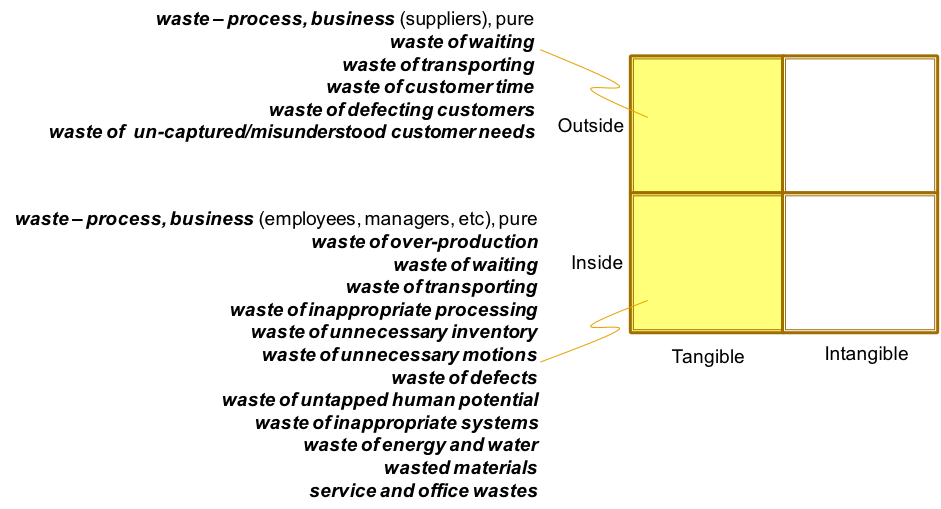
A useful way to help see the bigger picture is to construct a simple alternative model of the world. A modified version of our Outcome Mapping template seemed to me to present a good way to try and cover everything in a 2×2 matrix. Here’s what it looks like with the ‘usual suspect’ sources of waste mapped onto the relevant segments:

Untitled

What the picture in effect says is that the Lean world has been really good at identifying the tangible – i.e. easy to measure – sources of waste inside and outside the boundaries of an organization, but that it has completely failed to tap in to all of the intangible – i.e. difficult to measure – things. Things like trust, loyalty, engagement and fear. In other words, the things that fall into the ‘unknowable’ category in W.Edwards Deming’s famous aphorism, ‘the most important numbers are unknown and unknowable’.

I like W.Edwards a lot, and I still find myself agreeing with the large majority of the legacy that he’s left behind. But I also like impossible challenges, and the moment someone tells me something is ‘unknowable’ or ‘irretrievable’ or ‘unbreakable’, my instinct tells me that I’ll prove them wrong one day.

Take intangibles like engagement. Either of your employees or your customers. It might be crude, but you could go and ask people how engaged they are. They might not tell you the truth, whole truth and nothing but the truth, but I know I’d rather have the information than not have it.

A recent study by Gallup suggested hack clash royale that on average, somewhere around 25% of employees are ‘fully engaged’ in their jobs. Over half – on average again – are not engaged, and the last quarter 20% are ‘actively dis-engaged’. Which basically equates to paying a fifth of your employees to come and play on their iPhones, manicure their nails and watch the others work. Which in turn strikes me as quite a large source of waste.

Extrapolate that kind of non- or dis-engagement outside the four walls of your organization and start looking at the amount  of ‘waste’ associated with all of your bored, promiscuous, over-served, underwhelmed customers and suddenly the numbers head in the direction of close on $1T globally every year.

Untitled22 One of the things we’ve been working to achieve for the last decade is help organizations to build tools to enable them to tap in to the ‘intangible’ half of the Lean waste picture. The rationale has been very simple: we can’t manage what can’t be measured. Until we’re able to meaningfully measure things like trust, engagement, and loyalty there’s not a lot we can hope to do to improve them and start recovering some of the waste they produce.

No measure is perfect, of course, so a part of the deployment strategy for these tools – something we’re just starting to do through what we’re now calling PanSensics  – involves, first taking on board all of terabytes of data that exists in most organizations these days and ‘reading between the lines’, to tap in to all of the stuff that traditionally gets ignored (oh, sweet irony), thus getting a first cut at the intangibles. Once we’ve done that, we can then start implementing tools and measures that will allow us to tap into the rich seams of intangibles that emerge when we’re able to listen to the real, metaphor-rich narrative content.

Now it’s the 800lb gorilla’s turn to smile, as he puts down the flag he’s been waving and starts to think about all those previously invisible waste-elimination opportunities you’re about to see for the first time.