Who Moved My TRIZ?

rat keyhole

Once upon a time there was a land where everyone kept losing their keys. That’s everyone as in everyone. People lost their keys all the time. No matter what they did to try and make sure they didn’t lose them. Tie them on a chain around their necks, leave them in a safe space under the doormat, or put them in a safety deposit box at the bank. Nothing worked.

Now, one would have expected when society has a problem like this, necessity being the mother of invention and all, surely someone would have found a solution. Like inventing locks that don’t need keys for example. But the truth is, no-one could remember a time when keys didn’t get lost, and so the whole situation was viewed as normal. That plus the fact that the locksmiths of the land kind of liked things the way they were. And had created themselves a quite envious position at the top of society. Everyone knew it was a good idea to have a locksmith as a friend. Otherwise, next time you lost your front door key, you might find yourself having to stay in a hotel for a couple of nights until one would deem to turn up to replace your locks and give you a new key.

This was just how things were in the land of Emba. Whenever they lost their latest key, people just shrugged their shoulders, sent a message to their locksmith to the effect that, unfortunately, they’d done it again, and then waited for him to turn up and put things right again.

Most of the houses in Emba were built around the foot of a big mountain. Actually it was an enormous mountain. So high that no-one had been to the summit. So high that it always disappeared into the clouds. Even when the sun shone and the skies were blue, still the mountain seemed to disappear upwards into the unknown. Generally speaking, Emba was quite a hierarchical place. The higher up the hierarchy you were – like the locksmiths – the higher up the side of the mountain you tended to live. Were a visitor to arrive in Emba and were he to decide to climb one of the roads up the side of the mountain, the thing he’d notice before anything else was how the houses became grander and grander the higher he climbed. The locksmiths’ houses being the biggest and highest. Unless you count the professors who taught at the locksmith college. Their houses were highest and biggest of all. Every parent in Emba hoped their child would pass the locksmith entrance exam. Every parent knew it probably wasn’t going to happen. The only children who seemed to get a place at the locksmith college were the offspring of locksmiths. Again, this was just the way it seemed to be. No-one complained about it. Everyone just got on with whatever they were supposed to get on with. It was the way it was, it was the way it had always been.

This was the Emba that Oleg and Irwin arrived at one dull, lifeless day. The day after a big storm. The two of them hadn’t known each other for very long, but had already realised that rats stand a better chance of surviving if they travel together. Safety in numbers. Even if the number in this case was two. As in most parts of the world, rats were viewed as, how can we put this politely, vermin. People, when confronted by a rat, were more likely to scream or fetch a broom than they were to bend down and stroke between his ears and call him cute. Oleg and Irwin were used to this now. Again, it was just the way things were.

Oleg had been born in the faraway land of Russia. Russia was a whole other mountain to Emba. Oleg was extremely proud of being a Russian rat and, given half a chance, would invariably declare where he came from. No-one ever needed to ask Oleg where he was from. He’d already told you. That plus his Russian accent tended to give the game away right from the get go.

Irwin used to calmly raise his eyes to the sky whenever Oleg was doing his I’m-from-Russia-you-know thing. He’d got used to it by now, but Irwin definitely wasn’t Russian and he didn’t understand why coming from Russia was such a great thing to be proud of. Irwin didn’t actually know where he’d been born. His parents had been pretty much nomadic, and in any event had disappeared fairly soon after they’d seen Irwin fending for himself the first time. Irwin had pretty quickly learned what needed to be done in order to survive. In general it meant doing stuff that other people didn’t want to do. Like scratching around waste-dumps when there was no money or food to be had.

As it happens, it was at one such dump, on the far outskirts of Emba that Irwin and Oleg had met. Oleg, too, had learned that needs must. When you were hungry and in a strange land and looked like a rat, you did whatever needed to be done to get by. And if that meant rooting through other people’s trash that’s what he’d do. Even though he knew one day he would make his way in life and never have to do it again. The first thing Irwin noticed about Oleg was he was from Russia. The second thing was he knew where he was going. And that was to the top, where any self-respecting Russian rat deserved to be.

After they first bumped in to each other at the dump, they nodded politely to each other and went their separate ways. But then, after they met again a second and then a third time at the same sustenance-rich pile of garbage, they decided they might as well stick together.

One day, around the second week of their combined trash-hunt, Oleg noticed a shiny object sticking out of a pile of discarded papers. After he’d spent a few minutes freeing it, Irwin noticed that, unlike other finds the two of them had made, Oleg surreptitiously stuck the shiny object in his pocket and then went calmly back to sniffing out dinner. Like most things in life, Irwin shrugged it off.

That afternoon, Oleg disappeared for a couple of hours, only returning so the two rats could enjoy the sunset together as had become their end of day custom. This day, after the pinks and oranges and reds had bowed away to night, the sky was filled with a big bright full moon. Life didn’t get much better than this if you were a rat. Oleg smiled at Irwin, and Irwin smiled back at Oleg.

In the morning, Irwin found himself alone. No sign of Oleg anywhere. All of his things were gone. Irwin shrugged his little rat shoulders and set about finding breakfast. When you’re hungry, you’re hungry. And that’s all there is to say on that subject. Especially when it takes the whole day to still not quite fill your stomach. It wasn’t until he settled down to watch the sunset by himself that he had a chance to wonder again what might have happened to his Russian friend.

After a week of wondering, he found himself wondering what he was wondering about. Maybe Oleg had been a figment of his imagination? Or maybe he’d decided to go back to his beloved Russia?

In the end it was some days after the next full moon when the days had begun to shorten and the weather started to turn chilly before Irwin finally found out what had happened to Oleg. He was rifling through a newly tipped load of old newspapers on the hunt for bedding material when he suddenly found himself staring at a photograph of Oleg. Admittedly it was only on page 17 of the newspaper, but nevertheless, there was Oleg smiling at the camera.

‘Oleg’s Magic Key?’ read the headline. Apparently it was a miracle. Oleg had discovered a key that could open any lock. Mrs Samson, 47, of Lower Emba had been locked out of her house, the locksmith couldn’t come and along came Oleg to the rescue. ‘He just waved the key in front of the lock’, said a clearly amazed Mrs Samson, ‘and there it was open. It’s the most amazing thing I’ve ever seen’. Irwin read further through the article. Oleg was trying very hard to be modest. ‘It was nothing,’ he said, ‘I saw this problem back in my home country of Russia a few years ago, and merely used what I learned then to open the door.’ When the reporter pushed further, all Oleg would say was that he just liked helping out when he was needed. When asked if he could see the magic key, Oleg merely shook his head and said that it was a very delicate matter and that he didn’t want to reveal what the key looked like lest it fell into the wrong hands.

‘Magic key?’ thought Irwin, how strange that Oleg had never mentioned it before. Then he remembered the shiny object and had another thought. And off he scuttled back to the place where he thought the two rats had been when Oleg found it. Maybe what he’d picked up and hidden in his pocket was a magic key?

If it was, there was certainly no evidence of any more shiny magic keys in the vicinity. After two hours of scrabbling the closest he’d come to a magic key was a rusty paperclip. It didn’t look like it would open too many doors.

The next day, Irwin resolved to spend all of the time he wasn’t looking for food or sunsets, continuing the search for another magic key. By the time the pinks and reds had turned to night, all he had to show this time was one very rusty half of a key. It was another two days before he found an actual whole key. But even this one was too rusty to be of any use to anyone.

Irwin was close to giving up. Maybe, he thought, what makes magic keys magic is that there is only one of them, and that Oleg had just been in the right place at the right time.

Or maybe not. A couple of weeks later, when the weather was even colder, Irwin found himself back at the place where yesterday’s newspapers got dumped. This time there was no photograph of Oleg to be found. Just a headline about how the locksmiths were up in arms because the demand for their services seemed to be on the decline. ‘Locksmith prices tumble’ read the headline.

Irwin resolved to keep an eye on the story, and decided to spend less of his time looking for magic keys and more time reading up about the price of locksmiths.

By the time the first snows arrived, Irwin had amassed a grand total of four and a half rusty keys and three more newspaper articles. The oldest of these articles mentioned Oleg again, and how the locksmiths had accused him of being a fraud. The middle one talked about a surge in burglaries. And the most recent was another interview with a locksmith who’d put two and two together to make five and was accusing Oleg of not only being a fraud, but also somehow who preyed on the weak and vulnerable.

This didn’t sound like the Oleg that Irwin had known. It was very unfair. Irwin decided he should head into the town and see what was going on.


Irwin Goes To Town

The following morning he roused himself early, packed an overnight bag and headed out of the waste dump for the first time since he’d arrived over two months ago. As he looked back, he felt sad. Sad as if he was leaving home.

It took the best part of the whole day before Irwin reached the first signs of civilisation, a jumbled street of shops. Outside one of the shops he saw another newspaper headline, ‘I’ll pass any test’ says Oleg the Great.’ Irwin sneaked a peak at the rest of the story. There was going to be a demonstration the following day. Oleg would demonstrate how the Magic Key would only work if someone was locked out of their house. It was Oleg’s way of demonstrating that the burglaries were nothing to do with him.

Irwin resolved to go and watch the demonstration. Not so much to see the demonstration, but he thought it would be nice to catch up with his old friend again.

The town square where the demonstration was due to take place was packed with onlookers. Irwin could see Oleg up on his recently installed platform, but when he waved, it was clear Oleg couldn’t see him. No doubt he was concentrating on his demonstration. Open the lock where the owner had lost their key; fail to open the lock where he had not been given permission. The demonstration had been very carefully set up, and the MC went to great lengths to let the throng know that Oleg didn’t know which lock was which.

Needless to say, the whole thing worked like a charm. The lock that was supposed to open opened and the lock that was supposed to stay locked stayed locked. The crowd shouted and cheered, and Oleg beamed as he looked out at the crowd. He bowed deeply, raising what looked like a new top hat. Irwin couldn’t help but clap and cheer along with everyone else. It was nice to watch one of his friends do well. Irwin smiled as he left the square and headed back to the dump. All was well in the world. The search for another magic key would begin again tomorrow.


Oleg Thinks About His Business

Oleg, meanwhile, smiled down at everyone from the platform. It was good to know that everything had gone to plan. He knew he’d made many enemies amongst the locksmith community despite his attempts to show them he wasn’t a threat. As an outsider, he’d known he would have to move carefully. That’s why he’d deliberately sought to help only those people the locksmiths hadn’t helped or were too slow to help. In Oleg’s eyes, he was doing them a favour. They kept all of their most profitable customers, while he made a pretty good living from all the lost key customers who were mainly just seen as a nuisance. The people at the bottom of the Emba mountain.

But Oleg also knew that sooner or later he’d have to sort out some kind of arrangement with the locksmiths. If only because there was only one of him and only one Magic Key. If Oleg wanted to grow his little business he’d either have to start working with others, or start moving up the mountain to the locked-out customers with more money. Neither seemed ideal. The former because, who could he trust? The latter because the higher up the mountain he went, the more likely it would be that the locksmiths would have to do something to stop him.

But there was another problem too. One bigger than both the other two. The Magic Key didn’t work in every lock. Fortunately for Oleg, only he knew this. He’d been able to find out in secret which sorts of lock he could open and which ones he couldn’t and therefore only endeavoured to help those customers he knew he’d be able to help. Even more fortunately, these customers were the ones lower down the mountain.

Oleg stood in front of the mirror in his new house, took the Magic Key out of his pocket and stared at it. Then looked at his reflection. Then back at the Key. He felt proud of how he had advanced so quickly in Emba, how he had worked hard to get here, and how he knew he deserved more. A plan began to form in his mind. Maybe the Magic Key really was magic. Maybe it was able to open other kinds of lock.

In the morning, Oleg awoke bright and early. Today was the day he would begin selling Magic Keys. Just a few. To just the right people. For just the right amount of money. He sent a small advertisement to the classified section of the local newspaper: ‘Oleg is looking for apprentices’.

Within a couple of days he had more replies than he knew what to do with. Everyone in Emba, it seemed, was interested in owning a Magic Key. Including, Oleg noted with no small amount of glee, one or two locksmiths. He made up a short list of likely candidates and set about preparing his first Magic Key training programmes.

Magic Keys was the easy part, he wrote in the course notes, the real skill comes with how you use the Key. There’s a knack. And to teach you this knack, you will have to enrol for at least three months. And you will have to do exactly as I say. That will be Rule One. Follow the recipe. Do not deviate. Do not try and reverse engineer Magic Key Technology.

When he arrived at his first class, the room was full of willing apprentices, ready to subscribe to Oleg’s every word. They wrote down everything he said. And were even patient when he refused to let them practice with the replica Magic Keys he only occasionally allowed them to touch. ‘Until you know the knack,’ he scolded them, ‘you will do more harm than good. Nobody wants a lock with a broken key stuck in it do they’. His students nodded understandingly.

Finally, the three month programme was coming to an end. Oleg had realised he didn’t need to go and help people solve their lost key problems anymore. Far easier to have a crowd of advocates clinging to your every word. Even though many of them were being made up on the spot. Or contradicted what he’d told the students earlier in the programme. Not that any of the students noticed. He’d worked that trick out very early on in the programme. Step one of the Knack, he told them, is don’t think, rely on the Knack. If the Knack doesn’t work, it’s because you’re too busy thinking instead of focusing on the Knack. If he said so himself, this was the most brilliant part of the training programme.

Or at least it was up until the first student cohort arrived at their Magic Key Master Graduation Ceremony. After today, they would be sent out in to the big wide world with their own Magic Keys. Oleg felt an uneasy feeling in his stomach at the prospect.

Sure enough, not long after graduation, he started to receive communications from the loudest of his former students. ‘It doesn’t work,’ the graduate student shouted at him, ‘the lock didn’t budge’. Oleg promised to come along and work out what was happening. You probably over-thought the situation, he said. But when he went to the lock the following day, in his heart of hearts, the moment Oleg first saw what type of lock it was, he knew he was in trouble. This was one of the locks he’d failed to open during one of his early covert experiments. Now his former student was going to see Oleg failing too. Oleg took the Magic Key out of his breast pocket and looked at it. His reflection seemed to wink back. He nodded sagely, ‘this lock,’ he said calmly to the former student, ‘requires Advanced Knackery.’ The student looked crestfallen. He had already invested a lot of money he didn’t have and this sounded like he was about to be asked for more. ‘Don’t worry,’ said Oleg, ‘Advanced Knackery classes are not expensive. I will show you how to open this stubborn lock tomorrow. We will meet at noon.’ And with that, he tipped his latest new top hat, and bade the former student adieu.

The following day Oleg failed to show. The former student waited for a couple of hours, then headed to Oleg’s home to see what had gone wrong. Maybe he had misunderstood the instruction? Maybe he had misheard the timing? He knocked on Oleg’s door. Nothing. He knocked again. And then again. Finally an old man appeared. It was Oleg’s butler. ‘I’m sorry,’ the butler said, ‘Oleg had to attend an emergency lost-key situation of a very important customer. I’m sure he will come and meet you tomorrow.’ The former student nodded. He understood the situation, and offered his apologies to the butler.

But then, sadly, Oleg didn’t show the next day. Or the day after that. On the fourth day, the former student didn’t turn up either. By now the locksmiths had come and fitted a new lock and the customer was no longer interested in Magic Keys.

The former student would have forgotten about the incident, but when he accidently bumped into one of his fellow Magic Key Master Graduates in a café one afternoon a few weeks later the incident came back to him. The other former student nodded. The same happened to me he said. And Mr Procter. And Mr Lever. The two students looked at each other. Something was beginning to smell fishy. They decided to phone the newspaper.

The following morning, when Oleg’s butler opened the curtains in Oleg’s bedroom, there was a flurry of flashing cameras. The butler handed Oleg his usual newspaper. When he saw the headline, he knew he didn’t need to read any further. Emba had turned against him. The Magic Key was one great big fraud.

Even though it’s not, sighed Oleg to no-one in particular. It’s not the Magic Key that’s the problem, it’s the occasional un-magic lock. Nevertheless, as the flashbulbs continued to light up the sky outside his window, Oleg knew he needed another plan. Or possibly two. One to tr to work out what Advanced Knackery might actually mean. The other trying to find a new audience. Either one where the people were desperate enough to try anything, or, hmm, one where the people in charge of the people needed something to help them stay in charge: maybe a Magic Key would give people hope when in reality there was none? It was a thought. I need to let that one percolate, Oleg nodded to himself, as he went over to his wardrobe and started packing a few bags.


Meanwhile Back At The Dump

Irwin had returned to the dump determined to re-double his efforts to find his own Magic Key. Now, two months later, he had accumulated a pretty decent pile of retrieved keys. None looked particularly magic. Indeed, most were broken or bent or rusty, but the amazing thing was how many of them there were once you knew where to look. The more he found, the more he came to realise that he was merely re-finding all the lost keys. And once that thought dawned on him, the more likely it seemed that he might also be able to help people that had lost their keys. It was merely a matter of numbers. Find enough keys and eventually one of them would be the right one for whatever lock might need opening he surmised. The only question then was what constituted ‘enough’ keys to try out the theory.

Two more months of unearthing keys went by. By which time the answer to Irwin’s question answered itself. Enough keys was precisely the number he was able to carry with him when he walked in to town to test out the theory. Which in turn meant he needed something to hold all the keys he had accumulated. He looked around. And looked some more. Until he saw something glinting in the sun. It turned out to be an old bucket that someone had thrown out. Irwin picked it up. And then immediately dropped it again, yelped and thrust his paw into his mouth. The reason the bucket had been thrown out, Irwin realised as he tried to stem the flow of blood, was because the handle was full of sharp edges.

Still, apart from that, the main thing was the bucket didn’t have any holes and was big enough to hold all the keys an Irwin-sized rat could hope to pick up and carry. After bandaging his cut paw, Irwin proceeded to fill the bucket with his keys. Tomorrow he would take them to town.

His first opportunity to test his theory couldn’t have gone worse. Finding a person who had lost his door key was easy enough. Convincing him to let Irwin have a go at opening the lock was almost as easy. Especially after he’d offer to open the door for free. Pretty soon all the neighbours had come over to watch Irwin set to work. Taking one key out of his bucket at a time, Irwin, tried them in the lock, then, after they didn’t work, placed them on the ground and tried the next one. After thirty or forty attempts the crowd began to snigger. After the hundredth, someone shouted out that Irwin was an idiot. And then everyone laughed. And then when they saw the doubts creeping in to Irwin’s eyes for the first time, the laughter turned to tut’s and boo’s. And within a couple more minutes of failed key matching attempts, they began to shake their heads and walk back in to their homes. In the end it was just Irwin and the person with the lost key. All Irwin could do was apologise. And then, when that didn’t seem to help, volunteer to go find a locksmith. The final insult came when the locksmith offered to forego his fee in exchange for Irwin’s bucket of scrap metal.

Tempted as he was – especially after he saw the locksmith’s bill – he knew there was something in the theory that meant he couldn’t give up just yet. He paid the locksmith and headed back to the dump with his tail well and truly between his legs.

Sometimes, you need to reach the lowest of lows before things become clear in your mind. It was all very well to have lots of keys. But ultimately pointless if you had no way to connect the right key to the right lock. And for that you need a system. And that more often than not, you can only see the system by working through lots of variations.

It was another two months, then, before he dared to venture out into the public eye again. Two months of blisters and frustration. And more rusty keys. Which, now the pile was even bigger, Irwin could see formed a kind of pattern. Finally he felt it was time again. No more mistakes.

This time it was more difficult to get anyone to volunteer their lost key problem. Word had clearly got around of yet another charlatan rat. Nevertheless, it still wasn’t too long before someone was desperate enough to get back into their house that they were prepared to give Irwin’s new theories a try. This time around, it took a dozen attempts before he found the right key. But sure enough, when he did, the door popped open and the distraught homeowner clapped her hands with glee.

The next time it took just nine attempts to fit the right key to the right lock. The time after that eight. Then six. Then he started attracting a small crowd wherever he turned up with his bucket of keys. A week after that, he was averaging four attempts before the lock would obligingly click open. And now he was getting a round of applause. His efforts weren’t earning him much money, but they were already enough for him to take on an assistant to stay back at the dump and look out for more keys.

Then came the day when someone shouted out from the crowd that Irwin’s secret was a Magic Bucket. That brought a news reporter to come and talk to him. And then a small article in the newspaper. And then a bigger one. Irwin’s Magic Bucket was beginning to attract wider attention.


At The Dump Again

Not long after this headline, Irwin was at the bottom of one of the holes he’d excavated, looking for more keys, when he noticed a familiar face looking down at him. Irwin smiled up at the face. The face smiled back. ‘Hello, Irwin,’ Oleg shouted down, still smiling, ‘you haven’t changed a bit.’

Irwin shrugged his shoulders and started climbing out of the hole, ‘what about you though? You’re looking much smarter.’

Oleg admired his new silk cape and nodded in agreement, ‘I came to see your Magic Bucket.’

Irwin paused, ‘there is no magic,’ he said, finally, ‘it’s just a system.’

Oleg waved his hand dismissively, ‘the papers say it’s Magic. The people who see you call it Magic.’

Irwin shook his head, ‘it’s just learning how to put the right pieces together.’

‘That’s not what people want to hear,’ Oleg responded.

Irwin looked at Irwin with a confused expression on his face.

‘Systems. And learning,’ Oleg shook his head solemnly, ‘they sound like hard work. People don’t want hard work. They want someone to turn up with a Magic Bucket, shake it a couple of times, pull out a Magic Key and unlock their door for them. Bam. Just like that.’

Irwin laughed, ‘it really doesn’t work like that.’

‘You’re missing the point,’ Oleg responded, head still shaking, ‘the Magic Bucket idea. It’s not even a very good metaphor.’

‘What do you mean?’

‘I mean, who’s going to believe in the powers of a rusty bucket with a broken handle? A bucket for goodness sake.’

‘It’s not the receptacle that’s important,’ Irwin sounded a little bit hurt, ‘it’s…’

But Oleg held up his hand, and before Irwin could finish his sentence, interrupted, ‘it can’t be a bucket,’ he paused a moment, ‘we need something else. Something more believable. Something…. Something like a samovar. How about a Samovar?’

‘Samovar?’

Oleg nodded, ‘a Magic Samovar. Someone loses their key, they call for help, we turn up with our Magic Samovar, tap it a couple of times, lift the lid, and, hey presto, lift out a Magic Key that will open their door.’

Irwin shook his head, ‘it sounds like you have this all worked out.’

‘I know what the people want,’ Oleg smiled, ‘that’s why we always made such a good team.’

‘Team?’

Oleg nodded, an even bigger smile on his face, ‘you work out the system, I work out how to make it believable.’

‘Well…’

But Oleg interrupted again, ‘what do you say? Do we have a deal? I can give you money. I can take the Magic Bucket back to town with me. We can help everyone. There won’t be anything the locksmiths can do. We’re unstoppable.’

‘You want to buy the bucket? Even though you know it’s not really magic?’ Irwin looked puzzled.

‘And all the keys. Of course,’ Oleg held out his hand, ‘and a promise that you’ll stay out of the way. Let me do the selling.’

‘You want it that badly?’

‘Just tell me how much you want.’

Irwin shook his head, ‘you can have it. If it means that much to you, I will let you have it.’

‘Really,‘ Oleg hesitated, then extended his arm further towards Irwin’s, ‘you’d do that for me? You’d stay here? What would you do?’

Irwin looked deep into Oleg’s eyes and thought for a moment. Then his turn to smile, ‘there’s still work to be done. The locks in the houses at the top of Emba.’

‘The ones where no key works?’

Irwin nodded, ‘the further up you go, the more complex the system gets.’

‘You can work it out?’ Oleg looked confused.

‘I think I can,’ Irwin nodded slowly, ‘I just need to work out what holds Magic Samovars’

Oleg looked back at him, confused.

Irwin smiled some more, ‘if Magic Samovars hold Magic Keys,’ he stroked his whiskers, ‘what holds Magic Samovars? That’s the question.’
Where To (Really) Be Born

“I can’t complain, but sometimes I still do.“ Joe Walsh

qol 2


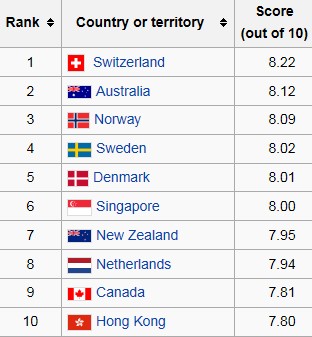
It’s that time of year when under-employed, over-bored economists publish their ‘Quality of Life’ indices for the different countries of the world. As ever, they seem to be extremely good at finding things that are easy to measure and correlating them to a desired result. It’s easy, for example, to measure the GDP per capita or life expectancy of people within a country, or stick up a few thermometers and rain gauges and measure climate, or even count the number of women working as members of parliament. Not so easy then, though, to relate that to ‘quality of life’ or ‘happiness’ or ‘where to be born’. Does the knowledge that there aren’t enough female politicians in my part of the world make me depressed?  Does knowing that we had no summer this year make me sad? The answer to those kinds of thorny question only emerge when we are able to escape from the highly quantifiable tangible world, and allow ourselves to enter the murky, unstructured waters of human enotion. Which is why the resulting tangible-only indices tend to be utterly meaningless. It’s one thing to know that you’re life expectancy is 95, quite another altogether if you spend all that time surrounded by people whining about the difficulty of finding a good oyster fork.

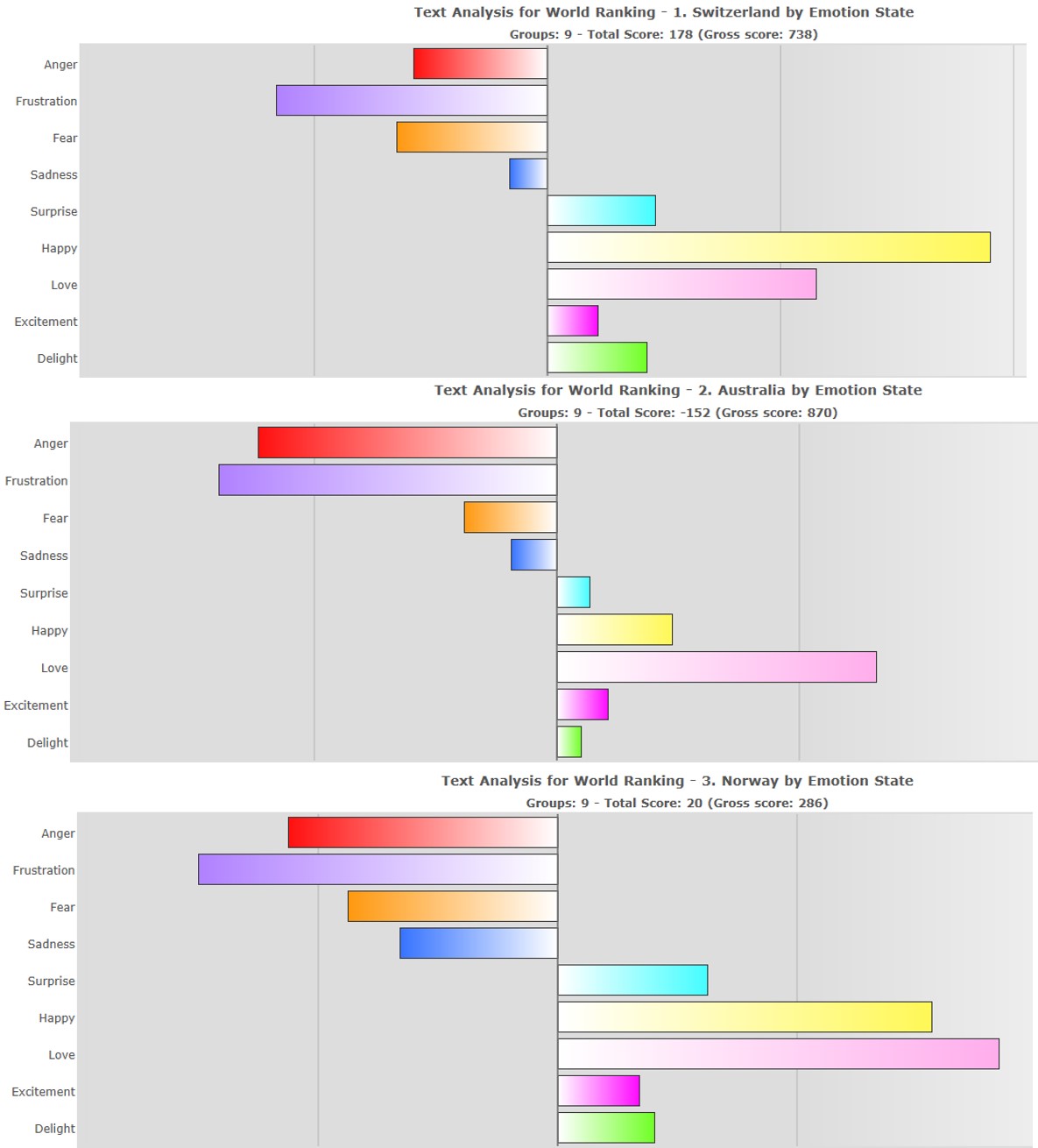
So, by way of a small experiment, we thought we’d start applying some of the PanSensic emotion lenses to the problem and see what happens. What happens when we analyse the sentiments being expressed on social media, in the popular press and in magazines in the various countries of the world.

We thought we’d start with the ‘official’ Top Three places to be born, Switzerland, Australia and Norway. Here’s what we found:

qol 1

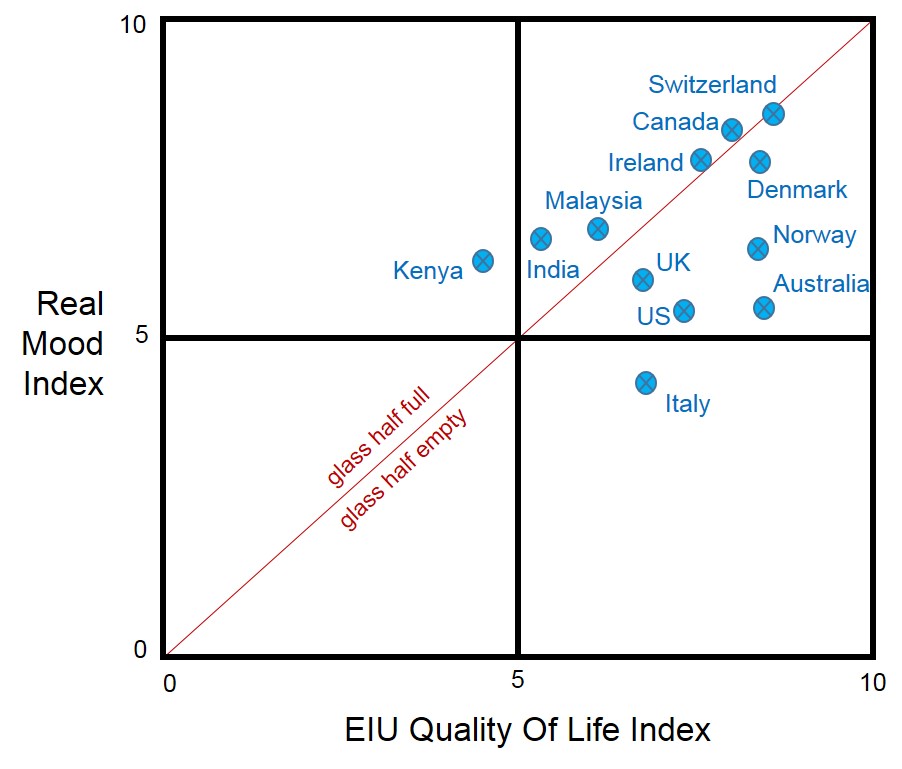
We then found a way to calibrate this kind of emotion data relative to the ‘official’ tangible Where-To-Be-Born scores. What we effectively then get is a tangible-intangible graph that looks something like this:

quality of life 2x2


It seems to offer a quite different view of the best place in the world to be born. Perhaps the first thing to look at is the Half-Glass diagonal line. Below this line are countries where people see their glasses as half empty. Life might be tangibly great, but intangibly, people, as in the Joe Walsh song, would still prefer to focus on the negative. The further below the line a country is, the emptier the glass. Conversely, where a country finds itself above the line, it’s a sign that people are happier with their lot than their actual circumstances might otherwise suggest. These are the glass-half-full nations.

Right now the data isn’t as rich as we’d like, but already it feels like we’ve uncovered something a tad more meaningful than the economists have come up with. The nice thing is that, having connected up to a host of different live data streams, it’s very easy to add in data for other countries, and to start plotting trends over time. Enabling us to see just how transient some of the emotional scores can be. When a national cricket team loses the Ashes, for example, or loses the rugby final that can have a very definite negative effect on societal mood. Albeit a quite temporary one.

Meanwhile, sticking with our consolidated averages for 2015, it looks like Switzerland is indeed the place to be born right now. If you can’t manage that feat, though, your next best bet is Canada or Denmark. Or, if you’re happiest when you’re surrounded by other optimists, maybe India. Or how about Kenya?

Innovation Loves Regulation

somersault 1

One of the most frequent excuses I hear from would-be innovators for their inability to shift from their current situation relates to regulation: ‘We can’t possibly change the design, because the regulations don’t allow it’.

To which my stock response has become to show them this video: https://www.youtube.com/watch?v=rzpB7ZhO3Dk

The rules of football are very clear. The rules for throw-ins are also very simple:

At the moment of delivering the ball, the thrower:

  • faces the field of play
  • has part of each foot either on the touch line or on the ground outside the touch line
  • holds the ball with both hands
  • delivers the ball from behind and over his head
  • delivers the ball from the point where it left the field of play

These are the rules. And they become the limiting factor when a footballer desires to throw the ball further than the opposing players might expect to be possible: we’d love to throw the ball further than anyone else, but the regulations prevent us.

Now one plausible response to this situation might be to appeal to the football regulators asking for a rule change. Another – usually more immediately effective one – is to recognize that we have a contradiction. And then to go and see how others have already done some hard work to solve that contradiction for us.

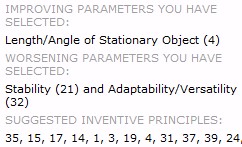
Here’s how we might map the longer-throw-in-versus-regulation problem onto the Contradiction Matrix:

somersault 2


Interesting to note how the amazingly inventive, fully regulation compliant, throw-in solution in the video offers us such an elegant illustration of Inventive Principles 15 (Dynamics – move from a stationary (feet) to dynamic situation) and 14 (Curvature – switch to a rotating motion).

We often assume that the Contradiction Matrix comes from patents and is to be used for difficult technical problems. But, as we see here, it also comes from studying anyone anywhere that’s determined to break the rules without breaking the Rules.

Don’t Just Do Something, Stand There

The twin drives for Operational Excellence and Business-School-inspired ‘Imperative For Action’ have generated enormous ROI for enterprises around the world. But inside every silver lining is a cloud…

…most enterprises are now so ‘Action-Oriented’ they forget to engage their collective brains. 98% of all change initiatives fail. 90% of them failed the day they started.

As with all things, the original concepts tend to get corrupted. Take ‘continuous improvement’, the primary engine behind Operational Excellence since the Japanese-lead Quality revolution of the 70s. One of the main ideas underpinning continuous improvement is the Plan-Do-Study-Act cycle. It is pretty much ubiquitous inside any enterprise these days. As a customer, I’d say that was a good thing.

When the originators of Plan-Do-Study-Act thought about things, they came up with the idea that each of the four activities required about the same level of time and attention. The area of the four boxes, in other words, was designed to illustrate time.

pdsa1


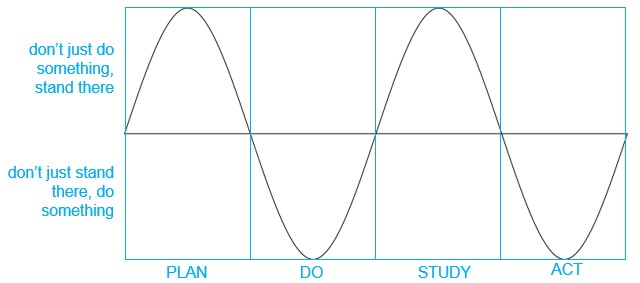
This is the bit that has been corrupted. It’s all well and good for people like George Washington to talk about chopping down trees in eight hours and spending six of those hours sharpening the axe, but in ‘Imperative for Action’ World, those six hours of sharpening can very quickly come to look and feel like waste. And in Operational Excellence Land, waste is very definitely unwelcome. If we can’t tangibly see and feel ‘progress’, then it gets categorised as bad. If my boss comes into my cubicle and sees me drawing something on the CAD system, or, better still, comes into the lab and sees me busy doing stuff, then she goes away happy. If she sees me scratching my chin thinking about stuff, I don’t look busy, and i’m more likely to be rebuked than rewarded for my ‘slacking’: ‘Don’t just stand there, do something’.

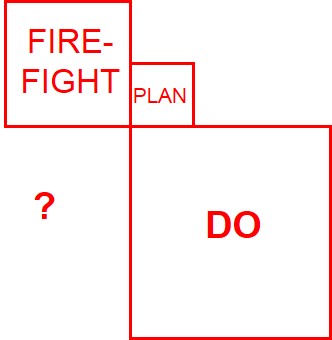
I’m sure it’s not the case in your organisation, but if I had to draw an average of the amount of time I see companies or teams Planning, Doing, Studying and Acting, I think the picture I’d find myself drawing is this:

pdsa2


In the Doing box, everything looks fine. We like ‘Doing’. We look busy and we feel busy, and both are psychologically very appealing. Planning, on the other hand, is psychologically very unappealing. When we’re Planning something we don’t look busy and we don’t feel busy either. Planning can very easily begin to look and feel like waste. Even more scary is that when we’re thinking about what we’re supposed to be doing, we might inadvertently find some bad news that causes us to have to go backwards. Even worse still, we might have to go and tell our boss as much. All the time knowing that messengers find themselves shot more often than celebrated. Better to brush bad news under the carpet, and get on to the Doing part of the job.

Then, when we’ve finished Doing something, we’re supposed to step back and Study what we’ve Done. More chin-stroking. More psychological discomfort. Especially since most company’s don’t know what they’re supposed to be Studying at this point.

What very likely does happen during this Study phase, however, is the bad news re-appears from under the rug and it becomes obvious to all that we’ve Done the wrong thing. And so the Act phase of the continuous improvement cycle quickly turns into Firefighting. Which also turns out to be very appealing, psychologically-speaking. The expression ‘firefighters light fires’ exists for a reason. Firefighters get to be the hero when the problem is solved. Hooray.

Except, of course, for the fact thatwe’ve just consumed a vast amount of time and effort conducting nugatory activities. We spent most of our time looking anf feeling busy, but most of that time we were busy being fools. Operationally excellent fools, admittedly, but fools all the same.

That was the real waste.

Sadly, I don’t think any manager inculcated into the ways of Operational Excellence is going to be very compfortable using expressions like, ‘don’t just do something, stand their’ to their workers. It’s just not the way we’re all wired. We’re wired to Do. And more specifically to Do what gets rewarded.

But I think what we can hope for, is that we ask better questions during the Planning and Studying phases of the continuous improvement cycle (i.e. TRIZ), and that we might start to get managers to design systems that reward people for sometimes not doing, and standing there instead.

pdsa3

Suffocating Generation Z

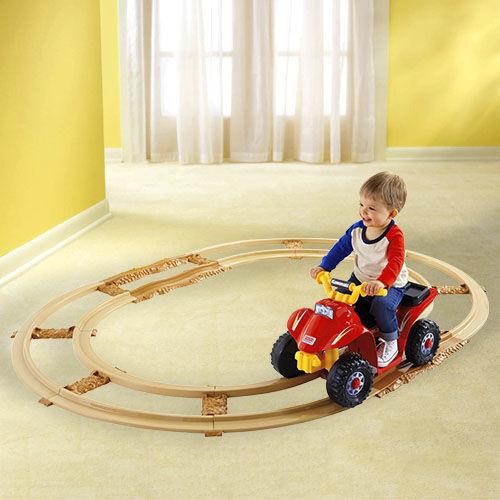
genz


Overheard in the OrKid Toy Co design department:

Marketing: we’re getting feedback from parents that our off-road quad bike toy is dangerous.

Design: Huh?

Marketing: well, not actually dangerous, but potentially dangerous.

Design: Potentially dangerous?

Marketing: Yes. If the child is playing outside, they might think it’s a real off-road quad bike and heaven knows what they might get up to.

Design: In their garden?

Marketing: We have to think about these things.

Design: Sure. But when the things turn out to be stupid, we’re supposed to ignore them.

Marketing: We need to send the message to parents that we actually did think about it.

Design: We advise them that the kid should wear a helmet.

Marketing (shaking head, solemn): apparently they’re also potentially dangerous.

Design: So what do you want us to do?

Marketing: Could we bring it indoors? Make it usable indoors where Mum and Dad can keep their eye on things?

Design: You want an indoor off-road quad bike?

Marketing: Yes, but without the element of danger.

Design: Danger of what? They’re indoors.

Marketing: Falling down stairs. Banging into the walls. Furniture. The home’s a minefield.

Design: How about if we put it on rails?

Marketing (smiling for the first time): Rails! That sounds more like it. Railways are fun. (Pause) They’re still a bit dangerous though, right?

Design: Not if we form the track into a circle.

Marketing: Won’t the kid get dizzy?

Design: We could add a couple of straight bits.

Marketing: Hmm. Yes. Better.

Design: We could add a slightly jiggly bit too.

Marketing: How jiggly?

Design: Well, side to side a bit. Not up and down.

Marketing: Great.

(pause)

Design: Okay. We’re on it.

Marketing: Great. We’ll start working on the name. Something that says ‘off-road fun’ without scaring mum and dad.

Design: Traction control?

Marketing (shaking heads): leave the fun problem to us.

Design: Even though it won’t actually be fun?

Marketing: You’re forgetting the giggle-jiggle.

(long pause)

Design: Maybe, when the kid reaches thirteen, when they’re allowed outside, they’ll work out they can take it off the track? Maybe that’s when the fun part comes in?

(longer pause)

Design: Or maybe it’s when they’re sixteen and learn how to set it on fire?

(even longer pause)

Design: Using the track as kindling.


Learn more about Generation Z and what their Generation Y parents are doing to them in one of our DNA books.

Worst Everyday Products Ever

This one’s for the inventors. Or, better yet, the innovators that might actually do something with their ideas for improving the crappy products we are about to rank.

‘Worst product’ surveys are everywhere on the internet. The problem with all of them is they’re very subjective, and too often compiled by an individual with a bee in his – occasionally ‘her’ – bonnet about one crappy product in particular.

We thought it was time to bring some structure to the discussion. What do we really mean by ‘worst’? And how might we objectively compare a bad apple with a worse orange?

It sounded like a job for PanSensic again. Meaningful measurement, we eventually decided, needed to think not just about the overall rubbishness of a product, but also how easy it ought to be to put it right. The idea being that if something was easy to put right, but no-one had, that somehow compounds the insult to the poor consumer.

It felt like time for a 2×2 matrix.

Up the vertical axis we formulated an integrated parameter to quantify product ‘terribleness’. Because our focus was on everyday products, we decided that terribleness needed to combine three different elements. Firstly the amount of negative emotion the product generates from customers. Scraping social media for such negative emotions, however, quickly revealed a problem. Our relationship with bad products is somewhat akin to the Kübler-Ross Grief Cycle: When we first realise we need a product and go out and buy one only to then realise that it doesn’t do what we want it to do very well, we tend to blame ourselves and grind to a halt. Then, when we realise it’s not our fault we get frustrated. This is the stage when good organisations begin to recognize there is an innovation opportunity and do something to make the product better. Less proactive companies, or industries in our case, let the frustration devolve into Anger. They do this, I sometimes think, because they realise that if no-one does anything to fix the problems with the product, the Anger eventually devolves to Confusion and then Apathy. And later still, assuming the poor old consumer still has a need for the function of the product, they learn to Adapt their behaviour to compensate as best they can for the ineptness of the product, and then finally Accept that this is the way the world is. The reason for mentioning this rubbish-product-grief-cycle is that we can’t just use our usual Frustration measure as the prime indicator of terribleness. A really bad product has gone past Frustration for most of its customers and so when we’re looking for social media narrative we also need to be on the lookout for post-Frustration Anger, Apathy, Confusion, Apathy, Adaptation and Acceptance. The further along that sequence things are allow to get, the worse the product.

grief cycle

Or almost. The second factor that needs to be taken into consideration somehow is whether there is a level of taboo associated with the product. Certain things are unlikely to be discussed in a social media context because it’s just not socially acceptable to do so. Picking up how people feel about things they tend not to talk about is inevitably more difficult than something that’s at the front of everyone’s mind, but then again, one of the key start points for the whole PanSensic story was ‘reading between the lines’. So that’s what we’ve built into the calculation.

Thirdly then is the ubiquity of the product. A bad product design that never sells is, according to our algorithm, less terrible than one that everyone has Accepted is rubbish and goes out and purchases anyway.

So much for the vertical axis. Along the horizontal we’ve plotted ‘ease of solution’. The way we’ve calculated this is through a combination of two quantifiable aspects of current product designs. Firstly how much untapped Evolution Potential the product possesses. The more untapped potential it has, the easier it will be to make a trend jump to advance the capability of the solution. Second is how many contradictions would need to be solved in order to improve the design. A product with lots of current unsolved contradictions will need more work to improve than a product that is being held back by a smaller number of contradictions.

Here’s what the plot looks like for all of the candidate rubbish products we’ve been able to identify from our PanSensic analyses:

worst matrix

The way the plot is configured, the ‘real’ worst products are revealed as the ones closest to the top right hand corner of the 2×2 matrix.

They are (drum roll), in reverse rubbishness leafblowerorder…


#5 Leaf-Blower – the ultimate design solution for bored gardeners and street cleaners. Basically a noisy pollution machine designed to temporarily move half a dozen leaves in the opposite direction to the prevailing wind. Only to watch them all blow back to precisely where they started five minutes after the leafblower operative goes off to get more fuel.


airblade

#4 Hand-Dryer – when you see Dyson getting involved in a product, you can be pretty certain they’ve spotted a current product that is rubbish. Sometimes they create a solution that is better than the incumbent rubbishness. And then sometimes they find themselves going in the opposite direction. Like the Airblade. All the stupidity of a hot air hand-dryer, but now with added noise and a small lake on the floor. I think in some circles its called a ‘design statement’. A statement that in this case goes something like, ‘we have no fecking clue what we’re doing’.


napkin

#3 Sanitary Napkins – the clue is probably in the name, but things get seriously worse when we see the horrendous rate of urinary tract infections this product causes. Not to mention advertising campaigns based on ‘X% better protection’. Who in their right mind bases an advertising campaign on the USP of ‘slightly less rubbish than everyone else’s product’? Oh, wait, I know, the sort of person that launches a Minion napkin ‘innovation’. Did I miss that scene in the movie?


floss

#2 Dental Floss – everyone knows they’re supposed to floss. 80% give up. Two-thirds of the people who persevere make things worse than if they hadn’t bothered in the first place. It’s like someone walking up to you in the street and whispering in your ear, ‘psst, if you buy this really expensive string, I promise you’ll get gum disease’ and you ask him how much to buy enough for the whole family?

And, finally, our winner…

toilet brush

#1 Toilet Brush – let’s see if I can get this right. The toilet is blocked, so I’m supposed to stick a high surface-area brush into the u-bend to try and unblock it. I then take the faecal matter covered  brush out again, and move it, all the time praying it doesn’t drip poison onto the toilet seat and bathroom floor, to an odour-releasing, fly-attracting, bacteria-magnet display-receptacle for all my guests to admire. So they can then repeat the process. Did I miss something?

Okay, enough already. Over to you, Kickstarter… even though you’re not even in the Top 20 yet.


Wafer Thin

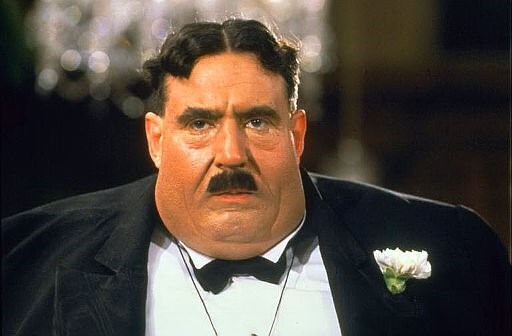
creosote


MAITRE D: And finally, monsieur, a wafer-thin mint.

Mr. CREOSOTE: Nah.

:

MAITRE D: It’s only wafer thin.

Mr. CREOSOTE: Look. I couldn’t eat another thing. I’m absolutely stuffed. Bugger off.

MAITRE D: Oh, sir, just– just one.

Mr. CREOSOTE: [groaning] All right. Just one.


Rule #1 with my friend Ancient Steve is don’t phone him at home early evening during the week. I’m not sure he knows about this rule, but I think all of his other friends have worked it out too. The rule, so far as I could establish it was an actual rule, started about a year ago. The change happened suddenly, though, and that’s the point of this post. How small changes can create non-linear change. How one last straw comes to break camel’s back.

Phone Ancient Steve up on a Wednesday evening now and, if he bothers to answer the phone at all, what you’ll hear on the other end of the phone is a gruff, curt, borderline offensive ‘what do you want this time?’ kind of hello. The same call a year ago would have been answered by normal Ancient Steve. Still a bit gruff, but gruff in a pleasant enough tone that you knew he wasn’t going to snap your head off.

Somewhere between the two, something happened.

What it turned out happened is that, because Ancient Steve doesn’t believe in things like phones with caller id on them or going ex-directory, when someone calls him, he doesn’t know who it is on the other end of the line until he picks the phone up.

Now the brain is really just a big old prediction engine as far as most of our lives are concerned. All those neurons are there to anticipate what’s going to happen in the next half second. This is a good thing to be able to do from an evolutionary survival perspective. It also means that, when the phone rings, our brain immediately gets busy anticipating who’s going to be on the other end of the line.

Prior to tweleve months agao, when Ancient Steve’s brain was making that prediction, the weight of probability was that the person on the other end of the line was going to be friendly, and so Ancient Steve was able to flood his response system with ‘be-polite’ chemicals and respond accordingly.

Around this time, Ancient Steve was also, it turns out, receiving a growing number of cold-calls from feckless salespeople. Early evenings during the week, the whole world of double-glazing sales personnel around the country gradually came to realise that Ancient Steve might be interested in buying replacement windows. Or a free life insurance assessment. Or a better deal on his utilities.

This was sort of okay until the fatal day when the balance of probabilities shifted past the fifty percent mark. When our brain does its prediction thing and tries to establish whether the incoming call is from a friend or double-glazing vending foe, the calculation is an essentially binary one. If 50.1% of past calls have been a friend, then the prediction that gets made is ‘the caller is friendly, be polite’. Ditto if the percentage is 50.01%. But, come the day that the balance of experience tips the probability the other side of the 50% mark, to 49.99%, then the default prediction becomes ‘the caller is an enemy, be gruff, surly and borderline offensive’. One call from the wrong person, one more piece of straw, tipped Ancient Steve’s behavioural balance.

And then, soon enough, they also affected mine. My prediction engine when I called Ancient Steve used to tell me, ‘here comes good old Ancient Steve’, so that I could pre-fire my own version of ‘be-vaguely-polite’ chemicals. But the moment the balance of probability in my own head about whether Ancient Steve was going to be gruff in a good way or a bad way shifted to the point where it was more likely I was going to hear the Bad version, then that’s the prediction I made.

Again, all it took was one too many calls to Bad Ancient Steve for me to change my whole view of what to expect when I phoned him.

That’s how it works. And until such times as Good Ancient Steve comes on the phone more than Bad Ancient Steve, that will remain my default expectation. Its the same thing with every other prediction calculation we make.

When I’m driving, and I see a car coming towards me flashing its headlights, my default reaction used to be to check that I hadn’t inadvertently left mine on full-beam. Then, when I realized I almost never had my lights on full-beam, my automatic, balance of probability prediction tipped to flashing my lights back at them to demonstrate that, look you idiot, I didn’t leave my full-beam on. Now I’ve lived in rural Devon for a year, the balance of probability has tipped again. When someone driving towards me flashes their lights at me now, the likelihood is there’s a silage-toting farm vehicle around the corner.

Strange that one wafer thin mint too many, as with Mr Creosote, can have such a non-linear results.

And, stranger still, even knowing all of this, is wondering how come after nearly a year of trying I haven’t managed to sell Ancient Steve any double-glazing yet.

tipping point


The Opposite Of Innovation?

One old joke goes that the opposite of ‘innovation’ is ‘innovation consultant’. I can see a fair amount of truth in this assertion. Especially if we qualify the statement as ‘innovation consultant who thinks the problem to be solved is lack of creativity’.

More pragmatically, it seems there is no antonym for the word. A bit like when Nassim Nicholas Taleb struggled to find an opposite for fragile. He ended up with ‘anti-fragile’, but I’m not sure the same prefix does the job in innovation-land. ‘Anti-innovation’ somehow sounds more like a protest than the proactive act of not innovating.

In any event, I’ve always kind of struggled with these kinds of opposite ends of a spectrum question anyway. Mainly because I think, rather than forming the two ends of a straight line, the two ends somehow bend themselves around to form an almost complete circle. The two ends, in other words, become effectively the same thing.

Love and hate for example. It’s a thin line between love and hate, so says the song, the implication being that you can love someone or something so much, you’re a tiny mis-step away from falling off a cliff and hating them or it. Or vice-versa. Which is pretty much the premise of nearly every Hollywood romcom ever made come to think of it: Boy meets girl; boy loses girl; boy gets girl back again.

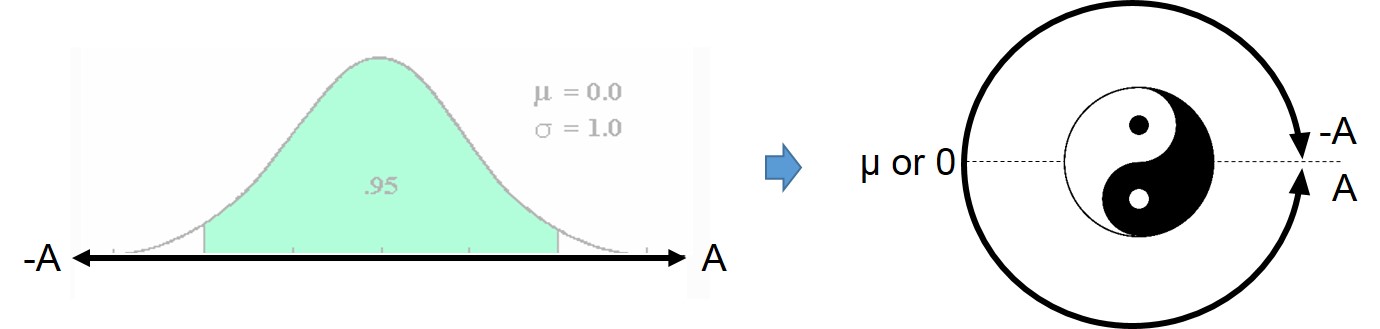
Put love and hate at two ends of a spectrum, curve the line into a circle and the actual opposite of love becomes the halfway point along the spectrum. The opposite of love, in other words, is indifference.

The other classic two-ends-of-a-spectrum-are-the-same can be seen in left versus right wing politics. Go far enough in either direction and the end result looks pretty much the same as far as citizens are concerned. The political opposite of left or right is thus in reality something along the lines of laissez-faire liberalism.

For a long time, I’ve assumed that love/hate and left/right are the only cases where the two ends of a spectrum are to all intents and purposes identical. Now I’ve come to think the model generalizes to pretty much any kind of supposed spectrum of extremes. If I define any two spectrum extremes as ‘A’ and ‘-A’, and draw circle such that they meet, the other side of the circle – their actual opposite – is the mean, μ, or, if the distribution isn’t skewed, zero.

opposite

Can that be true?

Is extreme Fragility the same as extreme Anti-Fragility?

Is extreme Freedom the same as extreme Responsibility?

Is extreme Fight the same as extreme Flight?

Is extremely expensive the same as extremely cheap?

In each case, I think the answer is they are: either the outcome is the same, or, as with love/hate, they are separated by a very thin line forming the edge of a cliff.

Once I accept that A is the same as –A, the real opposite of each pair becomes ‘μ’. It’s zero. It’s apathy. It’s doing what everyone else at the middle of the normal curve is doing.

In which case we might think of ‘Anti-Innovation’ as ‘proactively staying the same, irrespective of what’s happening in the external environment’. And that in turn means the meaningful opposite opposite of Innovation is not ‘Anti-Innovation’ it’s ‘Continuous Improvement’.

Saving The Planet One Towel At A Time

towel 1

Speaking as someone who spends the majority of his life staying in hotels, I’d have to say the novelty of the signs encouraging me to re-use my towels was pretty short-lived. Now, probably ten years since the signs first started appearing in hotel bathrooms around the planet, they’ve come to feel like some kind of dripping-tap torture.

The reason for the torture comes through the knowledge that, despite knowing the signs have never worked, somehow the hotel industry still hasn’t worked out how to dig themselves out of the hole it’s dug for itself.

It’s not as if the reasons for the counter-productive outcomes the signs produce are that difficult to diagnose. We can all read the words, but we also, too, make a swift interpretation of what the hotel management actually means. Something along the lines, ‘our laundry bill is really high, help us to lower it, please, even though we won’t be passing any of that saving along to you. Thanks.’

The signs are a clear signal of an industry that, ironically – given that they’re fundamentally in the ‘people business – doesn’t understand what drives peoples’ behaviour.

What’s really annoying about this is that we know the human behaviour story pretty much boils down to the ABC-M quartet of drivers we so frequently talk about in our workshops. Human Intangibles Rule #1: when you change anything, make sure stakeholders perceive perceptions of their Autonomy, Belonging, Competence and Meaning have all become better than they were before the change.

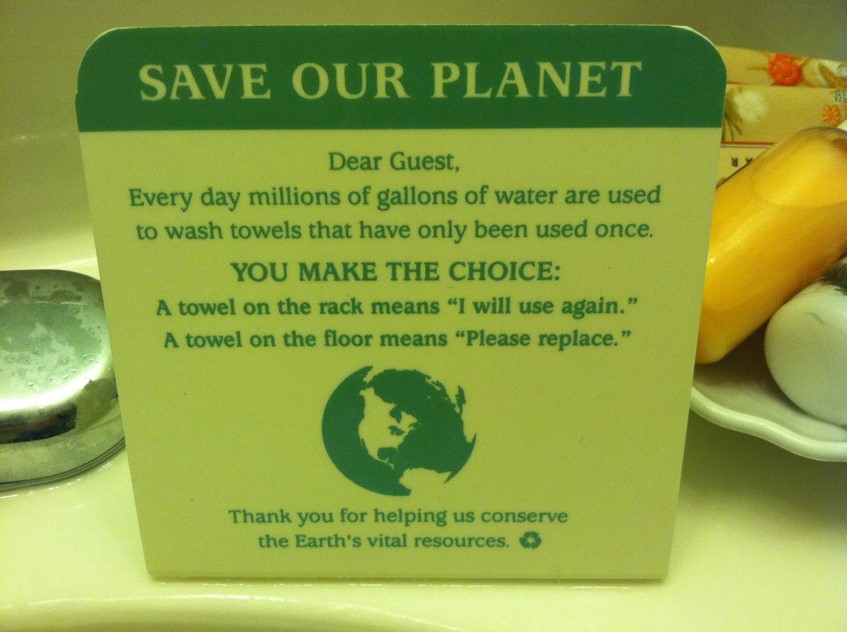
Look at the ‘save our planet’ towel re-hanging signs through this ABC-M lens and it becomes more than obvious why the signs would never work:

Autonomy – by telling people they have ‘the choice’ while at the same time shaming them  into hanging up their towel, the sign speaks from a higher moral ground and thus takes away autonomy.

Belonging – while in theory playing on the idea that we all have a collective responsibility to do something about the environment, the only tribe that wins were I to hang up my towel is the hotel chain and their lowered laundry bill, and that’s a tribe I don’t belong to.

Competence – by telling me something that I’ve already known about for the last decade, the sign implicitly assumes I’m an incompetent idiot.

Meaning – saving the planet is highly meaningful; re-hanging towels is such a trivial part of that story that by attempting to make a connection between the two the enormous contrast in effect exaggerates the meaninglessness of the act of re-hanging towels.

So, let’s try another approach. This time based at least in part on the ‘ABC-M gets better’ heuristic:

towel 2


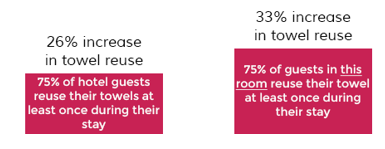
These approaches do a better job of re-framing the Belonging part of the story. We’re now in effect asked to become part of the majority of people that re-hang their towels. I can imagine that it had the impact that it had. 26% more people hang their towels.

Now how about this one:

towel 3

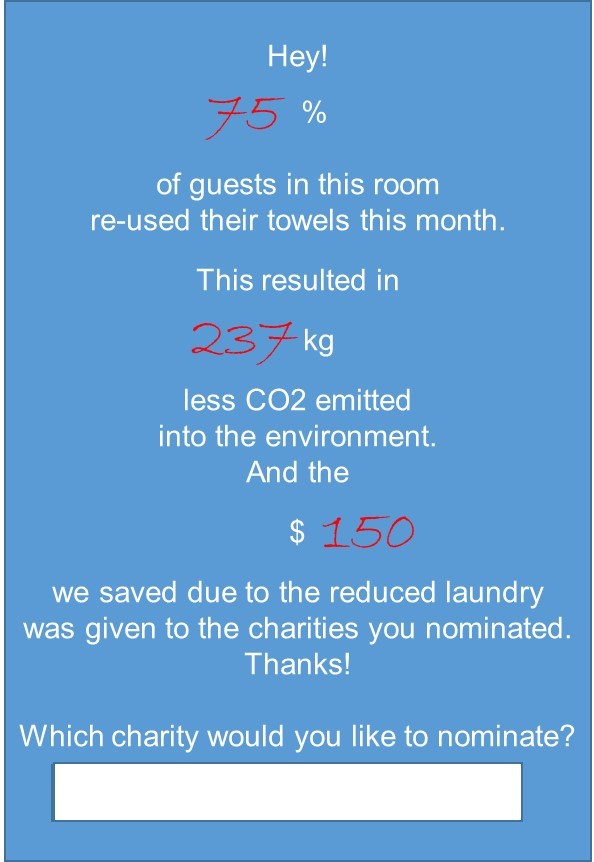
Autonomy – the guest is in control. They even get to write on the card and tell the hotel management what to do with the money they save.

Belonging – the guest gets to be part of the (majority) tribe of towel re-hangers. Plus they get to pass the money the hotel saves onto a tribe of their choice.

Competence – by telling the guest what the towel re-hanging exchange rate is in terms of environmental benefit and cost saving, the hotel helped make them better informed and therefore their competence went up.

Meaning – by connecting the trivial act of re-hanging my towel to a financial gain to something the guest cares about, the hotel just made the act a meaningful one.

Needles

needles


Big Data is great for finding correlations. The Bigger the Data, the better the correlation.

But correlation, no matter how good, has nothing at all to do with causation.

Which is a pity, because causation is the only stuff that any of us ought to act upon. When we confuse correlation and causation, the only certain result is we make matters worse.

When we talk about looking for needles in haystacks, correlation is hay. Needle is causation. Causal relationships between things. Contradictions. Insight. Insight is contradiction is causal relationship.

When we talk about enterprises being able to act with confidence, what we mean is we have found an actual needle, that we have uncovered a meaningful causal relationship that no-one spotted before.

As the world gets ever more complex, busy and interdependent, hay becomes easier and easier to find. Needles, conversely, do not. Moreover, if we believe all of the findings of TRIZ since 1946, that insight is causation is contradiction is needles, the number of needles is finite. And if we already found most of them, there’s not a lot of point in gathering more hay.

Big Data is hay. The best way to find needles is to find them before they get dropped in the hay. Better yet, is go visit the needle factory. You’ll recognize it when you see it, it has a big ‘TRIZ’ sign outside.