The more I do work in the healthcare sector, the more sceptical I get about ‘clinical evidence’.
I started my career in the aerospace so I understand the idea of evidence. When aerospace engineers get things wrong, aeroplanes fall out of the sky, and that’s never a good thing. Evidence is what keeps planes flying.
A couple of year’s ago, after a particularly frustrating experience with a part of the UK NHS that will remain nameless for the moment, we did a few calculations to translate the current level of safety performance of the NHS into aerospace terms. The numbers came out a bit scary. So we did them again. And then again from a different direction. Expressed in mortality rates, the NHS, we concluded, is currently equivalent to a shade under 2000 plane crashes per day. Over UK air-space.
When we shared the data with this part of the NHS, asking them to check over our numbers to see where we were going wrong, surprise, surprise, we never heard from them again.
Clinical Evidence matters came to a head again a couple of months ago. This time with a different part of the NHS. This time in a workshop setting. We were talking about Complex Systems Theory. And someone – inevitably I now see – asked the clinical evidence question. Where’s your evidence that treating healthcare as a complex system is a better way of doing things?
For a few moments, I didn’t know what to say. Fortunately, the question came just before a break, so I muttered a no-doubt inane answer and tried to move on.
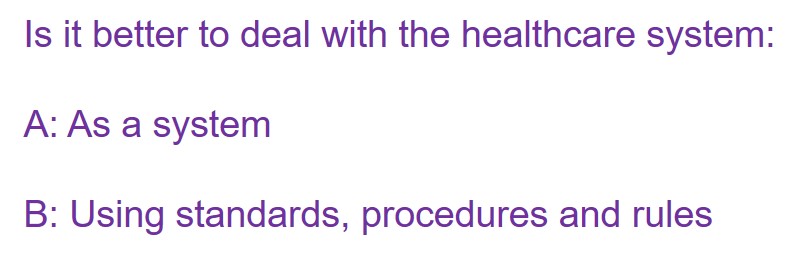
Over the break a made a new slide. Here’s a copy of it:
After the break, when everyone was back in the room, I put it up on the screen and asked for a hands-up vote. Everyone sat there, paralysed. ‘Any thoughts?’ I probed. Nothing.
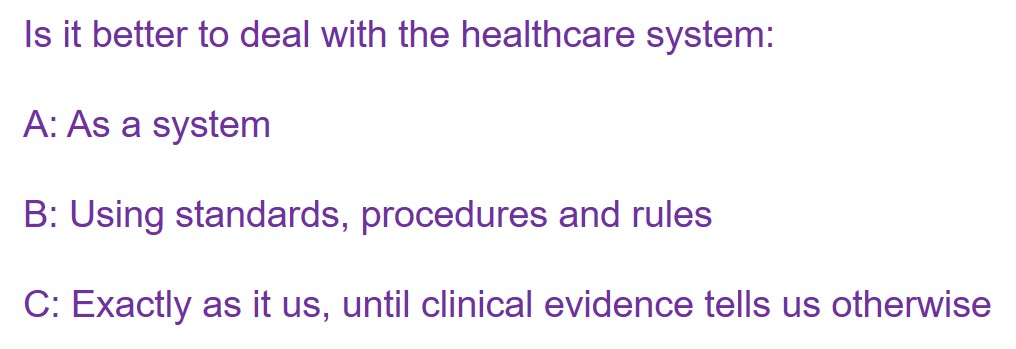
I’d kind of anticipated the reaction, so, after I’d let the tension build a bit more, I advanced the presentation to a new version of the slide. This is it:
Now answering the question had become easy. Within a minute we had a collective answer: 10% A, 90% C.
It’s a fine line sometimes. And it’s difficult to know which side we’re on.
Is it better to treat a system as a system or not as a system? There’s a clue in the question, right?
Is it better to treat – say – a headache as a system or with a pill?
Is it better to deal with crime as a system or by longer prison sentences?
Is it better to deal with education as a system or by re-introduction of grammar schools?
Is it better, post the Brexit vote, to have experts or not to have experts?
At which point on the line do we make the transition from tautology to ‘we really don’t know, so we need to go gather some actual evidence’?
I have some sympathy with those that, per Michael Gove’s epoch-making statement, ‘have had enough of experts’. But the alternative is not to say, ‘oh, in that case, let’s listen to dumb, stupid people instead’, it’s to ask the question, ‘experts in what?’
Wherever we all might individually draw the tautology line, given the choice of treating a system as a system or not a system, there’s really only one sensible answer. And a good part of the answer to the ‘experts in what?’ question, therefore, ought to be, ‘experts in systems’.
So why then did 90% of the people in my workshop ignore the obvious? People say and do things for two reasons; the good one and the real one. Apparent absence of clinical evidence is a good reason for denying the need to treat systems as systems. The real reason, of course, is that the 90% of people that voted ‘C’ in my workshop simply didn’t understand what a system was, and so used clinical evidence as their get-out-of-jail-free’ card.
To me, anyone that doesn’t understand systems, probably shouldn’t be working within one, but that, unfortunately, would mean no-one could go to work anymore. Everything in life is a system. Life is systems. So, assuming we have to have people working within systems that don’t understand systems, that doesn’t also mean we can or should allow managers the same privilege. And there’s the problem in a nutshell. Not just in the NHS, but in all walks of life, 90% of managers or leaders have no idea what a system is. So what we end up with are a million and one ‘fixes’ that backfire: headache medications that lead to addiction and long-term digestive tract injury; harsher prison sentences that increase crime-rates; education standards initiatives that increasingly make students into dysfunctional members of society; homeless shelters that perpetuate homelessness; food-aid programmes that increase starvation.
When it comes to politics my main rule is anyone that wants to be a politician, shouldn’t be allowed to become one. My second rule is, whoever’s left over, is only allowed to become a politician once they’ve graduated Systems Theory class. My new rule, as of two months ago, is that what applies to politicians also applies to managers and leaders.
Every complex problem has a million simple wrong answers. If you’re lucky – if you can get to the core principles of the system – you might just find a simple right answer. Most people don’t get lucky because they don’t know how to get to the core principles. Most people don’t get lucky because they listen to supposedly smart people who also don’t know how to get to the core principles.
Take Frederick F. Reichheld, the man that wrote, ‘One Number You Need To Grow’ in 2003. What manager wouldn’t want to know what that ‘one number’ was? It was a sure-fire Harvard Business Review hit, and it spawned the monster we now know as Net Promoter Score.
The one number starts from one question. Even simpler. “On a scale of 0-10, how likely is it that you would recommend our company/product/service to a friend or colleague?”
It’s a simplicity that turns out to be flawed on so many levels it’s stops being funny after about five minutes. The laughter turns to tears when Frederick F Reichheld spotted that a good Net Promoter score was correlated to company share price.
Despite the fact that Reichheld himself eventually worked out that he’d fallen into the correlation-isn’t-causation bearpit, it was too late. Every Fortune500 company in every Fortune500 listing had taken for the bait, and so a whole industry of NPS surveyors found themselves riding a gravy train that still feels like one of the greatest gravy trains in the history of gravy trains.
The rules of the Hype Cycle – fortunately – tell us no ride goes on forever. Some will die outright. Those that have some underlying merit will prevail, once everyone works out what the underlying merit is. And, more important, how to meaningfully get to it.
Given the choice of knowing or not knowing whether I’m making our customers happy or not, the responsible side of me thinks I’d rather know. That’s the ‘underlying merit’ of NPS: knowing whether my customers are actually happy. Whether or not I can meaningfully know that my customers are happy or not, and – more importantly – knowing what actions I should take to make sure everything is moving in the right direction, becomes the critical question.
Answering it requires at least three things:
1) I need to know that my customers are telling me the truth
2) I need to know the local context within which they gave me their answer
3) I’d like a measure of a customer’s ‘threshold for action’
Current NPS assessment methods fail on all three counts.
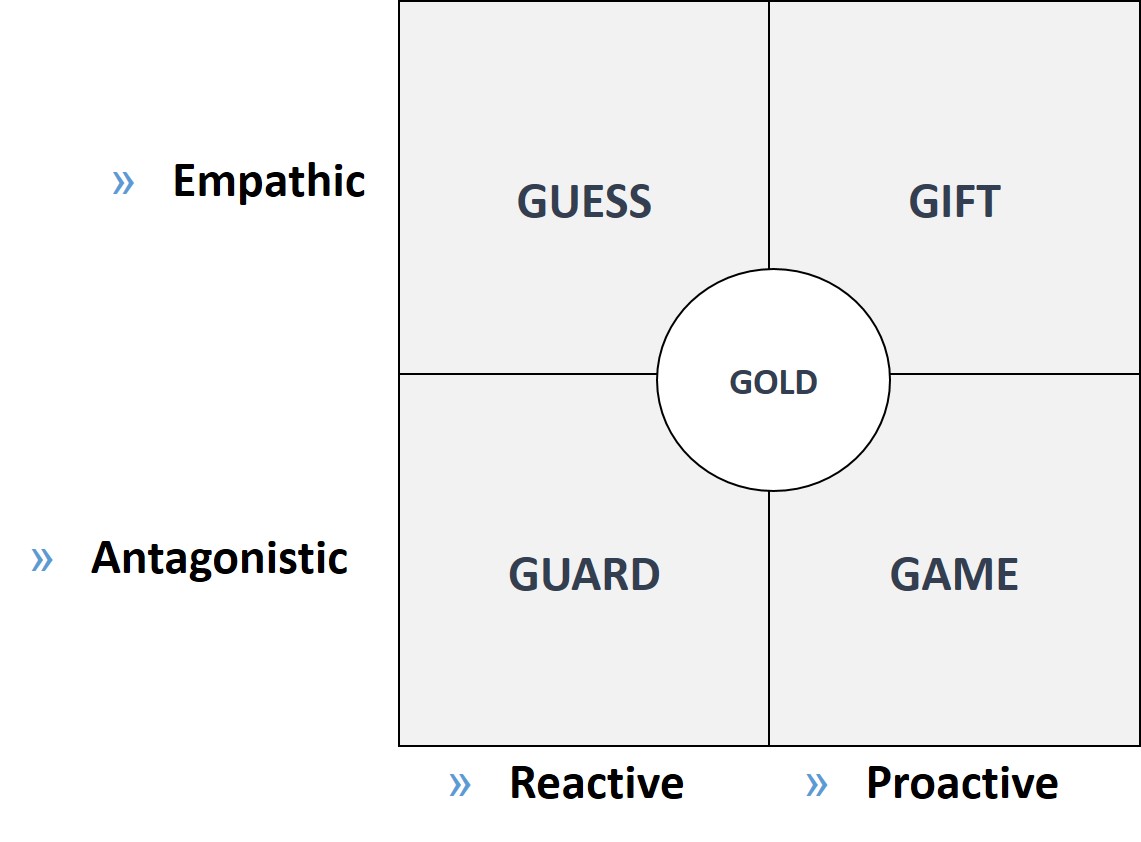
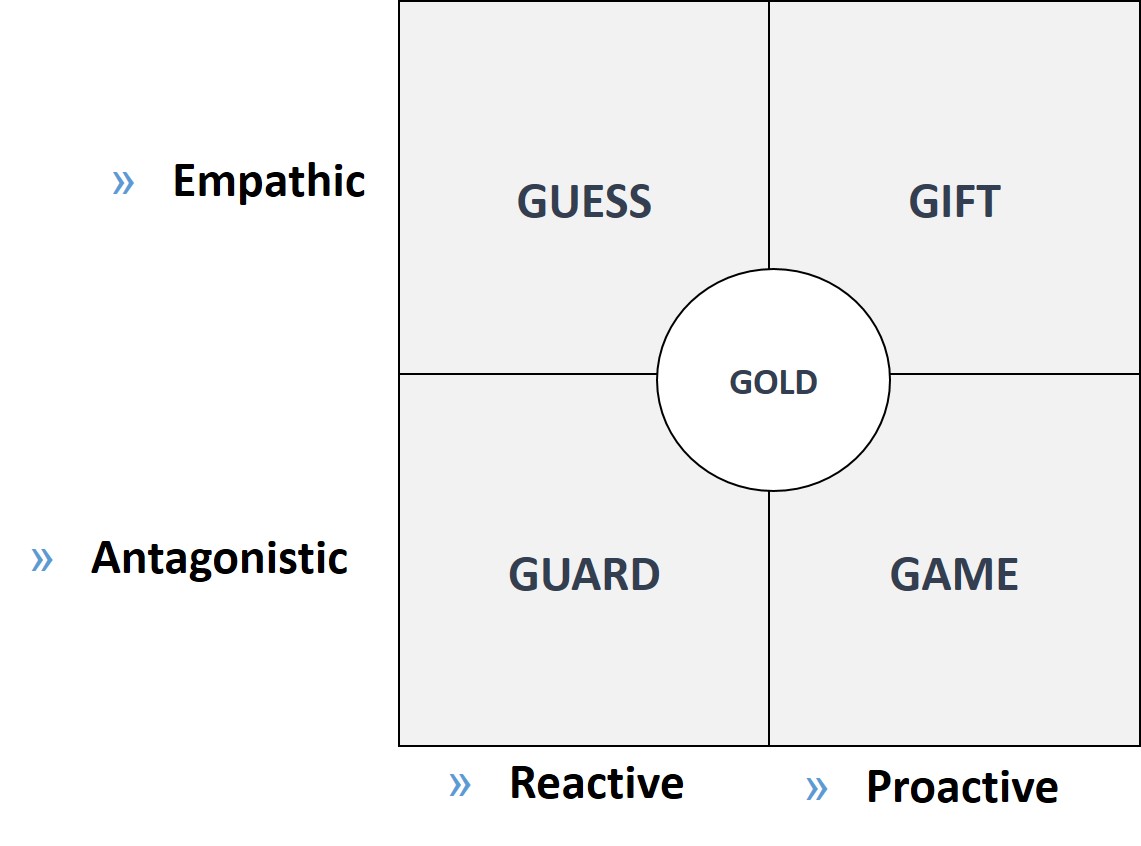
The first of the three is probably the easiest one to put right. Or, it is if you are using PanSensic and are able to map where a customer’s responses are on the 5Gs model:
Where you are on the map depends on a whole bunch of (measurable) things. One of them is your level of (over-)familiarity with NPS questions. Picture, if you can, the very first time you read that ‘how likely are you to recommend…’ question. You were probably in a restaurant. And it was probably part of a chain. Your surprise and lack of familiarity with the question probably meant you were intrigued. And very probably intrigued enough to do some actual, proper thinking about your answer. You were likely somewhere in the Golden middle of the 5G graph. Which was good for the restaurant. Now, bring yourself back to the present day, where it’s quite likely you’ve been asked ‘the question’ a couple of times during the last week. Not just in restaurants now, but on trains, at the airport, in the supermarket, at the mall, in the hospital. I even got asked it at a football game last month. Now you don’t think about your response any more. You probably have no inclination to respond at all. If you do feel inclined, it’s most likely because something extreme happened. Something extremely above-and-beyond-the-call-of-duty, or something horrendously bad. In neither case, though, are we going to answer the question objectively. That’s because the NPS question has progressively numbed our senses to the point where it has become meaningless the moment we see or hear it.
Local context is more difficult to capture, but still within the realm of possibility given the current range of different PanSensic lenses. Context, in terms of my likelihood or otherwise to recommend your products or services to my friends, has everything to do with the difference between correlation and causation. When I was asked whether I would recommend my friends to come and attend a game at the football club that asked me the question last month, the most sensible answer I could’ve given is ‘I’m an away supporter, I only came because my team is playing here.’ My actual likelihood of attending that club again – the causal link – is solely about whether they are in the same Division as my crappy team next season. I’m slightly ashamed to say that my actual answer to the questioner was, ‘yes, I am very likely to recommend your football club to my friends’. I watched as the questioner ticked the relevant box on her nifty Likert Scale. We were both happy. She was happy because she had something to correlate. The main reason I was happy, however, was because my crappy team had just beaten their even crappier team. If I’d been pushed any further, I’d very likely have made the request – as many of my fellow travelling fans chanted during the game – ‘can we play you every week?’ My reason for giving the answer I did, in other words, had precisely nothing to do with the way my answer was going to be interpreted.
So much for the situational aspect of ‘local context’. If you’re analysing the narrative around the answer rather than the score on the 0-10 scale it’s relatively easy to pick up this sort of situational effect. Ditto regarding whether someone is qualified to answer the question in terms of domain knowledge. I’ve been down this rant path before. Usually with things like Trip Advisor where the ‘reviews’ I read are usually written by people who stay in a hotel once in a blue moon and consequently have no way of saying this particular hotel is any better or worse than any other one on the planet. Their ‘review’ is usually – for the sorts of hotel I tend to stay at – based on a comparison between their experience and an advert they saw on TV for a seven star hotel in Dubai. i.e. fiction piled on fiction. “The taps weren’t even gold, two stars.”
The third aspect of ‘local context’ is the context of the person I might consider recommending your products and services to. I like music. I own a building full of records, tapes and CDs that aren’t going to be digitised and disposed of any time soon. When visitors see my music collection, they usually ask me to recommend something to them. A question that I can only usefully answer provided I know something about the sort of music they currently like. And how far in or out of their comfort zone they might want to go. And how much I want them to come back and ask for more recommendations in the future. It’s rarely as straightforward as saying, ‘Blue Nile, Hats’, although, I know that particular recommendation will work more often than it won’t, and if it doesn’t work, the visitor won’t be invited back very often in the future anyway.
Last up is ‘threshold for action’. This is the most difficult of the meaningful-NPS desire foundations. To an extent we know it boils down to the strength of the adjectives that people use to describe their experiences. Or rather the relative strengths.
Back to my football match. At half-time I – unusually – decided to go and get a cup of tea. There was a queue. I was stood behind a father and son duo. The son looked like he was about eight, and sounded like he hadn’t been to an away game before. Everything, therefore, was ‘awesome’. The journey to the ground had been awesome. The sandwiches were awesome. The floodlights were awesome. The two goals we’d scored were awesome. The late-night return home was also going to be awesome.
He was basically me forty-five years ago. Now I know that most things aren’t awesome. Our second goal, as it happens, was pretty awesome, but the first one was an umissable tap-in following a bad mis-kick by one of their defenders. It was never going to win any goal-of-the-season competition any time soon. Likewise, my cup of tea, when I eventually reached the front of the queue, tasted like it had been brewed a fortnight earlier, and had long past its moment of awesomeness. It doesn’t take much for an eight-year old to see that everything is awesome. For a cynical old man, awesome doesn’t happen very often any more. When it does happen, though, it probably means more in terms of useful feedback to a company than when they hear the same adjective come out of the mouth of the eight-year-old.
You need a lot of an individual’s narrative in order to calibrate their adjective use in order to work out where they need to be on an adjective-strength spectrum before they will act – i.e. recommend to their friends or family. Getting access to sufficient of this narrative is ‘possible’ if you have access to, say, the Facebook narrative of a smiley Millennial, but very often the people that talk the most are the ones with the least to say. In which case, the current ‘best’ way to calibrate the how well a customer thinks about you is to calibrate across many customers. Even better, thinking about the PanSensic ‘Mental Gear’ lens, is to calibrate across Blue, Orange, Green and (especially) Yellow customers, and then – most crucially of all – close the loop by finding some actual customers that actually did recommend you to their friends and family and examining their actual collective PanSensic profiles.
NPS is not as far along the maturity scale as other Weapons of Mass Distraction (Balanced Scorecard, SixSigma, QFD, PRINCE2, Scrum, Agile, etc). Unlike most of them, it at least has a valid start-point in that measuring customer emotions is a fundamentally good thing to do. Whether it gets to survive in the long term is largely dependent on how quickly it can evolve to a point where the measurements it’s is used to make are meaningful – as in truthful, context-relevant and actionable. Which is hopefully where PanSensic comes in to play.
“Incontinent the void. The zenith. Evening again. When not night it will be evening. Death again of deathless day. On one hand embers. On the other ashes. Day without end won and lost. Unseen.” Samuel Beckett
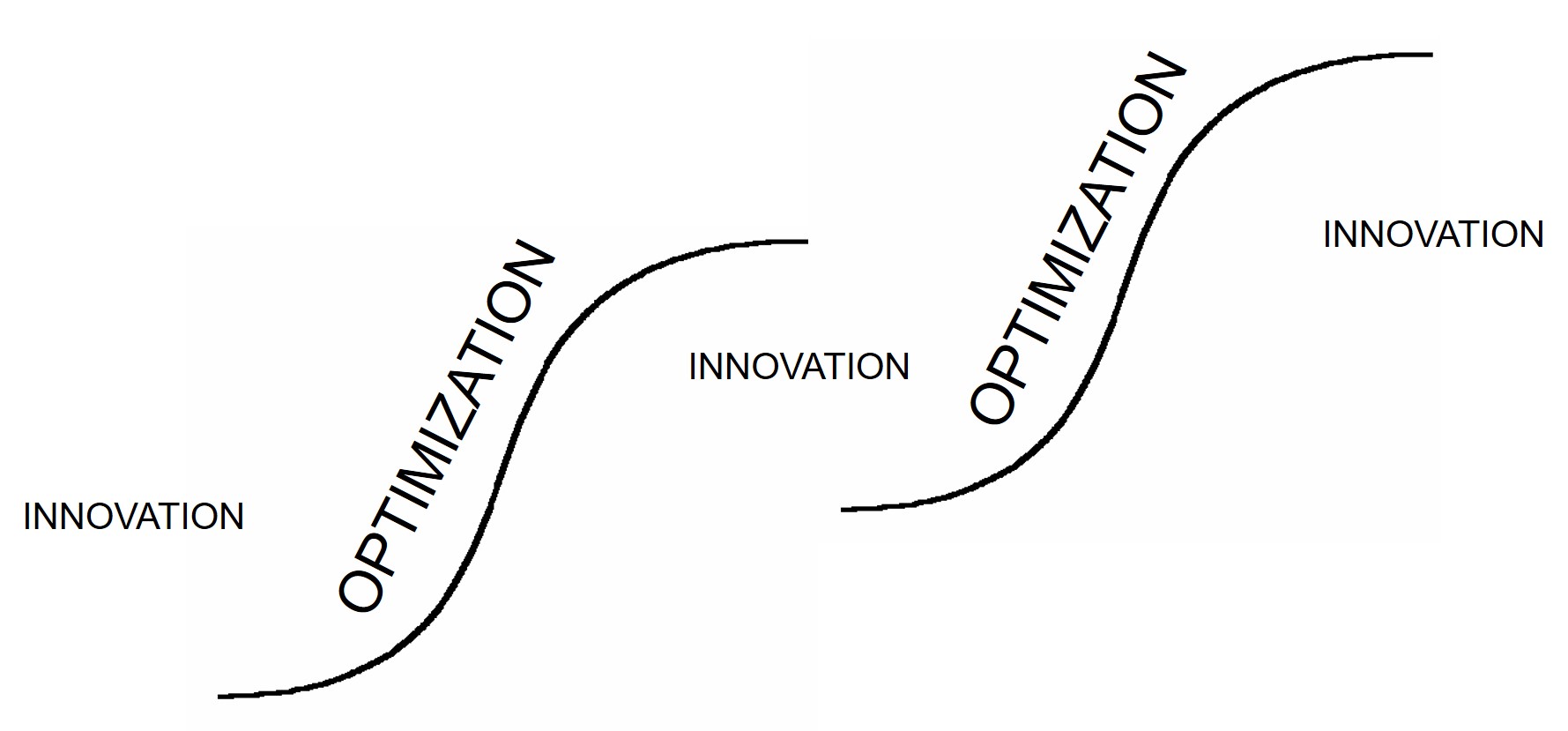
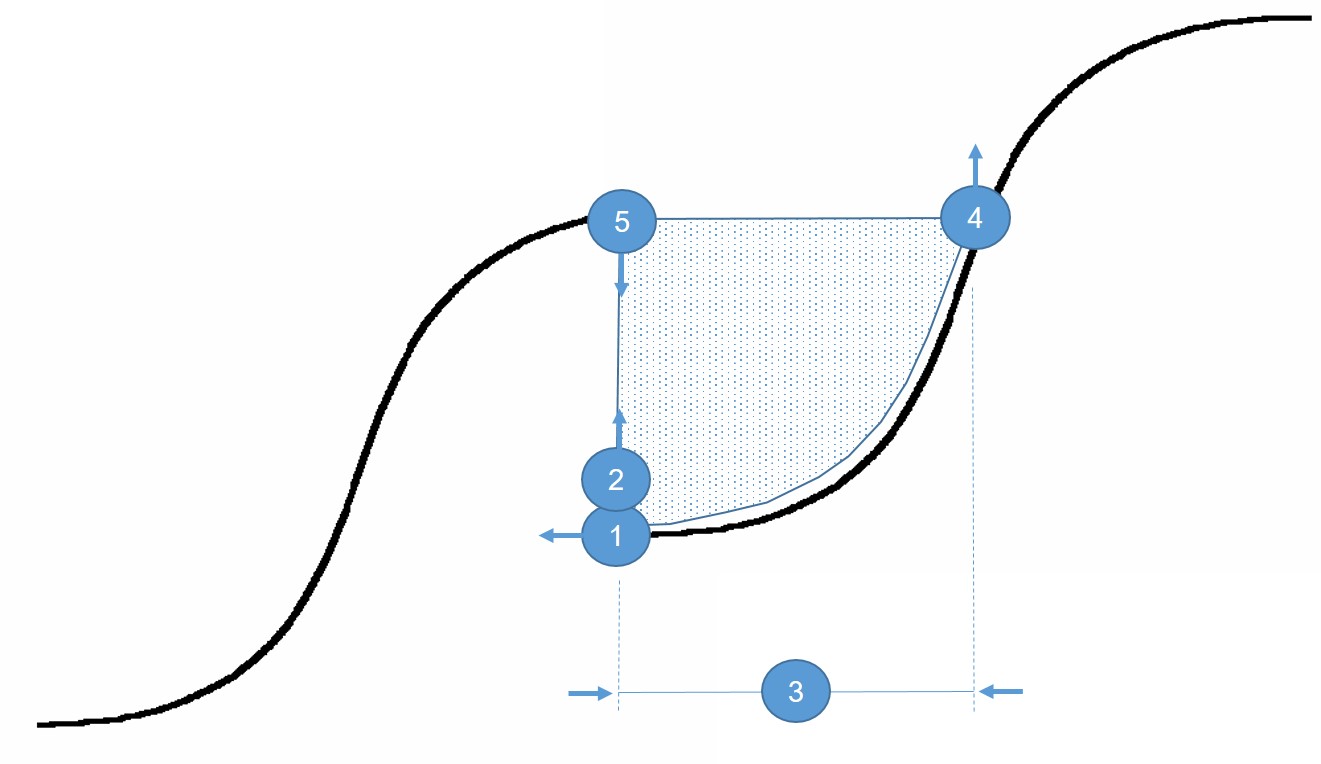
We use the expression ‘successful step-change’ to define innovation because it takes us right to the heart of the world of s-curves. The ‘step-change’ in question being the jump from one curve to the next. We usually draw the s-curve-jump story to look something like this:
There are no hard and fast rules about the relative positioning of two adjacent s-curves, but we know for sure that a big part of the innovation management job is successfully managing the gap between the two. And specifically the void defined by this area:
Whenever an enterprise embarks on an innovation project, they essentially make a decision to jump off the top of their current curve into the unknown of the coming ‘next world’. However we choose to measure the vertical axis defining the s-curve, this jump almost inevitably results in things looking and feeling worse than we felt when we were safely ensconced on the top of our current cliff. The trick to our descent and then – hopefully – rise up the next s-curve is to reach the point where the height we’ve ascended to on the new curve reaches the level we’re at on the top of our current curve. This is what the shaded area is all about.
Managing the Void, then, is all about minimising the area of this shaded region: the smaller the area, the faster everyone accepts that the innovation attempt being made has been successful. Or, put another way, the smaller the void area, the less time and money we have to invest in getting the project out of the red and into the black.
Given the fact that 98% of innovation attempts still end in failure, it is probably fair to say that the majority of enterprises on the planet are uncomfortable when it comes to managing the void. Most enterprises still see the world through Operational Excellence eyes. Which means they focus on improving what they have, rather than jumping off a cliff into some mysterious, unknown ‘void’.
As far as we can see, when we look at the 2% of innovation attempts that end in success, there are five basic strategies for managing the Void. None is mutually exclusive, and if we really were ‘managing’ our s-curve jump we would no doubt look to adopt as many of the five strategies as makes sense given our available resources. Here are the five in graphical terms:
And here’s what each of the five means in practical terms:
1) ‘Start Earlier’ – in many ways the easiest of the five strategies to engineer and manage, but, alas, in most enterprises, the strategy that gets adopted the least often. One of the best ways to manage the step-change from one s-curve to the next is to start work before we reach the top of the current s-curve. Starting to look for the new curve when we’re on the steepest climbing part of the current curve makes the most sense since that’s when our margins and cash-flows are at their strongest. The problem, however, is that most organisation leadership teams think that the best way to manage their affairs during the exhilarating climb is to put all of their attention on the job of maximising margins and revenues. Nobody, it seems, wants to be seen to be the killjoy that tells everyone that the future won’t always be so rosy, and we should start planning now for future rainy days.
2) ‘De-Traumatise’ – when people are stood on the top of their current s-curve, it means they’ve done an awful lot of hard work to get there. Their system has been massively optimised, everything has been worked out, and everyone has settled in to their comfort zone. No matter how good the new solution that kicks-off the start of the next s-curve is in reality, it looks and feels worse to everyone who looks at it from the perspective of the beautiful position of the existing system. Managing the Void strategy 2) is thus all about managing the psychology of change and the innovation version of the Kubler-Ross Grief Cycle – first we experience the shock of the new, then we deny it, then we get angry, then we try and bargain our way out of the difficult situation, then we get depressed, then we accept a little realism by testing the new, until, finally, we accept the change, and realise, it’s not as far down as it looks. ‘De-traumatising’ is about letting people still safely positioned on the old s-curve see that getting worse to get better is sometimes just how the world works.
3) ‘Climb Faster’ – the strategy that sits at the heart of ‘Lean-Startup’ and Design-Thinking – methods and processes that are all about making lots of rapid iterations of the new solution, exposing them to customers, learning from their reactions, and building new iterations as swiftly (and as cheaply) as possible. ‘Fail-Fast, Fail-Forward’ is the frequently heard mantra of teams comfortable operating in the Void: we can’t know everything right now, so our job is to try new things, learn from it and use the learnings to design the next iteration of the solution.
4) ‘New Measures’- perhaps the least immediately visible of the five possible strategies, the ‘new measures’ strategy is about recognising that in a large majority of cases, when innovation happens, it comes alongside new ways of measuring ‘success’. When JCB first invented the hydraulic earth-mover, for example, it was significantly inferior to the industry-standard cable-driven earth-movers in terms of earth-moving capacity, but what JCB understood before anyone else was that ‘value’ to a customer wasn’t just about how much earth could be lifted in a single bucket-load, it was also about how easy it was to get the earth-mover on-site, how manoeuvrable it was once it arrived, and how flexible it was. It was ultimately about earth-moving productivity, and if you spent a week less time getting the earth-mover on site, that more than compensated for the inferior bucket load. None of which were measured by the cable-driven earth-mover companies. When JCB showed earth-moving contractors how to re-frame and re-define their success criteria, that was when their business really took off.
5) ‘Unlearn’ – In some ways analogous to strategy, 2), but the focus in the ‘unlearning’ strategy is to get people to recognise that being on top of our current cliff is not as good as we think it is. It means key parts of the learning to get to the top of the current curve has become ‘waste’ and therefore needs to be thrown away. No-one likes to think of devoting lots of hard work to create what looks like irrelevant outputs. Until such times as everyone understands that this kind of ‘un-learning’ is an inherent part of the step-change process, s-curve jumps are always going to appear difficult. Managing the Void strategy 5) is therefore largely about educating people to understand this is how the world works – fundamental means fundamental – and that we periodically unlearn stuff in order to protect the future stability of the enterprise.
Operational Excellence versus Design Thinking. Compare And Contrast.
The Regional Education Board Operational Excellence Sense Radar hears a rumour that the budget for next year is going to be cut again.
The Management, as ever, moves swiftly and launches an investigation. Being a ‘budget’ problem, the investigation is handed directly to the Accounts team, with an ‘urgent’ priority code. The team jump to action and ‘run the numbers’. True to form, they do this very quickly. The message back to the top is, ‘we’re in trouble’.
Management asks for options.
The Accounts team run some more numbers, draws up an elegant cost-per-pupil distribution curve for all the schools in the region and come back with three options. The way they’ve been taught. Two of the options are visibly ridiculous – also the way they’ve been taught – and the other one involves closing the two worst schools on the distribution curve. They present their findings to Management. Management asks about the two worst schools. It turns out – no surprise – that they are the two smallest schools in the region. This is good news. Closures always mean protest, but closing the two smallest schools means the smallest amount of protest. The Management team declare themselves happy with the analysis and, being dynamic thrusting types, they announce the decision to their masters. A week later, the story goes public.
Two weeks after that the first lawsuit arrives. From one of the parents at one of the two soon-to be-closed schools. ‘How can it possibly be’, the suit charges, ‘that the school with the highest academic record in the region is going to be closed?’ Management look at the letter and do the only sensible thing. They pick up the phone, dial the Lawyers and tell them, ‘we have a problem for you to come and fix’.
So much for Operational Excellence thinking.
It’s a story based on a real situation. At this point in time it is ongoing. The lawyers are hard at work sending each other letters. On one level, we don’t as yet know what the outcome will be. On another, several things are already crystal clear:
– The outcome will be win-lose. Either the Education Board will win, or the parents will win.
– The teachers and pupils at the school will be caught in the middle, unwitting victims of a battle over their futures.
– The lawyers on both sides of the argument have no incentive to make a swift resolution. The longer the fight goes on, and the more acrimonious it becomes, the more money they will make.
On too many levels, it is a depressing story. Perhaps the most depressing part is how quickly the Operational Excellence-driven legal downward-spiral took hold.
Here’s how things might’ve played out if the Operational Excellence blinkers had been removed from Management’s eyes:
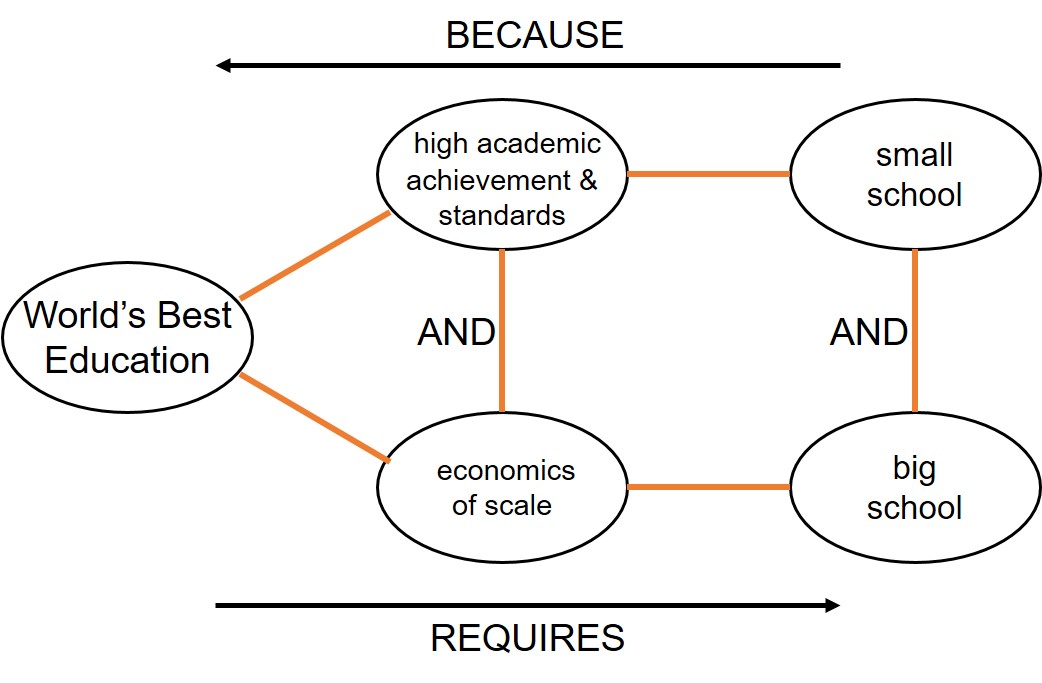
As part of their ongoing search for contradiction-solving opportunities, a member of the management team looks at the latest cost-per-pupil distribution curve prepared by the Accounts Department, and realises this would make a pretty good contradiction to try and solve at the next Management design-day. She draws the contradiction up in a way that will bring some structure to the discussion:
At the next design-day, the team spend a few minutes looking at the picture and someone shouts out, ‘this would be a great one for us to get all the parents, teachers and officials together to see what win-win solutions we can come up with.
Two weeks later, forty people turn up to a Saturday morning ideation session. They quickly agree on where they all ideally want to get to. Then spend an hour writing down all the reasons that might prevent the ideal from being achieved. That list then got turned into a perception map, which revealed what the key barriers were. Now capable of seeing where they were trying to get to and what was stopping them, they spent the last hour of the session working in small teams to generate solution ideas. They filled a wall with Post-It notes, clustered them, and then gave everyone three stickers so they could vote on their favourite ideas. Some people voted on things that could be done quickly, some on things they volunteered to take away and work on for the next semester.
Back in the office the following week, the Management team was still buzzed at the excitement and passion of the parents and teachers from the Saturday session. They heard a rumour that the education budget cuts next year were going to be bigger than ever, and smiled. Taking 75% out of the Legal budget suddenly seemed like a no-brainer.
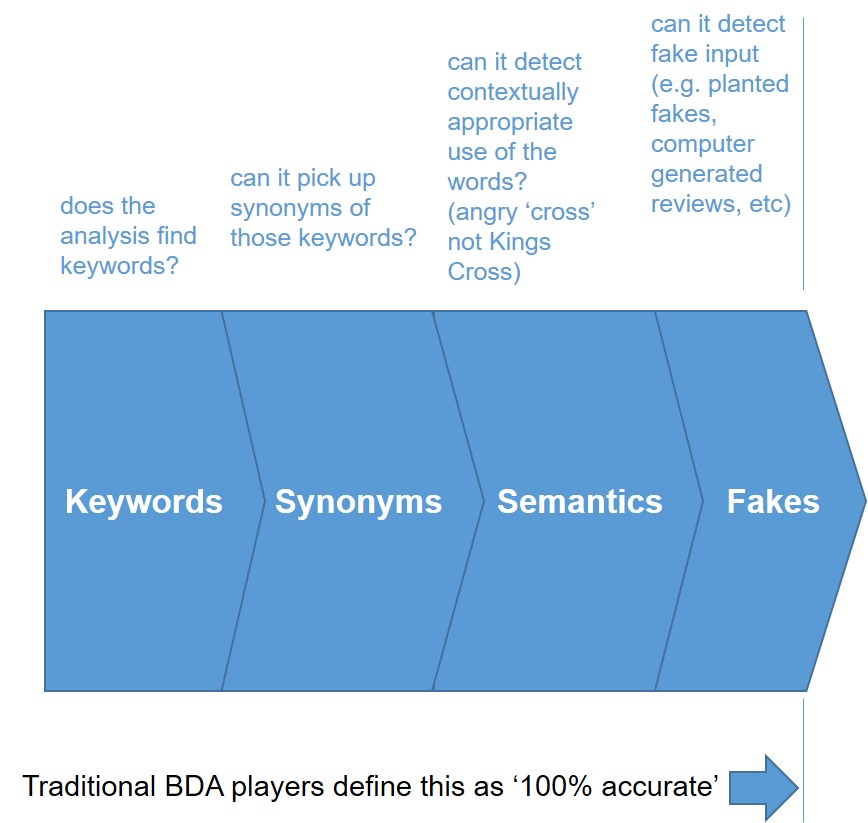
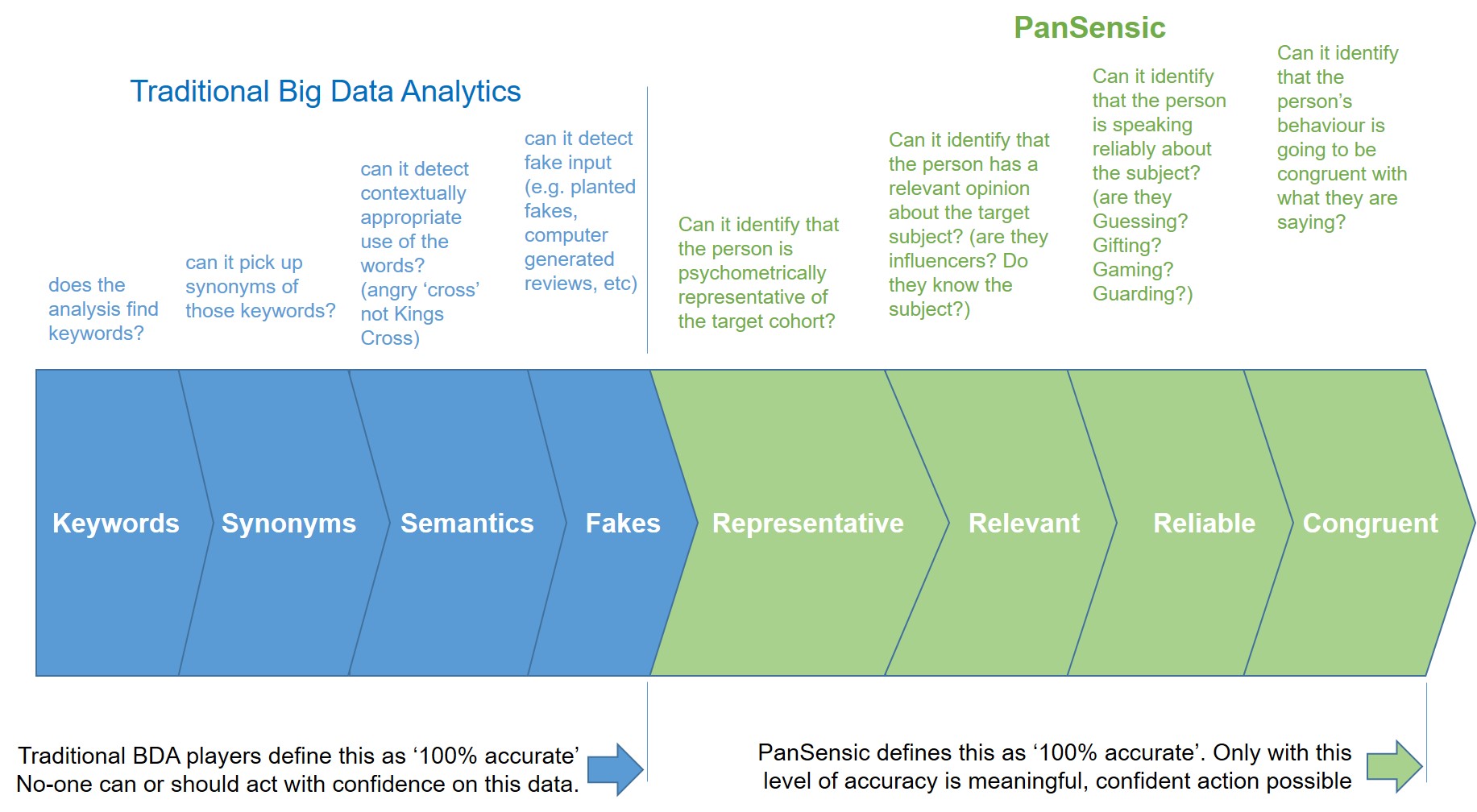
There’s been a lot of discussion in the Big Data Analytics community recently relating to the accuracy of the analyses providers are delivering to their customers. For the providers the discussion has rapidly devolved into a ‘mine’s bigger than yours’ race to be able to claim 100%. It’s not uncommon to already see numbers in the mid 90s percent. Which sounds good. At least until we start to examine the dysfunctional nature of the industry: lots of money being spent on analyses, but almost no apparent tangible benefit being delivered.
How can it be that 95+% ‘accurate’ analysis capability produces no real impact? Does it mean that all the benefit is in the final 5%? Or that the industry has defined ‘100%’ incorrectly?
‘100% of what?’ feels like a good place to start an exploration of the subject.
The answer, as far as I can tell, is something like ‘not a lot’.
Just because a BDA algorithm can pick out keywords, and synonyms and make some kind of semantic context check, and – as some of the most advanced algorithms are now claiming – to be able to identify ‘fakes’ (e.g. false reviews planted by robots), does not mean that what we end up with is ‘100% accurate’. At least not in any meaningful way. Anyone acting on this kind of ‘100% accurate’ analysis is as likely to make the wrong decision as they would have done having acquired no data.
‘100% accurate’ in the current BDA context turns out to actually mean ‘100% accurate assuming the world works in purely tangible ways’. Computers and data analysts love tangible things. Mainly because they’re easy to measure.
But 100% tangibly accurate has nothing at all to do with 100% meaningfully accurate. People are emotional creatures. People make decisions for two reasons: ‘the good reason and the real reason’. Tangible analysis is all about capturing the good reasons and nothing at all to do with capturing the real reasons.
If we’re to capture what drives peoples’ behaviour the analytics need to delve deeply into the world of intangibles because this is where we find all the ‘real reason’ stuff. Things like:
– Does the data come from a person who is psychometrically relevant to my target audience (e.g. if you’re trying to test a mass-market toothbrush design and all the product reviews you’re analysing are coming from Feudal-thinking, ENTPs, they’re not going to tell you anything useful at all about the future mass-market appeal of your design)
– Does the data come from a person with a relevant opinion about the subject? See my earlier TripAdvisor case study – is it sensible to listen to the comments of a person that stays in a hotel once a year? Is it sensible to listen to the comments of a person that tends not to be listened to by other people? Sometimes, maybe it is (if we’re designing products for dimwits), but the important point is that I would be well advised to understand the difference between the two and listen to only the relevant people.
– Does the data come from a person who is speaking reliably about the subject – are they telling the truth in other words or are they playing one of the 4Gs game:
– Can the analysis identify that the person’s behaviour is going to be consistent and congruent with what they’ve said. People often say one thing and then do something completely different. Back to the good-reason/real-reason dilemma, ‘congruent’ data means data that has successfully captured the between-the-lines ‘real-reason’ content.
Only when an analysis capability is able to achieve these four intangible things – Representative-Relevant-Reliable-Congruent – should we be talking about ‘100% accurate’. 100% accurate, to my mind, means we’ve accurately captured what people mean rather than what they’ve merely said.
‘Sheep in Fog’ is the metaphor I’ve been carrying around for a while now when I look at the innovation activities taking place – or not taking place – within a majority of organisations around the world right now: very little bravery and even less direction clarity.
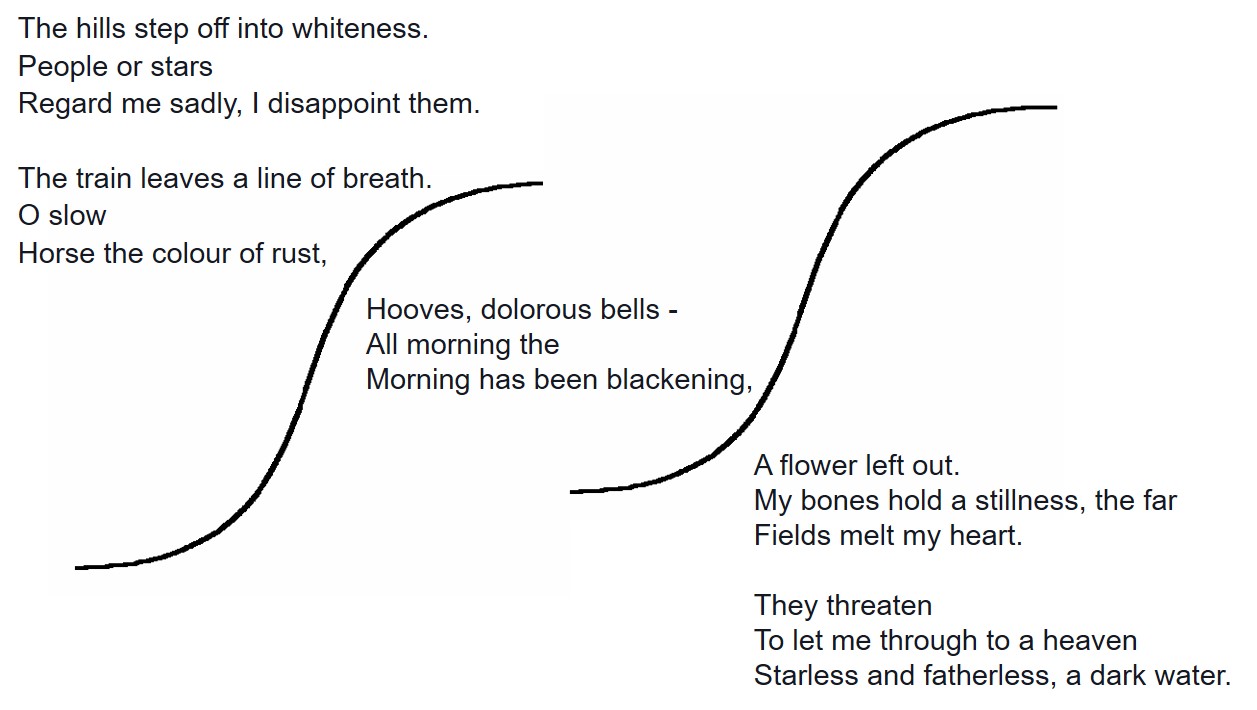
It’s also, as it happens, one of my favourite poems by Sylvia Plath. Well, ‘favourite’ is probably too strong a word. ‘Admire’ is probably better. The poem is overwhelmingly bleak and I’m only glass-half-empty-level bleak. I’ve always read it as a list of metaphors describing how she felt about the world at a particularly difficult time in her life.
Only lately have I come to connect my innovation metaphor to the poem. The more I think about the connection, however, the more I think Plath’s words tell us about the ‘Hero’s Journey’ from an innovator’s perspective. Four things stand out for me.
First, she uses personification – the stars ‘regard me sadly, the train has ‘breath’, and the fields ‘threaten’ her. All of this creates a sense that nature pities her, or finds her presence problematic. She does not belong in it. Plath as the prospective innovation Hero, and nature as the ‘efficiency engine’, everyday world she unwittingly finds herself in.
Secondly, she uses enjambment, a poetic device in which a single sentence is broken across two verses. Her discussion of the horse in the second stanza extends into the third, while the discussion of the morning is split between the third and the fourth. The technique is used to great effect in the poem to link all of the disparate metaphors together to create a profound sense of estrangement and uneasiness. While I’m sure Plath had no overt conception of s-curves and the idea of the innovator as the navigator between one s-curve and the next, it feels that, somehow, instinctively, she did. The enjambment makes an awful lot of sense, in other words, as a representation of the discontinuous jump between the current world and the next:
Thirdly, the title of the poem references how Plath (the ‘innovator’) feels – a lost sheep wandering in a murky and meaningless world. She feels like she continually disappoints those around her, all while she sees the world blackening. There is a clear paradox here in that she calls this terrifying place a ‘heaven’. This dark, fatherless heaven was used by Plath as a telling metaphor for her personal life, but perhaps it makes for an even more powerful metaphor to represent the ‘Ordeal’ of the Hero’s Journey? This ‘dark heaven’ is the Contradiction.
The Hero’s Journey stage connection follows, too, fourthly, when we step back and connect the poem to Plath’s life. Plath didn’t prevail over her Ordeal. In the Hero’s Journey, after the Ordeal, something has to die. Plath killed herself a month after the final changes she made to the poem. She never made it out of the fog. In this regard, the poem is certainly bleak and hopeless. But then again, perhaps, all the more sophisticated because it captures, in a very few lines, a profound ambivalence towards death. It is in this regard too, I think, a telling metaphor for the life of the innovator, and the (98%) likelihood that the innovation-sheep don’t make it out of the fog either.
Call it a warning. Or a roadmap. Or, maybe, just a call to arms.
In that regard, finally, I find much to think about in the final changes Plath made to the original draft of the poem in those final weeks of her life:
Whenever anything happens it happens because there is a viable system. Sometimes stuff happens unexpectedly: we didn’t know there was a system, but it turned out there was. Sometime we decide to be proactive and make stuff that we want to happen happen. This requires us to create a viable system.
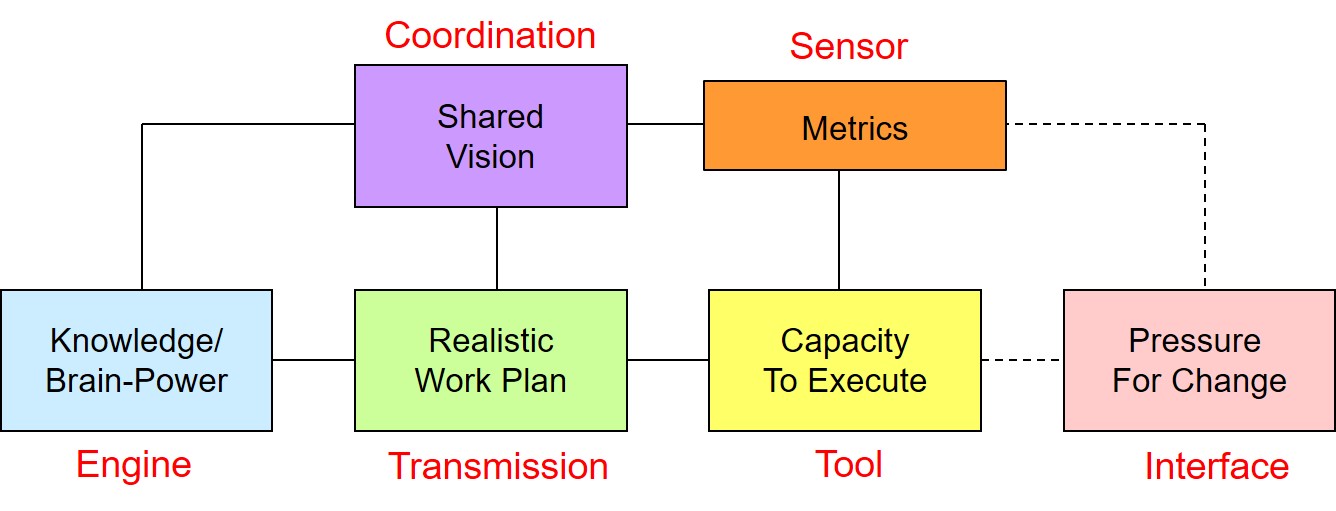
Strip the world back to first principles, and we see that a ‘viable system’ contains a minimum number of pieces. Depending on how you cut up the jigsaw, that minimum number is six. TRIZ calls it the ‘Law Of System Completeness’. If we have an intention to deliberately and successfully change something, it requires a viable system and that viable system needs these six pieces:
Sometimes we think we’ve designed our change system to include them all. Sometimes we’re right and sometimes we’re wrong. Sometimes people tell us that we have all the pieces we need and still we don’t get the successful change we were expecting.
When our change attempt doesn’t go as well as we expected, it is because one or more of the pieces of our jigsaw are missing. Or not working properly.
The question, then, becomes which one. Or ones.
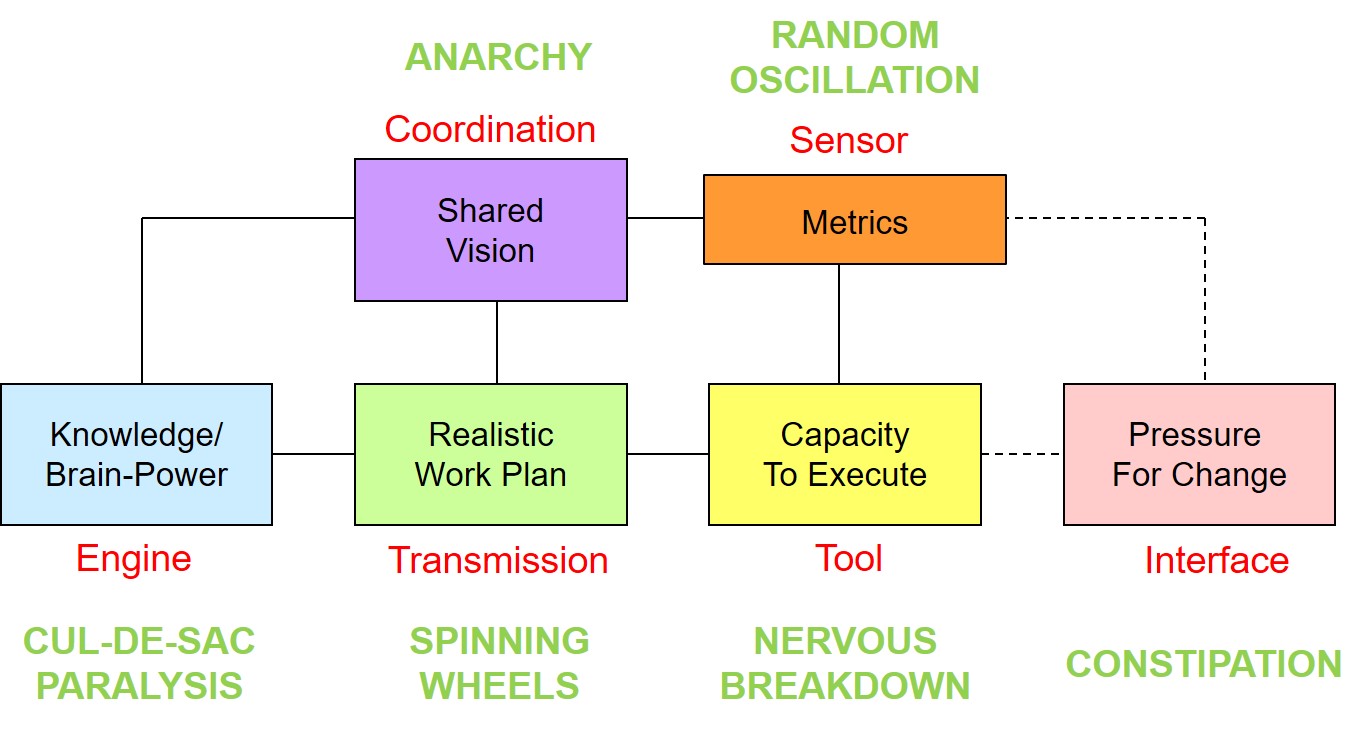
The best way to answer that question is to look at the symptoms we’re experiencing. Different symptoms come from different missing jigsaw pieces:
If the symptom is anarchy, the cause is a lack of shared vision about the change objectives.
If the symptom is constipation (lots of input, but no output), the cause is a lack of pressure for change from our intended customers.
If the symptom is getting stuck in cul-de-sacs, feeling paralysed and not knowing what to do next, the cause is a lack of relevant knowledge and/or brain-power within the team.
If the symptom is spinning wheels, the cause is lack of a realistic work plan.
If the symptom is everyone heading towards a nervous breakdown, the cause is a lack of capacity to execute.
If the symptom is random oscillation in directions or outcomes, the cause is a lack of relevant metrics.
If you have more than one symptom, the cause is a lack of understanding of systems in general and the Law of System Completeness specifically. Go directly to First-Principle-Jail, do not pass Go, do not collect $200.
“I am becoming convinced that confronting people with ‘facts’, although necessary to better understand our predicament, will be almost completely ineffectual when it comes to altering our course… facts are secondary to accessing raw emotions when it comes to change…”
Nate Hagens
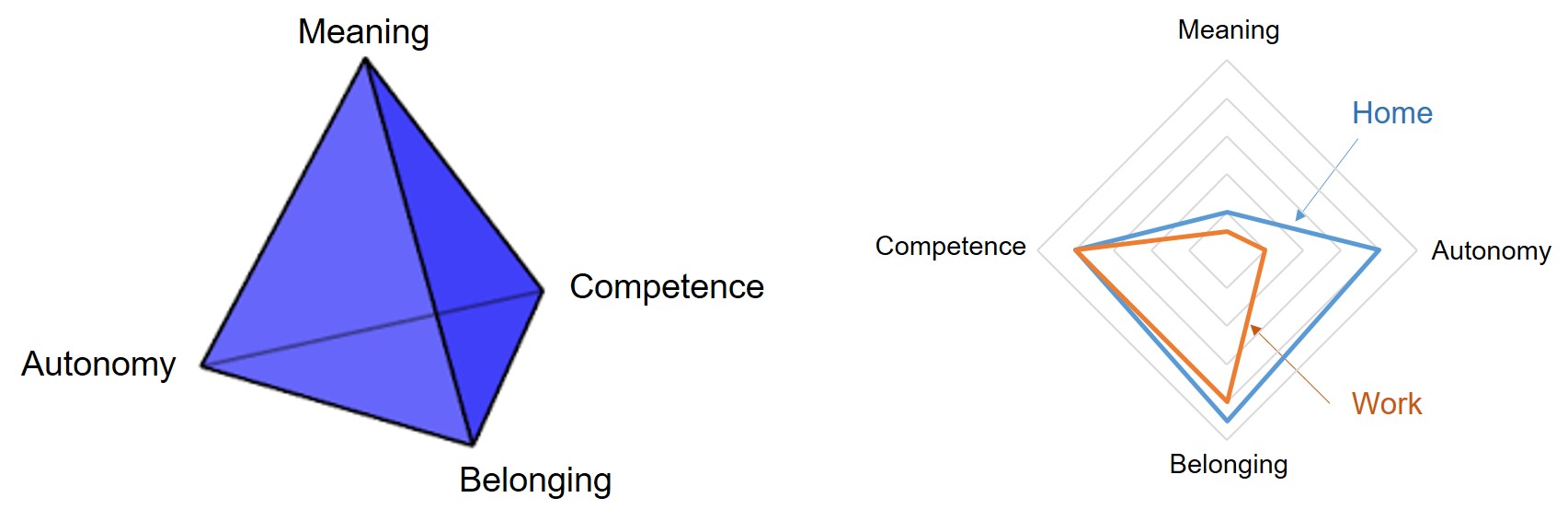
The large majority of all of the work we do with the ABC-M tetrad model is about providing clients with a better understanding of the intangible needs of their customers. A few of the braver ones are now also beginning to ask whether the model is also applicable to their employees. The nice thing about universal models, like ABC-M, is that the answer is an easy ‘yes, this also applies to the people within your organisation.’
That said, I suspect the reason few organisations are as yet asking the question is their instincts are telling them they won’t like the answer.
The simple rule, when we’re thinking about customers, is that innovation occurs when Autonomy, Belonging, Competence and Meaning all get better.
The corollary when switching the model to look inside organisations is perhaps something like, ‘success happens when employee Autonomy, Belonging, Competence and Meaning all get better’. ‘Success’ in the context of the workplace can be any number of things. Successful change. Successfully engaging people in their work. Successful project outcomes. Etc.
And therein lies the problem – or ‘problems’ – for most jobs and most organisations. Managers and leaders know that Autonomy, Belonging, Competence and Meaning for the most part don’t get better when people step across the company threshold and turn themselves into employees:
Autonomy – I often hear people saying, ‘I love change, I hate being changed’. What they hate, I think, is the loss of autonomy that occurs when managers ‘inflict’ change on their charges. For most of us, the moment we step into the office, we know that our level of Autonomy just took a turn for the worse: we used to be in control, now our boss is.
Belonging – if management have done their job in any way well, this is the easiest of the tetrad to get right. When people feel loyal to the organisations they work for, their sense of Belonging increases. They feel a sense of pride to be part of the team. The polo shirt with the company logo on it, or the team lanyard are both symbols of increased Belonging… or rather, they are provided people are actually proud to be ‘wearing the shirt’. One often gets the sense in some organisations that wearing the company logo detracts from a person’s true sense of Belonging – the logo being a sign that, by forcing them to wear it, you’ve just removed them from the (cool) tribe they were a member of before they stepped into the office and forced them to join your very uncool work tribe.
Competence – it is sometimes said that there are only three universal taboos – never criticise a person’s religion, life-partner or work. The last of these three is all about the Competence we feel when we know we’re good at our job, and how we really don’t like it when that competence comes in to question in any way. When people say, ‘I love change, I hate being changed’, what they’re typically also implying is, ‘provided it doesn’t make me feel like an incompetent idiot’. Change is uncomfortable for everyone because almost inevitably it causes our perceived level of Competence to dip, albeit hopefully temporarily. One of Apple’s biggest insights over the years has been to create products where, from the moment the customer opens the box, they feel more Competent than they were when the lid was still taped down. When we have to open a user-guide, our sense of Competence goes down. What Apple learned with their intuitive user interface design is what most organisations still need to learn when people enter the workplace: we all need to feel like we’re good at stuff. And we need to be able to demonstrate that competence to the people around us.
Meaning – the really tough one. To the extent that several clients have in effect asked us to remove it from the tetrad when we’re trying to help them measure what’s going on in their workplace. ‘Making ABC better’ is something they can live with. Making things more ‘meaningful’ is much more difficult. And the honest truth in far too many organisations right now is that a very large proportion of the work we ask people to do is worse than meaningless. Over time, one hopes, all the meaningless work will be eliminated (or given to the robots to do), but right now, for the most part, measuring Meaning – or the lack thereof – is a surefire way of depressing a majority of the people in your organisation. Nothing ever improves, of course, until we are able to measure it. Which is why the more enlightened organisations are now beginning allow for the ‘meaningful-ness’ of work to become something they should be measuring and sharing around the organisation. We’re still a long way away from the ‘war on meaningless work’ that is probably needed in most parts of society, but at least putting it on the radar – and letting managers know it is measurable – is a small step in the right direction.
And if that sounds like uncharacteristic optimism on my part, it probably is.
(PanSensic already has an ABC-M narrative analysis lens. If you’re feeling brave and want to explore how close your organisation or your employees are to achieving the ‘ABC-M all get better’ business success criterion, give me a shout.)
Back in 1994 when I first started describing myself as an ‘innovation consultant’, no-one seemed to recognise the term, never mind know what I did. Today, it feels like there are a million and one innovation consultants. I think there are many reasons for this, not least of which is that the world is in the midst of an innovation wave and a lot of frustrated corporate ‘innovators’ have found that it is easier to set up by themselves than it is to try and innovate in a big-company environment. The big-companies, it seems, still don’t really get it when it comes to innovation. As evidenced by the fact that 75% of innovation comes from small companies.
All that said, whenever an organisation – big or small – is thinking about innovating, and deciding they might benefit from some external assistance, the new problem they face is an apparently overwhelming amount of choice. A million and one innovation consultants with ten million and ten different messages. I just conducted one of our periodic reviews of the state of the art and I’d have to say the main feeling I was left with was one of deep sadness. So much choice and so little understanding of what innovation is about. Talk about the blind leading the blind.
I thought it might be time to start putting together a sort of user guide to help the bewildered become a little less bewildered.
Before we get to the guts of a prototype ‘how to choose the right innovation consultant’ process, there are a couple of questions prospective innovators might want to ask before they start actually talking to prospective consultants.
Question Zero: Do We REALLY Want To Innovate?
In my experience a fairly large proportion of ‘prospective innovators’ find themselves in such a position with a high degree of reluctance. They’ve been handed the challenge by a boss who, I think most believe in their heart of hearts, isn’t really interested in actually changing anything: there is a need to look busy, but, heaven help us if it ever comes to anything requiring a serious decision. Innovation tokenism.
If the real – heart of hearts – answer to this question is ‘no, we really don’t want to innovate’, your best bet is to choose your ‘innovation consultant’ on the basis of either a) they are the coolest and most fun, or, b) being able to say I worked with this one will be good for my CV.
Right now, if answer a) is the one you favour, you’re probably going to go for one of the swarm of under-employed, under-talented Hollywood sci-fi scriptwriters that seem to be doing the rounds at the moment. You’ll have fun (I can speak from experience), but you’ll learn absolutely nothing of any value at all, innovation-wise.
If b) is your answer, you need to go to the consultant with the highest daily rate and/or public cachet. Presence of words like ‘Stanford’ or ‘Silicon Valley’ are helpful indicators. Again, as with option a), don’t’ expect to actually learn anything of relevance to either innovation in general or your organisation in particular.
Question Zero-Point-Five: Is An Excuse For Failure More Important Than Success?
This is the plausible deniability question. 98% of innovation attempts end in failure, and in a lot of organisations, finding yourself in charge of one of the 98% failures can be very career limiting. If that’s your situation, the answer to the ‘which innovation consultant?’ question is very simple: you’re going to choose one of the Big Five consulting companies. Your project will still have a 98% likelihood of failure, but at least when things do go wrong, you won’t be blamed for the failure. Or the enormous consulting bill.
Okay, so now to the proper model. The one for people that have a genuine desire for their project to end up in the 2% success category. Here’s a hierarchy of questions you need to ask of your prospective innovation consultant candidates. The basic idea of the hierarchy is, if they fail one question, there’s no point advancing to the next question because their failure already dooms you to the 98% failure bucket.
Question One: Does The Consultant Understand ‘Good’ & ‘Real’ Customer Outcomes?
Given the fact that there are only two ways to innovate and that one of them is offering customers a new outcome (or ‘function’ or ‘job’ – different words, same meaning), a really good early question to a prospective consultant is how they set about identifying such ‘new outcome’ needs. Given the widespread use of words like function, job and outcome, and the presence of multiple types of ‘function database’, it’s fairly likely unless you’re particularly unlucky with your list of candidates, that they will be able to talk to you about tangible outcomes. The real decider, therefore, here is how they respond to probing questions about how they propose to bring the intangible customer outcome needs into their support of your project. This is the point where you might start to get the blank looks. As a test if/when this look appears, you can test whether they are properly out of their depth by asking to explain the relevance of the JP Morgan aphorism, ‘people make decisions for two reasons, the good reason and the real reason’. If they manage to bluff their way towards an answer that hints they’ll use any kind of customer interview to answer the question, they fail. Got to jail. Do not pass Go.
Question Two: Does The Consultant Understand Contradictions?
If new-outcomes is innovation strategy number one, the other is ‘solve a contradiction’. About 85% of innovations succeed by using this strategy. This also happens to be the test that will allow you to quickly eliminate the large majority of so-called ‘innovation consultants’ from your selection process. Whether you use the words ‘contradiction’, ‘conflict’, ‘trade-off’, ‘condundrum’, ‘paradox’, or any number of other synonyms, unless they can point you towards how they will help you to identify and eliminate contradictions, they’re not going to help you to innovate. Most respondents will answer with a blank stare, others will try and deflect the discussion onto a subject they are more comfortable with. Either way, they fail.
Question Three: Does The Consultant Understand Complex Adaptive Systems?
By the time you reach Question Three, something like 90% of your candidate consultants will have fallen by the wayside. Here’s where you get to eliminate over half of those that remain. Innovation fundamentally means embracing and working under the governing ‘rules’ of complex adaptive systems. You need to know that they understand what a complex adaptive system is. And, more importantly, how that knowledge impacts on the innovation project they’re going to support you through. The early stages of any innovation project are about exploration. Which in turn means identifying and answering ‘the unknowns’. Asking them about the process they propose to navigate you through the ‘fuzzy-front-end’ stages of your precious project, the moment they try and draw a Gantt chart or start talking about pipelines or Stage-Gate, you know they’re not going to be able to help you. Key words and phrases to listen out for in terms of the consultants that do actually understand the connections between complexity and innovation include: ‘emergent’, ‘first principles’, ‘minimum viable demonstration’. Plus, of course, they need to be able to convince you they know how to connect these key words to how they’ll affect how they’re going to spend the minimum amount of (your!) money to make the maximum amount of progress in answering the unknowns.
Question Four: Does The Consultant Understand Analytics?
By Question Four, you’re already somewhere near sifting the genuine cream from the curdled milk. The fourth Question is all about what sorts of analytical measurements and measurement tools are they going to bring to bear to help you get through the exploration and execution stages of your project. The key here is listening out for the sorts of thing they propose measuring. If their list includes all the ‘usual suspect’ measurements (any of the ’75 essential KPIs – see SI ezine worst of 2015 Awards), they’re wasting your time. You need to be listening out for unusual suspect measurements. Things that you know are going to be important (meaningful), but that are traditionally thought to be impossible to measure (‘team morale’, ‘answered unknowns’, ‘frustration’, ‘engagement’, ‘Hero’s Journey stage’, ‘sense of progress’, etc) are the things you need to know. Your consultant needs to be able to demonstrate that a) they know why such measures are important, and, b) how they’re going to make those measurements.
Question Five: Does The Consultant Understand Methods?
At a superficial level, this last Question is about whether your candidate consultant is trying to sell you their method, or the right method for you particular context. If they don’t ask you about the Innovation Capability Level of your organisation, the tools and methods your organisation/team currently uses, or the psychometric profiles of the project team members, the chances are they’re there to sell you ‘their’ method. Easy to catch them out on this question. If they’re trying to push ‘method X’ onto you, ask them for evidence that this is the right thing to bring to bear in your context. Ask them to describe an equivalent situation on a previous project that Method X has worked (if they can, ask them to explain the expression, ‘you can never step in the same river twice’). If they get through that question, the next one is to show you how they’ve done back to back analyses of Method X,Y and Z in order to establish that Method X was indeed the most appropriate one. Don’t worry too much about whether you’ve ever been through this kind of comparison exercise in your own organisation before, at the end of the day, 90%+ of consultants are well versed in just one or two methods, so you shouldn’t have too much difficulty getting them to the point where they are using the word ‘err’ twice per sentence and looking like the they’d rather be somewhere else. Which, as far as your selection process is concerned is precisely where they need to be.
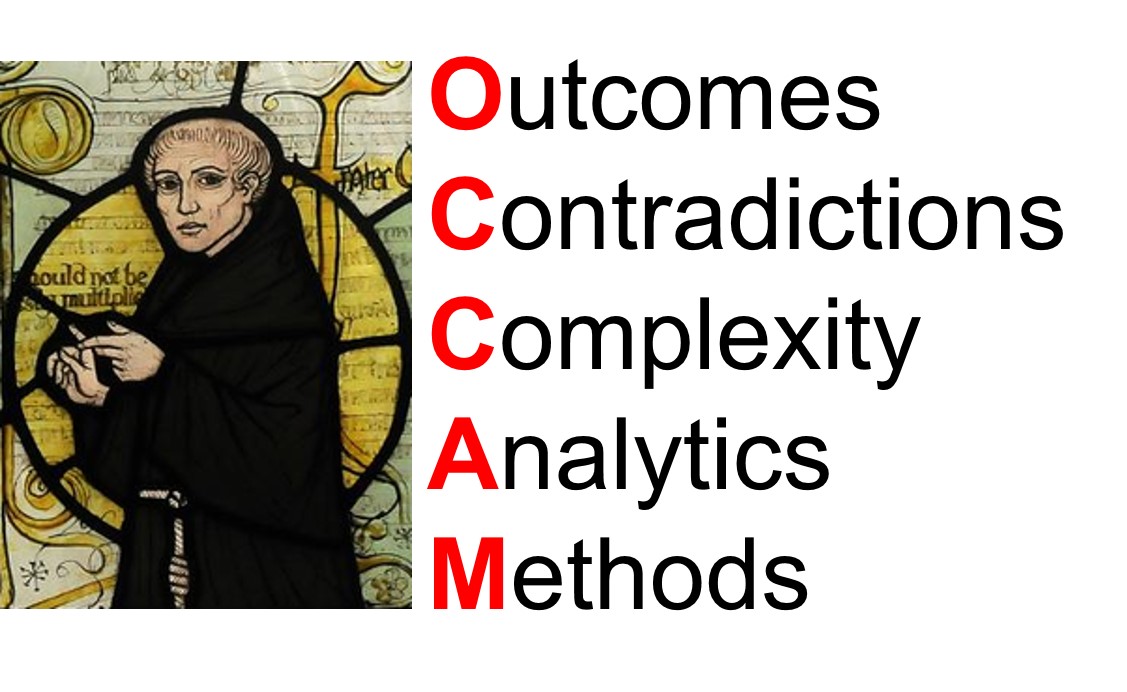
Taken together, those five questions should enable you to swiftly get down to a Top Two or Three. To help make the questions easy to remember, just think about OCCAM:
Beyond that point, your choice is basically going to boil down to your own intangible outcome needs: who’s best going to make you into a hero? Who’s going to stick by you when the going gets – inevitably – rough? Who, to cut through to the simplest answer, is the one that is going to be your innovation Razor?
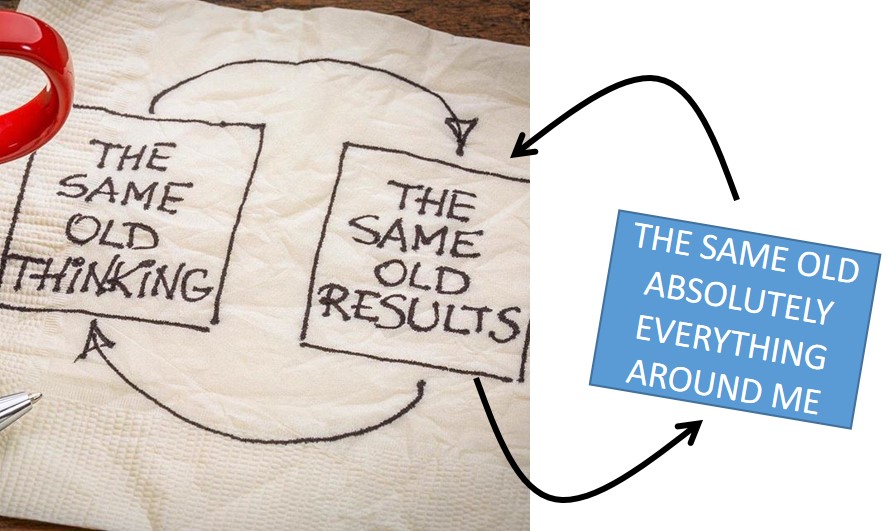
I’m a big fan of Albert Einstein, but one thing he definitely got wrong was the belief that “Insanity is doing the same thing over and over again, and expecting different results.” It’s an aphorism I still hear churned out unthinkingly by just about everyone in the ‘creativity consultant’ world. As if the statement is some kind of call to arms for clients stuck in the rut they’re perceived to be in. If Einstein said it, the unspoken logic goes, it must be true.
It becomes even truer, the creative consultant believes, when it gets written onto a napkin and a photo of it gets inserted into all of their Powerpoint slide decks.
Fortunately, after not very much searching, it turns out Einstein never said anything about insanity at all. Rather it seems to have been attributed to him by those parts of the ‘creative’ world seeking to inflate their already bloated sense of self-worth.
I’m pretty certain Einstein never really understood complexity theory, so he might have had every excuse for coming to a conclusion that anyone doing the same thing shouldn’t ever expect to get a different result. On the other hand, I’m pretty certain he would have understood the aphorism ‘you can never step in the same river twice’. Heraclitus gave us that little gem around 2500 years ago, when complexity theory definitely didn’t exist.
Perhaps it didn’t need to. Perhaps people had the common sense back then to recognize that it was very frequently the case that people did exactly what they’d always done and ended up getting very different results. Like 88% of 1955 Fortune 500 companies that are no longer with us. They all believed they’d keep being successful by thinking and doing the same old thing too.
The really simple way to make that napkin picture look like the dumb thing that it really is, is to modify it so it looks like this:
Now we’re forced to think about everything around us – Heraclitus’ ‘river’ – and about whether it is sensible to think that it is all staying the same. Think about that for a few seconds and you have to believe it’s never true. I’m sitting here in a noisy café and my not so good coffee is going cold. In a minute it will probably too cold. Which means I won’t get my full caffeine fix. Which means I’ll probably forget to write something on my job list. Which… you get the idea.
The reason there are so many fragile organisations on the planet right now is that they’ve somehow been brainwashed into believing the same-thinking-same-result mantra is true and, even worse, then connected it to the idea that, because they were doing well a couple of years ago, they just need to keep doing what they’ve been doing. It’s like they’ve become collectively drunk on a cocktail of cognitive flaws – Status Quo Bias, Normalcy Bias, Confirmation Bias and Illusion of Control. To all intents and purposes, you had me at ‘Fortune500’. The ‘environment around us’ doesn’t stay the same even in this stupid café with it’s dated soundtrack, never mind in a commercial organisation of several thousand people.
In a complex world the best we can say is that if we keep doing the same as we’ve always done we will probably get the same result. The closer we are to the edge of chaos, the less probable that same result becomes.There are no guarantees in a complex system because we’re surrounded by a swirling cauldron of interdependent causes and effects. The fact that thinking the same doesn’t necessarily mean we get the same result also tells us – anyone that wishes to be more resilient than the fragile organisation they’re probably working for – that what’s needed is a finely tuned what-around-me-has-changed radar so we can sense what’s changed and shift our response accordingly.
Oh, wait, evolution already gave us one of those. Strike that. What we need is to stay as far away as we possibly can from creativity consultants that teach us how to not use it any more.